⚡ Key Facts
- Chemical Capacity Loss: According to the American Automobile Association (AAA), a standard automotive lead-acid battery loses roughly 35% of its cranking power at 32°F (0°C) and up to 60% of its starting capacity at 0°F (-18°C).
- The Lithium Plating Hazard: Recharging any lithium-ion jump starter at ambient temperatures below freezing (32°F/0°C) causes permanent electrochemical damage known as lithium plating, which creates internal micro-shorts and drastically elevates thermal runaway risks.
- Explosion Hazard: The National Highway Traffic Safety Administration (NHTSA) and battery manufacturers warn that attempting to jump-start a frozen lead-acid battery can ignite trapped hydrogen gas, causing the polypropylene casing to rupture violently.
- Winter Roadside Demand: Battery-related failures consistently account for more than 1.8 million roadside assistance calls nationwide each winter, representing the single largest category of cold-weather mechanical breakdowns tracked by emergency auto clubs.
A single sharp turn of the ignition key met by a dull, hollow click is one of the most sobering sounds a motorist can experience in deep winter. When polar vortex conditions sweep across the continent, ambient temperatures plummet well past the design margins of ordinary consumer electronics. Many drivers take comfort in a compact lithium battery pack tucked away in their trunk, believing they are fully insulated against an unexpected stranding. Yet when freezing temperatures peak, an unprepared lithium jump starter can fail just as readily as the depleted vehicle battery it was designed to revive. For the practical checklist side, use the community emergency preparedness guide.
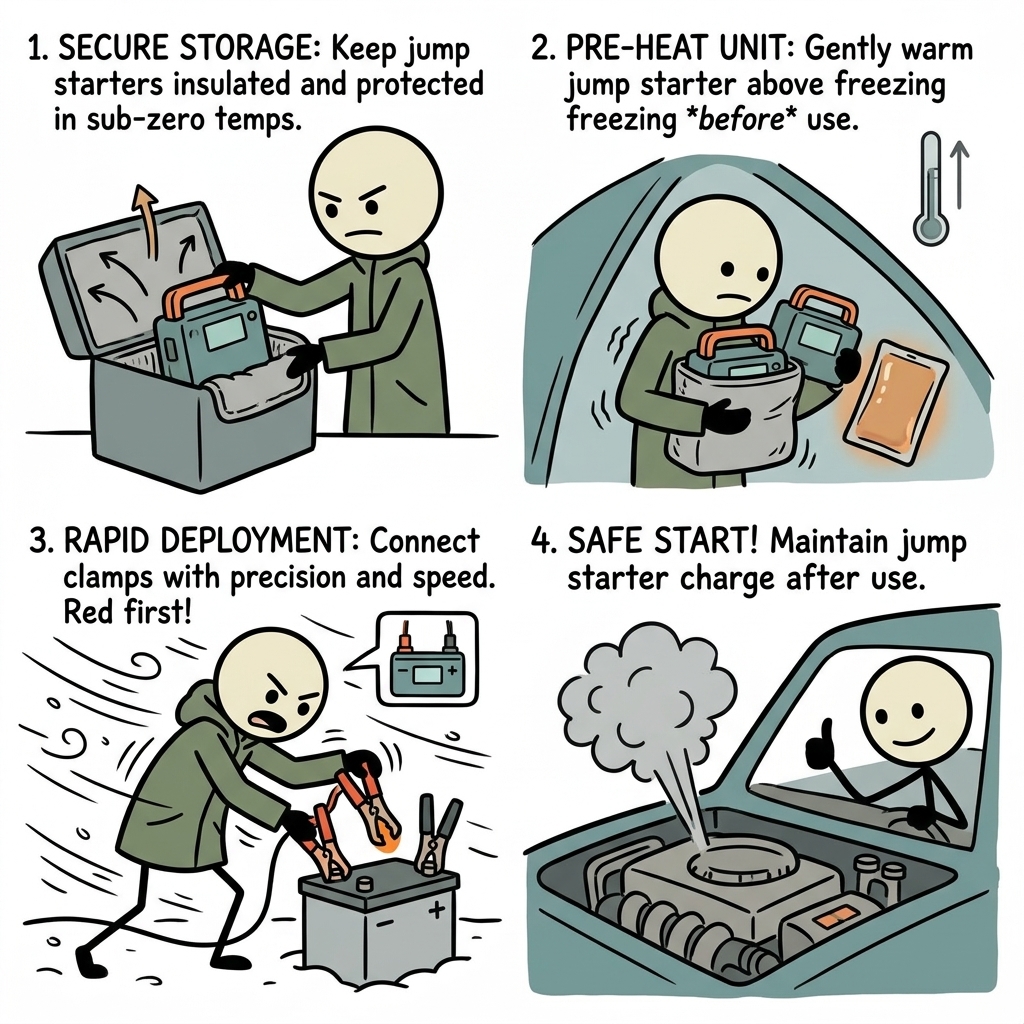
Modern emergency preparedness demands more than just purchasing tactical gear; it requires an operational understanding of how severe cold alters electrochemical performance. Lithium-ion cells operate through delicate liquid or gel electrolyte chemistries that slow dramatically as thermal energy drops. Treating a lithium jump pack like a simple mechanical tool rather than an active chemical system leads to premature failure, ruined equipment, and potentially life-threatening delays in hostile weather. Mastering the proper staging, charging maintenance, and deployment of a cold weather jump starter transforms unpredictable winter travel into a controlled, self-reliant operation. For the practical checklist side, use the neighborhood preparedness network.
The Physics of Electrochemistry at Sub-Zero Temperatures
Every vehicle relies on an intricate balance between the chemical potential inside its starting battery and the mechanical torque demanded by the starter motor. When winter temperatures drop, this balance shifts on both ends of the equation. Engine oil thickens from a pourable liquid to a viscous sludge, dramatically raising the mechanical resistance the starter motor must overcome. Simultaneously, the lead-acid battery in your engine bay suffers a catastrophic loss of internal ionic mobility, leaving it with less power precisely when the engine demands maximum energy. For the practical checklist side, use the emergency communication plan.
The internal chemistry of a portable lithium battery pack faces the exact same thermal constraints. Inside a lithium-based jump pack, lithium ions migrate between the cathode and anode through a liquid organic electrolyte. As ambient temperatures drop below freezing, the viscosity of this liquid electrolyte increases significantly, impeding the velocity of ion transfer. For the practical checklist side, use the family emergency planning guide.
This sluggish ionic migration manifests as a sharp spike in internal resistance, often referred to by electrochemical engineers as impedance. When you draw massive current from an ultra-cold lithium pack, this internal resistance causes severe "voltage sag." The pack may show a 100% state of charge on its LED display, but under the punishing 400-to-800-amp draw of a frozen engine, the available output voltage collapses beneath the minimum threshold required to turn the starter solenoid.
Understanding this physical reality dismantles the myth that a jump starter's printed capacity remains uniform across all seasons. In extreme cold, raw peak amps drop by 30% to 50% unless the pack's internal cells are deliberately managed and thermally shielded prior to cranking.
Lead-Acid vs. Lithium Chemistry in Sub-Zero Climates
- Flooded Lead-Acid: Highly susceptible to state-of-charge-dependent freezing; a fully charged battery resists freezing down to -76°F (-60°C), while a depleted battery can freeze at just 27°F (-3°C).
- Absorbent Glass Mat (AGM): Demonstrates superior cold-cranking performance due to lower internal resistance and immobilized electrolyte, but remains subject to cold capacity degradation.
- Lithium-Cobalt (LiCoO2) / NMC: Common in compact consumer jump packs; high energy density, but vulnerable to extreme voltage drop below 14°F (-10°C) and structural degradation if mistreated.
- Lithium Iron Phosphate (LiFePO4): Exceptional thermal and chemical stability, highly resistant to thermal runaway, but exhibits sharp discharge drops below freezing unless insulated or self-heated.
The Critical Danger: Never Jump Start a Frozen Car Battery
Before deploying any emergency power equipment, you must verify the physical state of the disabled vehicle's battery. Attempting to jump start frozen car battery units is an exceptionally hazardous mistake that can lead to catastrophic casing failure, chemical acid burns, and shrapnel injuries. When a lead-acid battery drops below its critical charge threshold, the sulfuric acid within the electrolyte is absorbed into the lead plates, leaving behind dilute water that readily freezes into solid ice.
As water freezes, it expands by approximately 9% in volume, exerting immense hydrostatic pressure against the internal lead grids and external polypropylene walls. If you apply a massive surge of current from a cold weather jump starter to a frozen battery, the electrical energy cannot flow normally through the crystallized electrolyte. Instead, the sudden current superheats the localized points of contact, producing hydrogen and oxygen gases at an accelerated rate while thermal expansion stresses the brittle plastic casing.
Federal agencies, including the Centers for Disease Control and Prevention (CDC) and NOAA, emphasize checking vehicle systems carefully before initiating winter travel. Inspection of the host battery must always precede cable attachment. If the battery is frozen, jump-starting is off the table; the unit must be brought inside, slowly thawed at room temperature, and evaluated for physical breaches before any charging or jumping attempt occurs.
Visual and Physical Checklist for Ice Detection
- Casing Distortion: Look closely at the long sides of the battery; any bulging, warping, or rounded profile indicates that water inside has frozen and expanded outward.
- Frost on Terminals: Visible frost accumulation, white crusting along seams, or crystalline ice around the terminal posts signals deep freezing.
- Inspection Eye Status: On sealed batteries featuring a built-in hydrometer "magic eye," a light yellow, clear, or bright red indicator frequently warns of dangerously low electrolyte levels or ice within the top chamber.
- Electrolyte Fluid Check: On serviceable batteries with removable vent caps, unscrew the caps and confirm that the electrolyte liquid is completely fluid. If you see slush or a solid ice shelf, immediately abort deployment.
Cold-Storage Protocols: The Glovebox Fallacy
The most widespread mistake vehicle owners make is treating their glove compartment or trunk as a permanent staging ground during midwinter. Storing jump starter in cold car cabins exposes the device to prolonged sub-zero soaking, pulling the chemical core of the cells down to ambient outdoor temperatures. When an unexpected vehicle failure occurs in an unheated parking lot, pulling a deeply frozen jump pack out of the trunk leaves you with a crippled unit suffering from massive internal resistance.
Beyond capacity degradation, leaving sensitive electronics in an unconditioned vehicle subjects them to relentless thermal cycling. As your vehicle's heater warms the interior during a commute and then cools to negative values overnight, condensation forms on the internal printed circuit boards (PCBs) inside the pack. Over weeks of daily driving, this moisture accumulation creates micro-corrosion, degrades solder joints, and damages the built-in microcontrollers responsible for reverse-polarity and surge protection.
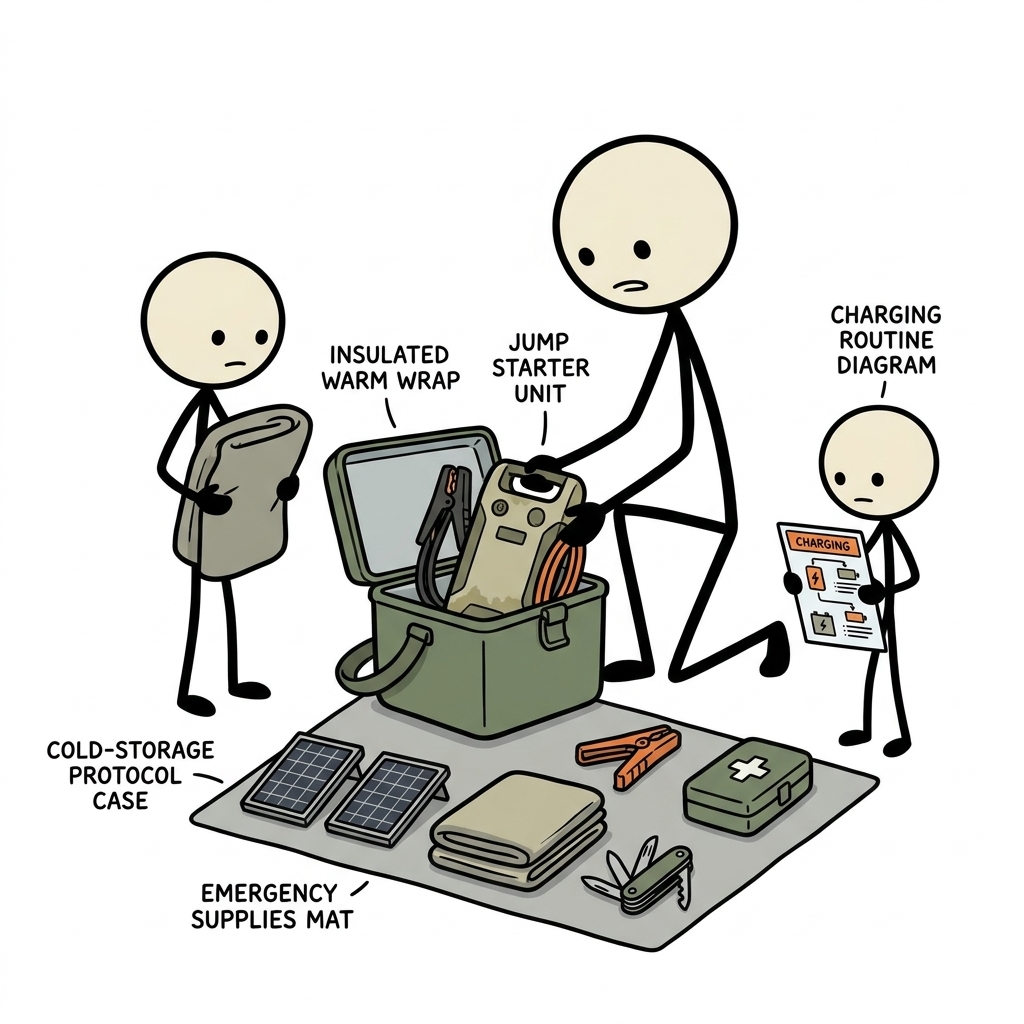
For individuals executing remote travel or backcountry expeditions where leaving the pack in the vehicle is unavoidable, passive thermal mitigation is non-negotiable. Storing the jump pack inside a dedicated thermal-break container—such as an insulated, closed-cell foam electronics case lined with reflective mylar—dramatically slows radiant and conductive heat loss. This provides a vital buffer window during short-term stops in hostile environments.
Optimal Thermal Staging Rules
Deploy the "Duty-Carry" principle whenever ambient temperatures fall consistently below 20°F (-7°C). The jump starter lives indoors in an ambient environment between 60°F and 75°F (15°C to 24°C) alongside your primary winter bug-out or severe-weather kit. Only transfer the warm pack to your vehicle when you are preparing to depart. By keeping the core battery cells warm, you preserve 100% of their rated output and eliminate voltage sag should an emergency arise shortly after leaving home.
Charging Routines: Preventing Irreversible Lithium Plating
Maintaining a dedicated routine for portable battery pack winter safety centers primarily around how and when you recharge the pack. While discharging a cold lithium battery temporarily limits its power output, attempting to charge a lithium battery when its internal cells are below 32°F (0°C) causes catastrophic, permanent structural damage. This issue is known in electrochemistry as lithium plating.
Under warm charging conditions, lithium ions smoothly slip between the crystalline atomic layers of the graphite anode—a clean process called intercalation. When the temperature drops below freezing, this intercalation reaction slows dramatically. The incoming electric current forces lithium ions to gather on the surface of the anode faster than they can enter it, causing them to deposit as solid, metallic lithium.
This metallic plating permanently removes active lithium from the battery chemistry, triggering an immediate and irreversible loss of storage capacity. Far worse, metallic lithium plating grows outward over successive cold charges into microscopic, needle-like structures called dendrites. Over time, these metallic dendrites pierce the microscopic porous polymer separator separating the anode and cathode, causing an internal short-circuit. This process is a leading cause of spontaneous, violent thermal runaway in lithium devices.
The Room-Temperature Equalization Protocol
- Never Charge in a Freezing Garage: Do not plug your jump starter into a wall outlet or an in-vehicle 12V accessory port while the unit itself is below 32°F (0°C).
- Mandatory Acclimation Window: Bring a cold pack into a climate-controlled room (65°F–72°F / 18°C–22°C) and let it rest undisturbed for a minimum of two to four hours before applying charging current.
- Core vs. Surface Temperature: The plastic outer casing will feel warm long before the dense, tightly wound internal battery core reaches safe room temperature; never rush this stabilization phase.
- Verify Built-in Protections: While premium cold-weather units feature integrated Low-Temperature Charge Cutoff sensors that prevent the pack from accepting current below freezing, budget options often skip this critical safety feature.
Winter State-of-Charge (SoC) Management
Lithium chemistries degrade fastest when subjected to prolonged storage at absolute extremes: either completely drained (0% SoC) or fully saturated (100% SoC). In spring, summer, and fall, standard storage recommendations point to a 50% to 60% state of charge to prolong cycle life. However, winter operational readiness demands a modified compromise.
Because self-discharge accelerates slightly during sudden thermal changes, and because cold reduces instantaneous power delivery, an emergency winter jump starter should be held between 80% and 90% SoC. This provides sufficient headroom to offset cold-induced voltage sag without stressing the internal cell components as severely as continuous 100% saturation. Set a recurring schedule on the first of every month to cycle the pack: discharge it by 20% to 30% through powering portable gear or running a 12V test load, let it rest, and recharge it back to 85–90% under warm indoor conditions.
Step-by-Step Safe Deployment Protocol in Freezing Conditions
Deploying a cold weather jump starter in blizzard conditions or negative wind chills introduces environmental stresses that impair fine motor skills and cloud tactical judgment. Operating under a deliberate, checklist-driven protocol prevents critical connection errors, minimizes exposure time, and ensures the highest probability of an immediate engine start on the first crank.
Phase 1: Pre-Deployment Conditioning
If the jump starter has been exposed to ambient freezing temperatures in a vehicle, you must elevate the unit's core temperature before demanding peak cranking amperage. Place the pack inside your inner winter coat against your mid-layer for 10 to 15 minutes, utilizing your own body heat to bring the internal chemistry up toward operational thresholds. Alternatively, hold the pack directly in front of the vehicle cabin's floor heater vents if another running vehicle is available.
Phase 2: Vehicle Preparation
Turn off the disabled vehicle's ignition completely and remove the key to prevent accidental cranking. Shut off every single auxiliary load: headlamps, climate control blowers, heated seats, defrosters, and infotainment displays. In extreme cold, auxiliary electronics draw substantial amperage that robs the starter motor of critical current.
Phase 3: Connection Sequence
- Inspect and Clean the Terminals: Cold weather accelerates terminal corrosion. Use a brass wire terminal brush to scrub away lead oxidation, white sulfate crust, and road grime from the terminal posts to guarantee metal-to-metal continuity.
- Clamp Positive (Red) First: Firmly clamp the positive booster cable directly to the positive (+) lead-acid terminal post. Rock the heavy-duty copper clamp teeth through any remaining oxidation to establish an uncompromised mechanical bite.
- Ground Negative (Black) Second: Clamp the negative booster cable to an unpainted, structural metal component on the vehicle chassis, engine block, or dedicated ground lug. Never connect the negative clamp directly to the negative (-) terminal post of a heavily discharged lead-acid battery in freezing weather. Connecting directly to the post can generate an arc adjacent to the battery vents, potentially igniting any hydrogen gas accumulated under the hood.
- Connect to Jump Pack: If the unit uses a detachable smart-cable harness, insert the heavy-gauge blue EC5 or proprietary connector firmly into the jump pack body after the terminal clamps are established, unless the manufacturer's logic board specifically mandates the reverse.
Phase 4: Cranking Limits and Thermal Cycling
Modern starter motors can draw anywhere from 250 amps to over 1,000 amps when churning through frozen engine oil. This massive discharge creates immense localized resistance heating inside the lithium cells. Observe strict cranking limitations to protect the pack from internal thermal shock:
- Maximum Crank Duration: Limit ignition cranking to a strict maximum of 5 continuous seconds.
- Mandatory Rest Window: If the engine fails to catch on the first attempt, pause and allow the jump starter to rest for a full 60 to 90 seconds. This allows internal voltages to recover and prevents the lithium polymer pouch separators from overheating and warping.
- Three-Strike Rule: Never attempt more than three consecutive cranking cycles in sub-zero weather. If the engine will not turn over after three spaced attempts, the mechanical issue extends beyond simple battery depletion—such as frozen fuel lines, gelled diesel fuel, seized starter solenoids, or mechanical hydraulic lock.
Phase 5: Post-Start Disconnection
Once the engine starts running smoothly, keep it idling and immediately disconnect the jump pack within 30 seconds. Disconnecting promptly prevents the vehicle's high-output alternator from sending unregulated reverse-charging current into the portable lithium unit. Unplug the cable harness from the pack first, then disconnect the negative chassis ground clamp, and finish by disconnecting the positive terminal clamp. Stow the jump pack inside the warm vehicle cabin right away; never leave it in the trunk after a rescue.
Choosing the Best Equipment: Lithium Chemistry & Specs for Sub-Zero Work
Identifying the best jump starter for winter duty requires cutting through superficial marketing metrics to assess raw electrochemical specifications. Consumer models often boast inflated "peak current" numbers—ranging from 2,000A to 4,000A—that only describe an instantaneous short-circuit burst measured in milliseconds under lab conditions. In freezing field scenarios, peak current matters far less than Continuous Cranking Amps (CCA), internal wire gauge, and pack safety logic.
The primary choice comes down to classic Lithium Nickel Manganese Cobalt Oxide (NMC) units versus Lithium Iron Phosphate (LiFePO4) systems. NMC offers exceptional gravimetric energy density, packing immense cranking potential into lightweight units that easily slip into a coat pocket. However, NMC chemistry is more volatile if mechanically punctured or thermally overstressed. Conversely, LiFePO4 packs feature unmatched thermal resilience, virtually zero risk of fire, and extraordinarily long shelf lives, but they tend to drop off sharply in raw output when exposed to extreme sub-zero cold without pre-warming.
A third technology that has gained widespread traction among high-latitude emergency specialists is the hybrid supercapacitor (ultracapacitor) jump starter. Supercapacitors store electrical charge electrostatically rather than chemically, making them completely immune to the ionic sluggishness that plagues lithium packs in sub-zero environments. A quality ultracapacitor unit can operate reliably from -40°F to 149°F (-40°C to 65°C), pulling residual energy out of a weak, drained car battery over several minutes, storing that energy, and then discharging it in a massive surge to start the motor instantly.
Key Hardware Features for Winter Reliability
- Heavy-Gauge Pure Copper Clamps: Avoid copper-coated aluminum clamps, which become brittle and snap under sub-zero mechanical stress while offering poor conductivity.
- Integrated Low-Temp Cutoffs: The smart-clamp module must feature hard-coded logic boards that reject charging attempts when the ambient temperature falls below 32°F (0°C).
- Internal Heating Pads: Premium cold-weather models incorporate built-in, low-draw resistive heating jackets that use a fraction of internal reserves to safely warm the battery cells to optimal operational temperatures before unleashing cranking current.
- Thick Silicone-Insulated Cables: PVC-jacketed jumper cables stiffen and crack like dry twigs in severe cold. Silicone-insulated cabling retains full flexibility down to -40°F, ensuring safe handling and leak-free insulation.
The Winter Vehicle Resilience Kit: Integrating Redundancy
Relying on a single piece of electronics as your sole contingency plan directly violates the core tenets of serious emergency preparedness. Federal family emergency planners at FEMA advise motorists to build redundant safety layers into all life-critical vehicle configurations. A high-performance portable jump pack is a frontline force multiplier, but it belongs within a broader winter survival system designed to handle compounding environmental failures.
Your vehicle setup should always include a set of commercial-grade, heavy-gauge (4-gauge or 2-gauge) jumper cables constructed with 100% pure copper conductors and oil-resistant, ultra-flexible arctic rubber jackets. If a portable pack fails due to cold soak, high-output mechanical jumper cables bridge the gap by drawing sustained cranking power from another running vehicle without the need for battery chemical compatibility.
Additionally, keep a dedicated Digital Multimeter (DMM) in your gear kit. In extreme cold, guessing the state of your battery creates unnecessary risks. A quick open-circuit voltage reading across the terminals instantly clarifies your situation: 12.6V represents a healthy 100% charge, 12.2V indicates a 50% depleted battery vulnerable to freezing, and anything below 11.9V signals a fully drained battery that must be thoroughly checked for internal ice before drawing current.
Essential Winter Battery Support Gear
- Digital Multimeter: For measuring resting battery voltage, tracking terminal drop under load, and checking alternator output once the engine fires.
- Brass Wire Terminal Brushes: Invaluable for cutting through heavy corrosion and winter road salt buildup on battery posts and clamps.
- Chemical Hand Warmers: Kept in your staging case, air-activated hand warmers can be placed against a cold jump pack's outer shell inside an insulated pouch to gently warm its internal cells during field deployment.
- Heavy Leather Palm Work Gloves: Working with bare skin around sub-zero engine metal, corrosive battery residue, and brittle plastics can quickly lead to flesh tears and cold-contact injuries.
Navigating harsh winter environments requires moving beyond basic roadside assistance habits and building true mechanical self-reliance. Extreme cold punishes unprepared equipment, but cold-weather limitations are predictable scientific realities that can be systematically managed. By maintaining disciplined charging routines, protecting your gear from long-term cold storage, inspecting host batteries for ice, and following strict deployment steps, you ensure that your equipment delivers the life-saving current you count on. True winter readiness turns an unexpected mechanical breakdown from a dangerous emergency into a calm, controlled, and successful recovery.
Frequently Asked Questions
Can you safely store a lithium-ion jump starter in a freezing vehicle?
While storing it in your vehicle offers quick access, extreme cold temporarily degrades lithium cell capacity and accelerates passive discharge. For guaranteed cold-cranking performance, keep the unit insulated inside an emergency kit or warm it inside your coat or heated cabin for 10 to 15 minutes before use.
Why should you never charge a jump starter below freezing?
Recharging lithium-ion cells at temperatures below 32°F (0°C) causes lithium plating on the anode, permanently degrading capacity and creating microscopic dendrites that can lead to internal short circuits and thermal runaway. Always allow the jump pack to reach room temperature before plugging it into a charger.
How often should cold-weather jump packs be recharged during winter?
Inspect and recharge your jump starter every 30 to 60 days during the winter months. Cold conditions drop internal chemical reactivity, so maintaining a baseline state of charge between 80% and 100% ensures adequate power to overcome high engine resistance.
How do you check if a car battery is frozen before attaching jump leads?
Visually inspect the vehicle's 12V battery casing for bulging sides, cracked plastic, or visible ice crystallization near the terminals or vents. Never attempt to jump-start or charge a frozen lead-acid battery, as the sudden surge of current can trigger a catastrophic casing explosion.
What amperage rating is required for cold-weather emergency jump starting?
Cold weather thickens engine oil and lowers battery output, demanding significantly higher cranking current. Choose a jump starter rated for at least 1,000 to 1,500 peak amps for standard four- to six-cylinder gasoline vehicles, and 2,000 to 3,000+ peak amps for larger V8 engines or cold-blooded diesels.