⚡ Key Facts
- Medical Vulnerability: The Centers for Disease Control and Prevention (CDC) estimates that over 30 million Americans suffer from obstructive sleep apnea (OSA), making continuous positive airway pressure (CPAP) therapy an essential life-support baseline for millions during natural disasters.
- Power Penalty: Running a heated humidifier and heated tube consumes between 70% and 80% of a CPAP machine's total energy draw; switching to passive humidification extends runtimes four- to five-fold.
- Efficiency Loss: Using a machine's native 12V or 24V DC converter instead of an AC inverter prevents a 15% to 25% energy loss caused by unnecessary DC-to-AC-to-DC power transformations.
- Grid Reliability: According to the U.S. Energy Information Administration (EIA), the average American electricity customer experienced over five hours of power interruptions in recent years, with extreme weather events tracked by NOAA increasing outage durations significantly.
- Battery Chemistry Matters: Lithium Iron Phosphate (LiFePO4) cells deliver up to 3,500 charge cycles at 80% Depth of Discharge (DoD), compared to just 500 cycles for traditional nickel-manganese-cobalt (NMC) lithium batteries and 300 cycles for lead-acid.
When the electrical grid fails at 2:00 AM during an ice storm or severe hurricane, the sudden silence of a stalled CPAP blower motor is more than an inconvenience. For individuals managing moderate to severe obstructive sleep apnea, an unpowered CPAP mask instantly turns into a suffocating barrier of trapped carbon dioxide, forcing an abrupt, adrenaline-spiked awakening. The Federal Emergency Management Agency (FEMA) classifies assistive medical technology as a critical component of personal resilience planning, yet thousands of individuals rely entirely on uninterrupted utility power without an automated safeguard. For the practical checklist side, use the community emergency preparedness guide.
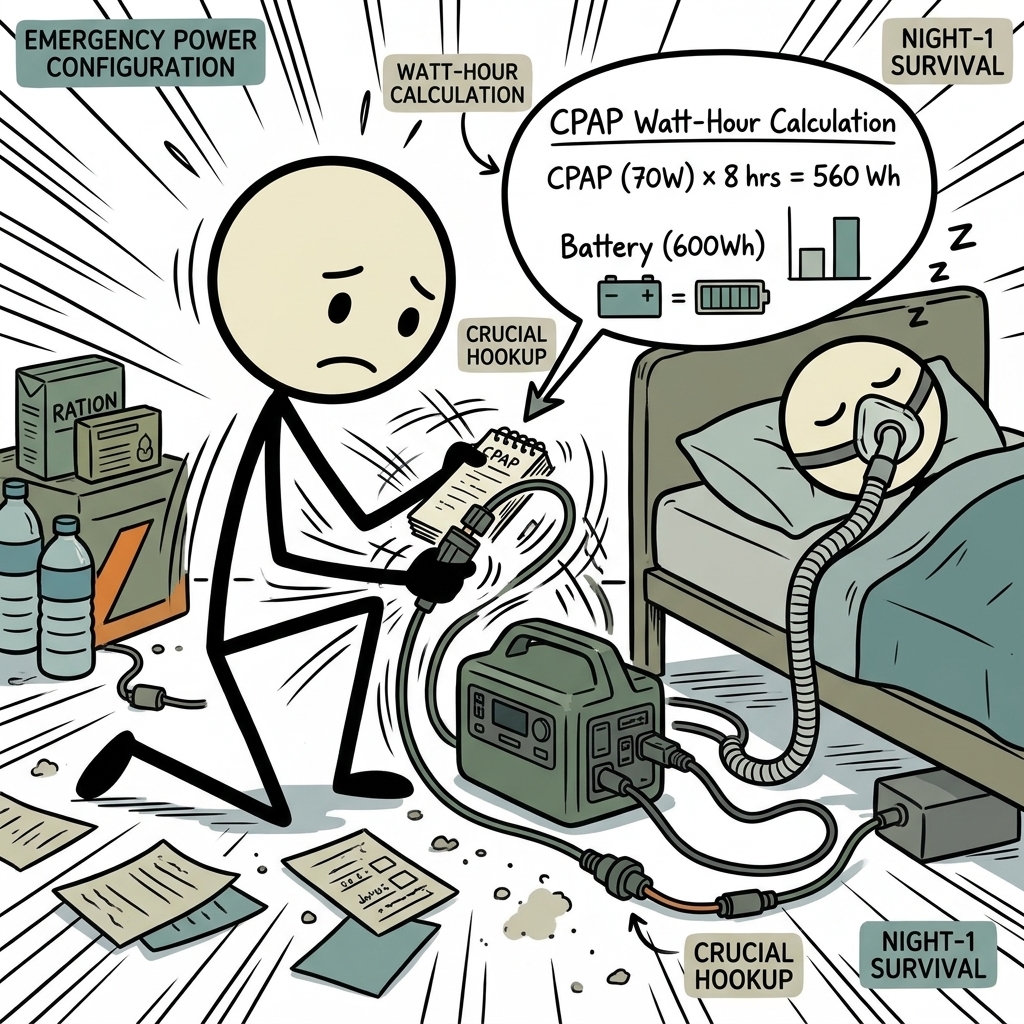
Preparing for electrical interruptions requires moving past vague assumptions and manufacturer marketing claims. True emergency readiness demands an engineering approach: quantifying electrical demand in watt-hours, minimizing parasitic system losses, and deploying a chemically stable, scalable CPAP emergency power supply. With the proper configuration, you can secure dependable, multi-night respiratory support regardless of what happens to the municipal grid. For the practical checklist side, use the family emergency planning guide.
The Physiology of Sleep Apnea and Grid Vulnerability
Sleep apnea is fundamentally an anatomical airway failure that occurs when the muscles of the throat relax during deep sleep. According to the American Academy of Sleep Medicine (AASM), repeated apneic events cause sharp drops in blood oxygen saturation, severe spikes in blood pressure, and persistent surges of cortisol. Over prolonged outages, going without therapy compromises cognitive function, degrades immune performance, and significantly increases cardiovascular strain during an already stressful emergency situation.
At the same time, electrical delivery systems are facing unprecedented strain. Historical data compiled by the National Oceanic and Atmospheric Administration (NOAA) shows a marked increase in billion-dollar weather disasters over the past decade, ranging from winter freezes that cripple regional distribution networks to severe convective storms that tear down localized infrastructure. When high-voltage lines fail, utility restoration prioritizes hospitals, municipal water works, and primary emergency services, often leaving residential neighborhood preparedness networks dark for days.
Relying on public emergency shelters for medical power is a precarious strategy. The American Red Cross notes that while emergency shelters work to accommodate individuals with functional and access needs, generator capacity is frequently prioritized for mass lighting, medical refrigeration, and administrative triage rather than personal bedside outlets. Establishing a private, decentralized overnight CPAP backup battery system is the only reliable way to guarantee that your treatment remains uninterrupted.
Decoding Your CPAP’s Electrical Profile
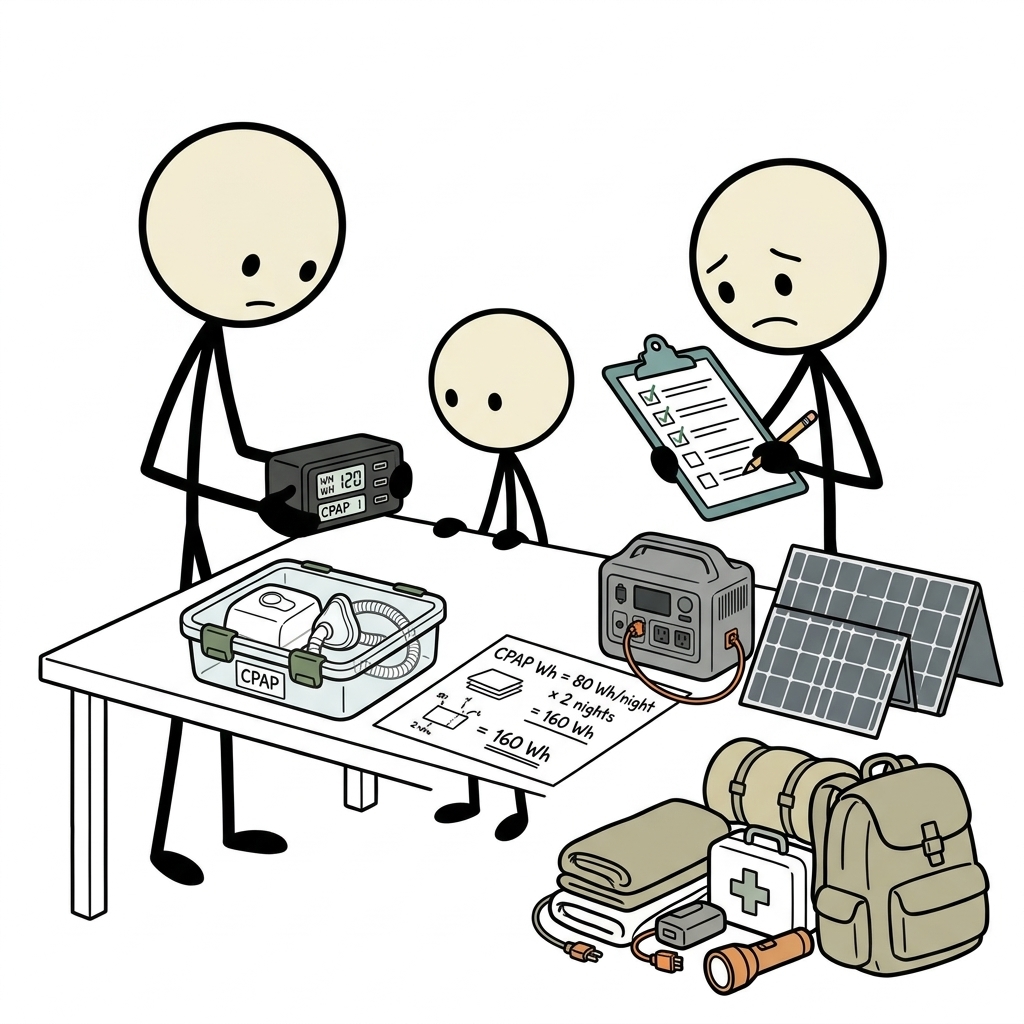
The primary barrier to configuring reliable backup power is misinterpreting the electrical ratings printed on the device. Every machine features a manufacturer label listing electrical specifications, but reading that your device accepts "100–240V ~ 50/60Hz, 1.0–1.5A" does not mean your device pulls 150 watts continuously. That figure denotes the maximum instantaneous electrical current the internal power brick can handle, usually sized to handle heating elements ramping up simultaneously from a cold start.
Modern positive airway pressure platforms—such as the ResMed AirSense 10 and 11, the Philips DreamStation series, and the BMC Luna—actually run internally on direct current (DC) electricity, typically either 12 volts or 24 volts. When you plug your CPAP into a conventional 120V wall socket, the external brick power supply steps that alternating current (AC) down into low-voltage DC power. Understanding this conversion pathway is critical for maximizing your CPAP battery runtime during a blackout.
The Real-World Impact of Heating Elements
The mechanical blower motor of a CPAP machine is remarkably efficient. Compressing air to a therapeutic pressure of 10 to 15 centimeters of water column (cm H2O) typically requires only 5 to 15 watts of continuous power. However, the comfort features engineered into modern machines—specifically the heated humidifier chamber and the integrated heated tubing—are resistive thermal loads that consume vast reserves of electrical power.
- Blower Motor Alone: Consumes approximately 5 to 15 watts, depending on therapeutic pressure and mask seal integrity.
- Blower with Passive Humidification: Consumes the same 5 to 15 watts when water is placed in the tub without powering the internal heating plate.
- Blower with Heated Humidifier (Medium/High): Consumes 35 to 65 watts continuous, cycling as the thermostat manages water temperature.
- Blower with Heated Humidifier and Heated Tubing: Consumes 60 to 105 watts continuous, drastically draining energy reserves over an eight-hour sleep cycle.
The Math: Accurate CPAP Watt Hour Calculation
To avoid undersizing your backup system, you must calculate capacity using watt-hours (Wh) rather than amp-hours (Ah). Amp-hours are meaningless unless tied directly to a specific voltage rating; a 50Ah 12-volt battery stores significantly less energy than a 50Ah 24-volt battery. A watt-hour represents a standardized unit of energy equivalent to one watt of power sustained for one hour.
The mathematical formula to determine your baseline overnight energy requirement is straightforward:
Energy Demand (Watt-hours) = Device Power Draw (Watts) × Sleep Duration (Hours)
However, real-world deployment requires factoring in system conversion losses and a safe Depth of Discharge (DoD) to avoid depleting the battery to absolute zero. If you rely on an AC inverter—powering your machine by plugging its standard wall transformer into the 120V receptacle of a portable power station for CPAP—you must account for the inverter's conversion penalty.
Inverters must convert direct current (12V/24V) from internal battery cells into alternating current (120V), which your CPAP power supply immediately rectifies back down into direct current. This double-conversion cycle bleeds between 15% and 25% of your total energy as waste heat. By utilizing a dedicated, manufacturer-approved DC-to-DC converter cable, you feed native battery voltage directly into the unit, boosting operational efficiency up to 95%.
Formula for Sizing Total Battery Capacity
To calculate the required battery nameplate capacity ($C_{min}$) needed to power your machine across an intended duration, use the following equation:
$C_{min} = \frac{P_{load} \times t}{\eta \times DoD}$
Where:
- $P_{load}$ = Device draw in watts (e.g., 10W for bare blower; 65W with full climate controls)
- $t$ = Planned operating time in hours (standard baseline: 8 hours)
- $\eta$ (Efficiency factor) = 0.80 to 0.85 for AC inverter output; 0.95 for direct DC-to-DC conversion
- $DoD$ (Depth of Discharge) = 0.80 to 0.90 for lithium-based power banks; 0.50 for lead-acid/AGM batteries
Comparative Runtime Matrix for an 8-Hour Night
| Operational Mode | Avg. Draw | Energy Used (8 Hrs) | AC Inverter Need (Wh) | DC Output Need (Wh) |
|---|---|---|---|---|
| Blower Only (10 cm H2O) | 8 Watts | 64 Wh | ~80 Wh | ~67 Wh |
| Blower (15 cm H2O, High Leak) | 14 Watts | 112 Wh | ~140 Wh | ~118 Wh |
| Blower + Moderate Humidity | 45 Watts | 360 Wh | ~450 Wh | ~379 Wh |
| Blower + Max Heat & Heated Tube | 80 Watts | 640 Wh | ~800 Wh | ~673 Wh |
This empirical divergence makes one reality crystal clear: running full humidification on an AC inverter requires a massive, costly battery reservoir. Stripping away the heating plate and moving to a DC cable drops the required storage by up to 90%, allowing a modest, highly portable battery to carry you through multiple nights of outage conditions.
Battery Chemistries: Selecting Your Storage Medium
Selecting the right power source means balancing cycle life, chemical stability, energy density, and cost. While consumer electronics have relied on standard lithium-ion for years, emergency preparedness applications require cells that can endure storage and cycling under fluctuating environmental conditions.
1. Lithium Iron Phosphate (LiFePO4)
LiFePO4 represents the gold standard for dedicated emergency backup. These cells possess an exceptionally stable chemical architecture that resists thermal runaway and combustion even under physical puncture or mechanical fault. They offer an extraordinary cycle life, regularly surviving 3,000 to 5,000 full discharge cycles while retaining over 80% of original factory capacity.
Furthermore, LiFePO4 cells maintain a steady, flat discharge curve, ensuring voltage does not sag mid-cycle. This stability prevents CPAP power bricks from throwing under-voltage cut-off faults in the early morning hours. Although slightly heavier than older lithium formulas, their safety profile, sustained lifespan, and deep discharge tolerance make them the premier choice for stationary home backups.
2. Nickel Manganese Cobalt (NMC Lithium-Ion)
NMC batteries are widespread in ultra-compact travel power packs and older portable power units. They provide superior gravimetric energy density, packing considerable power into lightweight, backpack-friendly enclosures. However, NMC chemistry features a shorter service life (typically 500 to 800 cycles to 80% capacity) and is more susceptible to thermal degradation if stored in hot garages or unconditioned spaces.
3. Sealed Lead-Acid (SLA) and Absorbed Glass Mat (AGM)
Traditional deep-cycle AGM batteries remain popular in budget setups due to their low upfront purchase price. However, their primary engineering drawback is usable capacity: discharging an AGM battery beyond 50% Depth of Discharge damages the lead plates through irreversible sulfation, slashing its usable life. A heavy 100Ah AGM battery (weighing upwards of 60 pounds) yields only 50Ah of usable power (approximately 600Wh), making it an inefficient, backbreaking solution compared to modern alternatives.
Three Reliable CPAP Emergency Power Architectures
Depending on your budget, mobility requirements, and mechanical aptitude, there are three proven architectural blueprints for implementing an overnight CPAP backup battery.
Option 1: The Commercial Portable Power Station (Plug-and-Play)
All-in-one solar-ready power stations from manufacturers like Bluetti, EcoFlow, and Jackery integrate a battery bank, battery management system (BMS), high-efficiency multi-stage AC inverter, and low-voltage DC outputs into a single unified housing. These units are ideal for users seeking an immediate, reliable solution that requires no specialized electrical wiring.
To deploy this setup successfully, select a power station built with LiFePO4 chemistry featuring an internal capacity of at least 500Wh to 1,000Wh. Always purchase the manufacturer's auxiliary 12V or 24V DC auxiliary adapter designed specifically for your CPAP brand. Plug the DC line directly into the high-output 12V port (often a cigarette-lighter style socket or Anderson Powerpole port) instead of the three-prong AC outlet to preserve maximum runtime.
Option 2: Dedicated Medical OEM Travel Batteries
Purpose-built medical batteries, such as the Medistrom Pilot-24 Lite or Freedom V2, are engineered for optimal weight and compact convenience. These devices automatically match native voltage outputs without requiring third-party accessories and frequently slip into your existing CPAP travel bag.
Their integrated electronics allow them to function as an automated uninterruptible power supply (UPS). The power brick plugs into the wall, the battery plugs into the power supply, and the machine connects directly to the battery. During normal operation, grid power bypasses the cells to run the machine; the instant the wall power cuts, internal relays transfer the load onto the battery cells without causing the CPAP blower to stutter or drop pressure. However, their internal capacity is modest (typically 90Wh to 190Wh), meaning you must operate with humidifiers turned completely off.
Option 3: The DIY Off-Grid Deep-Cycle DC Power Rig
For handy individuals seeking maximum capacity per dollar, assembling an independent 12V DC power rig using marine-grade components offers unmatched cost-efficiency. This configuration uses an individual 12V 100Ah LiFePO4 battery (providing 1,280Wh of raw capacity), an inline 15A marine fuse, and a heavy-duty fused DC cigarette-socket pigtail or Anderson terminal block, all kept conditioned with an external multi-stage smart charger.
With 1,280Wh of usable power on tap, this architecture can power a CPAP machine running without heat for nearly two straight weeks of sleep before requiring a recharge. It also serves as an expandable hub capable of running emergency 12V LED lighting, USB emergency communication plan gear, and portable two-way radios during prolonged regional infrastructure disruptions.
Maintaining Runtime During Long-Term Disasters
When localized storms escalate into catastrophic multi-week recovery scenarios, any battery system will eventually drain. Building true energy resilience means integrating a structured daytime replenishment cycle to maintain your CPAP emergency power supply indefinitely.
Sizing Photovoltaic Solar Arrays
Solar replenishment allows complete independence from municipal infrastructure or fuel supply chains. To size your solar array accurately, you must generate enough power during peak sunlight hours to both replenish what you consumed overnight and overcome atmospheric inefficiencies.
According to the National Renewable Energy Laboratory (NREL), most locations in the contiguous United States receive an average of 4 to 4.5 "peak sun hours" per day, factoring in sun angles and atmospheric conditions. If your night of CPAP sleep consumes 150Wh on DC power, your solar panel must replenish that 150Wh within a compressed window.
Factoring in a standard 25% system loss due to panel heating, dirt, and solar charge controller efficiency (MPPT vs. PWM), you calculate your panel requirements as follows:
Required Solar Input = $\frac{150\text{ Wh}}{4.2\text{ Peak Hours} \times 0.75\text{ System Derate}} \approx 47.6\text{ Watts}$
While a 50W panel theoretically covers the draw under clear skies, family emergency planning demands a 2x margin of safety to account for cloud cover, smoke, or improper panel tilt. Deploying a 100W or 200W monocrystalline folding panel guarantees full battery replenishment even on overcast days.
The Role of Fossil-Fuel Generators
If you use a gas, propane, or dual-fuel generator for emergency power, do not run the engine continuously all night solely to power a tiny CPAP machine. Small engines running at light electrical loads waste fuel, generate unnecessary noise, and dramatically increase your maintenance intervals.
Instead, follow a tactical battery-buffered strategy. Run your generator for two to three hours during peak daytime hours to run high-load appliances (such as freezers and water pumps) while simultaneously fast-charging your LiFePO4 CPAP power station. Shut the engine down before dark to preserve fuel, prevent carbon monoxide buildup, and sleep through the night using silent, emissions-free battery power.
Practical Power-Saving Adjustments for Outages
When remaining battery reserves are running thin, strategic behavioral changes can cut your device's energy consumption in half without compromising basic therapy.
- Completely Disable Climate Control Systems: Navigate into your CPAP's clinical or user settings and toggle both the Humidifier and Heated Tube from "Auto" to "Off." This simple modification instantly drops your power draw from 60–80 watts down to 8–12 watts.
- Adopt Heat and Moisture Exchangers (HME): If you suffer from airway drying without humidification, use an in-line disposable HME cartridge. These small, hygienic capture discs connect between your mask and hose, using hygroscopic material to capture exhaled moisture and return it on your next inhalation without consuming a single watt-hour of power.
- Fix Mask Air Leaks: Severe mask leaks force the internal turbine motor to spin up to maximum RPM to compensate for lost pressure, spiking mechanical power draw by 30% to 50%. Ensure cushions, headgear straps, and silicon seals are adjusted cleanly to prevent high-leakage motor runaways.
- Disable Integrated Cellular Modems: Many modern CPAP units (including the ResMed AirSense 10 and 11) house an internal 4G/LTE cellular modem designed to transmit therapy compliance data to the cloud every morning. Placing the machine into "Airplane Mode" prevents the modem from searching for damaged cell towers, saving additional battery capacity.
Safety, Testing, and Deployment Protocols
A battery storage system sitting unmaintained in a closet is an accident waiting to happen. Emergency gear must be regularly exercised, certified, and maintained long before severe weather threatens your region. Follow these structural safety and maintenance standards to ensure your system performs when needed:
NFPA Storage and Operating Safety
Always adhere to the National Fire Protection Association (NFPA) safety standards regarding lithium battery storage. Store all power supplies in a cool, dry area between 50°F and 70°F (10°C to 21°C). Never leave portable power stations charging in direct sunlight, on damp basement floors, or near combustible materials.
If you build an open-frame DIY battery setup, make sure to fuse the positive (+) terminal directly within six inches of the post. LiFePO4 cells are capable of delivering hundreds of amperes in a fractional-second short-circuit, which can melt copper wires and ignite bedding instantly without a fast-acting inline fuse.
Pre-Season Operational Drill
Do not wait for a hurricane warning or winter storm advisory to confirm your backup system functions properly. Conduct a practical operational drill twice each year, coinciding with seasonal time changes.
- Disconnect your CPAP setup entirely from grid-supplied wall outlets.
- Connect your emergency DC adapter cables directly into your primary battery pack.
- Sleep a full eight-hour night using exclusively off-grid power, monitoring total battery percentage drop and morning residual voltage.
- Inspect cables, plugs, and charging sockets for any unexpected heat buildup.
- Recharge the battery system fully to its storage baseline (typically 80% to 90% for long-term health if not deployed immediately).
Empowered Medical Independence
Managing sleep apnea presents challenges during normal routines, and grid failures introduce real physical stress that can compromise rest when you need it most. However, relying on continuous utility power is not your only option. By demystifying the relationship between volts, amps, and watt-hours, shedding power-hungry climate heating elements, and investing in safe, cycle-tested LiFePO4 battery storage, you can protect your health and retain control. An unexpected outage will simply mean that outside power lines are down—while your bedroom remains peaceful, your airway stays supported, and your family rests secure.
Frequently Asked Questions
How many watt-hours (Wh) does a CPAP machine use per night?
Without heated humidification or heated tubing, a standard CPAP machine typically consumes between 30 and 60 watt-hours (Wh) for an 8-hour night. With heated humidification and heated tubing enabled, consumption increases dramatically to 250 to 500 Wh per night.
Why should I use a native DC adapter instead of an AC inverter for battery backup?
CPAP machines run internally on direct current (DC). Using an AC inverter converts battery DC power to AC, which the CPAP power supply converts back to DC, losing 15% to 25% of your battery capacity to heat and conversion inefficiencies.
How much does turning off heated humidification extend battery life?
Disabling the heated humidifier and heated hose reduces total power consumption by 70% to 85%. Turning these off can turn a single-night battery reserve into a 3- to 5-night emergency backup system.
What size portable power station is needed for a 3-night emergency budget?
Without heated accessories and using a DC adapter, a 3-night budget requires approximately 150 to 200 Wh, meaning a 300 Wh power station provides an optimal safety margin. If running heated humidification, you need a minimum of 1,000 to 1,500 Wh for 3 nights.
Do mask leaks and pressure settings impact battery runtime?
Yes. Higher therapy pressure settings force the motor to work harder, increasing wattage draw. Significant mask leaks cause the blower to constantly accelerate to maintain target pressure, which can reduce total battery runtime by 20% to 30%.
Sources & Further Reading
- Ready.gov - Power Outages Emergency Preparedness
- U.S. Food and Drug Administration (FDA) - Medical Devices Requiring Electricity During Outages
- Centers for Disease Control and Prevention (CDC) - Preparing for a Power Outage
- American Red Cross - Power Outage Checklist & Emergency Medical Planning
- U.S. Department of Energy - Estimating Appliance and Home Electronic Energy Use