⚡ Key Facts
- Fragile Infrastructure: According to the Cybersecurity and Infrastructure Security Agency (CISA), 85% of the United States' critical infrastructure is privately owned, creating highly uneven cybersecurity standards across essential utilities. For the practical checklist side, use the community emergency preparedness guide.
- Rising Infrastructure Attacks: The FBI’s Internet Crime Complaint Center (IC3) reports a 74% year-over-year increase in cyberattacks targeting critical infrastructure sectors, with public water systems and energy grids being primary targets. For the practical checklist side, use the neighborhood preparedness network.
- Cashless Vulnerability: A Federal Reserve study indicates that over 80% of everyday transactions in the U.S. are now digital, leaving the vast majority of the population highly vulnerable to immediate financial paralysis during a payment network outage.
- The 72-Hour Preparedness Gap: While FEMA recommends a minimum of 72 hours of self-sufficiency during disasters, emergency managers increasingly advise preparing for up to 14 days of localized utility and emergency communication plan disruptions.
Imagine waking up to a completely silent smartphone. There is no cellular signal, your home Wi-Fi is down, and the local cellular towers show "No Service." You drive to the nearest gas station to fuel up, but the pumps are dark—the payment processing system is offline, and credit cards are useless. Across town, municipal water pressures begin to drop as a ransomware attack locks up the digital supervisory control and data acquisition (SCADA) systems of your local water treatment facility. This is not a scene from a dystopian thriller; it is the reality of a systemic, multi-sector cyber incident. As our physical and digital worlds merge, true emergency readiness requires a comprehensive strategy for cyberattack preparedness that bridges the gap between digital security and physical survival.
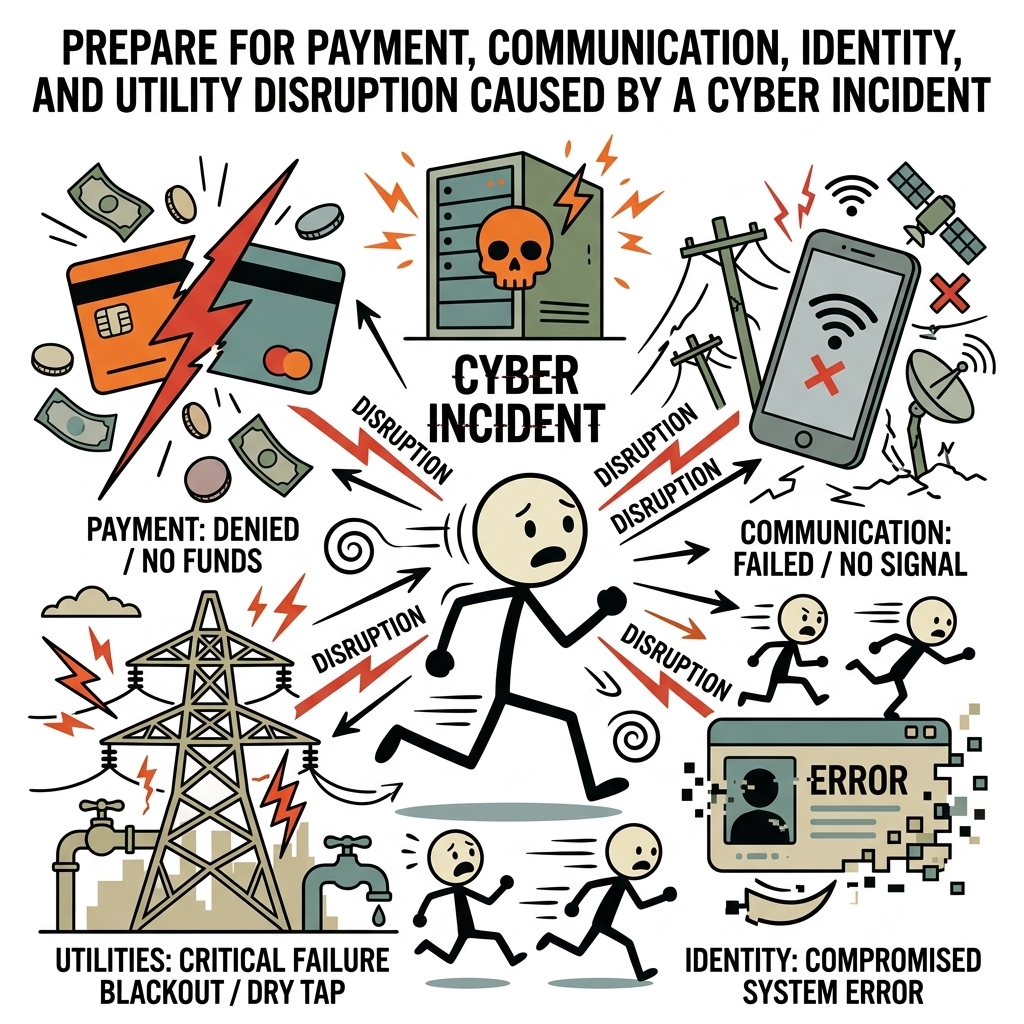
The Reality of Cascading Cyber Failures
In our modern, just-in-time economy, efficiency has replaced redundancy. We rely on highly integrated, cloud-based networks to deliver our electricity, clean water, financial transactions, and communications. While this digital ecosystem offers unprecedented convenience, it also creates a single point of failure. A cyberattack on one sector rarely remains isolated. Instead, it triggers a domino effect across multiple systems.
When the Colonial Pipeline was hit by a ransomware attack in 2021, it did not just disrupt computer screens; it caused physical fuel shortages, panic buying, and price spikes across the eastern United States. Similarly, the 2024 cyberattack on Change Healthcare paralyzed prescription processing nationwide, leaving patients unable to access life-saving medications. To protect your household, you must treat digital threats with the same physical readiness you would apply to a hurricane, earthquake, or severe winter storm. Integrating digital resilience into your broader cyberattack preparedness emergency preparedness strategy is no longer optional—it is a fundamental requirement of modern self-reliance.
Safeguarding Your Financial Resilience (Payment Disruptions)
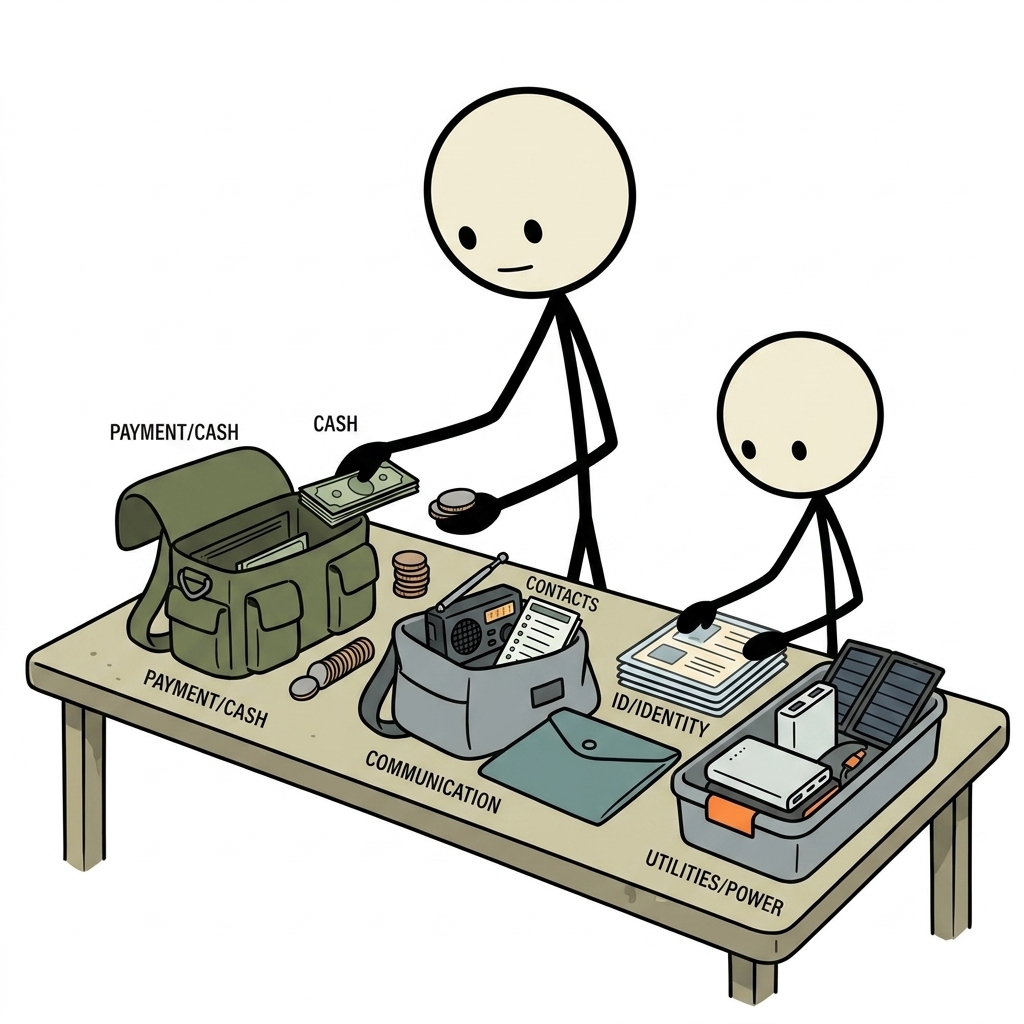
During a major cyber incident, financial networks are often the first to fail or be preemptively shut down to contain a breach. Point-of-Sale (POS) terminals, Automated Teller Machines (ATMs), mobile payment apps, and online banking portals all rely on constant, secure internet connectivity. If these systems go offline, your digital wealth becomes temporarily inaccessible. To maintain your purchasing power, you must establish an offline financial contingency plan.
The Three-Tier Emergency Cash Reserve
FEMA and the American Red Cross consistently recommend keeping a cash reserve on hand for emergencies. During a prolonged cyber outage, cash is the ultimate redundancy. However, simply throwing a few large bills into a drawer is insufficient. You should structure your cash reserve into three distinct tiers:
- The Wallet Stash: Keep $50 to $100 in small denominations ($1s, $5s, and $10s) tucked away in your daily wallet. This is for immediate, minor transactions if local card readers fail while you are away from home.
- The Home Safe Reserve: Store enough cash to cover two to four weeks of essential household expenses (food, fuel, water, basic medical supplies) in a fireproof, waterproof home safe.
- The Small-Bill Rule: Ensure that at least 70% of your cash reserve is in bills smaller than $20. During a systemic crisis, merchants will quickly run out of change, and a $100 bill may end up buying you only $10 worth of goods if the seller cannot break it.
Alternative Offline Payment Methods
While cash is king during a localized power or network failure, other analog financial tools can bridge the gap. Maintain a physical checkbook; even in a digital age, some local merchants and utility companies may accept paper checks as a written promise of payment, documenting transactions manually until networks return online.
Additionally, keep physical, printed copies of your most recent bank statements, credit card balances, and outstanding utility bills. If banking databases are corrupted or temporarily taken offline, these paper records serve as your legal proof of account balances and paid debts, protecting you from systemic record loss.
Maintaining Connection in a Digital Blackout (Communication Disruptions)
We take instant communication for granted. Yet, cellular networks, fiber-optic internet lines, and Voice over IP (VoIP) phone systems are highly vulnerable to digital disruption. A distributed denial-of-service (DDoS) attack or a sophisticated routing protocol exploit (such as a BGP hijacking incident) can sever your connection to the outside world in seconds. When the digital grid goes silent, you must have alternative means to gather information and contact loved ones.
The P.A.C.E. Communication Methodology
Military planners use the P.A.C.E. (Primary, Alternate, Contingency, Emergency) methodology to ensure continuous communication under the worst conditions. You can adapt this framework for your household's cyberattack preparedness plan:
| Level | System | Operational Use Case |
|---|---|---|
| Primary | Standard Cellular & Wi-Fi | Daily voice calls, text messaging, and internet-based communications. |
| Alternate | SMS & Landlines (Copper-based) | Text messages often go through when voice networks are overloaded; traditional landlines may still function if local exchange power holds. |
| Contingency | Two-Way Radios (FRS/GMRS/MURS) | Short-range, license-free communication within a neighborhood or localized family radius (typically 1 to 5 miles). |
| Emergency | Satellite Messengers & HAM Radio | Off-grid, space-based messaging (e.g., Garmin InReach) or long-range amateur radio networks operating independent of terrestrial infrastructure. |
Acquiring Reliable Information
During a major cyber incident, rumors and misinformation spread rapidly. To receive verified updates from emergency management officials, your household must have an emergency radio. Keep a high-quality, hand-crank or battery-powered NOAA Weather Radio on hand. While designed for weather emergencies, these devices are also utilized by federal authorities to broadcast critical civil emergency information during national security events or major infrastructure failures.
Protecting Your Digital Sovereignty (Identity & Credential Disruption)
A cyberattack does not just disrupt physical services; it can target the core databases that prove who you are. Ransomware attacks on government offices can freeze DMV databases, vital statistics offices, and municipal records. Simultaneously, large-scale data breaches can expose your personally identifiable information (PII), leaving you vulnerable to identity theft at a time when your attention is focused on immediate physical survival. Securing your identity requires a proactive, analog-meets-digital defense.
Building an Analog Identity Vault
If digital databases are compromised, corrupted, or offline, you must be able to prove your identity, medical history, and property ownership using physical documentation. Create a "Go-Binder"—a highly organized, waterproof, and fireproof document portfolio containing physical copies of your family's most critical records:
- Identification: Certified copies of birth certificates, passports, driver's licenses, and Social Security cards.
- Financial Proof: Recent mortgage statements, property deeds, vehicle titles, and insurance policies.
- Medical Records: A list of current prescriptions, immunization records, blood types, and critical medical histories for all family members.
- Key Contacts: A printed sheet of essential phone numbers and physical addresses (family, neighbors, doctors, utility companies, and financial institutions). Do not rely on your phone's contact list, which is inaccessible if your device is lost, damaged, or out of battery.
Proactive Digital Hygiene
To prevent malicious actors from exploiting your identity during a period of widespread digital confusion, implement robust digital security measures immediately. This is a core pillar of your personal cyberattack preparedness strategy:
First, utilize a reputable, offline-capable password manager. Avoid saving passwords directly in your web browser, which is highly vulnerable to malware. Instead, use a dedicated manager that allows you to access your encrypted vault offline on your local device. Print out emergency recovery keys for your critical accounts and store them securely in your physical Go-Binder.
Second, implement hardware-based Multi-Factor Authentication (MFA). While SMS-based codes are better than nothing, they are highly vulnerable to SIM-swapping attacks and require an active cellular network. Hardware security keys (such as YubiKeys) or offline authenticator apps (which generate time-based codes without needing an internet connection) provide far superior security.
Finally, freeze your credit files with the three major credit bureaus: Equifax, Experian, and TransUnion. Freezing your credit is free and prevents anyone from opening new accounts in your name, providing a permanent shield against identity theft even if your personal information is leaked in a major corporate or government database breach.
Surviving Infrastructure and Utility Failures (Power, Water, Gas)
The most severe physical consequence of a sophisticated cyberattack is the disruption of critical public utilities. Industrial Control Systems (ICS) manage the valves, switches, and pumps that deliver clean water to your tap, electricity to your outlets, and natural gas to your furnace. Organizations like the Environmental Protection Agency (EPA) and the Department of Energy (DOE) have repeatedly warned that municipal water systems and regional electrical grids are primary targets for foreign threat actors.
Water Security: The Ultimate Priority
A cyberattack on a municipal water treatment plant can result in two scenarios: a complete loss of water pressure, or the distribution of contaminated water due to disrupted chemical treatment processes. According to the CDC, you must store a minimum of one gallon of water per person per day for drinking and sanitation. To build a resilient water security plan, follow these guidelines:
- The Two-Week Standard: While FEMA suggests a 3-day supply, aim for a 14-day supply of stored water for your household. For a family of four, this equates to 56 gallons of water.
- Proper Storage Containers: Store water in food-grade, BPA-free plastic containers. Avoid using old milk jugs, as residual milk proteins can foster bacterial growth even after thorough washing.
- Redundant Purification Methods: If municipal water is still flowing but its safety is compromised, do not rely on standard refrigerator filters. Keep high-quality gravity filters (such as Sawyer or Berkey systems) on hand, along with unscented liquid household chlorine bleach (use 8 drops per gallon of water to disinfect in an emergency) or emergency water purification tablets.
Emergency Power and Climate Control
If a cyberattack destabilizes the electrical grid, your home will lose heating, cooling, refrigeration, and lighting. To prepare for a prolonged power outage, focus on modular, off-grid energy solutions:
Invest in a portable solar generator (battery power station) paired with foldable solar panels. Unlike traditional gas generators, solar generators are completely silent, produce no toxic exhaust, and can be safely operated inside your living room to recharge emergency communications gear, medical devices, and flashlights.
For climate control, keep high-quality thermal sleeping bags, mylar emergency blankets, and a safe, indoor-rated propane heater (such as a Mr. Heater Buddy) on hand, along with an adequate supply of propane canisters. Always operate propane heaters with a battery-powered carbon monoxide detector nearby to ensure safety.
To protect your emergency food storage guide, follow the USDA guidelines: keep refrigerator and freezer doors closed as much as possible. An unopened refrigerator will keep food cold for about 4 hours, while a full freezer will maintain its temperature for approximately 48 hours. Have a well-stocked pantry of non-perishable, ready-to-eat foods that do not require cooking or refrigeration.
The Ultimate Cyberattack Preparedness Checklist
True resilience is built through structured, incremental action. Use this comprehensive cyberattack preparedness checklist to systematically audit and upgrade your household's readiness over the next 30 days:
📋 Actionable Cyberattack Preparedness Checklist
Phase 1: Immediate Actions (Next 48 Hours)
- Establish an emergency cash reserve of at least $200 in small bills ($1s, $5s, $10s) and store it in a secure location.
- Print out a physical contact list containing emergency numbers, family phone numbers, and addresses of key locations.
- Download your password manager's database to your local smartphone or computer so it is accessible offline.
- Freeze your credit files with Equifax, Experian, and TransUnion to prevent unauthorized account creation.
Phase 2: Short-Term Security (Next 2 Weeks)
- Assemble your physical "Go-Binder" with certified copies of identification, financial statements, and medical records.
- Store a minimum of 3 days of emergency water (1 gallon per person per day) in food-grade containers.
- Purchase a hand-crank NOAA emergency weather radio to receive off-grid information broadcasts.
- Create a family communication plan, designating a physical local rendezvous point if cellular service is lost.
Phase 3: Long-Term Resilience (Next 30 Days)
- Expand your Water Calculator to a full 14-day supply for all household members and pets.
- Acquire a high-quality gravity-fed water filter and emergency purification tablets.
- Purchase alternative communication tools, such as GMRS two-way radios or a satellite messenger.
- Invest in a portable solar power station to keep essential medical and communication gear charged during grid outages.
- Audit your household food supply, ensuring you have at least two weeks of shelf-stable, no-cook food.
Building a Culture of Digital Self-Reliance
Preparing for a major cyber incident is not about living in fear or retreating from the modern world. Rather, it is about recognizing the vulnerabilities of our highly connected society and taking proactive, logical steps to mitigate those risks. By establishing alternative payment methods, securing off-grid communications, safeguarding your physical identity documents, and building redundant water and power systems, you transform your household from a fragile point of failure into a fortress of self-reliance. Cyber resilience is physical resilience. Start taking action today, audit your systems, and ensure that when the digital grid goes silent, your family remains safe, connected, and prepared.
Frequently Asked Questions
What should a cyberattack preparedness plan include?
Start with the immediate safety steps, the supplies and records your household needs, a communication plan, and a regular review schedule. Follow local official guidance during an active emergency.
How often should I review cyberattack preparedness preparations?
Review them at least twice a year and whenever your household, medication, location, or local risks change. Replace expired supplies and practice key steps.
Where can I find reliable emergency guidance?
Use local emergency management alerts and established public-health or emergency-management agencies. A blog guide should support, not replace, official real-time instructions.