⚡ Key Facts
- The 10-80-10 Rule: Survival psychology research shows that in any sudden crisis, only 10% of people maintain clear, analytical thinking, while 80% freeze or act aimlessly, and 10% actively panic. For the practical checklist side, use the community emergency preparedness guide.
- The Heart Rate Threshold: When acute stress pushes your heart rate above 175 beats per minute (BPM), fine motor skills and rational decision-making completely degrade, leaving only gross motor survival instincts. For the practical checklist side, use the neighborhood preparedness network.
- The Preparedness Gap: According to FEMA’s National Preparedness Survey, while 89% of Americans believe a disaster could affect them, only 51% have an actual family emergency plan, leaving the rest highly vulnerable to cognitive freeze.
- Cognitive Bandwidth Collapse: During a crisis, the CDC reports that cognitive load increases by up to 300%, severely restricting the brain's working memory from its usual 7 items down to just 1 or 2.
Imagine sitting at your office desk when a sudden, violent jolt rattles the building. The power cuts out instantly, plunging the room into darkness. The high-pitched wail of a fire alarm begins to scream through the hallways, accompanied by the faint, acrid smell of burning electrical wire. What do you do next? While we like to envision ourselves springing into heroic, decisive action, modern science reveals a far more sobering reality. For the vast majority of people, the initial response is not action, but a profound, paralyzing freeze. This is not a failure of character or a lack of courage; it is a fundamental design feature of the human brain. When a crisis strikes, our cognitive architecture undergoes an immediate, radical transformation. Understanding the brain in emergency states is the foundational step in true survival preparedness. By dissecting why our minds falter under pressure, we can build robust, practical systems to bypass cognitive overload and make life-saving decisions when every second counts.
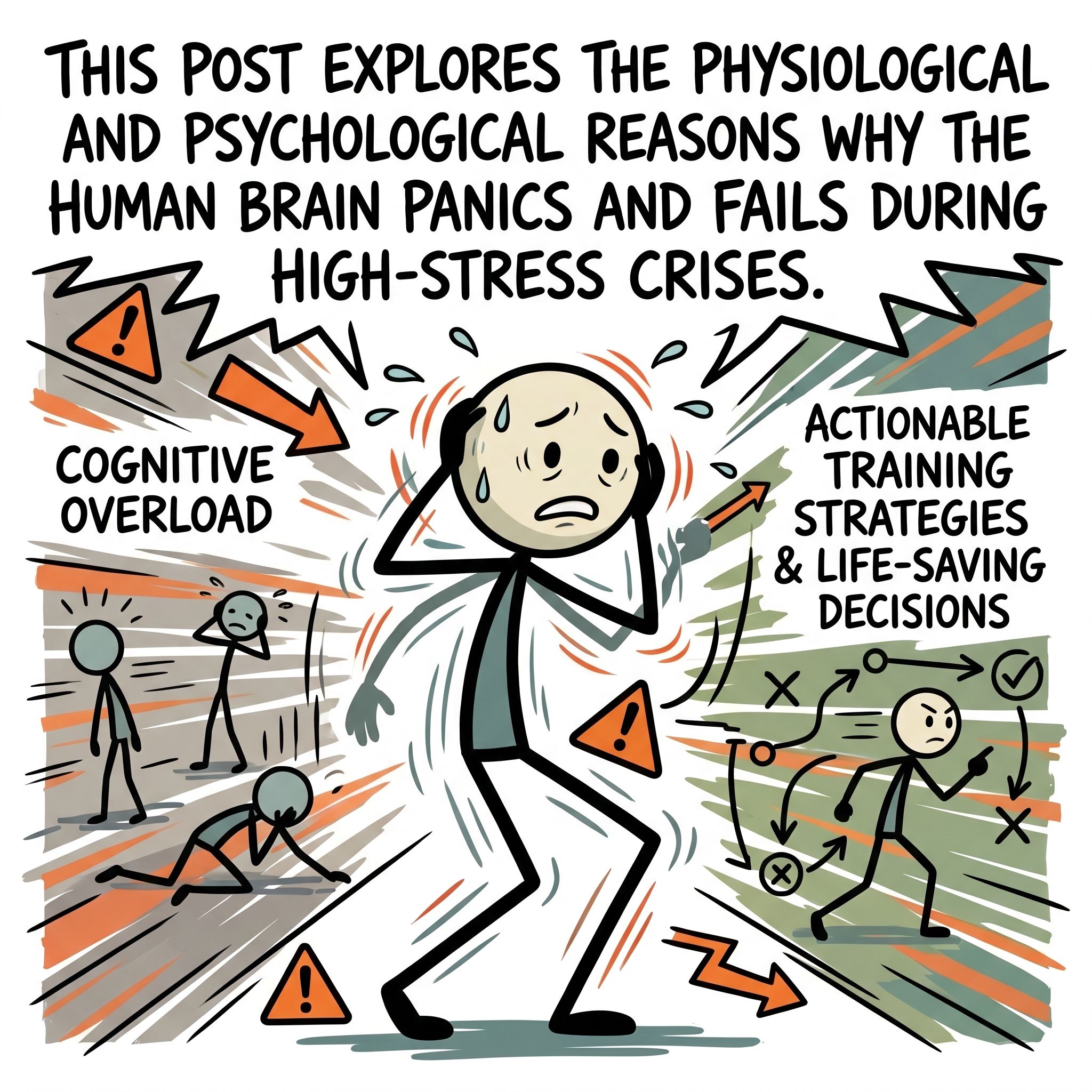
The Neurobiology of Fear: Inside the Brain in Emergency
To understand why we freeze or make poor decisions during a disaster, we must first look at the physical architecture of the human brain. Under normal conditions, our daily lives are governed by the prefrontal cortex (PFC). Located directly behind the forehead, the PFC is the "executive suite" of the brain. It is responsible for logical reasoning, abstract thinking, long-term planning, and deliberate decision-making under stress. However, the PFC is a slow, energy-hungry processor. It requires time to weigh options, analyze data, and project outcomes.
Deep within the temporal lobes lies the amygdala, an ancient, almond-shaped cluster of nuclei that serves as the brain's rapid-response security alarm. The amygdala does not think; it reacts. When sensory organs detect a sudden threat—such as a deafening boom, a flash of fire, or a violent shake—the amygdala bypasses the slow, analytical prefrontal cortex entirely. It triggers what psychologists call an "amygdala hijack," instantly activating the sympathetic nervous system (SNS) and flooding the bloodstream with a powerful cocktail of adrenaline, noradrenaline, and cortisol.
The Chemical Cascade and Vasoconstriction
This rapid hormonal surge is designed to prepare the body for immediate physical exertion: fight, flight, or freeze. While this chemical cascade is highly effective for running away from a predatory animal, it wreaks havoc on the modern human's ability to navigate complex, multi-step emergencies. One of the most immediate physiological consequences of this adrenaline dump is peripheral vasoconstriction. The body pulls blood away from the skin and extremities, redirecting it to the large, core muscle groups like the thighs and biceps. This is an evolutionary defense mechanism designed to reduce bleeding if you are wounded, but it has a devastating side effect: you instantly lose your fine motor skills.
- Fine Motor Skills (Degrade at 115 BPM): Tasks requiring precision, such as dialing 911 on a smartphone, keying open a deadbolt, or handling small tools, become incredibly difficult.
- Complex Motor Skills (Degrade at 145 BPM): Activities requiring coordination, such as driving a vehicle through a chaotic environment or performing CPR, begin to fail.
- Gross Motor Skills (Remain Functional up to 175+ BPM): Simple, high-energy actions like running, jumping, and striking remain intact, as blood is concentrated in the major muscle groups.
The Heart Rate Thresholds of Cognitive Collapse
The relationship between heart rate and cognitive performance is highly predictable. In his pioneering research on physiological arousal, Colonel Dave Grossman documented how escalating heart rates correlate directly with the degradation of human performance. Under normal conditions, a resting heart rate sits between 60 and 80 BPM. As emergency-induced stress pushes the heart rate higher, we pass through distinct performance zones:
Once the heart rate surpasses 175 BPM, cognitive processing collapses. At this level of hyper-arousal, individuals experience auditory exclusion (temporary deafness to instructions or alarms), tunnel vision (loss of peripheral sight, reducing the visual field by up to 70%), and a complete loss of near-vision focus. The prefrontal cortex goes completely offline. The brain is no longer capable of logical deduction; it is operating purely on primal instinct. If you have not pre-programmed your response through training, your brain will cycle endlessly in a loop of panic or freeze.
The Psychological Saboteurs of Survival Psychology
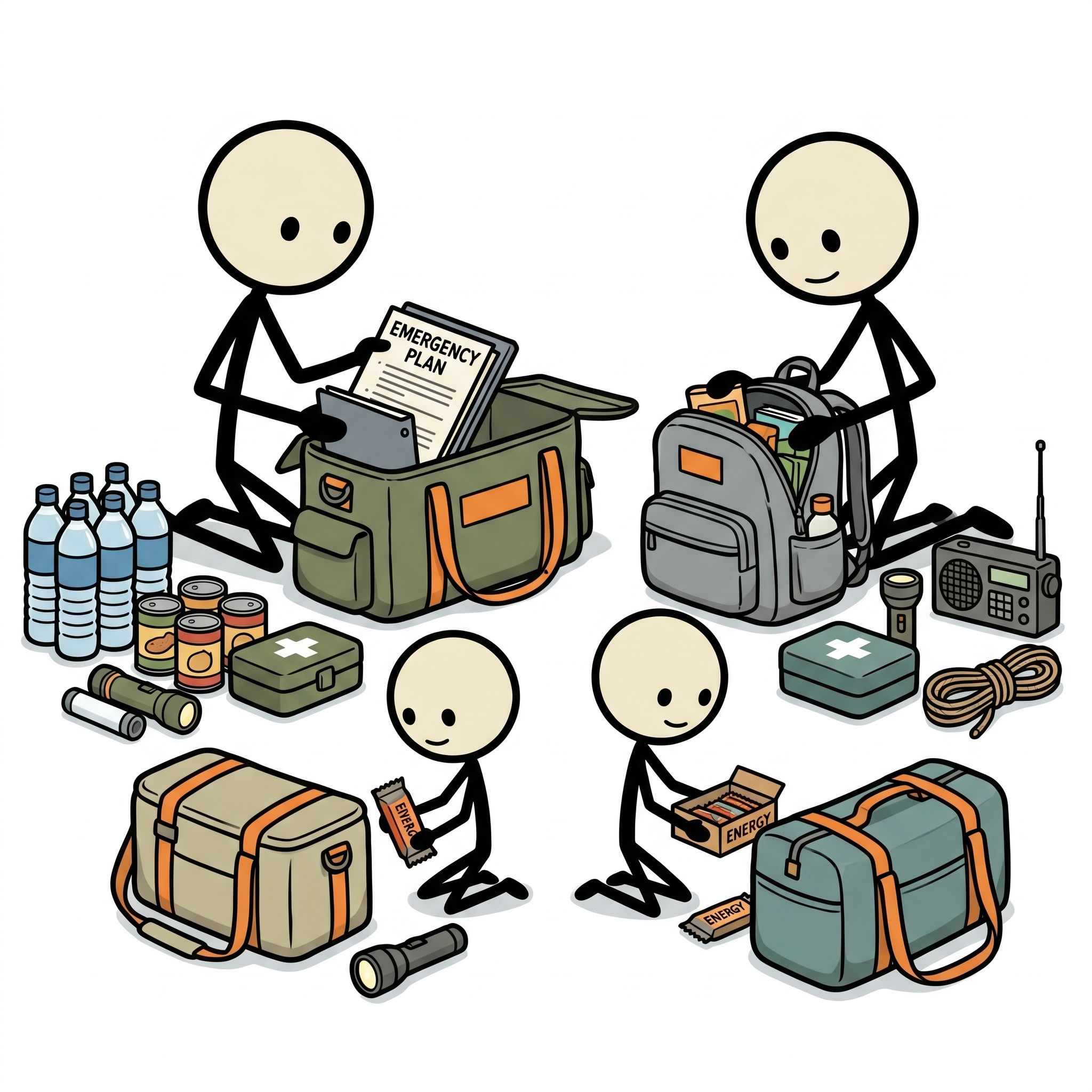
While neurobiology explains the physical limitations of the brain under stress, survival psychology explains the mental biases and behavioral traps that prevent us from acting before it is too late. Long before our heart rate reaches critical levels, our minds actively work to minimize, deny, or ignore the reality of a developing disaster.
The Lethal Grip of Normalcy Bias
Perhaps the most dangerous psychological hurdle in any crisis is normalcy bias. This is a cognitive bias that leads people to underestimate both the likelihood of a disaster and its potential effects. Because we rely on past experiences to interpret new events, the brain naturally attempts to fit novel, threatening stimuli into a framework of mundane, everyday occurrences.
According to data from the United States Geological Survey (USGS) and FEMA, during the initial stages of major disasters, a vast majority of casualties occur because people delayed evacuation to seek additional information or to perform routine tasks. When a fire alarm sounds, the brain does not immediately think "fire." Instead, it thinks: It’s probably just a drill, a system test, or someone burnt toast in the breakroom. This bias causes people to waste precious minutes rationalizing away danger until they are physically confronted with smoke or flames, at which point their escape routes may already be blocked.
The Bystander Effect and Social Proof
Human beings are intensely social creatures. In moments of ambiguity, we look to others to determine how we should behave—a phenomenon known as social proof. If a room begins to fill with smoke, but everyone else remains seated and calm, our brain concludes that the danger must not be real. This collective inaction is a primary driver of the bystander effect.
In a famous social psychology experiment by Latané and Darley, participants were placed in a room that slowly filled with smoke. When alone, 75% of participants reported the smoke within two minutes. However, when placed in a room with two actors who intentionally ignored the smoke, only 10% of the actual participants reported it or got up to investigate. The rest sat passively, coughing and rubbing their eyes, allowing social proof to override their survival instincts. In a real-world disaster, waiting for others to move is a recipe for catastrophe.
The 10-80-10 Rule of Disaster Response
To understand human behavior in mass emergencies, survival psychologists frequently refer to the 10-80-10 rule, formulated by Dr. John Leach. This model categorizes how a population reacts when suddenly thrust into a life-threatening situation:
- The Active 10%: These individuals retain their cognitive facilities. They quickly assess the situation, control their fear, and take decisive, logical actions to save themselves and others.
- The Bewildered 80%: The vast majority of people fall into this category. They do not panic hysterically; instead, they become stunned, numb, and highly suggestible. They experience "cognitive paralysis," struggling to process what is happening and waiting passively for instructions.
- The Counterproductive 10%: This group completely loses emotional control. They scream, weep, freeze entirely, or engage in irrational, dangerous behaviors that actively impede survival efforts.
The goal of emergency preparedness is not to miraculously turn everyone into a natural-born leader. Rather, it is to use targeted training to move yourself out of the bewildered 80% and into the active 10%, while developing the skills necessary to direct and lead those who are frozen in place.
The Mechanics of Crisis Decision Making
To make effective choices during an emergency, we must understand how our brain processes information under pressure. In daily life, we often use analytical decision-making: we identify a problem, generate a list of potential solutions, weigh the pros and cons of each, and select the optimal path. During a crisis, this method is utterly useless.
The Working Memory Bottleneck
Analytical decision-making relies heavily on working memory—the mental scratchpad where we temporarily hold and manipulate information. Under normal conditions, human working memory can hold roughly seven items (plus or minus two), according to Miller's Law. However, the CDC’s crisis emergency communication plan research indicates that high-stress environments cause a drastic reduction in this capacity.
When the brain is flooded with adrenaline, your working memory shrinks to a bottleneck of just one or two items. If you attempt to weigh multiple options, your brain experiences cognitive overload, leading to "analysis paralysis." You become utterly incapable of making a choice, freezing in place as the disaster unfolds around you.
Recognition-Primed Decision (RPD) Model
How do experienced emergency responders, such as firefighters, combat medics, and search-and-rescue personnel, make rapid, life-saving choices without succumbing to this cognitive bottleneck? They rely on a process called Recognition-Primed Decision (RPD) making, a model pioneered by cognitive psychologist Gary Klein.
Under the RPD model, decision-makers do not compare multiple options. Instead, they rapidly scan their environment for cues, recognize a familiar pattern based on their training or past experience, and immediately execute the first viable course of action that comes to mind. This is incredibly fast because it bypasses the analytical prefrontal cortex.
However, RPD only works if you have "mental slides"—a library of pre-existing patterns stored in your long-term memory. If you have never visualized, discussed, or trained for a specific emergency, your brain will search its library, find blank slides, and experience a catastrophic delay in crisis decision making while it attempts to invent a plan from scratch in a high-stress environment.
Actionable Training Strategies to Bypass Cognitive Overload
We cannot change our evolutionary biology. We cannot stop our amygdala from firing, nor can we prevent the initial adrenaline dump. However, we can train our emergency preparedness mind to manage these physiological responses, lowering our heart rate and keeping our prefrontal cortex online. Below are four highly actionable, scientifically validated training strategies designed to bypass cognitive overload.
1. Master the Art of Tactical Breathing
When the amygdala hijacks your brain, your respiration rate spikes, leading to rapid, shallow chest breathing. This hyperventilation alters the balance of oxygen and carbon dioxide in your blood, further accelerating your heart rate and worsening tunnel vision and cognitive decline. Fortunately, respiration is the only autonomic nervous system function that we can easily control consciously.
Tactical breathing (often called box breathing) is a simple, powerful technique utilized by elite military units, law enforcement officers, and first responders to manually override the sympathetic nervous system and activate the parasympathetic nervous system (the "rest and digest" response). By controlling your breath, you can actively drive your heart rate back down into the optimal performance zone (115–145 BPM).
- Inhale: Breathe in deeply through your nose, expanding your diaphragm (not just your chest), for a slow count of 4.
- Hold: Retain the air in your lungs for a quiet, steady count of 4.
- Exhale: Slowly release the air through your mouth, emptying your lungs completely, for a count of 4.
- Hold: Keep your lungs empty for a final count of 4 before repeating the cycle.
Practicing just three to four cycles of box breathing during a high-stress moment can break the cycle of panic, clear your vision, and restore your capacity for logical thought.
2. Implement Stress Inoculation Training (SIT)
Just as a medical vaccine exposes your immune system to a weakened pathogen to build antibodies, Stress Inoculation Training (SIT) exposes your mind to controlled, low-level stressors to build cognitive resilience. If you only practice your emergency plans in a quiet, comfortable living room, your training will fail when confronted with the noise, chaos, and fear of a real disaster.
To implement SIT in your personal emergency preparedness routine, gradually increase the difficulty and realism of your drills:
- Phase 1: Cognitive Mastery: Learn the steps of your plan thoroughly. Know your evacuation routes, how to shut off your utilities, and how to apply a tourniquet.
- Phase 2: Stress Integration: Practice these skills under mild physical or mental stress. Try assembling your emergency gear in pitch darkness, or practice applying a tourniquet on a family member while a loud, distracting alarm plays on your phone.
- Phase 3: Time Constraints: Introduce strict time limits. Give yourself exactly 60 seconds to locate your go-bag essentials guide and exit your home, simulating a rapid-onset event like a gas leak or fire.
By repeatedly exposing your brain to manageable levels of stress, you desensitize the amygdala. The next time a real crisis occurs, the stimulus will not feel entirely novel, allowing you to bypass the freeze response and initiate your trained actions.
3. Utilize the OODA Loop for Civilian Survival
Developed by military strategist and Air Force Colonel John Boyd, the OODA Loop is a four-step decision-making framework: Observe, Orient, Decide, Act. In a rapidly evolving emergency, the person who can cycle through the OODA loop fastest wins. Here is how to apply this framework to civilian survival:
Observe: Actively scan your environment. Do not walk with your head down, looking at a phone. Note the locations of emergency exits, fire extinguishers, and first aid kits whenever you enter a new building. This builds situational awareness.
Orient: This is the most critical phase. You must process what you observe through the lens of reality, stripping away normalcy bias. If you hear a loud pop, do not assume it is a firework. Orient yourself to the reality that it could be gunfire or an electrical explosion, and immediately assess your proximity to danger.
Decide: Formulate a simple, binary decision. Do not try to create a complex, multi-stage plan. Focus on the immediate next step: Do I stay, or do I go? Do I run left, or do I run right?
Act: Execute your decision with absolute commitment and speed. Hesitation is a secondary freeze response. Once you act, you immediately begin the loop again, observing the results of your action and adjusting your behavior accordingly.
Hardwiring Your Emergency Preparedness Mind
To ensure your brain can function when cognitive bandwidth is severely restricted, you must design your physical environment and emergency plans to accommodate a compromised mind. This process, known as cognitive offloading, removes the need for deep thinking during a crisis.
Create Low-Cognitive-Load Action Plans
During a disaster, you will not have the mental capacity to read a detailed, multi-page emergency manual. Your plans must be incredibly simple, highly visual, and easily accessible. The Red Cross and FEMA both emphasize the importance of creating one-page, step-by-step checklists for critical emergencies.
Your emergency checklists should use bold text, clear icons, and color-coded sections. For example, a utility shut-off checklist should feature a photograph of the exact valve you need to turn, with a bright red arrow indicating the direction of the turn. Keep these sheets laminated and posted directly next to the corresponding equipment (e.g., the main water valve, the electrical panel, or inside your medical kit).
The Rule of Redundancy and Standardization
When fine motor skills fail and tunnel vision sets in, finding a loose flashlight or a specific medical supply in a cluttered drawer becomes nearly impossible. Standardize your gear placement to build deep muscle memory:
- Tactile Differentiation: Use gear with distinct textures or shapes so you can identify them by touch alone in dark or smoky conditions.
- Consistent Placement: Always store your emergency go-bags, first aid kits, and flashlights in the exact same locations. If you move your gear, you reset your muscle memory, increasing the cognitive load required to locate it in a crisis.
- Color-Coded Kits: Use bright,
Frequently Asked Questions
What happens to the brain during a sudden emergency?
During an emergency, the amygdala triggers a 'fight, flight, or freeze' response, flooding the body with cortisol and adrenaline. This response bypasses the prefrontal cortex, which severely impairs logical thinking, working memory, and complex decision-making.
What is 'cognitive tunneling' in a crisis?
Cognitive tunneling is a psychological phenomenon where extreme stress causes an individual to focus narrowly on a single task or perceived threat. This narrow focus leads them to ignore critical environmental cues and alternative survival options.
How does stress affect our perception of time during a disaster?
High stress can distort time perception, making events feel like they are happening in slow motion or accelerating rapidly. This distortion can lead to panic, disorientation, or delayed reactions when immediate action is required.
Can you train your brain to make better decisions under pressure?
Yes. Through realistic scenario-based training, visualization, and repetitive drills, you can build muscle memory and 'stress inoculation.' This allows your brain to rely on pre-planned, automatic actions rather than panic.
What is 'social paralysis' in emergencies?
Social paralysis, or the bystander effect, occurs when individuals look to others to determine how to react. If a crowd remains inactive, individuals often freeze or delay taking life-saving action, assuming the danger is not imminent.