⚡ Key Facts
- Radiant Reflection: High-grade metallized biaxially-oriented polyethylene terephthalate (BoPET) can reflect up to 90% of emitted infrared radiation, but it offers an R-value of nearly zero against conductive heat loss.
- Leading Heat Killer: According to the Centers for Disease Control and Prevention (CDC), hypothermia can develop at temperatures well above freezing—even at 50°F (10°C)—if an individual is damp, wet, or exposed to moderate wind.
- The Conduction Trap: Wrapping a standard Mylar sheet directly against bare skin or wet garments increases conductive heat drain; aluminum has a thermal conductivity roughly 8,000 times higher than trapped dead air.
- Wind Chill Amplification: National Oceanic and Atmospheric Administration (NOAA) data shows a 15 mph wind at 40°F drops the effective wind chill to 34°F, stripping away the microclimate layer faster than passive radiation can restore it unless the blanket is structurally sealed.
A hunter strands his vehicle in an unexpected late-autumn sleet storm in the northern Rockies. Shivering uncontrollably, soaked through his cotton flannel, he reaches into his glovebox, tears open a palm-sized gold-and-silver packet, and wraps the wafer-thin foil tightly around his wet shoulders like a cape. Two hours later, search-and-rescue teams find him in moderate-to-severe hypothermia. He had the gear, he deployed it within minutes, and he still nearly died. This failure was not a manufacturing defect; it was a fundamental misunderstanding of thermal physics. For the practical checklist side, use the community emergency preparedness guide.
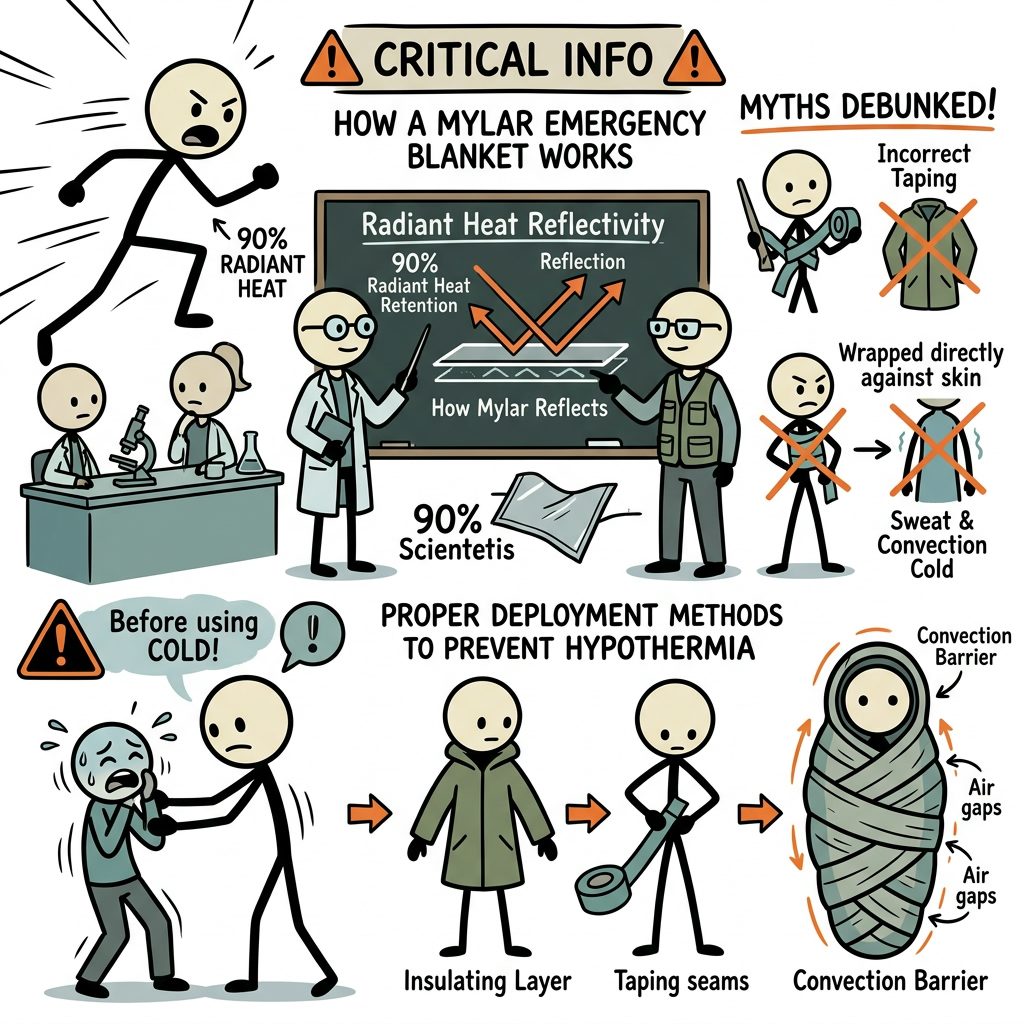
Every year, the mylar emergency blanket—ubiquitous in automotive kits, military loadouts, and ultralight packs—is treated as an autonomous, plug-and-play heat source. It is not. It is a passive optical barrier that manipulates one specific vector of thermodynamics while remaining profoundly vulnerable to three others. In this comprehensive emergency blanket guide, we analyze the rigorous science behind how space blankets work, dismantle lethal outdoor myths, and outline laboratory- and field-validated deployment protocols that turn an inexpensive sheet of foil into life-saving hypothermia prevention gear. For the practical checklist side, use the neighborhood preparedness network.
The Physics of Heat Transfer: How Space Blankets Actually Work
The human body functions as a biological furnace operating within an exceptionally narrow thermal margin. Core body temperature sits at approximately 98.6°F (37°C). If that core drops merely 3.6°F (2°C) down to 95°F (35°C), the clinical definition of hypothermia is met. To keep your core stable, metabolic heat production must equal heat loss to the ambient environment. Heat leaves the human body through four distinct thermodynamic pathways: radiation, conduction, convection, and evaporation. For the practical checklist side, use the emergency communication plan.
A standard foil blanket survival tool is designed almost exclusively to target one pathway: radiant heat transfer. To deploy it effectively, you must understand how all four mechanisms interact in an emergency Survival Scenarios.
1. Radiant Heat (Electromagnetic Radiation)
All physical objects with a temperature above absolute zero emit thermal radiation in the form of electromagnetic waves, primarily in the long-wave infrared spectrum (peaking around 9 to 10 micrometers for human skin). In a calm, temperate room at 68°F (20°C), thermal radiation accounts for roughly 60% of total metabolic heat loss from a stationary human body. Human skin has an extraordinarily high emissivity rating of approximately 0.98, meaning it radiates infrared energy almost as efficiently as an ideal theoretical "black body." For the practical checklist side, use the family emergency planning guide.
The space blanket counters this specific vector. Originally engineered by NASA's Marshall Space Flight Center in 1964 for the Apollo space program, the material relies on a vacuum-deposited vapor coating of pure aluminum applied to a biaxially-oriented polyethylene terephthalate (BoPET) substrate. Aluminum possesses an exceptionally low emissivity (around 0.03 to 0.05) and a reciprocal high reflectivity (reflecting 90% to 95% of thermal infrared). When thermal radiation strikes the metallized surface, it is reflected directly back toward the body rather than escaping into the wider environment.
2. Conductive Heat (Direct Contact Transfer)
Conduction is the transfer of heat through direct physical contact between solids or non-moving fluids, governed by Fourier's Law of thermal conduction:
q = -k × ∇T
Where q is local heat flux, k is thermal conductivity, and ∇T is the temperature gradient. Air is one of nature's finest thermal insulators when kept completely still, possessing a thermal conductivity (k) of approximately 0.026 W/(m·K). Pure aluminum, by sharp contrast, has a thermal conductivity of roughly 205 W/(m·K)—nearly 8,000 times greater than air. The BoPET plastic film substrate is micro-thin (typically between 10 to 12 microns thick, or roughly one-fifth the thickness of human hair).
Because the material is microscopically thin, it has an insulative R-value of virtually zero. If that aluminum-coated film is pressed flush against skin, damp clothes, or frozen granite, it ceases to act as an insulator and begins acting as a thermal bridge, rapidly pulling heat out of your body via direct conduction.
3. Convective Heat (Fluid Movement)
Convection occurs when a moving fluid (such as wind, air currents, or running water) strips away the thin layer of warmed air that forms around your body, known as the boundary layer. According to empirical wind chill formulations maintained by NOAA and the National Weather Service, convective cooling rates rise exponentially as wind speed climbs. A 10-micron sheet of BoPET is totally impermeable to gas; it creates a zero-permeability wind barrier. However, if the blanket is loosely draped rather than sealed, moving air currents create a Bernoulli effect—a low-pressure draft beneath the edges that pumps hot air out and draws freezing ambient air across your torso.
4. Evaporative Heat (Phase Change Cooling)
Whenever moisture evaporates from skin or inner clothing layers, it consumes a tremendous amount of energy known as the latent heat of vaporization—roughly 2,260 kilojoules per kilogram of evaporated water. Sweating or wearing wet clothing drains heat from your core at speeds up to 25 times faster than dry air. Because Mylar is chemically non-porous, moisture vapor cannot pass through it. If deployed improperly, the blanket traps internal condensation, soaking base layers and dramatically accelerating convective and conductive heat loss.
Debunking Lethal Space Blanket Myths
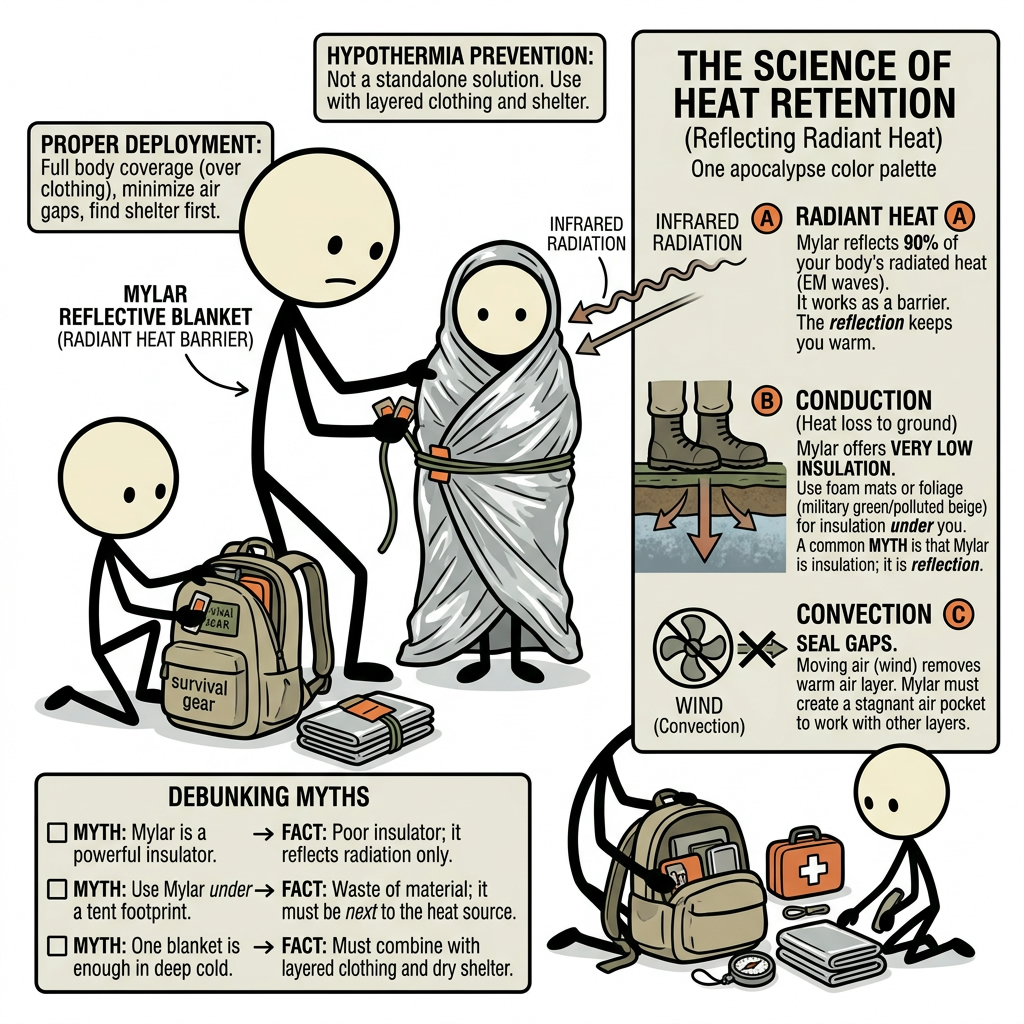
Few pieces of outdoor gear suffer from as much urban legend and tactical misunderstanding as the emergency foil blanket. These persistent misconceptions often originate from television survival tropes, military hearsay, or poor interpretations of physics. Believing these myths can cause you to build an unintentional conductive heat sink that accelerates hypothermia.
| Survival Myth | The Underlying Physics | Field Reality |
|---|---|---|
| "The blanket actively warms you up." | Mylar is a zero-energy passive reflector. It possesses no chemical or electrical thermal generation capacity. | Without a metabolic heat engine or trapped thermal layer, a space blanket remains dead cold. |
| "Wrapping tight like a burrito traps maximum heat." | Eliminates the insulative air gap, creating direct contact conduction through thin plastic. | Compressing layers crushes clothing loft, drastically speeding core heat drain. |
| "Silver side in vs. silver side out is critical." | Dual-sided vapor deposition yields identical emissivity; on single-sided sheets, clear BoPET absorbs negligible IR. | Orientation yields less than a 3% variance in field reflection tests compared to seal integrity. |
| "It replaces a sleeping pad on frozen ground." | R-value is near zero; conduction to earth occurs through direct mechanical contact points. | Direct ground placement drains body heat into the earth via high-efficiency conduction. |
Myth 1: "The blanket generates its own heat."
An emergency blanket does not generate BTUs. It is fundamentally an infrared mirror. If an individual is severely hypothermic, their endogenous thermoregulation systems have shut down. According to clinical protocols established by the Wilderness Medical Society (WMS), patients in Stage II or Stage III hypothermia lose the ability to shiver, drastically dropping internal heat production. Wrapping a shivering-depleted victim in a space blanket without adding an active external heat source (such as chemical heat packs on the axillae and groin, or warm water bladders) simply traps them in a cold reflective cocoon.
Myth 2: "Tight skin contact maximizes reflection."
The most dangerous thing you can do in sub-freezing weather is strip down and pull a Mylar sheet directly over bare skin. Radiant heat needs a short optical gap to reflect efficiently. When you wrap a sheet tightly around bare skin or saturated clothing, you convert radiant dissipation into direct conductive cooling. The micro-thin foil instantly equalizes to the freezing ambient air temperature, turning the interior surface into an active conductive heat drain. A structural air gap must exist between the skin and the reflective film.
Myth 3: "Orientation makes or breaks the blanket's performance."
Survivalists frequently argue whether the silver side should point inward or outward. Many commercial blankets feature dual-sided metallization; in these models, thermal emissivity is identical on both faces, rendering the argument completely moot. On single-sided blankets (which have a colored exterior, typically high-visibility orange or olive drab), physics shows that the metallized aluminum surface should face the radiant body to prevent minor surface absorption losses through the BoPET substrate layer. However, laboratory thermal imaging indicates this orientation delta affects heat retention by less than 3% to 5%. In a frantic emergency scenario, fussing over orientation while leaving the blanket open to the wind wastes precious minutes and causes critical core heat loss.
Myth 4: "Mylar is tough enough to act as an anchor point."
Standard consumer emergency blankets rely on unreinforced 12-micron BoPET. While this film boasts incredible tensile strength along its axial plane when pristine, its tear propagation resistance is near zero. The moment the factory edge is nicked or punctured by a rock, a twig, or a standard grommet, line tension splits the sheet in two like wet tissue paper. Believing you can lash an unreinforced foil blanket down as an exposed lean-to in a 30-knot gale is a recipe for sudden, catastrophic gear failure.
Field-Tested Deployment: The Protocol Survival Methods
To use an emergency blanket guide in a real survival scenario, you have to treat the material as an optical heat shield and wind barrier—never as standalone insulation. To prevent hypothermia, you must combine dead-air space, conductive isolation, and sealed radiant reflection into a single protective system.
Method 1: The Wilderness Medical "Hypothermia Wrap" (Burrito Method)
Endorsed by the American Red Cross, the CDC, and the Wilderness Medical Society, this is the gold standard for stabilizing an incapacitated or cold-stressed patient in backcountry environments. It builds an engineered thermal envelope by layering distinct materials to defeat all four heat loss vectors.
- Isolate from the Earth (Anti-Conduction): Clear snow and mud. Lay down a closed-cell foam sleeping pad, an inflated mattress, spruce boughs, an empty dry pack, or dry forest debris. The insulation must measure at least two to four inches thick between the patient and the ground.
- Establish Trapped Loft (Dead Air Layer): Ensure the patient is wrapped in dry, lofty clothing—fleece, down, wool, or a sleeping bag. This loft creates thousands of pockets of stationary air, which act as the primary barrier against conductive heat loss.
- Deploy the Radiant & Vapor Barrier (Mylar Core): Encase the insulated individual inside the mylar emergency blanket. The blanket should sit outside the dry insulating loft, but inside an external protective shell. The shiny surface faces inward, reflecting radiant infrared back into the lofted garments.
- Seal the Perimeter (Anti-Convection): Fold the edges over and seal them with duct tape, heavy-duty clips, or secure tucks. Convective drafts must not penetrate the inner cavity.
- External Protection (Wind/Moisture Shell): Enclose the entire assembly in an outer tarp or bivy sack. This outer shell deflects rain, blocks wind, and shields the delicate Mylar layer from puncturing or tearing against brush and rough terrain.
Method 2: The Fire-Reflector Lean-To Wall
When you cannot safely wrap yourself without inducing heavy condensation, use the reflective physics of Mylar to warm an entire shelter space. In a fixed wilderness survival shelter, your fire heats by radiation, not warm air transfer (warm air rises straight up into the sky).
Erect a simple ridgepole lean-to. Instead of facing raw timber toward the fire, line the back wall and ceiling of your shelter with the foil sheet, metallized side facing the flames. Position the open shelter 4 to 6 feet from a long, slow-burning fire, with an earthen or log reflector wall built directly behind the flames.
Radiant heat emitted by the fire travels horizontally, strikes the Mylar back wall of your shelter, and reflects down across your entire body. This deployment bypasses the risk of internal moisture condensation, shields your bed from ambient wind, and warms your survival space through clean, reflected infrared energy.
Method 3: The Internal Clothing Vapor Barrier Liner (VBL)
In sub-zero alpine conditions, advanced mountaineers deploy the vapor barrier technique. If you hike or work in freezing environments, sweat vapor moves away from your skin, enters your down or synthetic mid-layers, hits the external dew point, and condenses. This destroys the insulative loft of your down jacket and leads to severe hypothermia.
To prevent this, you can wear a thin, breathable wicking base layer, cover it with a loosely shaped, non-breathable Mylar layer, and stack your heavy insulating garments on the outside. This configuration accomplishes two things:
- The reflective surface mirrors infrared heat back across your skin boundary.
- The non-permeable film stops moisture vapor from penetrating your thick lofted coats, protecting your primary insulation from sweating out.
Caution: You must strictly regulate your exertion level when using a vapor barrier. If you hike hard and overheat, sweat will pool rapidly against your skin. You must move at a measured, non-sweating pace.
Durability, Engineering, and Hardware Selection
Not all foil sheets are engineered to the same specifications. Knowing the technical differences between retail consumer foils and expedition-grade survival gear helps you choose the right tools for your kit and deploy them safely in the field.
Standard BoPET (Thin Mylar)
- Thickness: 10 to 12 microns (0.43 to 0.50 mil).
- Pack Weight: 1.5 to 2 ounces.
- Mechanical Properties: High tensile strength under flat linear pull, but virtually zero puncture-tear resistance. A single edge tear propagates across the entire sheet under moderate loads.
- Best Use Case: Disposable, single-use, ultralight redundancy packs, first-aid hypothermia wrap cores, and flat-wall shelter reflectors.
Heavy-Duty Polyethylene (Laminated PE)
- Thickness: 28 to 35 microns (1.1 to 1.4 mil) or higher.
- Material Base: Vacuum-metalized spun-bonded polyethylene or reinforced ripstop layers (commonly found in high-end emergency bivies like those from Adventure Medical Kits).
- Pack Weight: 3.5 to 8 ounces.
- Mechanical Properties: Highly stretchable, puncture-resistant, self-arresting tear profiles, and significantly reduced crinkle noise.
- Best Use Case: Reusable survival shelters, primary emergency bivy sacks, dynamic alpine extraction, and high-wind environments.
Rigging and Modification in the Field
If you must rig a standard 12-micron sheet as a shelter or windbreak, you cannot simply cut holes or drive stakes through the thin film. Any puncture will quickly fail in high winds. Use the "Pebble and Cord" method to construct high-strength, field-expedient anchor points:
The "Pebble-and-Cord" Rigging Technique
- Locate a smooth, rounded stone, marble-sized nut, or clump of dry soil roughly the size of a nickel.
- Place the stone on the back of the Mylar sheet, roughly two inches inward from the corner or edge.
- Fold the foil around the stone, gathering the material behind it to form a distinct ball or knob.
- Tie a secure slipknot, clove hitch, or taut-line hitch using 550 paracord or bank line around the neck of the wrapped stone.
- Tension the line. The rounded stone evenly distributes tensile stress across a broad radius of the BoPET material, preventing puncture holes and edge tearing.
Environmental Hazards: Combating Wind, Rain, and Sweat
Deploying hypothermia prevention gear in the field rarely happens under ideal, dry laboratory conditions. Cold emergencies are driven by severe weather: driving rain, ocean spray, freezing sleet, and bitter winds. Environmental physics dictate how you adjust your setup on the fly.
Combating the Wind Chill Effect
Data from NOAA confirms that wind chill accelerates heat transfer far beyond static air figures. Moving air scrubs the warm, micro-insulative boundary layer off exposed skin and thin textiles. A fragile Mylar sheet deployed loosely in open wind will flap, rip, and pump air out through the edges via forced convection.
When working in open terrain without shelter, sit down with your back to the wind, tuck your knees to your chest in the fundamental Heat Escape Lessening Posture (H.E.L.P.), pull the blanket completely over your head and boots, and sit on your pack. Tuck every edge securely under your feet and thighs. This forms an air-sealed personal bivy dome, using your breath and core radiant heat to warm an isolated pocket of air while completely blocking convective wind chill.
The Condensation Trap and Evaporative Cooling
A trapped human body releases roughly 30 to 50 milliliters of insensible perspiration every hour, even while at rest. When stressed, shivering, or hyperventilating, that volume increases dramatically. Because BoPET does not breathe, this moisture condenses against the cool inner metallized wall within 30 minutes of a sealed wrap.
If your inner clothing gets soaked with condensation, its insulative loft drops to zero. As soon as the wind breaks through your shelter or your skin contacts the blanket, that moisture evaporates, pulling critical heat from your core. To avoid this condensation trap during extended, multi-hour survival scenarios:
- Never breathe into your internal survival cocoon. Human breath is saturated with near 100% relative humidity. Vent all exhalations outside the blanket.
- Leave a small, downwind vent open near the highest point of your wrap to vent moisture vapor while keeping direct drafts out.
- If you are walking or working to rescue yourself, do not wrap the blanket around your torso. Stash it until you are stationary. Moving inside a non-breathable Mylar blanket will soak your base layers in sweat, leaving you vulnerable to severe hypothermia as soon as you stop.
Clinical Triage: Recognizing Hypothermia Progression
A tool is only as effective as the operator's ability to assess when and how to deploy it. According to the CDC and outdoor triage systems, hypothermia moves through clear, progressive stages. Identifying these early clinical signs allows you to step in with an emergency wrap before motor skills degrade.
| Hypothermia Stage | Core Body Temp | Observable Symptoms | Immediate Action Protocol |
|---|---|---|---|
| Mild (Stage I) | 95°F – 98.6°F (35°C – 37°C) |
Alert, shivering vigorously, pale, cool skin, mild loss of fine motor coordination ("the umbles"). | Deploy wind/moisture barrier. Add dry thermal loft, drink warm caloric fluids, and encourage active muscle movement. |
| Moderate (Stage II) | 89.6°F – 95°F (32°C – 35°C) |
Shivering stops or becomes sporadic; confusion, apathy, slurred speech, stumble, muscle stiffness. | Patient cannot generate metabolic heat. Apply Hypothermia Wrap (Burrito Method) with active external heat sources. Do not walk them. |
| Severe (Stage III) | Below 89.6°F (< 32°C) |
Unresponsive, dilated pupils, slow or imperceptible pulse and breathing, muscular rigidity. | Extreme medical emergency. Handle very gently to avoid triggering ventricular fibrillation. Full hypothermia wrap, external heat, immediate rescue evacuation. |
Notice the critical inflection point at Stage II: shivering stops. When shivering halts, passive radiant barriers alone cannot reverse hypothermia. You must re-read this clinical line: wrapping a Stage II or III hypothermic patient in a solitary emergency blanket will not rewarm them. At that point, you must introduce external heat—such as warm water bottles or chemical packs placed against the armpits, chest, and groin—inside a properly insulated and sealed thermal wrap.
The Engineered Survival Protocol: Step-by-Step Deployment
When weather conditions deteriorate, stress levels spike, fine motor skills degrade, and cognitive tunneling sets in. Follow this simple, field-tested sequence to deploy an emergency space blanket safely and effectively:
- Halt and Assess: Stop immediately once you experience shivering, confusion, or severe weather exposure. Do not wait until you exhaust your glycogen reserves. Seek natural relief from driving wind and water.
- Eliminate Conductive Surface Sinks: Never sit or lay directly on the earth, rock, or snow. Sit on a dry pack, cut pine boughs, or place a foam pad down first.
- Shed Wet Layers (If Replacements Exist): If dry garments are available, peel off wet, cold clothes immediately. If you have no dry clothing, wring out all standing water, put the clothes back on, and layer insulating mid-layers directly over them.
- Create the Trapped Air Envelope: Put on all available insulative layers—jackets, beanies, extra shirts, or dry biological materials like leaves and grasses—to establish an insulative dead-air boundary layer.
- Wrap and Secure the Radiant Shield: Unfold the Mylar sheet and wrap it completely around the outside of your insulative layers. Orient the reflective side inward toward your core.
- Seal Open Edges: Crimp, tuck, or tape the edges to block convective airflow. Use pebble-and-cord ties on high-tension corners to anchor the blanket securely without puncturing the film.
- Maintain Moisture Venting: Keep your nose and mouth outside the wrap. Vent a tiny opening downwind to allow sweat vapor to escape, preserving your loft layers.
Survival gear is only as reliable as your understanding of the underlying physics. The mylar emergency blanket is a triumph of aerospace materials engineering, packing exceptional radiant heat reflection into a package that fits in your shirt pocket. But it is not magic. It cannot produce energy, and it cannot block conduction on its own. Respect the mechanisms of heat loss, master the physical requirements of dead-air insulation, and build layered survival shelters that keep you alive when exposure turns critical.
Frequently Asked Questions
How do foil emergency blankets work to keep you warm?
Emergency blankets use a vaporized aluminum coating on thin polyester film to reflect up to 90% of your body's radiated infrared heat back toward you, while also acting as an airtight barrier against convective wind chill.
Do emergency blankets generate their own heat?
No. Foil blankets only conserve and redirect the heat your body produces. If a person is already severely hypothermic, external heat sources (like warm water bottles or warm blankets) are needed in conjunction with the foil blanket.
Should the shiny side face inward or outward?
To retain body heat in cold weather, face the shiny silver side inward toward the body. In extreme desert heat where solar radiation is the primary hazard, facing the shiny side outward helps reflect direct sunlight away.
Can an emergency blanket insulate against cold ground?
No. Ultra-thin Mylar offers almost no conductive insulation. Lying directly on frozen or damp ground will drain your body heat rapidly through conduction; you must place insulating material, like dry leaves, pine boughs, or a foam pad, beneath you.
Are emergency foil blankets reusable?
Standard ultra-thin foil blankets tear easily once punctured and are nearly impossible to fold back into their original compact size. While usable in a pinch, reinforced, heavy-duty emergency bivvy sacks are far better suited for multiple uses.