⚡ Key Facts
- FEMA Directive: The Federal Emergency Management Agency (FEMA) explicitly recommends maintaining a physical cash reserve, noting that power outages routinely disable ATMs, point-of-sale terminals, and online banking systems. For the practical checklist side, use the community emergency preparedness guide.
- Infrastructure Vulnerability: According to NOAA, the United States experienced 28 separate billion-dollar weather and climate disasters in 2023 alone, many of which caused localized grid collapses that lasted from several days to weeks. For the practical checklist side, use the neighborhood preparedness network.
- The Small Bill Advantage: During a prolonged power outage, merchants cannot make change for large bills; emergency preparedness experts recommend that at least 50% of your cash reserve consist of $1, $5, and $10 bills.
- The Red Cross Standard: The American Red Cross includes physical currency in its list of essential survival supplies, categorizing it alongside water, non-perishable food, and first-aid supplies.
Imagine standing at a gas pump with a storm bearing down, your family in the car, and a highway evacuation route mapped out. You swipe your debit card, but the screen remains blank. The gas station's backup generator is running the pumps, but the cellular network that processes credit transactions is completely offline. In our highly digitized, tap-to-pay society, we rarely think about the complex web of electricity, satellite links, and fiber-optic cables that validate our transactions. When a natural disaster, cyberattack, or grid failure severs those links, your digital wealth becomes instantly inaccessible. Having a strategic physical cash reserve is not about paranoia; it is a foundational pillar of modern emergency preparedness that ensures you maintain agency and purchasing power when the systems we rely on falter.
The Vulnerability of the Cashless Society
Modern banking is a marvel of convenience, but it possesses a single, fragile point of failure: it requires a continuous connection to both power and teleemergency communication plans. When a severe weather event strikes—whether it is a hurricane monitored by NOAA, an earthquake tracked by the USGS, or a severe winter storm—utility poles are often the first infrastructure to fail. When the power goes out, local ATMs go dark. Even if a business has a backup generator to keep its lights on, it cannot process credit card or mobile payments if the local cellular towers or internet service providers are down.
This is not a theoretical scenario. During the aftermath of Hurricane Sandy, large swaths of New York and New Jersey were plunged into a cash-only economy for over a week. Residents with thousands of dollars in their bank accounts found themselves unable to buy basic supplies like ice, fuel, or hot food because merchants could only accept physical currency. The Federal Reserve Bank of New York noted that cash demand spiked dramatically immediately following the storm, highlighting how quickly citizens revert to physical currency when digital systems fail.
Furthermore, cyber threats to financial infrastructure are on the rise. Cybersecurity experts and government agencies regularly warn that regional financial institutions and payment processors are prime targets for ransomware attacks. A successful cyberattack on a major payment gateway could lock out millions of cardholders nationwide for days, regardless of local weather conditions. In these moments, possessing physical emergency cash is the only way to guarantee you can acquire food, medicine, and transport.
The Psychology of Cash in a Crisis
During a localized or national emergency, human behavior changes rapidly. Panic buying can deplete store shelves within hours, and business owners face immense stress. In these high-tension environments, cash functions as a universal solvent. It simplifies transactions, eliminates the risk of fraud or chargebacks for the merchant, and speeds up the checkout process when electronic systems are down.
For an individual, holding physical currency provides a psychological buffer. It reduces panic, allowing you to make rational, calculated decisions rather than acting out of desperation. When you know you have the immediate means to pay for a hotel room, a tank of gas, or a mechanic's help, your capacity to navigate a crisis calmly increases exponentially. This psychological resilience is a core tenet of comprehensive emergency preparedness.
Determining Your Target Reserve Amount
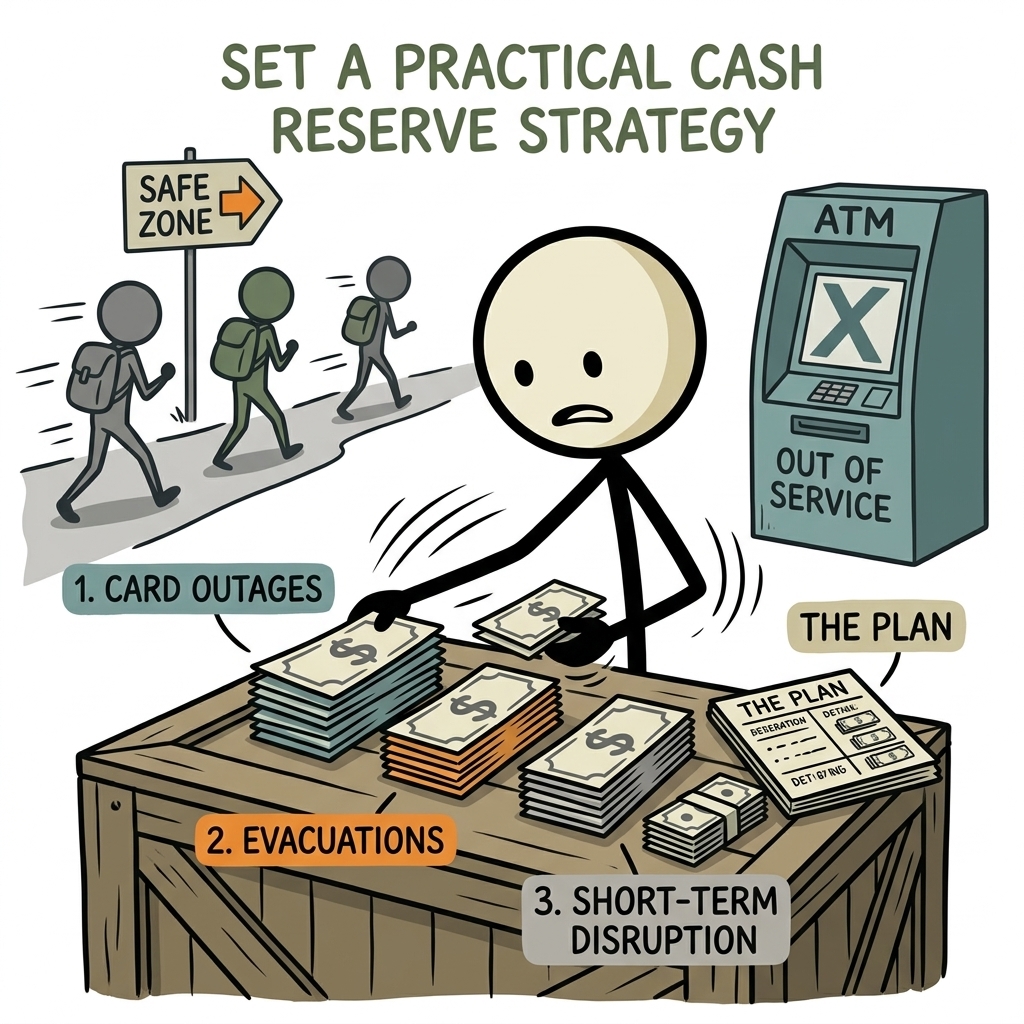
A common question in emergency preparedness circles is: "How much emergency cash is enough?" There is no one-size-fits-all answer, as your target reserve depends heavily on your household size, geographic location, and specific vulnerabilities. However, a practical strategy involves planning for three distinct tiers of disruption: immediate short-term localized outages, evacuation scenarios, and extended regional grid failures.
To build a realistic budget, you must calculate your baseline daily survival expenses. This is not your normal daily spending, which includes subscription services and online shopping. Instead, it is the bare-minimum cost to keep your family fed, hydrated, warm, and moving toward safety. Use the following baseline categories to calculate your daily emergency operational cost:
- Fuel: The cost of filling your primary vehicle's tank twice (essential for evacuation).
- Lodging: The average cost of two nights in a mid-range motel outside your immediate threat zone.
- Food & Water: The cost of purchasing three days of shelf-stable food and bottled water for all family members and pets.
- Critical Supplies: A buffer for emergency medication, basic tools, or cold-weather gear.
The Tiered Cash Strategy
Rather than aiming for an arbitrary, overwhelming number, break your emergency cash goal into manageable phases. This tiered approach allows you to build your reserve incrementally without straining your monthly household budget.
| Tier Level | Duration & Scenario | Target Amount (Average Household) | Primary Objective |
|---|---|---|---|
| Tier 1: Local Disruption | 48 to 72 Hours (Power outage, localized storm) | $200 – $400 | Purchase fuel, ice, fresh food, and basic hardware supplies locally. |
| Tier 2: Evacuation Event | 3 to 7 Days (Wildfire, hurricane evacuation) | $500 – $1,200 | Secure lodging, long-distance fuel, meals on the road, and minor vehicle repairs. |
| Tier 3: Extended Grid Failure | 7 to 14 Days (Severe regional infrastructure collapse) | $1,500 – $3,000+ | Sustain household independence, trade for critical resources, and cover emergency medical fees. |
For most households, starting with a Tier 1 goal of $300 is highly achievable. Once that milestone is met, you can systematically divert small amounts of cash over time to reach Tier 2 and Tier 3 levels. Remember, the goal of emergency cash emergency preparedness is to create a practical safety net, not to hoard paper currency at the expense of your active, interest-bearing savings accounts.
The Emergency Cash Checklist: Denomination Strategy
Having a thousand dollars in emergency cash is incredibly useful, but if that thousand dollars consists of ten $100 bills, you may find yourself in a difficult position during a crisis. Imagine trying to buy a $5 gallon of milk or a $10 bag of ice from a local merchant whose electronic cash register is dead. If they have no way to make change, you will be forced to either walk away empty-handed or pay $100 for a $5 item. In a crisis, merchants will fiercely guard their small bills and coins to keep their business running.
To prevent this, your emergency cash checklist must prioritize a highly diversified denomination structure. You want to be able to pay the exact amount whenever possible, preserving your own change and making transactions fast and seamless for the merchant.
The Ideal Denomination Breakdown
When assembling your cash reserve, use the following percentage-based breakdown as your guide. This distribution optimizes both the physical volume of the cash (making it easy to store and transport) and its practical utility in real-world transaction scenarios.
- $1 Bills (10% of total value): Critical for exact-change purchases, small tips, or buying single bottles of water. If you have a $500 reserve, keep $50 in singles.
- $5 Bills (20% of total value): The workhorse of emergency transactions. Perfect for small food items, ice, or quick tolls. Keep $100 in fives for a $500 reserve.
- $10 Bills (30% of total value): Provides excellent flexibility for mid-range purchases like basic hardware, batteries, or simple meals. Keep $150 in tens.
- $20 Bills (30% of total value): The standard ATM denomination. Highly accepted and useful for larger transactions like refueling your vehicle. Keep $150 in twenties.
- $50 or $100 Bills (10% of total value): Reserved strictly for high-value transactions, such as paying for a motel room, securing a tow truck, or purchasing major equipment like a generator. Keep only one or two large bills in your active kit.
Additionally, do not overlook the value of physical coins. Keeping one or two rolls of quarters ($10 to $20 total) in your emergency kit can be incredibly useful for older laundromats, vending machines, or toll booths that do not feature modern digital interfaces. Pack your coins securely in heavy-duty plastic bags or original paper rolls to prevent them from rattling and tearing your storage gear.
Storage, Security, and Portability
Once you have compiled your cash reserve using the emergency cash checklist, you must address the dual challenges of security and accessibility. If your cash is too secure (e.g., in a safe deposit box at a local bank), you cannot access it during a weekend power outage or a sudden evacuation. If it is too accessible (e.g., sitting in a drawer by the front door), it is vulnerable to theft, fire, or accidental spending.
The solution is a decentralized, tiered storage strategy that balances protection with rapid mobility. By splitting your cash reserve into distinct locations, you mitigate the risk of losing your entire emergency fund to a single event like a home burglary or a localized house fire.
Home Base: The Fireproof Safe
The bulk of your Tier 2 or Tier 3 emergency cash should be kept at home in a high-quality, fireproof and waterproof safe. When shopping for a safe, look for independent certifications such as a UL (Underwriters Laboratories) rating. A safe rated for 1 hour of fire protection at 1700°F is the industry standard for protecting paper documents and currency.
To maximize security, ensure your safe is physically bolted to the floor joists or wall studs in an inconspicuous location. Do not place it in obvious areas like the master bedroom closet or the home office, which are the first places burglars search. Instead, consider installing it in a dry basement, a guest room closet, or behind a false panel. To protect the paper currency from moisture damage, mold, and humidity inside the safe, seal the cash in airtight, waterproof bags alongside a few silica gel packets.
On the Move: The Grab-and-Go Kit
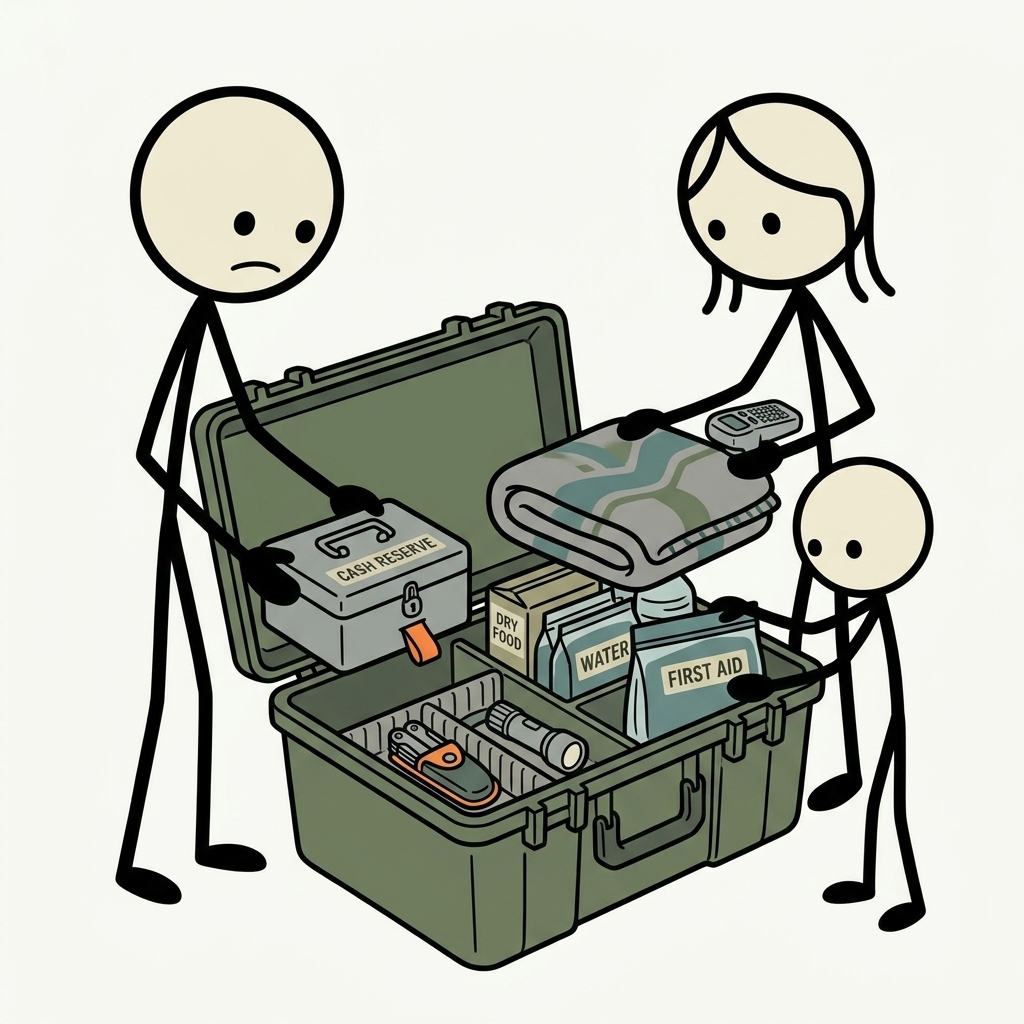
A portion of your cash reserve—specifically your Tier 1 fund (around $200 to $300)—should be integrated directly into your family's emergency "go-bag essentials guide" or Go-Bag Builder. This cash must be packed in a highly portable, discreet manner so that you can grab it and leave your home in under sixty seconds if an evacuation order is issued by local authorities.
- Discretion is Key: Avoid storing cash in bright, obvious bank envelopes or clear plastic sleeves. Instead, use opaque, waterproof utility pouches that blend in with the rest of your emergency gear.
- Everyday Carry (EDC) Cash: Keep a small, secondary reserve of cash ($50 to $100) tucked away in your daily wallet or purse, completely separate from your primary spending money. This ensures that even if you are away from home when a localized card outage strikes, you have immediate purchasing power.
- Vehicle Stash: Consider hiding a small emergency bill (such as a single $20 or $50 note) inside a secure, hidden compartment in your vehicle. This can save you if you lose your wallet or run out of fuel in an area with no cellular service.
Operational Rules for Your Cash Reserve
An emergency cash reserve is not a static asset; it is an active survival tool that requires consistent management and discipline. Without strict operational rules, it is incredibly easy for your hard-earned reserve to slowly erode over time due to convenience spending, inflation, or simple neglect.
To maintain the integrity of your emergency cash emergency preparedness strategy, implement the following three organizational rules within your household:
1. The "No Dip" Rule
The most common failure point of a home cash reserve is the temptation to borrow from it for non-emergencies. Whether it is paying the delivery driver, buying school fundraiser items, or grabbing quick cash for a weekend garage sale, "dipping" into the stash with the promise to replace it later quickly depletes your safety net. Treat your emergency cash with the same reverence you would treat a fire extinguisher: you only break the seal when there is an active crisis. If you must use emergency cash for a legitimate unexpected expense, make it an absolute priority to replenish the exact denominations within the next pay cycle.
2. The Annual Audit and Rotation
At least once a year—coinciding with daylight saving time changes or your annual smoke detector battery replacements—conduct a thorough audit of your cash reserve. Take the cash out of its secure storage, count it to verify the total, and inspect the physical bills for any signs of moisture, mold, or deterioration. This is also the perfect time to rotate your bills. If you have crisp, brand-new bills in your safe, you can swap them into your daily wallet and replace them with older, circulated bills to ensure your emergency stash remains clean, dry, and highly pliable.
3. Inflation Adjustments
A cash reserve sitting in a safe does not earn interest, meaning its purchasing power will naturally degrade over time due to inflation. A $500 cash reserve established in 2015 buys significantly less fuel, food, and lodging today. To combat this, review your target reserve calculations every two to three years. Adjust your total cash holdings upward to reflect the current cost of living in your region, ensuring that your emergency fund retains its real-world utility when you need to deploy it.
Integration with Your Broader Preparedness Plan
While cash is a powerful tool, it is important to remember that physical currency is not a replacement for tangible emergency supplies. In a severe, long-term catastrophe, currency of any kind may temporarily lose its utility if there are simply no goods available to purchase. Therefore, your cash strategy must exist in harmony with your physical preparedness efforts.
Ensure your home is stocked with at least a two-week supply of clean drinking water (one gallon per person per day, as recommended by the CDC), shelf-stable food, necessary prescription medications, and alternative power sources like solar chargers or portable generators. Cash is your primary tool for navigating the transition phase of a crisis—the critical window where society is disrupted, but commerce is still functioning. By securing your physical supplies first, you reduce the amount of cash you will actually need to spend during the initial days of an emergency, preserving your financial resources for long-term recovery and relocation efforts.
Securing Your Financial Agency
True resilience is built on self-reliance and proactive planning. By establishing a structured, practical emergency cash reserve, you build a bridge over the chaos of sudden infrastructure failures, cyberattacks, and natural disasters. You transition from a position of vulnerability—where your ability to feed your family relies entirely on the stability of digital networks—to a position of absolute agency. Take the first step today: print out your emergency cash checklist, audit your wallet, set aside your first fifty dollars in small denominations, and secure them in a safe place. In an unpredictable world, having physical currency on hand is not just smart financial planning; it is the ultimate guarantee that you can protect, support, and guide your family through whatever challenges lie ahead.
Frequently Asked Questions
What should a emergency cash plan include?
Start with the immediate safety steps, the supplies and records your household needs, a communication plan, and a regular review schedule. Follow local official guidance during an active emergency.
How often should I review emergency cash preparations?
Review them at least twice a year and whenever your household, medication, location, or local risks change. Replace expired supplies and practice key steps.
Where can I find reliable emergency guidance?
Use local emergency management alerts and established public-health or emergency-management agencies. A blog guide should support, not replace, official real-time instructions.