⚡ Key Facts
- Cellular Fragility: According to the Federal emergency communication plans Commission (FCC), cellular networks experience traffic spikes of 300% to 500% during major regional crises, leading to immediate network congestion and dropped calls.
- Preparation Gap: FEMA reports that while 80% of Americans live in counties hit by a natural disaster, less than 40% have created a dedicated, physical family emergency plan communication plan.
- Critical Response Time: The American College of Emergency Physicians (ACEP) notes that having physical, accessible medical data on your person can reduce time-to-treatment for critical trauma patients by up to 15 minutes. For the practical checklist side, use the community emergency preparedness guide.
- School Reunification: Safe Kids Worldwide indicates that during school evacuations, chaotic reunions are reduced by 60% when parents provide pre-authorized, physical consent forms directly to school administrators.
Imagine a sudden, fast-moving emergency: an earthquake rattles your city, a flash flood forces immediate evacuations, or a localized power grid failure plunges your neighborhood preparedness network into darkness. Within minutes, cell towers are overwhelmed by millions of simultaneous connection attempts, rendering your smartphone little more than a paperweight. Your child is at school, your spouse is at work, and your digital address book is completely inaccessible behind a dead battery or a spinning loading icon. In these high-consequence moments, survival relies on low-tech, high-reliability systems. A physical, laminated emergency contact card is your family’s ultimate analog safeguard—an indispensable asset for emergency contact card emergency preparedness that ensures critical communication, medical data, and reunification plans remain intact when the digital world goes dark.
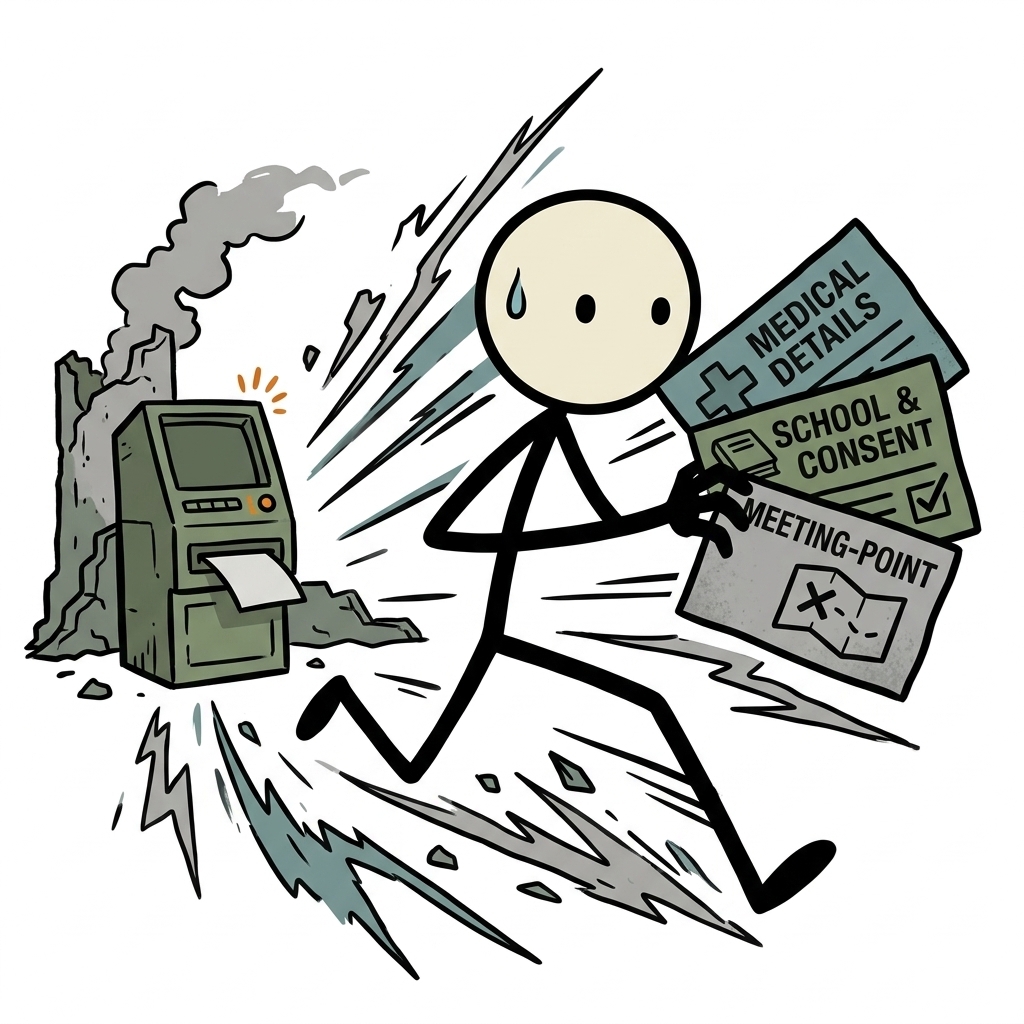
The Vulnerability of the Digital Grid
We live in an era of unprecedented digital convenience. However, our reliance on cloud storage, cellular networks, and smartphone batteries creates a dangerous single point of failure during a disaster. When a major crisis strikes, the infrastructure we rely on daily is often the first thing to fail.
According to the United States Geological Survey (USGS) and NOAA, severe weather events and seismic activity routinely disable physical cell towers, sever fiber-optic cables, and knock out power grids for days or even weeks. Even if the physical infrastructure survives, the sheer volume of network traffic during an emergency creates a digital bottleneck. First responders utilize prioritized communication bands, leaving civilian networks congested and unusable.
Furthermore, smartphones are fragile. They can drop and shatter during an evacuation, suffer water damage from heavy rain or flooding, or simply run out of battery power within hours. If you do not have your contacts, medical history, and meeting locations memorized, you lose access to your entire support network. Carrying a physical, offline emergency contact card bypasses these digital vulnerabilities entirely, providing a permanent, indestructible hard copy of your most vital information.
Why You Need a Physical Emergency Contact Card
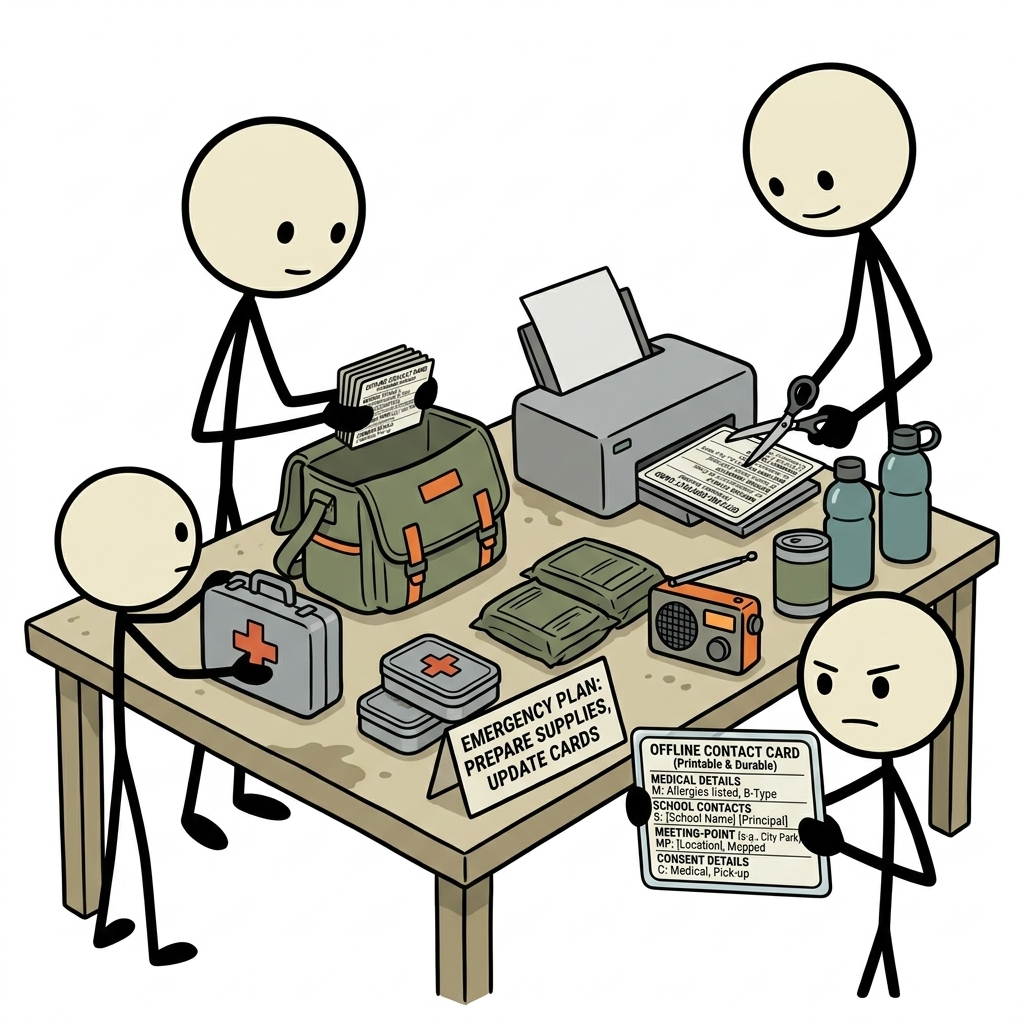
A physical card is more than just a list of phone numbers; it is a portable command center for emergency situations. When adrenaline surges during a crisis, cognitive function declines. Under extreme stress, even the most clear-thinking individuals can struggle to recall basic information, such as out-of-state phone numbers, specific medical dosages, or pre-planned evacuation routes.
Having an offline card reduces cognitive load when you need your wits about you the most. It provides clear, step-by-step instructions for yourself, your family members, and any first responders who may need to assist you. If you are rendered unconscious or unable to speak, your card acts as your voice, conveying life-saving medical details and emergency contact names to paramedics and emergency room staff.
For children, seniors, or family members with cognitive differences, these cards are particularly vital. If separated during an evacuation, a child can present their card to a police officer, teacher, or emergency worker, instantly establishing a line of communication with authorized guardians and providing necessary medical consent.
Anatomy of an Effective Emergency Contact Card
To be truly effective, an emergency card must be concise, highly legible, and packed with actionable data. It must fit easily into a wallet, backpack, or glove compartment while remaining organized enough to be read in low-light conditions. A comprehensive card is divided into four distinct, high-priority quadrants.
1. Primary and Secondary Contact Information
This section list the core individuals who need to be reached in an emergency. It should bypass local numbers in favor of an out-of-state contact whenever possible. During regional disasters, local phone lines are often jammed, but long-distance lines remain open. FEMA recommends designating one out-of-state relative or friend to act as a central "communication hub" for your family.
- Full Legal Names: Include middle initials to avoid identification confusion with medical authorities.
- Local Contacts: Home, work, and mobile numbers for immediate family members.
- Out-of-State Contact: Name, phone number, and physical address of your designated long-distance coordinator.
- Alternative Communication Channels: Include email addresses and social media handles, which may work via text-only data networks even when voice lines fail.
2. Medical and Critical Health Details
If you are injured or incapacitated, first responders need immediate access to your medical profile. This quadrant of the card must be highly accurate and updated regularly to reflect your current health status.
- Blood Type: Vital for rapid transfusions during trauma care.
- Severe Allergies: List life-threatening allergies to medications (such as penicillin), foods, or environmental triggers (like bee stings).
- Chronic Conditions: Note conditions such as diabetes, epilepsy, hemophilia, or severe heart conditions.
- Current Medications: List names and exact dosages of daily, life-sustaining prescriptions (e.g., insulin, blood thinners).
- Primary Care Physician: Name, clinic name, and direct phone number.
3. Reunification and Meeting Points
When communication fails, pre-planned meeting locations are your primary method of physical reunification. Your card should explicitly list these locations so every family member knows exactly where to go without needing to send a text message.
- Neighborhood Meeting Point: A specific spot right outside your home (e.g., "The oak tree at the corner of Elm Street") for immediate emergencies like a house fire.
- Regional Meeting Point: A location outside your immediate neighborhood (e.g., a specific library, community center, or place of worship) in case of localized evacuations.
- Out-of-Town Meeting Point: A designated safe zone or hotel in a neighboring city in the event of a wide-scale regional evacuation.
4. Legal Consent and School Release Details
For parents, this is a critical component that can prevent legal delays during a crisis. If you cannot physically reach your child's school or childcare facility, emergency cards must authorize specific individuals to pick up your children and consent to emergency medical treatment.
- Authorized Pickup Persons: Full names and phone numbers of trusted neighbors or local relatives authorized to collect your child.
- Medical Consent Waiver: A brief, signed statement authorizing emergency medical personnel to treat your child if a parent or guardian cannot be reached.
- School/Daycare Details: Facility name, address, main phone line, and the child's specific classroom or student ID number.
The Ultimate Emergency Contact Card Checklist
Before you begin designing and printing your cards, use this comprehensive emergency contact card checklist to gather all necessary data. Having this information organized beforehand ensures your cards are accurate, complete, and highly functional.
| Category | Required Information Details | Verification Source |
|---|---|---|
| Personal Identity | Full legal name, date of birth, photo (optional but recommended for children), and home address. | Driver's license, birth certificate. |
| Primary Contacts | Spouse/partner mobile, work, and email. Local guardian details if applicable. | Direct confirmation with contacts. |
| Out-of-State Contact | Name, landline, mobile, email, and physical home address of a contact outside your immediate region. | Coordination call with designated contact. |
| Medical Data | Blood type, severe drug/food allergies, active medical conditions, and critical daily prescription medications. | Primary care physician or medical portal. |
| Insurance Details | Health insurance provider name, policy number, group number, and member services phone number. | Physical health insurance card. |
| Reunification Locations | Addresses and descriptions of your neighborhood, regional, and out-of-town meeting places. | Family emergency plan agreement. |
| Legal Authorizations | Names of school pickup designees, and a signed medical treatment consent statement for minors. | School registration records. |
Step-by-Step Guide to Creating Your Offline Cards
Creating a durable, highly functional offline emergency contact card requires careful attention to detail, material selection, and formatting. Follow this step-by-step guide to build cards that will survive the elements and stand up to daily wear and tear.
Step 1: Gather and Verify Your Data
Using the checklist above, collect all relevant information for every member of your household. Do not rely on memory. Call your out-of-state contact to confirm their phone numbers and ensure they understand their role as your family's communication anchor. Double-check drug names and dosages with your actual prescription bottles to prevent medical errors.
Step 2: Choose Your Format and Layout
Keep the design clean and uncluttered. Use a high-contrast sans-serif font (such as Arial or Helvetica) at a size no smaller than 8-point to ensure readability in low-light conditions or stressful scenarios. You can use simple spreadsheet software, a word processor, or a dedicated graphic design tool to lay out the card. Divide the card into distinct sections using bold headers or colored borders.
Step 3: Print on High-Quality Materials
Standard printer paper is highly vulnerable to water, tearing, and general degradation. For true resilience, print your cards on heavy cardstock (at least 110 lb.) or synthetic, waterproof paper (such as Rite in the Rain paper or Teslin). If using standard paper, use a laser printer rather than an inkjet printer; laser toner will not run or bleed if the card gets wet.
Step 4: Waterproof and Protect
Once printed, cut the cards to standard wallet size (approx. 2.2" x 3.4" or 3.5" x 5" for backpack cards). Laminate each card using a heavy-duty, 5-mil or 7-mil laminating pouch. Ensure there is a sealed plastic border of at least 1/8 inch around all edges to prevent water from seeping into the paper. Alternatively, you can place the cards inside heavy-duty, waterproof plastic badge holders.
Special Considerations for Vulnerable Groups
A one-size-fits-all approach does not work for emergency preparedness. Different members of your household have unique needs that must be reflected on their specific cards.
Children and School-Aged Youth
Children's cards should be designed to be read by teachers, emergency workers, or law enforcement officers. Include a recent color photo of the child on one side of the card. This is invaluable for identification if they become separated from you. Clearly state their school name, teacher's name, and classroom number. Most importantly, list the names of individuals authorized to pick them up from school under emergency protocols, along with a signed, dated medical consent clause that permits treatment in your absence.
Seniors and Medically Fragile Individuals
For older adults or those with complex medical needs, the medical section of the card should take precedence. Include detailed information regarding mobility assistance devices, life-support dependencies (such as oxygen therapy), and cognitive conditions like dementia or Alzheimer's. If the individual has a legally binding Do Not Resuscitate (DNR) order or a living will, note this clearly on the card, along with instructions on where the physical legal documents are stored.
Pets and Service Animals
Our animals rely on us entirely during a disaster. Create a dedicated emergency card for each pet in your household. Include their name, breed, microchip number, veterinary contact info, and critical vaccination dates (especially rabies). If your pet requires daily medication, list the dosage and administration instructions. This card can be attached directly to their carrier or travel crate during an evacuation.
Where to Store and How to Carry Your Cards
An emergency contact card is useless if it is not accessible when a disaster strikes. Implement a redundant storage strategy to ensure these cards are always within arm's reach of every family member.
Every member of your family should carry a wallet-sized card in their everyday carry (EDC) setup. Place it directly behind their primary ID card or driver's license, where first responders are trained to look. For children, secure the card inside their school backpack, ideally in a zippered, waterproof internal pocket, or laminate it and attach it to the interior lining with a heavy-duty lanyard.
Keep duplicates in all family vehicles. Place a card in the glove compartment, taped to the inside of the lid, or tucked into the sun visor. This ensures that if you are involved in a traffic accident or forced to abandon your vehicle during an evacuation, the information remains with you.
Finally, integrate these cards into your home emergency supplies. Store copies inside your family’s Go-Bag Builders, get-home bags, and first aid kits. By maintaining multiple copies across different locations, you build a resilient, redundant safety net that ensures critical information is never out of reach.
Maintaining and Updating Your Emergency Cards
Emergency preparedness is not a one-time event; it is an ongoing process of refinement and maintenance. Your family’s contact information, medical prescriptions, and daily routines will change over time, meaning your emergency cards must change with them.
Establish a routine to review and update your cards at least twice a year. A simple way to remember this is to align your emergency card audit with daylight saving time changes—when you change the batteries in your smoke detectors, review your emergency contact cards. Check that phone numbers are still active, medical dosages are correct, and school pickup authorizations are accurate for the current academic year.
If any information has changed, do not attempt to write over the laminated card with a marker, as this can easily smudge or wear off. Print a fresh, updated version, cut it to size, and re-laminate it. Destroy the outdated cards immediately to prevent confusion during a high-stress crisis.
Use these update intervals to run a family communication drill. Practice calling your out-of-state contact, discuss your meeting locations, and ensure everyone—especially children—knows exactly where their offline card is located and how to use it. This simple practice builds muscle memory, reduces anxiety, and ensures your family is prepared to act calmly and decisively when seconds count.
Empower Your Family with Analog Resilience
In a world increasingly dependent on digital infrastructure, the simplest tools often provide the greatest security. Creating physical, offline contact cards is a low-cost, high-impact step that significantly elevates your household’s resilience. By gathering accurate medical data, establishing clear reunification points, and securing this information in a durable, waterproof format, you protect your family from the chaos of a collapsed communications grid. Do not wait for the next storm, power outage, or emergency to test your preparedness. Take action today: gather your information, print your cards, and secure your family's vital lifeline to one another.
Frequently Asked Questions
What should a emergency contact card plan include?
Start with the immediate safety steps, the supplies and records your household needs, a communication plan, and a regular review schedule. Follow local official guidance during an active emergency.
How often should I review emergency contact card preparations?
Review them at least twice a year and whenever your household, medication, location, or local risks change. Replace expired supplies and practice key steps.
Where can I find reliable emergency guidance?
Use local emergency management alerts and established public-health or emergency-management agencies. A blog guide should support, not replace, official real-time instructions.