⚡ Key Facts
- Carbon Monoxide Risk: The Centers for Disease Control and Prevention (CDC) reports that over 400 Americans die annually from accidental, non-fire-related carbon monoxide (CO) poisoning, frequently caused by the unsafe indoor use of outdoor heating and cooking devices during power outages. For the practical checklist side, use the community emergency preparedness guide.
- Indoor Storage Limits: The National Fire Protection Association (NFPA) Standard 58 strictly limits indoor propane storage to cylinders with a maximum water capacity of 2.7 pounds (typically 1-pound net weight canisters), with an aggregate limit of 5 pounds in residential dwellings. For the practical checklist side, use the neighborhood preparedness network.
- Cold Weather Physics: Standard butane stoves fail to vaporize fuel at temperatures below 31°F (0.5°C), rendering them useless in freezing winter emergencies unless specialized isobutane blends or liquid fuels are utilized. For the practical checklist side, use the emergency communication plan.
- Shelf-Life Disparity: Liquefied petroleum gases (propane and butane) have an indefinite shelf life when stored in sealed steel canisters, whereas liquid fuels like white gas degrade within two to five years, and stabilized gasoline degrades in as little as 12 months. For the practical checklist side, use the family emergency planning guide.
When a severe weather event, grid failure, or natural disaster strikes, the immediate focus of emergency preparedness is often directed toward securing clean water and non-perishable food. However, a critical vulnerability quickly emerges in the hours and days following a crisis: the ability to cook. According to the Federal Emergency Management Agency (FEMA), a warm meal does more than provide necessary caloric intake during a crisis; it delivers vital psychological comfort, maintains core metabolic body temperature in cold environments, and ensures that raw or dehydrated survival rations can be safely prepared. Selecting, storing, and utilizing the correct emergency cooking fuel is not merely a matter of convenience—it is a foundational pillar of household safety and survival engineering.
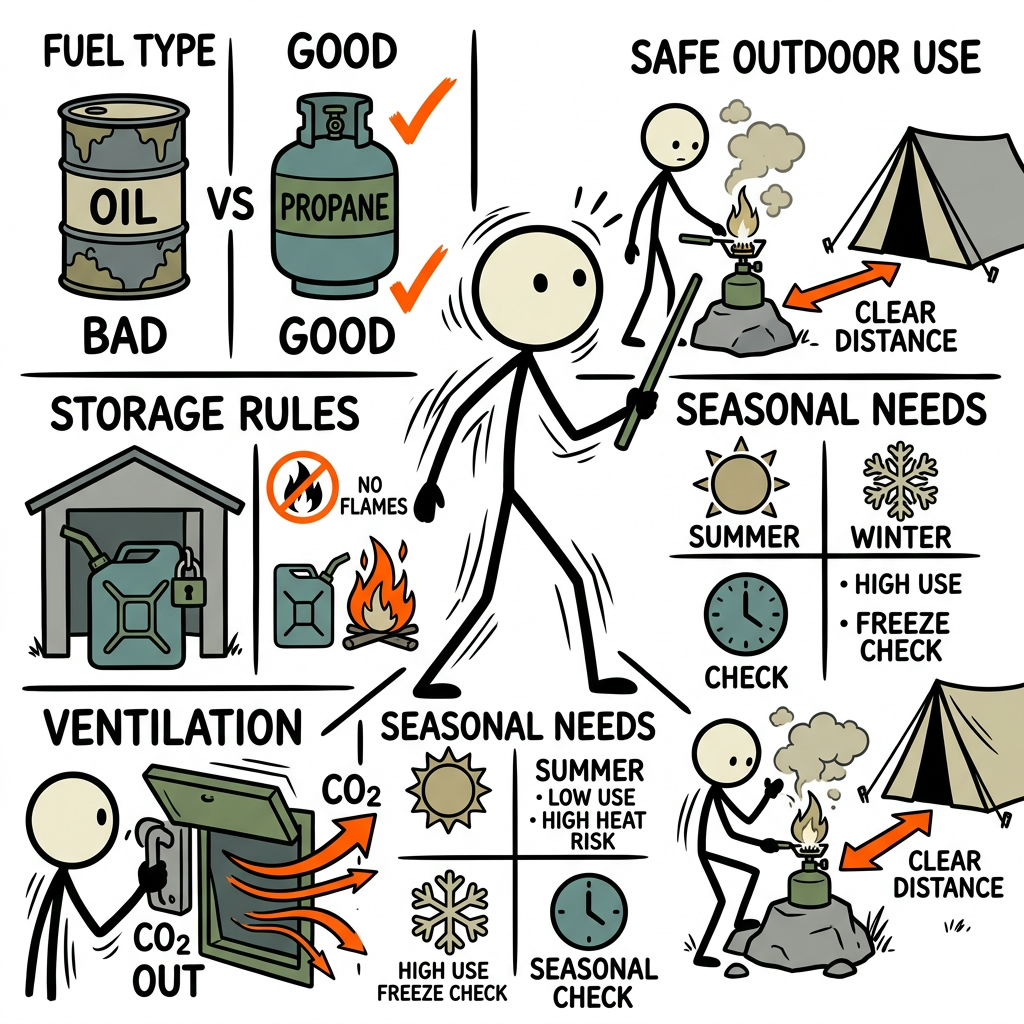
1. The Core Chemistry of Survival: Fuel Types Compared
To build an effective family emergency plan, you must first understand the chemical properties, advantages, and limitations of the primary fuels available for emergency cooking. No single fuel is perfect for every scenario. A robust strategy utilizes a tiered approach, matching specific fuels to indoor safety, extreme weather, or long-term off-grid survival.
Propane (Liquefied Petroleum Gas / LPG)
Propane is widely considered the gold standard of emergency cooking fuel. Under pressure, propane exists as a liquid inside steel cylinders, vaporizing into a highly flammable gas as it is released. It boasts an exceptionally high energy density of approximately 21,500 BTUs per pound.
- Pros: Indefinite shelf life; burns exceptionally clean; performs reliably in sub-freezing temperatures down to -44°F (-42°C); easily adjustable flame control.
- Cons: Highly pressurized cylinders require heavy steel packaging; cylinders are bulky and heavy; strict indoor storage limitations apply.
Butane
Butane is a popular choice for tabletop catering stoves and light-duty emergency kits. Like propane, it is stored as a liquid under relatively low pressure, allowing it to be housed in lightweight, aerosol-style aluminum canisters.
- Pros: Highly portable; inexpensive, compact stoves; extremely clean-burning with low carbon monoxide output compared to liquid fuels.
- Cons: Poor cold-weather performance; butane ceases to vaporize at 31.2°F (-0.4°C), making it virtually useless for outdoor winter cooking without specialized canister-warming techniques.
Isobutane/Propane Blends
Commonly used by backpackers, these pressurized canisters blend isobutane and propane (often in an 80/20 or 70/30 ratio) to balance weight and cold-weather performance. The addition of propane lowers the boiling point of the mixture, allowing the fuel to vaporize down to approximately 11°F (-11°C).
- Pros: Extremely lightweight; compact; highly efficient stoves; excellent for mobile or evacuation-based kits.
- Cons: Expensive per ounce compared to bulk propane; canisters cannot be easily refilled; performance still degrades as the canister empties in cold temperatures.
Liquid Fuels (White Gas, Kerosene, and Unleaded Gasoline)
Liquid fuel stoves, often referred to as multi-fuel or white gas stoves, utilize pressure pumps to atomize liquid fuel before ignition. White gas (refined petroleum light distillate) is highly pure and burns hot, while kerosene is a heavier, less refined oil that is highly stable but sootier.
- Pros: Outstanding cold-weather performance; multi-fuel stoves can run on unleaded automotive gasoline in an emergency; high heat output.
- Cons: Requires manual priming and pumping; high risk of fuel spills; white gas has a limited shelf life (typically 2 to 5 years); high carbon monoxide emissions require strict outdoor-only use.
Solid Fuels (Hexamine, Sterno/Gel, and Biomass)
Solid fuels represent the simplest cooking technology. Hexamine tablets burn with a high-intensity, concentrated flame, while Sterno (jellied alcohol) provides a gentle, low-heat flame. Biomass stoves burn wood, twigs, charcoal, or dried animal dung.
- Pros: Sterno is safe for indoor use; hexamine tablets are ultra-lightweight and waterproof; biomass is virtually unlimited and free to harvest.
- Cons: Low heat output (Sterno cannot easily boil large quantities of water); hexamine produces toxic, foul-smelling fumes; biomass produces heavy smoke, soot, and dangerous levels of carbon monoxide.
| Fuel Type | Boiling Point | Shelf Life | Indoor Safety Rating | Primary Emergency Application |
|---|---|---|---|---|
| Propane | -44°F (-42°C) | Indefinite | Restricted (Small canisters only) | All-weather home cooking, long-term storage |
| Butane | 31°F (-0.5°C) | Indefinite | Moderate (With ventilation) | Mild-weather tabletop cooking, short-term outages |
| Isobutane Blend | 11°F (-11°C) | Indefinite | Unsafe (Outdoor only) | Mobile evacuation kits, bug-out bags |
| White Gas | ~100°F (38°C) | 2–5 Years | Highly Dangerous (Outdoor only) | Extreme winter conditions, off-grid survival |
| Sterno (Gel) | N/A (Solid) | 2–5 Years | Safe (With minimal ventilation) | Indoor warming, low-heat cooking, medical sterilization |
| Biomass / Charcoal | N/A (Solid) | Indefinite (If dry) | Lethal (Strictly outdoor only) | Extended grid-down scenarios, backyard cooking |
2. Storage Rules & Shelf-Life Realities
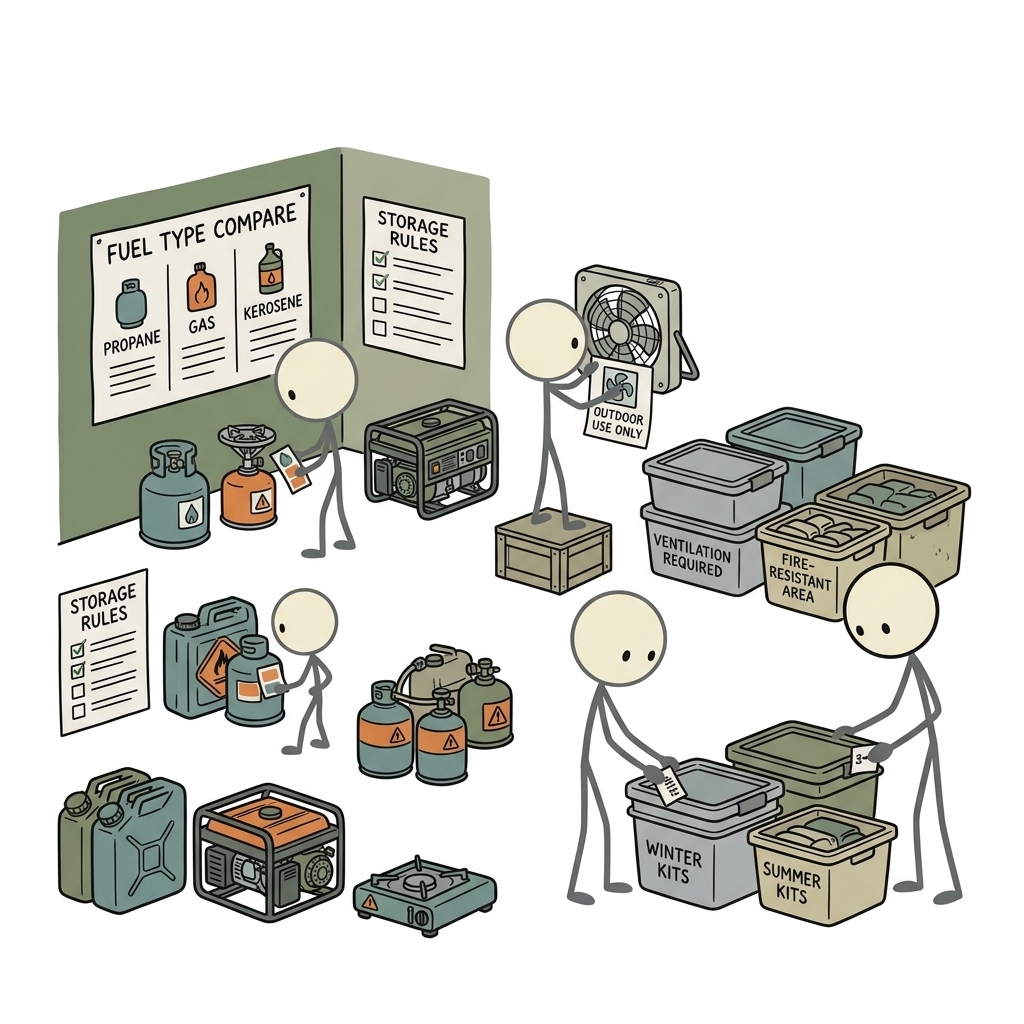
Proper storage is the cornerstone of emergency cooking fuel emergency preparedness. Storing highly flammable fuels requires strict adherence to physical science and local fire codes to prevent catastrophic accidents, structural fires, or toxic gas leaks.
Understanding the NFPA 58 Regulations
The National Fire Protection Association (NFPA) sets the safety standards for storing liquefied petroleum gases. Under NFPA 58, storing large propane cylinders (such as standard 20-pound barbecue tanks) inside a residential home, basement, or attached garage is strictly prohibited. If a relief valve on a large tank fails indoors, the heavy propane gas will pool along the floor, seeking ignition sources such as water heater pilot lights or appliance motors, resulting in a devastating vapor cloud explosion.
For indoor residential storage, you are permitted to store small, disposable DOT-39 cylinders (the green 1-pound propane canisters). However, the aggregate limit is 5 pounds of fuel per dwelling unit. Any quantity exceeding this must be stored in an exterior, detached structure, such as a well-ventilated shed or an open-air carport.
Shelf Life and Fuel Degradation
Not all fuels age equally. When designing your emergency storage system, you must account for chemical breakdown over time:
- Liquefied Gases (Propane & Butane): These fuels do not degrade. As long as the steel or aluminum canister remains free of rust, corrosion, and physical damage, the fuel inside will remain viable for decades. Inspect valves regularly for micro-leaks or degradation of the rubber O-rings.
- White Gas (Coleman Fuel): Once opened, white gas begins to oxidize and absorb moisture from the air. In a sealed, unopened metal can, it remains stable for up to 5 years. Once the seal is broken, it should be used within 2 years. Old white gas turns a yellowish color and can clog stove generators.
- Kerosene: Kerosene is highly hygroscopic (it attracts water). Over 12 to 24 months, condensation will form inside the storage container, leading to bacterial growth and fuel degradation. Always store kerosene in high-density polyethylene (HDPE) blue containers, treat it with a fuel stabilizer, and rotate your stock annually.
- Unleaded Gasoline: This is the least stable option. Untreated gasoline begins to break down within 3 to 6 months, forming gummy deposits that will ruin delicate multi-fuel stove jets. If you plan to use gasoline as a backup fuel, treat it immediately with a high-quality stabilizer (like STA-BIL) to extend its life to 12 months.
- Sterno/Gel Fuels: Over time, the alcohol inside gel canisters can evaporate if the lid seal is compromised. Store them in a cool, dry place, and check that the lids remain tightly sealed.
Safe Storage Best Practices
To maximize safety, always store your fuels according to the following protocols:
- Keep Off the Ground: Store metal canisters on wooden shelves or pallets rather than directly on concrete floors. Concrete holds moisture, which accelerates rust on the bottom rims of steel tanks.
- Temperature Control: Avoid storing fuels in areas where temperatures exceed 120°F (49°C), such as unventilated metal sheds or car trunks in the summer. High temperatures increase internal pressure, which can trigger safety relief valves to release flammable gas.
- Upright Orientation: Always store propane cylinders in an upright position. This ensures that the safety relief valve is in direct contact with the vapor space of the tank, rather than the liquid, allowing it to safely vent vapor if pressure spikes.
3. The Silent Killer: Ventilation & Carbon Monoxide Protocol
During a winter power outage, the temptation to bring an outdoor stove inside to cook or heat a room is incredibly high. Yielding to this temptation can be fatal. Carbon monoxide (CO) is an odorless, colorless, tasteless gas produced by the incomplete combustion of hydrocarbon fuels.
The Science of Incomplete Combustion
When a fuel burns with abundant oxygen, it undergoes complete combustion, producing heat, water vapor, and carbon dioxide ($CO_2$). However, in an enclosed space, the oxygen supply is rapidly depleted. As oxygen levels drop, the combustion process becomes incomplete, shifting the chemical output from relatively harmless $CO_2$ to highly toxic carbon monoxide ($CO$).
Carbon monoxide binds to hemoglobin in the human bloodstream with an affinity 200 times greater than oxygen, forming carboxyhemoglobin. This prevents red blood cells from delivering oxygen to vital organs, leading to rapid unconsciousness, brain damage, and death. The CDC warns that even low levels of CO exposure over several hours can cause permanent neurological damage.
Classifying Fuels by Indoor Safety
To protect your household, you must establish a strict boundary between indoor-safe and outdoor-only fuels:
- Strictly Outdoor-Only: Charcoal, wood, white gas, kerosene, and standard propane camping stoves. Charcoal is the single most dangerous fuel to burn indoors; it produces massive quantities of CO even when glowing red with no visible smoke.
- Conditionally Indoor-Safe (With Ventilation): Butane tabletop stoves designed for indoor catering use (certified by CSA or UL) and small, specialized indoor propane heaters (like the Mr. Heater Buddy series, which features an Oxygen Depletion Sensor). These require active ventilation—at least one window open 1 to 2 inches to create a cross-breeze.
- Safest for Indoor Use: Gelled alcohol (Sterno). Because alcohol molecules contain oxygen within their chemical structure, they burn very cleanly, producing negligible amounts of carbon monoxide. However, they still consume oxygen, so a completely sealed room must be avoided.
The Ventilation Formula for Emergency Cooking
If you must cook indoors using a conditionally safe fuel, you must calculate and establish proper ventilation. Do not rely on a standard range hood if the power is out, as the exhaust fan will not function. Instead, implement the Cross-Ventilation Protocol:
- Identify two windows on opposite sides of the room where you are cooking.
- Open the first window (the intake) at least 1 inch from the bottom.
- Open the second window (the exhaust) at least 1 inch from the top.
- This configuration utilizes natural thermal convection to draw fresh air into the living space while venting warm, contaminated air out through the top of the opposite window.
- Mandatory Equipment: Always keep a battery-operated carbon monoxide detector with a digital readout in the room where you are cooking. Do not rely on plug-in models, which fail during power outages.
4. Seasonal Adaptability: Winter vs. Summer Fuel Performance
A common failure in emergency planning is assuming that a stove that works perfectly during a summer camping trip will perform identically during a winter grid collapse. Atmospheric temperature and pressure dictate fuel performance.
The Physics of Vapor Pressure
For a liquefied gas stove to operate, the liquid inside the canister must boil and convert into a gas. This boiling process requires heat. The temperature at which this transition occurs is the fuel's boiling point.
In winter, as ambient temperatures drop toward the boiling point of the fuel, the pressure inside the canister plummets. When the canister pressure matches the atmospheric pressure, the fuel stops vaporizing, the stove sputtered, and the flame dies. This is known as the "canister freeze" effect.
Winter Fuel Strategy (Below 32°F / 0°C)
When preparing for winter emergencies, standard butane is your worst enemy. It ceases to vaporize at 31°F. If you must use canister fuels in freezing weather, opt for propane or high-performance isobutane/propane blends. Because propane has a boiling point of -44°F, it maintains high vapor pressure even in extreme sub-zero conditions.
For deep-freeze survival, liquid fuel stoves (white gas) are superior to all canister-based systems. Because liquid fuels are manually pressurized using a physical pump, they do not rely on ambient temperature to create pressure. This makes them the choice of arctic explorers and high-altitude mountaineers.
The Water Bath Trick: If you are forced to use an isobutane canister stove in freezing temperatures, place the canister in a shallow bowl of liquid water. Because liquid water is always above 32°F (0°C), it will act as a heat sink, transferring warmth to the canister and preventing the fuel from dropping below its vaporization threshold.
Summer Fuel Strategy (Above 90°F / 32°C)
In extreme summer heat, the primary challenge shifts from vaporization to pressure management. High ambient temperatures cause the liquid inside canisters to expand, rapidly increasing internal pressure.
Never store canister fuels in direct sunlight, on asphalt, or inside metal containers like vehicle trunks, where temperatures can quickly surpass 150°F (65°C). At these temperatures, the structural integrity of thin-walled butane or isobutane canisters can fail, leading to explosive decompression and fire.
5. Safe Outdoor Use & Wildfire Mitigation
When the emergency requires you to cook outdoors, you must transition from home safety protocols to environmental safety protocols. During regional disasters, emergency services are often stretched to their limits; starting an accidental wildfire with an emergency stove can have catastrophic consequences for your entire community.
Establishing a Safe Cooking Zone
The United States Forest Service (USFS) and the Federal Emergency Management Agency (FEMA) recommend establishing a designated, cleared cooking area before igniting any outdoor stove:
- The 10-Foot Rule: Clear all combustible materials—including dry grass, leaves, pine needles, and twigs—within a 10-foot radius of your stove. Clear the area down to bare mineral soil if possible.
- Overhead Clearance: Never set up an outdoor stove beneath low-hanging tree branches, patio covers, or canvas awnings. Keep at least 15 feet of vertical clearance.
- Stable Platform: Place your stove on a flat, non-combustible surface, such as a concrete patio, a flat rock, or a metal camp table. Never operate a stove directly on a wooden picnic table or dry ground.
Mitigating Wind Hazards
Wind is a major hazard when cooking outdoors. It can blow out a stove's flame, allowing unburned gas to pool, or blow embers from biomass stoves into dry brush.
While windbreaks are highly useful for improving fuel efficiency, they must be used with caution. If using a folding aluminum windscreen with a canister stove (isobutane or butane), ensure the windscreen does not fully enclose the canister. Enclosing the canister traps radiant heat from the burner, which can heat the fuel canister to dangerous levels, causing an explosion. Always leave at least one-third of the canister exposed to ambient airflow.
Disposing of Spent Canisters Safely
Empty pressurized fuel canisters cannot simply be thrown into standard trash bins. Residual gas remains inside, posing an explosion hazard at waste management facilities. Follow these disposal steps:
- Burn off all remaining fuel by leaving the stove attached and lit until the flame naturally extinguishes.
- Use a specialized canister recycling tool (such as a Jetboil CrunchIt tool) to safely puncture the canister dome, releasing any residual vapor and rendering the canister depressurized.
- Once punctured, the canister can be recycled as scrap metal.
6. The Ultimate Emergency Cooking Fuel Checklist
To assist in your emergency cooking fuel emergency preparedness, utilize this comprehensive checklist to audit your household's readiness. This emergency cooking fuel checklist is structured to cover short-term, medium-term, and long-term survival horizons.
📋 Emergency Cooking Fuel Checklist
Short-Term Phase (72 Hours to 1 Week)
- Primary Stove: Compact butane tabletop stove or backpacking isobutane stove.
- Fuel Supply: Minimum of three 8-ounce butane canisters or 100-gram isobutane canisters per person.
- Indoor Backup: Two canisters of gelled alcohol (Sterno) for safe, indoor-only water warming.
- Safety Gear: One battery-operated carbon monoxide detector placed in the cooking area.
- Ignition: Two windproof butane lighters, one box of waterproof matches, and a ferrocerium rod.
Medium-Term Phase (1 Week to 1 Month)
- Primary Stove: Heavy-duty, single-burner propane camp stove.
- Fuel Supply: Six to eight green 1-pound propane canisters (stored in a detached garage or shed).
- Adapters: A propane hose adapter with a regulator to connect your small camp stove to a larger 20-pound propane cylinder if outdoor use is possible.
- Cookware: Heavy-gauge cast iron skillet and a stainless steel pot with a tight-fitting lid (retains heat, saving fuel).
Long-Term Phase (1 Month+)
- Primary Stove: Multi-fuel liquid stove (capable of burning white gas, kerosene, or unleaded gasoline) AND a biomass-burning rocket stove.
- Fuel Supply: 2 to 5 gallons of white gas (treated with stabilizer) stored in approved metal cans, or a dry stockpile of seasoned hardwood/charcoal.
- Maintenance Kit: Spare stove jets, generator tubes, pump oil, and a multi-tool for field-stripping your liquid fuel stove.
- Fire Suppression: A class A-B-C fire extinguisher mounted within 10 feet of the cooking area, alongside a fire blanket.
Conclusion: Empowering Your Preparedness Strategy
True emergency preparedness is about eliminating variables and taking control of your environment when infrastructure fails. When selecting your emergency cooking fuel, remember that safety and adaptability are your highest priorities. By diversifying your fuel types—relying on clean-burning gelled alcohol for quick indoor heating, highly stable propane for general outdoor cooking, and robust liquid fuels or biomass for long-term off-grid survival—you protect your family from both the elements and the invisible dangers of carbon monoxide. Approach your fuel storage systematically, respect the physical laws of thermodynamics, and test your equipment before a crisis occurs. Armed with the correct gear, scientific knowledge, and a structured plan, you can face any power outage or natural disaster with confidence, resilience, and absolute self-reliance.
Frequently Asked Questions
What should a emergency cooking fuel plan include?
Start with the immediate safety steps, the supplies and records your household needs, a communication plan, and a regular review schedule. Follow local official guidance during an active emergency.
How often should I review emergency cooking fuel preparations?
Review them at least twice a year and whenever your household, medication, location, or local risks change. Replace expired supplies and practice key steps.
Where can I find reliable emergency guidance?
Use local emergency management alerts and established public-health or emergency-management agencies. A blog guide should support, not replace, official real-time instructions.