⚡ Key Facts
- Grid Vulnerability: According to the U.S. Energy Information Administration (EIA), the average American utility customer experiences over seven hours of power interruptions annually, a number that more than doubles during years with major weather events. For the practical checklist side, use the community emergency preparedness guide.
- The Silent Killer: The Centers for Disease Control and Prevention (CDC) reports that carbon monoxide (CO) poisoning is the leading cause of post-disaster generator-related deaths, with over 400 Americans dying annually from accidental non-fire CO poisoning. For the practical checklist side, use the neighborhood preparedness network.
- Total Harmonic Distortion (THD): Sensitive modern electronics (smartphones, laptops, smart TVs) require clean power with less than 5% THD. Standard conventional generators can produce THD levels up to 15%, potentially damaging delicate microprocessors. For the practical checklist side, use the emergency communication plan.
- Fuel Shelf Life: Standard unleaded gasoline begins to degrade and gum up carburetor jets in as little as 30 to 60 days unless treated with a high-quality fuel stabilizer. For the practical checklist side, use the family emergency planning guide.
- Legal Requirements: Backfeeding electricity from a generator directly into a home wall outlet without a transfer switch is illegal in almost all jurisdictions and violates National Electrical Code (NEC) regulations due to the extreme risk of electrocuting utility line workers.
When the sky turns black, the wind begins to howl, and the lights flicker out, your home transforms from a sanctuary into a ticking clock. In our hyper-connected, electrified world, a prolonged power outage is more than an inconvenience; it is a direct threat to your emergency food storage guide, your home’s structural integrity (via failed sump pumps), and, in extreme temperatures, your physical safety. Whether you are facing a severe winter ice storm, a Category 4 hurricane, or a localized grid failure, having a reliable source of backup power is the cornerstone of modern emergency preparedness. This comprehensive emergency generator buying guide is designed to cut through the marketing jargon and technical noise, empowering you with the practical knowledge needed to secure your household's energy independence.
Understanding the Three Pillars of Backup Power
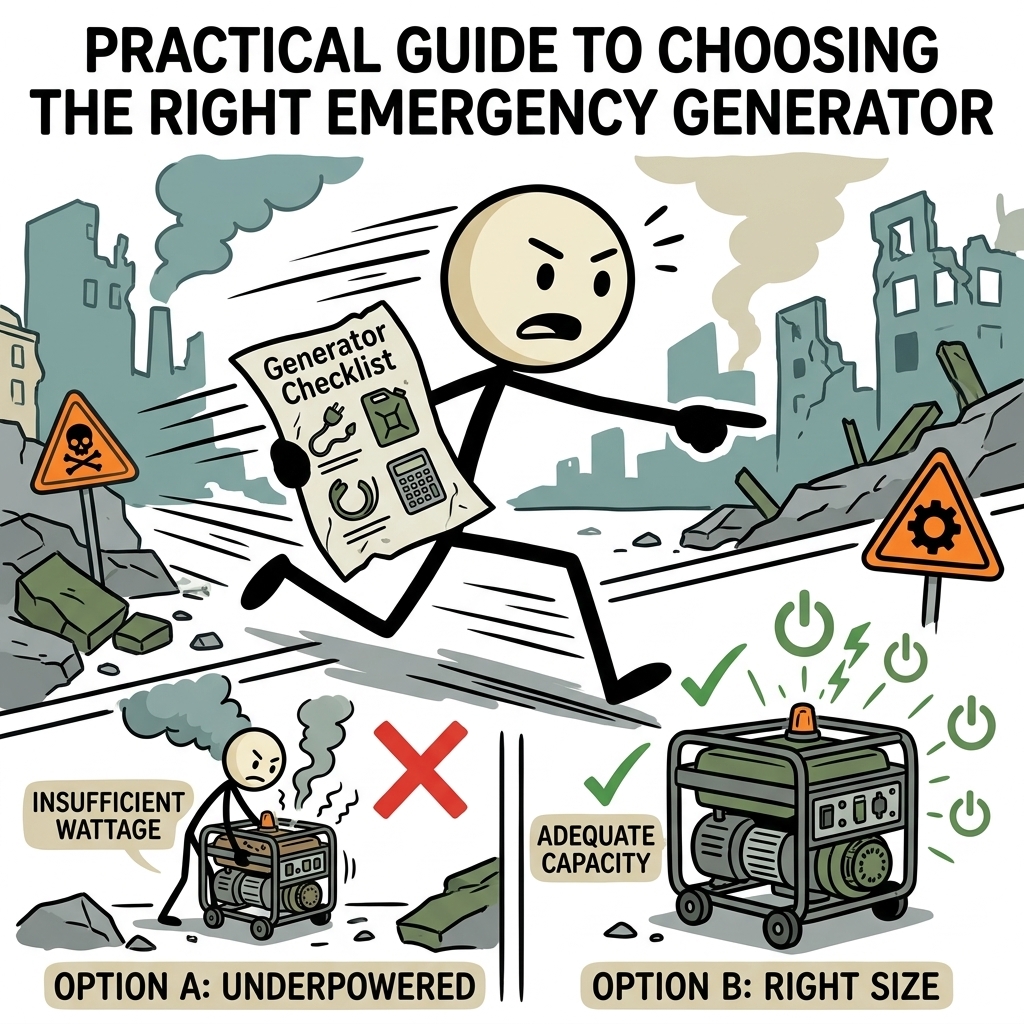
Before you can determine how to choose emergency generator models for your home, you must understand the three primary configurations available on the market today. Each type—conventional portable, portable inverter, and permanently installed standby—offers a distinct balance of cost, power output, fuel efficiency, and ease of use.
1. Conventional Portable Generators
Conventional portable generators are the traditional workhorses of emergency preparedness. Powered by heavy-duty internal combustion engines running on gasoline, diesel, or liquid propane, these units rotate an alternator at a constant speed (usually 3,600 RPM) to produce raw alternating current (AC) electricity.
- Pros: Excellent cost-to-wattage ratio; high power output (ranging from 3,000 to over 15,000 watts); capable of running heavy-duty 240V appliances like well pumps and central air conditioners.
- Cons: Extremely loud (often exceeding 75 decibels); heavy and difficult to maneuver; high fuel consumption because the engine must run at maximum speed regardless of electrical load; produces "dirty" power with high Total Harmonic Distortion (THD).
2. Portable Inverter Generators
Inverter generators represent a massive leap forward in portable power technology. Instead of running at a constant speed to produce AC power directly, an inverter generator produces high-frequency multi-phase AC power, converts it to direct current (DC), and then digitally "inverts" it back into clean, stable AC power with a near-perfect sine wave (typically under 3% THD).
- Pros: Extremely quiet (often operating at 50-60 decibels, equivalent to a normal conversation); highly fuel-efficient due to "eco-throttle" technology that adjusts engine speed to match electrical demand; safe for sensitive electronics; lightweight and highly portable.
- Cons: Higher cost per watt compared to conventional units; lower maximum power outputs (typically topping out around 4,000 to 9,000 watts); rarely feature 240V outlets in smaller sizes.
3. Whole-House Standby Generators
Standby generators are permanent installations that sit outside your home, much like a central air conditioning unit. They are hardwired directly into your home’s electrical panel via an Automatic Transfer Switch (ATS) and are fueled by your existing natural gas line or a large, dedicated liquid propane tank.
- Pros: Seamless operation; automatically turns on within seconds of a grid failure; can power the entire home, including central HVAC systems; requires no extension cords or manual fueling during a storm.
- Cons: Extremely high upfront cost (typically $5,000 to $15,000 including professional installation); requires professional permitting, concrete pad pouring, and utility coordination; ongoing annual maintenance costs.
| Feature | Conventional Portable | Portable Inverter | Whole-House Standby |
|---|---|---|---|
| Average Cost | $400 – $1,200 | $600 – $2,500 | $5,000 – $15,000+ |
| Power Quality (THD) | Poor (8% – 15%) | Excellent (< 3%) | Excellent (< 5%) |
| Noise Level | Loud (70 – 85 dB) | Quiet (50 – 65 dB) | Moderate (65 – 70 dB) |
| Fuel Source | Gasoline, Propane | Gasoline, Propane | Natural Gas, Propane |
How to Calculate Your Household Wattage Requirements
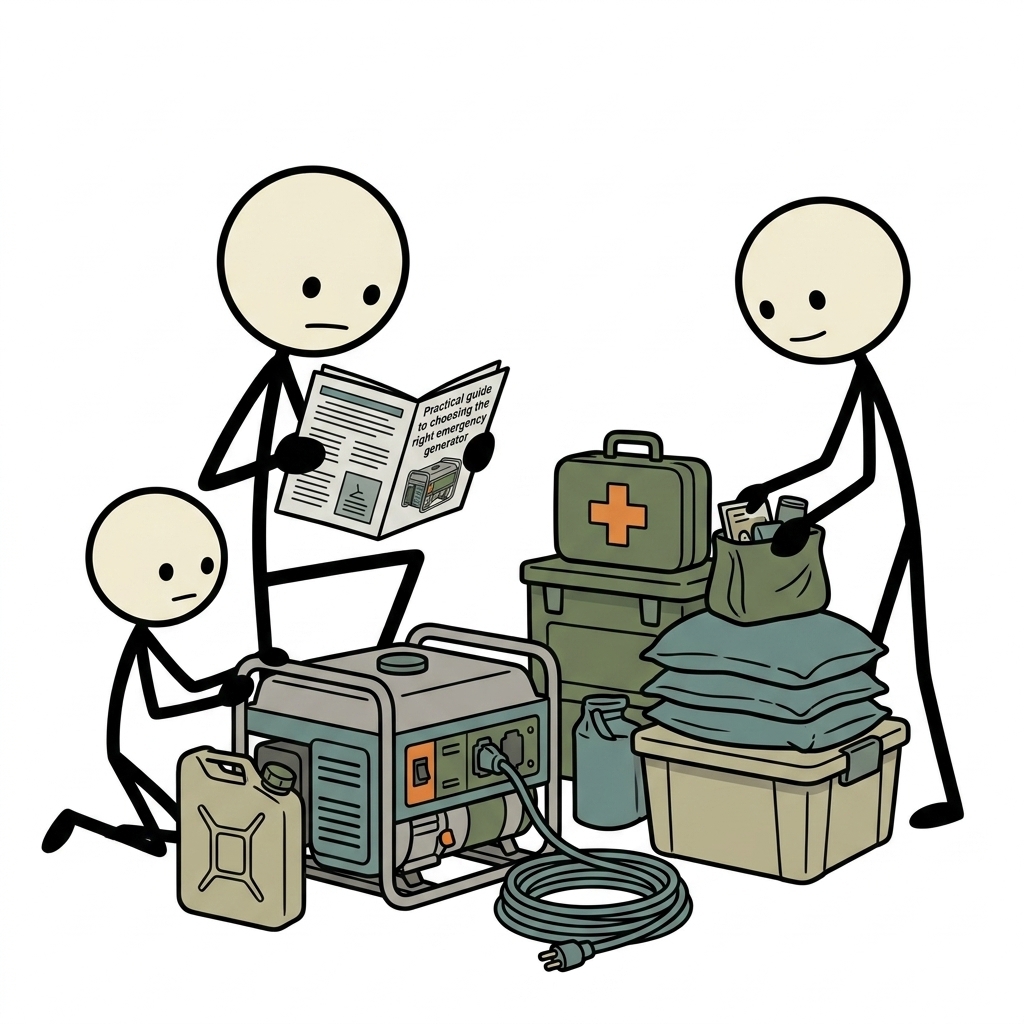
One of the most common and costly mistakes homeowners make is buying a generator that is either severely undersized (leading to overloaded circuits and system shutdowns) or vastly oversized (resulting in wasted fuel and unnecessary expense). To size your system correctly, you must act as your own generator wattage calculator.
Step 1: Understand Running (Rated) vs. Starting (Surge) Watts
Every electrical appliance has two wattage ratings that you must account for:
- Running (Rated) Watts: The continuous power an appliance requires to operate under normal conditions after its motor has started.
- Starting (Surge) Watts: The brief, high-energy burst of power required to start electric motors (found in refrigerators, air conditioners, sump pumps, and well pumps). Starting watts can be two to three times higher than running watts, though this surge only lasts for a fraction of a second.
Step 2: Inventory Your Critical Loads
Do not attempt to power your entire house on a portable generator. Instead, prioritize the critical systems required for survival, safety, and basic comfort. Locate the electrical data plates on the back or bottom of your appliances to find their specific voltage and amperage ratings (Amps x Volts = Watts).
Use the following baseline estimates for common emergency appliances to begin your calculations:
- Refrigerator/Freezer: 700 Running Watts | 2,200 Starting Watts
- Sump Pump (1/3 HP): 800 Running Watts | 1,300 Starting Watts
- Well Pump (1/2 HP): 1,000 Running Watts | 2,100 Starting Watts
- Furnace Fan Blower (Gas/Oil): 600 Running Watts | 1,400 Starting Watts
- Window Air Conditioner (10,000 BTU): 1,200 Running Watts | 1,800 Starting Watts
- LED Light Bulbs (x10): 100 Running Watts | 100 Starting Watts
- Wi-Fi Router and Modem: 50 Running Watts | 50 Starting Watts
- Microwave Oven: 1,000 Running Watts | 1,000 Starting Watts
Step 3: Perform the Math
To calculate the minimum generator capacity you need, follow this industry-standard formula:
- Identify the appliances you want to run simultaneously.
- Sum the Running Watts of all these appliances.
- Identify the single appliance with the highest Starting Watts requirement.
- Add that single highest starting watt figure to the total running watts of all other appliances.
Example Calculation: If you want to run a refrigerator (700W run / 2200W start), a sump pump (800W run / 1300W start), and ten LED lights (100W run / 100W start):
- Total Running Watts = 700 + 800 + 100 = 1,600 Watts.
- Highest Starting Watt Appliance = Refrigerator (2,200 Watts, which is 1,500 surge watts above its running watts).
- Required Generator Capacity = 1,600 (Total Running) + 1,500 (Refrigerator Surge) = 3,100 Watts.
To prevent the generator from running at 100% capacity continuously (which shortens its lifespan and decreases fuel efficiency), add a 20% safety margin to your final number. In this scenario, a 3,800-watt generator would be the ideal choice.
Fuel Logistics: Storage, Maintenance, and Lifespans
A generator is useless without a secure, viable fuel supply. During a large-scale emergency, local gas stations will lose power or run out of fuel within hours. Proper generator fuel storage and fuel selection are critical components of your emergency preparedness strategy.
1. Gasoline: The Accessible but Volatile Choice
Gasoline is readily available but presents significant long-term storage challenges. Untreated gasoline absorbs moisture from the air and undergoes chemical breakdown, forming gum and varnish that clog carburetors. According to the National Fire Protection Association (NFPA), residential gasoline storage is strictly limited—typically to no more than 25 gallons stored in approved, safety cans in a detached garage or shed.
- Stabilization: Always treat fresh gasoline with a high-quality stabilizer (such as Sta-Bil or Seafoam) immediately upon purchase. Treated gasoline can remain viable for up to 12 months.
- Rotation: Rotate your stored gasoline supply every six months by pouring it into your vehicle’s gas tank and refilling your storage containers with fresh fuel.
2. Liquid Propane (LPG): The Prepper's Best Friend
Propane is highly stable, clean-burning, and has an indefinite shelf life. It does not degrade, gum up fuel systems, or require stabilizers, making it an exceptional choice for emergency standby and dual-fuel portable generators.
- Storage: Propane is stored in pressurized steel tanks (like standard 20-lb BBQ cylinders or larger 100-lb tanks). It is much safer to store in large quantities than gasoline.
- Efficiency Trade-off: Propane contains roughly 25% less energy density than gasoline. A generator running on propane will typically produce 10% to 15% fewer running watts than it would on gasoline, and it will consume more fuel volume per hour.
3. Diesel: Industrial-Grade Reliability
Diesel generators are incredibly durable and fuel-efficient, making them the standard for commercial and agricultural backup systems. Diesel fuel can be safely stored for 12 to 24 months if treated with biocide additives to prevent microbial growth.
- Pros: Extremely long engine life (often exceeding 10,000 hours of operation); lower fire risk due to higher flashpoint.
- Cons: Diesel generators are heavy, expensive to purchase, and difficult to start in sub-zero winter temperatures without engine block heaters.
Engine Lifespan Expectations
Not all generator engines are built to the same standards. When comparing models, look at the engine's projected lifespan before major overhaul:
- Residential-Grade Engines (Splash Lubrication): Found in cheap conventional generators. Expected lifespan: 500 to 1,000 hours.
- Commercial-Grade Engines (Pressurized Lubrication with Oil Filters): Found in premium inverters and high-end portables (e.g., Honda GX series, Yamaha). Expected lifespan: 2,000 to 5,000 hours.
- Liquid-Cooled Standby Engines: Found in premium whole-house units. Expected lifespan: 10,000+ hours with proper maintenance.
Connecting to Your Home: Transfer Switches & Interlocks
How you connect your generator to your home’s electrical system is a matter of safety, convenience, and strict legal compliance. You cannot simply run a double-ended male extension cord (commonly called a "suicide cord") from your generator into a wall outlet. This dangerous practice backfeeds electricity into the utility lines, stepping up the voltage to thousands of volts and putting utility line workers at risk of electrocution. It is also a direct fire hazard to your home.
Option A: Extension Cords (The Budget Approach)
For small-scale power needs (under 3,000 watts), you can run heavy-duty, outdoor-rated extension cords directly from the generator outlets through a cracked window or door to your individual appliances. Ensure the cords are sized correctly (10-gauge or 12-gauge) to handle the amperage and prevent overheating.
Option B: Manual Transfer Switch (MTS)
An MTS is an electrical subpanel installed next to your main service panel by a licensed electrician. It allows you to safely connect a portable generator to your home’s electrical system via an external inlet box. With the flip of a switch, you isolate your selected household circuits from the utility grid and connect them directly to the generator.
- Cost: $500 – $1,500 (including professional installation).
- Benefits: Allows you to power hardwired appliances like well pumps, furnace fans, and ceiling lights without running extension cords inside the house.
Option C: Generator Interlock Kit
An interlock kit is a mechanical device installed on your main service panel that physically prevents the main utility breaker and the generator backfeed breaker from being turned on at the same time. This is a highly cost-effective, code-compliant alternative to a manual transfer switch.
- Cost: $150 – $400 (plus electrician installation fees).
- Benefits: Highly flexible; allows you to run any circuit in your main panel, provided you do not exceed the overall wattage capacity of your generator.
Option D: Automatic Transfer Switch (ATS)
Standard with whole-house standby generators, the ATS constantly monitors utility power. When a grid failure is detected, the ATS disconnects your home from the utility line, signals the generator to start, and transfers the electrical load to the generator—all within 10 to 30 seconds, completely automatically.
Carbon Monoxide (CO) Safety: Non-Negotiable Protocols
According to the Consumer Product Safety Commission (CPSC), portable generators are one of the most dangerous consumer products when operated incorrectly. The exhaust from a portable generator contains high concentrations of carbon monoxide—an odorless, colorless, tasteless gas that can incapacitate and kill an adult within minutes.
To ensure your family's safety during an emergency, you must adhere to these non-negotiable safety rules:
- The 20-Foot Rule: Never, under any circumstances, operate a portable generator inside a home, garage, basement, crawlspace, or covered porch. Always position the generator at least 20 feet away from the home, with the exhaust pointing directly away from any doors, windows, vents, or soffits.
- Install CO Alarms: Install battery-backed carbon monoxide alarms on every level of your home, especially outside sleeping areas. Test them monthly.
- Look for Auto-Shutdown Features: When shopping for the best generator for home emergency use, select models equipped with an integrated CO detection and automatic shutdown system (commercially branded as CO Shield, CO Guard, or CO Protect). These systems monitor ambient CO levels around the unit and shut the engine off immediately if levels rise dangerously.
- Weather Protection: Do not operate a generator in heavy rain or snow without a specialized generator tent or open-sided canopy. Operating a wet generator can lead to electrocution and damage to the alternator.
Best Value Picks by Category
Choosing the right generator means finding the sweet spot between reliability, features, and cost. Based on build quality, engine reliability, and user reviews, these are the top value picks for emergency preparedness:
1. Best Budget Portable: Champion Power Equipment 4500-Watt Dual Fuel
For homeowners seeking an affordable, versatile backup option, Champion is a highly reliable choice. This dual-fuel unit runs on both gasoline and liquid propane, giving you immediate fuel flexibility during a disaster.
- Key Specs: 4,500 starting watts / 3,500 running watts (on gas); electric start; quiet operation for a conventional open-frame unit (64 dB).
- Why It's a Best Value: Offers dual-fuel capability out of the box at a price point that fits most family budgets.
2. Best Quiet Inverter: Wen DF475T Dual Fuel Inverter Generator
WEN has built a strong reputation for producing high-quality, budget-friendly inverter generators that rival the performance of premium brands at a fraction of the cost.
- Key Specs: 4,750 starting watts / 3,800 running watts; clean, stable sine wave (< 1.2% THD at full load); dual-fuel capability; includes a 120V/240V transfer-switch-ready outlet.
- Why It's a Best Value: Delivers the clean power and ultra-quiet performance of an inverter with enough wattage to run a transfer switch, without the premium price tag.
3. Best Premium Portable: Honda EU3200i Companion
If budget is secondary to absolute reliability and portability, Honda remains the undisputed gold standard in portable power.
- Key Specs: 3,200 starting watts / 2,600 running watts; fuel-injection technology (no carburetor to clog); Bluetooth monitoring app; weighs only 59 pounds.
- Why It's a Best Value: Legendary commercial-grade GX130 engine reliability. It starts on the first pull, every single time, even after sitting idle for months.
4. Best Whole-House Standby: Generac Guardian 22kW
Generac is the market leader in standby power, protecting millions of homes across North America.
- Key Specs: 22,000 watts of continuous power; runs on natural gas or liquid propane; mobile link remote monitoring; includes a 200-amp smart transfer switch.
- Why It's a Best Value: Offers the lowest cost-per-kilowatt of any major standby brand, backed by a nationwide network of certified service technicians.
Securing Your Energy Independence
A power outage does not have to be a crisis. By understanding your household's specific wattage needs, choosing the correct fuel source, and implementing code-compliant connection methods, you transform a potentially chaotic event into a manageable inconvenience. Do not wait for the next major storm warning to make your move; local inventories deplete rapidly the moment a watch is issued. Take the time now to calculate your needs, invest in a quality system, and secure the peace of mind that comes with knowing your family will never be left in the dark.
Frequently Asked Questions
How do I calculate what size generator I need?
List your critical appliances and their wattage: refrigerator (600-800W starting), well pump (1000-2000W starting), CPAP machine (150W), phone chargers (100W combined), LED lights (20W per circuit), and a small window AC (1200-1500W). Add starting wattage (2-3x running wattage for motors), then add 20% buffer. Most households need 3,500-7,500W.
What is the difference between an inverter generator and a conventional generator?
Conventional generators produce power at a fixed engine speed — they're louder, less fuel-efficient, and produce 'dirty' power that can damage sensitive electronics. Inverter generators adjust engine speed to load, run quieter (50-60 dB vs 70-80 dB), use 20-40% less fuel, and produce clean power safe for electronics. Worth the premium for most emergency prep buyers.
How long can I store gasoline for a generator?
Untreated gasoline degrades in 30-60 days and causes carburetor gumming. With a fuel stabilizer (Sta-Bil) added at purchase, treated gasoline stores for 12-24 months. Ethanol-free gasoline stores longer than E10 blend. Store in approved metal or HDPE containers (not standard gas station containers for long-term storage), away from heat and ignition sources.
What is a transfer switch and why is it mandatory?
A transfer switch physically disconnects your home from utility lines when the generator is running, preventing dangerous backfeed that can electrocute utility workers. It's required by code in most jurisdictions. An automatic transfer switch (ATS) switches automatically during outages. A manual transfer switch ($300-800 installed) requires flipping before generator start-up. Never use extension cords from a generator to your main panel.
What are the most important generator safety rules?
Never run a generator indoors, in a garage, or within 20 feet of any window or door — carbon monoxide kills quickly and silently. Always install a CO detector on every floor when running a generator. Let it cool before refueling. Don't overload it. Check oil level before each use. Use ground fault circuit interrupter (GFCI) outlets. These rules are non-negotiable.