⚡ Key Facts
- Grid Vulnerability: According to the Federal Emergency Management Agency (FEMA), power outages in the United States have increased by over 60% since the early 2000s, driven by severe weather and aging infrastructure. For the practical checklist side, use the community emergency preparedness guide.
- The Silent Killer: The Centers for Disease Control and Prevention (CDC) reports that carbon monoxide (CO) poisoning kills over 400 Americans annually, with a significant spike in occurrences immediately following major natural disasters due to improper generator placement. For the practical checklist side, use the neighborhood preparedness network.
- Fuel Degradation: Untreated gasoline can begin to degrade and form engine-clogging gum and varnish in as little as 30 to 90 days, rendering emergency fuel storage useless without proper stabilization and rotation. For the practical checklist side, use the emergency communication plan.
- The Leading Cause of Failure: Industry statistics show that up to 80% of standby generator failures during an emergency are caused by battery failure or neglected maintenance, rather than mechanical engine breakdown. For the practical checklist side, use the family emergency planning guide.
- Wet Stacking Risk: Diesel generators operated at less than 30% of their rated load capacity are highly susceptible to "wet stacking"—the accumulation of unburnt fuel in the exhaust system—which severely degrades engine performance over time. For the practical checklist side, use the real-world emergency scenarios guide.
When severe weather strikes, the hum of an emergency generator is the sound of resilience. Whether you are facing a winter blizzard, a Category 4 hurricane, or a localized grid failure, a reliable backup power source keeps your medical equipment running, your food cold, and your home safe. However, a generator is not a "set-it-and-forget-it" appliance. It is a complex internal combustion engine that requires proactive, meticulous care. During major disasters, emergency management agencies like FEMA and the American Red Cross routinely document cases of generator failures that leave families stranded in the dark. To ensure your system stands ready when the grid fails, you must master the core pillars of emergency generator maintenance: fuel rotation, load testing, oil management, safe storage, carbon-monoxide safety, and structured maintenance schedules.
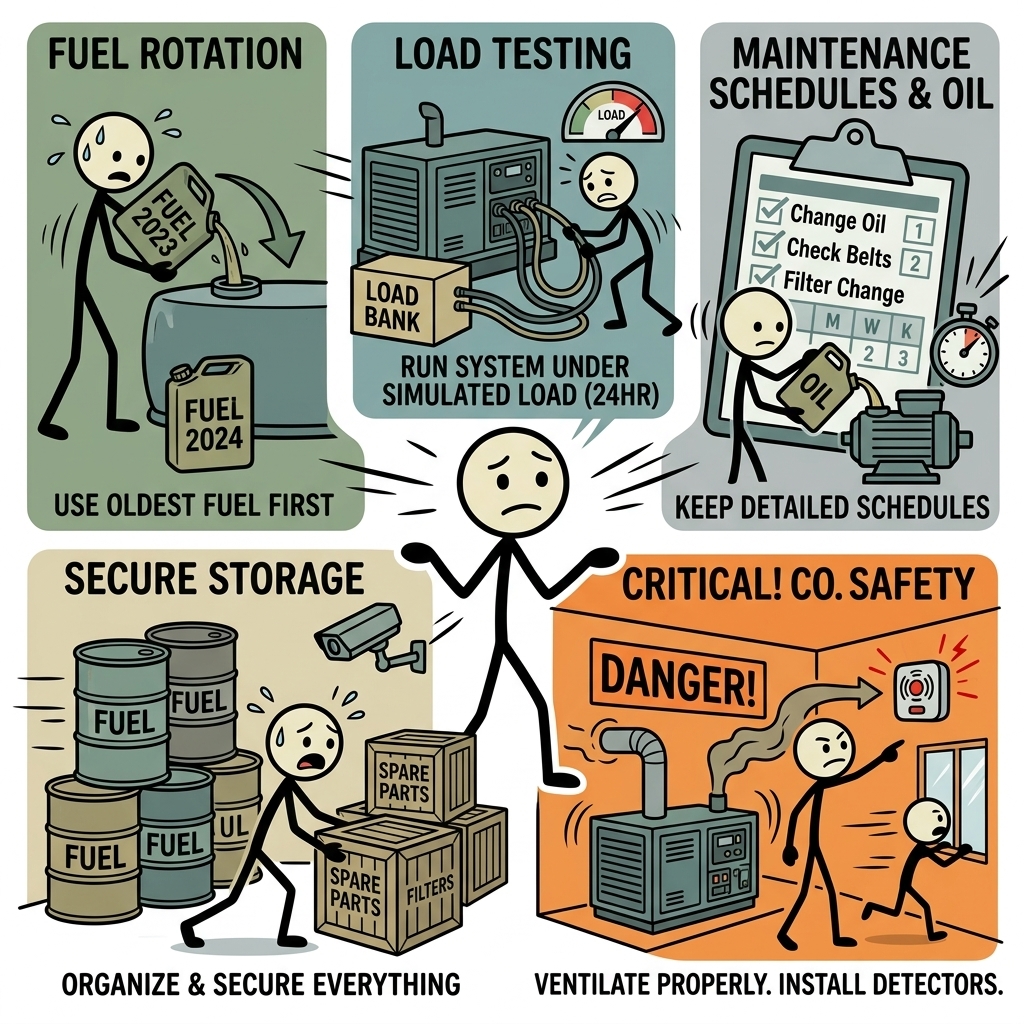
The Foundations of Emergency Generator Maintenance
To truly understand emergency generator maintenance emergency preparedness, you must view your generator as part of an integrated survival system. A generator does not operate in a vacuum; its performance is inextricably linked to the quality of its fuel, the integrity of its electrical connections, and the mechanical health of its engine. When a crisis occurs, you cannot afford to discover that your carburetor is gummed up or that your starter battery has lost its charge.
Proactive maintenance shifts your posture from reactive panic to structured readiness. By implementing a rigorous emergency generator maintenance protocol, you extend the lifespan of your investment, optimize fuel efficiency, and guarantee operational readiness. This guide breaks down the technical details of keeping both portable and whole-house standby generators running under the most demanding conditions.
Fuel Chemistry, Storage, and Rotation Protocols
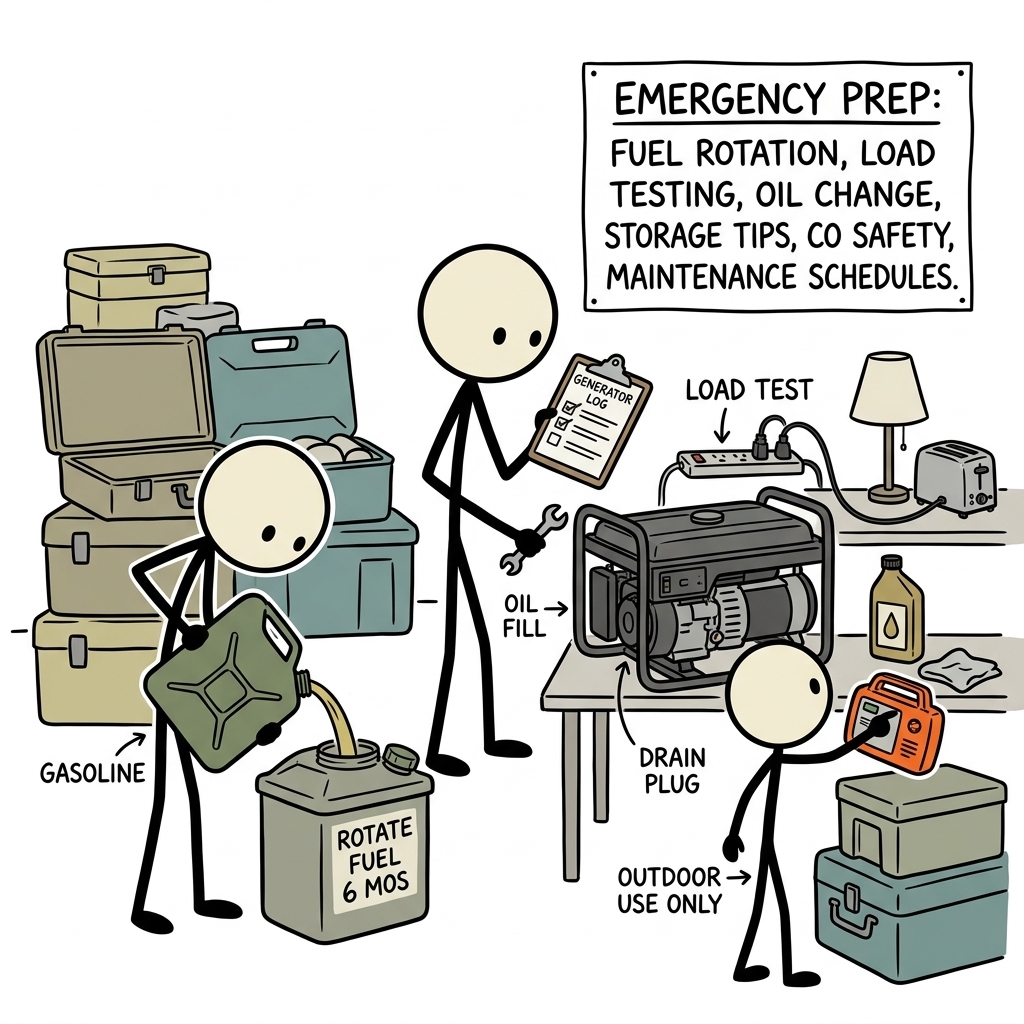
Fuel is the lifeblood of your generator, but it is also the component most vulnerable to the passage of time. Understanding the chemistry of fuel degradation is essential for any serious emergency preparedness plan. Different fuel types present unique storage challenges and require distinct mitigation strategies.
The Chemistry of Fuel Degradation
Gasoline is a complex mixture of hydrocarbons. When exposed to oxygen, these hydrocarbons undergo oxidation, a chemical reaction that produces sticky resins, gum, and varnish. This sticky residue easily clogs the microscopic passages within a generator's carburetor, preventing fuel flow and causing the engine to stall or fail to start. Additionally, modern pump gasoline contains up to 10% or 15% ethanol. Ethanol is highly hygroscopic, meaning it actively absorbs moisture from the surrounding air. When the water content in the fuel tank reaches a critical threshold, "phase separation" occurs. The water and ethanol bond and sink to the bottom of the tank, leaving a low-octane gasoline layer on top and a highly corrosive, water-rich mixture at the bottom where the fuel pickup is located.
Diesel fuel faces different chemical challenges. Over time, diesel is subject to microbial contamination. Bacteria and fungi thrive in the condensation layer at the bottom of diesel tanks, feeding on the hydrocarbons and producing a thick, acidic sludge that quickly plugs fuel filters and corrodes fuel injectors.
Fuel Type Comparison and Shelf Life
To plan your fuel storage strategy, you must weigh the pros and cons of each primary fuel type:
- Gasoline: Highly accessible but has the shortest shelf life. Untreated gasoline lasts only 3 to 6 months. Treated with a high-quality fuel stabilizer, it can remain viable for 12 to 24 months.
- Diesel: Highly efficient and safer to store than gasoline due to its higher flashpoint. Untreated diesel lasts 6 to 12 months. Treated with biocides and fuel stabilizers, its shelf life can be extended to 2 years.
- Propane (LPG): The gold standard for long-term storage. Propane does not degrade over time, does not gum up carburetors, and can be stored indefinitely in pressurized steel cylinders. However, propane generators generally consume more fuel by volume and require specialized delivery systems.
The "First-In, First-Out" (FIFO) Rotation Protocol
To ensure your fuel supply is always fresh, implement a strict First-In, First-Out (FIFO) rotation protocol. This system guarantees that you consume your oldest fuel reserves before they degrade, replacing them with fresh fuel.
- Label and Date: Use heavy-duty, color-coded, UV-resistant labels on all fuel canisters. Clearly write the purchase date and whether a fuel stabilizer has been added.
- Establish a Rotation Cycle: For gasoline, establish a 6-month rotation cycle. Every six months, pour your stored fuel into your primary vehicle's gas tank and refill the storage canisters with fresh, stabilized fuel from a high-volume station.
- Use the Right Containers: Store fuel only in EPA-approved, color-coded containers (red for gasoline, yellow for diesel, blue for kerosene). Ensure the seals are airtight to minimize oxygen exposure and prevent evaporation.
Load Testing: Why Running Without a Load Isn't Enough
A common mistake in emergency generator maintenance emergency preparedness is simply starting the generator, letting it idle for five minutes, and assuming it is ready for a crisis. Running an engine under "no-load" conditions does not test the generator's electrical generating capacity, its voltage regulation, or its ability to handle sudden power surges. To ensure reliability, you must perform regular load testing.
The Danger of Wet Stacking
For diesel generators, running without a sufficient load leads to a destructive condition known as "wet stacking." When a diesel engine operates under light loads (typically less than 30% to 40% of its rated capacity), it cannot reach its optimal operating temperature. As a result, fuel is not completely burned in the combustion chamber. This unburnt fuel mixes with carbon soot, creating a thick, oily liquid that accumulates in the exhaust manifold, turbocharger, and exhaust pipes. Wet stacking reduces engine efficiency, causes severe carbon buildup on valves, damages piston rings, and can ultimately lead to catastrophic engine failure. Load testing burns off these deposits and restores engine efficiency.
How to Perform a Proper Load Test
For residential standby and portable generators, you should conduct a load test at least once every three months. The goal is to run the generator under a sustained load of at least 50% to 80% of its rated capacity for a minimum of 30 to 60 minutes.
- For Portable Generators: Connect heavy-duty, resistive loads directly to the generator's outlets. Excellent household appliances for this purpose include space heaters, hair dryers, and electric kettles. Calculate the total wattage of the connected appliances to ensure you reach the desired load target without overloading the unit.
- For Whole-House Standby Units: Standby generators equipped with an Automatic Transfer Switch (ATS) can be load-tested by performing a simulated power outage. Safely trip the main utility breaker to force the generator to start, transfer the load, and run the entire household electrical system for an hour. Monitor the system for any voltage drops, frequency fluctuations, or unusual engine noises.
Oil, Filtration, and Lubrication Systems
If fuel is the lifeblood of your generator, motor oil is its protective armor. The high-RPM, air-cooled engines found in most portable generators run incredibly hot compared to liquid-cooled automotive engines. Under these extreme thermal conditions, motor oil degrades rapidly, losing its viscosity and its ability to protect critical engine components from friction and wear.
Understanding Viscosity and Oil Types
Choosing the correct oil viscosity is critical, especially when preparing for extreme seasonal temperatures. Consult your manufacturer's manual, but generally, the following guidelines apply:
- 5W-30 Synthetic Oil: Highly recommended for winter and cold-weather operations. It flows easily at sub-zero temperatures, ensuring rapid lubrication during critical cold starts.
- 10W-30 Conventional or Synthetic Oil: The standard choice for moderate, multi-season climates. It provides excellent protection across a wide range of operating temperatures.
- SAE 30 Weight Oil: Often preferred for hot-weather operations (above 40°F / 4°C). However, it should be avoided in cold climates as it becomes too thick, making manual starting incredibly difficult and starving the engine of oil upon startup.
The Break-In Period and Routine Change Intervals
Brand-new generators require a specialized "break-in" procedure to seat the piston rings and clear out any microscopic metal shavings left over from the manufacturing process. Never skip the break-in oil change. Typically, this involves running the generator under a light load for the first 5 to 20 hours, draining the oil completely while it is still warm, and refilling it with fresh oil.
For routine operations during an extended power outage, you must monitor engine hours closely. Most portable generators require an oil and filter change every 50 to 100 operating hours. During a major multi-day outage, your generator may run continuously, meaning you will need to perform an oil change every 2 to 4 days. Always keep several quarts of oil, spare spark plugs, and replacement oil and air filters on hand as part of your emergency preparedness kit.
Safe Storage, Environmental Protection, and Placement
Where and how you store your generator directly impacts its lifespan and its readiness during a crisis. Environmental factors such as moisture, dust, extreme temperatures, and pests can quickly degrade mechanical and electrical components.
Protecting the Unit from the Elements
Moisture is the primary enemy of a generator's electrical alternator. Rain, snow, and high humidity cause corrosion on copper windings, stator laminations, and electrical connections, leading to short circuits and component failure. When storing your generator long-term, choose a clean, dry, climate-controlled environment if possible, such as a sealed garage or utility shed. If you must store it outdoors, use a heavy-duty, breathable, waterproof cover. Avoid plastic tarps that trap condensation underneath, accelerating rust and corrosion.
Battery Maintenance: The Leading Cause of Standby Failure
For electric-start portable generators and automatic standby units, a dead battery is the single most common reason a generator fails to start during an emergency. Lead-acid batteries naturally discharge over time. If left unmanaged, they undergo "sulfation"—a chemical process where lead sulfate crystals build up on the battery plates, permanently destroying the battery's capacity to hold a charge.
- Use a Smart Float Charger: Keep standby batteries connected to a smart float charger (battery tender). Unlike a cheap trickle charger, a smart charger monitors the battery's voltage and automatically adjusts the charge rate, preventing destructive overcharging.
- Clean Terminals Regularly: Corrosion on battery terminals creates electrical resistance, preventing the starter motor from drawing the high amperage it needs to crank the engine. Clean the terminals annually with a wire brush and a mixture of baking soda and water, then coat them with dielectric grease or terminal protector spray.
- Prevent Pest Damage: Rodents love to nest inside generator enclosures, where they frequently chew through wiring harnesses, disabling critical sensors. Use steel mesh to cover air intakes and exhaust ports, and place non-toxic rodent repellents around the storage area.
Carbon Monoxide (CO) Safety: Preventing the Silent Killer
No discussion of emergency generator safety is complete without addressing carbon monoxide (CO). Carbon monoxide is a colorless, odorless, tasteless gas produced by the incomplete combustion of hydrocarbon fuels. According to the CDC, portable generators are a leading source of non-fire-related carbon monoxide poisoning during emergency power outages.
The Physics of CO Accumulation
Carbon monoxide binds to the hemoglobin in your red blood cells with an affinity roughly 200 times greater than oxygen. When inhaled, CO displaces oxygen in your bloodstream, starving vital organs like your heart and brain. In closed or semi-enclosed spaces, lethal concentrations of CO can accumulate within minutes. Never, under any circumstances, run a generator inside a home, garage, basement, crawlspace, or covered porch—even if the doors and windows are wide open. Simply opening a garage door does not provide sufficient ventilation to prevent the buildup of deadly gas.
The 20-Foot Rule and Safe Placement Guidelines
To protect your household, adhere strictly to the following safety protocols established by the Consumer Product Safety Commission (CPSC) and the National Fire Protection Association (NFPA):
- The 20-Foot Rule: Always operate your generator outdoors, at least 20 feet (6 meters) away from any occupied building, including your home, shed, or a neighbor's property.
- Exhaust Direction: Point the generator's exhaust pipe away from the house, doors, windows, vents, and air intakes.
- Wind Awareness: Pay attention to wind patterns. A strong wind can blow exhaust fumes back toward your home, even if the generator is placed 20 feet away. Adjust the unit's positioning accordingly.
- Install CO Alarms: Install battery-operated or battery-backup carbon monoxide alarms on every level of your home, especially near sleeping areas. Test these alarms monthly and replace the batteries annually. If a CO alarm sounds, immediately evacuate the building, call emergency services, and do not re-enter until the area has been cleared by professionals.
The Ultimate Emergency Generator Maintenance Checklist
To ensure you never miss a critical maintenance step, implement this structured emergency generator maintenance checklist. Keeping a physical logbook next to your generator to document dates, run hours, and completed tasks is highly recommended.
| Frequency | Maintenance Action Item | Technical Focus |
|---|---|---|
| Weekly | Visual Inspection | Check for fluid leaks (oil/fuel), loose wires, debris in cooling fins, and inspect battery terminals for corrosion. Ensure the fuel valve is in the correct position. |
| Monthly | No-Load Exercise Run | Start the generator and let it run for 10–15 minutes. Verify smooth idling, check the fuel gauge, and confirm the battery is charging. Verify the automatic transfer switch (ATS) functions if applicable. |
| Every 3 Months | Load Test & Fuel Check | Perform a sustained load test (50% to 80% capacity) for 30–60 minutes. Check stored fuel supplies for signs of water contamination, discoloration, or sour odor. |
| Every 6 Months | Oil & Air Filter Service | Check oil levels and viscosity. Clean or replace the air filter element. Inspect spark plugs for carbon buildup, gap wear, or cracking, and replace if necessary. Inspect the spark arrestor. |
| Annually | Comprehensive Tune-Up | Perform a full oil and filter change. Replace the spark plug. Flush and replace coolant (for liquid-cooled units). Rotate stored fuel. Inspect fuel lines and hoses for dry rot or cracking. Check valve clearances. |
By strictly adhering to this emergency generator maintenance checklist, you transform your backup power system from an unpredictable variable into a reliable asset. Remember, during a widespread natural disaster, professional repair technicians will be overwhelmed, and spare parts will be incredibly scarce. Your proactive maintenance is your primary defense against system failure.
Securing Your Power, Securing Your Peace of Mind
True emergency preparedness is built on a foundation of proactive, disciplined action. A generator is much more than a machine; it is your family's shield against the chaos of an extended grid failure. By mastering fuel rotation chemistry, conducting regular load tests, managing lubrication systems, and respecting the critical safety boundaries of carbon monoxide, you take control of your household's resilience. Do not wait for the storm clouds to gather or the lights to flicker before checking your equipment. Dedicate the time today to implement a rigorous maintenance routine, log your hours, and secure your fuel reserves. When the grid goes dark, you will have the confidence, the power, and the peace of mind to weather the storm safely.
Frequently Asked Questions
What should a emergency generator maintenance plan include?
Start with the immediate safety steps, the supplies and records your household needs, a communication plan, and a regular review schedule. Follow local official guidance during an active emergency.
How often should I review emergency generator maintenance preparations?
Review them at least twice a year and whenever your household, medication, location, or local risks change. Replace expired supplies and practice key steps.
Where can I find reliable emergency guidance?
Use local emergency management alerts and established public-health or emergency-management agencies. A blog guide should support, not replace, official real-time instructions.