Emergency radio frequencies: start here (United States)
For official weather warnings and local hazard information, start with NOAA Weather Radio. Its seven frequencies are 162.400, 162.425, 162.450, 162.475, 162.500, 162.525 and 162.550 MHz. Select the transmitter you can receive clearly at your location using the National Weather Service coverage maps.
- Local instructions: also save your emergency management agency's recommended AM/FM stations.
- Equipment: an ordinary AM/FM receiver does not necessarily receive NOAA channels. Check the radio's supported bands before relying on it.
- Two-way communication: there is no single frequency that guarantees emergency help. Agree on a legal channel and check-in schedule with your household before an outage.
These are U.S. frequencies, not a worldwide channel list. Listening and transmitting have different rules; check applicable laws and licensing requirements. Build the practical steps into your emergency communication plan.
⚡ Key Facts
- Grid Vulnerability: According to the Federal Communications Commission (FCC) Disaster Information Reporting System, major hurricanes and wildfires routinely knock out over 70% of commercial cellular towers across impacted counties within the first 24 hours.
- Universal Reach: The National Oceanic and Atmospheric Administration (NOAA) operates over 1,000 transmitters covering 95% of the United States population, providing continuous meteorological and civil hazard telemetry.
- Interoperability Standard: The Department of Homeland Security (DHS) National Interoperability Field Operations Guide (NIFOG) designates standard nationwide VHF and UHF mutual aid frequencies used across federal, state, and local agencies during mass-casualty events.
- Volunteer Force: Over 770,000 FCC-licensed amateur radio operators form the bedrock of auxiliary emergency communication via organizations like the Amateur Radio Emergency Service (ARES) and the Radio Amateur Civil Emergency Service (RACES).
- Monitoring and transmission: NOAA weather broadcasts are intended for public reception. Other monitoring and any transmission may be subject to legal restrictions.
When Hurricane Ian struck the Gulf Coast of Florida in 2022, high-velocity storm surges and 150 mph winds severed subterranean fiber-optic conduits and crippled commercial power grids. Across several counties, more than 80% of consumer cell sites failed simultaneously, stranding hundreds of thousands of residents in an immediate information blackout. While smartphones flashed "No Service," the airwaves were humming with activity. Emergency medical dispatches, search-and-rescue boat coordinates, evacuation corridor reports, and supply-drop alerts moved unhindered through the electromagnetic spectrum. In any severe crisis—whether an ice storm downing grid infrastructure, an earthquake fracturing fiber lines, or a regional power failure—radio frequency monitoring remains the single most reliable method for acquiring real-time, actionable intelligence. For the practical checklist side, use the family emergency planning guide.
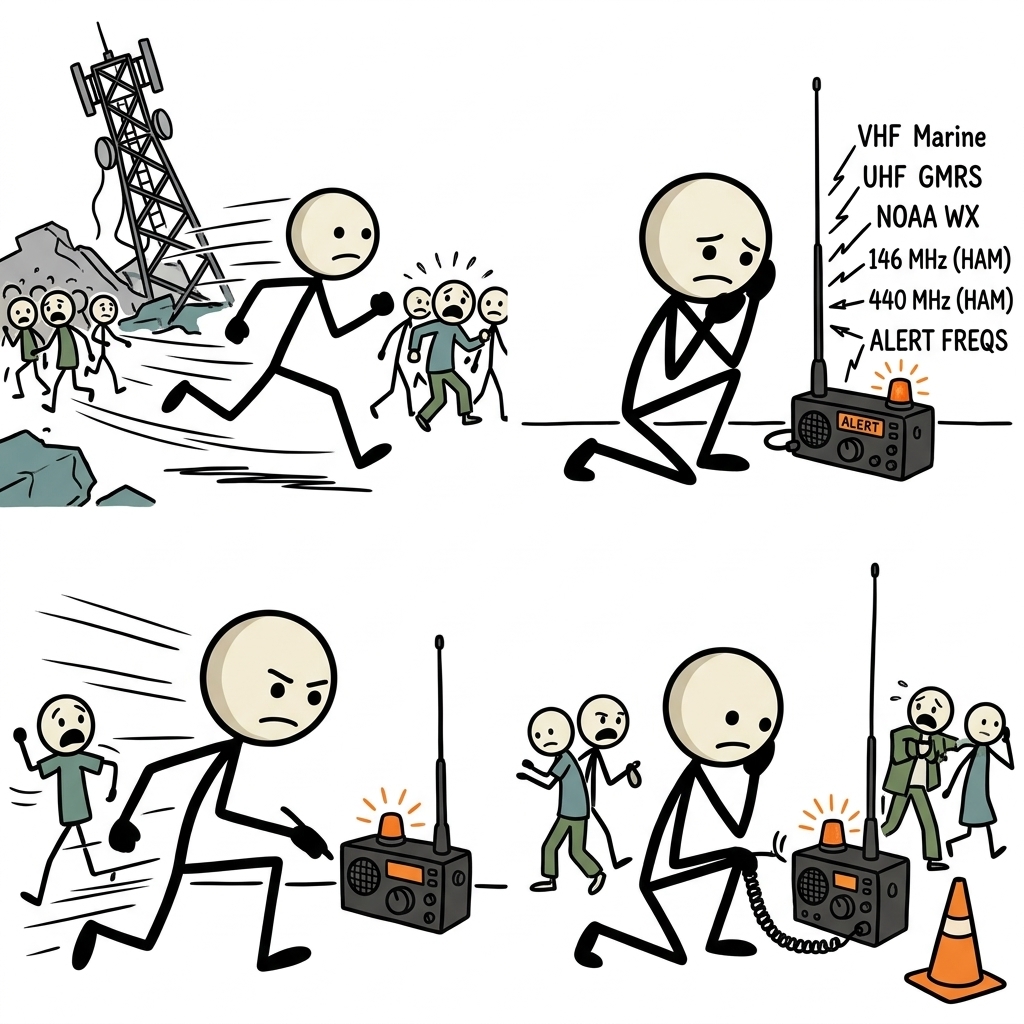
Possessing a functional emergency radio is only the initial step; situational awareness depends on knowing precisely where to look across the spectrum. Modern radio bands span vast operational swathes, and randomly searching through millions of kilohertz during an unfolding disaster wastes critical time and battery reserves. This guide provides a comprehensive manual of critical VHF, UHF, NOAA, and amateur frequencies. By programming these channels into your emergency emergency communication plans gear before infrastructure fails, you transform a silent piece of hardware into a resilient intelligence terminal for off grid radio communications.
Understanding RF Mechanics: VHF vs. UHF in a Crisis
Navigating the radio spectrum requires an understanding of how electromagnetic waves interact with the physical environment. Radio frequencies behave differently depending on their wavelength, atmospheric conditions, and geographical obstructions. The two primary frequency bands utilized for short- and medium-range tactical communications are Very High Frequency (VHF) and Ultra High Frequency (UHF). For the practical checklist side, use the real-world emergency scenarios guide.
The VHF band occupies the spectrum between 30 MHz and 300 MHz, characterized by longer wavelengths (approximately 1 to 10 meters). These longer waves excel at outdoor propagation, rolling over rolling terrain, diffracting over hills, and traveling extended distances through dense foliage. Consequently, state wildlife agencies, forest services, rural sheriff departments, and marine operations operate primarily within VHF allocations. If your operational environment is rural, heavily wooded, or maritime, VHF monitoring is your primary avenue for long-distance ground intelligence.
Conversely, the UHF band spans from 300 MHz to 3 GHz, characterized by shorter wavelengths (ranging from 10 centimeters to 1 meter). These shorter waves do not bend around terrain as effectively as VHF, but they possess superior penetration through structural materials such as reinforced concrete, brick, drywall, and steel. Furthermore, UHF signals bounce within urban environments, navigating "urban canyons" and indoor spaces where VHF signals become attenuated. For individuals residing in metropolitan centers, dense suburbs, or heavily built environments, UHF frequencies will provide the bulk of direct tactical intelligence.
When selecting your monitoring equipment, understanding the difference between simplex and duplex operations is equally critical. Simplex communications occur directly between two radios on a single frequency; you must be within line-of-sight range of the transmitter to intercept the traffic. Duplex operations utilize high-elevation repeaters mounted on towers or mountaintops. Repeaters receive transmissions on an input frequency and simultaneously rebroadcast them on an output frequency at high wattage—often covering an entire county. By programming your receiver to monitor the repeater's output frequency, you can listen to emergency personnel, search-and-rescue teams, and neighborhood preparedness network watch nets operating tens of miles away.
The Backbone: NOAA Weather Radio All Hazards (NWR)
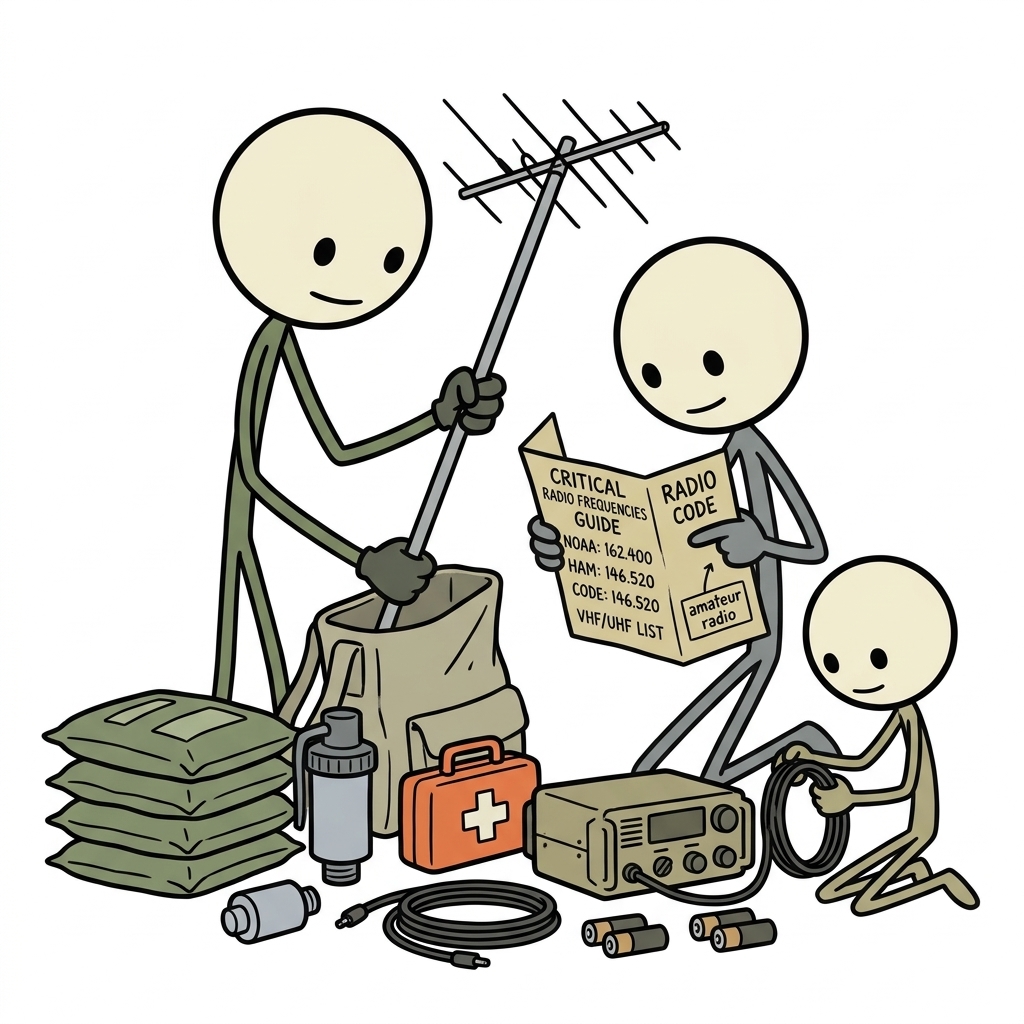
Operated by the National Oceanic and Atmospheric Administration under the Department of Commerce, the NWR network serves as the foundational broadcast system for civil emergencies in the United States. While colloquially called the "weather radio," this system is fully integrated into the Federal Emergency Management Agency's (FEMA) Integrated Public Alert and Warning System (IPAWS). Beyond meteorological disasters, the NWR broadcasts non-weather emergency messages (NWEM), including industrial hazardous material spills, radiological releases, dam failures, civil danger warnings, and evacuation mandates coordinated with local law enforcement and public safety agencies.
The entire national NWR network relies on seven dedicated, crystal-controlled VHF frequencies spaced at 25 kHz intervals. Memorizing and pre-programming these seven channels ensures your gear can capture local automated telemetry anywhere within the United States, Puerto Rico, the U.S. Virgin Islands, and adjacent coastal waters.
| Channel Designation | Frequency (MHz) | Standard Channel Identifier |
|---|---|---|
| WX1 | 162.400 MHz | Channel 1 |
| WX2 | 162.425 MHz | Channel 2 |
| WX3 | 162.450 MHz | Channel 3 |
| WX4 | 162.475 MHz | Channel 4 |
| WX5 | 162.500 MHz | Channel 5 |
| WX6 | 162.525 MHz | Channel 6 |
| WX7 | 162.550 MHz | Channel 7 |
Advanced preparedness demands an understanding of the Specific Area Message Encoding (SAME) protocol used across these NOAA weather radio frequencies. Under standard broadcast operations, NOAA continuously transmits local forecasts, automated ocean telemetry, and atmospheric readings. In a sudden disaster, however, transmitters broadcast a digital 1050 Hz warning tone preceded by a bursts of digital data containing SAME codes. These codes identify the precise county, emergency type, and severity of the hazard.
Radios equipped with SAME decoding remain silent until an emergency alert specifically targeting your programmed county code is transmitted. This eliminates alert fatigue while ensuring critical warnings wake you up in the middle of the night. You can obtain your six-digit county SAME code directly from the National Weather Service database. Always program your primary county alongside all immediately adjacent upstream counties, providing an advance operational cushion as weather systems or airborne hazardous materials drift in your direction.
National Interoperability and Mutual Aid Frequencies
When a municipal catastrophe scales beyond the containment capacity of local responders, multi-agency community emergency preparedness guide frameworks are activated under the National Incident Management System (NIMS). The Department of Homeland Security’s Cybersecurity and Infrastructure Security Agency (CISA) establishes standardized inter-agency communications channels through the National Interoperability Field Operations Guide. When out-of-county sheriff deputies, state police, search-and-rescue teams, and the National Guard arrive at a disaster staging area, they migrate communications to these standardized channels.
Monitoring these emergency radio frequencies to monitor allows you to track the exact logistical deployments, evacuation routes, hazard zones, and asset distribution during large-scale operations. Responders frequently utilize analog simplex or unencrypted repeater outputs to ensure seamless interoperability between agencies operating different proprietary digital radio gear.
National VHF Public Safety Mutual Aid (NIFOG)
- VCALL10 (155.7525 MHz): The nationwide VHF Public Safety Calling frequency. Initial check-ins, tactical staging, and inter-agency handoffs are established here before migrating to tactical operational channels.
- VTAC11 (151.1375 MHz): VHF Tactical Tactical Channel 1. Dedicated to on-scene incident command, tactical fire suppression operations, and field casualty sorting.
- VTAC12 (154.4525 MHz): VHF Tactical Channel 2. Typically assigned to search-and-rescue sectors, flood operations, and ground sweep coordination.
- VTAC13 (158.7375 MHz): VHF Tactical Channel 3. Frequently leveraged for mass decontamination, HAZMAT mitigation, and perimeter control.
- VTAC14 (159.4725 MHz): VHF Tactical Channel 4. Reserved for logistics, emergency transport staging, and medical evacuation triage points.
- VMAR29 (156.4500 MHz): Inter-system coordination channel bridging public safety land units with marine search teams and port assets.
National UHF Public Safety Mutual Aid
- UCALL40 (453.2125 MHz): The nationwide UHF Calling channel. Used in urban and subterranean environments where VHF penetration fails.
- UTAC41 (453.4625 MHz): UHF Tactical Channel 1. Primary operational assignment for structural triage, collapsed structure operations, and urban search teams.
- UTAC42 (453.7125 MHz): UHF Tactical Channel 2. Inter-agency logistical tracking, municipal evacuation security, and hospital intake status.
- UTAC43 (453.8625 MHz): UHF Tactical Channel 3. Perimeter defense, civil order preservation, and resource convoy tracking.
When listening to mutual aid frequencies, be aware that many emergency services utilize Continuous Tone-Coded Squelch Systems (CTCSS) or Digital-Coded Squelch (DCS) to prevent mutual interference. For monitoring purposes, ensure your radio's squelch is configured to Carrier or Open squelch. Do not program receive tones unless you want your receiver to actively filter out signals that do not transmit that exact sub-audible tone.
Ham Radio Emergency Frequencies: Tactical & Long-Distance Networks
Amateur radio operators represent the civilian tier of emergency communications. When state and cellular infrastructures undergo catastrophic failure, amateur operators step forward under coordinated structures like the Amateur Radio Emergency Service, sponsored by the American Radio Relay League (ARRL), and the government-chartered Radio Amateur Civil Emergency Service. These ham radio emergency frequencies act as conduits for hyper-local neighbor-to-neighbor aid, missing-person inquiries, and regional logistical requests.
Amateur operations are split between VHF/UHF tactical operations for local coordination and High Frequency (HF) bands for inter-state, continental communications.
VHF/UHF Tactical Civilian Frequencies
In local emergencies, hams configure neighborhood check-in nets and coordinate with local red cross disaster relief centers on established simplex calling channels. These frequencies should be programmed at the top of your monitoring banks:
- 146.520 MHz (2-Meter National Simplex Calling): The single most vital amateur frequency in North America. By common protocol, licensed operators monitor this channel while traveling or during power failures. Simplex communications here will reveal local neighborhood conditions, localized road closures, and direct civilian distress requests.
- 446.000 MHz (70-Centimeter National Simplex Calling): The primary UHF amateur calling channel. Outstanding for localized, building-to-building, or neighborhood-scale operations in suburban and urban areas.
- 146.550 MHz / 146.580 MHz: Standard regional secondary tactical frequencies. When 146.520 MHz becomes congested with initial check-in traffic, incident controllers shift secondary operations to these channels.
- The Wilderness Protocol: This emergency operating framework directs off-grid and backcountry operators to monitor calling channels (primarily 146.520 MHz, 446.000 MHz, and 52.525 MHz) for five continuous minutes starting at the top of every hour, and every half-hour, from 0700 to 2200 local time. If you are operating under severe battery constraints, tuning your receiver exclusively to 146.520 MHz during these specific operational windows maximizes your chances of intercepting civilian search requests.
HF Bands: Continental and Regional Situational Awareness
Local disasters often obscure the macro-level picture. In a regional grid outage, you cannot rely on local repeaters whose backup generator fuel may deplete within 48 to 72 hours. High Frequency (HF) amateur radio relies on ionospheric refraction (skywave propagation), bouncing signals thousands of miles beyond the horizon. Listening to HF frequencies yields crucial macro-intelligence: which ports are open, whether federal emergency declarations are active, where disaster mortuary teams are deploying, and the real-scale boundaries of the disaster footprint.
| Frequency / Mode | Net Designation / Mission Profile | Coverage Characteristics |
|---|---|---|
| 3.905 MHz (LSB) | Regional Emergency Nets (Day/Night 80m) | Statewide coverage via Near Vertical Incidence Skywave (NVIS). Ideal for listening to intra-state evacuation updates. |
| 7.240 MHz (LSB) | Midwest & East Coast Amateur Disaster Net | Excellent daytime regional coverage spanning 200–800 miles around your position. |
| 7.268 MHz (LSB) | Waterway Net / Hurricane Watch Auxiliary | Daytime coordination channel tracking storm damage across the southern coastal corridors. |
| 14.265 MHz (USB) | Salvation Army Team Emergency Radio Network (SATERN) | Trans-continental tracking of missing persons, medical logistics, and mass feeding allocations. |
| 14.300 MHz (USB) | Maritime Mobile Service Net (MMSN) / Intercontinental Net | 24/7 global monitoring channel for search-and-rescue, high-seas weather tracking, and federal incident reports. |
Unlicensed Citizen Bands: MURS, FRS, GMRS, and CB
Not every civilian operator holds an FCC amateur radio license. During a collapse of standard infrastructure, the vast majority of local neighborhood communications, roving neighborhood patrols, small businesses, and civilian families will utilize license-free or easily accessible citizen bands. Monitoring these segments provides ground-level situational awareness: looting alerts, localized structural fires, impassable secondary streets, and real-time medical emergencies.
Multi-Use Radio Service (MURS)
Operating in the VHF band between 151 and 154 MHz, MURS consists of five discrete frequencies that are completely license-free for any civilian operator within the United States. Due to its VHF wavelength, MURS outperforms FRS/GMRS hand-held radios in rural, forested, and open ground environments. Furthermore, numerous commercial drive-thru sensors, gate alerts, and perimeter security trip-wires operate over MURS, making it a critical band for monitoring local movements.
- Channel 1: 151.820 MHz
- Channel 2: 151.880 MHz
- Channel 3: 151.940 MHz
- Channel 4: 154.570 MHz (Commonly called the "Blue Dot" frequency; heavily utilized by small retail operations, perimeter guards, and logistics staff).
- Channel 5: 154.600 MHz (Commonly called the "Green Dot" frequency; widely used for tactical site-to-site coordination).
Family Radio Service (FRS) and General Mobile Radio Service (GMRS)
FRS and GMRS share 22 identical channels in the 462 MHz and 467 MHz UHF spectrum. These represent the most common consumer "walkie-talkie" units sold nationwide. Monitoring this band lets you track suburban civilian panic, local neighborhood watch check-ins, and immediate distress cries.
GMRS users also have access to eight dedicated repeater output channels that can project transmissions 20 to 30 miles when mounted on regional towers. A nationwide effort by civilian preparedness networks has standardized emergency protocols around these channels:
- GMRS Emergency & Traveler Assistance (Channel 20 / 462.675 MHz): Formally designated as the national emergency channel for GMRS. Many regional repeater owners link their systems on 462.675 MHz with a standard CTCSS tone of 141.3 Hz (commonly called the "Traveler's Tone" or Tone 21). This should be considered the primary civilian UHF monitoring channel in any disaster.
- FRS/GMRS Channel 1 (462.5625 MHz): Standard factory default frequency for nearly all consumer blister-pack radios. When non-technical civilians take radios out of packaging during a blackout, their transmissions land directly on Channel 1.
- GMRS Repeater Outputs: 462.5500, 462.5750, 462.6000, 462.6250, 462.6500, 462.7000, and 462.7250 MHz. Keep these outputs logged in your primary scan banks.
Citizens Band (CB) Radio
While often dismissed as obsolete technology, CB radio operates in the high-HF spectrum (26.965 MHz to 27.405 MHz) using AM and Single Sideband (SSB). It remains heavily integrated into the national logistics, trucking, and long-haul transportation infrastructure. When standard freight lines stall and highways lock into gridlock, CB radio illuminates logistical flows and road closures.
- CB Channel 9 (27.065 MHz): Legally designated under FCC Part 95 as the national emergency and traveler assistance channel. Monitored by some state highway patrols, volunteer monitoring associations (such as REACT), and municipal emergency dispatchers during highway gridlock events.
- CB Channel 19 (27.185 MHz): The primary national trucker channel. This is the single best frequency for hearing real-time highway reports, bridge damage, fuel availability along interstate corridors, and early warning of civil unrest approaching transport routes.
Aviation and Maritime Distress Frequencies
Catastrophic events often call maritime assets and aviation platforms into service for coastal evacuations, flood extraction, and medical airlift tracking. Both the marine and aviation bands operate in unencrypted, analog configurations, making them accessible to any scanner or wide-band communications receiver.
Aviation VHF Emergency Monitoring
Aviation communications utilize Amplitude Modulation (AM) across the 108–137 MHz VHF band. Air assets operate at substantial altitudes, meaning line-of-sight propagation can exceed 150 miles to a listener on the ground:
- 121.500 MHz (VHF Guard): The civilian International Aeronautical Emergency Frequency. Commercial airliners, search-and-rescue helicopters, and military aircraft flying civilian support continuously monitor Guard. Downed aircraft Emergency Locator Transmitters (ELTs) also pulse low-power distress signals across this frequency.
- 123.025 MHz / 123.050 MHz: National Search and Rescue (SAR) and civilian medical airlift coordination. Medevac helicopters maneuvering around natural disasters coordinate landing zones directly over these frequencies.
- 243.000 MHz (UHF Guard): The military counterpart to 121.500 MHz. Heavily activated during federal airborne deployments, Coast Guard sweeps, and military transport operations.
VHF Marine Bands
If your geographic area encompasses navigable rivers, major lakes, coastal ports, or intracoastal waterways, the VHF Marine band (156 to 162 MHz) is an essential monitoring asset. During major floods, civilian volunteers, maritime authorities, and the Coast Guard manage water-rescue task forces exclusively over these channels:
- Marine Channel 16 (156.800 MHz): The International Hailing, Distress, and Safety channel. All commercial ships, recreational vessels, and maritime law enforcement agencies are federally required to maintain an active watch on this frequency while underway. Mayday calls, vessel abandonments, and life-safety alerts originate here.
- Marine Channel 22A (157.100 MHz): The primary operational liaison frequency between the United States Coast Guard and civilian mariners. When a distress call is initially heard on Channel 16, operations are immediately shifted to Channel 22A to broadcast marine safety information and coordinate rescue sectors.
- Marine Channel 13 (156.650 MHz): Bridge-to-bridge navigational safety channel. Vital for tracking shipping channel blockages, tug traffic, and bridge closures over swollen waterways.
Monitoring Hardware Strategy: Scanners, SDRs, and Handheld Transceivers
Having a list of emergency radio frequencies to monitor is useless without the hardware to intercept them. Preparing for resilient off grid radio communications requires a tiered equipment strategy based on redundancy, power conservation, and monitoring breadth.
| Hardware Category | Strengths | Vulnerabilities & Limitations | Recommended Deployment |
|---|---|---|---|
| Digital Trunking Scanners | Extremely rapid scan rates; decodes P25 Phase I/II trunked municipal systems; non-transmitting (low power draw). | High cost; fragile internal electronics; cannot transmit under life-or-death circumstances. | Base station or municipal command monitoring post where local police use P25 digital systems. |
| Dual-Band Transceivers (e.g., VHF/UHF Ham) | Rugged; highly portable; operates on rechargeable lithium/AA packs; allows emergency transmission if licensed or under life-safety conditions. | Slow frequency scanning speeds; blind to trunked public safety systems; easily overloads front-end near strong RF sources. | Tactical field communications, bug-out bags, localized neighbor-to-neighbor and family checking. |
| Software Defined Radio (RTL-SDR) | Massive wideband coverage (25 MHz to 1.7 GHz); visual waterfall display to immediately spot hidden transmissions; cost-effective. | Requires a host computer, tablet, or smartphone; high overall system power consumption; complex software configuration. | Static base station situational analysis when tracking multiple concurrent signals across wide spectrums. |
While software-defined radios and digital scanners provide broad signal intelligence, a rugged analog dual-band (VHF/UHF) handheld transceiver remains the standard baseline tool for personal emergency preparedness. However, these budget transceivers feature slow scanning rates—frequently only 3 to 5 channels per second. If you load 500 channels into the memory banks, the radio may take two minutes to cycle through the entire list, causing you to miss brief 5-second tactical distress transmissions.
To overcome this limitation, organize your radio's memory architecture into dedicated, logically isolated banks:
- Bank 1: Life-Safety Core (10-15 Channels): NOAA local channels, 146.520 MHz, 446.000 MHz, MURS Channel 3, GMRS Channel 20, and local emergency dispatch. Scan this bank constantly.
- Bank 2: Municipal Interoperability: Regional NIFOG tactical channels (VTAC11-14, UTAC41-43), local fire and EMS simplex frequencies.
- Bank 3: Maritime & Aviation: Marine 16, 22A, Air Guard 121.500 MHz, and local medevac dispatch.
- Bank 4: Citizen Bands: MURS 1-5, common GMRS simplex channels, local CB cross-patches.
The Antenna: Your Most Critical Variable
The standard "rubber duck" antenna included with handheld radios is a severe compromise. Its internal coil is compressed to minimize physical length, resulting in severe signal attenuation and negative gain. To successfully monitor weak tactical signals from low-power transmitters during an emergency, upgrade to a balanced aftermarket whip antenna (such as a 15-to-19-inch flexible quarter-wave or half-wave design).
For home base stations, elevate your antenna as high as physically possible. Mount an external J-pole, discone, or roll-up slim-jim antenna on a rooftop, mast, or tree limb, connecting it to your receiver with low-loss coaxial cable (such as RG-8X or LMR-400). Antenna height above ground is the single most important factor determining your operational monitoring range over VHF and UHF bands.
Legal Framework: Monitoring vs. Transmitting
Clear boundaries exist regarding radio frequency usage under the Federal Communications Commission rules. Understanding the legal architecture protects your rights while preserving critical communications discipline during a crisis:
Passive Listening: In the United States, listening to unencrypted analog public safety, maritime, aviation, amateur, and citizen radio bands is completely legal under federal law. The airwaves are public property. You do not require a license of any kind to purchase radio scanners, Software Defined Radios, or amateur transceivers, nor do you need a license to monitor any of the frequencies detailed in this guide.
Transmitting Protocol: Transmitting on public safety, aviation, and marine frequencies without explicit institutional authorization is illegal under FCC regulations. Furthermore, operating on amateur radio bands requires obtaining a Technician, General, or Amateur Extra license through an accredited Volunteer Examiner Coordinator (VEC) team.
The Emergency Exception Myth: A widely circulated myth claims that FCC Part 97.403 provides an open waiver to transmit on any frequency using any radio gear during any declared emergency. Section 97.403 states: "No provision of these rules prevents the use by an amateur station of any means of radiocommunication at its disposal to provide essential communication needs in connection with the immediate safety of human life and immediate protection of property when normal communication systems are not available." Note the exact legal phrasing: this applies strictly to licensed amateur stations, and applies strictly to immediate, life-threatening emergencies when all other communication methods have failed. Relying on this clause as a substitute for acquiring an FCC amateur radio license is a dangerous preparedness failure. Proper operational licensing, training, and testing ensure your transmissions are technically sound, avoid emergency interference, and are handled professionally.
Building Your Local Emergency Frequency Action Plan
Write down your local NOAA transmitter, emergency broadcast stations and agreed household check-in channel before an outage. Test reception at home, save channels in the radio, and keep a printed copy with spare batteries. Recheck the list when you move or local services change.
Frequently Asked Questions
What frequencies broadcast official government weather and disaster alerts?
NOAA Weather Radio All Hazards broadcasts 24/7 continuous information across seven VHF frequencies: 162.400, 162.425, 162.450, 162.475, 162.500, 162.525, and 162.550 MHz.
Do I need an FCC license to monitor emergency radio transmissions?
Receiving NOAA weather broadcasts does not require an FCC license. Other monitoring can be subject to federal, state or local restrictions. Transmitting has separate licensing and equipment requirements.
What is the primary amateur (ham) radio calling frequency to monitor during an emergency?
The 2-meter VHF National Calling Frequency is 146.520 MHz, and the 70cm UHF calling frequency is 446.000 MHz. Local ARES (Amateur Radio Emergency Service) repeater frequencies should also be pre-programmed.
Which Citizens Band (CB) channel is designated for emergency communications?
CB Channel 9 (27.065 MHz) is designated by the FCC exclusively for emergency communications involving the immediate safety of life or property, as well as motorist assistance.
What channel should local neighborhood groups monitor on FRS and GMRS radios?
Agree on a channel with your group in advance and test it with compatible, authorized radios. No FRS or GMRS channel guarantees that emergency services are listening. Follow the licensing and equipment rules for the service you use.