⚡ Key Facts
- Massive Economic Waste: The USDA estimates that 30% to 40% of the United States emergency food storage guide is wasted annually, a loss that translates directly to household emergency budgets when pantries are unmanaged.
- FEMA Guidelines: FEMA recommends maintaining at least a two-week supply of non-perishable food, but notes that without active rotation, nutritional degradation begins within 12 to 18 months for standard canned goods. For the practical checklist side, use the community emergency preparedness guide.
- The Date Code Confusion: According to the FDA, "Best if Used By/Before" dates indicate peak quality rather than safety, yet millions of preppers prematurely discard perfectly safe food due to a lack of a structured rotation system. For the practical checklist side, use the neighborhood preparedness network.
- The Power of FIFO: Implementing a systematic First-In, First-Out (FIFO) protocol can reduce household food spoilage rates to near zero, saving families an average of $1,500 annually in lost emergency preparedness investments. For the practical checklist side, use the emergency communication plan.
Imagine a scenario where a severe weather event, such as a major hurricane tracked by NOAA or a sudden earthquake monitored by the USGS, knocks out your local power grid for two weeks. You confidently walk to your basement to access your emergency food supply, only to find that the canned meats are rusted through, the flour has been compromised by weevils, and the dry beans you stored five years ago have turned into rock-hard pellets that refuse to soften. This is the silent tragedy of "set-and-forget" emergency preparedness. Building a survival pantry is not a one-time event; it is an active, living system that requires deliberate management to ensure that your investment is viable when your life depends on it.
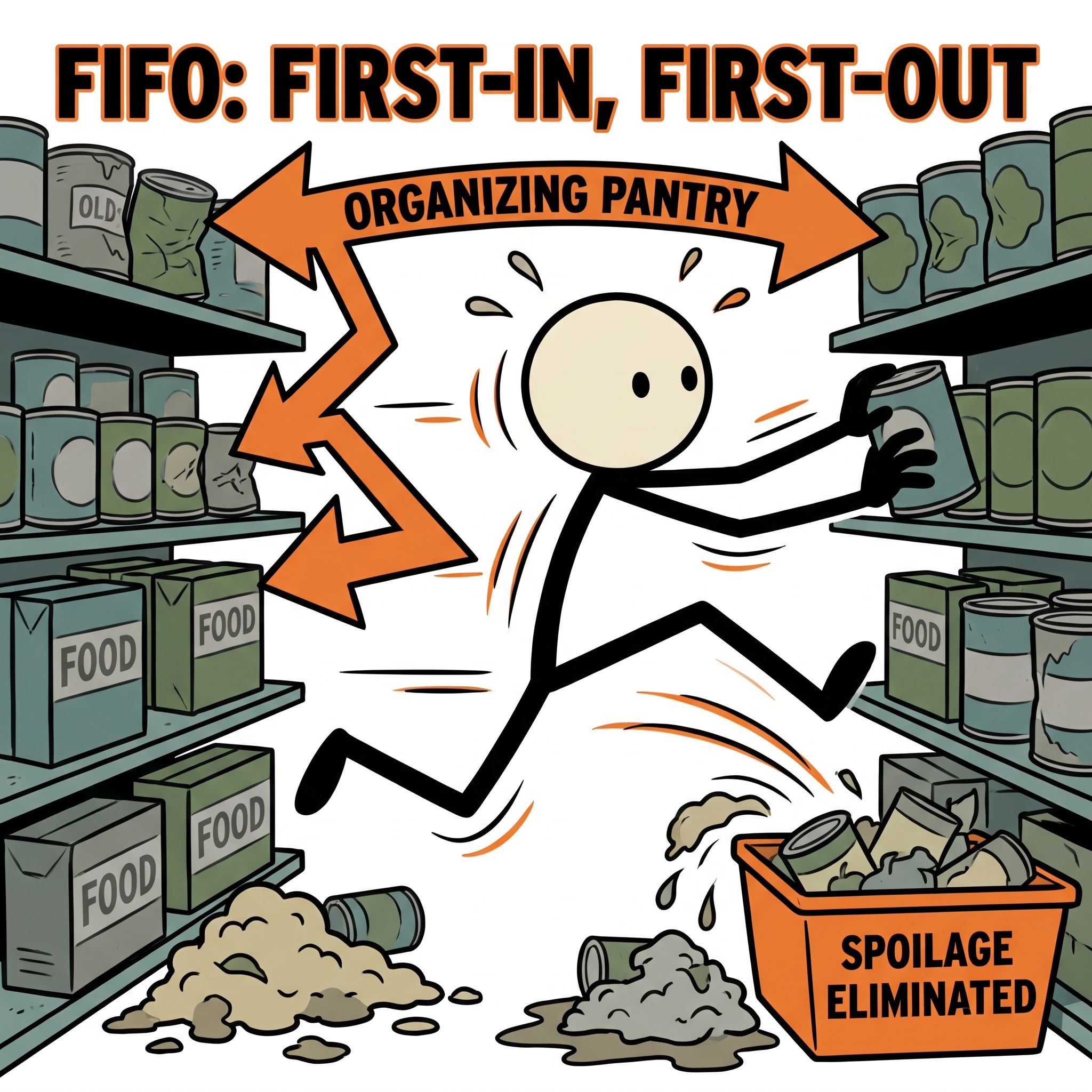
The High Cost of "Set-and-Forget" Food Storage
Many well-intentioned families treat their emergency food supply like a time capsule. They buy bulk dry goods, canned proteins, and freeze-dried meals, stack them in a dark closet, and assume they are secure for the next decade. However, without a structured food storage rotation system, this approach leads to rapid, expensive spoilage. Food degrades due to temperature fluctuations, humidity, oxygen exposure, and the natural breakdown of nutrients over time.
The USDA notes that while many canned goods can remain safe to eat for years past their printed dates, their flavor, texture, and vital vitamin content decline significantly. If your emergency pantry consists of items that have sat undisturbed for five years, you are not just risking unpalatable meals; you are risking nutritional deficiency during a high-stress survival situation when your body needs caloric density and micronutrients the most.
Financially, letting prepper food storage expire is equivalent to throwing cash directly into the trash. High-quality freeze-dried meals, canned meats, and bulk grains represent a substantial capital investment. By failing to rotate these items into your daily or weekly meal planning, you guarantee that a significant percentage of your investment will spoil before it can ever be consumed. To prevent food waste and protect your family's budget, you must transition from a static storage model to an active rotation loop.
The Real Threat of Nutritional Degradation
While botulism and bacterial contamination are the most severe risks of improperly stored canned goods, gradual nutritional decay is far more common. Vitamin C, thiamin (Vitamin B1), and folate are highly sensitive to heat and time. Over a two-year period in suboptimal storage conditions, canned vegetables can lose up to 50% of these essential nutrients, rendering them far less effective during an extended grid-down scenario where fresh produce is unavailable.
Understanding FIFO: From Commercial Kitchens to Home Pantries
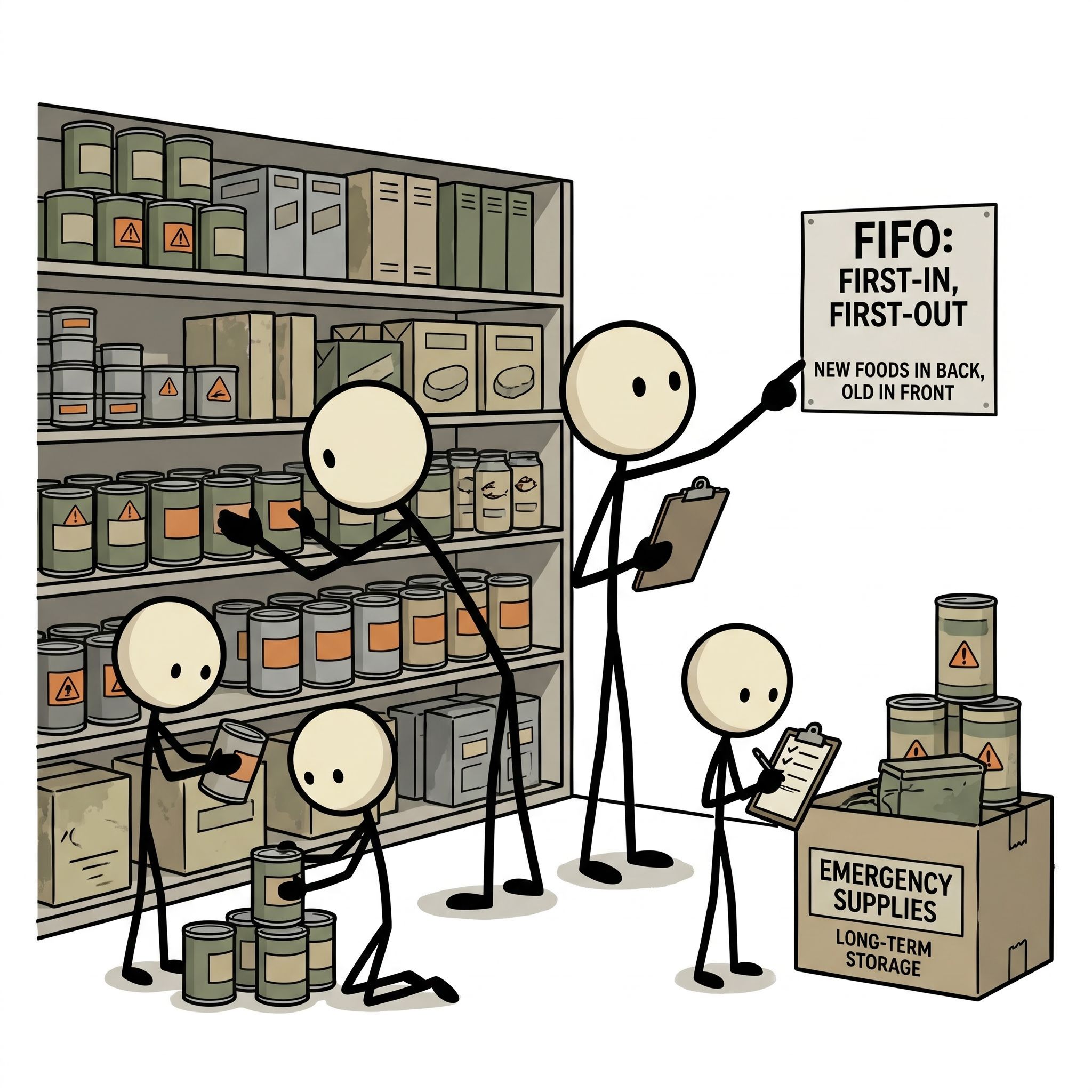
The commercial food service industry solved the problem of inventory spoilage decades ago using a methodology known as First-In, First-Out, or FIFO. The premise of FIFO is elegant in its simplicity: the oldest stock (the food that was put into the system first) must be consumed or utilized before the newer stock (the food put in last) is touched. This creates a continuous, forward-moving queue of inventory.
When applied to a home emergency food supply, FIFO ensures that your pantry is constantly refreshed. Instead of letting a can of peaches sit on the back of a shelf for four years until it swells and leaks, FIFO forces that can to the front of the line to be eaten as part of your regular Wednesday night dinner, while the newly purchased can of peaches goes to the very back of the shelf to begin its waiting period.
The opposite of FIFO is LIFO (Last-In, First-Out), which is the default, accidental state of most unorganized home pantries. When you return from the grocery store with fresh canned goods, the natural human tendency is to push the existing cans back just enough to slide the new ones onto the front of the shelf. Over time, the items at the very back of the shelf become ancient artifacts, completely out of reach and forgotten, while you continuously consume and replenish only the newest items at the front. LIFO is the primary driver of preventable food waste in residential storage.
The Psychology of the FIFO Mindset
Transitioning to a FIFO food rotation system requires a shift in how you view your emergency reserves. Your emergency pantry should not be an isolated vault; it should be an extension of your daily kitchen. By integrating your storage items into your weekly meal planning, you ensure that your family is accustomed to eating these foods, which also minimizes digestive shock during an actual emergency transition.
Step-by-Step Guide to Implementing a FIFO Food Rotation System
Implementing a highly functional FIFO system does not require expensive commercial-grade equipment or an advanced degree in logistics. It requires a systematic approach, a small investment of time, and the discipline to adhere to a few organizational rules. Follow this step-by-step blueprint to transform your chaotic storage space into an optimized, self-rotating survival resource.
Step 1: The Deep Pantry Audit
Before you can organize your food, you must know exactly what you have, where it is, and when it expires. Clear off a large table or space on your floor and empty your entire emergency food supply onto it. This process can be eye-opening, often revealing duplicated purchases and long-expired goods you forgot existed.
As you remove items from your shelves, inspect each container thoroughly. Discard any cans that are bulging, deeply dented along the seams, heavily rusted, or leaking. The CDC warns that consuming food from compromised cans can lead to botulism, a rare but life-threatening form of food poisoning. Wipe down surviving containers with a damp cloth to remove dust and prep them for labeling.
Step 2: Deciphering Date Codes
One of the biggest hurdles in establishing a food storage rotation system is understanding the manufacturer dating printed on packaging. Food manufacturers use two primary types of dating: open dating and closed dating.
- Open Dating: This is the most common format, featuring calendar dates such as "Best by 10/24" or "EXP DEC 2026." These are easy to read and indicate the manufacturer's estimate of peak quality.
- Closed Dating (Lot Codes): Often used on bulk goods, military MREs, and some canned items, these look like a confusing string of letters and numbers (e.g., "2134B"). This is often a Julian date code. For example, "2134" might represent the 134th day of the year 2022.
To keep your FIFO system running smoothly, do not rely on trying to decode these tiny, faint prints in a dimly lit pantry. Use a thick, black permanent marker to write the purchase date or the expiration date in large, bold numbers directly on the top lid or front face of every single container. This simple step makes visual scanning instantaneous.
Step 3: Categorization by Shelf Life and Use-Case
Group your food items into logical categories before returning them to the shelves. This prevents you from losing track of smaller items among larger bulk containers. Grouping should reflect both the food type and its expected shelf life:
- Short-Term Rotation (1 to 2 Years): Canned condensed soups, canned milk, packaged pasta meals, cereal, and cooking oils. These items degrade quickly and must be rotated aggressively.
- Medium-Term Rotation (2 to 5 Years): High-acid canned fruits (tomatoes, pineapple), low-acid canned vegetables (corn, green beans), canned meats (tuna, chicken, SPAM), and peanut butter.
- Long-Term Storage (10 to 30 Years): Triple-sealed Mylar bags of white rice, hard red winter wheat, pinto beans, rolled oats, and professionally prepared freeze-dried emergency meals.
Step 4: Physical Organization and Loading (The "Load from Back, Pull from Front" Rule)
This is the mechanical core of FIFO. When you organize your shelves, you must arrange them so that the items closest to expiration are always at the front of the shelf, ready to be grabbed first. Newer items must be loaded from the rear.
If your shelving units are flush against a wall, this requires a physical shift. When you buy three new cans of black beans, you cannot simply put them in front. You must pull the existing five cans of black beans forward, place the three new cans at the back of the row, and then slide the older cans back in front of them. This physical discipline is the single most important factor in preventing food waste.
Step 5: Establishing a Routine Integration Cycle
A FIFO system only works if you actually eat the food at the front of the line. Establish a routine where your kitchen pantry is regularly replenished from your emergency storage. For example, when you cook spaghetti, pull the pasta sauce and noodles from the front of your emergency shelves, and add those items to your weekly grocery shopping list. When you buy the replacements, they go to the back of the emergency shelf. This creates a continuous, healthy loop of fresh inventory.
Hardware, Shelving, and DIY Solutions for FIFO
While manual rotation on standard flat shelves is highly effective, it can be labor-intensive if you have a massive inventory. Fortunately, there are several hardware solutions and DIY hacks designed to automate the FIFO process physically.
Gravity-Fed Can Rotators
Gravity-fed can rotators are the gold standard for automated FIFO. These racks feature angled shelves where cans are loaded into the top tier and roll down to the bottom tier. When you pull a can from the front bottom slot, the entire row rolls forward, and the next oldest can takes its place. New cans are always loaded into the top, ensuring perfect, hands-free FIFO rotation.
These systems are available commercially in plastic or wire-frame designs that fit standard closet shelving, but they can also be built as a weekend DIY project using plywood, dowels, or PVC pipe. If you have the vertical space, gravity-fed racks are the most reliable way to manage high-volume canned goods like soups, beans, and vegetables.
Deep-Shelf Bin Systems
For items that do not roll easily—such as pouches, boxes, or jarred goods—deep-shelf bins are an excellent alternative. Assign a dedicated plastic bin to each food category (e.g., "Pasta & Rice Pouches" or "Canned Meat Jars").
When loading new items, place them at the very back of the bin, pushing the older items to the front. To make this process foolproof, you can use colored sticky notes or clip-on bin labels that indicate the month and year of the oldest item currently in that specific bin. This allows you to see at a glance which bins need to be prioritized for consumption.
DIY Cardboard and PVC Hacks
If you are on a tight budget, you can construct highly functional rotation tracks using recycled materials. Cut sturdy cardboard shipping boxes into angled chutes that mimic commercial gravity-fed systems. Alternatively, you can cut 4-inch PVC pipes in half lengthwise to create smooth, curved tracks that guide cans from the back of a deep shelf directly to the front. These low-cost solutions make a high-performance food storage rotation system accessible to any budget.
Digital and Analog Tracking Systems
While physical organization is critical, keeping a secondary record of your inventory is highly recommended for larger setups. A tracking system helps you plan grocery shopping trips, calculate total caloric reserves, and identify upcoming expiration dates without having to physically count every can on your shelves.
The Analog "Clip-and-Quill" Method
For those who prefer a non-digital, EMP-proof approach, a simple clipboard hanging on the pantry door is incredibly effective. Maintain a running tally sheet divided by food category. Each time you add an item to the back of the shelf, write it down with its expiration date. Each time you pull an item from the front, cross it off or use tally marks to update the count. This provides an instant, low-tech snapshot of your emergency food supply.
| Food Item | Category | Quantity | Oldest Exp. Date | Storage Location |
|---|---|---|---|---|
| Canned Albacore Tuna (5oz) | Protein | 24 Cans | 11 / 2026 | Shelf A, Row 2 |
| White Long-Grain Rice (Mylar) | Grains | 6 Bags (30 lbs) | 08 / 2045 | Bin #3, Floor |
| Canned Diced Tomatoes (14oz) | Fruits/Veg | 18 Cans | 03 / 2025 | Can Rack #1 |
| Cream of Mushroom Soup (10oz) | Short-Term | 12 Cans | 09 / 2024 | Shelf B, Row 1 |
Digital Inventory Apps and Spreadsheets
If you prefer a tech-forward approach, several home inventory apps allow you to scan barcodes directly with your smartphone camera to log items instantly. Apps like *PrepStuff*, *PantryCheck*, or standard home inventory databases let you input expiration dates and set up automated push notifications that warn you 30, 60, or 90 days before an item is set to expire.
If you prefer complete control over your data, a simple Google Sheet or Microsoft Excel spreadsheet can be customized to color-code your inventory automatically. By using conditional formatting, you can program cells to turn yellow when an item is within six months of expiration, and red when it has passed its prime, giving you a visual roadmap for your weekly meal planning.
Special Considerations: Water and Long-Term Dry Goods
While FIFO is most commonly associated with canned goods and packaged pantry items, the methodology must also be applied to your long-term dry goods and emergency Water Calculator to ensure comprehensive preparedness.
Rotating Water Supplies
Water is the single most critical element of emergency survival. The Red Cross and FEMA recommend storing at least one gallon of water per person per day. However, water is not a "set-and-forget" resource. Over time, stored water can develop algae, absorb plasticizer chemicals from its storage container, or lose its flat, oxygenated taste.
If you store water in standard 55-gallon food-grade drums, the CDC recommends treating the water and rotating it out at least once every six to twelve months. For smaller, portable 5-gallon water containers, apply the FIFO method by using the water to irrigate your garden, wash your car, or clean your home every six months, then thoroughly sanitizing the containers and refilling them with fresh, treated water.
Bulk Grains, Mylar Bags, and Oxygen Absorbers
For long-term dry goods stored in sealed Mylar bags inside 5-gallon buckets (such as beans, wheat, and white rice), the shelf life can extend up to 25 to 30 years if stored properly. Because these items have such an incredibly long runway, they do not require the rapid, monthly rotation of canned goods.
However, FIFO still applies on a multi-decade scale. Label each bucket clearly with the sealing date, the moisture content of the grain at the time of packing, and the quantity of oxygen absorbers used. When you eventually open a bucket of rice for daily consumption, ensure it is the oldest bucket in your inventory. This long-term discipline prevents a scenario where you are forced to consume 30-year-old grains while 10-year-old grains sit untouched in another corner of your basement.
Advanced Tips to Maximize Shelf Life and Efficiency
To get the absolute most out of your FIFO system, integrate these advanced storage practices into your routine:
- Climate Control is King: The shelf life of your food is highly dependent on temperature. The USDA states that for every 10°F rise in temperature above 70°F, the shelf life of canned goods is cut in half. Store your emergency food in a cool, dry, dark environment—ideally between 50°F and 70°F. Avoid uninsulated garages, attics, or damp crawlspaces.
- Protect Against Pests: Rodents and insects can destroy cardboard-packaged food in days. Store all boxed items (like pasta or cereal) in heavy-duty, gasket-sealed plastic bins. If a pest does manage to breach one bin, the damage is isolated, and your broader inventory remains safe.
- The "First-Expired, First-Out" (FEFO) Nuance: While FIFO assumes that the first item purchased is the first to expire, this is not always true. Different brands or grocery stores have different turn rates. Always check the actual printed expiration date when stocking shelves. If a newly purchased item has a shorter shelf life than an item already on your shelf, place the newly purchased item *in front* of the older one. This variation is known as FEFO (First-Expired, First-Out) and is the ultimate refinement of the FIFO methodology.
Building a Resilient, Zero-Waste Future
Implementing a First-In, First-Out food rotation system is more than just an organizational chore; it is a fundamental pillar of self-reliance and financial wisdom. By taking control of your emergency food supply, you eliminate the heartbreak of discovering spoiled resources when you need them most, while simultaneously saving hundreds of dollars in preventable waste. A truly resilient home is not one that hoards massive piles of static, decaying goods in secret corners, but one that maintains a dynamic, well-oiled, and continuously flowing cycle of life-sustaining resources. Start your audit today, label your containers, establish your rotation tracks, and build a pantry that is prepared to stand strong through any storm.
Frequently Asked Questions
What does FIFO stand for in food storage?
FIFO stands for 'First In, First Out.' It is a rotation method where the oldest food stock is consumed first to prevent spoilage and waste.
How do you implement a FIFO system for emergency preps?
Label all items with their purchase or expiration date, place newer items at the back of your shelves, and pull older items from the front for daily use.
Why is FIFO important for survival stockpiles?
It ensures your emergency food supply remains fresh, maximizes shelf life, and prevents financial loss from throwing away expired goods.
Can you use FIFO for canned goods and dry rations?
Yes, FIFO is highly effective for canned goods, dry rations, and any stored water or medicine with a limited shelf life.
How often should I audit my FIFO food rotation system?
It is recommended to audit your food storage system at least twice a year to check expiration dates and reorganize shelves.