⚡ Key Facts
- Primary Household Danger: According to the National Fire Protection Association (NFPA), cooking equipment is the leading cause of home structure fires and home fire injuries, accounting for 49% of all residential blazes.
- Modern Burn Dynamics: Research by Underwriters Laboratories (UL) and the National Institute of Standards and Technology (NIST) demonstrates that modern homes burn up to eight times faster than homes did 40 years ago due to synthetic materials, reducing average escape time from 17 minutes to under three minutes.
- Thermal Capabilities: Standard certified fire blankets (meeting EN 1869:2019 or ASTM F1989 standards) are woven from flame-retardant fiberglass capable of withstanding continuous temperatures up to 1,022°F (550°C) and brief spikes of 1,200°F.
- Zero Maintenance Lifespan: Unlike pressurized dry-chemical extinguishers that require hydrostatic testing every 5 to 12 years and annual pressure checks, fire blankets have no internal pressure and do not expire if kept clean, dry, and undamaged.
- Immediate Evacuation Metric: The U.S. Fire Administration (USFA) cautions that if an incipient-stage fire expands beyond its original fuel source (e.g., extends past the rim of a frying pan or reaches cabinetry), suppression efforts must cease immediately in favor of evacuation.
A routine Tuesday evening meal can transform into a life-threatening crisis in less than thirty seconds. You step away from a skillet of heating canola oil to check a notification, and when you return, a foot-tall pillar of yellow flame is licking the underside of your range hood. In that singular, adrenaline-charged moment, the human brain default-reacts through ingrained habits: many people instinctively reach for the faucet, an error that causes instantaneous vaporization, violent oil displacement, and a devastating ceiling-level fireball. Having the right tools mounted in your home is only half the battle; knowing the precise mechanical execution of those tools—and possessing the discipline to recognize when a fire has outgrown your ability to fight it—is the true foundation of residential survival. This comprehensive fire blanket guide cuts through the marketing hype to provide an objective, data-backed assessment of fire blanket effectiveness, tactical deployment methods, and the non-negotiable boundaries where suppression ends and emergency evacuation begins. For the practical checklist side, use the community emergency preparedness guide.
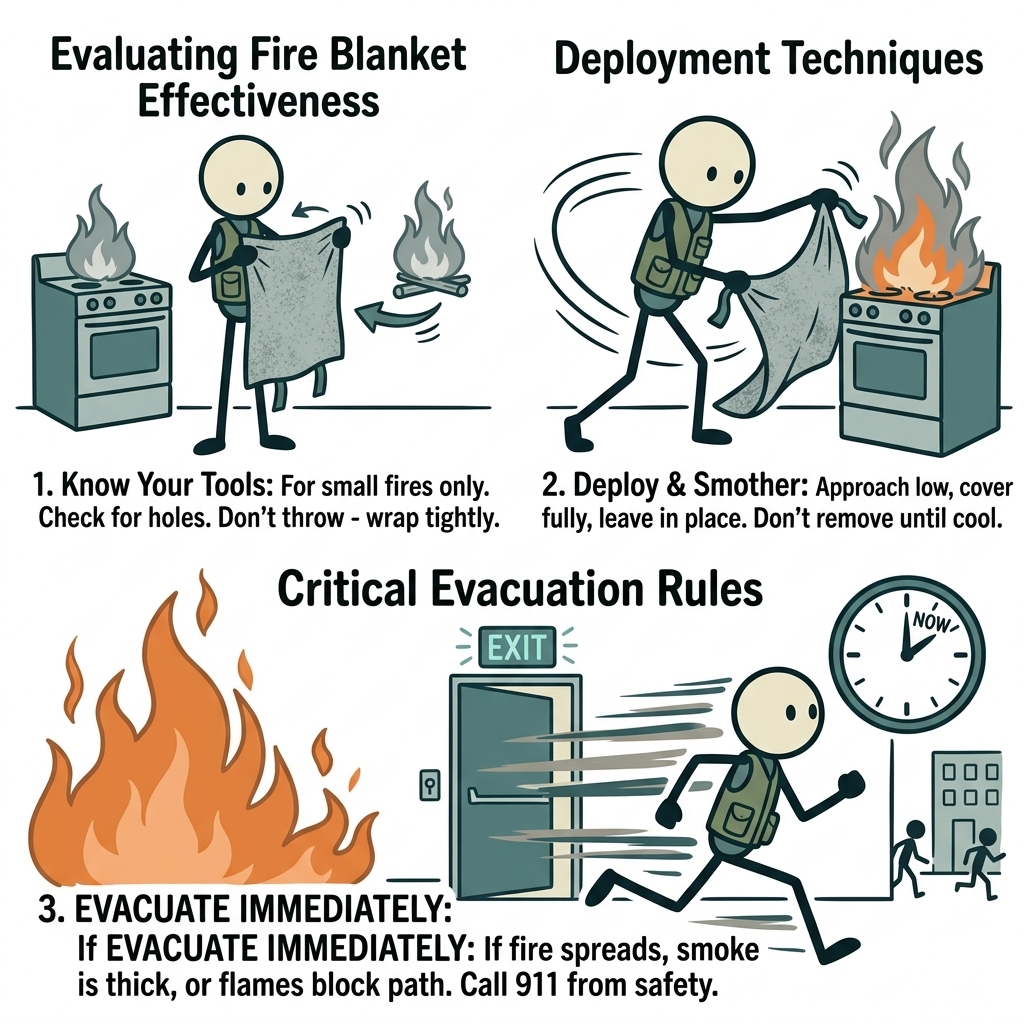
Anatomy of a Fire Blanket: Materials, Standards, and Thermal Resistance
A fire blanket is not simply a heavy piece of cloth; it is an engineered life-safety device calibrated to manipulate the fundamental chemistry of combustion. At its core, fire requires three components to survive: heat, fuel, and oxygen, an interaction commonly known in emergency services as the "fire triangle." While water works by absorbing thermal energy and dry-chemical extinguishers interrupt the chemical chain reaction, a fire blanket operates purely through rapid atmospheric starvation. By sealing the perimeter of an open burn, the blanket deprives the combustion zone of fresh oxygen, causing the flame to suffocate under its own combustion byproducts. For the practical checklist side, use the neighborhood preparedness network.
Commercial-grade blankets are primarily constructed from tightly woven, continuous-filament fiberglass sheets. Manufacturers frequently treat these fibers with specialized silicone or graphite coatings to minimize the dispersal of microscopic glass fibers into the air and improve tensile strength under acute thermal shock. The weave density is critical: low-quality, non-certified bargain blankets often feature loose weaves that permit oxygen seepage, which can cause the fabric to scorch through or fail completely when exposed to the high temperatures generated by deep-fryer grease. For the practical checklist side, use the emergency communication plan.
When selecting a blanket for household safety, look for compliance with recognized third-party performance criteria. The two gold standards in manufacturing are:
- BS EN 1869:2019: The European standard that rigorously tests blankets against hot cooking oil fires (Class F/K), ensuring the blanket can extinguish a standardized quantity of 572°F (300°C) oil without reigniting or allowing burn-through.
- ASTM F1989: The standard specification in North America designed specifically for consumer-grade cooking fire blankets used in residential kitchens.
Thermal thresholds dictate operational limits. A standard certified fiberglass blanket withstands continuous operational temperatures ranging between 900°F and 1,022°F (480°C to 550°C). Specialized units woven with Kevlar threading or vermiculite coatings can resist intermittent flashes up to 1,800°F (982°C). However, understanding what a blanket cannot survive is equally vital: a runaway Class D metal fire (such as burning magnesium) or a violently venting lithium-ion battery pack can burn at temperatures exceeding 2,500°F (1,370°C). In these extreme scenarios, a standard fiberglass blanket will melt, disintegrate, and fail to contain the blaze.
Fire Blanket vs Extinguisher: Strategic Comparison
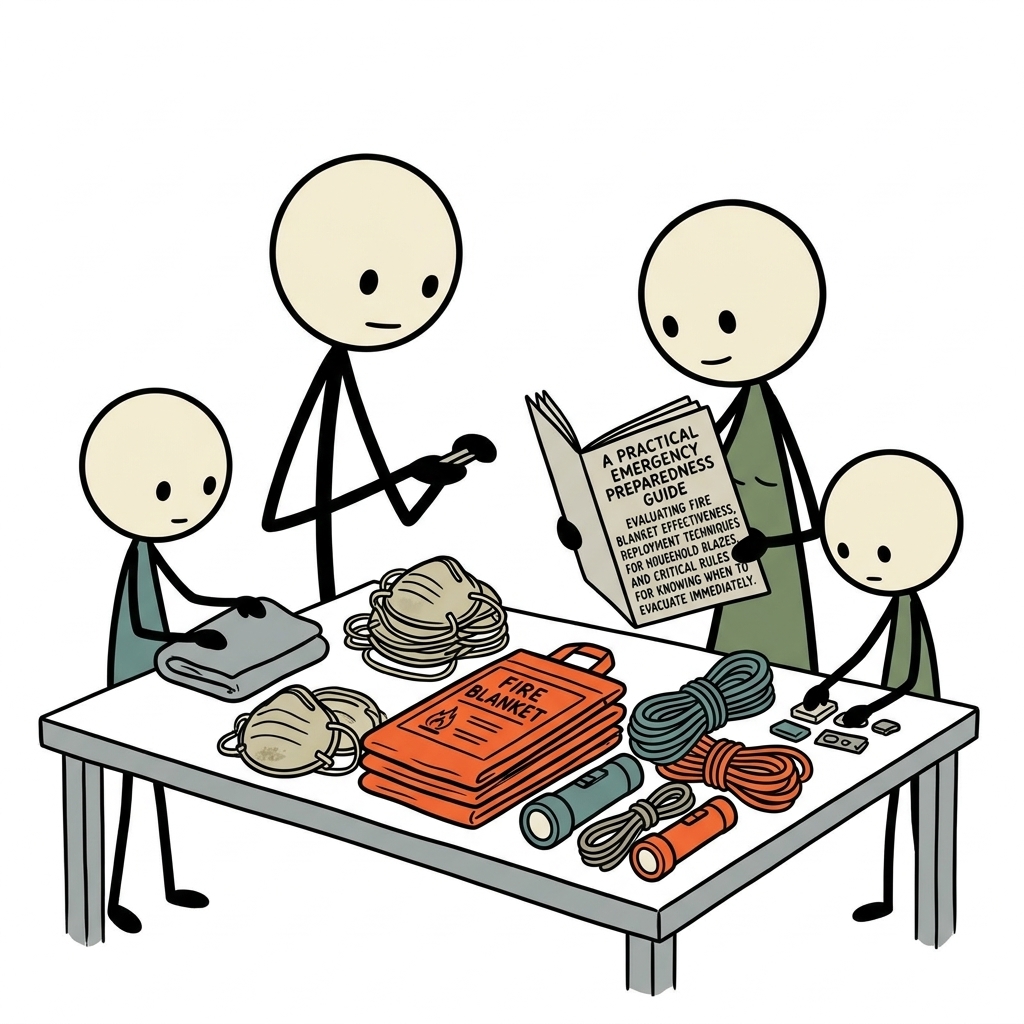
Debating whether a home should rely exclusively on a fire blanket or a traditional fire extinguisher is a false dilemma. Sound survival strategy mandates holding layered defensive capabilities, as each tool addresses distinctly different fire dynamics. Understanding the debate of fire blanket vs extinguisher requires analyzing the operational realities, mess factors, maintenance requirements, and biological stresses involved during an active emergency.
The standard multi-purpose home extinguisher is typically an ABC dry-chemical canister charged with monoammonium phosphate. When discharged, it blankets a wide area in a corrosive, yellow-tinted cloud that interrupts flame chemistry. While undeniably effective across larger surface areas, dry chemical extinguishers pose significant domestic drawbacks. Discharging one in an enclosed kitchen instantly reduces visibility to zero, irritates human respiratory tracts, and deposits fine, abrasive chemicals into electronics, cabinetry, and flooring that often cost thousands of dollars to remediate.
Conversely, a fire blanket produces absolutely zero collateral damage or residue. If a pan of olive oil ignites, a blanket deployed cleanly over the rim will suffocate the flame without tainting adjacent surfaces, allowing you to salvage the surrounding kitchen space. Fire blankets are also completely silent, whereas the sharp, pressurized hiss of a 2.5-pound dry chemical cylinder can startle inexperienced operators and cause them to drop the canister.
Functional Matrix: Fire Blanket vs Extinguisher
- Maintenance Cycle: Extinguishers demand regular monthly pressure gauge inspections, annual shake-ups to prevent chemical caking, and hydro-testing every 6 to 12 years (as detailed by NFPA 10 standards). Fire blankets require zero mechanical upkeep; as long as the packaging remains sealed and free of physical damage, their readiness does not degrade over time.
- User Competence and Training: Extinguishers rely on the well-known "P.A.S.S." protocol (Pull, Aim, Squeeze, Sweep) and require the user to stand 6 to 8 feet away. In high-stress scenarios, novices frequently discharge the cylinder prematurely, emptying the small 8-to-12-second chemical charge into the air without striking the base of the fire. Blankets rely on gross motor skills—pulling two quick-release tabs and draping the fabric—which are easier to execute when fine motor dexterity degrades under stress.
- Physical Flashback and Splash Risks: The discharge velocity of a pressurized chemical extinguisher can exceed 40 pounds per square inch at the nozzle. If an untrained operator points the nozzle directly into a pool of flaming oil at close range, the mechanical pressure can blast the burning liquid out of the vessel, instantly scattering the fire across countertops, curtains, and clothing. A fire blanket, applied correctly, introduces no pressure and completely prevents liquid displacement.
- Dimensional Constraints: Extinguishers excel at attacking irregular, deep-seated, or moving fires, such as flames spreading up wall drywall or underneath an appliance. A fire blanket is geographically limited by its physical dimensions (typically 3.9 feet by 3.9 feet, or 1.2m x 1.2m). It cannot smother a blaze that extends past its perimeter, making it largely ineffective on three-dimensional fires involving vertical surfaces.
For a robust preparedness plan, deploy both tools strategically. Mount a fire blanket directly in the primary risk zone (within reaching distance of the stove), and place a 5-pound ABC dry-chemical or clean-agent extinguisher near the primary exit door of the kitchen. This ensures you have an immediate, non-destructive suppression tool for small container fires, backed by a high-output expulsion tool if the fire escapes containment.
Step-by-Step Protocol: How to Use a Fire Blanket on a Domestic Blaze
Executing an emergency protocol while exposed to intense heat and crackling flames requires ingrained muscle memory. Practicing the physical deployment mechanics of how to use a fire blanket beforehand eliminates costly hesitation. Follow this standardized tactical procedure when dealing with an incipient, contained household fire.
Phase 1: Tactical Access and Hand Protection
Mount your fire blanket package on a clear wall, approximately 5 feet from the floor, along an unobstructed escape path. Crucially, do not mount it directly above the cooktop, where reaching for it would force your hands through rising heat and smoke. Grab the two quick-release hanging tabs firmly with both hands and yank downward in a continuous, smooth motion. The blanket will release from its hook-and-loop closure sleeve instantly.
Once the blanket is fully deployed, immediately shield your hands from radiant heat. Never hold the edges of the blanket with your fingers exposed toward the fire. Instead, roll the corners of the blanket backward over your hands, effectively creating protective fiberglass gauntlets, or grasp the tabs while rotating your wrists outward so the fabric forms a continuous thermal barrier between your flesh and the flames.
Phase 2: The Shielded Approach
Position your body behind the suspended blanket. Hold the fabric taut at chest height, tilting the top edge slightly away from you so your face and airways are shielded from the thermal thermal plume. Keep your elbows slightly bent to maintain control, and approach the fire with a stable, wide-stance walk.
Assess drafts and airflow before closing the distance. If an exterior door or window has created an air current, approach with the wind at your back to prevent heat from curling around the edges of the fabric toward your body. Move deliberately; rushing increases your risk of tripping or bumping the burning container.
Phase 3: The Gentle Draping Maneuver
The single most dangerous mistake made during fire blanket deployment is throwing or tossing the fabric. Tossing introduces an air current that feeds the fire, risks missing the target, and can knock over pans of boiling oil. Instead, lower the blanket smoothly and deliberately onto the burning container.
Let the bottom edge of the blanket touch the surface just in front of the near rim of the pan first. Roll the rest of the blanket forward, away from your body, across the top of the flames in one continuous, calm motion. Ensure the blanket settles fully over the rim, draping down on all sides to seal off incoming ambient air.
Phase 4: Source Neutralization and Cold Soak
Once the blanket is set in place, immediately address the fuel source. Reach below the level of the flames and switch off the burner, oven heating element, or electrical breaker. If the fire involves an electric appliance on a countertop, pull the electrical plug from the wall outlet only if you can do so without touching the blanket or reaching across the hot zone.
Do not touch, adjust, or peek under the blanket. Even if the visible flame has ceased, the liquid fat or oil underneath remains well above its autoignition temperature (which for vegetable oil sits around 750°F to 800°F). Introducing fresh oxygen by lifting the blanket prematurely will trigger a spontaneous, violent flashover. Leave the blanket completely undisturbed for a minimum of 30 to 60 minutes until the vessel has cooled entirely to room temperature.
Phase 5: The "Stop, Drop, and Wrap" Protocol for Clothing Fires
If a person’s garments catch fire, standard fire safety protocols dictate they must stop, drop, and roll. However, an alert bystander armed with a fire blanket can cut suppression time down to seconds. If someone near you catches fire, execute the following protocol:
- Pull the blanket free from its casing and hold it out wide.
- Forcefully instruct the victim to stop moving; running fans the flames and accelerates oxygen delivery to the burn front.
- Wrap the blanket securely around the victim's shoulders and torso, pulling the fabric snug against the body to suffocate the fire.
- Guide the individual down to the floor to prevent chimney-effect flames from searing their neck, face, and respiratory tract.
- Roll them gently while keeping the blanket tight against their frame until all combustion ceases.
- Immediately call 911 and begin cooling thermal burns with cool (not freezing) running water; never attempt to peel away clothing that has melted directly into skin tissue.
Kitchen Fire Safety: The Lethal Science of Grease Fires
Kitchen fire safety requires a clear understanding of why grease fires behave so differently from wood or paper fires. Liquid oils are combustible hydrocarbons with unique thermodynamic properties. As cooking oils absorb thermal energy, they pass their smoke point and climb toward their flash point, releasing volatile, flammable vapors. Once the autoignition temperature is reached, the vapor self-ignites across the surface of the liquid, even without direct contact with an open spark.
The catastrophic error made in home kitchens is applying water to burning oil. Water has a higher density than oil, meaning it sinks straight to the bottom of a hot pan. Because the oil is burning at temperatures far exceeding the 212°F (100°C) boiling point of water, the submerged water vaporizes instantaneously into steam. Water expands roughly 1,700 times its original liquid volume when transforming into gas.
This violent, explosive volume expansion blasts the burning oil upward into the air as millions of micro-droplets. This atomization drastically increases the oil's surface area and exposes it to ambient oxygen, producing an instantaneous, concussive fireball that surges to the ceiling, ignites overhead cabinets, and inflicts horrific third-degree burns on anyone nearby. A certified fire blanket safely eliminates this hazard by sealing the surface area without causing any mechanical turbulence in the underlying liquid.
Emerging Threats: Lithium-Ion Micro-Fires
Modern households contain an unprecedented density of rechargeable electronics, from smartphones and laptops to power tools and e-bike batteries. When a lithium-ion cell suffers mechanical damage, an internal short circuit, or manufacturing flaws, it can enter a state known as thermal runaway. During thermal runaway, the chemical decomposition of the battery's internal cathode releases oxygen gas, organic solvents, and extreme heat independently, creating a self-sustaining fire that feeds itself from within.
Can a standard household fire blanket extinguish a lithium-ion battery fire? The definitive answer is: No. Because thermal runaway produces its own internal oxygen supply, smothering the device with an EN 1869-rated domestic fire blanket will not halt the underlying chemical decomposition. While a fire blanket may temporarily suppress flying embers or flare-ups from adjacent plastics, the battery will continue to generate extreme thermal energy, melting fiberglass fabric and venting highly toxic hydrogen fluoride and carbon monoxide gases. For catastrophic lithium-ion events, specialized high-temperature pyro-containment blankets are required; otherwise, immediate evacuation is your only safe course of action.
The Threshold of Survival: Knowing When to Evacuate a Fire
The most dangerous trap in domestic real-world Survival Scenarioss guide is the "sunk cost" psychological fallacy. Once an individual grabs a suppression tool, their focus often narrows into tunnel vision, driving them to stand their ground long after the fire has crossed the threshold of controllable containment. The American Red Cross and FEMA emphasize that saving property should never take precedence over personal safety. Knowing when to evacuate a fire is the single most critical judgment call you will ever make.
Modern home construction relies heavily on engineered lumber, open-concept floorplans, and synthetic furnishings like polyurethane foam cushions and polyester textiles. Decades ago, natural materials like wood and cotton smoldered slowly, giving occupants roughly 14 to 17 minutes to evacuate safely. Modern synthetic rooms can reach flashover—the terrifying phenomenon where every combustible surface within an enclosed space simultaneously ignites from radiant heat—in less than three minutes. If your initial suppression effort does not eliminate the blaze within 10 to 15 seconds, your window for safe evacuation is rapidly closing.
The Five Non-Negotiable Evacuation Rules
Memorize these environmental triggers. The moment any of these five criteria are met, discard your fire blanket or extinguisher, alert everyone in the home, and evacuate immediately along your pre-planned escape routes:
- The Containment Boundary Rule: A fire blanket is designed solely for fires confined to a vessel, such as a pan, pot, toaster, or small trash bin. If the flames have jumped the boundary of the container and caught onto countertops, window curtains, wall trim, or overhead range hoods, the fire has transitioned from an incipient stage to a structural fire. Drop the blanket and evacuate.
- The Smoke Layering Rule: Smoke is fuel in an unburned, gaseous form. If you notice smoke accumulating along the ceiling and descending past shoulder height (known as thermal stratification or smoke layering), you are standing in a potential ignition envelope. This descending layer carries deadly concentrations of carbon monoxide, hydrogen cyanide, and phosgene. Once visibility drops and the smoke line lowers, immediate low-crouch evacuation is mandatory.
- The Escape Path Obstruction Rule: Never allow an active fire to position itself between you and your primary route of exit. If attempting to deploy a fire blanket forces you deep into a corner or kitchen dead-end where a flashover would trap you, abandon the attempt. Always face the blaze while keeping an unobstructed, open door directly behind you.
- The Auditory Indicator Rule: Structural fires produce distinctive acoustic signals. If you hear continuous, rhythmic crackling behind drywall, sharp popping from tempered glass windows, or deep, booming thuds from structural roof trusses expanding under heat stress, structural failure is imminent. The fire has likely traveled through wall cavities and chases out of reach of any manual suppression equipment.
- The One-Attempt Rule: If you place a fire blanket over a burning pan and flames continue to rage around the margins, or if the blanket scorches through due to chemical fuels, do not lift, reposition, or adjust it. You get one rapid attempt. If that action does not definitively control the hazard, your proactive intervention window has expired.
Evacuation Procedure: The Tactical Exit
When the evacuation threshold is crossed, shift instantly from fire containment to life safety. Yell alarms clearly to alert all occupants throughout the structure. As you clear rooms, close doors behind you—a simple closed interior door dramatically starves the fire of fresh air currents, limits structural damage, and can add five to fifteen minutes of survivable time for others escaping the house.
Drop below the thermal layer if smoke is present, crawling on your hands and knees where breathable air stays cleaner and cooler near the floor. Once you cross the exterior threshold of the home, do not return inside for any reason—pets, heirlooms, and documents are never worth a human life. Gather at your predetermined outdoor meeting spot and immediately dial 911 to provide dispatchers with precise details regarding the fire's location and any trapped occupants.
Establishing a Comprehensive Residential Fire Strategy
Emergency preparedness is not an isolated piece of gear sitting in a drawer; it is an integrated household system built on quality equipment, strategic placement, regular maintenance, and rehearsed family action plans. To maximize residential survivability, your home safety blueprint should combine the clean, rapid containment abilities of a fire blanket with reliable, modern early-warning systems.
Install interconnected photoelectric smoke alarms inside every bedroom, outside each sleeping area, and on every level of your home, testing them on the first of every month as recommended by the USFA. Keep your fire blanket mounted securely in the kitchen, outside the stove's immediate blast and grease radius, making sure every adult and teenager in the home understands how to pull the tabs and deploy the fabric safely. Pair this with a designated ABC-rated fire extinguisher mounted near an exterior exit, and conduct semi-annual home fire drills so every family member can execute primary and secondary escape routes under blackout conditions.
True crisis preparedness transforms unpredictable emergencies into structured, manageable events. By understanding the mechanical physics of fire blankets, mastering the calm, deliberate motor skills needed for safe deployment, and respecting the hard thresholds where fire demands immediate evacuation, you turn knowledge into a practical life-saving shield. Equip your home with the right tools, build real muscle memory through deliberate practice, and always prioritize human life over property when seconds count.
Frequently Asked Questions
What types of fires can a fire blanket safely extinguish?
Fire blankets are designed for small, contained Class A (combustible materials like paper and wood) and Class F/K (cooking oil and grease) fires, as well as wrapping around a person whose clothing has caught fire.
Can a fire blanket be washed and reused after an emergency?
No. Once a fire blanket has been deployed on an actual fire, the fibers and flame-retardant structural integrity are compromised, and it must be discarded and replaced immediately.
How do you properly deploy a fire blanket on a pan fire?
Pull the deployment tapes downward firmly, wrap the top edges around your hands to shield them from flames, gently place (do not throw) the blanket over the burning container, turn off the heat source, and leave it covered until completely cool.
When should you abandon using a fire blanket and evacuate immediately?
Evacuate immediately if the fire is larger than the blanket, if flames spread past the edges, if dense smoke compromises your breathing, or if the fire is not completely smothered within seconds.
Do fire blankets expire?
Most fiberglass fire blankets do not have a strict expiration date, but manufacturers generally recommend inspecting them annually and replacing them every five to seven years to ensure the packaging and fabric remain undamaged.