⚡ Key Facts
- Plastic Porosity Matters: Standard High-Density Polyethylene (HDPE #2) buckets are technically semi-permeable to oxygen, diffusing up to 150–300 cc of oxygen per square meter annually—making the pairing of mylar bags and buckets mandatory for decades-long shelf stability.
- The 0.1% Oxygen Threshold: The Federal Emergency Management Agency (FEMA) and food science researchers at Utah State University emphasize that oxygen levels must drop below 0.1% inside storage vessels to eradicate all life stages of common pantry pests without toxic chemical fumigants.
- Moisture Critical Limit: Storing staples with a moisture content exceeding 10% to 12% in airtight, oxygen-depleted containers creates an anaerobic environment that drastically increases the risk of fungal growth and Clostridium botulinum sporulation.
- Temperature Multiplier: In accordance with the Arrhenius equation applied to food degradation, every 10°C (18°F) reduction in ambient storage temperature doubles the effective shelf life of dry staples sealed in bulk containers.
- Resin Certification: A bucket marked "#2 HDPE" is not automatically safe for calories; it must be molded from virgin resin compliant with FDA 21 CFR 177.1520 to prevent toxic plasticizers, colorants, and recycled industrial lubricants from leaching into fats and starches.
A catastrophic disruption to national logistical arteries does not announce itself with a warning siren. Whether triggered by an extreme grid-down weather phenomenon documented by the National Oceanic and Atmospheric Administration (NOAA) or sudden geopolitical supply chain shocks, grocery store inventories deplete within an estimated 72 to 96 hours. For decades, emergency preparedness doctrine has championed the accumulation of dry bulk commodities—hard white wheat, polished white rice, dried pinto beans, and rolled oats. Yet, across community larders and home basements nationwide, millions of pounds of life-sustaining calories are quietly spoiling. They fall victim not to fire or flood, but to structural oversights in containment: microscopic insect larvae chewing through porous polymers, atmospheric humidity triggering invisible fungal decay, and non-food-grade resins leaching endocrine-disrupting chemicals directly into dry grain reserves. Mastering the procurement, sanitation, and hermetic sealing of food grade buckets for long term storage is not merely an optional survival chore; it is the single most critical engineering task separating nutritional resilience from total pantry failure when outside help is non-existent. For the practical checklist side, use the community emergency preparedness guide.
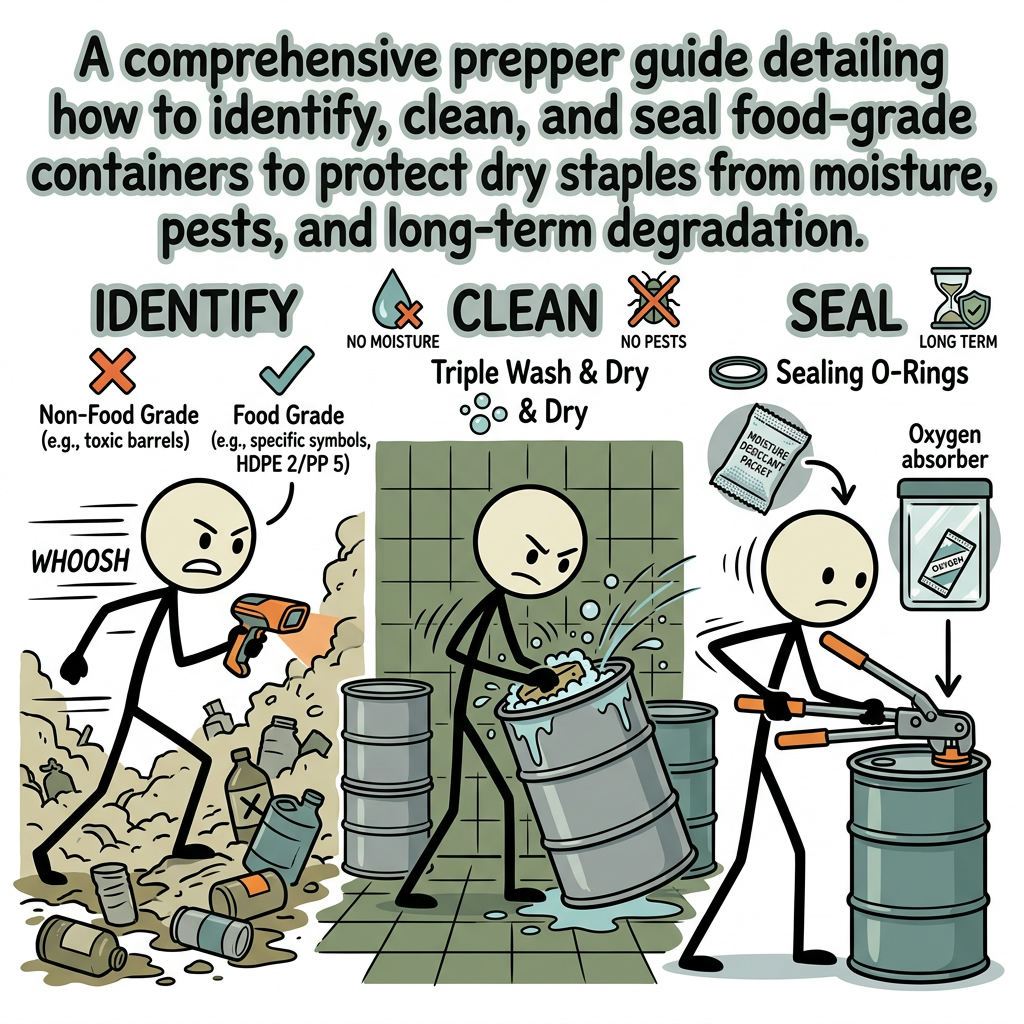
The Science of Food-Grade Containers: Identification and Polymers
Every long-term preservation strategy starts with the molecular integrity of the storage vessel. Consumers routinely assume that any heavy-duty five-gallon plastic pail procured from a local home improvement center provides an impermeable fortress for bulk goods. This assumption can ruin thousands of dollars of supplies. Industrial-grade utility buckets—often cast in bright orange, blue, or black—are manufactured from recycled post-consumer plastics and off-spec resins. During the rotational injection-molding process, industrial fabricators employ chemically harsh release agents, non-food-safe colorants containing heavy metals, and phthalate plasticizers designed to make the bucket impact-resistant rather than chemically inert. Over months of contact, these lipophilic chemicals migrate directly into the dry goods, rendering whole grains toxic. For the practical checklist side, use the neighborhood preparedness network.
To safely choose emergency emergency food storage guide containers, you must understand Resin Identification Codes (RIC) and the rigorous manufacturing standards enforced by the U.S. Food and Drug Administration (FDA) under Title 21 of the Code of Federal Regulations (21 CFR 177.1520).
Decoding the Markings: HDPE, PET, and Polypropylene
Turn any potential storage container upside down to inspect the base. You are hunting for specific, unambiguous molded alphanumeric stamps: For the practical checklist side, use the emergency communication plan.
- Resin #2 (HDPE - High-Density Polyethylene): The undisputed standard for heavy, rigid food storage buckets. HDPE possesses a densely packed molecular structure that yields high tensile strength, exceptional impact resistance, and a broad thermal operating range (-40°F to 180°F). It is impervious to short-term chemical attacks from acids and alkaline cleaning agents.
- Resin #5 (PP - Polypropylene): Commonly used for bucket lids, secondary snap seals, and intermediate rigid storage tubs. Polypropylene features a high melting point and superior fatigue resistance, making it ideal for the living hinges and threaded mechanisms found on high-end preservation covers.
- Resin #1 (PET or PETE - Polyethylene Terephthalate): Most frequently encountered in two-liter soda bottles, clear juice jugs, and secondary grain storage bottles. While highly effective as an emergency gas barrier for smaller dry-pack needs, PET lacks the long-term wall thickness and stacking rigidity required for multi-year bulk stockpiling.
A recycling triangle displaying a "2" is necessary, but alone it is insufficient. You must confirm that the bucket is cast from virgin resin. Look for the international food-contact icon—an embossed silhouette of a wine glass and fork. Alternatively, search for explicit textual verbiage reading "FDA Food Grade," "NSF Certified" (National Sanitation Foundation), or "USDA Approved." If the container base only bears the recycling triangle without certification text or the food-contact icon, assume it contains re-ground scrap resin intended strictly for construction paint, joint compound, or petroleum oils. For the practical checklist side, use the family emergency planning guide.
Sourcing Virgin Containers on a Budget
Procuring pristine storage containers does not require paying exorbitant premiums at boutique preparedness outlets. Commercial food operations generate vast quantities of heavy-duty, food-certified plastic pails on a daily basis. Local bakery departments, donut shops, commercial restaurants, and institutional dining halls routinely discard four- to six-gallon HDPE buckets that originally housed liquid shortening, high-fructose corn syrup, honey, bulk pickles, or bulk egg washes.
When sourcing used vessels, ask the kitchen manager what ingredients the bucket held. While a bucket filled with vegetable oil or corn syrup cleans up quickly, buckets that previously held concentrated garlic puree, dill pickle brine, or chemical sanitizers retain microscopic volatile organic compounds deep within the polyethylene matrix. These smells can never be fully purged and will transfer off-flavors into sensitive dry staples like oats and flour. Prioritize containers that held neutral syrups, shortening, or dry bulk ingredients.
Sanitization Protocols: The 3-Stage Decontamination Lifecycle
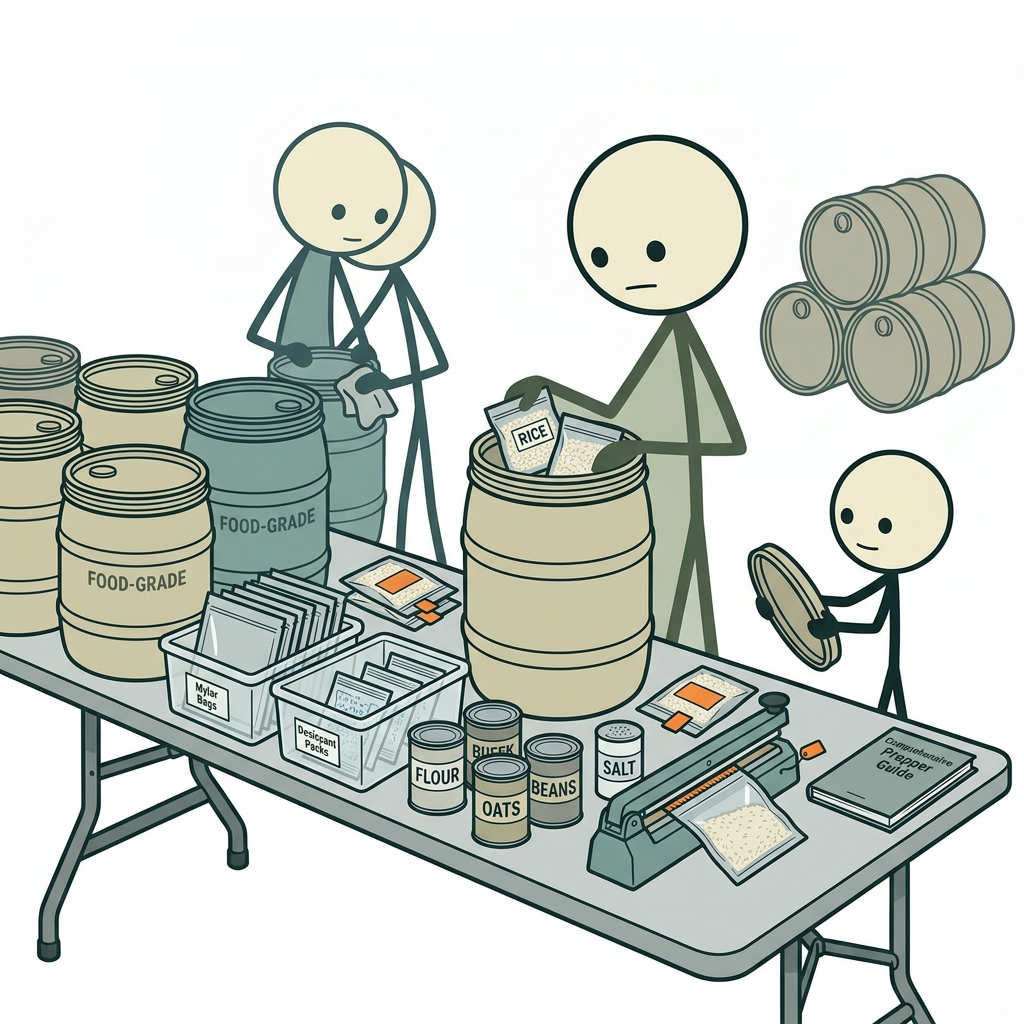
Never pour calorie reserves into a container straight from the distributor or restaurant kitchen. Brand-new factory buckets carry static-attracted factory particulates, mold-release talcs, and airborne warehouse residues. Secondary commercial buckets, meanwhile, harbor residual oils that quickly oxidize into rancid compounds, alongside active spore populations of bacteria and wild molds. Decontaminating your emergency food storage containers requires a three-stage lifecycle: mechanical degreasing, chemical sterilization, and a strict dehydration sequence.
Stage 1: Mechanical De-Greasing and Soil Stripping
Fill the bucket with scalding water (120°F to 130°F) and a high-surfactant, dye-free, unscented dishwashing liquid. Using a non-abrasive microfiber towel or soft-bristled nylon scrub brush, scour every square inch of the internal walls, rim flanges, and external bottom ridges. Avoid steel wool, scouring pads, or metallic scrapers at all costs. HDPE is relatively soft; micro-abrasions create minute fissures measuring between 5 to 50 microns across. These tiny grooves serve as micro-harbors where insect eggs and fungal spores shield themselves from subsequent chemical disinfectants.
Stage 2: Antimicrobial Sanitation
Once the container is completely rinsed and stripped of all mechanical soils, you must eliminate biological contaminants. Two methods deliver reliable field sterilization:
- The Sodium Hypochlorite Method (CDC Household Ratio): Blend 1 tablespoon of unscented, conventional household bleach (5%–6% sodium hypochlorite concentration) per gallon of cool ambient water. Swirl this solution across all internal surfaces, ensuring continuous wet contact for a minimum of 10 full minutes. Never use scented or "splash-less" bleaches, as they leave lingering surfactant residues that degrade food quality.
- The Acid Anionic Method (Star San): For preppers seeking a zero-rinse, food-grade alternative, brew-grade Star San (a blend of food-grade phosphoric acid and dodecylbenzenesulfonic acid) offers rapid, high-level antimicrobial action within 60 seconds of contact. It self-neutralizes into trace nutrients that are entirely harmless to dry staples.
After treatment with the bleach solution, thoroughly rinse the container with pure, potable tap or well water to flush out residual chlorine salts. If using Star San, simply empty the excess foam and inverted-drain the bucket; do not rinse with unsterile water.
Stage 3: The Dehydration Imperative
Moisture is the primary catalyst for rapid spoilage. Introducing raw grain to a bucket containing even three drops of trapped water can spur an explosion of localized mold growth, ruining the entire 35-pound batch. Stand the sanitized containers upside-down at an angle on a clean wire rack or drying dowels in a low-humidity, temperature-controlled indoor room. Allow a full 24 to 48 hours for complete evaporative drying. Never leave drying buckets outdoors in direct sunlight on grass or concrete patios; airborne pollen, ambient road dust, and insects will quickly recolonize the damp plastic interior.
Field Tip: Deodorizing Pickle and Brine Barrels
If you inherit heavily odor-impregnated food-grade buckets, standard washing will not neutralize the smell. Combine 1 pound of pure sodium bicarbonate (baking soda) with 1 gallon of warm water, scrub down the interior, and seal the lid tightly for 7 days. Afterward, vent the container and expose it to unfiltered, midday ultraviolet light for 6 to 8 hours. The combination of alkaline neutralization and UV-induced photo-oxidation breaks down the stubborn allyl sulfide compounds common in alliums and brines.
The Threat Matrix: Moisture, Oxygen, Pests, and Light
To successfully design a storage setup capable of keeping wheat, beans, and rice fresh for 25 to 30 years, you must defend against four relentless natural enemies: moisture, oxygen, internal insect infestation, and photo-thermal degradation. Each vector attacks the cell walls, lipids, and vitamins of your staples through distinct chemical and biological pathways.
Moisture and the Water Activity ($a_w$) Threshold
The United States Department of Agriculture (USDA) advises that dry goods intended for extended shelf storage must exhibit a moisture content below 10%, with an absolute maximum threshold of 12%. When grain moisture crosses the 14% boundary, seed respiration spikes, generating localized micro-climates of free water and heat. This triggers non-enzymatic browning and invites the growth of mycotoxin-producing molds, notably Aspergillus flavus, which synthesizes lethal aflatoxins. Furthermore, sealing moist staples into completely oxygen-deprived containers creates ideal conditions for the anaerobic germination of Clostridium botulinum, transforming high-value provisions into a dangerous poison.
Oxygen: The Driver of Lipid Rancidity
Atmospheric air consists of roughly 78% nitrogen, 21% oxygen, and trace inert gases. In food preservation, that 21% oxygen is pure chemical hazard. Oxygen drives oxidative rancidity: it attacks free fatty acid chains within the germ of grains, breaks down essential amino acids, and destroys vital micronutrients (notably vitamins A, C, and E). Even polished white rice and low-fat dried beans carry trace lipids that rapidly oxidize when exposed to air, leaving the food smelling foul, tasting metallic, and offering drastically diminished nutrition.
Pests: The Latent Threat
Most home preppers assume pantry pests enter containers through loose seals. In reality, the call is usually coming from inside the house. Female granary weevils (Sitophilus granarius) and lesser grain borers (Rhyzopertha dominica) chew tiny holes into developing grain kernels while they are still in agricultural fields. They deposit microscopic eggs within the starchy endosperm, sealing the entry wound with a gelatinous fluid. Once sealed inside your storage buckets, these eggs hatch into hungry larvae as soon as moisture and ambient temperature align. Within months, an undetected infestation can reduce 40 pounds of premium hard red wheat into a hollowed-out collection of dust and frass.
Light and Heat: Catalysts of Decay
Ultraviolet and shortwave visible light cleave chemical bonds through photolysis, accelerating the rancidification of trace lipids and bleaching organic pigments. Concurrently, thermal energy dictates the speed of every underlying decay reaction. For every 10°C (18°F) rise above optimal baseline conditions (defined by the Red Cross and FEMA as roughly 50°F to 60°F), nutritional loss and cellular breakdown occur twice as fast. A bucket kept at an uninsulated 90°F in an attic or outbuilding will degrade four times faster than an identical bucket held in a cool 55°F basement cellar.
The Gold Standard: Mylar Bags and Buckets Integration
A persistent myth in preparedness circles claims that pouring clean grain directly into a food-grade bucket and snapping a tight lid down provides 30 years of security. It does not. High-Density Polyethylene is a semi-porous polymer. At a microscopic level, ambient oxygen, environmental moisture vapor, and volatile aromas slowly diffuse through the bucket's walls over prolonged timelines. Storing staples in buckets offers rugged physical defense against gnawing rodents, physical impacts, and light penetration, but the plastic alone cannot maintain an ultra-low oxygen environment for decades.
The definitive solution combines mylar bags and buckets into a unified, redundant system. The Mylar acts as an impermeable gas barrier, while the bucket provides mechanical, puncture-proof armor.
Selecting High-Performance Mylar Film
Mylar is an industry trade name for biaxially-oriented polyethylene terephthalate (BoPET) film laminated to an ultra-thin layer of vaporized aluminum foil and an inner food-safe polyethylene sealant layer. The aluminum layer provides near-absolute gas impermeability, exhibiting an Oxygen Transmission Rate (OTR) of zero and a Water Vapor Transmission Rate (WVTR) hovering at an imperceptible 0.0001 grams per square meter per day.
Avoid thin, economy-grade 3.5-mil or 4.0-mil bags sold on discount websites. These light-duty films are prone to microscopic pinholing at sharp fold creases and tear easily when filled with jagged, hard grains like un-milled dent corn or wheat berries. Select professional-grade, multi-laminate bags with a minimum thickness of 5.0 to 7.0 mils. A 5-gallon, 7-mil Mylar liner inside an HDPE bucket delivers a tough, multi-decade storage system capable of weathering challenging conditions without vacuum failure.
Sizing and Activating Oxygen Absorbers (OAs)
Oxygen absorbers do not contain toxic chemicals. They rely on a reliable, well-understood chemical reaction: finely divided iron powder mixed with sodium chloride (salt) and bentonite clay. When unsealed and exposed to ambient air, the atmospheric moisture activates the salt, driving the iron to oxidize rapidly into iron oxide ($Fe_2O_3$). This reaction binds all free gaseous oxygen at the molecular level, pulling ambient oxygen levels down from 20.9% to below 0.01% (100 ppm).
Oxygen absorbers are rated in cubic centimeters (cc) of pure gaseous oxygen they can absorb. You must calculate the capacity of your container, account for the density of the food, and factor in the internal void space:
| Commodity Category | Void Space Fraction | Typical Staples | Recommended OA Capacity (5-Gal Mylar) |
|---|---|---|---|
| Dense / Small Granule | ~20% to 30% void air | White Flour, Cornmeal, Sugar (NO OA!)*, White Rice | 1,500 cc to 2,000 cc |
| Medium / Semi-Dense | ~40% to 45% void air | Hard Red Wheat, Lentils, Whole Rye, Pearl Barley | 2,000 cc |
| Bulky / Irregular Grain | ~50% to 65% void air | Pinto/Kidney Beans, Rolled Oats, Dehydrated Pasta | 2,500 cc to 3,000 cc |
*CRITICAL EXCEPTION: Never place oxygen absorbers inside sugar (white, brown, or powdered) or salt. Oxygen absorbers absorb moisture alongside oxygen, which turns bulk sugar into a solid, impenetrable block of rock candy. Salt is an inorganic mineral that cannot support insect life or spoil; it simply requires a sealed, moisture-proof barrier without an oxygen scavenger.
The Sealing Playbook: Thermal Sealing and Lid Mechanics
A flawless Mylar liner and correctly sized oxygen absorbers will fail completely if your thermal seal or container closures are poorly executed. True long-term food preservation requires precise, repeatable mechanical discipline.
Executing the Hermetic Mylar Thermal Seal
To produce an airtight, laboratory-grade heat seal on 5.0- to 7.0-mil Mylar, you need a stable heat source capable of generating and holding 375°F to 425°F (190°C to 218°C). While specialized industrial jaw-style impulse sealers are ideal, a conventional household flat iron set to its highest setting (linen/cotton) works exceptionally well when backed by a flat, non-flammable thermal surface.
- Insert the Liner: Drop the 5-gallon Mylar bag directly into the clean, dry bucket, pushing the bottom base corners fully into the bucket's lower perimeter.
- Fill with Staples: Pour in the dry grain in 10-pound increments, lifting and gently dropping the bucket an inch off the floor to vibrate and settle the contents. Fill until the grain sits roughly three inches below the top rim of the bucket.
- Pre-Seal: Smooth the open neck of the Mylar bag flat, pressing out excess ambient air by leaning your forearms along the sides. Lay a straight, clean piece of wood across the bucket rim to serve as a firm ironing board. Smooth the bag mouth across the board. Using the flat iron, seal 85% of the bag's width, leaving a 2- to 3-inch open "burp port" at one end.
- Drop the Absorber: Take your fresh oxygen absorber package out of its factory vacuum seal. Quickly slip the calculated dose (e.g., one 2,000 cc packet or four 500 cc packets) through the open port, placing it directly atop the grain layer. Avoid holding up the process: you have roughly 15 to 20 minutes before the absorber begins heating up and exhausting its capacity in room air.
- Final Vacuum and Seal: Insert a small shop-vac hose or your own hands to compress and exhaust the remaining pocket of headspace air. Quickly apply the heat iron to the remaining open port, running a wide, uninterrupted 1-inch to 1.5-inch thermal weld straight across the bag mouth.
- Inspection: Allow the sealed plastic to cool for 60 seconds. Inspect the seam: it should show an even, continuous imprint with no puckers, bubbles, wrinkles, or channels through which air could leak.
Within 24 to 48 hours, the oxygen absorber will consume the 21% oxygen fraction in the headspace. The Mylar bag will draw in tightly against the contours of the grain, resembling a craggy brick of freeze-dried coffee. Note: The bag will not pull down into an absolute vacuum, because nitrogen still accounts for nearly 79% of the remaining gas volume. This residual nitrogen cushion is inert, completely safe for food, and keeps the grains in prime condition.
Secondary Mechanical Containment: Lid Architectures
Once the internal Mylar bag is sealed and folded down into the bucket neck, you must lock the primary plastic container. Emergency preppers rely on two main closure systems:
- Standard Tear-Strip Gasket Lids: These heavy-duty industrial closures feature a built-in ethylene-propylene diene monomer (EPDM) or neoprene rubber O-ring running inside the inner perimeter channel. Seat the lid squarely on the bucket rim, then drive it home using a two-pound rubber dead-blow mallet, striking the edge clockwise until every segment locks down over the bucket lip. These lids deliver tremendous impact strength and stacking stability, but they require a plastic bucket wrench to pry off during an emergency.
- Gamma Seal Lids: A two-piece threaded closure system comprising an outer snap-on structural collar and a central, heavy-gauge screw-in lid equipped with dual elastomeric O-rings. The outer collar is permanently driven onto the bucket using a rubber mallet; after that, the central core can be spun open or closed by hand in seconds without tools. Gamma Seal systems are ideal for short-rotation working buckets, dry dog food, or everyday access items. However, take care during installation: apply a thin film of food-grade silicone lubricant to the rubber O-rings every few years to keep the rubber pliable and prevent cracking over decades of use.
Commodity Profiles: Engineering the Ultimate Long-Term Bulk Reserve
Not every bulk grocery staple behaves identically inside sealed storage systems. Preparing long-term bulk goods requires matching specific commodities to appropriate preservation methods.
Low-Fat, Ultra-Stable Commodities (25–30 Year Longevity)
These staples possess low moisture contents (<10%) and near-zero lipid profiles, making them practically invulnerable to chemical breakdown when kept in an oxygen-free, moisture-depleted state:
- Polished White Rice (Jasmine, Basmati, Long Grain): Because the fat-heavy bran and germ layers are milled away during processing, white rice stored with an oxygen absorber in Mylar will remain chemically and nutritionally stable for 30 or more years. Conversely, brown rice retains its lipid-rich bran coat, turning rancid within 6 to 12 months regardless of packaging. Never attempt to preserve brown rice for long-term reserves.
- Hard Red and Hard White Wheat Berries: The foundational calorie engine of human civilization. When protected against moisture, intact whole wheat kernels preserve their internal starches and gluten structures for up to three decades. When ground fresh, they produce high-protein, nutrient-dense survival flour.
- Dry Legumes (Pinto, Black, Navy, and Kidney Beans; Lentils): Whole dried legumes deliver high-yield protein and carbohydrates. Packaged in oxygen-free environments, they resist fungal rot and oxidation for up to 30 years. Note: Legumes stored beyond ten years can experience hard-seed syndrome, meaning their seed coats resist softening during boiling. You can easily fix this by soaking them longer with 1/4 teaspoon of sodium bicarbonate (baking soda) per quart of water to break down hardened pectins.
- Rolled Oats (Quick or Traditional): Low moisture, processed by steam-stabilization to deactivate lipase enzymes, and exceptionally hardy. Oats comfortably last 20 to 25 years inside sealed food storage buckets.
Special Protocols: Sugar, Salt, and Honey
Certain core pantry items will keep for decades—or even centuries—without oxygen absorption technology, provided you manage their packaging correctly:
- Pure Refined Cane Sugar: Pure sucrose is naturally toxic to bacterial life through osmotic dehydration; microbes cannot grow on it. However, sucrose is intensely hygroscopic, meaning it greedily pulls moisture vapor right out of ambient air. Seal sugar tightly inside thick Mylar bags alongside food-grade desiccants (silica gel packets) to prevent clumping. Again, never introduce oxygen absorbers to sugar.
- Non-Iodized Salt: Pure sodium chloride is a stable mineral that cannot decay, rot, or oxidize. Store it in simple, heavy-duty HDPE buckets fitted with gasketed lids to protect it from outside floodwater and moisture vapor. No oxygen control is necessary.
- Raw Honey: The archaeological record confirms honey remains edible for thousands of years thanks to its high acidity, low moisture content, and naturally occurring hydrogen peroxide. Never seal raw honey in thin plastic Mylar or thin-walled buckets over the long term; honey slowly erodes thin plastics. Keep honey inside thick, food-grade glass jars or rigid, virgin HDPE containers stored in cool, dark quarters. If it crystallizes, set the container in warm water (105°F to 110°F) to gently reliquefy the sugars without damaging beneficial enzymes.
Environmental Staging and Storage Monitoring Protocols
Your finished buckets represent a significant investment of time, money, and labor. Do not abandon them to harsh, unmonitored home storage environments. A poorly chosen staging location will quickly undermine your preparation efforts.
Thermal and Moisture Control: Where to Cache
The ideal home storage depot maintains an ambient temperature between 50°F and 65°F (10°C to 18°C) with a relative humidity level sustained below 50%. Finished basement footprints, interior climate-controlled closets, and purpose-built below-ground root cellars represent the gold standard.
Avoid outdoor metal storage sheds, uninsulated pole barns, lean-to shelters, and attics. A metal outbuilding easily experiences daily thermal swings ranging from 40°F at dawn to over 115°F by mid-afternoon. These severe temperature shifts create internal vacuum shifts, stretch and stress the Mylar laminate layers, and accelerate lipid breakdown within grains. Storing staples at sustained temperatures above 85°F can slash a theoretical 30-year operational life down to five years or less.
Keep your containers off bare concrete floors. Concrete is porous, wicking subterranean ground moisture directly through its slab via capillary action. When plastic buckets sit directly against cold concrete, moisture condenses underneath them. Over several seasons, this moisture can corrode the bottom seams of metal-ringed containers and cultivate dense colonies of toxic black floor mold (Stachybotrys chartarum). Always place clean wooden pallets, heavy dimensional lumber (2x4s), or dedicated plastic warehouse grids under your buckets, maintaining a minimum 2- to 3-inch air gap above the floor.
Stacking Engineering and Rodent Defenses
HDPE buckets are remarkably strong, but plastic slowly softens and yields under long-term structural loads—a physical process known as creep. Never stack five-gallon buckets more than three tiers high unless you use dedicated industrial shelving designed to bear the weight. A typical 5-gallon bucket packed with hard red wheat weighs roughly 37 to 42 pounds. A three-tier stack concentrates over 80 pounds of continuous downward force on the bottom bucket's rim. Excessive weight can warp the plastic, buckle the sidewalls, and pop the rubber gasket seals.
While HDPE stops minor insect invasions and small mice, determined urban rats (Rattus norvegicus) can chew through plastic when guided by olfactory clues. Always wash the exteriors of your buckets with diluted rubbing alcohol after packing to remove trace flour dust or sweet smells. For maximum perimeter security, circle your storage cache with mechanical traps, maintain clean sightlines along all walls, and store your primary bulk
Frequently Asked Questions
How can I tell if a plastic bucket is truly food-grade?
Check for resin identification code #2 (high-density polyethylene, or HDPE) along with an explicit label stating 'Food Grade,' 'FDA Compliant,' or the international cup-and-fork food safety symbol made from virgin plastic.
Can I store bulk dry staples directly in a food-grade bucket without a liner?
While direct contact is non-toxic in food-grade buckets, standard HDPE is slightly gas-permeable over time; lining the bucket with a heat-sealed Mylar bag and an oxygen absorber is necessary to protect against oxygen, light, and humidity for multi-decade shelf life.
Which staples are best suited for long-term bucket storage?
Low-moisture (under 10%) and low-oil dry staples store best, including hard white and red wheat berries, white rice, rolled oats, dried pinto and black beans, corn, and dry pasta.
What is the difference between standard tear-strip lids and Gamma Seal lids?
Standard lids feature rubber gaskets and tear-strips designed for long-term hermetic storage that require a bucket wrench to pry open, whereas Gamma Seal lids install a threaded rim that allows frequent, airtight spin-on access for working pantries.
Why shouldn't long-term storage buckets sit directly on bare concrete floors?
Temperature fluctuations can cause condensation beneath the bucket, potentially rusting metal handles, encouraging mold, and allowing moisture or chemicals from untreated concrete to leach into the outer plastic over time.