⚡ Key Facts
- The 48-Hour Baseline: According to the USDA Food Safety and Inspection Service (FSIS), a fully stocked upright or chest freezer will maintain safe freezing temperatures for roughly 48 hours without power if the door remains closed; a half-full freezer buys only 24 hours.
- The 40°F Safety Threshold: The CDC and FDA establish 40°F (4.4°C) as the critical biological boundary; perishable foods kept above 40°F for more than two hours enter the bacterial "Danger Zone" and must be discarded.
- Refreezing Integrity: Foods that still contain visible ice crystals or remain reliably at or below 40°F can be safely refrozen without cooking, though cellular damage may compromise structural texture and moisture retention.
- Insurance Compensation Limits: Standard HO-3 and HO-5 homeowners insurance policies frequently cap refrigerated and frozen property coverage between $500 and $2,500, often subject to distinct power-interruption deductibles or utility-outage riders.
- Pre-Power Restoration Documentation: Insurance adjusters routinely deny bulk claims lacking itemized dates, estimated retail weights, and logged interior temperatures recorded prior to power restoration and disposal.
When severe weather strikes—whether an ice storm downing regional transmission lines or a Category 3 hurricane knocking out coastal substations—the immediate focus naturally rests on personal safety, emergency heat, and physical shelter. Yet within 12 to 24 hours of grid collapse, a silent, secondary emergency unfolds inside your home: the rapid devaluation and bio-hazardous degradation of your frozen food reserves. According to data compiled by the National Oceanic and Atmospheric Administration (NOAA), the United States experienced 28 separate billion-dollar weather and climate disasters in 2023 alone, causing widespread, multi-day electrical outages across every major climate zone. For homesteaders, bulk shoppers, and prepared families whose freezers contain thousands of dollars in pasture-raised meats, vacuum-sealed game, and preserved produce, an unmonitored power loss is both a significant financial blow and a profound food safety hazard. Navigating this scenario successfully requires a dispassionate, forensic approach to inventory data capture, real-time thermal monitoring, and insurance evidence gathering before the electrical hum returns. For the practical checklist side, use the community emergency preparedness guide.
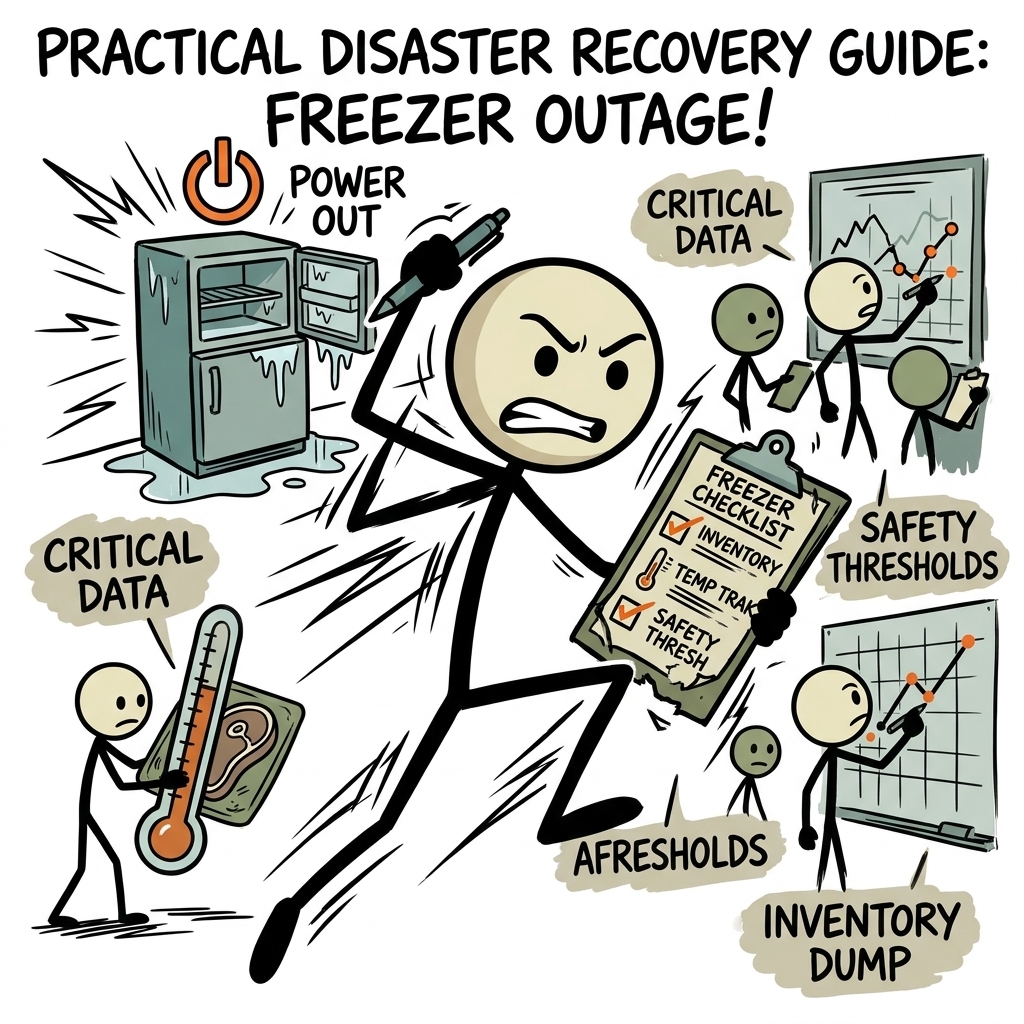
The Physics of Cold Containment: Thermal Mass and Air Space
Understanding cold retention begins with thermal mass. In thermodynamics, dense solids hold temperature significantly longer than ambient air. A standalone deep freezer packed to 90% capacity with solid, vacuum-sealed proteins acts as an isolated thermal battery. Each pound of frozen tissue absorbs ambient thermal energy through latent heat absorption, delaying the point at which interior temperatures climb toward dangerous levels. Conversely, a unit that is half-empty contains a higher ratio of air to solid mass. Air possesses a very low volumetric heat capacity, meaning that every cubic foot of void space accelerates the warming curve. For the practical checklist side, use the neighborhood preparedness network.
The orientation of your appliance also fundamentally dictates its internal microclimate during an outage. Chest freezers possess an intrinsic mechanical advantage over upright models. Because cold air is dense and falls toward the base, opening a chest freezer allows minimal cold-air displacement; the cold reservoir remains settled in the structural basin. Upright freezers, by design, suffer an immediate gravity-driven spill of cold air the instant the door seal breaks, replacing that chilled atmosphere with warm, humid household air. A single 30-second inspection of an upright model can elevate interior air temperatures by 5°F to 10°F, severely diminishing the safe window calculated by the USDA. For the practical checklist side, use the family emergency planning guide.
During an extended outage, your baseline protocol must be absolute containment. Keep the door closed until you are formally executing a planned, timed monitoring check or an emergency thermal-stabilization measure. If local ambient temperatures hover above 80°F, external insulating wraps (such as wool blankets or closed-cell foam board secured around the appliance exterior—taking care never to obstruct passive venting paths) can slow conductive transfer through the appliance walls. For the practical checklist side, use the real-world emergency scenarios guide.
Real-Time Temperature Tracking: Critical Thresholds and Equipment
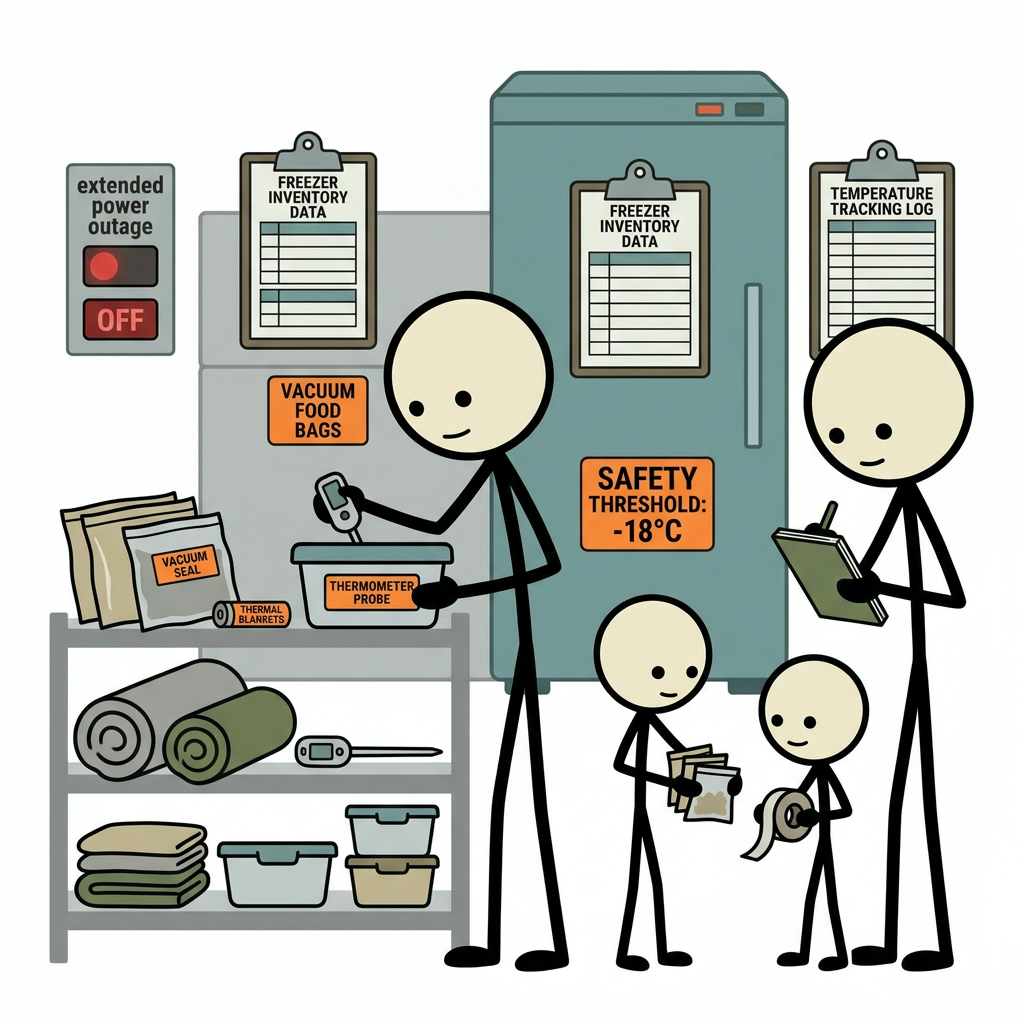
Precision documentation cannot rely on subjective sensory evaluation. Sniffing food or touching the exterior of a packaging pouch is an unreliable metric for pathogenic activity. Gram-negative bacteria such as Salmonella enterica, Escherichia coli O157:H7, and Campylobacter produce no noticeable odor, color variance, or off-putting slime during the initial stages of proliferation. Survival medicine and disaster preparedness mandate objective instrumentation.
Establishing the Boundary: The 40°F (4.4°C) Ceiling
The standard operational ceiling for frozen inventory stability is 40°F. The FDA Food Code explicitly mandates that potentially hazardous foods held between 41°F and 135°F reside in the temperature danger zone. In this thermal band, bacterial doubling rates accelerate exponentially. Between 70°F and 100°F, common foodborne pathogens can divide every 20 minutes. Therefore, your tracking system must precisely log the moment the internal cabinet air crosses the 32°F freezing line, and more critically, the precise timestamp when internal ambient conditions breach 40°F.
Monitoring Technologies: Probes, Loggers, and Analog Failsafes
Opening the freezer to check a standard analog dial thermometer defeats your primary objective by destroying the thermal seal. Optimal disaster readiness involves deploying non-invasive monitoring equipment before emergencies occur:
- Bluetooth and Wireless RF Sensors: Place remote sensor probes directly inside the central cargo zone, running thin ribbon cables or transmitting radio frequencies to a base unit or smartphone receiver outside the seal. These allow continuous power outage freezer temperature tracking without opening the door.
- Digital USB Data Loggers: Industrial-grade temperature loggers record continuous temperature curves at programmable intervals (e.g., every 15 minutes). When you later export this data, it generates an unalterable, time-stamped graph that serves as indisputable evidence for commercial or residential property claims.
- The Gravity Indicator Technique (The Quarter-on-a-Cup Method): As a baseline analog backup, freeze a small cup of water solid, then place a metal coin on the surface ice. If the coin remains atop the ice, temperatures never climbed above 32°F. If the coin has sunk midway or settled at the bottom of the vessel, the unit underwent significant thermal failure and refroze upon utility restoration, indicating that microbial growth occurred silently before power was recovered.
The Active Freezer Outage Food Log: Hour-by-Hour Logging Protocols
The moment utility infrastructure fails, your operational clock starts. Transition immediately from passive storage management to active record-keeping. The primary tool here is a structured freezer outage food log. Maintaining this log provides two vital outcomes: it eliminates guesswork regarding which foods must be culled to protect your family from severe illness, and it constructs the exact audit trail demanded by insurance claim adjusters seeking to verify economic losses.
Your log must be physical (waterproof paper and ink) or maintained on a battery-backed mobile device saved locally, rather than reliant on cloud access, which may be unavailable during regional emergency communication plans blackouts. Every entry must document uniform metrics at set intervals—ideally every six hours during the first 24 hours, transitioning to every two to four hours as internal temperatures approach the 35°F to 40°F mark.
Data Fields Required for Complete Documentation
To establish a legally and medically defensible log, each entry must track six specific variables across the timeline of the disruption:
- Exact Timestamp: Date and 24-hour military time to establish uninterrupted chronological integrity.
- External Ambient Room Temperature: The temperature of the room housing the appliance (e.g., a 95°F garage versus a 65°F basement drastically alters the rate of internal degradation).
- Internal Cabinet Temperature: Reading taken from your remote probe or external digital display.
- Observed Physical State: Solid, partial softening (ice crystals present), fully liquid/soft, or packaging distention (swelling from anaerobic gas generation).
- Cabinet Quadrant Location: Top shelf/basket, mid-tier core, or bottom floor. Thermal stratification causes top-rack goods to warm up to 36 hours ahead of bottom-floor goods.
- Corrective Interventions Executed: Adding dry ice, shifting items to a secondary high-density cooler, or strategic culling.
Item-by-Item Safety Classifications (USDA/FDA Framework)
When assessing food safety after power outage events, the core imperative is clear: never base consumption choices on optimistic assumptions. When electrical power returns, you must evaluate the logged data against established clinical food microbiology standards. The USDA Food Safety and Inspection Service outlines clear paths for categorized goods based on thermal exposure thresholds.
Meat, Poultry, and Seafood (Highest Pathogen Risk)
High-protein, high-moisture items represent the greatest acute danger for foodborne intoxication. If beef, pork, poultry, or wild game has completely thawed and reached temperatures exceeding 40°F for more than two hours, it cannot be salvaged. Cooking does not eliminate all microbial threats. While heat kills vegetative cells of bacteria like Staphylococcus aureus and Bacillus cereus, it fails to denature heat-stable enterotoxins already synthesized within the protein matrix. If these proteins still maintain ice crystals throughout the core tissue and register under 40°F on a sanitized food-penetration thermometer, they may be safely refrozen or immediately processed via pressure canning or cooking.
Dairy, Eggs, and Prepared Dishes
Commercial milk, soft cheeses (brie, mozzarella, ricotta), opened egg washes, and leftover casseroles containing meat or dairy must be culled if exposed to temperatures above 40°F for longer than two hours. Hard cheeses (such as aged cheddar, Parmesan, and Romano) and commercially manufactured salted butter retain stability and may be safely preserved even after complete thawing. Commercial mayonnaise, paradoxically, resists bacterial growth due to high acidity and salinity, but should be discarded if warmed above 50°F for extended windows due to oil-emulsion separation and quality breakdown.
Produce, Breads, and Acidic Preserves
Frozen fruits and fruit-based pie fillings exhibit exceptional resilience. Because of their natural acidity, thawing fruit does not support rapid pathogen proliferation, though fermentation may occur. If thawed fruit smells fresh, displays no fungal growth, and tastes unfermented, it can be safely refrozen or turned into jams and purees, though the cellular walls will collapse, yielding a softer texture. Commercial bread dough, baked pastries, and nuts can be refrozen indefinitely without safety consequences, provided no active mold has sprouted from localized condensation.
Constructing the Protocol Survival Freezer Inventory Log Sheet
To streamline data recording under duress, pre-print several copies of a standardized freezer inventory log sheet and store them in a waterproof sleeve affixed directly to the side of your primary freezing units. Below is the operational template design optimized for disaster recovery documentation and subsequent post-incident verification.
| Timestamp | Ambient Temp | Internal Temp | Target Item/Category | Physical Condition | Disposition / Action Taken |
|---|---|---|---|---|---|
| Oct 12, 08:00 | 72°F (Basement) | -2°F | Full Cabinet Baseline | Frozen solid; heavy surface frost | Grid down; seals checked; access locked |
| Oct 13, 08:00 | 74°F (Basement) | 28°F | Top Basket: Poultry | Crystalline; firm to tactile check | No action; thermal barrier holding |
| Oct 14, 14:00 | 78°F (Basement) | 38°F | Top Tier: Ground Beef | Softening; liquid phase starting | Cooked immediately via outdoor propane |
| Oct 15, 10:00 | 81°F (Basement) | 46°F | Core Tier: Pork Loins | Fully thawed; >40°F for 3.5 hrs | Total loss; photographed; culled to waste |
Positioning for Insurance Recovery: Building an Indisputable Claim
Filing a successful spoiled food insurance claim after an extended outage demands the same burden of proof required in a commercial property loss investigation. Homeowners insurance carriers routinely deny or underpay food spoilage claims due to lack of substantiate documentation. Adjusters are trained to challenge generic, lumped valuations—such as claiming "$2,000 in miscellaneous frozen meat"—which are often reduced to a token payment or rejected under policy coverage exclusions.
Most standard homeowners policies (HO-3, HO-5) and renters forms (HO-4) contain specific provisions regarding food spoilage. Key policy elements dictate how the insurer handles these losses:
- Off-Premises vs. On-Premises Power Interruption: Many standard policies cover spoilage only if the power failure originates from equipment on the insured premises (such as a downed line on your parcel). If a regional transmission failure occurred miles away, you may require a specific "Utility Service Interruption" endorsement. Review this rider long before storm season.
- Deductible Application: Some policies waive the baseline property deductible for refrigerated food claims or apply a separate, low-tier deductible (typically $100). If claiming $1,200 of lost contents against a general $2,500 deductible with no waiver, filing an insurance claim is financially pointless and risks marking your claims history.
- Itemization Rigor: Your inventory should detail brand, cut, weight, quantity, and approximate purchase date. Rather than listing "beef," record "15 packages of 100% grass-fed organic Ribeye steaks, 1.25 lbs each, purchased June 2024."
The Visual and Evidentiary Chain of Custody
Before throwing a single package into the trash, complete an evidentiary sweep. Photograph items systematically. Line up packages on a flat surface, with labels and weights facing the camera lens, alongside a readable digital thermometer displaying the ambient or core temperature. Take a wide-angle context photograph displaying the entire appliance interior, followed by close-ups of any identifying pricing labels or grocery receipts you have on file. If dealing with custom-processed whole, half, or quarter beef purchases, have the invoice or cut-sheet from the butcher ready for the adjuster. Retain your detailed freezer outage food log as the historical foundation of the filing; adjusters are far less likely to challenge an insured homeowner who presents a dated, hour-by-hour operational log tracking the gradual failure of the thermal environment.
The Remediation Protocol: Power Restoration and Appliance Sanitization
When the local grid stabilizes and utility power flows back to the home, your work shifts from tracking and containment to systematic triage, safe disposal, and bio-remediation. The initial, immediate step is to isolate the equipment: shut off the appliance circuit breaker or pull the wall plug before assessing the interior, preventing the compressor from running continuously over an uninspected, leaking, or mechanically fouled cabinet.
Phase 1: Safe Extraction and Liquid Containment
Proteins that thaw completely release myoglobin-rich purge water. This fluid accumulates in the drainage basin of chest freezers or runs beneath internal shelf seals in upright configurations. This liquid acts as a rich nutrient broth for rapid fungal and bacterial propagation. Wear nitrile or heavy-duty chemical gloves during extraction. Double-bag all condemned food directly out of the freezer cabinet using heavy-duty, 3-mil contractor bags to prevent tears, leaks, and secondary exposure inside the home. Never dispose of warm raw meats in outdoor refuse cans days ahead of municipality trash pickups, as the odor will attract scavengers, vermin, and insect vectors to your perimeter.
Phase 2: Chemical Decontamination
Clear, warm soapy water will remove surface debris, but it will not kill the spores or bacterial biofilm embedded in the plastic liners and rubber door gaskets. Follow the Centers for Disease Control and Prevention (CDC) guidelines for sanitation following disasters:
- Wash down all hard, non-porous interior surfaces using warm water and a neutral detergent to lift biological residue and grease films. Rinse thoroughly with clear water.
- Apply a sanitizing solution consisting of one tablespoon of regular, unscented household liquid chlorine bleach (5.25% to 8.25% sodium hypochlorite) per one gallon of clean, potable water.
- Allow all surfaces to remain thoroughly wet with the sanitizing bleach solution for a minimum contact time of 10 minutes to guarantee complete microbial eradication.
- Leave the freezer doors propped fully open in a well-ventilated space, allowing the surfaces to dry completely via ambient air. UV exposure from direct sunlight can further help eliminate persistent odors.
Phase 3: Gasket and Insulation Odor Elimination
If liquid decomposition products seeped into the interior fiberglass insulation via shelf screw points or cracked plastic linings, typical chemical surface cleaning may not completely eliminate the foul smell. Plastic wall liners readily absorb volatile organic compounds (VOCs) and sulfur-bearing degradation byproducts. Avoid using toxic chemical deodorizers that can contaminate future food supplies. Instead, pack the interior shelves of the decommissioned, open appliance with crumpled plain black-and-white newspaper, trays of clean activated carbon pellets, or shallow pans of freshly ground coffee beans. Seal the unit closed for 72 hours to allow the porous carbon and paper to draw out the volatile compounds through passive adsorption before washing the surfaces down one final time.
Long-Term Mitigation: Hardening Your Cold-Storage Posture
Experiencing an uncontrolled thermal failure highlights critical weaknesses in storage strategy. Use the lessons from a power loss event to reinforce your household against future grid failures:
- Thermal Mass Ballast Strategy: Never run a freezer with significant void space. Fill empty spaces with food-grade plastic jugs or four-liter bottles containing clean water (leaving a 10% headspace to accommodate the volumetric expansion of freezing ice). In an outage, these dense ice blocks serve as supplemental cold sinks, keeping surrounding items safe for an additional 24 to 36 hours. If disaster conditions persist, these melt into safe drinking water for emergency consumption.
- Layered Thermal Separation: Store raw meats and high-value game in the lowest quadrant of the unit, where temperatures stay coldest the longest. Keep items with high acid profiles, breads, and less volatile produce near the top. This spatial organization prevents melting fluids from thawing poultry or pork from dripping down onto, and cross-contaminating, items located on lower shelves.
- Auxiliary Emergency Power: The only definitive protection against food spoilage during a prolonged outage is a tested secondary power system. High-efficiency modern chest freezers draw surprisingly little electrical current—often only 100 to 200 running watts once the compressor stabilizes, though startup surges can reach 800 to 1,200 watts. A modest 1,000-watt solar generator (lithium iron phosphate battery linked to portable solar panels) or a dual-fuel inverter generator running on propane can operate a standalone freezer cyclically (e.g., run two hours on, four hours off) to keep contents securely below the freezing threshold indefinitely.
Systematic disaster recovery requires deliberate, data-driven execution rather than panicked, reactive decisions. By implementing a reliable monitoring system, maintaining an hour-by-hour freezer outage food log, strictly applying scientific safety thresholds, and assembling thorough insurance documentation, you protect your household from both debilitating foodborne illness and steep financial losses. Take control of your food security today: inspect your seals, deploy remote temperature sensors, print your log sheets, and ensure that when the next major storm cuts the grid, your cold storage remains resilient, manageable, and safe.
Frequently Asked Questions
Why should I log freezer contents before power is restored?
Documenting contents before power returns captures accurate core temperatures, visible ice crystal presence, and item condition before automated cooling obscures how long items sat in the bacterial danger zone, while also providing necessary proof for insurance reimbursement.
What specific details belong on a freezer outage inventory log?
Record the outage start time, the internal appliance temperature, individual item descriptions, whether visible ice crystals remain, estimated monetary value, and photographic evidence of spoiled goods.
Can food that partially thawed be refrozen after an outage?
According to USDA guidelines, food that still contains visible ice crystals or has remained at or below 40°F (4°C) can be safely refrozen, though textural quality may decline.
How long does food stay safe inside a closed freezer without power?
A full, unopened freezer maintains safe temperatures for approximately 48 hours, while a half-full freezer keeps food safe for about 24 hours if the door remains shut.
How does an outage log support homeowners or renters insurance claims?
Most standard policies cover between $500 and $2,500 for food spoilage due to power failures; an itemized log with quantities, replacement values, and photos substantiates your claim without disputing item existence.