⚡ Key Facts: Food Safety and Temperature Monitoring
- The 4-Hour Rule: According to the USDA Food Safety and Inspection Service (FSIS), an unopened refrigerator will keep food safely cold for only about 4 hours during a blackout.
- Freezer Resilience: A full, unopened freezer maintains its temperature for approximately 48 hours (24 hours if half-full), provided the door remains sealed.
- The Scent Trap: The CDC warns that pathogenic bacteria like Salmonella, E. coli, and Listeria do not alter the smell, taste, or appearance of food—relying on the "sniff test" causes severe foodborne illness.
- The Financial Stakes: The average American household refrigerator contains between $250 and $450 worth of perishable groceries, all of which can be lost without accurate monitoring.
- Minimal Investment, High Yield: A dedicated, independent appliance thermometer costing under $10 eliminates guesswork, preventing both food waste and emergency room visits.
When high-wind events, summer heatwaves, or winter ice storms trigger unexpected grid failures, a ticking clock starts inside your kitchen. Within minutes, the steady hum of your compressor dies, and the race between ambient room temperature and your household emergency food storage guide begins. In that moment of uncertainty, most people swing open the refrigerator door to inspect their groceries, inadvertently releasing a critical plume of cold air. Without reliable fridge and freezer thermometers in place, you are forced to make a high-stakes gamble: prematurely discard hundreds of dollars in perfectly safe groceries, or feed your family perishable goods that have lingered in the bacterial proliferation zone. Managing food safety during a power outage requires moving away from sensory assumptions and relying strictly on empirical temperature data.
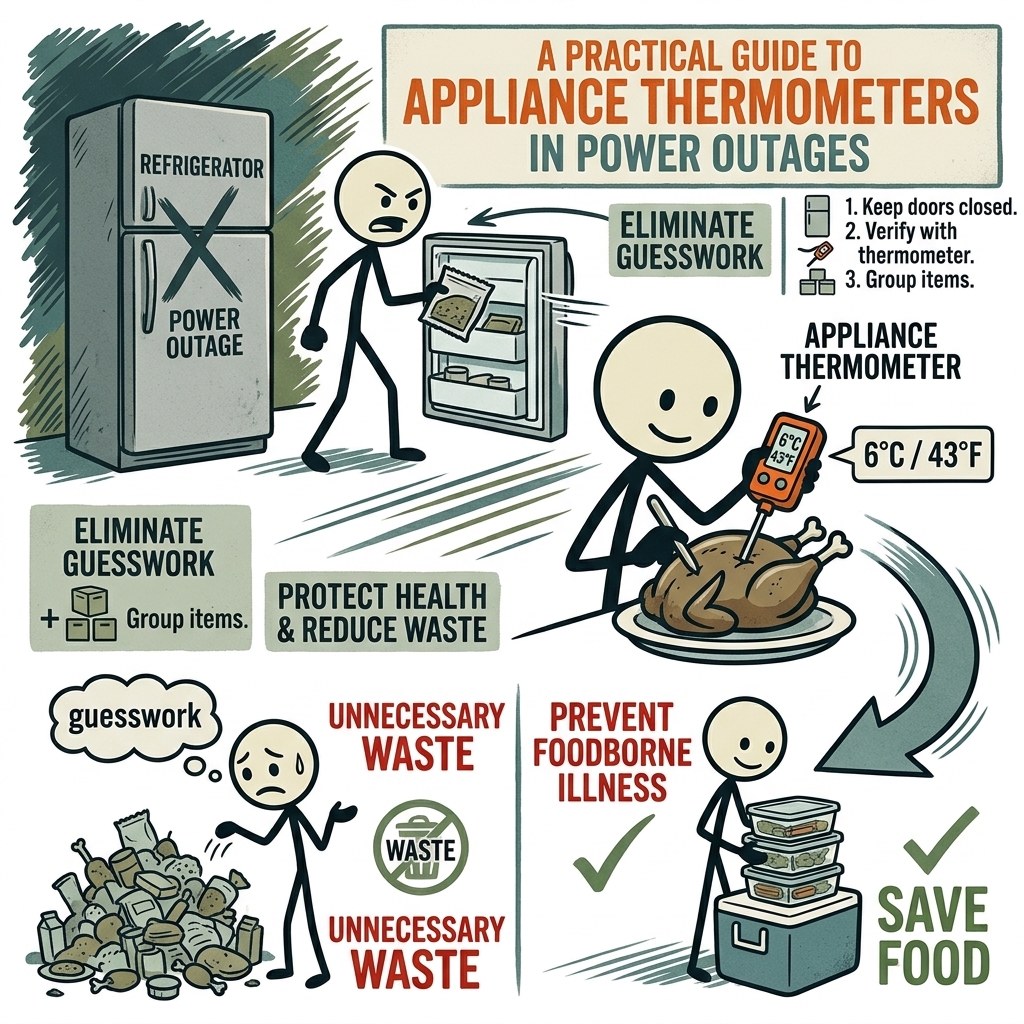
The Hidden Mechanics of the "Danger Zone"
Understanding cold chain management starts with basic microbiology. Bacteria exist everywhere in our environment, but their reproductive cycle is dictated almost entirely by ambient temperature. Both the U.S. Department of Agriculture (USDA) and the Food and Drug Administration (FDA) define the critical threshold between 40°F and 140°F (4.4°C to 60°C) as the "Danger Zone." For the practical checklist side, use the community emergency preparedness guide.
Within this spectrum, microorganisms double their population roughly every 20 minutes under optimal conditions. Between 70°F and 100°F—the typical interior temperature of an unconditioned home during a summer blackout—bacterial growth explodes exponentially. At these elevated levels, common pathogens produce heat-stable enterotoxins that cannot be deactivated even by boiling or intense reheating. For the practical checklist side, use the neighborhood preparedness network.
Many homeowners operate under the dangerous misconception that spoiling food gives off an obvious warning sign. However, biological contamination falls into two entirely distinct categories: For the practical checklist side, use the emergency communication plan.
- Spoilage Microorganisms: Molds, yeasts, and bacteria that break down cellular structures, causing foul odors, slime, visible discoloration, and sour tastes. While unpalatable, they rarely cause acute, life-threatening illness.
- Pathogenic Microorganisms: Invisible organisms such as Campylobacter jejuni, Listeria monocytogenes, Salmonella enterica, and pathogenic Escherichia coli. These multiply silently across meat, poultry, dairy, and sliced produce without creating any detectable alteration in smell, texture, or flavor.
A milk jug or raw chicken breast sitting at 48°F for six hours may smell completely fresh while carrying an infectious dose of pathogenic bacteria. Investing in a reliable refrigerator thermometer power outage setup is the only way to replace subjective, hazardous guesswork with concrete evidence. For the practical checklist side, use the family emergency planning guide.
Why Built-In Appliance Displays Fail During Emergencies
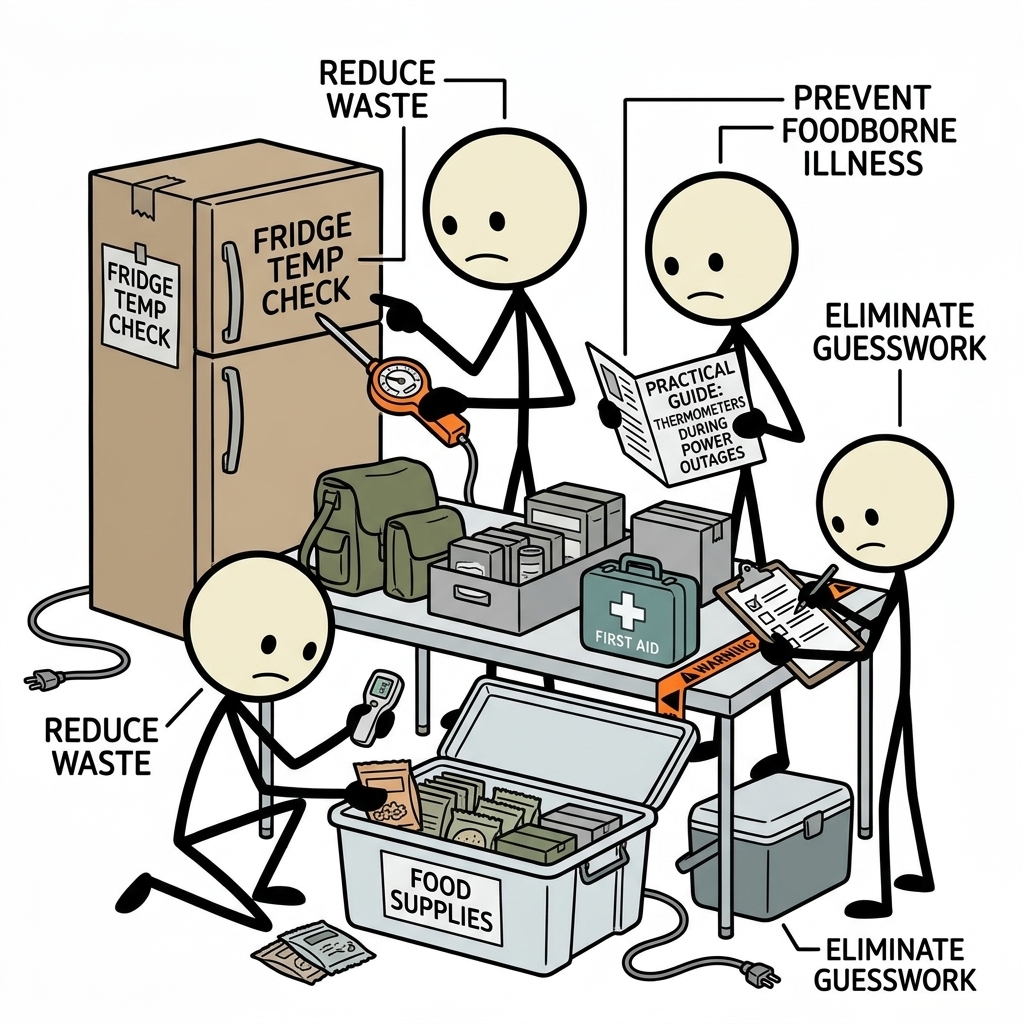
Modern smart refrigerators feature sleek exterior touchscreens and digital readouts indicating 37°F for the fresh food cabin and 0°F for the freezer. Unfortunately, these systems introduce a false sense of security that crumbles the moment the utility grid goes dark.
First and foremost, built-in digital displays rely on line voltage. When the power cuts out, the digital interface goes black. Unless your home features an automatic whole-house backup generator or a dedicated battery storage system, you lose immediate visibility into internal cabinet temperatures.
Second, built-in thermistors do not measure food surface temperature; they measure circulating air temperature at a single sensor location, typically near the top air duct. During an outage, air warms at a vastly different rate than dense food mass. As stratification takes place, heat rises to the upper shelves while denser cool air sinks to the crisper drawers. When power returns, an appliance display might immediately jump to reading 37°F because the cooling cycle restarted, masking the fact that the internal cabinet sat at 52°F for twelve straight hours.
Autonomous appliance thermometers solve this problem by functioning entirely independently of utility power, remaining physically embedded within the cold storage cavity throughout the crisis.
Choosing the Right Thermometer for Outage Resilience
Not all monitoring tools perform equally when the power goes out. Selecting the right hardware for your freezer temperature emergency preparedness plan depends on your budget, your household setup, and how strictly you need to monitor the cold chain without opening appliance doors.
1. Liquid-in-Glass and Bimetallic Dial Thermometers
These are the traditional, mechanical units seen hanging from refrigerator wire racks for decades. Bimetallic models use two joined metal strips with different expansion rates that twist a needle across a calibrated dial. Non-mercury spirit-filled glass tubes track temperature via the thermal expansion of a dyed liquid column.
- Advantages: Extremely inexpensive ($5 to $10 each); require zero batteries; entirely immune to electrical surges and EMPs; long service life.
- Disadvantages: You must crack open the door to read them, letting out valuable cold air; slower response time; can be knocked off wire shelving or obscured behind containers.
- Best Use: Secondary backup verification positioned on middle shelves.
2. Digital Wired Probe Thermometers
These units feature an electronic display module that mounts magnetically to the outside of your refrigerator, connected to an internal sensor via an ultra-thin ribbon wire that slips past the magnetic door gasket without breaking the air seal.
- Advantages: Displays internal temperature continuously without opening the door; features programmable high/low audible alarms; battery-powered via standard AAA or coin cells.
- Disadvantages: Thick wires can crimp gaskets if improperly routed, causing ambient air leaks; display unit can be knocked down in high-traffic kitchens.
- Best Use: Primary residential monitoring during short- to medium-duration blackouts.
3. Wireless Remote (RF / Bluetooth) Sensor Systems
The gold standard in modern cold-chain monitoring. These systems utilize battery-powered radio frequency (433 MHz) or Bluetooth Low Energy (BLE) pods placed directly inside both the refrigerator and freezer cavities. They transmit real-time telemetry to an external base station or an offline smartphone application.
- Advantages: Totally zero-loss monitoring; logs historical temperature graphs showing exactly how long food stayed above 40°F; sends alerts before the Danger Zone is reached.
- Disadvantages: Higher initial cost ($25 to $60); requires active battery tracking and routine maintenance; RF signals can struggle to penetrate dense, commercial-grade stainless steel walls.
- Best Use: Serious emergency preparedness setups, rural properties subject to prolonged outages, and medical storage (e.g., insulin or temperature-sensitive biologics).
Strategic Thermometer Placement Inside Your Appliances
Dropping a thermometer haphazardly into your refrigerator door bin undermines its accuracy. Convection currents, thermal stratification, and seal proximity make certain regions of your appliance significantly warmer than others.
Follow these placement principles to guarantee reliable data:
- Avoid the Door Bins: The door is the absolute warmest zone in any cooling appliance. Every micro-opening introduces ambient room air directly into these compartments. Place thermometers in the primary cabin where critical items are stored.
- Target the Center of the Mass: Position the unit in the geometric center of the middle shelf. This provides the most representative measurement of the ambient air surrounding your most vulnerable food stores.
- Keep Away from Walls: Do not let the sensor make direct contact with interior plastic or metal walls, which conduct temperature differently than the surrounding air. Suspend it from a wire rack or place it in an open, stable container.
- Freezer Placement: In chest freezers, place the sensor roughly one-third of the way down from the top lid, as heat rises and the top layer always melts first. In upright freezers, position the thermometer directly in the center of the middle shelf, nestled between packages of frozen food.
| Thermometer Type | Average Cost | Door Opening Required? | Power Source | Ideal Placement |
|---|---|---|---|---|
| Bimetallic Dial | $5 – $9 | Yes | None (Mechanical) | Hanging from center wire shelf |
| Wired Probe | $12 – $20 | No | AAA / Coin Cell | Probe on middle rack, display on door exterior |
| Wireless RF/Bluetooth | $25 – $65 | No | Lithium AA / AAA | Mid-level interior shelf away from walls |
Managing the Cold Chain: Operational Protocols by Hour
When the power grid trips, implementing a disciplined, phase-based protocol prevents rapid temperature loss and helps support your spoilage prevention power outage strategy. Your thermometer serves as the sole trigger for each operational stage.
Phase 1: Hour 0 to 4 (The Sealed Preservation Window)
The Federal Emergency Management Agency (FEMA) and the Red Cross emphasize a strict, zero-entry policy during the first four hours of a utility disruption. An insulated residential refrigerator functions essentially as a passive cooler. If the door stays shut, food temperatures will generally stay below the 40°F safe threshold for up to 240 minutes.
If you use an external wireless display, track the temperature rise every 30 minutes without touching the appliance handle. If your setup requires opening the door to read a mechanical dial, do not open it during this window. Trust the insulation and let the system rest undisturbed.
Phase 2: Hour 4 and Beyond (The Triage and Transfer Point)
Once your refrigerator thermometer crosses 40°F, you have reached the critical operational fork in the road. Pathogenic bacteria have begun their two-hour window before rapid replication starts. At this point, take deliberate action based on the empirical data:
- Deploy Insulated Coolers: If the ambient temperature is hot and your thermometer indicates the cabin is at 42°F, pack high-risk perishables into heavy-duty rotomolded coolers lined with frozen ice packs or block ice.
- Consolidate to the Freezer: If your freezer is holding steady at 15°F, transfer vulnerable fresh foods (like raw meats and poultry) down into the freezer compartment immediately. This extends their shelf life significantly while helping to fill empty air pockets in the freezer.
- Prepare Rapid-Consumption Meals: Cook raw meats, poultry, and open dairy products that have not spent more than two hours above 40°F using alternative outdoor cooking methods (camp stoves, charcoal grills, or propane burners) while the core product is still fresh.
The Science of Freezer Retention: 24 vs. 48 Hours
Freezers operate under entirely different thermodynamic principles than fresh-food cabins. While refrigerators rely primarily on the sensible heat capacity of cold air, freezers benefit from the latent heat of fusion. It requires vastly more energy to convert 32°F ice into 33°F water than it does to warm liquid water from 33°F to 40°F.
The USDA confirms that a fully packed freezer will remain at a safe, sub-freezing level for roughly 48 hours without utility power. A freezer that is only half-full will cross into thawing territory in roughly 24 hours. The empty air inside a partially filled unit warms quickly, accelerating the heat transfer into frozen goods.
To maximize cold retention before emergencies happen:
- Bank Cold with Water Containers: Fill food-grade plastic jugs with water (leaving 10% headspace for expansion) and pack them into any empty space in your freezer. During an outage, this massive thermal anchor holds temperatures stable long after the motor shuts off.
- Group Items Closely: Group meats together on the lowest level, creating a compact block of ice-cold mass. Place breads, frozen fruits, and dry goods around the periphery.
- Add Dry Ice for Extended Outages: According to the FDA, 50 pounds of commercial dry ice will keep a fully loaded 18-cubic-foot freezer safely below freezing for up to two full days. Always handle dry ice with thick, insulated gloves, and never store it in an airtight container or an unventilated room due to carbon dioxide displacement.
The Salvage Matrix: What Stays, What Goes
Once power is restored, your thermometer provides the timeline you need to assess your supplies. If the refrigerator cabin reached 45°F and stayed there for five hours, some foods must be thrown away, while others can be kept without risk.
Use the following safety matrix, cross-referenced against official CDC and FSIS guidelines, to evaluate your food stores after an outage:
| Food Category | Status Above 40°F for More Than 2 Hours | Safety Protocol & Rationale |
|---|---|---|
| Raw Meats, Poultry, Seafood | DISCARD IMMEDIATELY | High moisture and protein content encourage rapid, undetected growth of pathogens like Salmonella. |
| Soft Cheeses, Milk, Yogurt | DISCARD IMMEDIATELY | High water activity and low acidity create ideal conditions for Listeria monocytogenes proliferation. |
| Hard Cheeses (Cheddar, Swiss) | SAFE TO KEEP | Low moisture content and natural lactic acidity keep bacterial growth in check for extended periods. |
| Leftover Cooked Casseroles | DISCARD IMMEDIATELY | Spores of Bacillus cereus and Clostridium perfringens survive initial cooking and reactivate during prolonged warming. |
| Commercially Opened Condiments | SAFE TO KEEP | Ketchup, mustard, relishes, and vinegars contain high acidity and sodium levels that naturally inhibit pathogens. |
| Cut Melons, Sliced Tomatoes | DISCARD IMMEDIATELY | Breaching the protective rind allows pathogens to enter low-acid flesh; classified by the FDA as Time/Temperature Control for Safety (TCS) foods. |
| Commercial Fruit Juices | SAFE TO KEEP | Natural acidity retards bacterial growth; minor fermentation may occur over time without creating severe toxins. |
Refreezing Protocols: Can Partially Thawed Food Be Saved?
One of the most persistent questions during prolonged blackouts is whether partially thawed food from the freezer can be safely refrozen. The decision depends entirely on reading your freezer's independent thermometer.
According to the USDA FSIS, if your appliance thermometer still reads 40°F or below, or if the food package still retains visible ice crystals throughout its core, the food can be safely refrozen without cooking.
Keep these rules in mind when assessing thawed items:
- Quality Degradation vs. Safety: Refreezing food that has partially thawed causes ice crystals to rupture cell membranes. While the food remains biologically safe to eat, meats may lose moisture and produce can become mushy. Plan to use these ingredients in soups or stews where texture changes are less noticeable.
- The Ice Cream Exception: Ice cream and frozen yogurts must be discarded if their temperature climbs past safe refrigerator levels. Their porous structure and dairy base make them ideal breeding grounds for bacteria, and their texture will turn grainy and unpalatable once refrozen.
- Avoid Direct Cross-Contamination: As frozen poultry and meats thaw, their fluids seep into surrounding areas. If raw meat juices drip onto vegetables, baked goods, or other ready-to-eat items, discard those items immediately regardless of the reading on your thermometer.
Calibrating and Testing Your Appliance Thermometers
A thermometer that drifts out of calibration gives you inaccurate readings right when you need precision most. Mechanical dial thermometers should be tested and calibrated annually, as well as after any severe physical drops or impacts.
Use the standard Ice Bath Calibration Method to check accuracy at the critical freezing threshold:
- Fill a tall drinking glass completely to the rim with crushed ice.
- Add clean cold tap water until the liquid sits just below the top layer of ice. Stir the slurry thoroughly and let it stabilize for three full minutes so the water reaches a uniform thermal equilibrium.
- Submerge the thermometer’s sensing stem or electronic probe at least two inches deep into the center of the slush, avoiding direct contact with the bottom or sides of the glass.
- Wait two minutes for the reading to settle. The dial or digital screen should read exactly 32°F (0°C).
- If an analog bimetallic thermometer is off by more than 1°F to 2°F, carefully adjust the calibration hex nut behind the dial face using a small wrench until it points directly to 32°F. Digital models with drift must either be recalibrated through internal software settings or replaced entirely.
Incorporating Cold-Chain Monitoring into Family Emergency Drills
Equipment is only as effective as the household habits surrounding it. When an unexpected outage strikes, every family member must understand the protocols for using your food safety during power outage tools.
Take these practical steps to build household-wide discipline:
- Label External Displays Clearly: If using wired or wireless external monitors, affix a clear label to the display indicating the critical thresholds: "REFRIGERATOR: MUST STAY UNDER 40°F" and "FREEZER: KEEP BELOW 0°F (32°F MAX DURING OUTAGES)." This removes any ambiguity for children or houseguests.
- Keep Door-Opening Drills Practiced: Train your family to treat the refrigerator like a vacuum chamber during outages. Plan what you need before opening the door, extract the items within five seconds, and latch the door firmly shut.
- Keep Replacement Batteries on Hand: Keep a labeled stash of fresh lithium coin cells, AAA, or AA batteries taped to the top or side of the refrigerator. Standard alkaline batteries can drain quickly in freezing environments, whereas quality lithium batteries operate reliably down to -40°F.
Turning Panic into Actionable Data
A widespread blackout presents immediate challenges, but managing your home's food supply does not have to rely on guesswork. Using high-quality fridge and freezer thermometers transforms an uncertain, stressful situation into a calm, data-driven response. Instead of wondering whether that carton of milk or raw roast has crossed into dangerous territory, you can reference precise internal temperatures to make confident calls for your family's safety. By pairing proactive thermometer placement with strict door discipline and clear triage protocols, you protect your household from preventable foodborne illnesses, minimize expensive grocery waste, and maintain control of your kitchen even when the grid fails.
Frequently Asked Questions
What temperatures should my refrigerator and freezer maintain during normal conditions?
Your refrigerator should always be set at or below 40°F (4°C), and your freezer should be maintained at 0°F (-18°C) or colder to inhibit bacterial growth.
How long will food remain safe in a sealed refrigerator and freezer during a blackout?
An unopened refrigerator will keep food cold for about 4 hours. A full, unopened freezer maintains safe temperatures for approximately 48 hours, while a half-full freezer lasts about 24 hours.
Can I safely refreeze food that has thawed during a power outage?
You can safely refreeze thawed food if it still contains ice crystals or has remained at 40°F (4°C) or below as verified by an appliance thermometer, though quality and texture may suffer.
What is the best type of thermometer to use for an outage preparedness setup?
Digital wireless or Bluetooth appliance thermometers with external displays are best because they allow you to monitor internal temperatures without opening the door and losing trapped cold air.
Why shouldn't I rely on smell or appearance to judge food safety after an outage?
Foodborne illness-causing bacteria do not reliably produce foul odors, discoloration, or off-flavors, making internal temperature monitoring the only dependable measure of safety.