⚡ Key Facts
- Catastrophic Financial Risk: According to the Federal Emergency Management Agency (FEMA), just one inch of floodwater inside a home can cause upwards of $25,000 to $27,000 in structural and personal property damage.
- Surge Demands: Sump pump motors utilize inductive loads, requiring up to 200% to 300% more power during startup (locked rotor amperage) than during continuous runtime.
- Battery Failure Windows: Standard deep-cycle 12-volt marine battery backup systems typically exhaust their charge within 4 to 12 hours of continuous cycling during intense hydrological events.
- Lethal Safety Hazards: The Centers for Disease Control and Prevention (CDC) reports that carbon monoxide (CO) poisoning from improperly placed portable generators claims an average of 70 to 80 lives annually in the United States, peaking directly after major storm events.
- Increasing Rainfall Extremes: The National Oceanic and Atmospheric Administration (NOAA) confirms that extreme single-day precipitation events have increased significantly across North America over the past three decades, saturating water tables and overwhelming residential drainage infrastructure.
When severe weather systems descend, the municipal power grid is often the first casualty. High winds, fallen limbs, and compromised distribution lines disconnect homes precisely when precipitation hits its peak. For homeowners with below-grade living spaces, finished basements, or mechanical rooms, this timing presents an immediate structural emergency. Your sump basin is the last line of defense against rising groundwater, and without a reliable source of emergency sump pump power, hydrostatic pressure will exploit every microscopic fissure in your foundation walls. For the practical checklist side, use the community emergency preparedness guide.
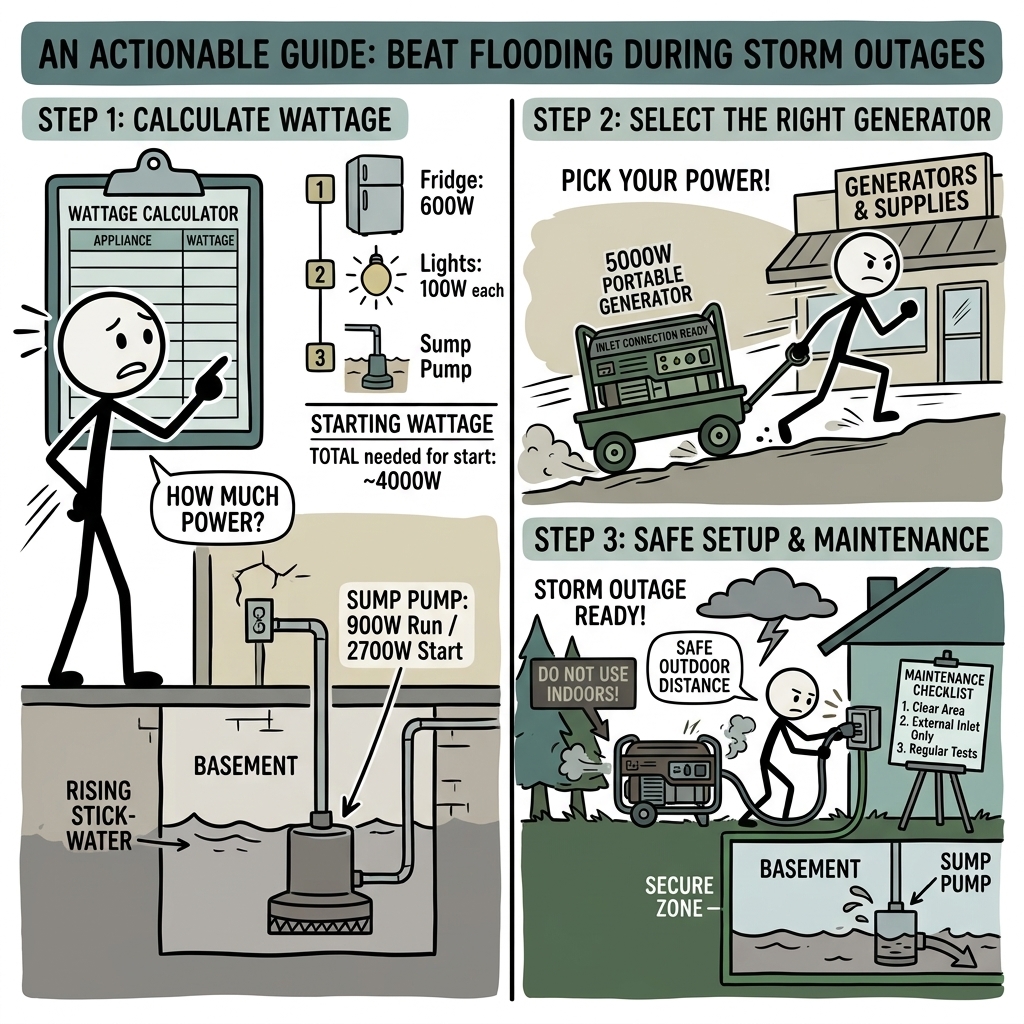
A residential drainage system is entirely binary: it either pumps water away from the foundation or allows the basement to inundate. While small 12-volt battery backups can bridge brief interruptions, prolonged multi-day storm cycles require mechanical generation. Selecting, sizing, and operating a sump pump backup generator is not merely a matter of buying a piece of hardware from a big-box store; it is an engineering calculation that demands precision, safety rigor, and scheduled maintenance. This guide provides an actionable operational protocol to safeguard your home against moisture intrusion, catastrophic property loss, and hazardous electrical missteps during extended grid collapse. For the practical checklist side, use the neighborhood preparedness network.
The Physics of Basement Flooding During Grid Failures
Basement flooding during storms is rarely just surface runoff finding an unsealed door. It is driven by subsurface soil mechanics governed by the United States Geological Survey (USGS) hydrological principles. As heavy precipitation falls, the upper soil layers reach full saturation, causing the subterranean water table to rise rapidly. This localized rise exerts immense hydrostatic pressure against the exterior footing, foundation walls, and concrete slab of your dwelling. For the practical checklist side, use the family emergency planning guide.
Perimeter drain tiles (French drains) collect this water and divert it via gravity into an interior sump basin. Under mild conditions, a pump might cycle once every ten minutes. However, during atmospheric rivers, nor'easters, or convective storm complexes, the inflow can exceed 30 to 60 gallons per minute. If the pump stops because utility power cuts out, water fills the pit, reverses the drain tile gradient, and rises through floor cracks, perimeter joints, and floor drains.
Many homeowners rely exclusively on standard 12-volt secondary battery backup pumps. While these systems offer immediate, automatic switchover, they possess a defined electrochemical limit. A typical 100-amp-hour (Ah) lead-acid or AGM battery can deliver roughly 50 to 60 usable amp-hours before voltage drops below functional motor thresholds. Under heavy continuous cycling (running every 30 to 45 seconds), that battery will fully deplete within 4 to 8 hours. If the utility outage persists for 48 to 72 hours, an external generator for sump pump support is your only viable mitigation measure.
The Real Cost of Water Intrusion
Water intrusion is categorized by the Institute of Inspection, Cleaning and Restoration Certification (IICRC) into three categories. Category 1 is clean water, such as an overflowing municipal supply line. However, groundwater entering via foundation slabs instantly qualifies as Category 2 (gray water) or Category 3 (black water) due to dissolved soil minerals, biological contaminants, lawn chemicals, and microscopic pathogens.
Remediating Category 2 or 3 water requires stripping drywall up to two feet above the water line, discarding saturated insulation, lifting perimeter flooring, and running commercial desiccant dehumidifiers for weeks. In finished basements containing electrical panels, HVAC furnaces, water heaters, and family possessions, costs regularly surpass the $50,000 threshold. Deploying a dedicated portable generator basement flooding prevention plan is a cost-effective insurance mechanism against foundation degradation and out-of-pocket structural repairs.
Sump Pump Motor Mechanics: Starting vs. Running Watts
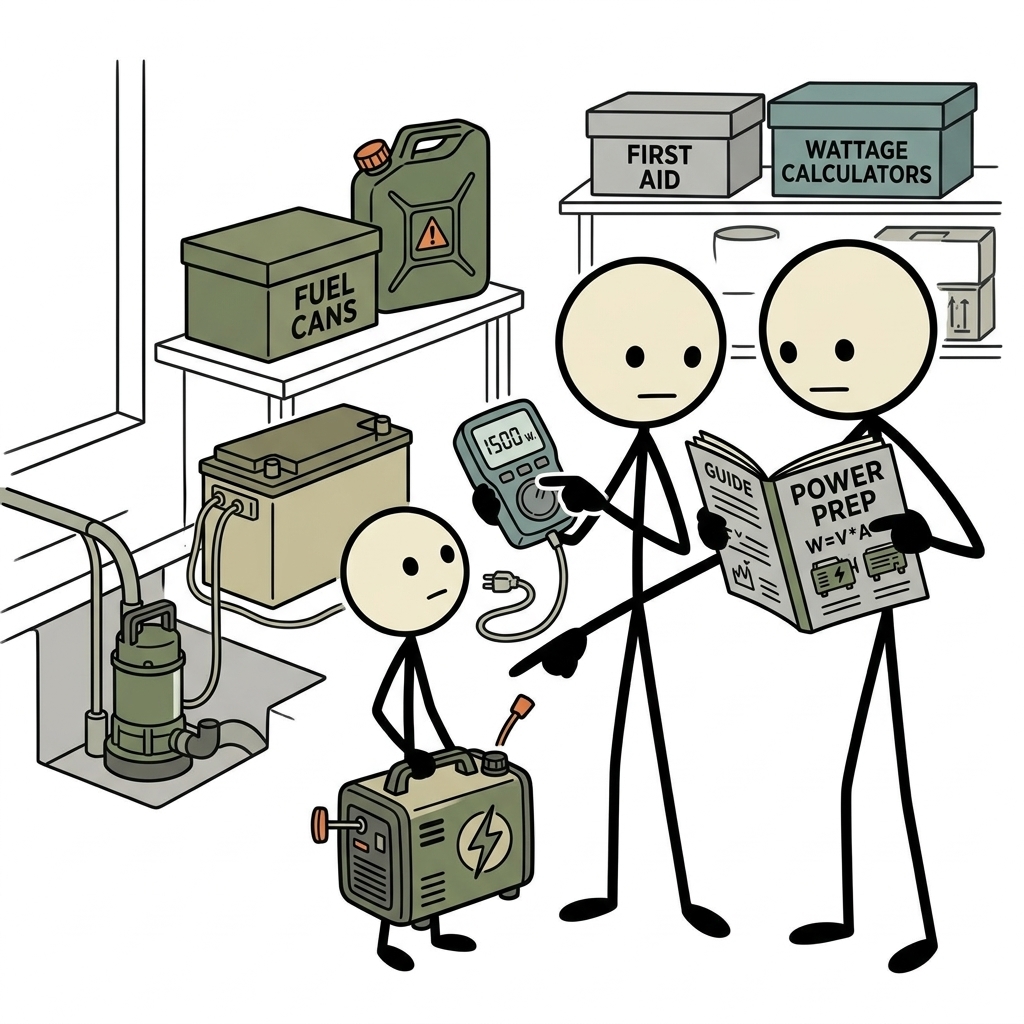
The single most common mistake made when sourcing an emergency generator is buying a unit sized only for continuous wattage. Electric motors installed in sump pumps are split-phase or capacitor-start inductive motors. Unlike resistive loads (such as incandescent light bulbs, space heaters, or toasters) that demand a constant stream of power, inductive loads require an enormous initial burst of electrical energy to overcome rotor inertia and establish an electromagnetic field.
This initial demand is referred to in electrical engineering as Locked Rotor Amps (LRA) or inrush current. Once the motor rotor begins spinning at its rated RPM, the demand plummets to Full Load Amps (FLA), which represents the continuous "running watts." Sizing your generator for sump pump duty requires that you account for this startup spike. If the generator lacks adequate transient surge capacity, its voltage will sag instantly, triggering the generator's internal circuit breaker or stalling the pump motor entirely.
Decoding Sump Pump Electrical Ratings
Motor data plates contain the exact specifications required to calculate true power needs. If your pump's label only shows horsepower (HP), voltage, and amperage, you can convert these parameters into watts using basic electrical formulas. In an alternating current (AC) inductive circuit, real power (Watts) equals Voltage multiplied by Amperage multiplied by the Power Factor (PF):
Watts = Volts × Amps × Power Factor (typically 0.8 to 0.85 for small residential motors)
When full electrical data is missing, use these baseline industry standards based on single-phase 120-volt motors:
- 1/3 Horsepower: Typically demands 700 to 800 running watts, but requires a startup surge of 1,300 to 2,200 watts.
- 1/2 Horsepower (Most Common): Demands 900 to 1,050 running watts, but requires an inrush surge of 2,100 to 2,900 watts.
- 3/4 Horsepower: Demands 1,200 to 1,400 running watts, with an inrush surge requirement of 3,000 to 4,000 watts.
- 1 Horsepower (High-Head / Commercial): Demands 1,500 to 2,000 running watts, requiring a starting surge of 4,500 to 6,000 watts.
If you run a dual-pump setup (a primary pump positioned low in the pit and an auxiliary high-water pump placed four inches higher), you must plan for the Survival Scenarios scenario: both pumps activating simultaneously. If a sudden surge of inflow trips both float switches at once, their combined inrush current could exceed 5,000 to 7,000 starting watts.
How to Calculate Your Total Wattage Needs
Determining what size generator for sump pump applications depends on whether you plan to run the pump isolated on an extension cord or connect the generator to your home’s critical electrical panel. During an extended blackout, critical life-support loads (refrigeration, emergency communication plans, medical devices, lighting) compete for generator capacity.
Follow this step-by-step engineering audit to calculate your minimum power threshold:
- Identify Your Pump's Peak Demands: Locate the electrical plate on the pump housing or consult the manufacturer specification sheet. Multiply the running amps by 120 to find running watts. Multiply this figure by 2.5 to 3 to estimate starting surge requirements.
- Catalog Auxiliary Critical Circuits: List the essential equipment that must remain energized simultaneously during an outage. Common accompanying loads include a residential refrigerator (150W running / 800W starting), an internet modem and router (15W continuous), LED emergency lamps (20W total), and a gas furnace blower motor (600W running / 1,400W starting).
- Determine Coincident Peak Surge: Modern electrical codes and generator sizing practices assume that not all motors start at the exact same millisecond. To find your peak starting load, sum the running watts of all devices, then add the single largest starting surge requirement among them.
- Add a Safety Buffer (20% Reserve Rule): Generators should not be run continuously at 100% of their rated capacity. Running an engine at maximum load accelerates internal thermal wear, burns fuel rapidly, and increases total harmonic distortion (THD). Add a 20% to 25% operational buffer above your total calculation.
Consider this real-world sizing scenario for a standard residential storm profile:
| Device / Appliance | Running Watts | Starting Watts (Surge) |
|---|---|---|
| 1/2 HP Primary Sump Pump | 1,050 W | 2,600 W |
| Full-Size Refrigerator/Freezer | 200 W | 800 W |
| Internet Modem, Router, Cell Booster | 30 W | 30 W |
| Selected LED Lighting (4 Rooms) | 40 W | 40 W |
| Baseline Totals | 1,320 W | 3,470 W (Summed Running + Max Surge) |
| Recommended Generator Size (+20% Buffer) | ~1,650 W Continuous | ~4,200 W Starting Surge |
In this common configuration, an economy generator rated at 2,000 running watts and 2,500 starting watts will likely stall the moment the sump pump kicks on while the refrigerator compressor is engaged. A generator rated at 3,500 continuous watts and 4,500 surge watts provides the minimum mechanical overhead to guarantee operational resilience.
Choosing the Right Generator for Sump Pump Reliability
When selecting a sump pump backup generator, three primary architecture classes exist on the market: conventional open-frame portable generators, closed-frame inverter generators, and stationary standby units. Each class carries distinct advantages and trade-offs regarding fuel efficiency, operational noise, electrical clean-power delivery, and long-term durability.
1. Open-Frame Portable Generators
Open-frame mechanical generators are the most common historical choice for disaster preparedness. They are cost-effective, deliver high wattage outputs per dollar, and offer rugged mechanical simplicity. However, they run at a fixed 3,600 RPM to maintain a standard 60-Hertz frequency, consuming a steady volume of fuel regardless of whether the pump is actively running or idle.
These units also produce high levels of Total Harmonic Distortion (THD), often fluctuating between 12% and 25%. While basic single-phase mechanical sump pumps operate fine on high-THD power, modern digital sump controllers, solid-state float sensors, and integrated microprocessor alarms can malfunction or trigger false error codes when exposed to rough alternating-current waveforms.
2. Closed-Frame Digital Inverter Generators
Inverter generators process electrical current through three stages: producing high-frequency multiphase AC power, converting it to DC, and finally inverting it into clean, smooth AC power via microprocessors. Inverter units deliver true sine-wave electricity with less than 3% THD, equal to or better than standard utility power.
Crucially, inverter units feature "Eco-Throttle" mechanisms that dynamically ramp engine speed up or down to match real-time demand. Since a sump pump operates intermittently—cycling on for 15 seconds, then shutting off for two minutes—an inverter generator throttles down during the idle phase. This saves fuel, lowers operational decibels, and extends total runtime per tank, making it an exceptional emergency sump pump power platform during multi-day fuel shortages.
3. Stationary Home Standby Generators
Stationary standby systems are permanently mounted outside the home on a concrete or aggregate pad and plumbed directly into the municipal natural gas line or an on-site liquid propane (LP) tank. Paired with an Automatic Transfer Switch (ATS), these units monitor utility voltage continuously. If utility power drops for more than ten seconds, the standby engine starts, transfers the home’s electrical circuits, and powers your drainage system automatically.
The clear advantage is automation: if a severe storm strikes while you are away from home, at work, or asleep, your basement remains fully protected. The primary drawbacks are the substantial upfront equipment and professional installation costs, as well as dependence on municipal natural gas infrastructure, which can occasionally lose pressure during seismic events or severe regional flooding.
Fuel Strategy: Gasoline vs. Liquid Propane vs. Dual-Fuel
Fuel storage is the most vulnerable failure point in long-term emergency readiness. Standard pump gasoline contains up to 10% or 15% ethanol. Ethanol is hygroscopic; it actively pulls ambient moisture out of the air and binds with it. Within 30 to 60 days, untreated ethanol fuel suffers phase separation, forming an acidic, gum-like varnish that coats internal carburetor jets, rendering your portable generator for basement flooding useless when the power goes out.
If you utilize gasoline, you must treat every gallon with high-grade fuel stabilizer immediately upon purchase, store it in vapor-tight, flame-arrestor-equipped containers meeting NFPA 30 standards, and rotate the stock every six months through your passenger vehicle. Alternatively, dual-fuel or tri-fuel generators run on liquid propane (LP). Propane does not degrade over time, will not gum internal carburetor pathways, and can be stored indefinitely in standard 20-pound or 100-pound cylinders, making it an ideal long-term storage fuel.
Safe Connection Methods and Electrical Integration
Once you have acquired a reliable generator, you must establish a code-compliant, safe connection to your drainage system. Connecting an emergency electrical source requires strict adherence to the National Electrical Code (NEC / NFPA 70). Hazardous shortcuts like creating a male-to-male "suicide cord" to backfeed your electrical panel through a wall outlet are exceptionally dangerous, illegal, and can electrocute utility line workers working miles away to restore the grid.
Method A: Heavy-Duty Exterior Extension Cords
The simplest, lowest-cost connection method is running an industrial-grade outdoor extension cord directly from the portable generator into the basement sump pump receptacle. However, voltage drop across long wire distances can starve an inductive motor of current, overheating the windings and causing premature motor failure.
Never use light-duty indoor cords or 16-gauge light-duty outdoor cords. Match cord gauge directly to amperage and length:
- 10-Gauge (10 AWG): Rated for up to 20 amps. Essential for distances between 50 and 100 feet to prevent line-loss voltage drops during inductive motor starting spikes.
- 12-Gauge (12 AWG): Rated for up to 15 to 20 amps for runs under 50 feet. Acceptable for 1/3 HP and 1/2 HP pumps.
- 14-Gauge (14 AWG): Strictly limited to short runs under 25 feet for small 1/3 HP pumps only. Avoid if possible.
Ensure the cord features a standard SJTW (hard-service, thermoplastic, weather-rated) jacket, and seal all exterior connections inside weather-resistant inline connection boxes to prevent water intrusion from tripping the generator’s GFCI protection.
Method B: Manual Transfer Switch (MTS) and Inlet Box
The professional standard for portable generator basement flooding prevention is installing a dedicated Manual Transfer Switch (MTS) alongside your main service panel, wired directly to an external power inlet box on your home's exterior. This setup provides permanent mechanical interlocks that physically prevent utility power and generator power from energizing the panel simultaneously.
With an MTS installed, you simply connect one heavy-gauge 30-amp or 50-amp twist-lock cord from the generator to the exterior inlet box, flip the interlock, and toggle on the dedicated sump pump branch circuit breaker. This eliminates loose cords running through windows or doors, maintains your home's thermal seal, and allows you to power hardwired basement pumps, secondary high-water pumps, and ceiling light circuits simultaneously.
Bonded Neutral vs. Floating Neutral Complications
Modern portable generators and sump pumps often run into a common electrical issue: ground fault circuit interrupter (GFCI) tripping. Most portable generators feature a bonded neutral, where the neutral conductor is internally bonded to the generator frame. However, in residential service panels, the neutral and ground are already bonded together at the main disconnect.
When you plug a bonded-neutral generator into a home electrical panel via a transfer switch that does not switch the neutral wire, you create a dual-bonded system. This causes stray current to flow along the grounding conductor, instantly tripping the generator's onboard GFCI breaker. If you integrate with a transfer switch, ensure an electrician evaluates whether your generator should be converted to a floating neutral configuration, or install a transfer switch designed specifically to switch both the ungrounded and grounded conductors (three-pole switch for 120/240V systems).
Operational Safety and Prolonged Storm Maintenance
A generator deployed to prevent basement flooding is only an asset if it can be operated safely. Running a combustion engine during severe weather introduces two lethal hazards: toxic carbon monoxide gas and high-voltage electrocution in soaking wet environments.
Carbon Monoxide Defense Protocol
According to safety guidance from the Consumer Product Safety Commission (CPSC) and the CDC, portable generators must operate outdoors at a minimum distance of 20 feet away from any living structure. Never operate a generator inside a garage, carport, covered porch, shed, basement, or crawlspace, even with doors and windows open. Carbon monoxide is an invisible, odorless, tasteless gas that reaches lethal concentrations within minutes.
Position the exhaust system pointing directly away from the home, and confirm that the unit is well clear of basement window wells, soffit vents, sliding glass doors, and HVAC fresh-air intakes. Install battery-powered carbon monoxide alarms on every level of your home, with dedicated units placed in the basement and right outside all sleeping quarters. Test these alarms prior to every storm season.
Wet-Weather Operating Safeguards
Operating an internal combustion generator in driving rain, sleet, or snow presents an electrocution hazard and can short out electrical outlets. However, placing a generator under an enclosed overhang creates a severe CO accumulation point.
Use a purpose-built, flame-retardant, high-wind-rated generator running tent or canopy. These kits bolt to the generator frame and shed rain while leaving the exhaust and engine cooling profiles completely unobstructed. Alternatively, construct a dedicated, permanently ventilated exterior generator shed that features mechanical louvered intake and exhaust vents engineered to move required air volumes.
Engine Maintenance During Extended Run Cycles
Small small-displacement air-cooled engines (typically ranging from 150cc to 450cc) work hard under load. Most consumer generator engines require an oil change after every 50 to 100 hours of continuous operation. During a prolonged four-day storm outage, your generator will reach this service interval quickly.
Maintain an on-site emergency maintenance kit containing:
- Three to four quarts of manufacturer-specified synthetic motor oil (e.g., 5W-30 or 10W-30 designed for wide ambient temperature ranges).
- Two replacement spark plugs gapped to exact factory specifications.
- A spark plug wrench and an oil funnel with a flexible neck.
- A clean container for draining and holding used engine oil.
Before checking or changing engine oil, shut down the generator and let it cool for 15 minutes. Never refuel a hot or running engine; splashing gasoline onto a red-hot exhaust header can cause immediate fuel vapor combustion. Always observe a complete cool-down window before refueling.
Routine Testing Protocols: Ensuring Power When the Grid Drops
An emergency sump pump power system cannot sit uninspected for ten months in a humid garage and be expected to start smoothly during a hurricane. Emergency readiness depends on scheduled operational verification. Establish this disciplined maintenance cycle:
Monthly Operational Readiness Drill
Every 30 to 45 days, wheel the generator outside to its designated run zone. Inspect the fuel tank, verify clean oil levels, open the fuel valve, set the choke, and start the engine. Let the engine reach stable operating temperature for three to five minutes. Plug in a resistive load, such as an electric heat gun or space heater, to verify that the alternator field is exciting and generating power correctly.
Quarterly Sump Basin Discharge Verification
Every three months, combine your generator exercise with an actual pump load test. Run your heavy-duty 10-gauge cord directly from the running generator to the sump pump receptacle. Take a 5-gallon bucket of water and dump it into the sump pit until the float switch trips.
Observe the cycle carefully. Note how quickly the pump engages, listen for any motor hesitation or unusual humming, and confirm that the generator’s governor adjusts cleanly to the startup surge. Verify that the check valve closes cleanly without violent water hammer when the pump cuts out, and ensure water discharges fully at the street or exterior drainage swale.
Pre-Season Storm Checklist
When the National Weather Service issues a flood watch, tropical storm warning, or high-wind advisory for your region, shift immediately to active readiness:
- Verify Fuel Volume: Confirm you have a minimum of 48 to 72 hours of stabilized fuel on hand (calculating roughly 4 to 8 gallons per day for efficient inverter units, or 10 to 15 gallons per day for open-frame units under fluctuating loads).
- Inspect the Basin: Clear any silt, gravel, or debris from the bottom of your sump basin that could jam the pump impeller during high inflow.
- Check the Mechanical Float: Lift the float switch manually to verify unobstructed travel along its vertical guide rod.
- Prep Physical Access: Ensure the path from your storage area to the exterior setup zone is clear of debris, and stage your outdoor-rated extension cords and weather tent within easy reach.
Preparation transforms a potential crisis into a manageable mechanical routine. By calculating your inductive motor wattage accurately, deploying a generator built to handle surge demands, and establishing a safe connection outside the reach of toxic exhaust, you protect your home against the most relentless forces of nature. When severe storms knock out the power grid, a reliable backup power strategy keeps your drainage system cycling, your foundation stable, and your basement completely dry.
Frequently Asked Questions
What size generator do I need to power a sump pump?
A standard 1/3 HP to 1/2 HP sump pump typically requires 800 to 1,050 running watts and a surge of 1,300 to 2,150 starting watts. A portable generator rated for at least 2,000 to 3,000 starting watts provides sufficient headroom to start and run the pump safely alongside basic essentials.
Can I plug a sump pump directly into a portable generator?
Yes, you can connect a sump pump directly to a portable generator using a heavy-duty, outdoor-rated 10- or 12-gauge extension cord rated for the pump's amperage, provided the generator is positioned outdoors at least 20 feet away from the home.
What is the difference between a battery backup sump pump and a generator?
A dedicated battery backup engages automatically when grid power drops, providing 24 to 48 hours of protection without manual effort. A portable generator requires manual starting and refueling, but it can run indefinitely as long as fuel is available and can power other household circuits.
How do I safely run a generator in heavy rain during a flood emergency?
Never operate a generator indoors, in a garage, or under an open carport due to lethal carbon monoxide risks. To run it safely in rain, position it at least 20 feet from the house and cover it with a specially designed, weather-resistant generator tent that maintains proper ventilation.
Does an inverter generator work for a sump pump?
Yes, an inverter generator will power a sump pump provided its peak wattage meets the pump's surge demand. Inverter units also deliver clean, stable power that protects delicate digital pump switches and auxiliary electronic monitoring equipment.