⚡ Key Facts
- Energy Density Dictates Efficiency: Diesel contains roughly 138,500 BTUs per gallon, compared to 114,000 BTUs for standard gasoline and 91,500 BTUs for liquid propane, meaning propane requires up to 33% more fuel volume to generate the same electrical output.
- Non-Linear Burn Scaling: Doubling your generator's electrical load from 25% to 50% does not double fuel burn; however, stepping from 50% to 90% load disproportionately spikes consumption due to engine thermal inefficiencies and governor response curves.
- The 72-Hour Fuel Reality: According to data from the Federal Emergency Management Agency (FEMA) and the U.S. Energy Information Administration (EIA), a standard 7,500-watt portable gas generator running continuously at 50% load consumes approximately 18 to 24 gallons of fuel every 24 hours, requiring up to 72 gallons for a basic three-day regional disruption.
- Oil Depletion Precedes Fuel Exhaustion: Small off-grid engines (typically 200cc to 450cc) consume motor oil under continuous heavy load; manufacturers specify oil service intervals between 50 and 100 operating hours, meaning crankcases will run dry or ruin engines before long-term fuel stores are exhausted without scheduled maintenance shutdowns.
When catastrophic weather strikes—whether an ice storm bringing down transmission corridors as tracked by the National Oceanic and Atmospheric Administration (NOAA) or a hurricane knocking out coastal substations—the immediate scramble is invariably for mechanical power. Yet, across major disaster after-action reports published by emergency management agencies, the primary point of failure for residential resilience is rarely the mechanical failure of the engine. It is logistical failure: homeowners vastly underestimate their true fuel burn rates, misjudge the impact of continuous loads, and discover too late that their reserves cannot sustain their operational requirements. For the practical checklist side, use the community emergency preparedness guide.
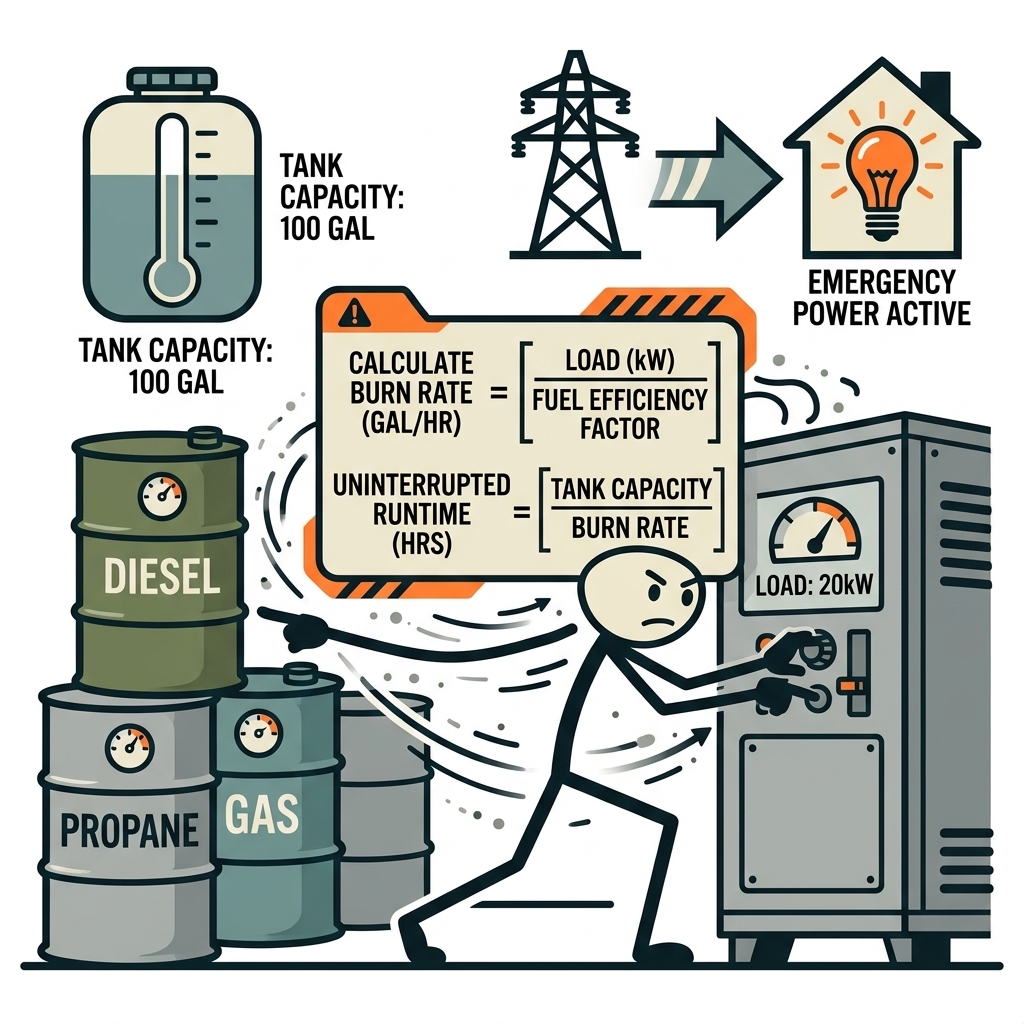
Operating an emergency generator without precise fuel calculations is the tactical equivalent of flying an aircraft without a fuel gauge. Many consumers rely on the generous runtime estimates printed on manufacturer retail boxes, which typically reflect an unloaded engine or an unrealistically low 25% to 50% duty cycle under lab conditions. In the real world, starting surges from well pumps, continuous cycling of refrigeration compressors, and the heating demands of baseline life-safety systems rapidly drain tanks. This comprehensive technical guide breaks down the physics of internal combustion fuel consumption, establishes a field-tested methodology to estimate generator runtime, and provides an empirical framework for emergency power fuel planning across gasoline, diesel, and propane systems. For the practical checklist side, use the emergency communication plan.
The Thermodynamic Foundation: How Generators Turn Fuel into Watts
To accurately calculate how quickly your generator depletes its reserves, you must first understand the relationship between chemical potential energy and electrical output. A generator is fundamentally an energy conversion train: liquid or gaseous fuel combusts inside an engine cylinder, driving a piston to create rotational mechanical energy (brake horsepower), which spins a rotor inside a stator to produce alternating current (AC) electricity. For the practical checklist side, use the family emergency planning guide.
Every step in this mechanical chain incurs parasitic losses. Small air-cooled internal combustion engines operate at roughly 20% to 30% thermal efficiency. The remaining 70% to 80% of the energy stored in your fuel dissipates into the environment as radiant heat through the cylinder block and cooling fins, acoustic energy through the exhaust, and pumping losses through the valves. For the practical checklist side, use the real-world emergency scenarios guide.
Because the engine's mechanical governor must hold a steady rotational velocity—precisely 3,600 Revolutions Per Minute (RPM) for standard two-pole synchronous portable engines in North America to maintain a 60-hertz electrical frequency—it must burn a baseline volume of fuel simply to overcome its own internal friction and inertia. This is known as "tare" or "zero-load" consumption. Once electrical devices are connected, the electromagnetic resistance between the rotor and stator increases, forcing the throttle butterfly valve open to admit more air-fuel mixture to maintain that strict 3,600 RPM baseline. The greater the continuous electrical draw, the more fuel must be continuously injected into the cylinder.
Inverter Generators vs. Standard Open-Frame Generators
The internal architecture of your equipment significantly impacts baseline generator fuel consumption. Standard open-frame contractor generators operate at a fixed 3,600 RPM regardless of whether you are drawing 100 watts to charge a radio or 4,000 watts to run a water heater. Consequently, their idle fuel consumption is high, routinely burning 0.25 to 0.4 gallons per hour with virtually zero electrical demand.
Inverter generators utilize a digital microprocessor and pulse-width modulation to decouple engine speed from electrical frequency output. The alternator produces high-frequency multiphase AC, which is rectified to direct current (DC), and then digitally inverted back into clean 60Hz AC. This enables the engine to drop into an "Eco-Throttle" mode, idling down to 1,800 to 2,400 RPM when loads are minimal. If your emergency posture primarily consists of low-draw sustainment loads, an inverter generator will yield substantial runtime dividends over standard open-frame machinery.
Fuel Chemistries and Energy Density Breakdown
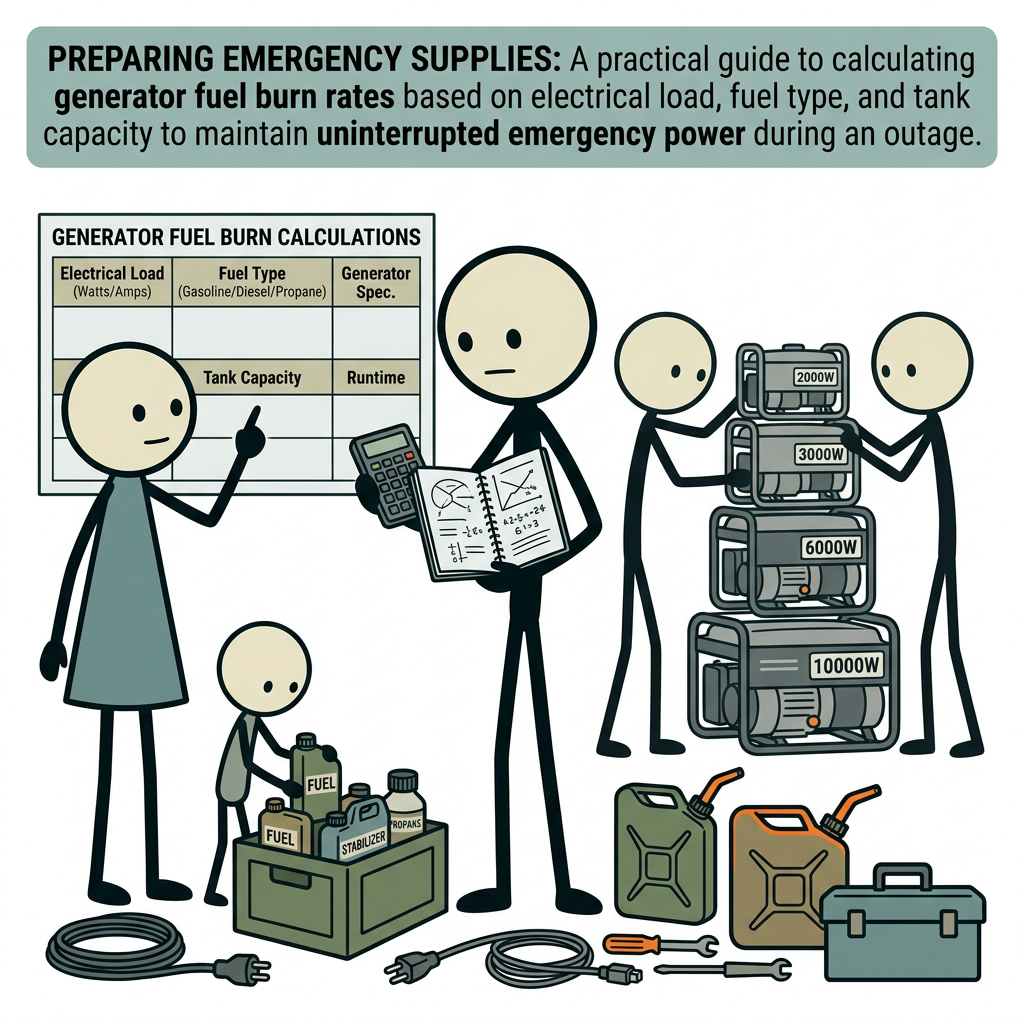
Not all fuel is created equal. When executing an emergency power fuel planning strategy, the chemical makeup of your chosen energy vector dictates how many gallons or pounds of fuel you must stockpile on-site.
Fuel energy content is quantified in British Thermal Units (BTUs). One BTU is the amount of heat energy required to raise the temperature of one pound of water by one degree Fahrenheit. The higher the BTU concentration per unit of volume, the lower your engine's volumetric burn rate will be to maintain an identical electrical output.
- Diesel Fuel (No. 2): Approximately 138,500 BTUs per gallon. Diesel operates on high compression ignition, delivering the highest thermodynamic efficiency of any common small-engine platform. Diesel engines run cooler under moderate load, exhibit exceptional longevity, and yield the lowest gallons-per-hour (GPH) burn rate in disaster environments.
- Unleaded Gasoline (87 Octane, E10): Approximately 114,000 BTUs per gallon. Gasoline is the most common fuel source, but the inclusion of up to 10% ethanol lowers its energy density compared to pure hydrocarbon chains. Gasoline burns hot and degrades rapidly in storage due to volatile organic compound (VOC) evaporation and moisture absorption.
- Liquid Propane Gas (LPG): Approximately 91,500 BTUs per gallon (liquid state) or roughly 21,548 BTUs per pound. Because propane contains approximately 20% to 25% fewer BTUs per gallon than gasoline, an engine running on propane will naturally consume a larger physical volume of fuel to output the exact same wattage.
- Natural Gas (Methane): Approximately 1,000 BTUs per cubic foot. While municipal natural gas supplies bypass on-site storage limitations, pipeline pressure can drop during seismic events, major floods, or deep freezes, as documented by the U.S. Geological Survey (USGS) and local utility emergency audits.
The Dual-Fuel and Tri-Fuel Derating Factor
When calculating burn rates for multi-fuel equipment, you must account for operational derating. Because propane and natural gas displace more air in the combustion chamber than atomized liquid fuel droplets, volumetric efficiency drops. A generator rated at 10,000 peak / 8,000 running watts on gasoline typically derates to approximately 9,000 peak / 7,200 running watts on propane, and down to 8,000 peak / 6,500 running watts on natural gas.
Consequently, if a household draws an absolute 5,000-watt load, that draw represents 62.5% of the machine's capacity on gasoline, but almost 70% of its capacity on propane. This shift pushes the engine further up its mechanical fuel consumption curve, exacerbating the volumetric burn penalty already imposed by propane's lower BTU density.
Step 1: Auditing Your True Electrical Demand
Before you can accurately estimate generator runtime or utilize a generator fuel consumption calculator, you must conduct a rigorous electrical audit. Calculating your burn rate against the generator’s nameplate maximum output will yield inaccurate logistical projections. Instead, you must calculate your actual draw across dynamic operational cycles.
Every electrical load falls into one of two categories: resistive loads or inductive loads. Managing these dynamics is essential for steady-state fuel planning:
- Resistive Loads: Devices that produce heat or simple light through continuous electrical resistance (e.g., incandescent bulbs, space heaters, toasters, basic electric water heaters). These devices maintain a constant current draw; their starting wattage is identical to their running wattage.
- Inductive Loads: Equipment driven by electric motors or compressors (e.g., deep freezers, well pumps, furnace blowers, air conditioners, sewage ejector pumps). Inductive equipment requires a massive surge of current—often three to five times their continuous running rating—for two to three seconds to break mechanical inertia and energize the motor's magnetic field.
To construct your operational baseline, compile your critical hardware using the following format:
| Appliance / Circuit | Running Watts | Surge (Starting) Watts | Typical Duty Cycle / Day |
|---|---|---|---|
| Standard Refrigerator / Freezer | 150W – 200W | 800W – 1,200W | 35% (approx. 8.4 hours run) |
| Chest Deep Freeze | 100W – 150W | 600W – 900W | 25% (approx. 6.0 hours run) |
| Submersible Well Pump (1/2 HP) | 1,000W | 2,500W – 3,000W | 10% (intermittent use) |
| Gas Furnace Blower Motor | 400W – 600W | 1,200W – 1,800W | 40% (seasonal dependent) |
| Critical LED Lighting & Comms | 100W | 100W | 50% (evening hours) |
| Medical Equipment (e.g., CPAP) | 40W – 60W | 60W | 33% (nighttime operation) |
Notice the "Duty Cycle" column. A refrigerator does not pull 200 watts for 24 continuous hours. It cycles its compressor on and off based on ambient temperatures and internal thermostat thresholds. Assuming your household's peak continuous load represents its continuous fuel burn will skew your logistical calculations, causing you to over-prepare storage containers or unnecessarily ration critical power.
Step 2: The Empirical Math Behind Burn Rates
When field engineers calculate internal combustion consumption in the absence of exact bench testing data, they turn to Brake Specific Fuel Consumption (BSFC). BSFC measures the fuel mass consumed divided by the power produced over time.
For standard small, carbureted industrial air-cooled engines, empirical testing establishes a reliable rule of thumb: an engine produces roughly 10 to 12 horsepower-hours per gallon of gasoline under balanced load, which translates mechanically to approximately 0.5 to 0.6 pounds of gasoline per horsepower-hour. Converted to electrical terms, a standard portable generator will consume approximately 0.075 to 0.10 gallons of gasoline per hour for every 1,000 watts (1 kW) of continuous electrical load, plus baseline tare burn.
The Field Consumption Formula
To accurately predict fuel consumption without complex engineering software, use this field formula:
$\text{Hourly Fuel Consumption (GPH)} = \text{Tare Rate} + \left( \frac{\text{Actual Operating Load (Watts)}}{1000} \times \text{Load Scaler} \right)$
Where typical metrics for a mid-tier 5,000W to 8,000W portable engine reflect:
- Gasoline Tare Rate: 0.20 to 0.30 GPH (idle / zero-load consumption).
- Gasoline Load Scaler: ~0.065 GPH per kilowatt demanded.
- Propane Tare Rate: 0.28 to 0.40 GPH (liquid equivalent).
- Propane Load Scaler: ~0.085 GPH per kilowatt demanded.
- Diesel Tare Rate: 0.12 to 0.18 GPH.
- Diesel Load Scaler: ~0.045 GPH per kilowatt demanded.
Using this mathematical framework, if you run a 7,500-watt gasoline generator supporting a steady 3,000-watt load (running your refrigerator, deep freeze, select lights, and a furnace blower), your calculation is:
$\text{GPH} = 0.25 + \left( \frac{3000}{1000} \times 0.065 \right) = 0.25 + 0.195 = 0.445 \text{ gallons per hour}$
Over a full 24-hour cycle of continuous operation, that balanced 3 kW draw requires: $0.445 \times 24 = 10.68 \text{ gallons of fuel}$.
Notice how starkly this contrasts with running the generator at high output. If an inefficient space heater, an electric water heater, or continuous cooking appliances elevate your sustained load to 6,000 watts, your math fundamentally changes:
$\text{GPH} = 0.25 + \left( \frac{6000}{1000} \times 0.065 \right) = 0.25 + 0.390 = 0.640 \text{ gallons per hour}$
At 0.640 GPH, your 24-hour consumption jumps to $15.36 \text{ gallons}$. That is an extra 4.68 gallons every single day—a difference of nearly 33 gallons over a week-long crisis.
Burn Rate Reference Tables Across Engine Classes
To simplify logistical calculations, the following empirical reference tables compile average real-world fuel consumption across standard generator categories. These values reflect tested operational averages rather than idealized manufacturer metrics.
Table 1: Gasoline Generator Fuel Consumption (Gallons Per Hour)
| Generator Class & Type | Tare / Zero Load | 25% Load | 50% Load | 75% Load | 100% Load |
|---|---|---|---|---|---|
| 2,000W Inverter (79cc – 80cc) | 0.08 GPH | 0.12 GPH | 0.18 GPH | 0.26 GPH | 0.34 GPH |
| 3,500W Inverter (150cc – 212cc) | 0.12 GPH | 0.20 GPH | 0.32 GPH | 0.45 GPH | 0.58 GPH |
| 5,000W Open Frame (270cc – 300cc) | 0.22 GPH | 0.35 GPH | 0.48 GPH | 0.62 GPH | 0.78 GPH |
| 7,500W Open Frame (389cc – 420cc) | 0.28 GPH | 0.42 GPH | 0.60 GPH | 0.82 GPH | 1.05 GPH |
| 10,000W Open Frame (459cc – 500cc) | 0.35 GPH | 0.55 GPH | 0.80 GPH | 1.10 GPH | 1.45 GPH |
Table 2: Liquid Propane (LPG) Generator Fuel Consumption
Propane is measured both by volume (liquid gallons) and by mass (pounds). A standard "barbecue" tank holds 20 pounds of propane, which equates to roughly 4.7 gallons of liquid fuel when filled to the standard 80% safety margin.
| Generator Class | 25% Load (Gal / Lbs per Hr) | 50% Load (Gal / Lbs per Hr) | 75% Load (Gal / Lbs per Hr) | 100% Load (Gal / Lbs per Hr) |
|---|---|---|---|---|
| 3,500W Dual-Fuel | 0.26 gal (1.1 lbs) | 0.42 gal (1.8 lbs) | 0.59 gal (2.5 lbs) | 0.76 gal (3.2 lbs) |
| 7,500W Dual-Fuel | 0.55 gal (2.3 lbs) | 0.79 gal (3.3 lbs) | 1.08 gal (4.5 lbs) | 1.38 gal (5.8 lbs) |
| 12,000W Standby / Portable | 0.88 gal (3.7 lbs) | 1.30 gal (5.5 lbs) | 1.85 gal (7.8 lbs) | 2.45 gal (10.3 lbs) |
Table 3: Diesel Generator Fuel Consumption (Gallons Per Hour)
| Generator Class | 25% Load | 50% Load | 75% Load | 100% Load |
|---|---|---|---|---|
| 5,000W Air-Cooled Diesel | 0.16 GPH | 0.26 GPH | 0.36 GPH | 0.48 GPH |
| 8,000W Water-Cooled Diesel | 0.24 GPH | 0.38 GPH | 0.54 GPH | 0.72 GPH |
| 12,000W Industrial Diesel | 0.35 GPH | 0.58 GPH | 0.82 GPH | 1.10 GPH |
Step 3: Calculating Runtime by Fuel Type and Tank Capacity
A frequent question in post-disaster assessments is simple: how long does a generator run on a full tank? The answer is never static. Runtime is entirely a function of fuel capacity, steady-state demand, and ambient environmental conditions.
To determine this variable for your specific operational load, use the runtime calculation formula:
$\text{Total Runtime (Hours)} = \frac{\text{Usable Tank Capacity (Gallons)}}{\text{Calculated Hourly Consumption (GPH)}}$
Note the term usable capacity. Most fuel tanks feature a low-level fuel siphon floor designed to prevent sediment, condensation, and particulate matter at the bottom of the tank from entering the carburetor jet. As a result, approximately 5% to 8% of the volume indicated on a retail tank specification is mechanically unusable.
Applied Scenario: The 5-Gallon Jerry Can Real-World Test
Let us model a common scenario: A homeowner possesses an industry-standard 7,500-watt open-frame portable generator with a 6.5-gallon fuel tank, accompanied by four standard 5-gallon CARB-compliant jerry cans of gasoline. The reserve totals 26.5 gross gallons (approx. 25 usable gallons). The house experiences an infrastructure-collapsing blizzard.
If the homeowner leaves the generator continuously running with heavy loads connected—such as a 1,500W electric space heater, deep freeze, refrigerator, halogen work lights, and entertainment electronics, maintaining a steady 5,000W continuous draw (66% load):
- The engine burns roughly 0.73 gallons per hour.
- Runtime per full 6.5-gallon tank: $\frac{6.1 \text{ usable gal}}{0.73 \text{ GPH}} \approx 8.35 \text{ hours}$.
- Total runtime from the entire 25 gallons of usable fuel reserves: $\frac{25 \text{ gal}}{0.73 \text{ GPH}} \approx 34.2 \text{ hours}$.
Their entire logistical reserve is exhausted in under a day and a half. Now, contrast that with an informed, disciplined energy posture:
The homeowner implements strict power discipline: space heaters are disconnected in favor of passive thermal zoning and wood heat; lights are dropped to low-wattage LEDs; high-draw loads are shed. The baseline demand drops to an average of 1,200 watts (refrigeration compressors cycling, occasional water pump use, electronics).
- At 1,200 watts (~16% load on a 7.5kW unit), the burn rate drops near the tare boundary to roughly 0.36 gallons per hour.
- Runtime per 6.5-gallon tank: $\frac{6.1 \text{ usable gal}}{0.36 \text{ GPH}} \approx 16.9 \text{ hours}$.
- Total runtime from the identical 25 gallons of fuel: $\frac{25 \text{ gal}}{0.36 \text{ GPH}} \approx 69.4 \text{ hours}$.
By understanding the mechanics of load and fuel burn rate, the operational sustainability of the identical quantity of fuel is doubled without purchasing a single extra gallon.
The Thermodynamic Trap: Cold Weather and Propane Vaporization
When relying on liquid propane (LPG) for emergency power, your fuel burn calculations must account for a key physical phenomenon: the liquid must physically boil inside the tank to turn into the gaseous vapor consumed by the engine's demand regulator.
Propane boils at -44°F (-42°C). However, the latent heat of vaporization extracts heat from the liquid itself during this process. As your generator pulls a high volume of propane vapor, the liquid level drops, the remaining liquid cools rapidly, and the wetted surface area of the tank shrinks. In cold ambient temperatures, the tank cools significantly, dropping internal tank pressure below the threshold required by the generator's fuel regulator.
This means that even if a 20-pound propane cylinder has 30% of its liquid fuel remaining, in a freezing environment under high electrical demand, the generator will starve of fuel and stall. The fuel is physically present, but it cannot vaporize rapidly enough to satisfy the engine’s burn rate.
To mitigate this in your emergency power fuel planning:
- Avoid drawing heavy continuous loads from small 20-pound tanks in freezing weather; manifold two or three 20-pound tanks together using a dual-inlet propane tee to distribute the vaporization burden across double the surface area.
- Step up to 100-pound (23.6 gallon) cylinders, which offer far greater wetted surface area and thermal mass to sustain continuous vaporization rates down to sub-zero ambient conditions.
- Never heat a propane cylinder with an open flame or unapproved heating implements. Thermal wraps specifically engineered for propane tanks can safely preserve vaporization efficiency during extreme winter events.
Environmental and Elevation Derating: Hidden Burn Modifiers
Engine fuel efficiency calculations must also account for ambient atmosphere. Internal combustion engines mix atmospheric air with fuel at a stoichiometric ratio (approximately 14.7 parts air to 1 part fuel by mass for gasoline). As altitude increases, atmospheric pressure drops, resulting in less dense air entering the cylinder.
According to industrial engineering standards:
- Altitude Derating: Small engines lose roughly 3.5% of their total power output for every 1,000 feet of elevation above sea level. Operating a standard generator at 6,000 feet in the Mountain West results in an immediate ~21% mechanical capacity loss. Because the engine operates closer to its physical maximum output to pull a standard load, its relative fuel efficiency declines.
- Temperature Derating: High ambient heat lowers air density. For every 10°F above 77°F (25°C), engines lose roughly 1% of their operational efficiency. Combine extreme heat with continuous load, and your gallons-per-hour burn rate climbs higher than standard baseline predictions.
To run equipment efficiently above 3,000 feet, you must re-jet your carburetor. Installing a high-altitude carburetor jet restricts fuel flow to match the lower air density. Running a standard rich fuel jet at high elevations wastes significant volumes of fuel, soils spark plugs with carbon, and causes rapid oil contamination.
Run-Time Management: The Intermittent Run Strategy
The single most common mistake in residential disaster response is running a generator 24 hours a day. Continuous operation accelerates mechanical wear, drastically compounds fuel consumption, and exposes neighborhood preparedness networks to prolonged acoustic signatures and elevated carbon monoxide risks—a hazard repeatedly tracked by the Centers for Disease Control and Prevention (CDC).
A sound operational approach utilizes an Intermittent Duty Strategy. Instead of letting your generator burn fuel while your family sleeps or works, switch to an engineered run schedule.
The 3-Hours-On, 3-Hours-Off Protocol
Modern residential refrigeration units are insulated thermal envelopes. If chest freezers and refrigerator doors remain closed, safe internal food temperatures remain secure for four to six hours without power, and up to 48 hours for a fully packed freezer, according to United States Department of Agriculture (USDA) food safety standards.
Implement an alternating rotation:
- Run Phase (Morning: 2.5 to 3 Hours): Fire the generator. Run well pumps to charge pressure tanks and fill water containers. Let refrigerators and freezers pull down to low thermal setpoints. Recharge auxiliary battery banks, communications gear, portable power stations, and power tool batteries. Cook hot meals using high-draw appliances while the generator is operating at baseline efficiency.
- Rest Phase (Midday: 3 to 4 Hours): Shut the generator down. Close the main fuel line valve to prevent vapor lock and pressure build-
Frequently Asked Questions
How much fuel does an average portable generator use per hour?
A standard 5,000 to 7,500-watt portable generator typically consumes between 0.5 and 0.75 gallons of gasoline per hour at a 50% load, requiring approximately 12 to 18 gallons for 24 hours of operation.
How does electrical load affect generator fuel consumption?
Engine fuel consumption increases with electrical demand; running a generator at 100% capacity can consume up to 50% to 80% more fuel than running it at a 50% load.
How long can gasoline be stored for emergency generator use?
Untreated gasoline degrades within three to six months, but treating it with a fuel stabilizer immediately upon purchase can extend its usable lifespan up to 12 to 24 months in sealed containers.
Which generator fuel type offers the best runtime efficiency?
Diesel provides the highest energy density and lowest fuel consumption rate per kilowatt-hour, whereas propane consumes more fuel by volume but stores indefinitely without degrading.
How do you calculate total fuel reserves needed for an outage?
Determine your hourly fuel burn rate at your estimated load, multiply by planned daily operating hours, multiply by the expected outage duration in days, and add a 20% to 25% safety buffer.