⚡ Key Facts
- Lethal Output: According to the Consumer Product Safety Commission (CPSC), a typical 5,500-watt portable generator produces as much poisonous carbon monoxide as approximately 450 idling mid-sized cars.
- Mandated Distances: NFPA 37 guidelines stipulate that stationary engine enclosures must maintain at least 5 feet of separation from combustible building walls, window openings, doors, and roof overhangs.
- Critical Air Exchange: Air-cooled generator engines require between 100 and 150 Cubic Feet per Minute (CFM) of fresh airflow per operating kilowatt to avoid thermal shutdown and fuel vapor lock.
- Toxicity Speed: The Centers for Disease Control and Prevention (CDC) reports that carbon monoxide concentrations above 400 parts per million (ppm) become life-threatening in less than two hours, while concentrations over 1,600 ppm induce unconsciousness and death within 20 minutes.
- Structural Fire Risk: Engine exhaust manifolds frequently exceed surface temperatures of 900°F (482°C), sufficient to ignite dry framing timber, leaf litter, and common plastic storage bins within minutes of sustained contact.
When catastrophic weather severs the municipal power grid, a portable or stationary generator serves as a vital lifeline, keeping deep freezes running, water well pumps pressurized, and medical equipment online. However, the instinct to shelter machinery from freezing rain, windstorms, and driving snow often leads well-meaning homeowners into a lethal trap. Enclosing an internal combustion engine without understanding thermal dynamics, mechanical airflow, and exhaust physics turns an essential asset into an insidious poison delivery system or a structural fire hazard. Successfully executing generator shed safety demands an engineer’s approach to air management, absolute physical clearance, and failsafe detection. For the practical checklist side, use the community emergency preparedness guide.
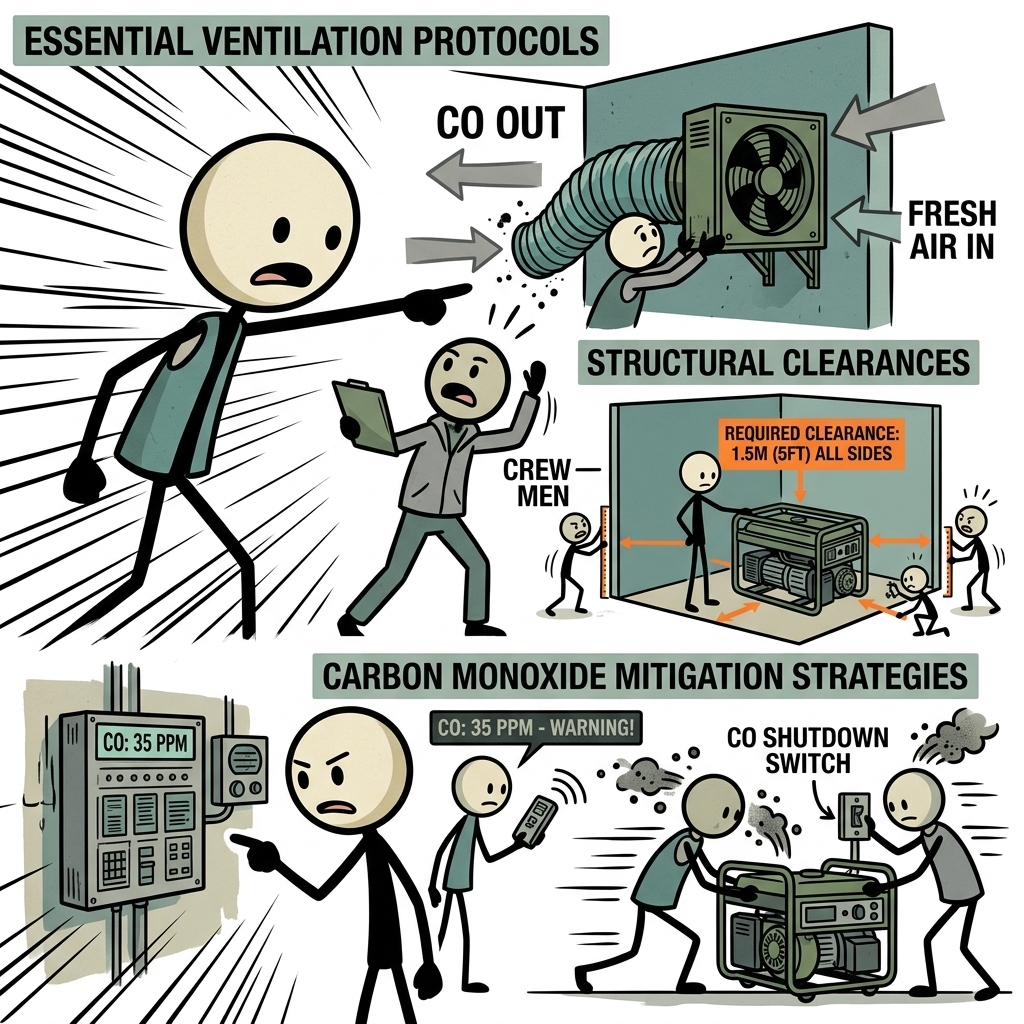
The Physics of Engine Combustion and Carbon Monoxide Risks
Internal combustion engines are fundamentally inefficient thermal pumps. For every gallon of fuel your generator burns, roughly one-third transforms into electrical energy, while the remaining two-thirds dissipates as mechanical friction, radiant engine block heat, and scorching exhaust gas. In a completely unrestricted outdoor environment, these thermal currents and toxic emissions disperse rapidly into the atmosphere. For the practical checklist side, use the neighborhood preparedness network.
When placed inside any confined perimeter, the thermodynamic dynamic shifts immediately. The engine consumes vast volumes of ambient oxygen for combustion, while simultaneously discharging massive volumes of carbon dioxide, unburned hydrocarbons, nitrogen oxides, and carbon monoxide. As ambient oxygen levels inside the structure fall below normal atmospheric concentrations (20.9%), the engine enters an oxygen-starved state known as incomplete combustion. For the practical checklist side, use the emergency communication plan.
Under incomplete combustion, generator carbon monoxide risks multiply exponentially. Instead of cleanly oxidizing carbon into carbon dioxide, the engine begins dumping raw carbon monoxide (CO) into the air. A portable generator operating inside an under-ventilated enclosure can saturate a 1,000-cubic-foot space with more than 1,000 ppm of CO in less than five minutes. At these concentrations, carbon monoxide binds aggressively to human hemoglobin, forming carboxyhemoglobin, which halts oxygen delivery to vital organs and causes irreversible brain damage or rapid asphyxiation. For the practical checklist side, use the family emergency planning guide.
Research published by the National Institute of Standards and Technology (NIST) demonstrates that carbon monoxide travels fluidly through building materials, porous drywall, framing penetrations, soffit vents, and window frame weeping channels. Operating a generator in an attached shed, garage, or makeshift lean-to allows deadly gas plumes to migrate into primary living spaces, even if the enclosure door stands wide open. The only way to operate inside any enclosure safely is to mechanically isolate the exhaust stream, guarantee forced thermal rejection, and maintain rigorous spatial buffers. For the practical checklist side, use the real-world emergency scenarios guide.
Engineering Generator Shed Ventilation: Intake, Heat Rejection, and Exhaust
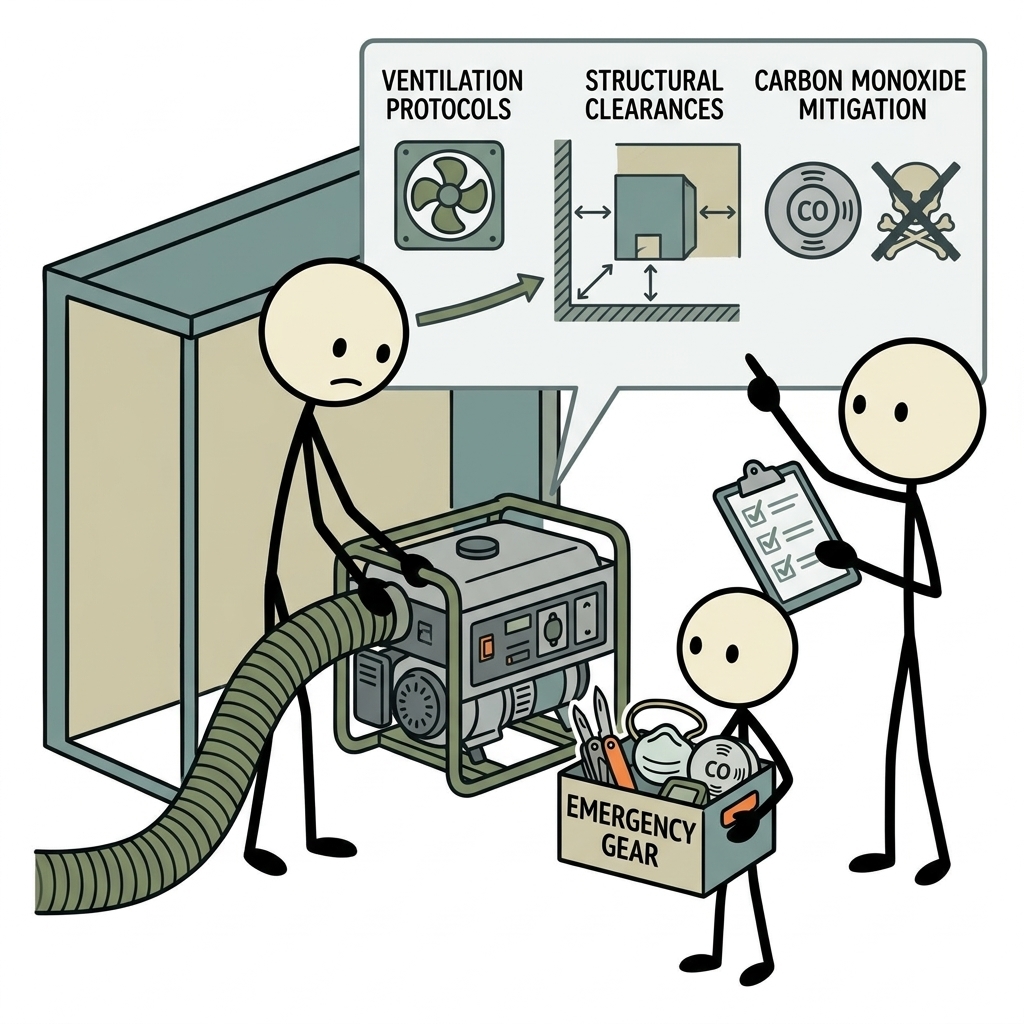
Effective generator shed ventilation requires calculating three distinct air requirements: combustion air, engine cooling air, and structural ambient air exchange. Relying on passive wall louvers or standard hardware-store gable vents is a dangerous gamble that nearly always causes equipment failure or enclosure warping. You must build a dynamic airflow channel that aggressively pushes heat away from sensitive electrical alternators while drawing fresh, cool oxygen across the engine block.
Calculating CFM Airflow Requirements
Air-cooled engines rely on an integrated flywheel fan that pulls air across the finned cylinders. If the enclosure's ambient temperature rises above 104°F (40°C), this air loses its capacity to absorb heat, triggering engine vapor lock, alternator insulation breakdown, and safety shutoffs. To prevent thermal buildup, calculate your required mechanical airflow using this standard operational formula:
Total Airflow (CFM) = Combustion CFM + Thermal Dissipation CFM
As a baseline standard across the emergency preparedness industry:
- Combustion Air: Standard small engines require roughly 2.5 to 3.0 CFM of clean intake air per engine horsepower (HP).
- Thermal Dissipation Air: Air-cooled portable units require approximately 100 to 150 CFM per kilowatt (kW) of continuous electrical output to hold the ambient enclosure temperature within 15°F to 20°F of outside air.
For an 8,000-watt (8 kW) continuous load generator, your ventilation system must move a minimum of 800 to 1,200 CFM of uninterrupted air. Passive ventilation alone cannot deliver this volume through standard louvers without massive, unmanageable wall openings.
Forced Mechanical Airflow vs. Convective Cooling
To establish a truly safe generator enclosure, install high-temperature, commercial-grade inline exhaust blowers or shutter-mounted exhaust fans rated for continuous duty. These fans must be wired directly into the generator's auxiliary output, ensuring that whenever the engine runs, the mechanical exhaust fan engages automatically.
Direct the intake and exhaust vents to create a sweeping cross-breeze across the machine. Position the cold air intake low on the enclosure wall nearest the generator’s alternator end cap, where electrical components require the lowest ambient temperatures. Mount the mechanical exhaust fan high on the opposite wall, immediately adjacent to the engine cylinder head and muffler. This layout harnesses natural thermal convection while the powered fan pulls rising heat out before it recirculates.
Intake Louver and Shutter Sizing
Never choke your intake fan. Restricting incoming air creates a vacuum inside the structure that strains fan motors and compromises engine combustion. Calculate the Free Area Ratio (FAR) of intake louvers by using this standard guideline:
| Generator Output (Rated kW) | Required Active Fan CFM | Minimum Intake Free Air Area (Sq. In.) | Muffler Surface Clearance (Inches) |
|---|---|---|---|
| 3.5 kW - 5.0 kW | 500 - 650 CFM | 144 sq. in. (1.0 sq. ft.) | 18 inches |
| 5.5 kW - 8.0 kW | 800 - 1,200 CFM | 216 sq. in. (1.5 sq. ft.) | 24 inches |
| 8.5 kW - 12.0 kW | 1,300 - 1,800 CFM | 360 sq. in. (2.5 sq. ft.) | 30 inches |
| 13.0 kW - 20.0 kW (Whole Home) | 2,000 - 3,200 CFM | 576 sq. in. (4.0 sq. ft.) | 36 inches |
Every intake vent must feature deep-angle storm louvers to block driving rain, along with heavy-gauge galvanized wire mesh (1/4-inch hardware cloth). Avoid fine insect screens on the primary high-volume intake, as dust and debris quickly choke their narrow openings, choking off airflow within days of continuous operation.
Exhaust Isolation: Rerouting Toxic Gases Safely Outside
Simply mounting a fan on the wall does not solve the carbon monoxide crisis. The engine’s raw exhaust gas must be completely isolated from the internal air envelope using a dedicated, gastight exhaust extension system. The enclosure interior must never hold free-floating exhaust fumes; it should only contain the ambient heat radiated from the engine block.
Preventing Harmful Backpressure
Generator mufflers are precision-engineered to manage engine backpressure. Clamping a long, narrow metal pipe directly to the muffler outlet restricts the free expulsion of burned exhaust gases, raising cylinder head temperatures, warping exhaust valves, and triggering unburned fuel fouling. To pipe exhaust safely out of an enclosure:
- Diameter Expansion: Increase the interior diameter of your exhaust extension pipe by at least 0.25 to 0.5 inches over the factory muffler outlet diameter for every 3 feet of horizontal pipe run.
- Limit Elbows: Keep the exhaust path as straight as possible. Every 90-degree elbow creates airflow resistance equivalent to roughly 5 to 7 feet of straight pipe.
- Vibration Decoupling: Never rigidly connect an exhaust extension to both the vibrating generator engine and a stationary shed wall. Install an automotive-grade, corrugated stainless steel flexible exhaust bellows between the muffler and the wall pipe. This absorbs severe mechanical vibrations, preventing metal fatigue, cracked flanges, and hidden exhaust leaks.
Insulated Wall Penetrations (Thimbles)
Generator exhaust pipes regularly reach sustained temperatures between 600°F and 900°F under heavy load. Passing bare steel pipe directly through wood framing, composite siding, or standard wall sheathing creates a severe fire hazard through thermal degradation and ignition.
Every through-wall penetration demands a dual-wall or double-insulated metal wall thimble rated for wood stove or commercial exhaust applications. The assembly must provide at least 1 inch of circulating air gap between the hot exhaust tube and surrounding combustible framework. Pack the outer annular space exclusively with non-combustible refractory insulation, such as dense mineral wool or ceramic fiber blankets. Finish the exterior pipe with a weighted, gravity-actuated rain cap to stop water, rodents, and hornets from migrating down the pipe during storage.
Structural Generator Clearance Requirements and Fire Safety Protocols
Enclosure placement is governed by strict fire prevention codes designed to prevent hot engines from igniting adjacent structures. The National Fire Protection Association (NFPA) develops clear benchmarks that local municipalities adopt as legal building codes, most notably NFPA 37 (Standard for the Installation and Use of Stationary Combustion Engines) and NFPA 70 (National Electrical Code).
NFPA 37 and Spatial Clearance Baselines
To adhere to strict generator clearance requirements, position any power equipment enclosure with life-safety spatial buffers in mind:
- Five-Foot Distance Rule: Maintain a minimum clearance of 5 feet (60 inches) between the enclosure's exhaust discharge side and any combustible structure walls, overhangs, wooden privacy fences, or vinyl siding.
- Structure Openings: Never place an enclosure within 5 feet of operable windows, entry doors, basement stairwells, exterior crawlspace access hatches, or attic soffit vents. Carbon monoxide pooled outside an enclosure follows thermal pressure gradients directly into home living spaces.
- Vertical Clearance: Keep an open, unobstructed vertical buffer of at least 5 feet directly above the enclosure roof. Never place a shed under low-hanging tree branches, wood decks, structural awnings, or building eaves.
- Internal Maintenance Buffer: Inside the enclosure, maintain at least 18 to 24 inches of clearance around all four sides of the generator. This spacing ensures proper convective airflow, lets you inspect fuel lines, and gives you room to safely access maintenance points.
Foundation Pads and Anchoring Systems
Never rest a generator enclosure directly on damp earth or turf. Soil shifts, retains moisture that corrodes steel framing, and allows settling that stresses rigid electrical conduits and fuel lines. Instead, pour a reinforced, level concrete pad at least 4 inches thick, or build a framed gravel bed using 4 to 6 inches of compacted 3/4-inch crushed stone edged with pressure-treated timbers.
Anchor the generator to the pad using heavy-duty elastomeric vibration isolation pads. These industrial dampers eliminate ground-borne acoustic vibration, stop the machine from shifting under load, and prevent structural stress fractures in exhaust line fittings and electrical connections.
Enclosure Construction: Materials and Acoustic Dampening
When selecting or constructing a safe outbuilding, prioritize fire resistance, thermal handling, and structural integrity. Off-the-shelf plastic utility boxes are inexpensive, but their thin walls ignite quickly under extreme heat and deform rapidly when exposed to high temperatures, making them dangerous for running engines.
Non-Combustible Structural Envelopes
If you build an enclosure from wood framing, line the interior surfaces with fire-rated, non-combustible materials. Standard 1/2-inch gypsum drywall breaks down quickly when exposed to humidity and high heat. Instead, choose 1/2-inch or 5/8-inch non-combustible cement backer board (such as HardieBacker or Durock) fastened with corrosion-resistant stainless steel screws.
For added protection, line the areas closest to the muffler with 24-gauge galvanized sheet metal or aluminum heat shields. Mount these shields over 1/2-inch ceramic standoffs to create a thermal air gap between the metal shield and the structural wall. This air barrier prevents conductive heat transfer from reaching underlying timber framing, drastically lowering the risk of thermal ignition.
Fireproof Acoustic Soundproofing
Generator noise can be frustrating during a prolonged power outage, but quieting a generator should never compromise heat dissipation or fire safety. Never line an enclosure with consumer acoustic foam, polyurethane pads, or styrofoam insulation. These petrochemical products ignite easily, burn fast, and produce blinding, toxic smoke.
Use high-density mineral wool insulation (such as Roxul or Rockwool) for all acoustic dampening. Rockwool is non-combustible, withstands temperatures over 2,150°F (1,177°C) without melting, and provides outstanding acoustic sound dampening. If you build interior noise-baffle channels for your intake and exhaust ports, frame them entirely with cement board lined with dense mineral wool batts, securing the material behind perforated aluminum sheets.
Carbon Monoxide Mitigation: Sensors, Switches, and System Relays
Relying on a single mechanical fan or an exhaust pipe to manage generator shed safety leaves you without a backup if a component fails. True protection requires a layered approach using active monitoring, automated thermal disconnects, and early-warning alarm networks that alert you long before dangerous fumes reach your living quarters.
Automated High-Temperature Shutoffs
If an auxiliary ventilation fan throws a belt, burns out its motor, or jams, enclosure temperatures can spike past 160°F (71°C) in under three minutes. This extreme heat softens fuel lines, boils gasoline out of carburetor bowls, and destroys alternator windings.
Mount a bi-metallic, normally closed snap-disc thermal switch inside the enclosure, positioned directly above the engine block. Wire this thermal cutoff in series with the generator’s low-oil ground circuit or primary ignition kill switch. If the interior ambient temperature tops 130°F (54°C), the switch trips automatically, grounding the ignition circuit and shutting down the engine before radiant heat can spark a fuel fire.
ANSI/PGMA G300-2018 and UL 2201 CO-Detecting Engines
Modern portable generators increasingly comply with ANSI/PGMA G300-2018 or UL 2201 standards. These units feature integrated carbon monoxide detection modules that continuously sample the air around the engine block, cutting power to the ignition spark plug if ambient CO spikes to unsafe levels.
While this built-in safety feature saves lives outdoors, running a PGMA G300-compliant generator inside a poorly vented enclosure will trip this internal sensor within minutes, causing frustrating, unexpected shutdowns. Do not bypass or rewire these factory safety sensors. Instead, build your ventilation system with sufficient air volume and clean cross-breezes so the engine sensor detects only fresh, circulating air.
Residential Sensor Networks and Perimeter Alarms
Enclosure containment represents only half of your carbon monoxide defense plan. You must also verify that exhaust plumes are not entering nearby homes or living spaces. Follow guidelines from the CDC and the Consumer Product Safety Commission to set up an effective indoor sensor network:
- UL 2034 Listed Alarms: Install interconnected, battery-backed UL 2034-certified carbon monoxide alarms on every level of the home, directly outside each sleeping area, and inside any finished room sharing an exterior wall with the yard space where your generator sits.
- Digital PPM Displays: Choose at least one detector with a digital display that reads low levels of carbon monoxide (down to 10 ppm). Standard alarms remain silent until levels hit roughly 70 ppm over an hour, but long-term exposure to lower concentrations still causes headaches, fatigue, and nausea.
- Outbuilding Sensors: Install an industrial, low-temperature electrochemical CO sensor inside the generator enclosure, connected to a wireless indoor receiver. If an exhaust gasket cracks or a pipe clamp slips loose, the remote alarm sounds inside your home long before exhaust fumes reach dangerous levels outside.
Pre-Operation Checklist and Inclement Weather Protocols
Safe operation depends as much on reliable operating routines as it does on sound engineering. When an intense storm knocks out the power grid, follow this operational checklist before starting the generator inside its enclosure.
Pre-Flight Safety Checklist
- [ ] Intake Inspection: Check that intake louvers and snow hoods are free of leaves, ice, blown debris, and hornets' nests.
- [ ] Exhaust Clearance: Confirm that the external exhaust flapper moves freely and sits at least 3 feet clear of drifted snow, yard debris, or encroaching brush.
- [ ] Duct and Bellows Integrity: Visually inspect the flexible stainless exhaust pipe, tightening all band clamps and checking for soot rings that indicate exhaust leaks.
- [ ] Fan Validation: Spin the intake and exhaust fan blades by hand to verify that bearings turn freely and haven't seized during seasonal storage.
- [ ] Interior Clearances: Remove all extra fuel cans, oil containers, rags, spare tools, and yard equipment from inside the enclosure. The shed must house only the generator itself.
Refueling Safety Protocols
Spilling fuel inside a hot, enclosed space is one of the leading causes of generator fires. Dropping cold gasoline onto an 800°F exhaust manifold creates immediate, explosive vapor ignition.
Never refuel a generator while it is running inside an enclosure. Always shut down the engine and let it cool for at least 15 to 20 minutes before opening fuel caps. Carry fuel in OSHA-approved safety cans equipped with flame arrestor screens and non-spill, self-venting pour spouts. If any fuel spills during filling, wipe it up completely and ventilate the enclosure thoroughly before starting the engine again.
Handling Severe Winter Weather
Severe winter blizzards and blowing drifts can quickly bury an outdoor enclosure, blocking intake ports and trapping exhaust gases along perimeter walls. During heavy snowfall, clear a perimeter around the enclosure every few hours, shoveling snow down to the gravel pad and clearing a 6-foot radius around the exhaust pipe.
Freezing rain also presents severe risks, encasing gravity louvers in ice and locking them shut. Inspect intake louvers regularly during freezing weather to clear away frost and ice buildup, ensuring the engine continues to receive the fresh combustion air it needs to run safely.
Precision Engineering Protects Your Family and Property
Operating an emergency generator inside an enclosure offers clear benefits: it preserves your equipment through severe weather, lowers acoustic noise, and keeps critical home systems running smoothly. However, capturing these benefits requires uncompromising attention to safety codes and physical dynamics. You cannot cut corners on thermal venting, ignore structural clearances, or gamble with exhaust piping when managing carbon monoxide. By applying precise CFM airflow calculations, installing double-insulated through-wall exhaust thimbles, maintaining fire safety buffers, and using responsive, interconnected monitoring, you build a dependable power system that stands ready for any storm without ever threatening your home or family.
Frequently Asked Questions
How far should a generator shed be placed from a home?
A generator shed must be placed at least 20 feet away from any home, garage, or occupied structure. It should be positioned downwind and far from windows, doors, and fresh air intake vents to prevent deadly carbon monoxide from entering living spaces.
Can I run a portable generator inside a standard garden shed?
No. Running a generator inside a standard, unmodified garden shed will cause rapid carbon monoxide accumulation and extreme overheating, posing lethal toxic exposure and severe fire hazards. A shed must be specifically engineered with direct exterior exhaust extension, heavy-duty intake louvers, and active exhaust fans.
What internal clearance is required inside a generator enclosure?
Maintain a minimum of 3 to 5 feet of clear space on all sides and above the generator. This clearance ensures sufficient cooling airflow, prevents thermal buildup that can ignite shed walls, and allows safe access for routine maintenance and fueling.
How do you properly ventilate exhaust out of a generator shed?
Exhaust must be vented directly outdoors using a dedicated, heat-shielded metal exhaust extension pipe that is sealed airtight at the shed wall penetration. In addition, high-CFM intake and exhaust louvers or fans are required to remove ambient radiant heat from the engine and alternator.
Are carbon monoxide detectors necessary if the generator is enclosed in a shed outside?
Yes. Even when housing a generator in a dedicated outdoor enclosure, you must install working, battery-powered or battery-backup carbon monoxide detectors on every level of your home, especially outside sleeping areas, to alert occupants to any drifting exhaust.