⚡ Key Facts
- Grid Vulnerability: According to the U.S. Energy Information Administration (EIA), the average American experiences over seven hours of power interruptions annually, with extreme weather events driving a sharp upward trend in prolonged outages.
- Carbon Monoxide Risks: The Centers for Disease Control and Prevention (CDC) reports that more than 400 Americans die every year from accidental carbon monoxide (CO) poisoning, frequently linked to the improper use of portable gas generators during blackouts.
- Fuel Longevity: While untreated gasoline degrades in just three to six months, propane has a virtually unlimited shelf life, making it a highly reliable fuel source for long-term emergency preparedness.
- Renewable Resilience: The Federal Emergency Management Agency (FEMA) increasingly recommends integrating solar and battery storage into household preparedness plans to mitigate the impacts of supply chain disruptions during regional disasters.
- Weather Extremes: Data from the National Oceanic and Atmospheric Administration (NOAA) confirms that billion-dollar weather disasters are increasing in frequency, emphasizing the critical need for independent, reliable off-grid power solutions.
Imagine a severe winter storm howling outside, effectively severing your neighborhood from the electrical grid. The temperature inside your home is slowly dropping, the food in your refrigerator is at risk of spoiling, and vital communication devices are running low on battery. In these critical moments, relying on hope is not a strategy. True resilience comes from having a robust, thoroughly tested home backup power system ready to deploy at a moment's notice. Read the emergency food storage guide for planning details. See Shelf Life Estimator for additional options. See Shelf Life Estimator for additional options.
As extreme weather events become more frequent and the aging national power grid faces unprecedented strain, securing your own electricity is no longer just a luxury - it is a fundamental pillar of modern emergency preparedness. Whether you are facing a localized blown transformer or a multi-state blackout caused by a hurricane, the ability to generate and store your own power dictates whether your family experiences a minor inconvenience or a genuine crisis. Read the emergency food storage guide for planning details.
However, navigating the complex market of inverters, wattages, and fuel types can be overwhelming. Should you invest in a traditional gas-guzzling workhorse, or is a silent solar battery bank the better choice? The answer depends entirely on your specific household needs, geographical location, and long-term preparedness goals. This comprehensive guide will dissect the advantages and limitations of gasoline, propane, solar, and hybrid setups, empowering you to build the ultimate blackout power backup system for your home. Read the emergency food storage guide for planning details. For a quick definition, see two is one, one is none.
Assessing Your Blackout Power Backup Needs
Before purchasing any equipment, you must conduct a ruthless audit of your household's energy requirements. Buying a generator that is too small will result in tripped breakers and damaged appliances, while buying one that is too large will waste expensive fuel and money. The foundation of any emergency generator guide begins with understanding the difference between "starting watts" (surge wattage) and "running watts" (continuous wattage). Read the emergency food storage guide for planning details.
Running watts refer to the continuous power an appliance needs to operate normally. Starting watts refer to the brief, massive spike in power required by appliances with electric motors - such as refrigerators, well pumps, and air conditioners - just to turn on. For example, a standard refrigerator might only require 700 running watts to keep your food cold, but it can demand up to 2,200 starting watts when the compressor kicks in. Read the emergency food storage guide for planning details.
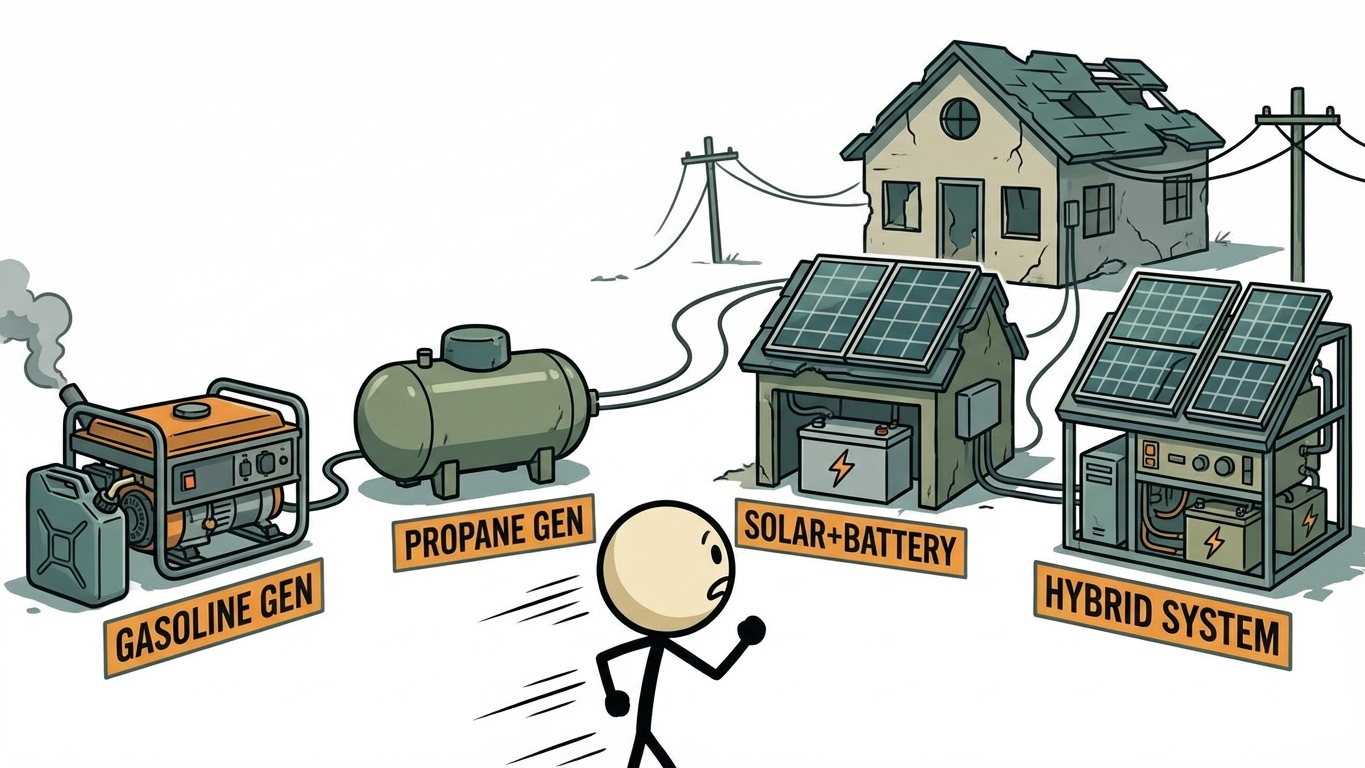
To calculate your total power requirement, you must adopt a tiered approach to survival electricity. You do not need to power your entire home during an emergency; you only need to power the essentials. Break your needs down into three distinct categories to better understand the scale of the home backup power system you will require.
The Three Tiers of Emergency Power
Tier 1: Absolute Survival Essentials. These are the non-negotiable items required to keep your family alive and safe. This tier includes medical equipment (like CPAP machines or oxygen concentrators), a few LED lights for safety, communication devices (radios, smartphones), and potentially a small space heater or fan depending on the extreme weather. A system providing 1,000 to 2,000 watts is generally sufficient for Tier 1.
Tier 2: Sustained Habitation. This tier keeps your household functioning during a multi-day outage without losing significant resources. It includes everything in Tier 1, plus your refrigerator to prevent food spoilage, a microwave or hot plate for boiling water and cooking, and a sump pump to prevent basement flooding. To comfortably manage Tier 2, you will typically need a system capable of producing 4,000 to 7,000 watts.
Tier 3: Near-Normalcy. This level attempts to replicate your standard grid-tied life. It includes running a central air conditioning unit, an electric water heater, an electric clothes dryer, and a deep well pump. Achieving Tier 3 requires a massive power output, usually necessitating a whole-house standby generator capable of producing 15,000 to 25,000 watts. For most practical emergency preparedness plans, aiming for a robust Tier 2 setup is the most cost-effective and realistic goal.
Gasoline Generators: The Traditional Workhorse
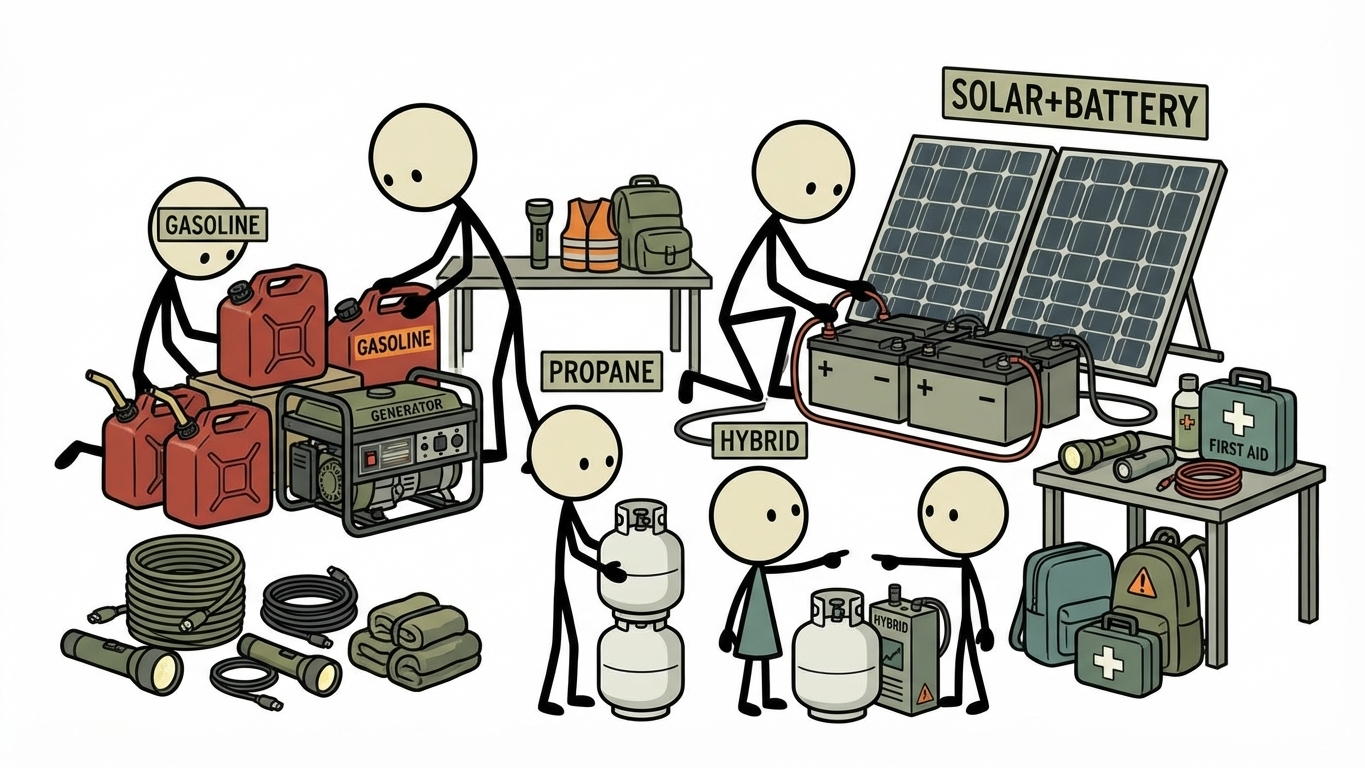
For decades, the portable gasoline generator has been the undisputed king of emergency power. Walk through any neighborhood after a hurricane, and the familiar roar of small gas engines will echo down the streets. Gasoline generators are widely available, relatively inexpensive to purchase upfront, and capable of producing massive amounts of power in a compact footprint.
The primary advantage of a gasoline generator is its accessibility. You can purchase a 5,000-watt gas generator at almost any local hardware store and have it running in your driveway within the hour. They provide excellent surge wattage, easily handling the heavy starting loads of refrigerators and window air conditioning units. For short-term, localized outages where fuel stations remain operational, a standard gas generator is a highly effective tool.
However, relying solely on gasoline presents significant logistical challenges during widespread disasters. When the grid goes down regionally, gas station pumps cannot operate. Even if stations have backup power, panic buying often leads to immediate fuel shortages. If you do not have gasoline stored on your property before the disaster strikes, your generator quickly becomes a useless metal paperweight.
The Challenges of Gasoline Storage and Maintenance
Storing gasoline safely is a complex endeavor. According to the National Fire Protection Association (NFPA), there are strict limits on how much gasoline a homeowner can legally and safely store, usually capped at around 25 gallons in approved containers. Furthermore, untreated gasoline degrades rapidly. Within three to six months, the volatile compounds evaporate, and the fuel begins to varnish, which will severely clog a generator's carburetor.
To mitigate this, you must treat all stored gasoline with a high-quality fuel stabilizer immediately upon purchase. Even with stabilizers, you must actively rotate your fuel supply every year. This means pouring your stored emergency gas into your daily commuter vehicle and refilling your jerry cans with fresh fuel. This rotation requires discipline and organization, which is a common point of failure for many novice preppers.
Maintenance is another critical factor. Gasoline generators are small engines that require regular oil changes, spark plug replacements, and air filter cleanings. If a gas generator sits unused in a garage for two years, it is highly likely that the carburetor will be gummed up when you finally need it. You must commit to test-running a gas generator under load for at least twenty minutes every single month to ensure it remains operational.
Propane (LPG) and Dual-Fuel Generators: The Reliable Alternative
Because of the inherent headaches associated with storing and maintaining gasoline, many emergency preparedness experts strongly advocate for propane, also known as Liquefied Petroleum Gas (LPG). Modern manufacturers have responded to this demand by producing highly efficient dual-fuel generators that can run on either standard unleaded gasoline or liquid propane with the flip of a switch.
The most significant advantage of propane is its shelf life. Unlike gasoline, propane never degrades, varnishes, or goes bad. A standard 20-pound barbecue tank of propane will be just as viable twenty years from now as it is today. This infinite shelf life completely eliminates the tedious chore of annual fuel rotation, allowing you to stockpile fuel indefinitely without anxiety.
Propane also burns much cleaner than gasoline. This cleaner combustion means significantly less carbon buildup inside the engine, extending the lifespan of the generator's internal components and reducing the frequency of required maintenance. Furthermore, if you spill propane, it simply evaporates into the air, eliminating the environmental hazards and fire risks associated with pooling liquid gasoline.
Limitations of Propane in Extreme Conditions
While propane is a superior storage fuel, it is not without its drawbacks. Propane has a lower energy density than gasoline. This means that a dual-fuel generator running on propane will generally produce about 10% to 15% fewer running and starting watts than it would when running on gasoline. You must factor in this power drop when calculating your appliance loads.
Additionally, propane struggles in extreme cold. Because propane is stored as a liquid under pressure, it must boil into a gas before the generator can combust it. As temperatures drop below freezing, the pressure inside the tank plummets. In sub-zero temperatures, a standard propane tank may not be able to vaporize the fuel fast enough to keep a large generator running. In these freezing scenarios, having the dual-fuel option to switch back to gasoline becomes a critical survival advantage.
For those looking for a permanent, hands-off solution, whole-house standby generators powered by massive underground propane tanks (250 to 500 gallons) offer the ultimate peace of mind. These systems automatically detect a grid failure and turn themselves on within seconds. However, they require professional installation, permits, and a significant financial investment, often exceeding $10,000.
Solar Plus Battery Systems: The Silent Guardian
In recent years, advancements in lithium battery technology and photovoltaic efficiency have revolutionized the preparedness landscape. The debate of "generator vs solar battery" is now at the forefront of family emergency planning. A portable power station emergency setup - often referred to as a solar generator - consists of a large battery bank, a built-in pure sine wave inverter, and a charge controller, all replenished by portable or roof-mounted solar panels.
The most profound advantage of a solar battery system is safety. Because they do not combust fuel, they produce zero carbon monoxide and zero emissions. This means a portable power station can be operated safely indoors, right in your living room or bedroom. You can run a CPAP machine on your nightstand or keep a refrigerator running from the kitchen floor without running extension cords through an open window in the dead of winter.
Solar setups are also entirely silent. In a post-Survival Scenarios, the loud roar of a gas generator advertises to the entire neighborhood that you have power, resources, and supplies. This can attract unwanted attention and compromise your operational security. A solar battery bank operates in total silence, keeping your home powered while maintaining a low profile.
Understanding Battery Chemistry and Solar Limitations
When selecting a portable power station, battery chemistry is the most important specification to check. Older models use standard Lithium-ion (Li-ion) batteries, which degrade after roughly 500 charge cycles and pose a slight, albeit rare, thermal runaway (fire) risk. Modern, high-quality units utilize Lithium Iron Phosphate (LiFePO4) chemistry. LiFePO4 batteries are incredibly stable, completely safe from thermal runaway, and boast a lifespan of 3,000 to 5,000 cycles before degrading to 80% capacity. This means you could drain and recharge a LiFePO4 battery every single day for ten years before it shows significant wear.
Despite their incredible benefits, solar battery systems have distinct limitations. The primary hurdle is the initial cost. A high-capacity power station capable of running a refrigerator and a few appliances (around 2,000 watt-hours of storage) can cost significantly more than a traditional gas generator of the same output. Furthermore, their power output is limited by the capacity of the battery; once the battery is dead, the power is gone until it can be recharged.
This brings us to the ultimate weakness of solar: weather dependency. FEMA and the Department of Energy (DOE) heavily promote renewable energy for resilience, but the reality is that major power outages are frequently caused by severe weather - hurricanes, blizzards, and atmospheric rivers. During a multi-day winter storm with heavy cloud cover and snow-covered panels, your ability to recharge a solar battery will be severely crippled. If your battery dies and the sun isn't shining, you are entirely out of luck.
Hybrid Setups: The Best of Both Worlds
If traditional generators require finite, volatile fuel but offer massive on-demand power, and solar batteries offer safe, silent power but rely on cooperative weather, what is the optimal solution? For the ultimate home backup power strategy, the answer is a hybrid setup. By combining a medium-sized dual-fuel generator with a robust portable power station, you eliminate the weaknesses of both systems while amplifying their strengths.
A hybrid blackout power backup system relies on a strategic daily cycle. During the day, you wheel your dual-fuel generator outside and run it on clean-burning propane. You use this massive influx of power to run your heavy-duty, high-draw appliances: you cool down the refrigerator, run the well pump to fill your bathtubs and water containers, and operate any high-wattage cooking appliances.
Simultaneously, while the generator is running these heavy loads, you plug your portable power station into the generator to charge its battery bank. Modern power stations can accept a massive AC input, often charging from zero to 100% in under two hours.
Once the heavy chores are done and the battery is fully charged, you turn off the gas generator. As night falls, you bring the silent, fully charged portable power station indoors. You use it to power your lights, charge your phones, run a CPAP machine, and keep the refrigerator running quietly through the night.
The Strategic Advantages of Hybrid Power
This hybrid approach offers unparalleled advantages. First, it drastically conserves your fuel supply. Instead of running a loud generator 24 hours a day and burning through a 20-pound propane tank in a single night, you only run the generator for two to three hours a day. This stretches a single tank of propane into a week-long fuel supply.
Second, it provides redundancy. If your generator suffers a mechanical failure, you still have your solar panels to slowly charge your battery bank. If a blizzard blocks out the sun for five days, you still have your generator to charge the battery bank. The military adage "two is one, and one is none" applies perfectly to emergency power. A hybrid system ensures that a single point of failure does not leave your family in the dark.
Finally, a hybrid setup maximizes your operational security and comfort. You are not forced to listen to a loud engine vibrating through your walls while you try to sleep, nor are you advertising your resources to the neighborhood during the vulnerable nighttime hours. You get the brute force of fossil fuels when you need it, and the silent safety of lithium batteries when it matters most.
Critical Safety and Installation Guidelines
Possessing the right equipment is only half the battle; deploying it safely is arguably more important. The aftermath of a disaster is chaotic, and emergency rooms frequently see a spike in injuries related to improper generator use. Any comprehensive emergency generator guide must heavily emphasize the strict safety protocols outlined by agencies like the Red Cross, FEMA, and the CDC.
The most lethal threat during a power outage is carbon monoxide (CO). CO is an odorless, colorless gas produced by the incomplete combustion of fossil fuels. You must never, under any circumstances, run a gasoline, diesel, or propane generator inside a home, garage, basement, crawlspace, or enclosed porch. The Red Cross mandates that generators must be placed at least 20 feet away from your home, with the exhaust pointing away from any windows, doors, or air intake vents.
To protect your family, you must install battery-operated carbon monoxide detectors on every level of your home, particularly near sleeping areas. Test these detectors monthly and replace the batteries during your routine emergency supply audits. Do not let the desperation of a freezing night convince you to bring a combustion engine indoors; the risk of fatal poisoning is absolute.
Connecting to Your Home: Extension Cords vs. Transfer Switches
Once your generator is safely positioned outside, you must determine how to get the power to your appliances. The simplest method is using heavy-duty, outdoor-rated extension cords. If you choose this route, ensure the cords are rated for the exact wattage of the appliances you are running. Using a thin, low-gauge cord for a high-wattage appliance like a space heater will cause the cord to melt and potentially start a house fire. Always inspect cords for cuts or exposed wires before use.
For a more permanent and robust solution, you should hire a licensed electrician to install a manual transfer switch or a generator interlock kit. These devices wire your generator directly into your home's main electrical panel. Instead of running extension cords through an open window (which lets cold air in and creates a security risk), you simply plug the generator into a specialized inlet box mounted on the exterior of your house.
A transfer switch allows you to power hardwired appliances that cannot be plugged into an extension cord, such as your furnace blower, well pump, and ceiling lights. More importantly, a transfer switch safely disconnects your home from the utility grid while the generator is running. This prevents "backfeeding" - a highly dangerous scenario where your generator sends electricity back up the utility lines. Backfeeding can easily electrocute utility linemen who are working miles away to restore the neighborhood's power. It is illegal, incredibly dangerous, and entirely preventable with a proper transfer switch.
Maintaining Your Power Independence
A backup power system is not a "set it and forget it" investment. Like a fire extinguisher or a first aid kit, it requires routine inspection and maintenance to ensure it will function flawlessly when the grid collapses. Establish a quarterly schedule to test your equipment. Fire up your dual-fuel generator, apply a load to it (like a large power tool or a space heater), and let it run for twenty minutes to lubricate the engine seals. Simultaneously, plug in your portable power station, drain it down to 50%, and recharge it to ensure the inverter and battery cells are functioning correctly.
Store your solar panels in a safe, dry location where they will not be crushed or scratched. Keep your propane tanks elevated off the bare dirt to prevent rust on the bottom ring. Ensure you have extra quarts of the manufacturer-recommended motor oil and a few spare spark plugs stored right next to your generator. When a hurricane is twenty-four hours away, you will not have the time or the ability to run to the store for supplies.
Choosing the right home backup power system is one of the most empowering steps you can take in your preparedness journey. By carefully assessing your wattage needs, understanding the distinct advantages of propane and solar technology, and perhaps combining them into a resilient hybrid setup, you take absolute control over your family's safety. When the skies darken and the grid inevitably fails, you will not be a victim of circumstance. Instead, you will flip a switch, the lights will come back on, and your household will weather the storm in comfort and security.
Compare power backup systems through our emergency preparedness guide. Review backup options in our bug-out bag guide. Calculate power needs with our supply calculator. Build backup kits with our go-bag builder. Master power solutions through our preparedness courses.
Frequently Asked Questions
How long should a household plan for a blackout?
Plan for at least 72 hours as a minimum, then build to 7 to 14 days if your area faces severe weather or grid instability.
What should I do in the first hour of a power outage?
Check safety first, confirm outage scope, protect refrigerated food, set light discipline, and start your communication plan.
Can I run a generator in my garage with the door open?
No. Never run fuel generators in garages or near doors or windows. Carbon monoxide can build up quickly and become fatal.
How do I keep my phone charged during long outages?
Use layered charging: power banks first, then vehicle charging, then generator or solar recharge windows.
What foods are safest during blackouts?
Prioritize ready-to-eat shelf-stable foods, then fridge items early, then freezer items while still frozen.
Develop your emergency preparedness strategy. Compare solar emergency backup options. Prepare for natural disaster survival scenarios. Use our supply calculator and check our courses.
Sources & Further Reading
Related resource: Shelf Life Estimator.