⚡ Key Facts
- Social Cohesion Saves Lives: According to FEMA’s National Preparedness Report, communities with high levels of social trust and localized community emergency preparedness guide networks recover up to 40% faster from catastrophic events than highly individualistic, isolated populations.
- The Bystander Effect in Crises: A comprehensive American Red Cross survey revealed that 70% of survivors in sudden-onset urban disasters received life-saving assistance from civilian bystanders before professional first responders or federal agencies arrived on the scene.
- The Tactical Target: Sociological research published by the National Institutes of Health (NIH) indicates that during civil unrest, individuals wearing overtly tactical, military-style clothing are three times more likely to be targeted for confrontation, theft, or detention by both civilian crowds and law enforcement.
- Search and Rescue Realities: Data from the National Oceanic and Atmospheric Administration (NOAA) and the U.S. Geological Survey (USGS) shows that in natural disasters like floods or earthquakes, high-visibility gear reduces rescue response times by up to 80% compared to individuals attempting covert movement.
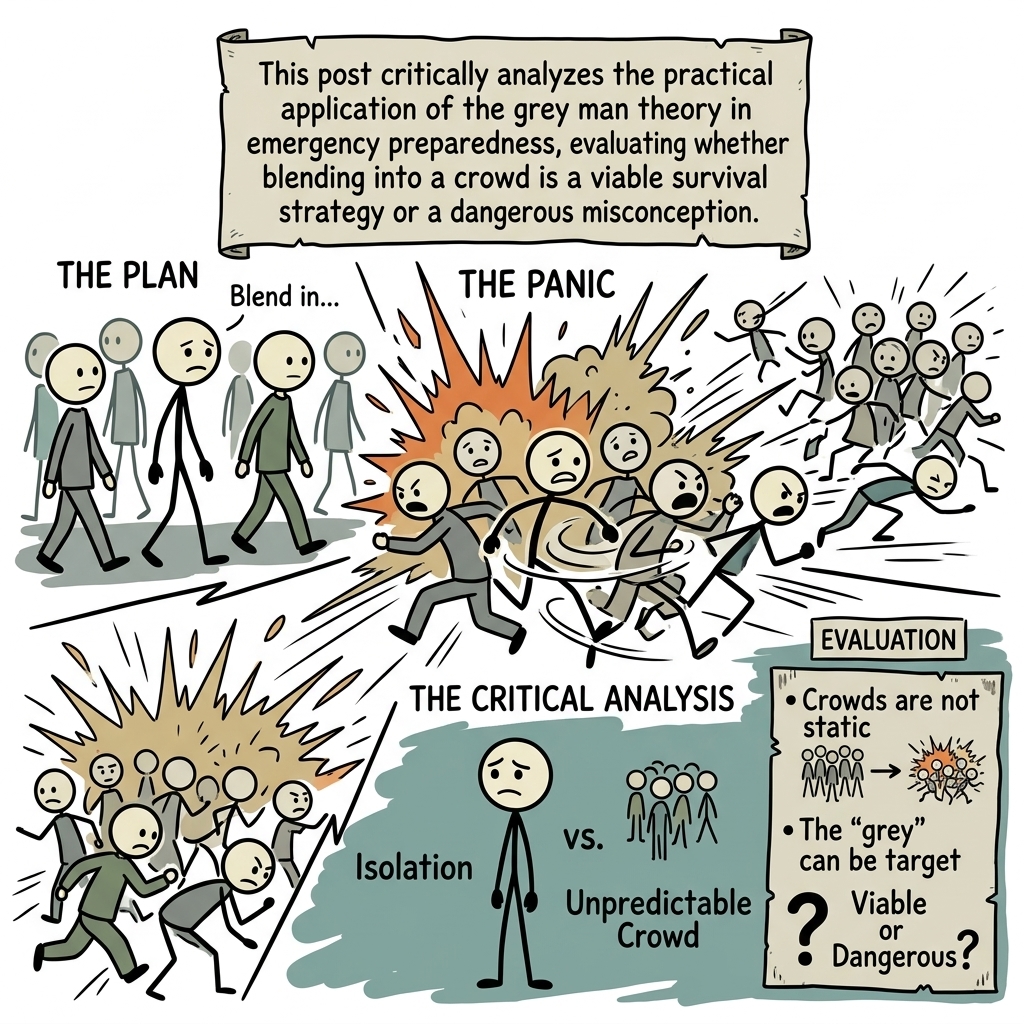
When the power grid fails, civil unrest spills into the streets, or a natural disaster shatters the veneer of everyday stability, a distinct psychological shift occurs within the human collective. In these high-stakes moments, the instinct to survive manifests in two polarizing philosophies: the desire to band together for mutual protection, or the urge to vanish into the shadows. The latter approach has spawned one of the most widely discussed, debated, and romanticized concepts in modern tactical culture: the grey man theory. Proponents of this methodology argue that the ultimate survival strategy is complete anonymity—the art of moving through a crisis undetected by blending seamlessly into the background. However, when applied to real-world disasters, this espionage-born tactic often collides with the messy, unpredictable realities of human sociology. To build a truly resilient emergency plan, we must critically analyze whether trying to disappear is a brilliant tactical shield or a dangerous misconception that could cost you your life.
Demystifying the Grey Man Theory: Origins and Modern Application
To understand the utility of the grey man theory, we must first strip away the Hollywood mystique. The concept did not originate in the civilian prepper community; rather, it was forged in the crucible of cold-war espionage and military special operations. Intelligence agencies, including the CIA and MI6, trained operatives to navigate hostile foreign cities by matching the local "baseline." The objective was simple: look like everyone else, act like everyone else, and leave absolutely no lasting impression on anyone who crosses your path. An operative who successfully blended in could gather intelligence, evade surveillance, and escape hostile territory without firing a single shot.
In the context of modern emergency preparedness, the theory has been adapted as a defensive mechanism for civilian survival. The core premise is that in a collapsing societal structure, visible assets make you a target. If you appear well-fed, highly organized, and heavily geared, you invite envy, desperation, and hostility from those who are unprepared. Conversely, if you look desperate, weak, or overly vulnerable, you invite victimization. The grey man seeks the golden mean: a state of utter unremarkable neutrality. By mastering how to blend in, you theoretically pass through chaotic environments without drawing the attention of opportunistic criminals, desperate crowds, or overstretched security forces.
While this sounds logical on paper, the transition from military intelligence to civilian disaster survival is fraught with systemic failures. A trained operative operates with a network of state-backed support, secure emergency communication plans, and a highly specific mission profile. A civilian navigating a localized grid-down scenario or a regional hurricane aftermath faces a vastly different set of challenges. In these situations, the pursuit of total anonymity can easily morph into isolation, paranoia, and a fatal rejection of community resources.
The Tactical Trap: Why Your "Urban Survival Gear" is Giving You Away
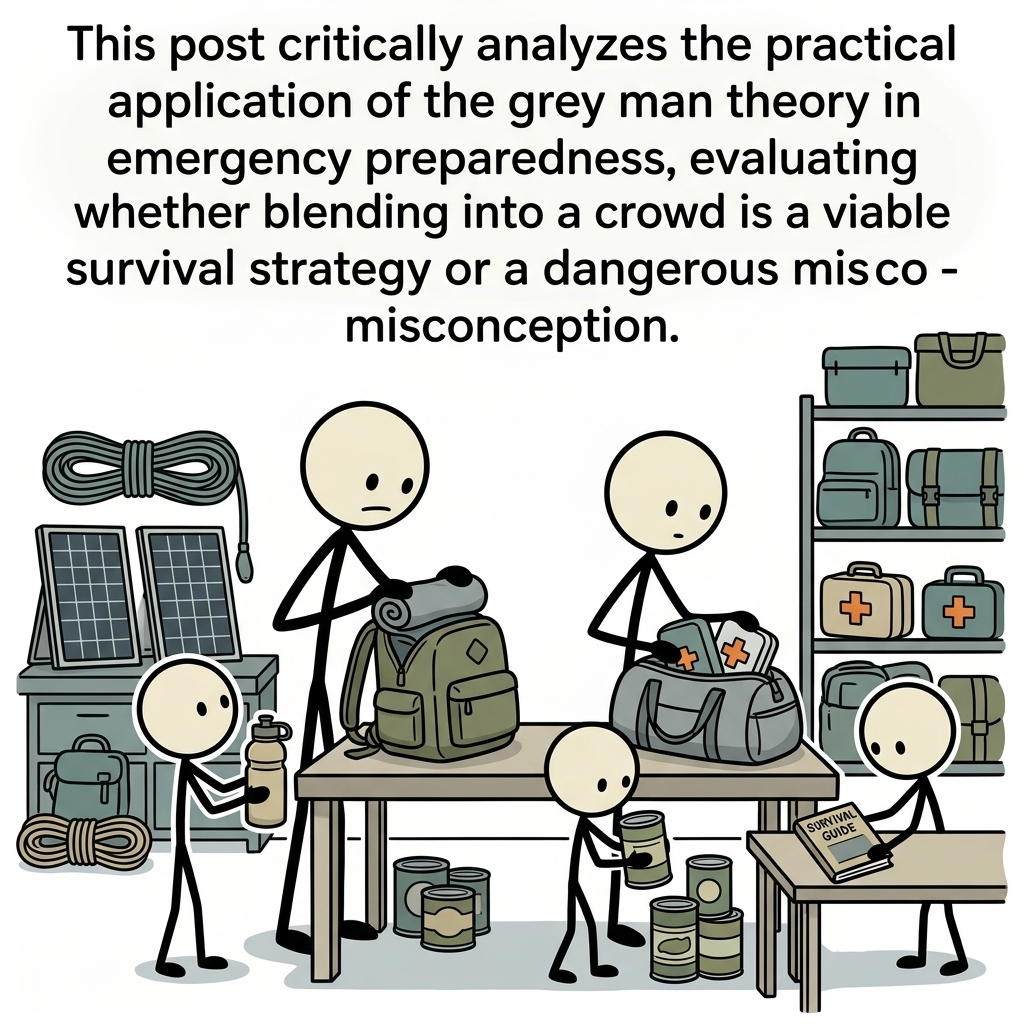
Perhaps the greatest paradox of the modern survival movement is the commercialization of stealth. A quick browse through any survival forum or retail outlet reveals a massive market for "tactical" gear designed to help you survive an urban crisis. Consumers load up on heavy-duty backpacks covered in MOLLE webbing, desert tan or olive drab apparel, paracord bracelets, and tactical boots. While this equipment is undeniably durable and highly functional, wearing it in an urban evacuation scenario is the exact opposite of maintaining a low profile.
In a crisis, human beings utilize rapid heuristic processing to categorize threats. When civilian populations and law enforcement officers see someone walking through a chaotic environment clad in military-style clothing and carrying a tactical rucksack, they do not see a "grey man." They see one of three things: an off-duty soldier, a vigilante, or a high-value target who is carrying a wealth of premium supplies. Instead of blending in, this tactical aesthetic acts as a beacon, drawing intense scrutiny from police checkpoints and inviting ambush from desperate individuals looking to acquire high-quality urban survival gear.
Reevaluating the Visual Baseline
To truly understand how to blend in, you must learn to read and mimic the visual baseline of your specific geographic location. The baseline is the average appearance of a person in a given space at a given time. If you are evacuating a downtown metropolitan area during a sudden emergency, the baseline consists of office workers in business casual attire, students in hoodies and sneakers, and commuters carrying simple canvas messenger bags or school backpacks. In this environment, a high-end tactical pack stands out like a flare.
True urban survival gear must perform exceptionally well while looking entirely mundane. This concept, often referred to as "covert tactical," involves utilizing gear that possesses military-grade durability and organization but is wrapped in a civilian aesthetic. Consider the following comparison when auditing your evacuation kit:
- The Tactical Mistake: A 50-liter coyote tan backpack with external MOLLE straps, velcro morale patches, and attached water bottle pouches.
- The Grey Alternative: A neutral-colored, durable commuter backpack (such as those made by Osprey, Jansport, or Patagonia) with internal organization compartments that hide your emergency supplies from public view.
- The Tactical Mistake: Combat boots, cargo pants with reinforced knees, and a moisture-wicking tactical shirt.
- The Grey Alternative: Well-worn denim or dark canvas work pants, a plain cotton or merino wool t-shirt, and broken-in trail running shoes or low-profile hiking shoes.
- The Tactical Mistake: Wearing visible knife clips, tactical pens, or heavy-duty flashlights on your belt or pockets.
- The Grey Alternative: Keeping all tools, defensive implements, and emergency electronics completely pocketed or stowed deep within your pack.
The Psychology of the Baseline: Behavior Over Appearance
While clothing and gear constitute your visual signature, your behavior dictates your psychological signature. Human beings possess an evolutionary ability to detect anomalies in their environment—a survival mechanism designed to identify predators. If your clothing is perfectly plain, but your behavior is incongruent with the surrounding crowd, you will instantly trigger the alarm bells of everyone around you.
During a crisis, a crowd typically exhibits specific behavioral patterns: confusion, urgency, collective communication, and a focus on immediate escape routes. If you are practicing a rigid interpretation of the grey man theory, you might attempt to walk with an overly deliberate, calm pace, scanning every window and doorway with intense, hyper-vigilant eyes. While you may think you look calm and collected, to an outside observer, you look like a predator hunting for prey, a scout looking for vulnerabilities, or someone hiding a guilty conscience. Your hyper-vigilance makes you highly visible.
The OODA Loop and Situational Awareness
To navigate this psychological landscape, emergency preparedness experts advocate for a balanced application of the OODA Loop (Observe, Orient, Decide, Act), developed by military strategist John Boyd. The goal is to maintain high situational awareness without projecting a threatening aura. This is achieved through passive observation rather than active scanning.
Keep your head up, but do not make lock-jawed eye contact with everyone you pass. Match the general speed of the crowd; walking too fast signals panic, while walking too slowly signals suspicion or physical vulnerability. Your body language should project quiet confidence and belonging, not fear or intense calculation. If the crowd is moving toward an evacuation point, move with them while gradually seeking safe lateral exits, rather than aggressively pushing against the flow of human traffic, which draws immediate physical resistance and attention.
The Dangerous Misconceptions of the Grey Man Strategy
While the grey man theory has practical utility when navigating a dangerous transit corridor, treating it as a comprehensive, long-term survival strategy is a dangerous misconception. When a disaster transitions from an acute event (like an active shooter or a sudden explosion) to a prolonged crisis (like a multi-week power outage or a severe pandemic), the utility of stealth rapidly diminishes, and the necessity of community engagement rises.
Misconception 1: Isolation is Safer Than Community
The most perilous flaw of the grey man mindset is the belief that you can survive a prolonged disaster entirely on your own. This "lone wolf" mentality directly contradicts decades of disaster research compiled by agencies like the Federal Emergency Management Agency (FEMA) and the American Red Cross. In a prolonged grid-down scenario, security, resource distribution, sanitation, and medical care are almost impossible to maintain individually.
FEMA’s historical data on Protocol Survival community demonstrates that neighborhood preparedness networks that establish immediate, visible communication networks experience significantly lower rates of looting, violence, and resource depletion. When you choose to remain entirely "grey" and isolated within your neighborhood, you are not seen as a neutral bystander; you are eventually perceived as an outsider, a hoarder, or a security risk by your neighbors. True security lies in numbers, shared watch rotations, and pooled resources.
Misconception 2: You Can Maintain Stealth Indefinitely
Operating as a grey man requires immense cognitive energy. Constantly monitoring your posture, gait, clothing, speech, and digital footprint while managing the physiological stress of a survival situation leads to rapid cognitive fatigue. When decision fatigue sets in, critical thinking fails, and you are far more likely to make catastrophic tactical errors. Human beings are social creatures; forcing yourself into a state of perpetual, guarded isolation during a crisis creates severe psychological distress that degrades your long-term survival capacity.
Misconception 3: "Grey" Means Wearing Dark, Drab Colors
In many survival circles, the literal interpretation of "grey" has led people to dress entirely in charcoal, black, or dark navy blue. In a daylight scenario, a group of individuals dressed in uniform dark colors looks highly suspicious, resembling a tactical unit or a criminal group. Conversely, in a night-time scenario, walking around in pitch-black clothing makes you a massive safety hazard for vehicles, emergency personnel, and civilian evacuations. The term "grey" is a metaphor for neutrality, not a literal color scheme. In a beachside community, a bright pastel polo shirt and shorts are "grey." In a rural farming town, a high-visibility Carhartt jacket is "grey." Context is everything.
When Standing Out Saves Lives: The Limits of Stealth
There are numerous Survival Scenarioss where attempting to blend in or hide is not only ineffective but actively suicidal. Understanding when to abandon the grey man persona and transition to high-visibility mode is a critical component of comprehensive emergency preparedness.
Search and Rescue (SAR) Scenarios
If you are stranded in a vehicle during a severe winter storm, lost in a national park, or trapped in the rubble of a building following a major earthquake (a scenario frequently mapped by the USGS), trying to blend in is a fatal mistake. Search and rescue teams operate under immense time constraints, often searching vast areas with thermal imaging, helicopters, and canine units.
In these moments, you must stand out as loudly as possible. This requires high-visibility safety vests, international orange tarps, signal mirrors, marine whistles, and active strobe lights. If your emergency gear consists solely of low-profile, earth-toned survival equipment, you severely hamper the ability of rescue teams to locate you before exposure, dehydration, or medical complications claim your life.
Navigating Official Checkpoints and Evacuations
During large-scale evacuations, such as those ordered by NOAA during Category 5 hurricanes, National Guard troops and local law enforcement establish strict checkpoints to control movement, prevent looting, and direct aid. If you approach these checkpoints attempting to look invisible, evasive, or overly guarded, you will immediately be detained for questioning.
In these highly managed environments, the safest strategy is clear, cooperative visibility. Keep your hands empty and visible, make polite eye contact, follow instructions without hesitation, and carry your identification in an easily accessible pocket. Projecting the image of a cooperative, calm, and law-abiding citizen is far more effective at getting you through a security perimeter than trying to slip past unnoticed.
Practical Steps: How to Blend In Safely and Effectively
If you determine that a specific situation requires you to maintain a low profile—such as traveling on foot through an unstable urban center to reach a safe zone—you must execute the grey man strategy with precision. Here is a practical guide to minimizing your signature without compromising your safety or isolating yourself from potential help.
1. Conduct a Local Baseline Audit
Before an emergency ever occurs, analyze the daily baseline of your commute, your workplace, and your neighborhood. Take mental notes of the following factors:
- What is the average brand of clothing worn by people in this area? Is it high-end athletic wear, basic workwear, or fast fashion?
- What type of bags do people carry? Are they laptop backpacks, reusable grocery totes, or designer handbags?
- What is the average walking speed and level of interaction? Do people walk with headphones in, looking at their phones, or do they greet neighbors?
- What are the local demographics and cultural norms regarding personal space and eye contact?
Your emergency wardrobe and behavioral plan should be custom-tailored to match these specific local baselines, ensuring you never look out of place in your daily environment.
2. Disguise Your Emergency Gear
You do not need to sacrifice high-quality survival gear to look normal. Instead, focus on creative concealment. Use everyday containers to house your emergency supplies:
- The Trauma Kit: Instead of a red, MOLLE-compatible IFAK (Individual First Aid Kit) hanging off your belt, store your medical supplies in a durable, unmarked zippered pouch inside your commuter bag.
- Water Filtration: Keep your personal water filter, purification tablets, and collapsible water bottles tucked inside a standard, stainless-steel insulated water bottle (like a Hydro Flask or Yeti). It looks like a normal drink container but holds your survival tools.
- Emergency Rations: Pack high-calorie food bars in standard grocery store ziplock bags or a simple lunchbox, rather than carrying military-style MREs with visible olive-drab packaging.
3. Master the Art of "Controlled Vulnerability"
In a widespread crisis, looking completely untouched by the disaster (clean clothes, perfectly groomed, high energy) makes you an immediate target for resentment and theft. Conversely, looking completely defeated makes you a target for exploitation. Aim for "controlled vulnerability." Look tired but alert. Wear clothes that are slightly dusty or rumpled, matching the physical state of the general public, but maintain a strong, upright posture that signals you are not an easy target.
Community Resilience: The Ultimate Survival Strategy
While the grey man theory offers valuable tactical tools for short-term transit through dangerous areas, it must never replace the foundation of true emergency preparedness: community resilience. The Centers for Disease Control and Prevention (CDC) emphasizes that social connectedness is one of the single greatest predictors of survival during public health emergencies and natural disasters.
When the storm clears and the hard work of rebuilding begins, those who spent the crisis hiding in the shadows will find themselves isolated, without a voice in the local recovery efforts, and lacking the vital social capital required to access shared resources. The ultimate survival strategy is not slipping through the cracks of a broken society; it is actively participating in the strengthening of that society before the crisis ever hits.
By building strong relationships with your neighbors, participating in local Community real-world emergency scenarios guide Teams (CERT), and organizing neighborhood communication networks, you create a collective shield that is infinitely stronger than any individual stealth tactic. When a community stands together, there is no need for a grey man, because the collective whole ensures that no single member is left vulnerable to the shadows.
Finding the Balance in Your Preparedness Journey
The grey man theory is not a binary choice between complete invisibility and reckless exposure. Rather, it is a highly contextual tool in your emergency preparedness toolkit. Understanding how to blend in, audit your visual signature, and avoid the tactical trap can keep you safe during the volatile initial hours of an urban crisis. However, as the situation unfolds, true survival demands that you step out of the shadows and engage with the community around you. By balancing low-profile personal transit with robust, cooperative community networks, you build a resilient, empowering survival strategy that protects not just yourself, but those who stand beside you.
Frequently Asked Questions
What is the Grey Man Theory in emergency preparedness?
The Grey Man Theory is the practice of blending into your surroundings by avoiding conspicuous clothing, gear, or behavior, making you less likely to become a target or draw unwanted attention during a crisis.
Does the Grey Man concept actually work in real-world emergencies?
Yes. Minimizing your visual profile and maintaining situational awareness reduces the risk of confrontation, theft, or being targeted, though its effectiveness depends on accurately reading and matching the local environment's baseline.
What are the most common mistakes when trying to blend in?
Common mistakes include wearing tactical-style clothing (like military boots or MOLLE gear), acting overly suspicious or hyper-vigilant, and carrying oversized or high-end survival gear that stands out in a crowd.
How should I dress to successfully blend in during a disaster?
Wear neutral, common, and non-descript clothing that matches what the local population is wearing. Avoid bright colors, political or military logos, and obvious tactical brands.
Is situational awareness more important than physical gear?
Yes. Recognizing threats early and avoiding them entirely through active situational awareness is always safer and more effective than relying on gear to resolve a physical conflict.