⚡ Key Facts: Amateur Radio Frequency Spectrums
- Infrastructure Independence: During catastrophic grid failures—such as Hurricane Maria, which disabled over 95% of cell sites in Puerto Rico according to Federal Communications Commission (FCC) reports—amateur radio remains the only operational direct communication system.
- VHF Local Reliability: The 2-meter Very High Frequency band (144–148 MHz) is the primary tactical backbone for local disaster response, offering reliable 5 to 30-mile line-of-sight simplex coverage and up to 50+ miles through elevated emergency repeaters.
- UHF Structural Penetration: The 70-centimeter Ultra High Frequency band (420–450 MHz) features shorter wavelengths (~28 inches) that penetrate concrete, dense timber, and urban obstacles far more effectively than VHF or HF signals.
- HF Regional and Continental Reach: High Frequency bands (3–30 MHz) utilize ionospheric refraction; specifically, Near Vertical Incidence Skywave (NVIS) propagation on 40m and 80m provides 0-to-400-mile coverage over mountainous terrain without repeaters.
- Regulatory Pathway: An entry-level FCC Technician Class license immediately unlocks extensive VHF and UHF privileges, while upgrading to a General Class license provides access to the global High Frequency spectrum.
When catastrophic weather, cyber disruptions, or structural disasters sever fiber-optic cables and exhaust backup generators at cellular towers, mainstream emergency communication plan collapses with stunning speed. The Federal Emergency Management Agency (FEMA) repeatedly underscores that the first 72 hours of any catastrophic disaster require localized, community-level resilience before coordinated federal logistics fully spool up. In these silence-filled corridors, the electromagnetic spectrum becomes your sole lifeline to outside intelligence, emergency coordination, and mutual assistance. Yet, purchasing an emergency radio without understanding frequency physics is like buying a survival rifle without knowing the difference between a rimfire plinker and a large-bore cartridge. To establish dependable ham radio emergency communications, you must understand the operational boundaries of HF, VHF, and UHF bands.
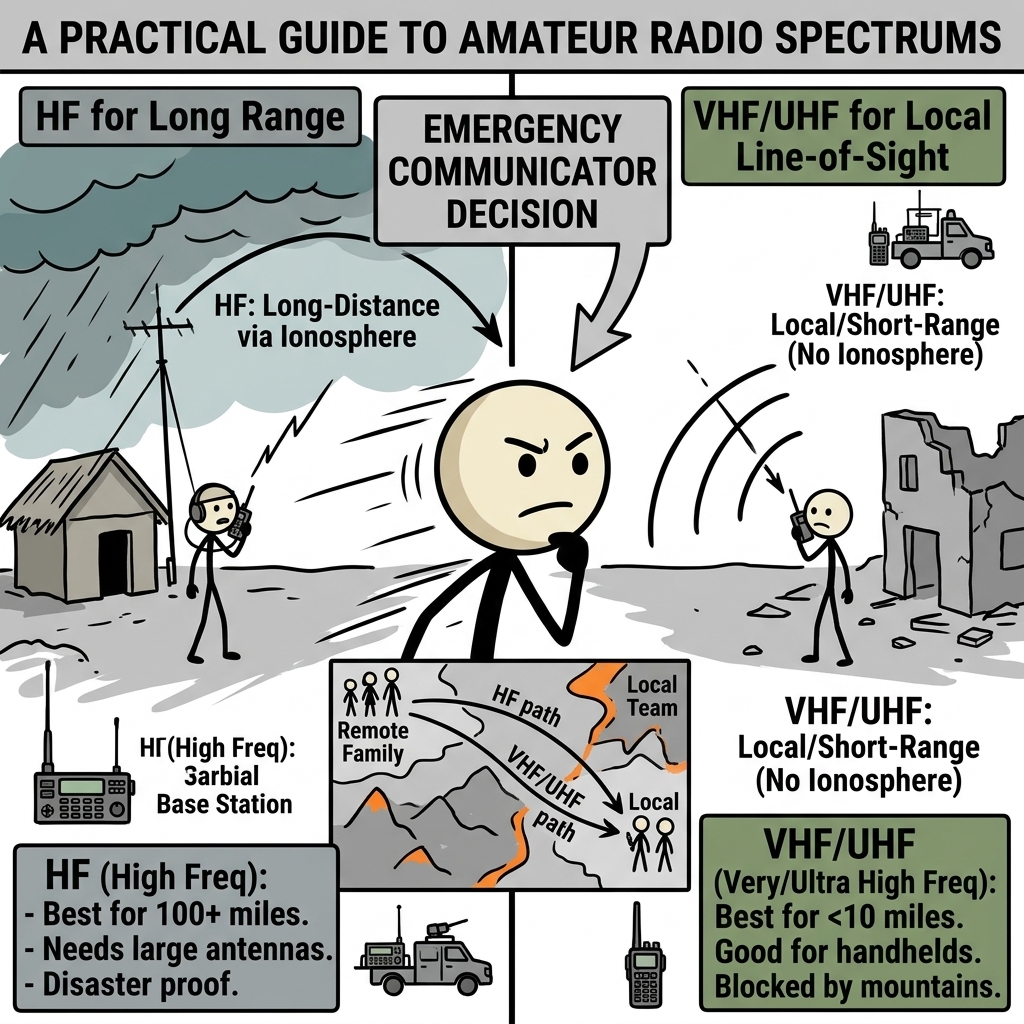
De-Mystifying the RF Spectrum: How Waves Travel Through Space
Every amateur radio transmission relies on electromagnetic radiation moving at the speed of light. The primary discriminator between different ham radio bands is wavelength—the physical distance between the crests of an alternating wave. Frequency is inversely proportional to wavelength: higher frequencies feature shorter physical wavelengths, while lower frequencies stretch across dozens of meters. This basic physical reality dictates antenna dimensions, battery power draw, and, most critically, the method by which a signal travels across terrain. For the practical checklist side, use the community emergency preparedness guide.
Signals move through the environment via three distinct propagation mechanisms:
- Direct Wave (Line-of-Sight): Radio waves travel straight from the transmitting antenna to the receiving antenna. This mechanism dominates VHF and UHF communications, where natural terrain, dense vegetation, and the curvature of the Earth inevitably truncate the signal path.
- Ground Wave: Lower-frequency signals skim along the surface of the Earth, following its physical curvature to a limited degree. This propagation mode is most effective in lower HF regions (such as the 160-meter and 80-meter bands), particularly over high-conductivity surfaces like seawater.
- Skywave (Ionospheric Refraction): Signals directed upward enter the upper atmosphere—specifically the ionosphere's D, E, and F layers—where solar radiation ionizes gas molecules. Under proper atmospheric conditions, these ionized layers bend and refract High Frequency signals back down to Earth hundreds or thousands of miles away.
Understanding these three mechanisms keeps you from making fatal assumptions during an emergency. An operator attempting to hit an evacuation hub thirty miles away behind a mountain range using a line-of-sight frequency will fail, while an operator using appropriate atmospheric refraction or local knife-edge diffraction will succeed effortlessly. For the practical checklist side, use the family emergency planning guide.
VHF (Very High Frequency): The Tactical Local Workhorse
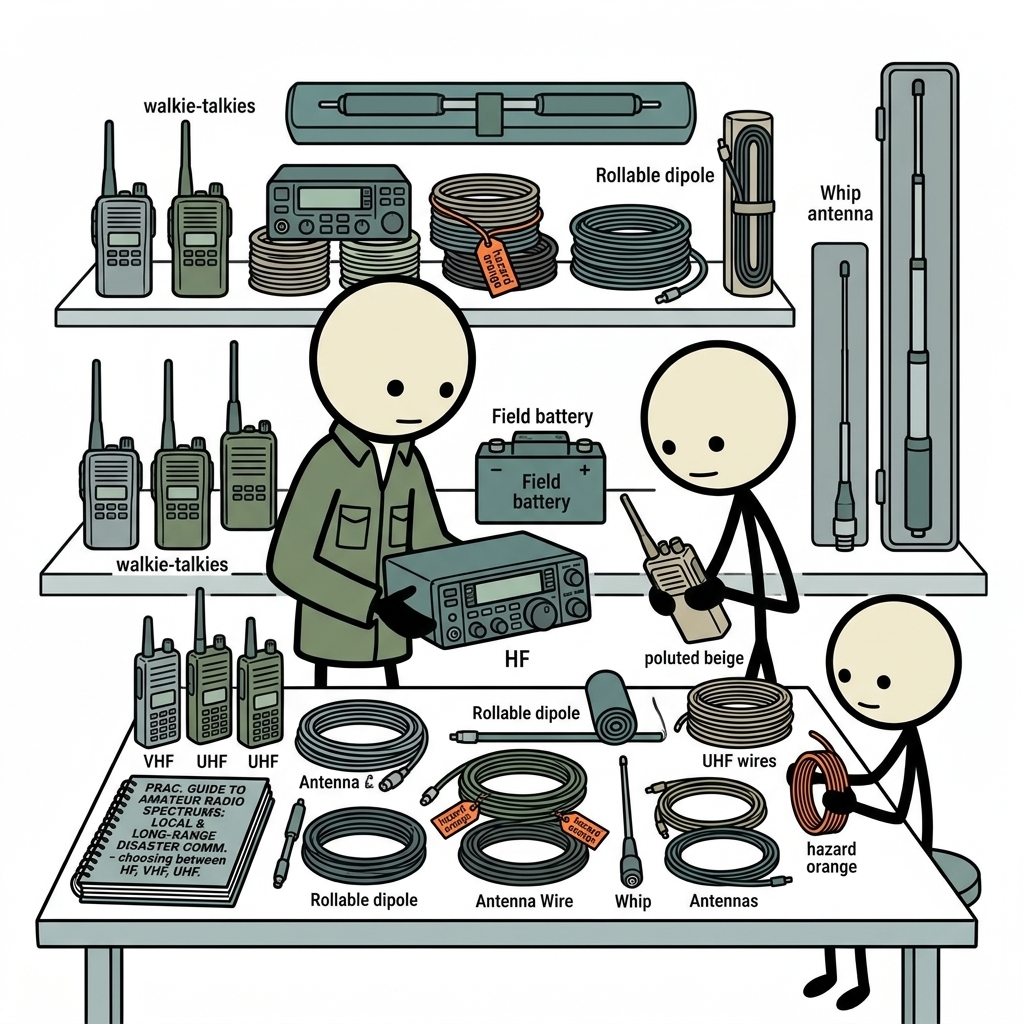
Occupying the spectrum from 30 MHz to 300 MHz, Very High Frequency is the definitive standard for operational, tactical emergency communications. Within the amateur radio allocations, the 2-meter band (144.000 to 148.000 MHz) serves as the primary meeting ground for emergency groups like the Amateur Radio Emergency Service (ARES) and the Radio Amateur Civil Emergency Service (RACES).
Propagation Characteristics of the 2-Meter Band
VHF frequencies propagate primarily via direct line-of-sight and ground-reflected paths. While standard direct waves travel approximately to the visual horizon, VHF exhibits atmospheric refraction that extends roughly one-third beyond that boundary—a distance known as the radio horizon. In flat or gently rolling terrain, a standard 5-watt handheld transceiver (HT) paired with an aftermarket half-wave antenna reliably covers 3 to 8 miles radio-to-radio (simplex).
VHF waves also experience "knife-edge diffraction." When a 2-meter wave encounters a sharp obstacle, such as a mountain ridge or prominent hill, the crest of the barrier can diffract the signal downward into the shadow zone behind it. This phenomenon gives VHF an operational advantage over higher-frequency signals in rugged backcountry environments where direct visual paths are blocked.
Strengths for Disaster Preparedness
- Repeater Density: Thousands of coordinated, volunteer-maintained repeaters populate mountaintops, commercial communication towers, and water tanks across North America. An emergency ham radio pushing just 5 watts into a hilltop repeater can easily broadcast over an entire county or 50-to-70-mile radius.
- Emergency Infrastructure Interoperability: County emergency operation centers (EOCs), the American Red Cross, and local search and rescue teams predominantly establish their local tactical nets on 2-meter VHF simplex and repeater frequencies.
- NOAA Weather Integration: The National Oceanic and Atmospheric Administration operates its continuous weather broadcast network between 162.400 and 162.550 MHz. Because this sits directly adjacent to the 2-meter amateur band, nearly every modern VHF amateur transceiver comes pre-programmed to monitor these life-saving alerts.
- Manageable Antenna Sizes: A quarter-wave ground-plane antenna for 2 meters is roughly 19 inches long, making it exceptionally portable, easy to hoist into a tree, or simple to mount on a vehicle roof via a magnetic base.
Limitations of the VHF Band
While VHF excels in open and rural environments, it struggles inside dense structural architecture. A 2-meter wavelength (approximately 6.5 feet) cannot easily pass through small openings, structural steel framing, or metal-reinforced concrete walls. Additionally, heavy wet foliage can scatter and attenuate VHF signals, diminishing range unless an operator elevates the antenna above the local canopy.
UHF (Ultra High Frequency): Urban Density and Structural Penetration
The Ultra High Frequency spectrum spans from 300 MHz to 3 GHz, with the amateur 70-centimeter band (420.000 to 450.000 MHz) anchoring this tier for preparedness communications. UHF represents the short-range, high-density tactical arm of your communications plan, perfectly tailored for urban environments, industrial centers, and close-quarters neighborhood preparedness network watch systems.
VHF vs UHF for Survival: The Structural Difference
The fundamental operational distinction between VHF and UHF comes down to physical scale. A 70-centimeter wave measures just under 28 inches. Because these waves are shorter, they slip through window openings, doorway passages, and structural voids that absorb or reflect 2-meter VHF waves. In an urban bug-in scenario, an operator transmitting from an interior apartment room will push a far cleaner signal to the street via UHF than VHF.
Conversely, UHF signals dissipate more rapidly in ambient air, scatter extensively in rainfall, and lack the terrain diffraction capabilities of lower frequencies. If you place a substantial granite ridge between two UHF transceivers without a repeater overhead, direct communication will fail completely.
Urban Grid-Down Utility
In metropolitan areas, high-power commercial repeaters frequently feature emergency backup generators or solar arrays. A compact dual-band handheld running on 70cm can link members of a dispersed family across an urban center using community repeaters. Furthermore, UHF is exceptionally resilient against man-made electrical noise. High-voltage power line arcing, failing transformers, and industrial motor interference produce widespread interference across the HF and lower VHF spectrums, but rarely disrupt the 440 MHz band.
Auxiliary Utility: GMRS and FRS Cross-Monitoring
The General Mobile Radio Service (GMRS) and Family Radio Service (FRS) operate within the 462 to 467 MHz range, which falls just above the amateur 70-centimeter amateur band. While FCC regulations govern distinct transmission certifications for equipment, many emergency ham radios feature wide-band receive capabilities. This enables an amateur operator to monitor local neighborhood watch networks, farm patrols, and family groups using consumer FRS/GMRS walkie-talkies during regional evacuations.
HF (High Frequency): Regional Resilience and Continental Reach
The High Frequency spectrum spans 3 MHz to 30 MHz. This is the domain of strategic, long-distance communication. When regional electrical grids fail, cellular backbones disconnect, and local repeaters exhaust their backup batteries after 48 to 72 hours, HF is the only medium capable of transmitting voice, Morse code (CW), and emergency digital messages over hundreds or thousands of miles without a single piece of intermediary hardware.
The amateur HF space contains several prominent operational bands, each designated by its approximate wavelength:
- 160 Meters (1.8–2.0 MHz): Technically Medium Frequency, but grouped with HF; an exceptional night-time local and regional ground-wave band requiring large wire antennas.
- 80 Meters (3.5–4.0 MHz): The workhorse night-time regional band for emergency traffic nets and state-level coordinating networks.
- 40 Meters (7.0–7.3 MHz): The most versatile 24-hour disaster communications band in existence, offering reliable daytime regional coverage and long-distance evening propagation.
- 20 Meters (14.00–14.35 MHz): The undisputed king of cross-continental and international intelligence gathering during daylight hours.
- 10 Meters (28.0–29.7 MHz): Highly volatile; fluctuates alongside the 11-year solar cycle, alternating between localized line-of-sight performance and dramatic intercontinental openings during solar maximums.
Near Vertical Incidence Skywave (NVIS): The Survivalist’s Secret Weapon
Standard long-distance HF propagation launches radio signals toward the horizon at a shallow angle. These signals refract off the ionosphere and return to Earth hundreds of miles away, creating a dead zone known as the "skip zone." A skip zone leaves an area between 30 and 300 miles from the transmitter completely blind to the signal—a major flaw if you are trying to coordinate with relatives two counties over or reach a state emergency operations center.
The solution to this tactical blind spot is Near Vertical Incidence Skywave (NVIS). By orienting a horizontal dipole antenna low to the ground (typically one-eighth to one-quarter wavelength high, or about 10 to 20 feet up), radio waves are directed almost straight up toward the ionosphere, like a flashlight beam bouncing off a high ceiling. The signal refracts straight down in an inverted umbrella pattern, providing complete, continuous, gap-free coverage from your station out to roughly 400 miles.
NVIS completely bypasses mountains, deep canyons, dense timber, and geographical blockages. During flood events or catastrophic wildfires that incinerate ridgetop repeaters, NVIS deployed on the 40-meter (daytime) or 80-meter (nighttime) band remains entirely operational from the safety of low-lying valley floors.
Strategic Intelligence Gathering
An HF base station or portable field rig transforms you from an isolated survivor into an informed strategic asset. Monitoring the HF spectrum gives you real-time access to the Maritime Mobile Service Net (14.300 MHz), military and government HF networks operating under shared protocols, inter-state health and welfare nets, and overseas shortwave broadcasts from international outlets. When domestic media blackouts occur or commercial regional feeds fail, HF raw data flows undeterred.
Strategic Frequency Selection Matrix
To establish an effective communications plan, you must assign specific operational bands to exact geographic and situational requirements. The following matrix illustrates how to route transmissions across HF, VHF, and UHF bands:
| Operational Tier | Primary Band | Frequency Spectrum | Realistic Range | Optimal Deployment Scenario |
|---|---|---|---|---|
| Tactical / Neighborhood | 70 Centimeters (UHF) | 420 – 450 MHz | 1 – 4 Miles | Urban evacuation, dense structural retreats, search and rescue inside collapsed architecture, family patrol coordination. |
| Local / County | 2 Meters (VHF) | 144 – 148 MHz | 5 – 30 Miles | County ARES/RACES disaster check-ins, simplex convoy coordination, rural property link-ups, NOAA monitoring. |
| Regional / State | 40m / 80m (HF - NVIS) | 3.5 – 7.3 MHz | 30 – 400 Miles | Overcoming mountain blockages without repeaters, county-to-state EOC links, regional mutual aid groups. |
| Continental / Global | 20m / 15m (HF - DX) | 14.0 – 21.45 MHz | 500 – 3,000+ Miles | Long-range situational awareness, cross-country family contact, international news gathering during nationwide grid-down events. |
Power Consumption, Portability, and Hardware Footprints
Every operational advantage gained in radio range introduces trade-offs in power consumption, physical weight, and deployment time. A balanced survival communications system accounts for these physical constraints.
Handheld Transceivers (HT): VHF/UHF Simplicity
Handheld dual-band (VHF/UHF) transceivers are standard field gear for good reason. Weighing under a pound, powered by internal lithium-ion battery packs, and drawing roughly 1.5 to 2.0 amps on high-power transmit (5 watts), an HT fits securely into a chest rig or Go-Bag Builder. Paired with a small 14-watt folding solar panel and a 5-volt USB charging cradle, an HT can remain operational indefinitely in the field.
However, handheld radios feature limited range when operated from ground level using flexible factory rubber duck antennas. In dense timber or broken topography, practical simplex range frequently drops below 1.5 miles. To overcome this limitation without upgrading to higher wattage, carry an emergency roll-up J-pole antenna made of 300-ohm twin-lead transmission line. Hoisting this wire antenna twenty feet into a tree branch using 550 cord instantly doubles or triples your tactical line-of-sight range.
Mobile Base Rigs: The High-Power Compromise
Vehicle-mounted or go-box mobile rigs run on 12-volt direct current and transmit between 25 and 50 watts on VHF/UHF, or up to 100 watts on HF. This ten-fold jump in output power reliably burns through RF interference, punches through heavy atmospheric attenuation, and secures stable connections with distant stations.
The operational cost is energy consumption. A 50-watt VHF mobile radio draws 8 to 11 amps during active transmission. A 100-watt HF transceiver draws up to 20 amps on voice peaks. Supporting these rigs requires dedicated power infrastructure: a 12.8V Lithium Iron Phosphate (LiFePO4) battery bank, heavy-gauge fused cabling, and a 50W to 100W monocrystalline solar array backed by a clean MPPT solar charge controller.
Antenna Real Estate
The most overlooked constraint in emergency communications is spatial footprint:
- UHF: A quarter-wave antenna measures barely 6.5 inches; an entire 70cm directional Yagi antenna can be built on an 18-inch wooden boom.
- VHF: A 2-meter dipole measures approximately 38 inches from tip to tip—compact enough to mount discreetly inside an attic or camouflage against a balcony railing.
- HF: An 80-meter half-wave dipole spans roughly 134 feet of copper wire; a 40-meter dipole spans roughly 66 feet. Deploying an HF base station requires clear, open terrain, robust mast supports, and secure anchoring points.
Digital Modes: Maximizing Efficiency in Degraded Environments
While voice (phone) operations remain the most intuitive form of communication, analog voice is the least efficient way to push information through the electromagnetic spectrum. A standard single-sideband (SSB) voice transmission requires approximately 2.8 kHz of bandwidth. When band conditions deteriorate or an operator drops power to conserve battery life, voice signals quickly become buried beneath atmospheric noise.
Digital emergency modes revolutionize survival communications by compressing information into narrow audio streams that a laptop, tablet, or dedicated modem processes below the audible noise floor:
- Winlink Global Radio Email: The undisputed premier emergency ham radio data tool, relied upon by the Red Cross, FEMA, and the U.S. Coast Guard. Winlink lets operators transmit plain-text emails, GPS coordinates, and casualty rosters over HF and VHF frequencies to radio gateways hundreds of miles away, routing traffic directly onto the internet outside the disaster area.
- JS8Call: A directed-messaging HF protocol derived from the weak-signal FT8 mode. JS8Call transmits text messages, automatic heartbeats, and relay requests across the continent using as little as 5 to 10 watts of power into compromised, stealthy wire antennas, decoding signals that the human ear cannot even hear.
- APRS (Automatic Packet Reporting System): Operating primarily on 144.390 MHz VHF across North America, APRS transmits short bursts of data containing GPS location coordinates, weather station reports, and brief tactical text bulletins without requiring manual intervention.
Licensing, Legal Realities, and Tactical Protocol
A widespread, dangerous myth in survival circles is the idea that "I don't need a license because the FCC doesn't matter during an emergency." Relying on this assumption guarantees operational failure when a crisis actually hits.
The Practice Paradox
Radio operation is a technical, perishable field craft. Understanding band conditions, adjusting antenna tuners, programming frequency splits and CTCSS tones, working around radio frequency interference (RFI), and rigging NVIS wires under adverse weather conditions require extensive hands-on experience. If you wait until regional infrastructure collapses to remove your transceivers from their original packaging, you will lack the muscle memory and operational knowledge needed to establish contact.
The FCC offers a straightforward three-tier licensing progression:
- Technician License: Earned by passing a 35-question multiple-choice exam on basic radio regulations, electronics, and safety. It instantly unlocks all VHF and UHF spectrums, granting immediate access to local tactical networks, emergency repeaters, and localized digital modes.
- General License: Requires a second 35-question exam covering radio physics, solar propagation, and circuit design. This unlocks the entire HF spectrum, providing legal access to worldwide emergency frequencies and NVIS regional networks.
- Extra License: Provides complete operating privileges across every sliver of the amateur spectrum, valuable for high-density spectrum environments and coordinated emergency traffic management.
FCC Rule 97.403: Emergency Exceptions Explained
Under FCC Part 97, Section 97.403 states: "No provision of these rules prevents the use by an amateur station of any means of radio communication at its disposal to provide essential communication needs in connection with the immediate safety of human life and immediate protection of property when normal communication systems are not available."
This rule exists for life-or-death emergencies when standard communications are completely inaccessible. However, it is an emergency protection measure, not an open pass to broadcast casually during minor disruptions. If you do not have an active license, you cannot legally test, calibrate, or train on your equipment beforehand. By securing your license in advance, you can legally test your gear, participate in weekly local emergency nets, and identify weak links in your equipment long before your family’s safety relies on it.
Standard Tactical Operating Procedure
In high-stress disaster conditions, chaotic transmissions paralyze the spectrum. You can maintain speed and clarity on both local and regional bands by adopting standard radio discipline:
- Implement a PACE Plan: Designate your Primary (e.g., local 2m VHF repeater), Alternate (2m VHF Simplex 146.520 MHz), Contingency (40m NVIS HF Net), and Emergency (70cm UHF cross-band repeater or satellite communicator) channels in advance. Ensure every family member or group member carries a laminated card detailing this hierarchy.
- Listen First: Always monitor a frequency for at least 30 to 60 seconds before keying your transmitter. In an emergency, interrupting an active casualty report or traffic net degrades overall operational effectiveness.
- Plain Language Protocols: While military and commercial agencies use complex 10-codes, both FEMA and the National Incident Management System (NIMS) mandate plain language for disaster operations. Abandon confusing police codes in favor of direct, concise communications: state who you are, your current location, your operational status, and your specific requirements.
- Establish Scheduled Contact Windows: Handheld radios quickly exhaust their batteries if left scanning 24 hours a day. Conserve power by adopting a standard contact schedule—such as transmitting for five minutes at the top of the hour every three hours (the "3-3-3" rule). This operational cadence dramatically extends system life while maintaining dependable contact windows.
Building Your Resilient Comms Network
Securing reliable off-grid communication does not require an industrial budget or an advanced engineering degree. It simply requires selecting the appropriate band for your specific operational range and environmental terrain. Begin by anchoring your local capabilities with a reliable dual-band VHF/UHF handheld radio, learn your local repeater offsets and national simplex channels, and secure an FCC Technician license. As your skills advance, expand your operational reach into the High Frequency spectrum by deploying an HF portable transceiver, building an inexpensive 40-meter wire NVIS antenna, and testing digital protocols like Winlink and JS8Call.
Mastering this spectrum gives you true communications independence. When storms roll in, regional power grids fail, and standard cell systems fall silent, understanding the mechanics of HF, VHF, and UHF bands ensures you can consistently send and receive vital operational intelligence through the open airwaves.
Frequently Asked Questions
Which ham radio band is best for local emergency communications?
The VHF 2-meter (144–148 MHz) and UHF 70-centimeter (420–450 MHz) bands are best for local communications, offering reliable direct line-of-sight and community repeater access.
What band is best for long-distance or regional emergency communications?
High Frequency (HF) bands like 40 meters (7 MHz) for daytime regional coverage and 80 meters (3.5 MHz) for nighttime regional coverage use ionospheric skywave propagation to reach hundreds of miles without repeaters.
Can I transmit on ham radio bands without a license during an emergency?
FCC Part 97.403 permits the use of any means of radio communication in immediate life-threatening situations where no normal communication facilities are available, but licensing is required for all preparatory practice and routine operation.
What is the practical difference between VHF and UHF bands in disaster zones?
VHF waves travel farther outdoors and around gentle terrain, making them ideal for rural areas, whereas UHF waves have shorter wavelengths that better penetrate concrete buildings and dense foliage.
What amateur radio license level is needed to access emergency HF bands?
While the entry-level Technician class grants full VHF and UHF privileges, upgrading to a General class license is necessary to access the primary HF bands required for nationwide emergency communication.