⚡ Key Facts: Real-World Emergency Ham Radio Range
- Handheld Reality Check: While retail packaging often claims "up to 35 or 50 miles," real-world simplex (radio-to-radio) handheld ham radio range on VHF/UHF typically spans just 0.5 to 2 miles in suburban or forested environments.
- Antenna Height Trumps Wattage: Raising an antenna from 5 feet to 30 feet yields a massive 150% to 200% increase in coverage area, whereas quadrupling your transmitter wattage from 5 Watts to 20 Watts typically increases operational distance by less than 30%.
- Grid-Down Infrastructure Fragility: Federal Communications Commission (FCC) Disaster Information Reporting System (DIRS) data reveals that catastrophic hurricanes regularly knock out 25% to over 70% of commercial cellular towers within primary disaster impact zones, instantly elevating local line-of-sight ham radio to mission-critical status.
- NVIS Eliminates the Terrain Barrier: Near Vertical Incidence Skywave (NVIS) operating on High Frequency (HF) bands (typically 40m and 80m) bypasses mountain ranges and urban clutter entirely, establishing reliable regional communications across a 50- to 400-mile radius without repeaters or internet infrastructure.
- Mobile & Base Power Advantage: Vehicle-mounted mobile units (50W) and permanent base stations (50W–100W) with elevated external antennas achieve dependable simplex VHF communications of 10 to 30+ miles across rolling terrain, bridging the critical gap when mountain-top repeaters exhaust backup generator fuel.
When catastrophic weather systems strike, the modern teleemergency communication plans network is routinely the first critical lifeline to crumble. During major disaster declarations—such as Hurricane Helene in 2024 and Hurricane Ian in 2022—the Federal Communications Commission documented widespread cellular blackouts, with local county outages exceeding 75% in immediate strike zones due to fiber backhaul severances, wind-sheared towers, and submerged backup power systems. In these communication voids, emergency managers, search-and-rescue task forces, and resilient neighborhood preparedness networks depend on amateur radio. However, a dangerous misconception persists among newly licensed operators and preparedness planners: the belief that a pocket-sized handheld transceiver can effortlessly bridge cross-county distances at the push of a button. Understanding practical ham radio range is not a theoretical exercise—it is the direct boundary between isolation and coordinated survival when the power grid goes cold.
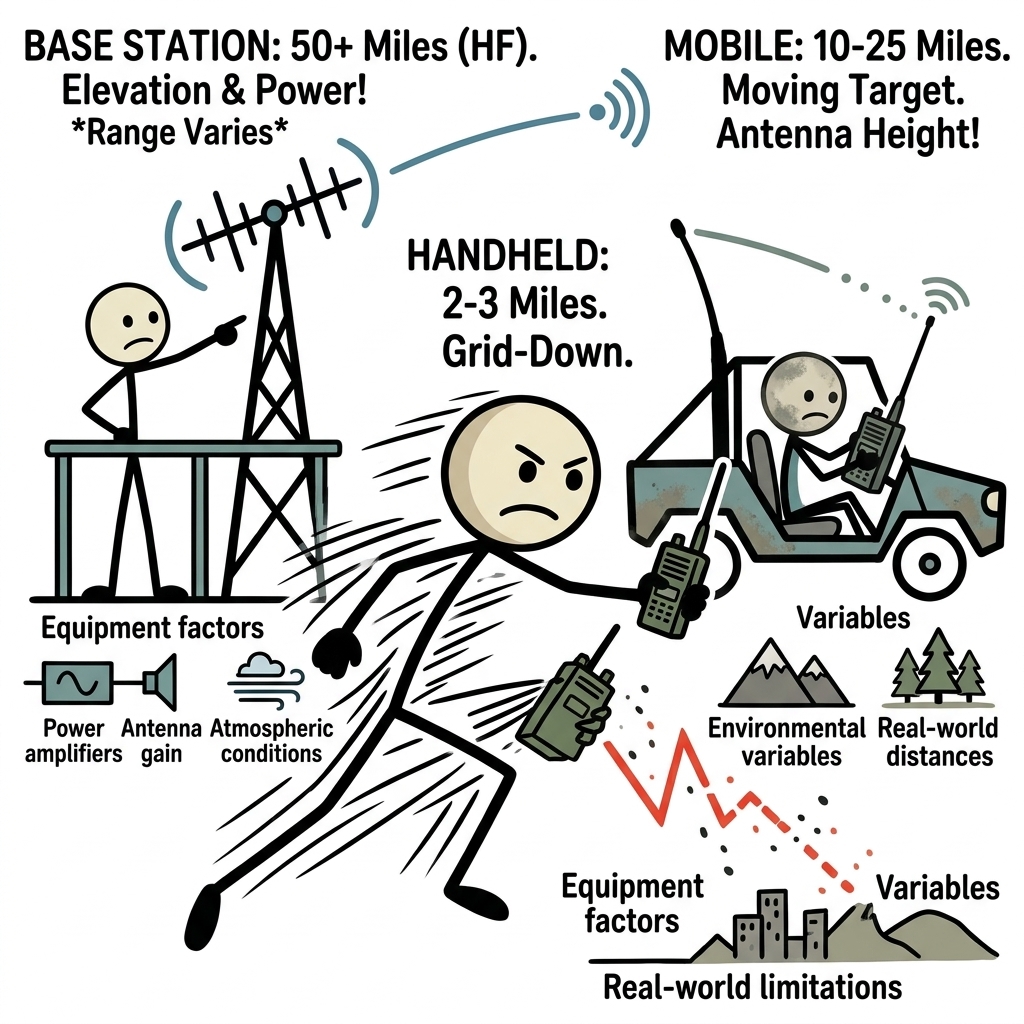
The Physics of Radio Propagation: Why Consumer Packaging Lies
To plan an effective disaster communication plan, you must discard the marketing claims printed on blister packs. Handheld radios advertising "36-Mile Range" are technically reporting theoretical free-space propagation between two high mountain peaks across an unobstructed vacuum with zero atmospheric interference. In real-world emergency ham radio distance planning, the physical earth, dense tree canopies, and manufactured infrastructure dictate signal survival. For the practical checklist side, use the community emergency preparedness guide.
The vast majority of tactical, local emergency communication operates on Very High Frequency (VHF, typically the 2-meter band at 144–148 MHz) and Ultra High Frequency (UHF, typically the 70-centimeter band at 420–450 MHz). Both bands rely fundamentally on "line-of-sight" propagation. If a physical barrier completely blocks the optical path between two antennas, the radio frequency (RF) signal must bend, reflect, or penetrate the obstruction—processes that rapidly bleed signal energy. For the practical checklist side, use the family emergency planning guide.
The Curvature of the Earth and the Radio Horizon
Because the Earth is curved, the ground drops away from your antenna. Fortunately, atmospheric refraction bends VHF and UHF radio waves slightly downward toward the earth's surface, effectively extending the "radio horizon" approximately 15% farther than the true geometric optical horizon. Radio engineers calculate this single-station horizon distance using a straightforward standard formula:
Distance to Radio Horizon (in miles) ≈ 1.415 × √(Antenna Height in Feet)
To determine the maximum theoretical flat-ground line-of-sight between two stations, combine the radio horizons of both operators:
Total Theoretical Distance = (1.415 × √H1) + (1.415 × √H2)
If two operators are standing on flat ground holding radios at eye level (roughly 5 feet off the ground), each station has a radio horizon of approximately 3.16 miles. Added together, their absolute maximum flat-earth transmission range before the curvature of the Earth cuts the signal is roughly 6.3 miles. Crucially, this calculation assumes zero trees, zero structures, zero atmospheric moisture, and perfectly flat terrain. Once real-world friction enters the equation, these figures contract dramatically.
Handheld Transceivers (HTs): Ground Truth and Distance Limits
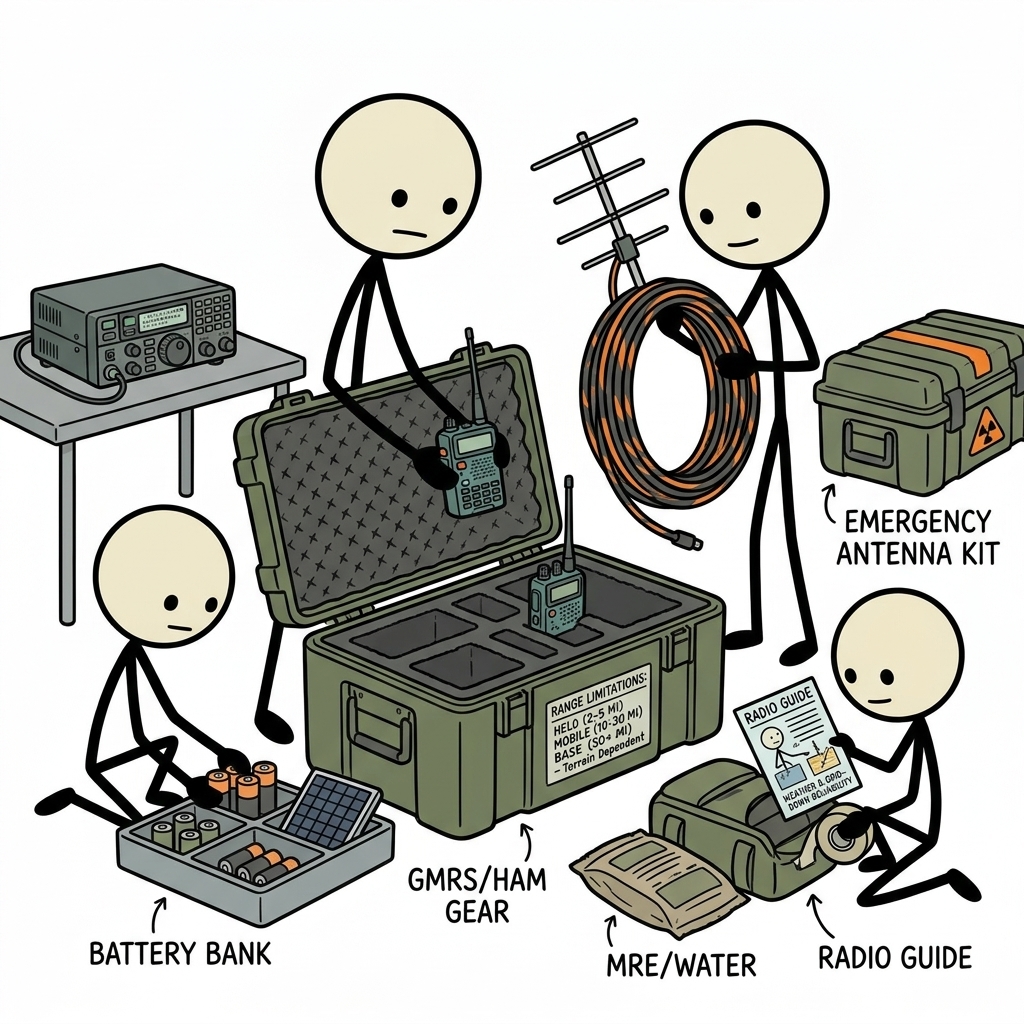
The handheld transceiver (HT) is the most ubiquitous emergency radio in circulation. Brands like Yaesu, Icom, and Kenwood dominate the professional tier, while millions of budget radios have flooded the market, prompting frequent queries about true Baofeng range during a crisis. While invaluable for immediate tactical movement, relying on an HT for regional command-and-control without external infrastructure is a recipe for failure.
Most handheld units broadcast at output levels between 4 and 8 Watts. In the field of RF engineering, wattage dictates signal penetration and signal-to-noise ratio, but height dictates transmission distance. Moving from a 4-Watt radio to an 8-Watt radio yields an incremental gain in fringe performance, but it will never punch through a solid granite mountain or double your line-of-sight horizon.
Realistic Simplex Handheld Ranges by Environment
When operating "simplex"—direct radio-to-radio without an intervening repeater—handheld ham radio range degrades across common operational settings:
- Dense Urban Environments (Concrete and Steel): 0.25 to 0.75 miles. Highly reinforced commercial structures, subterranean levels, and massive steel frames create deep RF shadows and severe multi-path interference.
- Suburban Neighborhoods: 1 to 2 miles. Wood-frame homes, asphalt shingle roofs, utility poles, and neighborhood foliage attenuate signals, but moderate roof-clearing allows usable street-to-street coverage.
- Heavy Deciduous or Coniferous Woodlands: 0.5 to 1.5 miles. Wet foliage and high pine canopies absorb VHF energy rapidly through dielectric loss, turning a 5-Watt signal into static over short physical distances.
- Open Water or Desert Flatlands: 4 to 6 miles. With zero obstacles, performance reaches the absolute limit dictated by the earth's curvature formula.
- Mountain Peak to Valley: 10 to 35+ miles. If one operator holds high ground along an unobstructed optical path down into an inhabited basin, the radio horizon expands massively.
The Stock Antenna Vulnerability
The standard, flexible antenna included in the box with low-cost handheld transceivers (frequently called a "rubber duck") is an extreme electrical compromise. To make the radio portable, manufacturers wind a shortened wire around an internal core encased in rubber. This design acts as an inefficient dummy load, shedding up to 60% to 80% of your transmitted power as heat rather than radiated energy.
Swapping a factory rubber duck for a certified aftermarket quarter-wave or half-wave flexible whip (such as a Diamond SRJ77CA, Comet SMA-24, or a resonant Signal Stuff Signal Stick) instantly boosts usable handheld ham radio range by 30% to 50%. In an austere grid-down camp, hoisting an emergency roll-up half-wave J-pole antenna 25 feet into a tree via paracord will turn a modest 5-Watt handheld into a high-performance local command station capable of reaching across the entire township.
Mobile Installations: The Power and Antenna Sweet Spot
Mobile radio rigs—permanently or semi-permanently mounted inside a four-wheel-drive vehicle, work truck, or bug-out rig—represent the true operational backbone of local disaster management. While an HT tops out at 5 to 8 Watts with an inefficient antenna pressed against an operator's head, mobile units run continuously at 50 to 65 Watts on VHF and 40 to 50 Watts on UHF, drawing uninterrupted energy directly from a 12-volt vehicle battery network.
How far can a ham radio reach from a moving vehicle? Under ordinary conditions, an operator driving across rolling, semi-wooded terrain can reliably maintain direct simplex communications over a radius of 8 to 20 miles with another mobile rig or base station. If communicating down to an operator carrying a handheld on the ground, that distance averages 3 to 7 miles, offering a substantial bubble of tactical coverage during evacuation logistics or area patrols.
The Critical Ground Plane Advantage
A vehicle roof is not merely an elevated shelf; it functions as a critical RF component known as a ground plane. When a vertical whip antenna mounts directly in the center of a metallic vehicle roof, the sheet metal below acts as a massive radio mirror. This reflective surface forces the radiated signal downward toward the horizon in a low, flat pattern—precisely where other vehicles and handheld operators are located—rather than scattering power upward into the clouds.
- Permanent NMO Hole Mount (Center Roof): The undisputed gold standard. Provides the cleanest 360-degree omnidirectional radiation pattern, zero ground-loss resistance, and maximum range.
- Heavy-Duty Magnetic Mount: An exceptional secondary option for emergency conversions. It achieves ground-plane coupling through capacitive capacitance with the underlying paint and metal, sacrificing only a fraction of efficiency compared to a drilled mount.
- Lip/Clamp Mounts (Hood or Tailgate): Highly vulnerable to signal bias. A lip-mount positioned on a rear bumper or driver-side hood hinge skews your signal drastically through the vehicle body, severely attenuating transmissions aimed in the opposite direction.
Base Stations and High-Frequency (HF) Rigs: Regional to Continental Reach
When an emergency escalates from a localized weather disturbance to a multi-state grid collapse, local VHF line-of-sight is insufficient. If public safety answering points fail and utility providers lose county-wide supervisory control and data acquisition (SCADA) links, operators turn to high-power fixed base stations and the High-Frequency (HF, 1.8 MHz–30 MHz) spectrum.
A VHF/UHF base station utilizing a stationary mast-mounted antenna (such as an omnidirectional fiberglass dual-band colinear antenna) raised 30 to 50 feet above ground level fundamentally shifts the radio horizon. By clearing standard tree lines and suburban roof clutter, a 50-Watt base unit pushes clean, noise-free simplex communications out to 20 to 35 miles across standard terrain, and up to 60+ miles if communicating with a similarly equipped elevated station.
NVIS: Defeating Geography in Disaster Zones
The ultimate emergency ham radio distance challenge in rugged geography is terrain masking. If you are positioned at the bottom of a deep mountain hollow or river canyon, line-of-sight VHF signals crash directly into stone walls, rendering external comms impossible. High-Frequency operations utilizing Near Vertical Incidence Skywave (NVIS) solve this tactical dilemma completely.
Instead of aiming a radio wave along the ground toward the horizon, an NVIS station uses a horizontal wire dipole cut for the 40-meter (7 MHz) or 80-meter (3.5 MHz) band suspended intentionally low to the earth—typically between 8 and 20 feet high (roughly 0.1 to 0.25 of a wavelength). This geometry reflects the RF energy straight upward into the ionospheric F-layer at an incident angle close to 90 degrees.
The charged ionosphere acts as an overhead mirror, refracting the signal straight back down like a spray nozzle spraying water against a flat ceiling. The returning footprint blankets an unbroken circular zone across an approximate 50- to 400-mile radius. There are no dead zones, no skip zones, and zero degradation from mountain ridges or dense forests. The American Red Cross and FEMA regularly integrate NVIS ham stations into disaster response drills because it provides bulletproof regional command coordination across entire states without a watt of commercial grid power.
Operational Ham Radio Range Matrix (Simplex Grid-Down Scenario)
| Equipment Tier | Output Power | Antenna Deployment | Real-World Range (Flat/Suburban) | Real-World Range (Forest/Hills) |
|---|---|---|---|---|
| Entry Handheld (e.g., Baofeng) | 4W - 5W | Stock Rubber Duck (At waist/head) | 0.75 - 1.5 Miles | 0.25 - 0.75 Miles |
| Handheld + Tactical Whip | 5W - 8W | Aftermarket 1/2 Wave or Roll-Up J-Pole (Elevated) | 3 - 6 Miles | 1.5 - 3 Miles |
| Mobile Vehicle Transceiver | 50W | Center-Roof NMO 5/8 Wave Whip | 10 - 20 Miles | 4 - 8 Miles |
| Base Station (VHF/UHF) | 50W - 100W | Omni Colinear on 35-Foot Mast | 20 - 35 Miles | 8 - 15 Miles |
| HF Regional Base (NVIS) | 100W | Horizontal Dipole (15-20 Feet Elevated) | 50 - 400 Miles (Regional) | 50 - 400 Miles (Terrain Immune) |
Environmental Variables That Slash Transmission Range
When assessing how far a ham radio can reach, theoretical range calculations frequently fail because nature introduces chaotic environmental resistance. Radio waves attenuate—meaning they drop in power amplitude—as they interact with atmospheric and terrestrial mediums.
1. Topography: Knife-Edge Diffraction vs. Shadow Zones
Topography is the most aggressive killer of VHF and UHF radio signals. The United States Geological Survey (USGS) notes that terrain variance can completely obstruct signals within a matter of paces. When a direct line-of-sight signal encounters a distinct ridgeline, one of two events occurs:
- Shadow Zone Extinction: The terrain fully absorbs the signal. Behind the hill rests an RF "shadow zone" where receiver meters drop to absolute zero, regardless of whether you push 5 Watts or 50 Watts into your transmitter.
- Knife-Edge Diffraction: If a sharp, well-defined ridge obstructs the wave, a portion of the wave can clip the peak and bend downward along the backside of the mountain. While knife-edge diffraction can occasionally provide a miraculous signal path into an obscured valley, it introduces severe signal attenuation (often 20 to 30 dB of loss), requiring high input power from mobile or base units to remain intelligible.
2. Foliage Attenuation (The "Wet Leaf" Factor)
A dense forest in the dead of winter presents minimal resistance to radio waves. However, the same forest during a late-summer storm creates a massive RF sponge. Water is a non-linear dielectric absorber of radio frequency energy, particularly at UHF frequencies (70cm). When leaves are saturated with rain or dew, an operator's effective Baofeng range or general handheld performance can easily drop by 50% compared to dry conditions. VHF (2-meter) waves, being longer (roughly 6.5 feet from wave crest to wave crest), navigate foliage noticeably better than shorter UHF waves (roughly 2.3 feet).
3. Severe Meteorological Events and Ducting
While standard precipitation (falling rain, light snow, or fog) causes negligible degradation below 1 GHz, extreme atmospheric conditions drastically impact propagation. The National Oceanic and Atmospheric Administration (NOAA) tracks cold fronts, high-pressure cells, and temperature inversions—conditions where a layer of cool surface air is trapped beneath an overhead layer of warm air.
This temperature inversion can form an atmospheric waveguide, a phenomenon known as "tropospheric ducting." During deep ducting events, VHF and UHF signals that normally escape into space get trapped between the atmospheric boundaries and bounced along the ground, enabling standard 5-Watt handhelds to intermittently contact stations 100 to 200+ miles away. While exhilarating for hobbyist operators, ducting is wildly unpredictable and must never be treated as a dependable emergency channel.
Overcoming Bottlenecks: Practical Range-Maximization Protocols
In a true grid-down emergency, when commercial infrastructure collapses and regional mountain repeaters eventually run dry on propane or diesel reserves, your team must have pre-planned protocols to maximize emergency ham radio distance across your network.
Elevate Antennas First; Add Power Last
Radio operators must learn the fundamental law of radio propagation: Height is Might. In RF transmission, the inverse-square law dictates that signal power drops exponentially relative to the distance traveled. Pushing an amplifier to turn a 5-Watt signal into a 50-Watt transmission quickly drains critical emergency batteries without overcoming physical horizon limits.
Instead of investing in power amplifiers, invest in deployable antenna elevation. Carrying a 30-foot telescoping carbon-fiber or fiberglass mast, an A/B antenna switch, and 50 feet of high-grade, low-loss coaxial cable (such as Times Microwave LMR-400 or RG-213) will provide dramatic performance improvements. Running an HT through low-loss coax to an omnidirectional antenna securely strapped to a chimney, high ridge, or tree limb will regularly outperform a 50-Watt mobile unit transmitting from a valley floor through a poor antenna.
Deploy Tactical Cross-Band Repeating
Many modern dual-band mobile radios (such as units manufactured by Yaesu, Kenwood, and Alinco) feature a native function called "cross-band repeat." In a Survival Scenarios, this capability allows a solitary operator to effectively bridge the gap between low-power handheld mobility and high-power structural dominance.
A survival group can park a mobile vehicle rig on the crest of a local hill or leave a base station active at a high home site, configured in cross-band repeat mode. Operators on foot patrolling neighborhoods or search grids transmit to the vehicle on UHF at low power (conserving handheld battery). The mobile rig instantly receives the UHF signal and retransmits it simultaneously out on VHF at 50 Watts through its elevated antenna, expanding the handheld's functional operating perimeter from 1 mile to upwards of 15 to 20 miles across surrounding territory.
Integrate Digital Text Modes for High-Noise Thresholds
Human voice transmission (FM analog telephony) requires a strong, coherent signal-to-noise ratio to remain intelligible through an audio speaker. When a signal weakens near the fringe of its physical range, voice audio quickly degrades into an unreadable hiss of white noise.
Digital emergency modes extend usable ham radio range across poor paths:
- Automatic Packet Reporting System (APRS): Operates on 144.390 MHz in North America. Short, high-burst 1200-baud data packets containing GPS coordinates, weather alerts, or short text messages can cut through high static environments where voice transmission fails entirely.
- Winlink Global Radio Email: Allows disaster operators to send and receive standard internet email over VHF/UHF line-of-sight packet nodes or long-range HF skywave links directly to unaffected operational centers across the globe.
- JS8Call and FT8 (HF Spectrum): Advanced weak-signal software designed to extract digital data buried deep inside ambient background noise—often reaching decibel levels far below what human ears can discern—allowing low-power, battery-operated stations to push vital survival status reports across continents during solar disruptions.
Building an Emergency Comms Plan Based on Reality
Preparing for communication resilience in an unstable world requires shedding commercial illusions and embracing the hard parameters of radio wave mechanics. A handheld radio is not a magic satellite phone, and a 50-Watt mobile rig cannot dissolve a mountain range. However, when you understand how antenna elevation reshapes the radio horizon, how ground planes focus RF energy, and how specialized HF paths like NVIS establish regional umbrellas of protection, amateur radio becomes an unshakeable tactical asset. Acquire the proper FCC license, systematically map your local terrain using USGS elevation profiles, invest in resilient antenna platforms over raw transmitter wattage, and train in the field under authentic weather conditions. When modern digital networks evaporate, clear, actionable radio communication remains entirely within your control.
Frequently Asked Questions
What is the realistic range of a handheld ham radio?
Handheld transceivers (HTs) operating at 5 watts on VHF/UHF typically achieve 2 to 5 miles in direct radio-to-radio (simplex) communication, though this can extend to 20 to 50 miles when accessing an elevated repeater.
How far can high-frequency (HF) ham radios transmit?
HF transceivers utilize skywave propagation to bounce signals off the ionosphere, allowing emergency transmissions to travel hundreds to thousands of miles, including across continents and oceans.
What physical factors have the greatest impact on ham radio distance?
Antenna elevation and terrain topography are the primary limiters; VHF/UHF signals require line-of-sight, meaning hills, dense forests, and urban structures significantly reduce effective range.
How do repeaters increase emergency communication range?
Repeaters placed on high towers, mountaintops, or tall buildings receive low-power signals from handheld or mobile units and instantly re-transmit them at higher power, dramatically bridging distances across regional terrain.
Do you need a license to transmit on ham radio frequencies during a survival situation?
FCC Part 97 rules allow non-licensed transmission only in immediate, life-threatening emergencies where no other communication methods exist; however, earning a license beforehand is vital for practicing and understanding equipment operation.