⚡ Key Facts: Emergency Hand Crank Radios
- Mechanical Energy Bottleneck: Sustained manual cranking produces roughly 2 to 4 watts of power (500mA at 5V); it takes an average of 10 to 15 minutes of continuous 120-RPM cranking to generate just 2% to 4% of battery life on a modern 4,000mAh smartphone.
- Reception vs. Generation: A standard hand crank radio requires less than 0.5 watts to run its internal receiver, meaning two minutes of cranking delivers between 30 and 60 minutes of low-volume emergency radio broadcasts.
- The NWR Network: All commercial emergency radios cover the seven frequencies of the NOAA Weather Radio (NWR) All Hazards network (162.400 MHz to 162.550 MHz), which broadcasts continuous regional alerts verified by the National Weather Service.
- Power Architecture Flaws: Sub-$30 crank radios frequently utilize volatile nickel-metal hydride (NiMH) battery packs that self-discharge within three to six months; modern preparedness-grade units use standardized, replaceable 18650 lithium-ion cells with multi-year shelf stability.
- Life-Safety Value: While hand crank radios make poor power banks for consumer electronics, they are among the most reliable, battery-independent warning receivers recognized by FEMA, the American Red Cross, and the USGS during long-duration blackouts.
When the catastrophic winter storm of February 2021 crippled the ERCOT power grid across Texas, leaving more than 4.5 million homes in sub-freezing darkness, commercial cell towers lost their backup generator fuel reserves within 48 to 72 hours. Cellular data plummeted, residential broadband evaporated, and millions of Americans discovered that their modern multi-thousand-dollar smartphones were suddenly unable to load basic civil defense alerts. In the middle of prolonged, wide-area infrastructure collapses, teleemergency communication plan hubs fail under load shedding, structural damage, and battery exhaustion. The Federal Emergency Management Agency (FEMA) and the National Oceanic and Atmospheric Administration (NOAA) have long emphasized a hard logistical truth: when the two-way digital grid fails, the one-way analog broadcast network remains the national backbone of disaster survivability. A hand crank radio is often hailed as the ultimate, self-sustaining survival tool for these scenarios, yet vast misconceptions persist regarding what these devices can—and cannot—deliver from an electrical and radio-frequency standpoint.
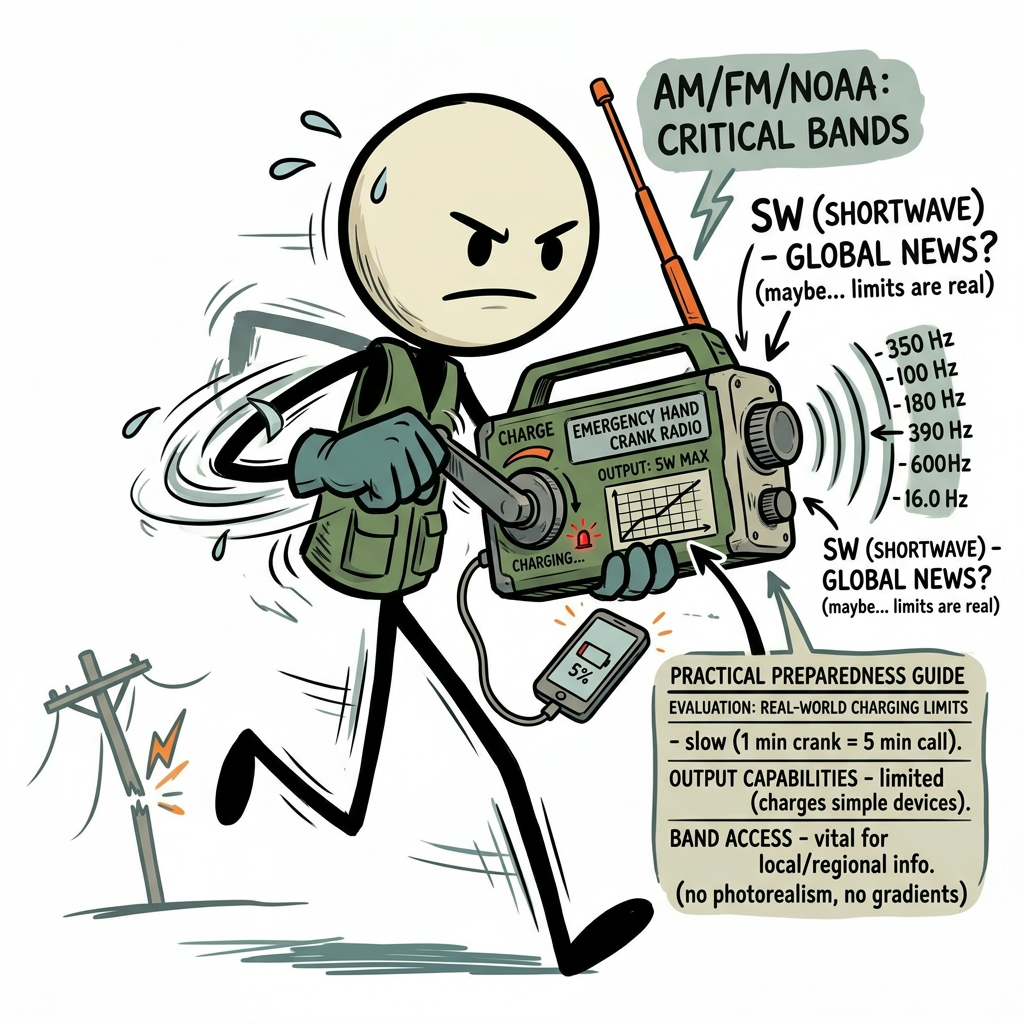
The Anatomy of the Dynamo: Real-World Crank Radio Power Output
To employ an emergency hand crank radio effectively, one must strip away marketing hyperbole and evaluate the physics of mechanical energy conversion. At the core of every crank-operated radio sits a miniature permanent-magnet DC generator (or dynamo) driven by a geared mechanical lever. When you turn the handle, your physical exertion rotates a central armature through a magnetic field, inducing an electrical current that passes through a bridge rectifier, travels across a rudimentary charge controller, and charges an internal battery or powers the audio circuit directly. For the practical checklist side, use the community emergency preparedness guide.
Human mechanical power output via hand-cranking is surprisingly limited. While a trained cyclist can sustain 200 watts of output with their lower extremities over an extended duration, the average adult human arm can sustainably produce between 10 and 20 watts of mechanical energy before localized muscular fatigue sets in. Due to mechanical friction in low-cost plastic gearboxes, thermal dissipation in the dynamo windings, and the inefficiency of basic rectification diodes, the electrical conversion efficiency of standard emergency communications gear hovers between 20% and 35%. Consequently, the actual crank radio power output delivered to the internal circuitry tops out at an average of 1.5 to 3.5 watts under steady physical exertion. For the practical checklist side, use the neighborhood preparedness network.
Rotational Velocity and Torque Requirements
Most manufacturers recommend a rotational cadence of approximately 120 to 130 revolutions per minute (RPM)—essentially two complete turns per second. Cranking slower than this fails to clear the operational voltage threshold of the internal battery's charge circuit, resulting in zero net energy gain. Conversely, violent, high-speed cranking (exceeding 160 RPM) generates excessive friction within the nylon or polyoxymethylene (POM) drive gears, rapidly inducing mechanical stress, stripped teeth, and thermal loss without substantially boosting electrical input. For the practical checklist side, use the family emergency planning guide.
The operational output translates to a modest 5-volt rail producing roughly 300 to 700 milliamperes (0.3A to 0.7A) of direct current. While this is entirely adequate to drive the ultra-low-draw silicon tuner and internal operational amplifier of an AM/FM receiver, it changes the conversation entirely when attempting to reverse-charge modern personal electronics. For the practical checklist side, use the real-world emergency scenarios guide.
The Smartphone Reality Check: Emergency Radio Charging Limits
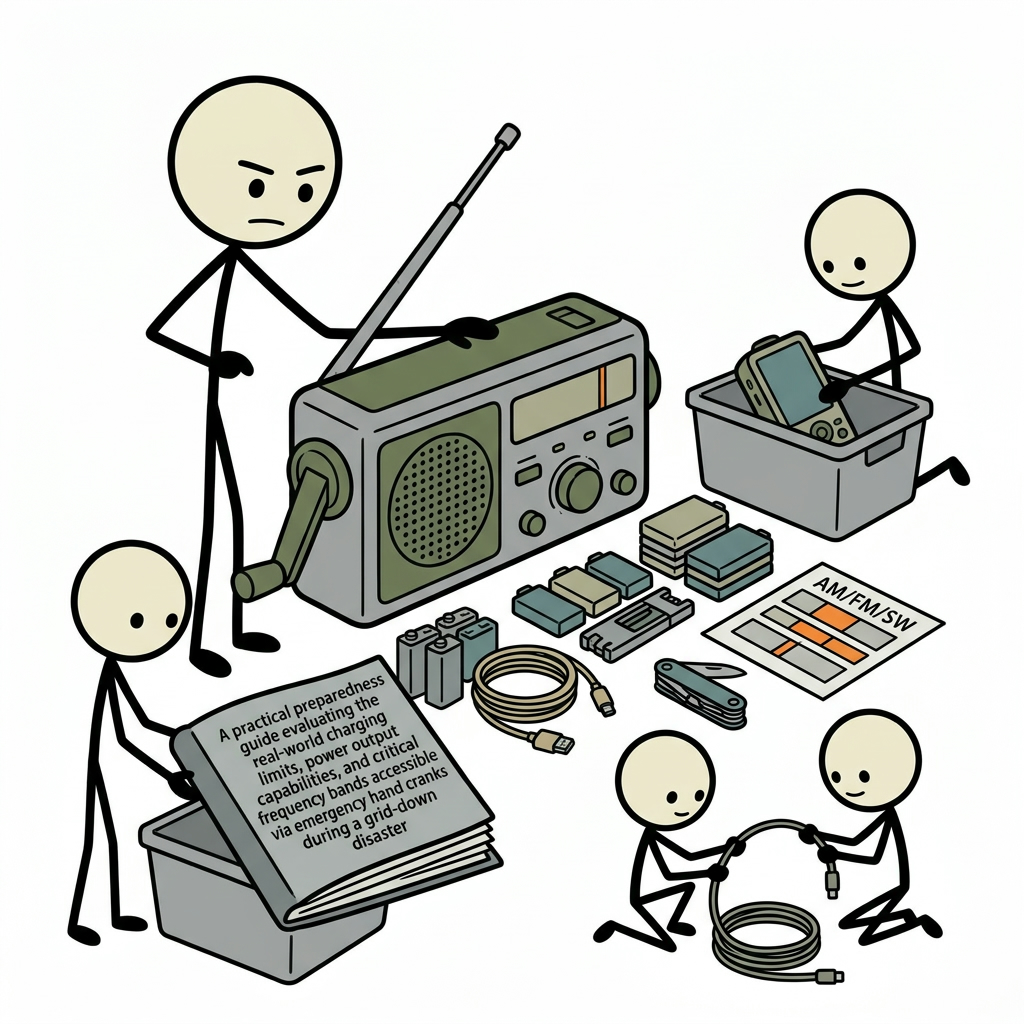
One of the most persistent survival myths is that a hand crank radio can serve as a dependable, manual charging station for consumer smartphones during extended grid outages. Modern smartphones—such as late-generation iPhones, Samsung Galaxies, and Google Pixels—feature internal lithium-ion or lithium-polymer cells with capacities ranging from 3,300 milliamp-hours (mAh) to over 5,000mAh. Running at a nominal 3.85 volts, these batteries store between 12.7 and 19.5 watt-hours (Wh) of total electrical energy.
To contextualize these numbers against real-world emergency radio charging metrics, let us calculate the physical requirements for a baseline charge:
- Target Device: Standard smartphone with a 4,000mAh (15.4 Wh) battery.
- Average Steady Dynamo Output: 5 volts at 0.5 amperes (2.5 watts).
- System Losses: 25% energy loss across the radio's buck-boost converter, the USB cable resistance, and the phone's internal battery management system (BMS).
- Effective Power Delivered to Battery: ~1.87 watts.
- Calculated Time to Reach 100% Charge: Approximately 8.2 hours of uninterrupted, continuous cranking at 120 RPM.
Physical exhaustion and physiological limits make continuous cranking for hours on end completely unfeasible for a disaster survivor. In a survival situation where caloric expenditure must be balanced against water and food availability, burning 300 to 500 calories per hour of vigorous arm-cranking to gain a 10% phone charge is an inefficient allocation of human energy.
The "911 Pulse" Protocol
Does this render the USB output on a hand crank radio useless? Absolutely not. The integrated 5V USB port on emergency radios should not be viewed as an everyday off-grid charging hub, but as an emergency lifesaver designed for targeted communication bursts. Emergency management agencies, including the American Red Cross and FEMA, recommend viewing manual charging through the lens of critical intervention.
A focused, ten-minute session of mechanical cranking at a measured 120 RPM will typically feed between 30 and 50 milliamp-hours of energy into a depleted phone. Under modern operating system management, this yields roughly 1% to 3% of battery capacity. In an urgent crisis, that minimal reserve is sufficient to boot the handset, transmit a geo-tagged SMS with survival coordinates to emergency dispatch or family contacts, or place a brief voice distress call to 911 before the handset dies again. Understanding this charging limit shifts the operator's mindset from comfort-oriented recharging to targeted life-safety communications.
Internal Energy Storage: NiMH Packs vs. Lithium-Ion Cells
The practical field longevity of an emergency radio is determined just as much by its internal storage chemistry as its manual generator. Manufacturers build emergency units using two primary battery profiles, each carrying stark operational trade-offs during extended staging and deployment.
| Feature / Parameter | Legacy NiMH Battery Packs | Modern 18650/21700 Lithium-Ion |
|---|---|---|
| Nominal Voltage | 3.6V (3 x 1.2V cells in series) | 3.7V nominal (4.2V fully charged) |
| Typical Capacity Range | 600mAh to 1,200mAh (2.1Wh to 4.3Wh) | 2,000mAh to 5,000mAh (7.4Wh to 18.5Wh) |
| Self-Discharge Rate | High (15% to 30% per month) | Extremely Low (1% to 3% per month) |
| Cold Weather Tolerance | Poor; steep voltage drops below freezing | Moderate to Good (discharge operational to -20°C) |
| User Replaceability | Often soldered or proprietary connectors | Standard cylindrical form-factor / easily swappable |
| Memory Effect Risk | Moderate if partially cycled continuously | None; accepts frequent, shallow top-ups |
Budget emergency radios traditionally incorporate bundled Nickel-Metal Hydride (NiMH) battery packs. These packs suffer from significant self-discharge rates. An untreated NiMH pack stored inside a disaster kit in a garage or closet will lose up to 50% of its stored capacity within ninety days. If pulled from storage two years into an emergency, these cells often exhibit internal chemical passivation, rendering them completely incapable of accepting or holding a charge from either the solar panel or the hand crank.
Higher-tier emergency communications gear utilizes removable, standardized 18650 or 21700 lithium-ion cells. These batteries feature exceptional charge retention, retaining upwards of 80% to 90% of their capacity after a year of shelf storage. More importantly, models that feature an accessible battery compartment allow operators to swap in pre-charged external cells during an incident, bypassing manual cranking entirely when physical labor needs to be conserved for defensive, rescue, or shelter-maintenance operations.
Multi-Source Power Architectures: Beyond the Crank
A resilient survival kit relies on redundant energy paths. While the hand crank provides mechanical independence from the electrical grid, relying entirely on the dynamo for day-to-day radio operation during a month-long blackout is inefficient. Modern survival radios circumvent this vulnerability by deploying a hybrid power matrix.
The Photovoltaic Paradox
Nearly all consumer-grade hand crank radios come equipped with a tiny, integrated photovoltaic panel mounted on their top surface. These panels—rarely measuring more than two by four inches—are the subject of considerable misunderstanding. Under ideal, unshaded solar noon conditions delivering 1,000 watts per square meter of irradiance, a monocrystalline solar panel of this physical footprint can produce at most 0.3 to 0.6 watts (roughly 60mA to 100mA at 5V).
To fully charge an internal 4,000mAh lithium-ion battery exclusively via this integrated panel requires anywhere from 40 to 60 hours of direct, unobstructed sunlight. Because ambient sunlight shifts continuously and passes through seasonal atmospheric attenuation, the integrated solar panel is practically incapable of serving as a primary fast-charging mechanism. Instead, its true engineering purpose is anti-self-discharge maintenance: leaving the unit on a south-facing windowsill allows the trickle-charge panel to cancel out the radio's natural standby current draw, ensuring the internal battery stays topped off until the moment a disaster strikes.
Dry-Cell Redundancy
The most dependable feature in field-grade crank radios is a dual-power switch tied to an auxiliary bank of standard alkaline or lithium dry cells (typically AAA or AA). Standard AA lithium batteries (such as Energizer Ultimate Lithium) boast a 20-year shelf life, operate down to -40°F (-40°C), and hold approximately 3,000mAh of energy per cell at high discharge rates. Equipping your emergency pack with a radio that switches instantly from depleted internal lithium cells to standard AA batteries gives you immediate access to news broadcasts without expending physical effort on the dynamo.
Decoding the Spectrum: Critical Frequency Bands for Survival
Power generation is ultimately useless if the radio's internal receiver lacks the sensitivity, selectivity, and frequency coverage required to intercept civilian, governmental, and search-and-rescue broadcasts. An effective survival radio is fundamentally an intelligence terminal. Preparedness-grade units cover three core spectra: standard commercial broadcast bands (AM/FM), the specialized public safety spectrum (NOAA Weather Radio), and extended international Shortwave (HF) bands.
1. NOAA Weather Radio (NWR) All Hazards Network
Operated by the National Oceanic and Atmospheric Administration, the NWR network is a continuous nationwide system of roughly 1,000 high-power VHF radio transmitters broadcasting localized civil, geological, environmental, and weather warnings 24 hours a day. The network covers all 50 states, adjacent coastal waters, Puerto Rico, the U.S. Virgin Islands, and U.S. Pacific Territories. It is designated by FEMA as a direct feed for the Emergency Alert System (EAS).
The NWR system broadcasts within an extremely narrow VHF public service band across seven dedicated channels:
- Channel 1: 162.400 MHz
- Channel 2: 162.425 MHz
- Channel 3: 162.450 MHz
- Channel 4: 162.475 MHz
- Channel 5: 162.500 MHz
- Channel 6: 162.525 MHz
- Channel 7: 162.550 MHz
When selecting a hand crank radio, confirm that it natively tunes to these specific NOAA weather radio bands. Basic radios require you to cycle manually through the seven channels until you locate your local transmitter. Advanced receivers feature automated hazard alerting, wherein the device remains in a low-power "sleep" mode and automatically powers on the speaker when a 1,050 Hz warning tone is intercepted from the nearest regional National Weather Service forecast office.
The Power of S.A.M.E. Technology
Standard NOAA auto-alert radios monitor the entire transmission footprint of a tower, which can cover up to 40 miles and encompass five to ten distinct counties. In dynamic scenarios—such as localized tornado outbreaks or industrial chemical plumes—this causes continuous, irrelevant false alarms for distant jurisdictions, leading to alert fatigue. Superior emergency communications gear integrates Specific Area Message Encoding (S.A.M.E.).
Introduced by the National Weather Service in the 1990s, S.A.M.E. utilizes digital audio frequency shift keying (AFSK) at the start of every alert transmission. Users program a six-digit Federal Information Processing System (FIPS) county code into their radio. The receiver listens quietly to the frequency, monitors the digital preamble, and only opens the audio squelch if the packet's embedded FIPS code matches the specific geographical zone the user occupies. This gives survival teams actionable, pinpoint situational awareness while filtering out distant municipal noise.
2. Standard Broadcast: AM (Medium Wave) and FM
The ubiquitous Amplitude Modulation (530 to 1700 kHz) and Frequency Modulation (88 to 108 MHz) bands carry the backbone of the domestic Emergency Alert System. In an emergency, local commercial stations drop regular programming to distribute guidance from governors, municipal emergency managers, local police, and public utility teams.
The engineering properties of these two bands serve different tactical purposes:
- FM (VHF Line-of-Sight): FM signals provide high-fidelity audio but rely strictly on optical or tropospheric line-of-sight propagation. Transmission ranges are typically limited to 30 to 50 miles depending on elevation and terrain. FM is ideal for tracking micro-local civil defense updates from within your immediate metropolitan basin.
- AM (Ground Wave & Skywave): The Medium Wave (AM) band travels ground-paths efficiently through the soil during daylight hours, reaching well over 100 miles. At night, changes in the upper atmosphere allow AM signals to bounce off the ionosphere (skywave propagation), enabling an operator to monitor 50,000-watt clear-channel stations hundreds of miles beyond a localized disaster footprint. If a regional cyber incident knocks out all local broadcast towers, a skywave-capable AM receiver can tune into distant metropolitan centers to track incoming national emergency instructions.
Primary Entry Point (PEP) Stations
FEMA maintains a specialized network of high-priority commercial AM and FM broadcast facilities designated as National Primary Entry Point (PEP) stations. These broadcast facilities are hardened against high-altitude electromagnetic pulse (HEMP) events, blast overpressures, and long-term utility collapses via dedicated on-site fuel supplies, reinforced structures, and localized emergency generators. PEP stations are the designated nodes used to distribute presidential-level National Public Warning System announcements. Operating an emergency radio with clean AM sensitivity ensures reception from these hardened stations when localized media infrastructure completely collapses.
3. High Frequency (HF) / Shortwave Bands
Many consumer-focused crank radios include basic Shortwave (SW) bands covering parts of the 3.2 MHz to 22 MHz spectrum. Shortwave transmissions refract off the ionospheric layers (F1, F2, and E), skipping across continental distances without the need for orbital communication satellites, domestic relays, or submarine cables.
While voice-based amateur radio communication (ham radio) generally requires a specialized single-sideband (SSB) receiver that standard consumer crank radios lack, broad shortwave coverage allows survivalists to intercept critical English-language international broadcasts from organizations like the BBC World Service, Radio France Internationale, and Radio New Zealand, alongside time/frequency calibration alerts from NIST stations WWV and WWVH (broadcasting on 5.0, 10.0, and 15.0 MHz). When domestic news is censored, disrupted, or crippled by widespread infrastructure failure, shortwave bands provide unvarnished external intelligence regarding geopolitical crises or continental-scale emergencies.
Optimizing Reception: Antennas and RF Interference
The electrical efficiency of a radio receiver is heavily constrained by its antenna architecture. The telescoping whip antenna built onto most hand crank units measures between 14 and 24 inches in length. While this length approaches a mathematically balanced quarter-wave resonant profile for VHF emergency bands (NOAA at ~18 inches; FM at ~30 inches), it is fundamentally inefficient for receiving the long wavelengths of the AM Medium Wave (hundreds of meters long) and Shortwave bands (10 to 80 meters).
To maximize signal interception during a crisis without drawing extra battery power, utilize these zero-draw field craft adjustments:
- Deploy a Terminal Clip Wire: Carry a 20- to 30-foot length of thin insulated 22 AWG copper hookup wire wrapped around an old spool. Strip one end and secure it to the radio's telescoping whip antenna using an alligator clip. Hoist the opposite end into a nearby tree branch or suspend it across an interior ceiling. This improvised long-wire antenna immediately expands the physical capture area for Shortwave signals, lowering the noise floor and resolving faint distant signals.
- Eliminate Switched-Mode Power Interference: Low-cost solar power inverters, battery charging bricks, and LED utility lights emit severe electromagnetic interference (EMI) that wipes out AM and Shortwave reception. When tuning for critical emergency broadcasts, step away from operating inverters, unshielded LED lanterns, and active vehicle engines to prevent the radio's front-end receiver from being swamped with RF hash.
- Orient the Internal Ferrite Rod: AM signals are captured not by the external telescoping antenna, but by an internal horizontal ferrite bar tightly wrapped in copper wire located inside the radio's housing. If an AM signal is weak or fading, rotating the physical body of the radio 90 degrees can orient the ferrite rod's reception lobes toward the transmitter, dramatically improving signal clarity without any power penalty.
Field Inspection and Staging Protocols
Emergency communications gear must not be stored indefinitely in deep storage without ongoing preventative maintenance. Equipment stored carelessly can suffer unexpected points of failure that compromise its utility during a genuine emergency.
| Frequency | Inspection Task | Action Required |
|---|---|---|
| Every 90 Days | Battery Chemistry Cycling | Cycle the internal lithium cell down to roughly 40%, then recharge to 80% to avoid chemical degradation and swelling. Inspect dry cell storage boxes for terminal oxidation. |
| Every 180 Days | Mechanical Gearbox Audit | Rotate the hand crank for two minutes at the recommended 120 RPM. Verify that internal gears spin smoothly without high-pitched plastic screeching, resistance loss, or slippage. |
| Every 180 Days | Antenna & Squelch Inspection | Extend telescoping antenna sections fully; inspect for bends or lateral play. Apply a trace drop of mineral oil or dielectric grease to telescoping joints to resist moisture corrosion. |
| Annually | NOAA S.A.M.E. Alert Verification | Confirm your county's 6-digit FIPS code against current NWS designations. Verify that the radio can successfully trigger an alert during weekly Wednesday testing windows. |
The Verdict: The True Role of the Hand Crank Radio
An emergency hand crank radio is not an infinite off-grid power plant. It will not efficiently charge smartphones, it will not power auxiliary camp lighting, and it cannot replace a dedicated field-grade solar generator or a high-capacity LiFePO4 battery system. Viewing an emergency radio as a high-output power source sets unreasonable expectations that will quickly lead to disappointment in a crisis.
However, when evaluated for what it is engineered to be—a resilient, self-contained, grid-independent information lifeline—the hand crank radio remains an irreplaceable part of any robust emergency readiness posture. It asks for virtually nothing in the way of logistics: it requires no fuel deliveries, demands no access to functional municipal utilities, and operates completely outside the fragile digital architecture of cellular towers and internet service providers. Armed with a firm grasp of dynamo physics, a realistic communication plan, and the technical knowledge to navigate regional frequency bands, you can turn a modest, hand-cranked device into an operational command center that delivers real-time civil defense updates when the world around you goes completely silent.
Frequently Asked Questions
What broadcast frequencies can a standard emergency hand crank radio receive?
Most models receive standard AM and FM radio bands alongside all seven designated NOAA Weather Radio (NWR) frequencies ranging from 162.400 MHz to 162.550 MHz, which transmit 24/7 automated weather forecasts and civil emergency alerts.
Can a hand crank radio fully charge a modern smartphone?
Generally, no. Hand cranks produce low amperage (typically 500mA or less) designed for trickle charging; cranking is intended to provide just enough battery capacity (1% to 5%) to place an urgent call or send critical text messages during a power outage.
How long do you need to crank an emergency radio to get power?
One to two minutes of sustained cranking at roughly 120 to 130 revolutions per minute typically delivers 10 to 15 minutes of low-volume radio reception or up to 30 minutes of emergency LED flashlight usage.
What is NOAA SAME alert capability and do all crank radios have it?
Specific Area Message Encoding (SAME) filters weather broadcasts so the alarm only sounds for emergencies in your designated county or region. Many basic crank radios lack SAME decoders and instead sound alerts for broad broadcast areas, so check model specifications.
What internal components and accessories can a hand crank radio power?
Beyond AM/FM/NOAA receivers, the internal rechargeable battery typically powers built-in LED flashlights, high-decibel SOS sirens, reading lamps, digital clocks, and small 5V USB accessories via power-out ports.