⚡ Key Facts
- Infrastructure Fragility: During catastrophic landfall events like Hurricane Helene and Hurricane Katrina, the Federal Communications Commission (FCC) reported that up to 75% to 85% of cellular base stations in affected counties went completely dark within the first 48 hours due to power loss and fuel starvation.
- Proven Emergency Bandwidth: Over 760,000 licensed Amateur Radio operators in the United States form the backbone of the Amateur Radio Emergency Service (ARES), routinely providing auxiliary communication directly to FEMA and the American Red Cross during full grid disruptions.
- Line-of-Sight Realities: A standard 5-watt handheld transceiver (HT) typically offers a direct simplex ground range of 2 to 5 miles depending on terrain, but can reliably trigger mountain-top or tall-tower repeaters positioned 20 to 60 miles away.
- Rapid Knowledge Barrier: The FCC Technician Class entry-level license requires zero Morse code testing and consists of a single 35-question multiple-choice exam, making basic regulatory compliance accessible to any prepared citizen within a couple of weeks of study.
When catastrophic disasters strike, municipal infrastructure does not degrade gracefully—it collapses in cascading waves. The Federal Emergency Management Agency (FEMA) and the U.S. Geological Survey (USGS) consistently document that whether the catalyst is a Category 4 hurricane, a major fault-line shift, or a regional winter power failure, commercial emergency communication plans fail almost immediately. Cell towers rapidly exhaust their 4-to-8-hour backup battery banks, fiber trunk lines sever under uprooted trees, and civilian cellular networks become suffocated by millions of simultaneous connection requests. In these silent hours, the ability to pull critical information out of the airwaves and coordinate with family, neighborhood preparedness network response teams, and civil defense agencies is not an esoteric hobby; it is a life-saving operational necessity.
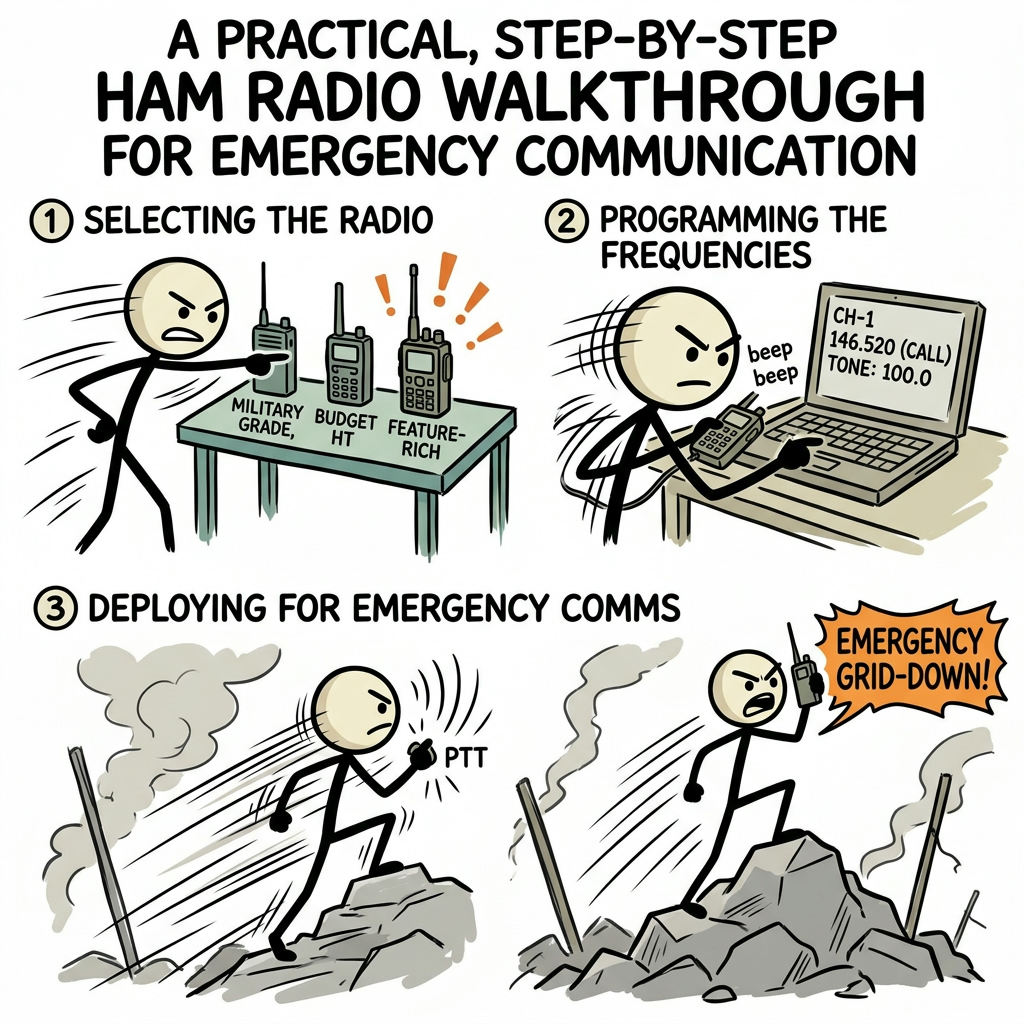
This comprehensive handheld ham radio guide walks you through the exact blueprint required to transition from radio novice to fully mission-capable operator. By systematically selecting resilient hardware, mastering programming environments, establishing tactical operational schedules, and understanding electromagnetic propagation, you will construct an off-grid lifeline that functions completely independent of commercial utilities. For the practical checklist side, use the community emergency preparedness guide.
VHF/UHF Realities: The Science of Handheld Transceivers
Before purchasing hardware, you must understand the physics that dictate what a handheld transceiver emergency tool can and cannot do. Handheld ham radios primarily operate on two radio frequency bands: Very High Frequency (VHF), spanning 144 to 148 MHz (known as the 2-meter band), and Ultra High Frequency (UHF), spanning 420 to 450 MHz (the 70-centimeter band). Unlike High Frequency (HF) systems that bounce radio waves off the ionosphere to communicate across continents, VHF and UHF are inherently line-of-sight signals. For the practical checklist side, use the family emergency planning guide.
Line-of-sight does not mean you must physically see the target with your naked eye, but it does mean the radio wave must physically travel through the atmosphere without being wholly absorbed or blocked by the curvature of the Earth, dense structural concrete, or mineral-heavy mountain ridges. VHF waves tend to travel slightly farther over open terrain, bend slightly over rolling hills, and push through rural foliage more effectively. UHF waves, with their shorter physical wavelengths (roughly 70 centimeters long), excel at penetrating structural obstacles, reflecting down concrete-and-steel urban corridors, and navigating interior commercial buildings.
A portable handheld radio typically transmits at an output power between 1 and 8 watts. While 5 watts is the industry standard for tactical handheld transceivers, output wattage is often the least important factor in determining your effective operational range. Terrain, elevation, antenna efficiency, and atmospheric obstructions govern roughly 90% of your radio's performance. Understanding these physical constraints prevents dangerous planning assumptions during an emergency ham radio setup.
Simplex vs. Repeater Communications
Handheld operations occur in two distinct modes: simplex and duplex.
- Simplex Communication: Your radio transmits and receives on the exact same frequency directly to another radio. This is radio-to-radio tactical comms. If you are on flat ground standing six feet tall, your radio horizon is roughly 3 miles; direct simplex communication between two handhelds at ground level usually maxes out around 2 to 4 miles.
- Duplex (Repeater) Communication: Your radio transmits on one frequency and simultaneously receives on a slightly offset frequency through a high-powered repeater station. Repeaters are usually perched on 1,000-foot towers, mountain peaks, or tall commercial structures, equipped with high-gain antennas and robust backup power. When your 5-watt HT transmits to a repeater 15 miles away, the repeater instantly rebroadcasts your signal at 50 to 100 watts across an expansive geographic footprint of 30 to 80 miles.
Selecting the Hardware: From Budget HTs to Field-Grade Units
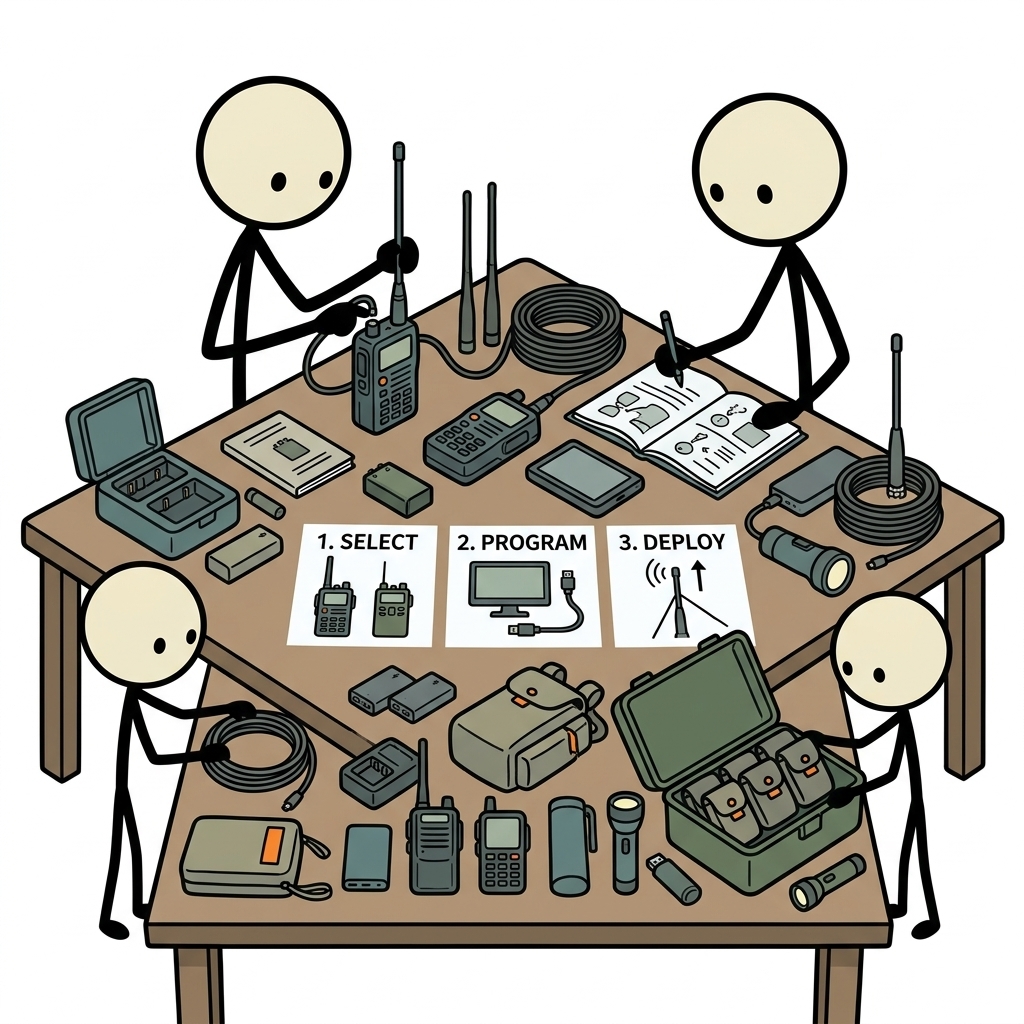
The marketplace for handheld transceivers is divided into two distinct philosophies: ultra-cheap disposable radios and ruggedized, purpose-built field transceivers. As part of a disciplined prepper ham radio strategy, you must understand the operational trade-offs of both tiers.
The Budget Workhorse: The Realities of Baofeng Emergency Prep
The Baofeng UV-5R and its direct variants (such as the BF-F8HP) dominate the emergency preparedness conversation due to an undeniable factor: price. For the cost of a decent meal, you receive a dual-band VHF/UHF radio that can transmit, receive, access repeaters, and monitor commercial FM broadcasts. For equipping neighborhood watches on a strict budget or staging multiple redundant radios inside emergency kits, they provide undeniable utility.
However, serious baofeng emergency prep requires an unvarnished look at the unit's technical limitations. These radios use an inexpensive "System-on-a-Chip" (SoC) design that lacks tight front-end filtering. When operating in RF-dense environments—such as near cell towers, broadcast antennas, or municipal transmitters—the receiver frequently suffers from "desensitization" (desense). In plain terms, the radio’s receiver becomes completely deafened by nearby background noise, rendering it unable to hear weak incoming transmissions even if your signal meter indicates incoming RF energy. Furthermore, the spectral purity of their transmissions is notoriously inconsistent, occasionally emitting spurious harmonics that violate FCC Part 97 spectral compliance.
Field-Grade Transceivers: The Professional Standard
When reliability under harsh operational conditions is non-negotiable, seasoned radio operators transition to Japanese superheterodyne receivers manufactured by brands like Yaesu, Icom, and Kenwood. A superheterodyne architecture utilizes dedicated physical tuning circuits and intermediate frequency stages that filter out stray RF noise, allowing you to copy faint signals that budget radios completely miss.
- Yaesu FT-60R: Widely regarded as the gold standard for analog disaster resilience. It features a die-cast aluminum housing, an exceptional superheterodyne receiver, intuitive front-panel programming, and years of proven reliability in real-world SAR (Search and Rescue) deployments.
- Yaesu VX-6R: A submersible (IPX7 rated) tactical handheld built explicitly for wet, punishing outdoor environments. It features wideband reception capabilities, allowing you to monitor civil defense, marine, shortwave, and aircraft bands alongside standard VHF/UHF amateur frequencies.
- AnyTone AT-D878UVII Plus: For teams integrating digital communications, this unit combines traditional analog VHF/UHF with Digital Mobile Radio (DMR) capabilities and onboard APRS (Automatic Packet Reporting System) GPS tracking, giving you secure, static-free digital voice routing when local repeater networks support it.
The Vital Importance of Battery Architecture
An unpowered radio is merely an expensive, lightweight hammer. Most modern transceivers rely entirely on Lithium-Ion (Li-ion) proprietary battery packs. While Li-ion yields the highest energy density, it poses a severe point of failure during a multi-week grid failure if your recharging workflow is disrupted.
Every field-ready emergency transceiver setup must incorporate an AA alkaline battery battery-case adapter. AA batteries boast an ambient shelf life of up to 10 to 12 years when stored properly (such as Energizer Industrial or L91 Ultimates) and can be scavenged from household electronics during prolonged logistics failures. Pair your Li-ion packs with a 12-volt DC automotive charging cord and a dedicated 5-volt USB-to-12-volt step-up charging cable, which permits battery rejuvenation via ubiquitous off-grid folding solar panels.
Antennas: The True Multiplier of Emergency Radio Performance
If you take away only one technical lesson from this handheld ham radio guide, let it be this: the antenna is 90% of the radio. The stock flexible antenna included in the box with virtually every handheld transceiver—colloquially referred to as the "rubber duck"—is an engineering compromise. It is designed for physical convenience and durability, not electromagnetic efficiency.
Inside that thick, 6-inch rubber jacket sits an electrically short, tightly wound coil of wire. It forces the radio to achieve an impedance match (roughly 50 ohms) without offering the physical surface area required to effectively project or capture radio waves. Replacing the factory rubber duck with a high-performance aftermarket antenna will improve your transmit and receive clarity more than doubling your radio's wattage ever could.
Tiered Field Antenna Upgrades
- The Extended Whip: Antennas like the Nagoya NA-771 or the flexible, high-tensile steel Signal Stuff "Signal Stick" measure approximately 15 to 19 inches long. This physical length represents a true quarter-wave on 2 meters and a half-wave on 70 centimeters. They instantly deliver an observable gain of 2.15 to 3 dBi over stock units, effectively doubling your real-world signal projection.
- The Quarter-Wave Counterpoise ("Tiger Tail"): A handheld radio’s antenna is only half of an antenna system; the radio chassis and your hand act as the other half (the counterpoise/ground plane). By securing a simple, flexible 19.5-inch insulated wire to the ground sleeve of your antenna’s BNC or SMA connector and letting it dangle freely, you complete a center-fed dipole system. This simple, free modification dramatically lowers the Standing Wave Ratio (SWR) and pushes your signal outward toward the horizon rather than into your body.
- The Tactical Roll-Up J-Pole: Built from 300-ohm twin-lead television feeder wire or ladder line (such as the Ed Fong DBJ-2), this antenna rolls up tightly into an emergency pack. When you make camp or establish an observation post, you use a length of paracord to hoist the J-Pole 20 to 30 feet up into a nearby hardwood tree. Connected to your HT via lightweight RG-58 or RG-316 coaxial cable, this setup bypasses terrain blockages and elevates your effective radiated power past the reach of any handheld unit at ground level.
Legalities, Licensing, and the "Rule of 911" Myth
A dangerous myth routinely circulates across uncensored prepping forums: "You don't need a license, because in an emergency, the FCC rules don't apply." Relying on this pervasive misunderstanding is one of the most critical operational errors a prepared citizen can make.
The FCC does have an emergency provision codified in Title 47 of the Code of Federal Regulations, specifically 47 CFR § 97.403. It explicitly states: "No provision of these rules prevents the use by an amateur station of any means of radiocommunication at its disposal to provide essential communication needs in connection with the immediate safety of human life and immediate protection of property when normal communication systems are not available."
Notice the exact language: it grants an amateur station (meaning an already licensed station) the authorization to step outside standard frequency bands or protocols strictly when human life or immediate property is in peril and normal infrastructure has failed. It is an affirmative legal defense designed for catastrophic extremes, not a blanket permission slip for unlicensed individuals to buy a radio, toss it into a footlocker, and assume they can operate it smoothly when a disaster strikes.
Radio operation is a psychomotor and technical skill. If you have not routinely transmitted, configured tones, adjusted your squelch, managed dead spots, and spoken to live operators on the air, you will fail when high-stress adrenaline floods your system. Obtaining an FCC Technician Class license eliminates this vulnerability. The licensing process demands no knowledge of Morse Code, costs roughly $35 for an FCC application fee plus a nominal testing fee, and requires passing a straightforward 35-question multiple-choice exam administered by Volunteer Examiners (VE) either in person or over an interactive online Zoom session.
Programming Your Radio: From Manual Chaos to CHIRP Mastery
A blank radio is completely useless during a crisis. While knowing how to program your radio via its Front-Panel Programming (FPP) buttons is an essential survival skill if you must adjust a frequency in the field, mass-programming dozens of channels by hand is prone to catastrophic error. The gold standard for open-source emergency ham radio setup is the free multi-platform software suite known as CHIRP.
To connect your radio to your computer, purchase an authentic programming cable containing an official FTDI or Prolific chipset. Avoid generic cables priced under ten dollars; they typically house counterfeit chips whose driver sets intentionally brick or reject connections on modern Windows and macOS operating systems.
Building Your Tactical Communications Matrix
An emergency codeplug (your radio’s frequency directory) should not be an arbitrary list of random channels. It must be organized into logical, predictable tiers. Program your channels into identical memory blocks across all family or team radios using the following framework:
| Channel Block | Band / Service | Operational Purpose |
|---|---|---|
| 01 – 10 | Local Tactical Simplex | Line-of-sight team comms (e.g., 146.520 MHz National Calling, localized VHF/UHF tactical simplex). |
| 11 – 30 | Regional Amateur Repeaters | Primary and secondary coordinated repeaters within a 40-mile radius (with verified offsets and tones). |
| 31 – 40 | Interoperability & Monitor | Receive-only monitoring of local fire dispatch, EMS, search and rescue, and highway maintenance. |
| 41 – 47 | NOAA Weather Broadcasts | All seven national NOAA weather frequencies (162.400 MHz to 162.550 MHz) for automated civil emergency alerts. |
| 48 – 60 | MURS / FRS / GMRS | Direct interoperability monitoring for short-range civilian, family, and neighborhood radio networks. |
Understanding Repeaters: Offsets and Tones
When you program repeaters into your radio using CHIRP, you must configure three critical parameters correctly, or the repeater will simply ignore your transmissions:
- Receive Frequency: The output frequency of the repeater that your radio listens to (e.g., 146.820 MHz).
- Offset Frequency and Direction: Because repeaters cannot transmit and receive on the exact same frequency simultaneously without destroying their own sensitive receivers, they listen on an offset. In the 2-meter band, the standard offset is 600 kHz (0.6 MHz) up (+) or down (-). In the 70-centimeter band, the standard offset is 5.0 MHz.
- CTCSS Tones (PL Tones): Continuous Tone-Coded Squelch System. This is a sub-audible tone (ranging from 67.0 Hz to 254.1 Hz) transmitted silently beneath your voice. Repeaters use these tones like an electronic key to open their squelch. If your radio does not transmit the specific CTCSS tone required by that repeater, the machine will disregard your signal entirely, even if your power and offset are otherwise correct.
You can identify local repeaters along with their verified offsets and tones using open-source crowdsourced registries like RepeaterBook.com, which offers an offline-capable smartphone application that uses your device's internal GPS to find every active repeater within range during travel.
Field Deployment & Tactical Comms Operating Procedures
Possessing functional, programmed hardware covers only half of the preparedness equation. The remaining half is operational discipline. In a grid-down emergency, your radio communications should be calculated, minimal, and secure by procedure.
The Comms Window: Conserving Precious Milliamps
A standard 5-watt handheld transceiver consumes massive amounts of energy while transmitting (often between 1.5 to 2.0 Amps), moderate power while receiving (150 to 250 mA), and minimal power while idling on standby with power-save squelch activated (30 to 50 mA). If you leave your radio powered on and scanning continuously, a standard 1800mAh battery will be exhausted in roughly 12 to 18 hours without you ever pressing the Push-To-Talk (PTT) switch.
To ensure your batteries endure for weeks rather than days, implement strict Comms Windows across your group. Establish a firm protocol: radios are turned on only during the first five minutes of every scheduled operational hour (e.g., 0800, 1200, 1600, and 2000 hours). Everyone powers up their transceivers, listens for 60 seconds to detect priority traffic, conducts brief situational status check-ins, confirms the next window, and powers down. This procedure extends a single battery charge from a single day to over a week of sustained operational readiness.
Establishing a PACE Plan
A standard military methodology adopted by emergency managers and serious preppers alike is the PACE plan. It establishes four redundant layers of communications architecture:
- Primary: Local High-Performance Amateur Repeater (Broadest coverage, easiest group contact).
- Alternate: Pre-selected 2-Meter Simplex Frequency (Completely independent of grid power or infrastructure failures).
- Contingency: 70-Centimeter Simplex or MURS (Multi-Use Radio Service) frequencies (Optimized for short-range penetration through neighborhoods).
- Emergency: Visual, Acoustic, or Fixed-Location Physical Dead Drops (Signals, whistles, designated bulletin points when RF communication is entirely compromised).
Radio Discipline and Plain Language Protocols
Hollywood has popularized the misuse of cryptic "10-codes" and jargon-heavy chatter. In genuine civilian crisis operations, the Department of Homeland Security’s National Incident Management System (NIMS) mandates clear, plain text language.
Keep your transmissions governed by the three Cs: Clear, Concise, and Calm. Before pressing the PTT switch, mentally compose your entire message. State who you are calling, who you are, your precise location, your situational status, and release the PTT immediately. Remember that an open microphone ties up the frequency, blocking anyone suffering a direct life threat from calling for help. Always rely on the standardized NATO Phonetic Alphabet (Alpha, Bravo, Charlie...) when spelling names, coordinates, or medical codes to prevent lethal miscommunications across weak, static-laden channels.
Pro-Tip: Terrain Defilade and "Tiger Tails"
If you are struggling to reach a distant station or repeater from a low-lying valley or heavily wooded area, do not simply turn up your radio's wattage. Take ten steps uphill. Elevation gains of just 15 to 20 feet frequently alter the RF line-of-sight path enough to turn an unintelligible, scratchy transmission into an effortless, full-quieting signal. Combine that elevation with an attached quarter-wave counterpoise wire, and your low-power handheld will consistently outperform an obstructed high-wattage vehicle station.
Testing and Maintaining Your Comms Lifeline
An family emergency plan that has not been rigorously tested is simply a collection of unverified assumptions. Build the habit of participating in weekly local amateur radio "nets." Nearly every community across the United States has an amateur radio club that conducts weekly on-air check-in nets on local repeaters. Checking into these nets exercises your equipment, validates that your CTCSS tones and offsets are programmed correctly, and introduces you to the actual volunteer operators who will coordinate disaster communications during real emergencies.
Perform an audit of your emergency communication gear every six months, ideally coinciding with daylight saving time adjustments. Verify the state of charge on your lithium packs, inspect your coaxial cables for physical degradation or loose connectors, ensure your AA battery backups have not corroded in storage, and review local repeater directories to verify that operational frequencies have not shifted. Disaster will not wait for you to track down a driver issue on your laptop or diagnose a damaged antenna connector.
Taking mastery over your tactical communications returns a critical degree of calm and decisive agency to your family when disaster looms. By investing the time today to acquire an entry-level license, configure an organized CHIRP frequency matrix into a proven radio platform, equip yourself with functional high-gain antennas, and drill your team on disciplined comms windows, you transform a fragile vulnerability into an enduring operational shield. When the towers fail and the sirens fade, your network will stand ready.
Frequently Asked Questions
Do I legally need a license to use a handheld ham radio in an emergency?
An FCC Amateur Radio license is required to transmit legally under normal circumstances. While FCC Part 97.403 permits unlicensed transmission in immediate, life-threatening emergencies when no other communication exists, obtaining an entry-level license beforehand ensures you know how to operate the radio effectively.
What is the realistic range of an emergency handheld ham radio?
Handheld transceivers typically reach 1 to 5 miles line-of-sight in simplex mode (direct radio-to-radio), depending on terrain and obstacles. However, connecting through elevated local repeaters can extend coverage across 20 to 50 miles or more.
What channels and frequencies should I pre-program into my radio?
Pre-program local VHF/UHF repeaters with correct offset and tone settings, the national 2-meter simplex calling frequency (146.520 MHz), regional Amateur Radio Emergency Service (ARES) frequencies, and local NOAA Weather Radio stations.
How can I maintain power for a handheld radio during an extended power outage?
Prepare a layered power strategy that includes at least two fully charged spare lithium-ion battery packs, an AA-alkaline battery adapter case, a 12V DC vehicle charging adapter, and a USB-compatible charging cable paired with a portable solar panel or power bank.
Which amateur radio license class is required for handheld operation?
The Technician Class license provides full privileges on the VHF (2-meter) and UHF (70-centimeter) bands, which are the primary bands used by handheld transceivers and emergency repeaters.