⚡ Key Facts
- Unmatched Coverage: NOAA Weather Radio All Hazards (NWR) operates over 1,000 transmitters covering approximately 95% of the United States population across all 50 states, adjacent coastal waters, Puerto Rico, the U.S. Virgin Islands, and U.S. Pacific Territories. For the practical checklist side, use the community emergency preparedness guide.
- Cellular Fragility: According to Federal emergency communication plans Commission (FCC) disaster reports, major hurricanes routinely disable between 25% and 70% of cell towers in impacted zones during landfall, rendering smartphone notifications unreliable.
- S.A.M.E. Accuracy: Specific Area Message Encoding (S.A.M.E.) technology allows modern emergency receivers to filter out alerts for distant regions, targeting your precise county and reducing alert fatigue by up to 80%.
- All-Hazards Mandate: Despite the "weather" moniker, NOAA transmitters broadcast civil emergencies—including industrial chemical plumes, 911 telephone outages, dam failures, AMBER alerts, and radiological threats—in direct partnership with FEMA and local authorities.
- Standardized Certification: The Consumer Technology Association's CEA-2009 standard (Public Alert certification) guarantees that a radio can wake up from standby mode, issue an audible alarm of at least 80 dBA, and support assistive accessories.
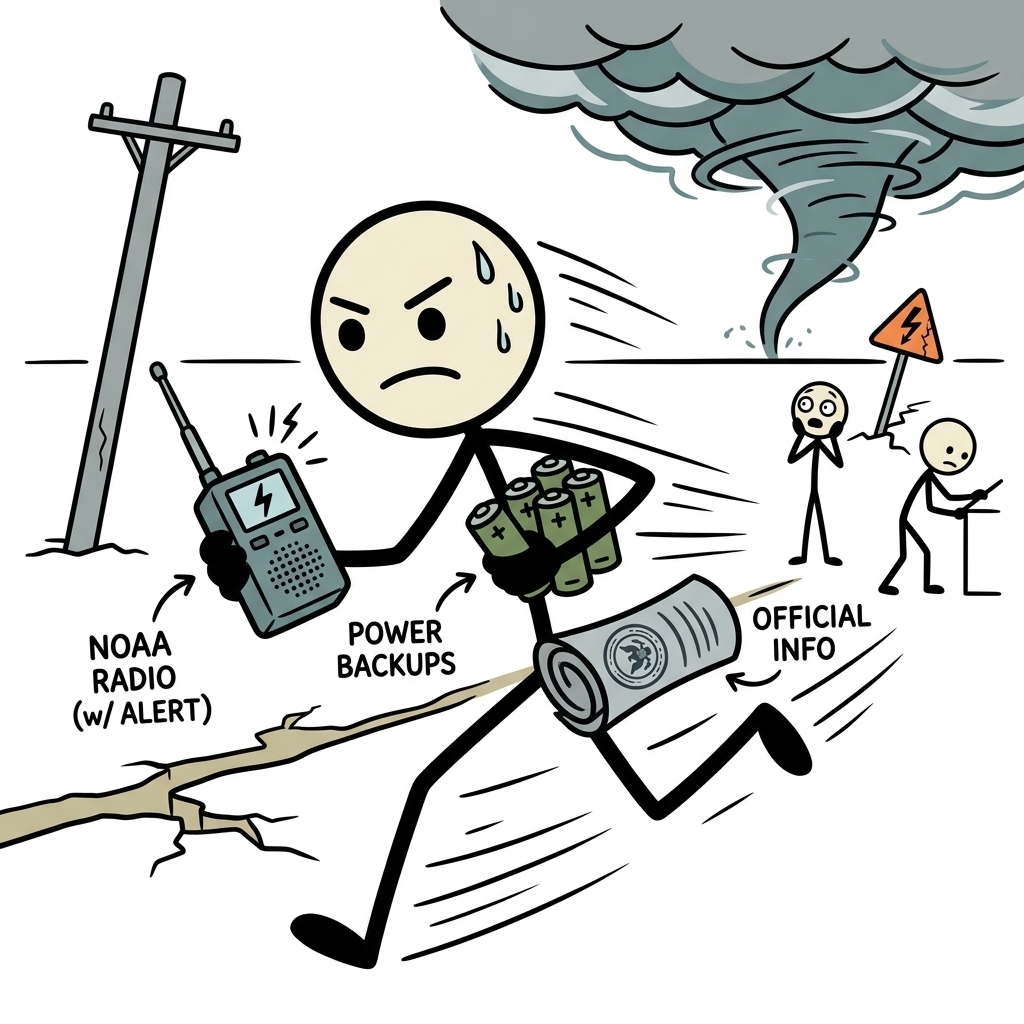
When the catastrophic 2021 winter storm crippled Texas’s electrical grid, leaving more than 4.5 million homes in freezing darkness, millions of residents discovered an uncomfortable modern vulnerability: smartphones are only as resilient as the regional telecommunications infrastructure supporting them. Cell towers exhausted their battery backups within six hours, generators ran dry, and data networks collapsed under unprecedented query loads. In contrast, battery-powered and mechanical-crank emergency radios continued receiving real-time civil defense bulletins from local National Weather Service (NWS) broadcast towers. Achieving true family resilience requires moving past ad-hoc digital assumptions and establishing a dedicated, robust audio-frequency lifeline that operates independently of local municipal utilities.
The Critical Role of Radio in Civil Emergency Preparedness
Modern telecommunications networks are built on a "just-in-time" data delivery model that optimizes for everyday bandwidth efficiency, not crisis durability. In an acute event—such as an earthquake, tornado outbreak, or grid collapse—cellular systems experience simultaneous physical damage and catastrophic traffic congestion. High-throughput packet switching collapses into endless loading screens, cutting you off from life-saving directions.
Broadcast radio operates on an asymmetrical "one-to-many" topology. A single hardened government transmitter can push instantaneous, voice-quality signals to an infinite number of receiving devices across hundreds of square miles. The Federal Emergency Management Agency (FEMA) and the Cybersecurity and Infrastructure Security Agency (CISA) explicitly identify broadcast radio as the primary baseline for the National Public Warning System.
Integrating a home emergency radio into your household safety plan eliminates reliance on fragile consumer services. It bridges the critical information gap during the "golden hours" of a disaster—the initial 24 to 72 hours when official rescue personnel are overwhelmed and you must rely on your own situational awareness to preserve life and property.
Broadcast Bands Defined: NOAA, AM, FM, and Shortwave
Understanding the radio spectrum allows you to extract maximum intelligence during a blackout. Different frequency bands serve distinct operational roles during localized or widespread emergencies:
- NOAA Weather Radio (NWR): Operates on dedicated Very High Frequency (VHF) bands between 162.400 and 162.550 MHz. These line-of-sight broadcasts provide automated, immediate synthetic or live voice updates, operational 24/7, covering local environmental and civil hazards.
- AM Broadcast (Medium Wave, 530–1710 kHz): AM signals bounce off the ionosphere at night, allowing listeners to hear high-wattage primary entry point (PEP) broadcast stations hundreds of miles outside the disaster perimeter. AM is the definitive band for long-range regional assessment.
- FM Broadcast (VHF, 88–108 MHz): Offers high-fidelity, highly local coverage. Local independent and public radio stations transmit updates here on neighborhood preparedness network-level evacuations, shelter openings, and water distribution points.
- Shortwave (HF, 3–30 MHz): Critical for catastrophic or continental disruptions. International shortwave operators, state civil defense units, and emergency nets provide uncurated macro-updates when local infrastructure is completely offline.
Emergency Walkie-Talkie Channel Plan: FRS First
A receive-only weather radio cannot coordinate your household. For short-range family communication in the United States, use license-free FRS radios and agree on one primary channel before an emergency. A simple starting plan is FRS Channel 3 (462.6125 MHz) as the primary call channel and FRS Channel 7 (462.7125 MHz) as the backup. These are common FRS simplex channels, but they are not private: listen first, keep messages brief, and move your family to a different legal FRS channel if the channel is busy.
Write the primary channel, backup channel, call signs and check-in times on the same paper as your family emergency communication plan. Do not rely on a printed range claim: buildings, terrain and weather can shorten usable range dramatically. GMRS can add power and repeater access, but it requires the appropriate FCC license; use FRS settings only unless every intended user is covered by the applicable rules. For alerts and official instructions, keep this two-way plan alongside a NOAA receiver and the community preparedness guide.
The NOAA Network Architecture: More Than Severe Weather
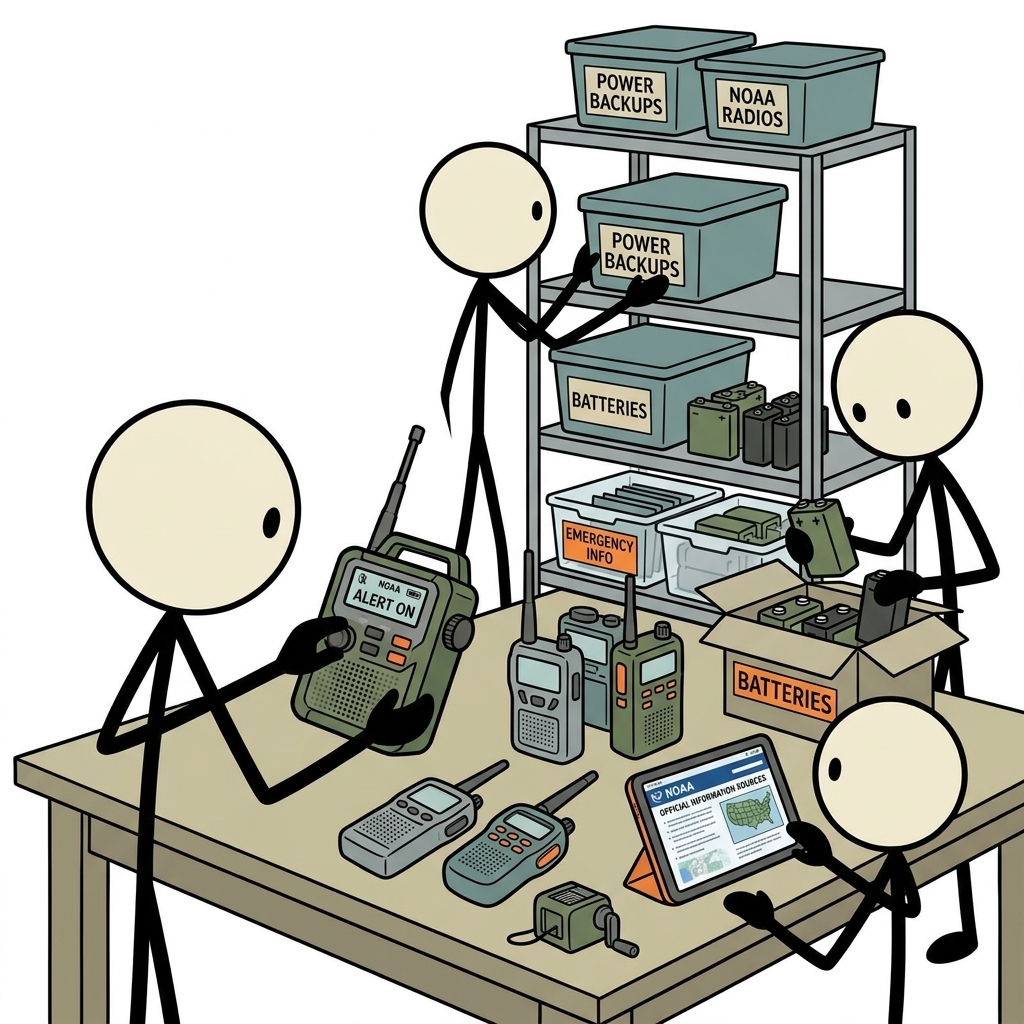
A frequent mistake in home emergency radio emergency preparedness is viewing the NOAA network merely as a rain or tornado monitor. The National Oceanic and Atmospheric Administration operates the system under an expansive "All Hazards" mandate. Through agreements with the Department of Homeland Security and FEMA, the NWR network serves as a foundational delivery system for the Emergency Alert System (EAS).
If an industrial train derailment releases chlorine gas into your county's atmospheric basin, the local Emergency Operations Center (EOC) initiates an EAS request. That alert is immediately ingested by the local NWS Weather Forecast Office (WFO) and broadcast directly across regional transmitters as a Civil Emergency Message (CEM) or Hazardous Materials Warning (HMW). The system alerts you long before commercial news crews arrive on the scene.
Decoding the 7 Standard NWR Frequencies
Every commercial home emergency radio built for the North American market comes pre-programmed with the seven standard VHF-FM frequencies allocated to the NWS. These narrow-band FM channels include:
- Channel 1: 162.400 MHz
- Channel 2: 162.425 MHz
- Channel 3: 162.450 MHz
- Channel 4: 162.475 MHz
- Channel 5: 162.500 MHz
- Channel 6: 162.525 MHz
- Channel 7: 162.550 MHz
Transmitters generally feature an effective broadcast range of roughly 40 miles, though terrain variations, building materials, and atmospheric conditions dictate real-world reception. In mountainous or densely built urban environments, finding an optimal listening position within your dwelling is essential for a clean signal lock.
S.A.M.E. Technology: Mitigating Alert Fatigue
The single greatest obstacle to sustained emergency radio readiness is false-positive alarm fatigue. A basic, non-S.A.M.E. emergency radio set to "Alert Mode" will trigger its piercing, full-volume alarm for any event occurring anywhere within the transmitter's entire broadcast radius. If you live on the eastern border of a vast county, waking up at 3:00 AM for a flash flood advisory affecting an area 60 miles west of you will quickly tempt you to power off the receiver entirely.
Specific Area Message Encoding (S.A.M.E.) solves this dilemma. Developed by the NWS in the 1980s and formally adopted for all EAS operations, S.A.M.E. utilizes digital audio bursts at the onset of every broadcast. These bursts transmit digital metadata containing four essential data fields: the originating agency, the specific event type, the targeted geographic zone, and the duration of the alert.
When you program your radio with your specific geographic code, its internal microprocessor continuously monitors the broadcast channel in an ultra-low-power standby mode. It silently evaluates incoming S.A.M.E. digital headers. If the code does not match your stored location, the unit remains silent. If a match occurs, the radio immediately unmutes its speaker, sounds an alarm, and displays the emergency text.
How to Program Your 6-Digit FIPS Code
S.A.M.E. systems categorize geography using the National Institute of Standards and Technology (NIST) Federal Information Processing Standards (FIPS) county codes. A standard FIPS code consists of six digits arranged in a precise structure: SSCCC, where:
- The first digit represents a sub-county division (usually
0for the entire county, unless the NWS office subdivides large counties). - The second and third digits represent your state's numerical ranking alphabetically (e.g.,
01for Alabama,06for California,48for Texas). - The final three digits identify the specific county or independent city within that state.
To configure your receiver, access the NOAA S.A.M.E. database online or contact the National Weather Service directly by telephone at 1-888-NWR-SAME (1-888-697-7263). Navigate to your radio's programming menu, set the memory slot to your designated 6-digit code, and assign the channel offering the clearest, static-free carrier signal.
For individuals residing near county borders or downstream from major reservoirs, inputting secondary and tertiary FIPS codes for adjacent, upwind, or upstream counties is a sound tactical precaution. This provides early warning if a storm system or chemical plume is traveling in your direction.
Alert Hierarchy and Event Filters
A capable home emergency radio lets you configure the threshold of alerts that will audibly interrupt your household. The National Weather Service and real-world Survival Scenarioss guide agencies structure alerts into three distinct operational tiers, each dictating a specific level of personal response:
- Advisories / Statements: Informational notifications highlighting weather or civil conditions that may cause inconvenience. These rarely justify waking a sleeping household (e.g., Winter Weather Advisory, Frost Advisory).
- Watches: Conditions are favorable for the development of a hazardous event in your area. Watches require increased situational vigilance and the initial staging of home emergency kits (e.g., Tornado Watch, Flood Watch).
- Warnings: A hazardous event is occurring, imminent, or verified by radar or human observers. Immediate protective action is required to preserve life (e.g., Tornado Warning, Flash Flood Warning, Shelter-in-Place Order).
Higher-end receivers allow you to suppress the audible siren for minor statements while preserving the highest decibel warnings for life-threatening scenarios. However, modern CEA-2009-certified radios permanently lock critical life-safety codes—such as Tornado Warnings, Radiological Alerts, and Civil Emergency Messages—ensuring they cannot be accidentally muted or disabled.
Essential Hardware Requirements: Public Alert Certification
When selecting a home emergency radio, look for the official "Public Alert" logo, developed by the Consumer Technology Association alongside the NWS. Cheap novelty radios flooding online marketplaces frequently lack this certification and cut corners on crucial life-safety components.
To earn Public Alert certification, a radio must fulfill rigorous mechanical and electronic benchmarks:
- The unit must retain its S.A.M.E. programming during a complete loss of main electrical power.
- It must produce an attention-grabbing signal of at least 80 decibels (measured at a distance of 1 meter), sufficient to wake sleeping occupants through closed interior doors.
- It must include a dedicated output interface for external accessories—such as high-intensity strobe lights and tactile bed-shakers—to protect individuals who are deaf or hard of hearing.
- It must reliably wake up from silent standby mode within a fraction of a second of detecting the 1050 Hz alerting tone or S.A.M.E. digital header.
Prioritize units with digital phase-locked loop (PLL) synthesized tuners over analog dial sliders. Analog dials drift off-frequency over time due to ambient temperature shifts and mechanical vibration, which can lead to missed alerts.
Power Architecture: Establishing True Triple-Redundancy
An emergency receiver with dead batteries is useless dead weight. A sound emergency preparedness strategy requires a layered, failsafe approach to power. You cannot rely on a single primary battery bank or an unverified solar panel when facing multi-day grid down scenarios.
| Power Source | Practical Longevity | Operational Strengths | Inherent Weaknesses |
|---|---|---|---|
| AC Mains / Wall Power | Indefinite (Grid active) | Zero maintenance; keeps internal battery trickle-charged. | Vulnerable to grid failures and electrical surges. |
| Standard Disposable Alkaline (AA/AAA) | 7 to 10-year shelf life | High energy density; immediate swap; ubiquitous availability. | Prone to potassium hydroxide leakage over long storage spans. |
| Rechargeable Lithium/NiMH Internal | 300 to 500 charge cycles | High capacity; powers USB charging ports for auxiliary gear. | Self-discharges over months; performance degrades in extreme cold. |
| Manual Hand Dynamo (Crank) | Infinite mechanical cycles | True black-sky backup; functions when all stored power is spent. | High physical labor; low output (2-3 minutes of crank = 10-15 min audio). |
| Integrated Photovoltaic (Solar) | 20+ years physical panel life | Passive, silent generation under unobstructed sunlight. | Extremely slow charging speed; completely ineffective indoors or under storm cloud cover. |
The Truth About Hand Cranks and Solar Panels
Consumer marketing often exaggerates the capabilities of hand-crank and solar-powered emergency radios. While these features are worthwhile backups, it is vital to understand their real-world output.
The miniature photovoltaic cells mounted to the top of compact emergency radios generally deliver a modest output of 5 volts at roughly 30 to 50 milliamps under direct, mid-day summer sun. Fully charging a depleted 2,000 mAh internal lithium battery exclusively via this tiny panel can take upwards of 40 to 60 hours of direct, cloud-free sunlight. Treat the solar panel strictly as a continuous trickle charger to slow down battery drain, not your primary charging method.
Similarly, an integrated mechanical hand dynamo produces roughly 200 to 400 milliamps under vigorous, sustained cranking. Two solid minutes of steady hand-cranking typically yield roughly 10 to 15 minutes of low-volume radio reception, or barely 1 to 2 percent of battery life on a modern smartphone. The crank is an emergency fallback for situational audio bulletins, not an engine to recharge your personal electronics.
Best Practices for Battery Care
To ensure your home emergency radio works reliably when disaster strikes, follow this disciplined maintenance schedule:
- Deploy Energizer Ultimate Lithium AA/AAA cells: Unlike standard alkaline batteries, lithium iron disulfide cells resist internal pressure variations, withstand extreme temperatures (-40°F to 140°F), and will not leak corrosive electrolyte into your radio's contacts during years of storage.
- Keep stored batteries separate: Store disposable dry cells in an airtight, moisture-proof case directly next to the radio rather than keeping them seated inside the battery tray. This avoids parasitic drain and mechanical corrosion.
- Execute a quarterly exercise schedule: Every 90 days, run the radio off its internal rechargeable battery for 30 minutes, inspect for physical corrosion, top the charge off to 100%, and check that the internal battery management system (BMS) remains stable.
Tactical Radio Placement and Reception Optimization
A high-performance radio cannot process warnings if the signal cannot pass through your home's exterior walls. Modern home construction presents several challenges for radio frequency propagation. Low-E window glazing, foil-backed radiant barrier insulation, steel framing, and reinforced concrete behave like a rudimentary Faraday cage, degrading incoming VHF signals.
Position your baseline emergency receiver on an elevated surface near an exterior-facing wall, ideally adjacent to a window facing the directional azimuth of your nearest NWS transmitter. Keep the unit away from appliances that produce high electromagnetic interference (EMI), such as switching power supplies, microwave ovens, Wi-Fi routers, television sets, and low-cost LED light transformers. These devices generate a constant background noise floor that can mask NOAA digital headers and cause missed alerts.
If you live in a deep valley, an earth-bermed home, or an urban concrete-and-steel midrise, a basic telescoping whip antenna may not be sufficient. Invest in a radio equipped with an external RCA, BNC, or 3.5mm RF antenna port. Running a high-grade coaxial lead to an external 162 MHz J-pole antenna mounted on your roof or balcony will significantly boost reception quality and eliminate dropped alerts.
The Master Home Emergency Radio Checklist
Use this comprehensive home emergency radio checklist to configure, maintain, and operate your emergency communications hub over the long term.
Phase 1: Procurement & Initial Configuration
- Confirm the radio has official Public Alert (CEA-2009) certification and an integrated S.A.M.E. decoder.
- Ensure it supports three separate power sources: AC line power, a standard dry-cell battery tray (AA or AAA), and an integrated crank/solar-backed rechargeable cell.
- Look up your six-digit county FIPS code through the official NOAA directory and program it into Memory Location 1.
- Program the FIPS codes of up to two adjacent, upwind, or upstream counties into supplemental memory locations.
- Scan through all seven standard NWR frequencies to identify the channel with the cleanest, lowest-noise signal, and lock it as the default.
- Set the alert tone to maximum volume, ensuring the audible alarm produces a minimum of 80 dBA across all common living areas.
Phase 2: Tactical Placement & Environmental Setup
- Position the receiver on a stable, elevated surface on an upper floor, clear of major household EMI generators (microwaves, routers, PCs).
- Fully extend the telescoping antenna and orient it vertically, as NOAA VHF transmissions use vertical polarization.
- Connect any needed external accessibility peripherals, such as high-output strobes or bed-shakers for household members with hearing impairments.
- Place a weather-sealed hard case containing a fresh 12-pack of lithium primary batteries directly next to the base of the radio.
Phase 3: Recurring Maintenance Drills
- Every Wednesday (11:00 AM – 12:00 PM local time): Verify that the radio accurately receives and displays the automated NWS Required Weekly Test (RWT). If the test does not register, adjust your antenna's orientation or move the radio closer to an exterior window.
- Quarterly (Every 90 Days): Disconnect the radio from AC line power and let it run off its internal rechargeable battery for 30 minutes to verify cell health. Manually crank the dynamo for 60 seconds to confirm the mechanical gear train is operating smoothly.
- Biannually (Daylight Saving Time Transitions): Inspect the auxiliary dry-cell battery compartments for any sign of corrosion or electrolyte leakage, check expiration dates, and replace backup cells as needed.
Triangulating the Official Information Ecosystem
While your home emergency radio provides an essential early warning foundation, resilient operators never rely on a single data path. Broadcast radio works best when integrated into a broader, multi-layered communication setup that cross-references both government networks and community-level reports.
The information ecosystem surrounding any major civil incident includes several critical elements:
- FEMA Integrated Public Alert and Warning System (IPAWS): The federal portal that pushes coordinated messages across multiple channels at once—including NOAA Weather Radio, the Emergency Alert System (EAS) on standard commercial TV and radio, and Wireless Emergency Alerts (WEA) on cell phones.
- U.S. Geological Survey (USGS) Earthquake Hazards Program: Provides definitive, near-instant seismic analyses through its automated ShakeMap feeds. For localized, post-impact infrastructure assessments, the USGS "Did You Feel It?" citizen-science system offers valuable data on structural shaking patterns.
- Local Emergency Management Operations Centers (EOC): Your county or municipal EOC directs localized evacuations, tactical resource points, and field triage operations. Determine in advance whether your local EOC broadcasts on a dedicated low-power AM Highway Advisory Radio (HAR) frequency (typically 530 kHz or 1610 kHz).
- Amateur Radio Emergency Service (ARES) & RACES: Licensed ham radio operators coordinate auxiliary regional communications during wide-scale infrastructure outages. Tuning a shortwave or dual-band VHF/UHF receiver to local 2-meter repeater frequencies (144–148 MHz) allows you to listen to unfiltered, neighborhood-level situational reports long before they appear in mainstream press releases.
When monitoring emergency broadcasts during high-stress situations, maintain a physical logbook near your radio. Record the timestamp, precise frequency, originating agency, and specific instructions of every bulletin you hear. This keeps your household anchored to verified, official guidance and avoids the dangerous rumors and misinformation that inevitably surface during a crisis.
Operational Readiness: Calm, Proactive Preparation
True emergency preparedness is not about giving in to fear or bracing for an apocalypse; it is about building calm, systematic household self-reliance. Setting up a dedicated home emergency radio takes less than an hour of focused attention, yet it provides durable protection against one of modern infrastructure's greatest points of failure: the fragile digital cell network. By choosing a certified receiver, configuring your localized S.A.M.E. codes, securing reliable battery backups, and practicing basic operational habits, you remove panic from the equation. When the storm clouds gather and the power grid goes silent, you will not be left guessing in the dark. You will have a clear, uninterrupted stream of verified information to guide your decisions and protect the people who depend on you.
Frequently Asked Questions
What should a home emergency radio plan include?
Start with the immediate safety steps, the supplies and records your household needs, a communication plan, and a regular review schedule. Follow local official guidance during an active emergency.
How often should I review home emergency radio preparations?
Review them at least twice a year and whenever your household, medication, location, or local risks change. Replace expired supplies and practice key steps.
Where can I find reliable emergency guidance?
Use local emergency management alerts and established public-health or emergency-management agencies. A blog guide should support, not replace, official real-time instructions.