⚡ Key Facts
- The 2-Minute Window: According to the National Fire Protection Association (NFPA), synthetic materials in modern home furnishings cause fires to burn significantly faster, reducing the average safe evacuation window to two minutes or less once a smoke alarm sounds. For the practical checklist side, use the community emergency preparedness guide.
- Night-time Vulnerability: Federal Emergency Management Agency (FEMA) data reveals that over 50% of fatal residential fires occur between the hours of 11:00 PM and 7:00 AM, when occupants are sleeping and reaction times are delayed. For the practical checklist side, use the neighborhood preparedness network.
- The Preparation Gap: An American Red Cross survey found that while 74% of families believe they know what to do in a home fire, only 26% have actually created and practiced a comprehensive escape plan. For the practical checklist side, use the family emergency planning guide.
- Toxic Smoke Risk: The Centers for Disease Control and Prevention (CDC) identifies smoke inhalation, rather than thermal burns, as the primary cause of death in indoor fires, with toxic gases like carbon monoxide and hydrogen cyanide causing rapid incapacitation. For the practical checklist side, use the real-world emergency scenarios guide.
- Closed Door Survival: Research by the UL Firefighter Safety Research Institute shows that a closed bedroom door can keep temperatures below 100°F and carbon monoxide levels at a fraction of what they would be in a room with an open door, where temperatures can exceed 1,000°F.
Imagine waking up at 2:30 AM to the piercing, rhythmic shriek of a smoke detector. Your bedroom is pitch-black, the air is already smelling of acrid, synthetic smoke, and your cognitive processing is severely degraded by sleep inertia. In this high-stakes, disorienting moment, there is no time to formulate a strategy, argue about exits, or search for misplaced keys. Modern home fires burn hotter, faster, and produce far more toxic smoke than those of forty years ago, transforming your living space into a hazardous environment in less than 120 seconds. Surviving this crisis depends entirely on decisions made long before the first spark ignites. By developing, practicing, and adapting a comprehensive home fire escape plan, you replace panic with muscle memory, ensuring that every member of your household—including children, seniors, and pets—knows exactly how to navigate the darkness to safety.
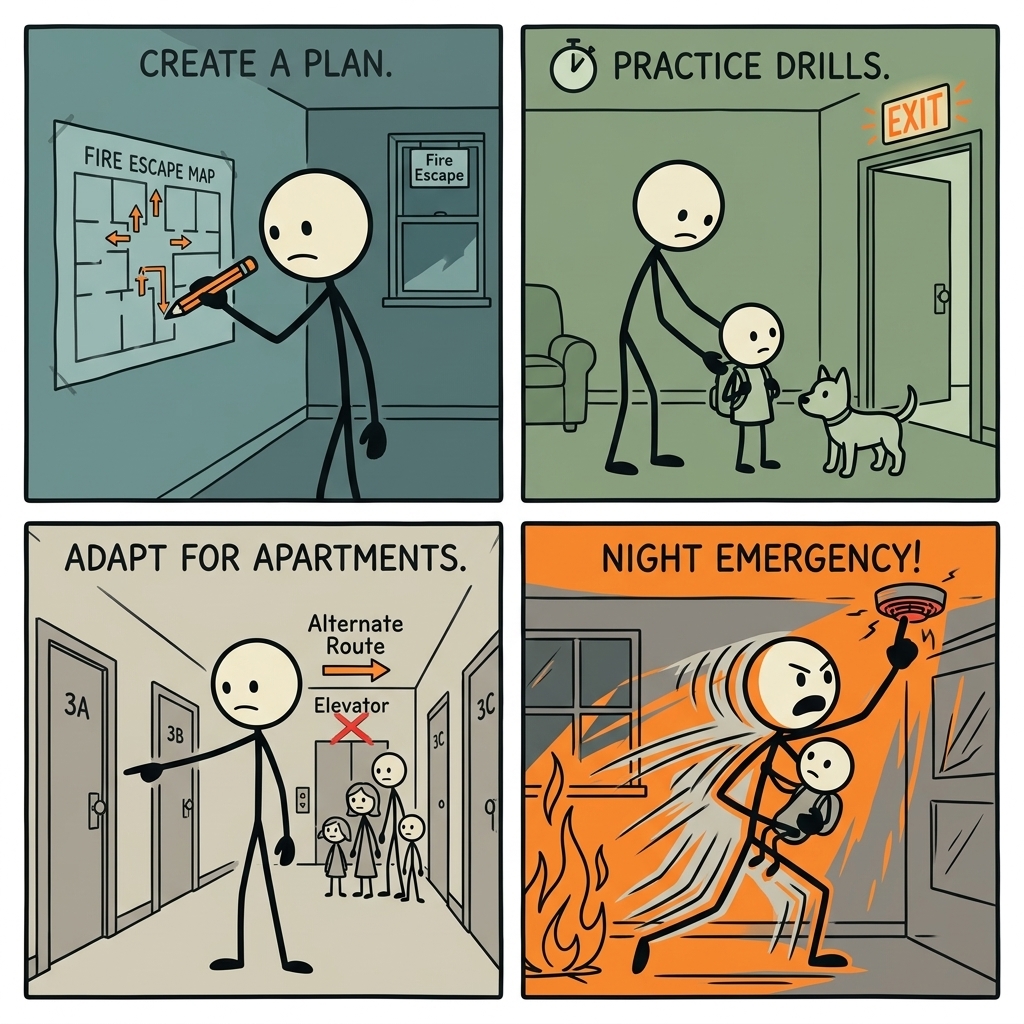
The Anatomy of a Home Fire Escape Plan
A successful survival strategy is built on a foundation of spatial awareness and pre-determined actions. A home fire escape plan is not merely a mental agreement to meet outside; it is a highly detailed blueprint of your living space that accounts for every potential obstruction and variable. When designing your plan, you must analyze your home from a tactical perspective, identifying multiple pathways of egress and assigning specific roles to capable household members.
Mapping Your Sanctuary
To begin, obtain or draw a basic floor plan of your home, detailing every room, hallway, door, and window. According to emergency preparedness guidelines from FEMA, your plan must identify at least two ways out of every room. The primary exit is typically the door leading into the main hallway or exterior pathway. The secondary exit is usually a window or an alternative door. For each room, trace the path of escape from both exits all the way to the outside of the property. Ensure that every window identified as an escape route can be easily opened from the inside, is not painted shut, and is not obstructed by heavy furniture or security bars unless those bars feature a quick-release mechanism.
Establishing the Safe Assembly Point
Once outside, your household needs a single, designated meeting location to perform an immediate headcount. This assembly point must be a fixed, easily identifiable landmark located a safe distance from the front of the home—such as a specific street light, a neighbor’s mailbox, or a prominent tree in the front yard. It should be situated in an area that does not obstruct arriving emergency vehicles. Instruct all family members that once they reach this location, they must remain there. Under no circumstances should anyone re-enter a burning structure. If someone is missing, communicate this immediately to the 911 dispatcher or arriving firefighters, who possess the protective gear and training necessary for search-and-rescue operations.
Assigning Tactical Roles
A chaotic evacuation is a dangerous evacuation. To streamline the process, assign specific responsibilities to adult or teenage household members. For example, designated "guardians" should be assigned to assist infants, young children, elderly relatives, or individuals with mobility limitations. A secondary guardian should be assigned to secure pets if it is safe to do so. By formalizing these roles during your planning phases, you eliminate the dangerous assumption that "someone else" is helping a vulnerable family member, ensuring that no one is left behind in the rush to escape.
The Ultimate Home Fire Escape Plan Checklist
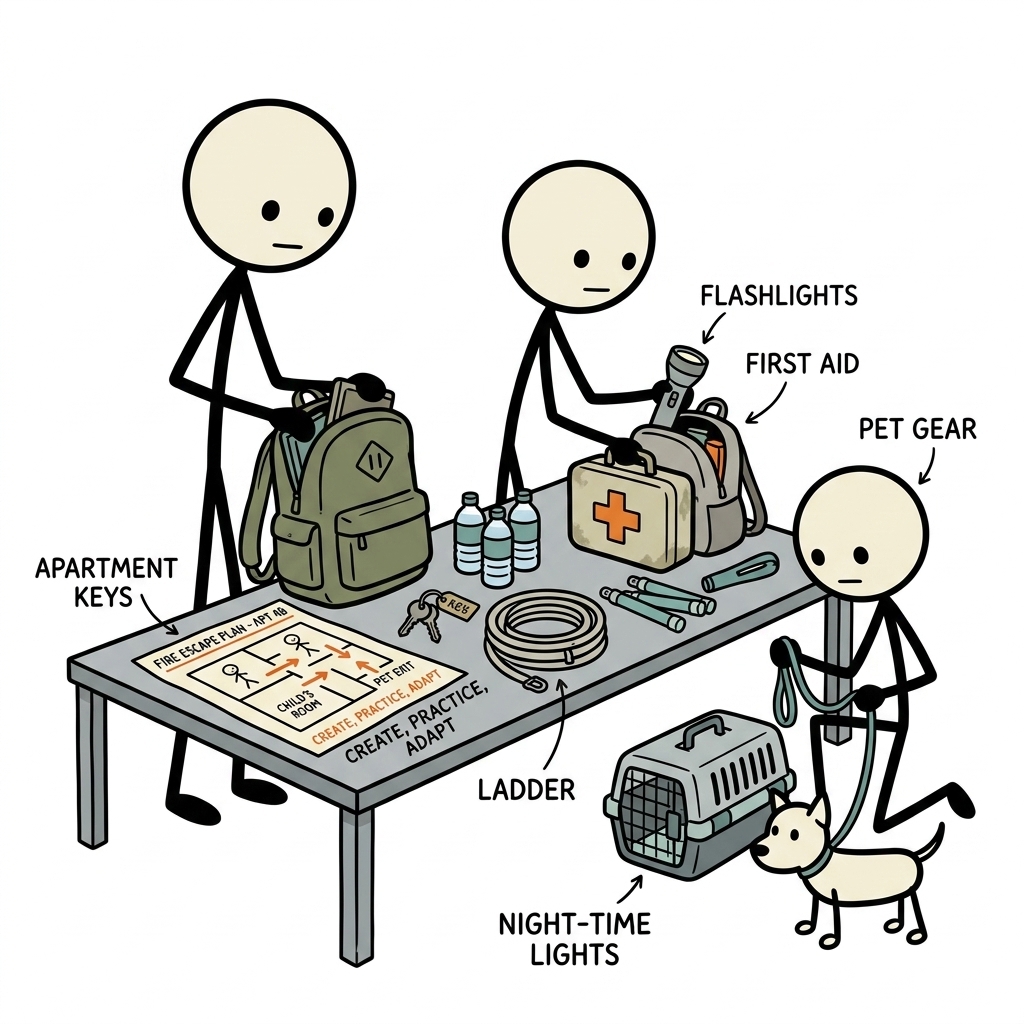
To transition your strategy from a conceptual drawing to an actionable defense system, you must systematically audit your home’s safety infrastructure. Utilizing a structured home fire escape plan checklist ensures that no critical vulnerability is overlooked. This checklist should be reviewed and updated at least twice a year, coinciding with seasonal daylight saving time changes.
Smoke Alarm Integration
- Ubiquitous Installation: Verify that smoke alarms are installed inside every bedroom, outside every sleeping area, and on every level of the home, including the basement, as recommended by the NFPA.
- Interconnection: Ensure that all smoke alarms are interconnected. When one alarm detects smoke, all alarms throughout the dwelling must sound, providing the earliest possible warning to occupants in distant rooms.
- Monthly Testing: Test every alarm monthly by pressing the physical test button. Replace batteries annually, or immediately if the unit emits a low-battery chirp.
- Ten-Year Lifespan: Check the manufacture date printed on the back of each alarm. Replace the entire unit every 10 years, regardless of its operational status, as sensor sensitivity degrades over time.
Egress Clearance and Functionality
- Obstruction-Free Pathways: Keep all hallways, stairwells, and doorways completely free of clutter, shoes, toys, and storage boxes that could present tripping hazards in low-visibility conditions.
- Window Operationality: Open and close every window in the home to verify smooth operation. Apply silicone lubricant to sticky tracks if necessary.
- Security Bar Release: Ensure that any security bars installed over windows are equipped with interior quick-release latches that can be operated without keys or specialized tools.
- Key Proximity: If your exterior doors require a key to unlock from the inside (double-cylinder deadbolts), hang a designated key on a secure hook immediately adjacent to the door, out of reach of small children but easily accessible to adults.
Specialized Egress Equipment
- Escape Ladders: Equip all occupied second- and third-story rooms with high-quality, collapsible escape ladders. Store them in an easily accessible location, such as under the bed or in the closet nearest the window.
- Tactile Flashlights: Mount heavy-duty, high-lumen LED flashlights near the bed of every family member to assist with navigation and signaling in dark, smoke-filled corridors.
- Whistles: Place emergency whistles in nightstand drawers. If an occupant becomes trapped in a room, blowing a whistle creates a high-pitched sound that easily penetrates walls and alerts rescue crews.
Child-Centric Fire Safety: Overcoming the Fear Instinct
Children present unique challenges during a home fire emergency. Their physiological responses, sleep patterns, and psychological reactions differ fundamentally from adults, requiring targeted strategies to ensure their safety. Integrating child-specific protocols into your home fire escape plan emergency preparedness efforts can mean the difference between a successful evacuation and tragedy.
The Psychology of a Child in a Fire
During a fire, children rarely react with logical self-preservation. Instead, their natural instinct is to hide from what frightens them. When confronted with loud alarms, crackling flames, and thick black smoke, children frequently retreat under beds, deep into closets, or behind furniture, making them exceptionally difficult for parents or firefighters to locate. Furthermore, pediatric sleep studies indicate that children sleep much more deeply than adults, often sleeping directly through the high-frequency pitch of standard smoke alarms. To counter this, parents must actively teach children that smoke alarms are helpful tools, and that hiding is the single most dangerous action they can take.
Demystifying the Rescue
To a young child, a firefighter dressed in full turnout gear, wearing a self-contained breathing apparatus (SCBA) and a face mask, can look like a terrifying monster. The heavy, mechanical sound of exhaled air through the respirator can frighten a child into hiding or running away from their rescuer. Introduce your children to images and videos of firefighters in full gear, or visit a local fire station open house. Teach them that these individuals are helpers, and that their muffled voices and unusual appearance are designed to keep them safe. Instruct your children to call out to firefighters if they are trapped, rather than staying silent.
Interactive Egress Education
Teaching children how to escape requires hands-on, engaging instruction rather than abstract lectures. Use these practical steps to build their confidence:
- The "Get Low and Go" Drill: Teach children that the cleanest, coolest air is always closest to the floor. Practice crawling on hands and knees beneath a sheet held suspended at waist height to simulate the boundary of a smoke layer.
- The "Stop, Drop, and Roll" Technique: Ensure children understand this classic maneuver, emphasizing that they must cover their faces with their hands to protect their airway and eyes if their clothing ever catches fire.
- Tactile Route Finding: Blindfold your children in a safe environment and have them navigate their bedroom to the door using only their hands along the walls. This builds the spatial muscle memory required to find exits in zero-visibility conditions.
Pet Evacuation Strategies: Protecting Our Four-Legged Family Members
Pets are highly sensitive to environmental changes and will panic long before humans register the presence of smoke or heat. Because they cannot open doors or communicate their distress, they rely entirely on your pre-planning for survival. Incorporating pets into your evacuation protocols requires specialized gear and realistic expectations of animal behavior during a crisis.
Pre-Positioning Evacuation Gear
In a fast-moving fire, you will not have time to search closets for leashes, collars, or pet carriers. Keep these essential items stored in highly visible, easily accessible locations near your primary exit points. For dogs, maintain a spare collar and heavy-duty leash hanging by the front door. For cats and small mammals, store sturdy hard-sided carriers near their primary resting areas. Keep a basic pet emergency kit nearby, containing a multi-day supply of food, water, and any critical medications, which can be grabbed quickly on your way out.
Navigating the Panic Response
When a fire occurs, domestic animals will immediately seek out hiding spots that offer a sense of security, such as underneath beds, behind heavy appliances, or inside deep closets. Do not waste precious minutes searching the entire home if your pet is not immediately visible. If you locate your pet but they are biting, scratching, or resisting due to extreme terror, do not sacrifice your life trying to force them into a carrier. Exit the home immediately, leave the door open behind you, and call out to your pet from the safety of your assembly point. Inform arriving firefighters of the exact room where you last saw your pet, and what type of animal they are looking for.
Post-Escape Security and Recovery
The chaos of an active fire scene—flashing lights, loud sirens, screaming, and rushing personnel—will terrify even the most well-trained animal. If a dog or cat escapes the home, their immediate instinct will be to bolt away from the noise. Keep dogs securely leashed at all times once outside, and secure cats inside a carrier or a neighbor's closed vehicle. Ensure all pets are microchipped with up-to-date contact information, and place high-visibility "Pet Alert" decals on your front windows. These decals should clearly state the number and types of pets residing in the home, alerting search crews to look for them even if you are not present to advocate for their rescue.
High-Rise and Apartment Dynamics: Navigating Shared Spaces
Living in a multi-family residential building or high-rise complex introduces unique variables to your fire safety strategy. Unlike single-family homes, apartment buildings feature shared egress pathways, complex alarm systems, and structural designs engineered to contain fires to their unit of origin. Navigating these environments safely requires a deep understanding of building construction and specialized evacuation protocols.
The Elevator Trap
In the event of a fire, the single most critical rule of high-rise survival is to never use the elevator. Elevators are programmed to recall to the lobby or ground floor during an alarm, and their shafts can act as chimneys, channeling toxic smoke and heat directly to upper levels. Additionally, power failures can trap occupants inside elevator cars between burning floors. Always utilize designated fire-rated exit stairwells. These stairwells are constructed with heavy concrete walls and self-closing fire doors designed to keep smoke and heat out, providing a safe path of travel to the ground level.
The Power of Fire-Rated Doors
Modern apartment buildings are constructed using compartmentalization strategies. This means individual units are designed to act as self-contained concrete and drywall boxes that resist fire spread for up to two hours. The primary defense in this system is your unit's front door, which is typically a heavy, fire-rated door. If you must evacuate your apartment, always close the door behind you. Leaving your apartment door open allows oxygen to feed the fire and permits toxic smoke to pour into the common hallways, blocking the escape routes of your neighbors on the same floor.
Sheltering in Place When Trapped
If common hallways are completely filled with thick, black smoke, or if fire blocks your access to the stairwells, you may be forced to shelter in place. This is a highly effective survival strategy if executed correctly:
- Seal the Entryway: Close your front door tightly. Wet towels, sheets, or clothing and stuff them into the cracks around the door frame to block incoming smoke. Turn off all HVAC systems to prevent smoke from being drawn through ventilation ducts.
- Signal for Help: Go to a window that opens to the outside. Hang a brightly colored sheet or towel out the window to signal your location to emergency responders. Do not break the glass unless absolutely necessary, as you may need to close the window to block rising exterior smoke.
- Maintain emergency communication plan: Call 911 and provide the dispatcher with your exact apartment number, floor, and current conditions inside your unit, even if fire trucks are already on scene.
The Night-Time Emergency Protocol: Navigating in the Dark
A fire that strikes while you sleep is exceptionally dangerous. The human sense of smell is significantly diminished during deep sleep, meaning you will not wake up from the odor of smoke; only the auditory stimulus of a smoke alarm or the physical sensation of heat will rouse you. Operating in a dark, toxic environment requires a highly structured, step-by-step physical protocol to ensure safe egress.
The Science of "Close Before You Doze"
One of the simplest yet most effective fire safety actions you can take occurs before you even go to sleep. The UL Firefighter Safety Research Institute’s "Close Before You Doze" campaign highlights the dramatic difference a simple closed door makes during a residential fire. A closed bedroom door acts as a physical thermal barrier, keeping toxic carbon monoxide levels, heat, and smoke out of your sleeping space. In a burning home, a room with an open door can quickly reach temperatures over 1,000°F—lethal to human life—while a room with a closed door remains under 100°F. Make it an absolute rule in your household that all bedroom doors must be closed completely before sleeping.
Tactile Navigation in Zero Visibility
If you are awakened by a smoke alarm, do not immediately stand up. Roll out of bed onto the floor, where the air is coolest and cleanest. If you must move through the room or hallway, crawl on your hands and knees. When you reach a closed door, do not grab the handle with your bare hand. The metal handle can conduct intense heat from a fire burning on the other side, causing severe burns that can incapacitate you. Instead, use the back of your hand to feel the door, the doorknob, and the crack between the door and the frame. If the door feels hot, or if you see smoke seeping through the edges, do not open it; utilize your secondary escape route instead.
The Bedside Readiness Kit
To facilitate a rapid, night-time escape, maintain a small "readiness kit" in or on your nightstand. This kit should consist of a sturdy pair of slip-on shoes, a high-intensity LED flashlight, and your prescription eyeglasses if you require them to see. Stepping on broken glass, hot embers, or sharp debris in your bare feet can instantly stop your evacuation. Having these items immediately accessible ensures you can move quickly and safely through a damaged environment without losing precious seconds searching for basic necessities.
Practicing and Adapting Your Plan: Muscle Memory Under Stress
A written plan is only as good as the practice behind it. During a high-stress emergency, the prefrontal cortex of the brain—responsible for logical decision-making—largely shuts down, leaving you to rely on instinct and muscle memory. Regular, realistic drills are the only way to hardwire your evacuation routes into your subconscious mind, ensuring rapid, decisive action when every second counts.
The Twice-Yearly Benchmark
According to the American Red Cross, families should practice their home fire escape plan at least twice a year. These drills should not be treated as casual walk-throughs; they must be run as realistic simulations. Announce the drill by pressing the test button on a smoke alarm to familiarize everyone with the actual sound they will hear during an emergency. Start the drill with family members in their respective bedrooms, simulating a night-time scenario, and time the evacuation from the moment the alarm sounds until everyone is safely gathered at the designated assembly point. Aim to complete the entire evacuation in under two minutes.
Simulating Obstacles and Real-World Scenarios
Real fires are unpredictable and rarely allow for a perfect, unobstructed escape. To build true resilience, introduce variables and challenges into your practice sessions:
- The Blocked Exit Drill: During a scheduled drill, place a sign or a red cloth over the primary exit door or hallway. Force family members to recognize the obstruction, pivot immediately, and safely utilize their secondary escape route (such as an escape ladder or alternative window).
- The Zero-Visibility Simulation: Have family members practice escaping with their eyes closed or wearing blindfolds, navigating solely by feeling their way along the walls. This simulates the terrifying reality of thick, black smoke, which renders flashlights useless.
- The Surprise Drill: Once your family has mastered scheduled drills, conduct an unannounced drill. This tests how quickly members transition from normal household activities to emergency mode, highlighting any lingering gaps in your planning.
Seasonal Audits and Life Transitions
Your home is a dynamic environment that changes over time. As your family grows, moves, or rearranges living spaces, your fire escape plan must adapt accordingly. Conduct a seasonal audit of your plan to address these changes:
| Variable | Potential Hazard | Adaptive Action Required |
|---|---|---|
| Infant to Toddler Transition | Child gains mobility but lacks understanding of fire hazards. | Update guardian assignments; practice guiding the child physically down escape routes. |
| Seasonal Weather (Winter) | Snow and ice accumulation can freeze windows shut or block exterior doors. | Clear snow from all exterior exit pathways and ensure windows remain operable. |
| Room Rearrangement | New furniture layout may block secondary exit paths or access to escape ladders. | Verify that all doors and windows can still open fully without obstruction. |
| Temporary Guests | Visitors are unfamiliar with your home’s layout and assembly point. | Give a brief safety walkthrough of exits and the meeting location upon arrival. |
Fire safety is not a matter of luck; it is a discipline of preparation. While the speed and toxicity of modern house fires are sobering realities, they are hazards that can be successfully navigated through structured, proactive planning. By taking the time today to map out your home, establish clear checklists, address the unique needs of children and pets, and commit to regular, realistic practice drills, you strip the emergency of its ability to cause panic. You transform a potentially devastating crisis into a structured, survivable event. Do not wait for the smoke alarm to sound to find out if your plan works—empower your household with the gift of readiness, and ensure that every member of your family knows exactly how to navigate the darkness back to the light.
Frequently Asked Questions
What should a home fire escape plan plan include?
Start with the immediate safety steps, the supplies and records your household needs, a communication plan, and a regular review schedule. Follow local official guidance during an active emergency.
How often should I review home fire escape plan preparations?
Review them at least twice a year and whenever your household, medication, location, or local risks change. Replace expired supplies and practice key steps.
Where can I find reliable emergency guidance?
Use local emergency management alerts and established public-health or emergency-management agencies. A blog guide should support, not replace, official real-time instructions.