⚡ Key Facts
- Home Is Where Accidents Happen: According to the National Safety Council (NSC), more than 75% of all preventable injury-related deaths occur inside the home or domestic perimeter, primarily driven by poisonings, falls, burns, and airway obstructions.
- EMS Response Disparity: Data published by the American Red Cross and emergency medical services (EMS) studies indicate that the national average ambulance response time is between 7 and 14 minutes, stretching past 30 minutes in rural zones, making immediate domestic triage essential.
- The Infection Reality: The Centers for Disease Control and Prevention (CDC) notes that secondary infections from improperly irrigated, poorly dressed domestic wounds represent a major cause of preventable outpatient antibiotic prescriptions and hospital visits.
- Misallocated Equipment: Most commercial "tactical" first aid kits allocate up to 70% of their volume to battlefield trauma (such as tension pneumothorax decompression needles and combat tourniquets) while lacking basic burn hydrogels, rehydration salts, or adequate pediatric wound closures.
A frantic emergency in the home rarely looks like an action movie. It rarely involves ballistic trauma, tactical extractions, or blast injuries requiring combat application tourniquets and vented chest seals stashed in every drawer. Far more often, domestic emergencies are visceral, quiet, and ordinary: a paring knife slipping through an avocado into the palm of a hand; a toddler pulling a pot of boiling pasta water off the range; an elderly relative tumbling down basement stairs; or a severe bout of norovirus inducing dangerous electrolyte depletion at 3:00 AM on a Sunday. When panic sets in, searching through an olive-drab pouch packed with chest decompressors and combat gauze will not help you stabilize a second-degree burn, splint a fractured radius, or treat an escalating allergic reaction. True emergency readiness requires an intentional, evidence-based approach centered on domestic triage, wound care, and pragmatic therapeutics. For the practical checklist side, use the community emergency preparedness guide.
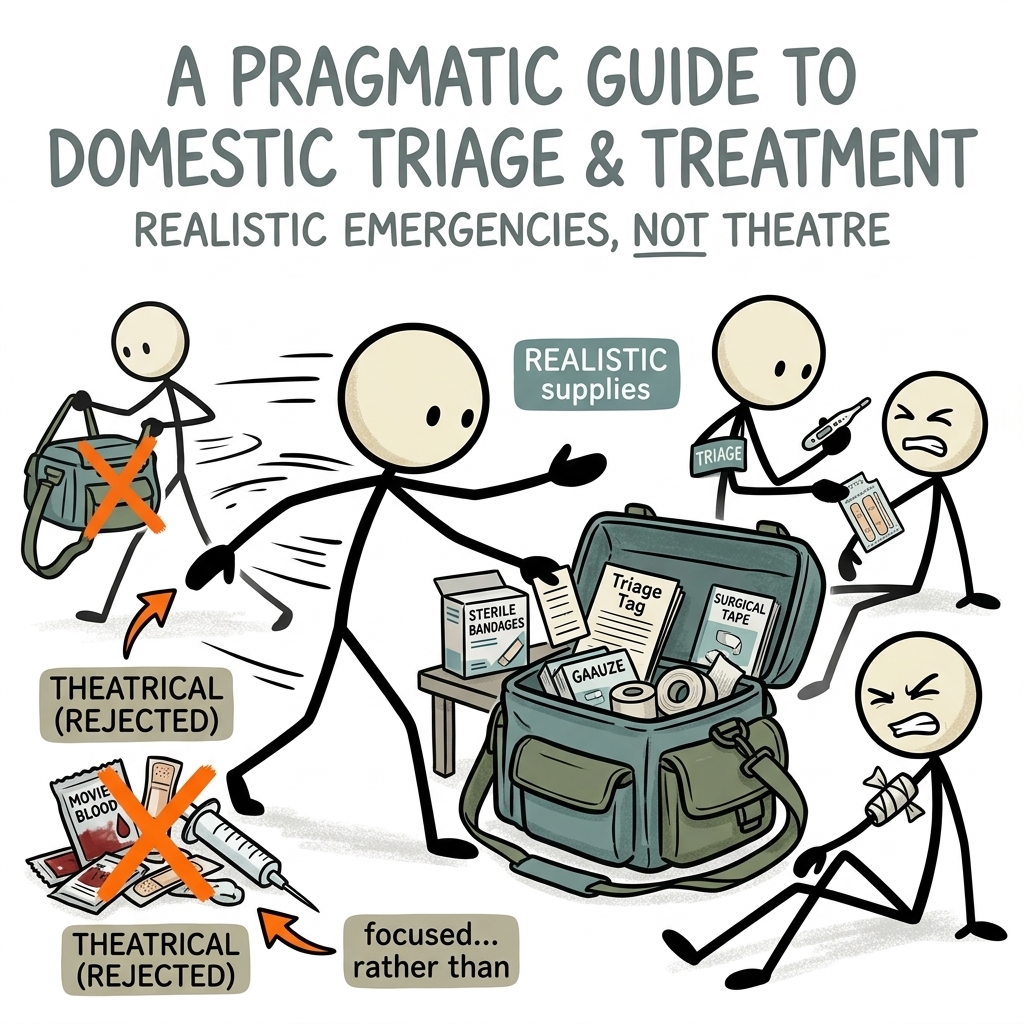
Theatrical Preparedness vs. Domestic Reality: Understanding Your Actual Risk Profile
The modern emergency preparedness market is saturated with "theatrical" medicine. Driven by military aesthetics and apocalyptic marketing, consumers are routinely nudged toward buying Individual First Aid Kits (IFAKs) engineered explicitly for the battlefield. While military trauma systems like Tactical Combat Casualty Care (TCCC) have revolutionized catastrophic bleeding management, their direct transposition into a family home often creates a dangerous illusion of preparedness. A chest decompression needle requires advanced paramedic-level diagnostic skill; in untrained hands attempting to treat a domestic fall, it is an instrument of severe medical malpractice. Conversely, an untreated deep laceration contaminated with raw poultry bacteria requires copious mechanical irrigation and layered non-adherent dressing—items rarely found in tactical blowout pouches. For the practical checklist side, use the neighborhood preparedness network.
Data from the National Safety Council (NSC) demonstrates that domestic trauma overwhelmingly clusters into five categories: blunt force impacts and falls, mechanical lacerations, thermal and scald burns, accidental toxic ingestions or medication errors, and acute respiratory or systemic allergic events. When assembling a household medical kit, your supply allocation must strictly reflect these probabilities. If your kit possesses three tourniquets but lacks an irrigation syringe, sterile saline, hydrogel burn pads, and a reliable pulse oximeter, your medical strategy is oriented around fantasy rather than clinical epidemiology. For the practical checklist side, use the emergency communication plan.
Pragmatic home preparedness does not mean ignoring life-threatening trauma. Severe bleeding can and does happen domestically—chainsaw kickbacks, lawnmower blade accidents, and severe glass table breaks are well-documented mechanisms of severe hemorrhage. However, a pragmatic kit integrates life-saving hemorrhage control within a broader, balanced architecture that addresses the full continuum of care: from life-threatening bleeding to the high-frequency minor emergencies that, if mismanaged, lead to systemic infection, chronic disability, or preventable hospital admissions. For the practical checklist side, use the family emergency planning guide.
The Tiered Architecture of an Effective Household Medical Kit
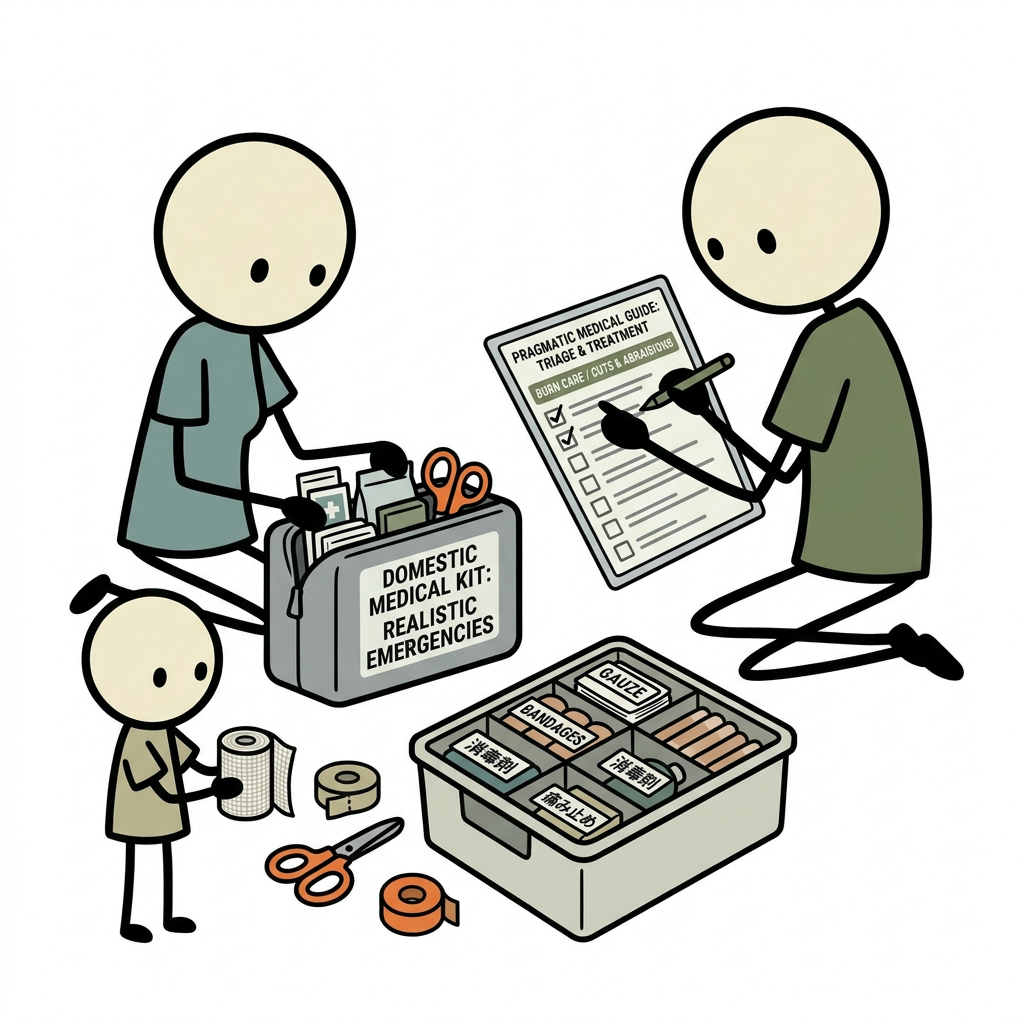
To avoid a disorganized pile of bandages and expired ointments, a domestic medical kit should be engineered according to clear operational tiers. When an incident occurs, you should not be rummaging through loose plastic bags. Grouping supplies into functional, modular modules allows the rescuer to access the exact tools needed for specific physiological challenges without creating visual chaos or contamination. For the practical checklist side, use the real-world emergency scenarios guide.
The Federal Emergency Management Agency (FEMA) emphasizes that medical kits must be structured to support both sudden, acute trauma and extended self-reliance during periods when municipal infrastructure is overwhelmed or unavailable. By dividing your supplies into distinct operational tiers, you ensure that anyone in your home can locate and deploy life-saving tools within seconds.
Tier 1: Immediate Hemostatic and Airway Intervention
This module addresses the immediate threats to life: rapid external hemorrhage and sudden airway obstruction. It should live at the very top of your storage system or in an instantly accessible pull-out pouch. The objective here is stabilization within the first 60 to 180 seconds of injury.
Tier 2: Wound Cleansing, Closure, and Infection Mitigation
This is your highest-utilization module. It manages everyday mechanical injuries: full-thickness lacerations, abrasions, punctures, and incision wounds. The clinical focus is not merely stopping blood flow, but achieving high-volume mechanical wound irrigation, sterile tissue approximation, and infection barriers.
Tier 3: Thermal, Chemical, and Scald Burn Management
Burns represent one of the most painful, clinically vulnerable injuries sustained in kitchens, workshops, and around outdoor heating equipment. This tier houses non-adherent hydrogel sheets, sterile protective wraps, and cooling agents designed to halt tissue necrosis without adhering to denuded dermis.
Tier 4: Orthopedic Stabilization and Soft Tissue Support
Designed for fractures, dislocations, sprains, and structural joint trauma resulting from falls or physical exertion. This module contains moldable structural splints, compressive immobilization wraps, and triangular bandages designed to secure extremities before professional radiological assessment.
Tier 5: Systemic Pharmacopeia and Diagnostics
The diagnostic and systemic module addresses systemic illness, toxic exposures, metabolic shifts, and pain management. It houses physiological monitoring equipment alongside an evidence-based selection of over-the-counter (OTC) oral medications, rehydration salts, and individual prescription buffers.
The Pragmatic Home First Aid Kit Checklist: Component by Component
Building a successful DIY first aid kit requires sourcing individual, hospital-grade items rather than purchasing generic, pre-packaged plastic cases filled with 200 plastic adhesive bandages and little else. Use the following structured home first aid kit checklist to assemble a medical cache that can genuinely handle serious domestic emergencies.
1. Hemorrhage Control & Mechanical Wound Management
When selecting emergency first aid supplies for lacerations, prioritize volume and versatility. A single roll of gauze is virtually useless during an active, pulsing bleed; your kit must contain sufficient absorbent and compressive material to maintain sustained direct pressure.
- Windlass Tourniquet (1-2 units): Procure only Committee on Tactical Combat Casualty Care (CoTCCC)-approved models, such as the Combat Application Tourniquet (C-A-T Gen 7) or the SOFTT-Wide. Avoid unbranded knockoffs sold on discount marketplaces; counterfeit windlasses frequently snap under operational torque. Keep one for severe domestic tool injuries.
- Elastic Pressure Dressings (2 units): 4-inch and 6-inch pressure bandages (commonly referred to as Israeli bandages or emergency trauma dressings). These combine a sterile non-adherent pad with an elastic wrap and built-in pressure bar to maintain constant force over an open laceration.
- Sterile Gauze Sponges (20-30 units): 4x4-inch, 12-ply woven cotton sponges. Essential for packing wounds, applying direct pressure, and cleaning peri-wound margins.
- Rolled Gauze / Conforming Bandages (4-6 rolls): 3-inch and 4-inch stretch gauze rolls used to secure dressings across moving joints or wrap limbs without restricting circulation.
- Wound Irrigation Syringe & Saline (500 ml): A 60 mL catheter-tip irrigation syringe paired with sterile 0.9% sodium chloride bottles. The CDC consistently warns against using hydrogen peroxide or isopropyl alcohol inside open wounds, as they destroy healthy granulating tissue. Mechanical irrigation with pressurized saline is the clinical gold standard for infection prevention.
- Wound Closure Strips & Skin Adhesive (2 packs each): Reinforced wound closure strips (such as Steri-Strips) and medical-grade 2-octyl cyanoacrylate (skin glue). These permit non-invasive approximation of clean, low-tension linear lacerations where traditional sutures are delayed or unnecessary.
- Heavy-Duty Trauma Shears (1 pair): Milled metal trauma shears with fluoride coating. Plastic-handled first-aid scissors will bind when cutting through heavy denim, leather work boots, or thick outerwear during an injury assessment.
2. Burn Care and Management
According to the American Burn Association, scald injuries and grease burns represent a massive share of domestic trauma. Standard cotton gauze applied directly to a partial-thickness burn will embed in the exudate, causing agony and tissue damage upon removal. Your household medical kit must feature dedicated burn supplies.
- Sterile Hydrogel Burn Dressings (3-4 units): Water-Jel or BurnTec dressings in 4x4-inch and 8x8-inch dimensions. These water-based ionic gels rapidly dissipate heat, mitigate pain through nerve ending coverage, and will not adhere to damaged skin.
- Medical Grade Plastic Cling Wrap (1 roll): Clean, food-grade plastic wrap or medical wrap sheets. Burn centers globally advocate the use of clean plastic film as an immediate cover for large burns: it protects exposed nerve endings from air currents, prevents evaporative fluid loss, and does not stick to the wound bed.
- Non-Adherent Dressings (10 units): Petrolatum-impregnated or Telfa pads designed specifically to cover healing burns and fragile skin without peeling away new cellular growth.
3. Orthopedic Stabilization and Soft Tissue Support
Domestic falls, sprains from home maintenance, and athletic injuries require immediate immobilization to prevent secondary neurovascular damage and manage severe pain. The objective is to stabilize the joint or bone in the position of comfort until radiographic imaging can be performed.
- Malleable Aluminum Foam Splints (2 units): Commonly known as SAM Splints (36-inch length). These lightweight strips of aluminum covered in closed-cell foam can be bent into structural structural curves (C-curve or reverse C-curve) to immobilize forearms, ankles, or wrists with exceptional rigidity.
- Elastic Compression Bandages (3-4 units): High-grade ACE-style wraps in 3-inch and 4-inch widths with hook-and-loop closures. Essential for sprain management, swelling control, and securing splints in place.
- Triangular Bandages / Cravats (4 units): 40x40x56-inch unbleached cotton cravats with safety pins. These provide immense utility: sling and swathe configurations for shoulder/collarbone trauma, wide tourniquet binders, or padding for splinted extremities.
- Instant Cold Packs (3-4 units): Chemical cold packs for immediate soft-tissue trauma and acute inflammation control when freezer ice is unavailable or inaccessible.
- Self-Adherent Cohesive Wrap (3 rolls): Often known as Coban or Vetrap. This wrap sticks only to itself, not to skin or hair, making it ideal for securing dressings on delicate or fragile skin without adhesive tears.
4. Essential Over-the-Counter (OTC) Pharmacopeia
An elite household medical kit is not merely a trauma kit; it is a point-of-care clinic. Your OTC medical cache must contain clear, functional treatments for pain, allergic reactions, gastrointestinal failure, and systemic dehydration. Store these in their original blister packs or clearly labeled containers, complete with active ingredients and expiration dates.
- Analgesics and Antipyretics: Maintain both Acetaminophen (Tylenol) and Ibuprofen (Advil/Motrin). These operate via distinct metabolic pathways (hepatic vs. renal) and can be safely alternated every 3–4 hours for intractable fever or severe pain under appropriate clinical guidelines.
- Antihistamines:
- First-generation: Diphenhydramine (Benadryl) for acute allergic reactions, hives, or acute sleep disruption.
- Second-generation: Cetirizine (Zyrtec) or Loratadine (Claritin) for non-sedating management of environmental allergies or milder histaminic reactions.
- Gastrointestinal Agents:
- Loperamide (Imodium): Halts runaway diarrheal motility, preventing rapid domestic fluid loss during infectious gastroenteritis outbreaks.
- Bismuth Subsalicylate (Pepto-Bismol): Provides antimicrobial and anti-secretory action against mild foodborne toxicity and dyspepsia.
- Famotidine (Pepcid) or Antacids: Manages acute esophageal reflux and acts as an H2 blocker during systemic allergic responses alongside diphenhydramine.
- Oral Rehydration Salts (WHO Formula, 6-10 packets): Dehydration from seasonal gastrointestinal illness kills thousands domestically every year, particularly among children and the elderly. Oral Rehydration Salts (ORS) utilizing the World Health Organization ratio of glucose to sodium exploit the sodium-glucose cotransport mechanism in the small intestine, rehydrating patients far more efficiently than standard sports drinks.
- Topical Formulations: 1% Hydrocortisone cream for inflammatory contact dermatitis; Triple Antibiotic or Bacitracin ointment for superficial abrasions; and 10% Povidone-Iodine solution for cleaning uncompromised skin surrounding an injury.
5. Clinical Assessment and Diagnostic Tools
You cannot treat what you cannot measure. One of the greatest failures of commercial first aid kits is the complete absence of diagnostic instruments. Treating an emergency without vital signs is pure guesswork; having objective metrics allows you to communicate clearly and effectively with emergency dispatchers or triage nurses.
- Pulse Oximeter: A reliable fingertip plethysmograph measuring peripheral capillary oxygen saturation (SpO2) and pulse rate. Crucial for assessing respiratory distress from asthma, viral infections, or carbon monoxide exposure.
- Digital Blood Pressure Monitor: An automated, clinically validated upper-arm cuff. Avoid wrist-based units, which are notoriously prone to positional error. Essential for assessing shock, hypertensive crises, or syncope.
- Accurate Digital Thermometer: Both an oral/rectal digital probe and an infrared temporal scanner to detect hypothermia or rapid-onset pediatric fever.
- Medical Diagnostic Penlight: For inspecting the posterior oropharynx, pupillary response, and deep tissue wounds without the blinding glare of a standard high-lumen tactical flashlight.
- Surgical Lubricant and Nitrile Gloves (10-15 pairs): Nitrile eliminates latex allergy concerns. Stock multiple sizes to accommodate all adult members of the household.
Comprehensive DIY First Aid Kit Checklist
Use the following summary table to audit your existing supplies and build a resilient household medical inventory from scratch.
| Category | Recommended Item | Target Quantity | Primary Clinical Function |
|---|---|---|---|
| Hemorrhage & Trauma | CoTCCC-Approved Tourniquet (C-A-T or SOFTT-W) | 1–2 | Occlusion of arterial limb hemorrhage |
| Hemorrhage & Trauma | 4" & 6" Pressure Bandages (Emergency Trauma Dressing) | 2–3 | Focused compression over moderate-to-severe lacerations |
| Hemorrhage & Trauma | 4" x 4" Sterile Gauze Sponges (12-ply) | 20–30 | Wound packing, exudate absorption, direct manual pressure |
| Hemorrhage & Trauma | Rolled Conforming Gauze (3" and 4") | 4–6 rolls | Securing primary dressings across limbs and joints |
| Wound Hygiene | Sterile 0.9% Saline Solution (250–500ml bottles) | 2 bottles | Mechanical irrigation of contaminated wounds |
| Wound Hygiene | 60 mL Catheter-Tip Irrigation Syringe | 1–2 | Delivers pressurized fluid to dislodge debris |
| Wound Closure | Reinforced Skin Closures (Steri-Strips) & Skin Glue | 2 packs each | Non-invasive primary closure of linear incisions |
| Burn Management | Hydrogel Burn Dressings (4"x4" and 8"x8") | 3–4 | Rapid thermal cooling, pain relief, non-adherent barrier |
| Burn Management | Medical-Grade Cling Wrap / Clear Film | 1 roll | Temporary non-stick covering for extensive burns |
| Orthopedics | SAM Splint (36-inch universal) | 2 | Immobilization of suspected fractures/dislocations |
| Orthopedics | Elastic Bandages (ACE-type, 3" and 4") | 3–4 | Joint compression, soft tissue support, splint fixation |
| Orthopedics | Triangular Bandages (Cravats with safety pins) | 4 | Arm slings, shoulder immobilization, versatile binding |
| Diagnostics | Fingertip Pulse Oximeter | 1 | Monitoring peripheral SpO2 and resting heart rate |
| Diagnostics | Automatic Upper-Arm Blood Pressure Monitor | 1 | Assessing cardiovascular stability and signs of shock |
| Diagnostics | Digital Clinical Thermometer | 1 | Objective fever and hypothermia evaluation |
| Pharmacopeia | Acetaminophen & Ibuprofen | 1 bottle each | Tiered dual-mechanism antipyresis and pain control |
| Pharmacopeia | Diphenhydramine & Cetirizine | 1 box each | Acute vs. daily histamine/allergic reaction mitigation |
| Pharmacopeia | Loperamide & Bismuth Subsalicylate | 1 box each | Gastrointestinal stabilization and fluid preservation |
| Pharmacopeia | WHO-Formula Oral Rehydration Salts (ORS) | 6–10 packs | Corrects severe fluid/electrolyte loss from illness |
Tailoring Emergency First Aid Supplies to Household Realities
A standardized checklist provides the structural baseline, but a genuinely practical household medical kit accounts for the specific vulnerabilities of your household. Two demographics in particular—pediatric patients and older adults—require tailored additions to prevent standard first aid items from failing during an emergency.
Pediatric Considerations
Children are not simply small adults; their physiology, airway geometry, and pharmacological tolerance differ fundamentally. Standard adult bandages are too large for small limbs, and adult medications can lead to accidental toxicity if dosing is rushed during a crisis.
- Weight-Based Dosing Guides: Pre-print a laminated pediatric dosing chart for liquid Acetaminophen and Ibuprofen based on current weights. In an emergency, calculating milligrams per kilogram under severe cognitive stress invites dangerous dosage errors.
- Calibrated Syringes: Stock multiple 5 mL and 10 mL oral dosing syringes. Dosing spoons are notoriously imprecise; exact volumetric measurement is mandatory for infants and toddlers.
- Pediatric-Specific Dressings: Smaller 2x2-inch gauze pads, flexible fingertip bandages, and gentle silicone-based tapes that peel off without tearing immature epidermis.
Geriatric and Fragile Skin Modifications
As human skin ages, the dermal layer thins significantly, while vascular fragility increases. Aggressive medical adhesives like standard zinc-oxide surgical tape or traditional duct tape will cause skin tears and deep epidermal stripping on older adults, compounding the original injury.
- Silicone-Based Medical Tape: Soft silicone tape bonds gently to skin surfaces, allowing repositioning and pain-free removal without mechanical trauma.
- Tubular Elastic Retainers: Net-style tubular bandages that slide over limbs to hold primary gauze dressings securely in place without requiring any skin adhesive whatsoever.
- Prescription Buffers: Work with personal physicians to secure a rotating 14-to-30-day buffer supply of critical maintenance medications (antihypertensives, insulin, antiarrhythmics, thyroid medications). FEMA consistently warns that standard pharmacies often close for days during severe weather or logistics interruptions.
Storage, Organization, and Maintenance: Building an Actionable System
The finest essential first aid items in the world become useless if they are stored in a disorganized plastic tote in the back of an inaccessible closet. When an emergency strikes, your cortisol spikes, your fine motor skills degrade, and tunnel vision sets in. If your system requires sorting through a chaotic pile of supplies to find a roll of tape, that system has failed.
Avoid the temptation to use a deep, single-cavity gym bag or a tackle box with dozens of tiny compartments that spill open. Instead, choose a clear-sided medical organization bag, a drop-front trauma backpack, or a wall-mounted hard-shell cabinet with internal color-coded pouches. Transparency and rapid visual recognition are non-negotiable.
Implement a modular, color-coded packing protocol based on clinical function:
- Red: Massive Hemorrhage, Tourniquets, Pressure Dressings
- Blue: Airway, Diagnostics, Vitals (Oximeter, BP Cuff, Thermometer)
- Yellow: Burn Care and Hydrogels
- Green: Minor Wound Care, Irrigation, Bandages, Topicals
- Orange: Splints, Cold Packs, Orthopedic Support
- Clear/White: Systemic Pharmacopeia and Rehydration
Finally, establish a rigid inspection schedule. A domestic medical kit is an active, evolving life-support system, not a static purchase. Mark your calendar to audit your kit every six months—the biannual daylight saving time transition serves as an ideal trigger. During each audit, systematically discard expired medications, verify that diagnostic batteries haven't corroded, confirm sterile seals remain intact, and replenish supplies used during minor household mishaps.
Preparedness Grounded in Reality
True emergency preparedness is measured not by the visual intimidation of your gear, but by its alignment with the emergencies you are most likely to face. While military aesthetics may offer a feeling of control, real resilience is forged through the quiet, disciplined assembly of tools that address the practical threats to human life: wound infection, thermal trauma, sudden musculoskeletal collapse, and systemic illness. By stepping away from theatrical medical gear and building a methodical, clinically grounded domestic medical kit, you replace panic with competence. You ensure that when an unexpected emergency occurs within your home, you will not be a helpless bystander—you will be an equipped, rational, and effective first responder for the people who matter most.
Frequently Asked Questions
What common injuries should a standard home first aid kit be equipped to handle?
A standard home kit should be equipped for everyday, non-life-threatening emergencies including minor cuts, abrasions, puncture wounds, first- and mild second-degree burns, sprains, insect stings, and minor allergic reactions.
How often should you inspect and restock your home first aid kit?
Inspect your kit at least every six months to check expiration dates on topical ointments and medications, replace depleted items, and ensure that sterile packaging has not been compromised.
Should you buy a pre-packaged first aid kit or build a custom one?
A hybrid approach is ideal: purchase a reputable pre-assembled kit meeting ANSI standards to cover basic sterile dressings and tools, then supplement it with specific family medications, trauma shears, and personalized supplies.
Where should a home first aid kit be stored?
Store the kit in a cool, dry, clearly marked location that is easily accessible to all adults and responsible children, avoiding humid environments like bathrooms which can degrade adhesive and sterile seals.
What is the threshold between treating an injury at home and seeking professional emergency care?
Home care is appropriate for wounds with controlled bleeding, surface burns, and minor swelling. Seek professional medical evaluation immediately for arterial or uncontrolled bleeding, deep puncture wounds, severe burns covering large surface areas, signs of fracture, or head trauma.