⚡ Key Facts
- Supply Chain Fragility: According to the Federal Emergency Management Agency (FEMA), localized disasters can disrupt grocery store supply chains within 48 to 72 hours, making active food procurement skills essential for long-term resilience. For the practical checklist side, use the community emergency preparedness guide.
- Nutritional Density: United States Department of Agriculture (USDA) data reveals that wild venison contains roughly 50% more protein and up to 80% less saturated fat than commercial grain-fed beef, providing a clean, nutrient-dense survival fuel. For the practical checklist side, use the neighborhood preparedness network.
- High Caloric Return: A single mature white-tailed deer yields an average of 45 to 65 pounds of boneless, lean meat, translating to approximately 35,000 to 50,000 calories of life-sustaining nutrition. For the practical checklist side, use the emergency communication plan.
- Pathogen Mitigation: The Centers for Disease Control and Prevention (CDC) emphasizes that cooking wild game to safe internal temperatures (160°F for ground meat and wild game) is critical to eliminating zoonotic risks such as trichinellosis and toxoplasmosis.
- Watering Hole Reliability: United States Geological Survey (USGS) wildlife mapping confirms that over 80% of terrestrial game species in North America rely on riparian zones (creeks, rivers, and wetlands) for daily hydration and travel corridors.
When a severe, systemic crisis disrupts our highly centralized food distribution networks, store-bought stockpiles begin a relentless countdown to zero. While freeze-dried meals, white rice, and canned goods are indispensable components of an initial emergency reserve, they represent a finite, depreciating asset. True long-term resilience requires a transition from passive emergency food storage guide to active, sustainable food production. For those preparing for extended off-grid scenarios, mastering the art of hunting for food security is not merely a traditional skill—it is a critical imperative for self-reliance. This comprehensive guide introduces beginner preppers to the essential gear, tracking fundamentals, and preservation strategies necessary to transform the wilderness into a reliable, renewable pantry.
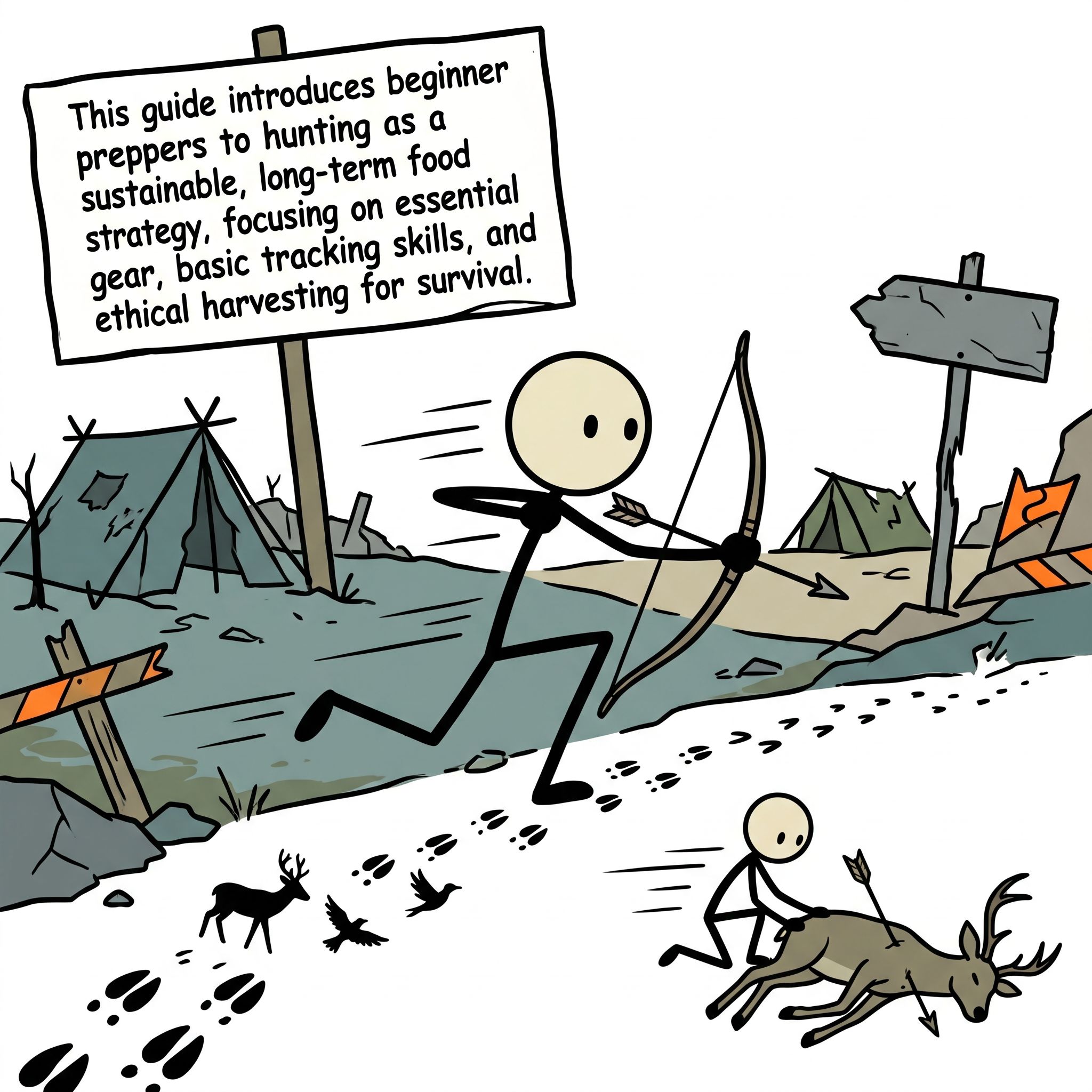
The Tactical Shift: Hunting for Food Security vs. Recreational Sport
Recreational hunting in the modern era is heavily defined by regulations, specific seasons, trophy selection, and high-tech conveniences. In contrast, utilizing hunting for survival requires an entirely different operational mindset. In a long-term emergency, your primary objective is caloric efficiency and risk mitigation. Spending days tracking a single trophy buck across rugged terrain may yield a high caloric reward, but it also carries a high risk of injury, exhaustion, and caloric deficit if the hunt fails.
To establish true food security, beginner preppers must focus on the concept of Return on Investment (ROI). This means prioritizing high-probability, low-risk game. While big game animals like deer and elk offer massive caloric payloads, small game animals—such as rabbits, squirrels, and waterfowl—are far more abundant, easier to harvest, and present a lower risk of physical injury. Additionally, hunting small game minimizes the noise signature of your firearms, helping you maintain a low profile in a sensitive security environment.
The Math of Survival Calories
Understanding the caloric requirements of your household is the first step in planning your emergency food procurement strategy. A moderately active adult requires approximately 2,000 to 2,500 calories per day to maintain body weight and physical performance. In a high-stress, physically demanding Survival Scenarios, this requirement can easily climb to 3,500 calories or more.
- Small Game (Rabbit/Squirrel): Yields approximately 300 to 600 calories per animal. Easy to process, requires minimal salt or preservation equipment, and can be harvested using silent methods like traps, snares, or air rifles.
- Large Game (White-tailed Deer): Yields approximately 35,000 to 50,000 calories. Requires significant effort to harvest, field dress, transport, and preserve, but can sustain a small family for weeks if properly managed.
- Waterfowl (Duck/Goose): Yields approximately 600 to 1,200 calories. Highly migratory, offering seasonal abundance, but requires knowledge of local flyways and water bodies.
By balancing your efforts between consistent small-game harvesting and opportunistic big-game hunting, you create a diversified, resilient strategy for long-term survival.
Essential Prepper Hunting Gear: The Minimalist Survival Kit
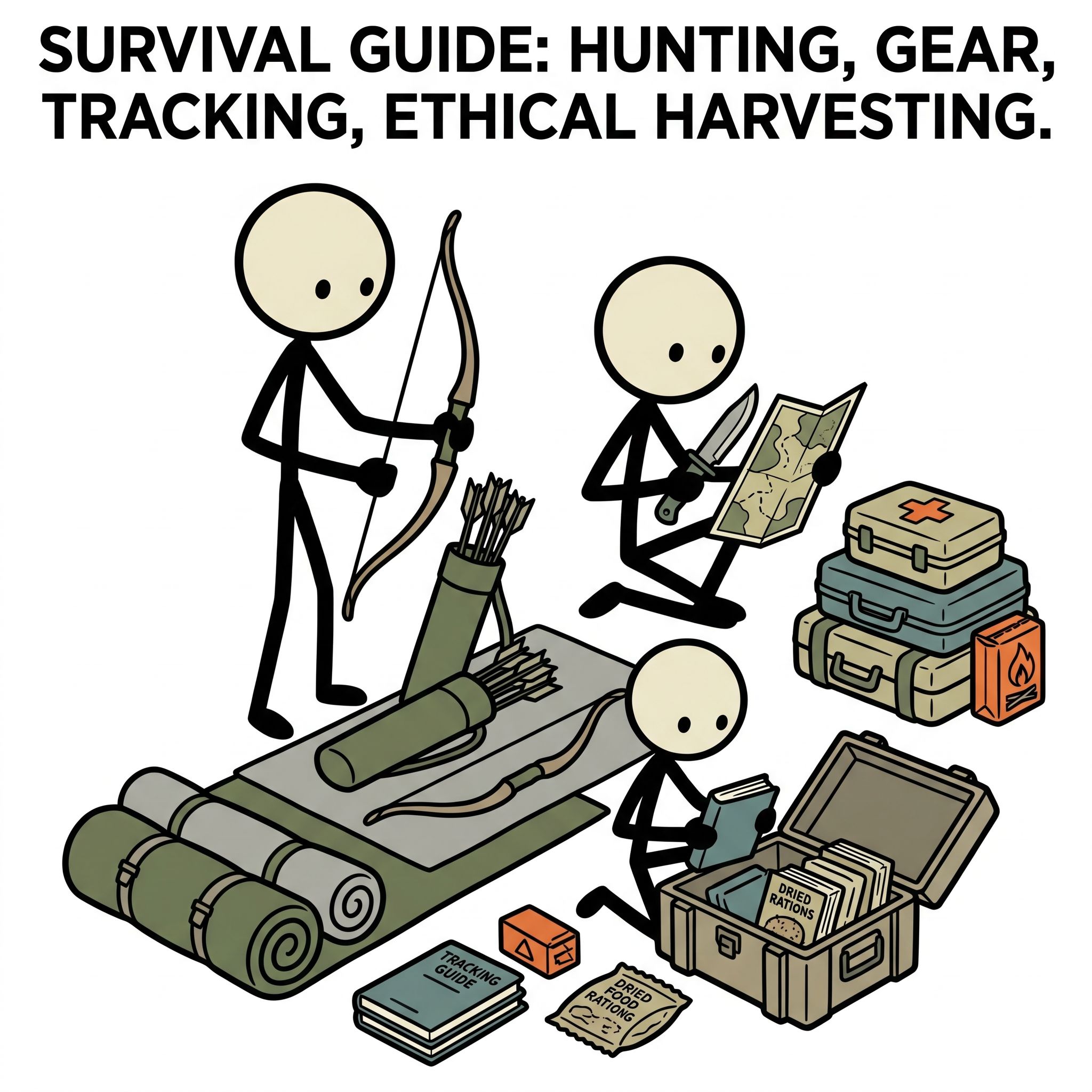
In a long-term grid-down scenario, you cannot rely on specialized archery shops or sporting goods retailers for replacement parts, specialized ammunition, or high-tech maintenance. Your prepper hunting gear must be selected based on three non-negotiable criteria: durability, versatility, and ease of maintenance. When assembling your kit, focus on robust, time-tested tools that can perform multiple functions in the field.
1. Primary and Secondary Harvest Tools
A versatile survival battery does not require an arsenal of specialized firearms. Instead, a beginner should focus on two highly versatile platforms that cover both small and large game procurement:
- The .22 Long Rifle (.22 LR): This is the undisputed king of survival calibers. The ammunition is incredibly lightweight, allowing a single prepper to carry 1,000 rounds in a small backpack. It is quiet, has virtually no recoil, and is highly effective for harvesting small game up to 50 yards away without destroying valuable meat.
- The 12-Gauge Shotgun: Perhaps the most versatile firearm on the planet. With birdshot, it is an excellent tool for taking fast-moving small game and waterfowl. With buckshot or slugs, it is fully capable of harvesting large game at close-to-medium ranges. The pump-action mechanism is incredibly robust and rarely malfunctions in harsh environments.
- The Mid-Caliber Bolt-Action Rifle: For long-range big game hunting, a bolt-action rifle chambered in standard, highly available calibers like .308 Winchester or .30-06 Springfield is ideal. Bolt-action designs have fewer moving parts than semi-automatics, making them highly reliable and easy to field-strip and clean in the bush.
2. Field Dressing and Processing Tools
Once an animal is down, the clock begins ticking against bacterial spoilage. Having the right processing gear on your person is just as important as the weapon used to make the harvest. Your field dressing kit should include:
- A High-Quality Fixed-Blade Knife: Avoid folding knives for field dressing, as fat, blood, and tissue will quickly clog the locking mechanism, creating a breeding ground for bacteria. Choose a full-tang, fixed-blade knife with a 3- to 4-inch blade made of high-carbon or high-quality stainless steel (such as S30V or 1095) that holds an edge through tough hide and bone.
- A Compact Bone Saw: Essential for cleanly splitting the pelvic bone and brisket of large game, which speeds up the cooling process and prevents contamination from the digestive tract.
- Breathable Game Bags: Lightweight, synthetic, or cotton mesh bags protect the meat from flies, dirt, and debris while allowing heat to escape, facilitating rapid cooling.
- Nitrile Gloves and Sanitizing Wipes: Protection against zoonotic pathogens is paramount. The CDC recommends wearing heavy-duty nitrile gloves when handling wild game to prevent the transmission of diseases like tularemia or brucellosis.
3. Navigation, Scent Control, and Safety
Getting lost or injured in the backcountry during a crisis can turn a food procurement mission into a life-threatening emergency. Always carry a mechanical lensatic compass and physical USGS topographic maps of your hunting area. Do not rely solely on GPS units or smartphone applications, which are vulnerable to battery depletion, cold weather failure, and EMP (electromagnetic pulse) vulnerability.
Additionally, scent control is critical. Wild animals, particularly cervids (deer, elk), have olfactory systems that are thousands of times more sensitive than ours. Pack scent-free soap for your body and gear, and always carry a basic wind indicator (such as a small puff bottle of unscented powder) to monitor shifting thermal currents in real-time.
Basic Tracking and Woodsman Skills
Successful survival hunting for beginners relies far more on woodcraft and observation than on marksmanship. To harvest game consistently, you must learn to read the landscape like a map, identifying the subtle clues that animals leave behind as they move between bedding areas, water sources, and feeding zones.
Reading the Landscape and Game Sign
All animals are driven by basic biological needs: food, water, security, and reproduction. By analyzing these three factors on a USGS topographic map, you can predict animal movement patterns with high accuracy.
- Tracks and Trails: Look for established game trails, which appear as narrow, worn paths through the vegetation. Examine tracks to determine the direction of travel, the relative size of the animal, and how recently the print was made. Sharp, defined edges in damp soil indicate a fresh track, while rounded, eroded edges indicate an older print.
- Scat (Feces): Scat provides invaluable clues about the species, diet, and proximity of the animal. Moist, shiny scat indicates that the animal passed through the area recently. Dry, fibrous, or bleached scat suggests the area has been abandoned or is only used seasonally.
- Rubs and Scrapes: During the autumn breeding season, male deer scrape their antlers against small trees (rubs) and clear away ground leaf litter with their hooves (scrapes) to mark their territory. These signs indicate active, local resident populations and are prime locations for setting up an ambush.
- Browse Lines: Look for signs of feeding. Deer clean-cut the tips of twigs and low-hanging branches, while rabbits leave clean, 45-degree angle cuts on small woody stems. Identifying these feeding zones helps you determine where game will congregate during early morning and late evening hours.
The Art of the Approach: Wind and Stealth
The wind is the single most important factor in hunting. If an animal catches your scent, the hunt is over before it begins. Always hunt with the wind blowing directly into your face, or crosswise to your path of travel. If you feel the wind hitting the back of your neck, you are blowing your scent directly into the bedding or feeding areas ahead of you.
When moving through the woods, practice "still hunting." This does not mean standing still; rather, it is a highly deliberate method of moving incredibly slowly. Take two or three quiet steps, then pause for 30 to 60 seconds to scan your surroundings. Use your peripheral vision to detect movement, such as the flick of a tail, the twitch of an ear, or the horizontal line of an animal's back amidst the vertical patterns of the forest trees.
Ethical Harvesting and Shot Placement
In a survival situation, an ethical harvest is not just a moral obligation—it is a practical necessity. A poorly placed shot can result in a wounded animal that runs for miles before dying, wasting valuable energy in a grueling search and potentially losing the meat entirely to predators or spoilage. Furthermore, a clean, rapid kill prevents the release of excess adrenaline and lactic acid into the animal's muscles, which can negatively affect the flavor and preservation qualities of the meat.
Optimal Shot Placement for Big Game
For large game like deer, the most effective and forgiving target is the vital zone, which contains the heart and lungs. This area is located directly behind the animal's front shoulder.
When the animal is standing broadside (perpendicular to you), aim approximately one-third of the way up from the bottom of the chest cavity, just behind the shoulder crease. A projectile passing through this zone will collapse the lungs and disrupt the cardiovascular system, resulting in a rapid, humane harvest within seconds. Avoid head and neck shots unless you are an exceptionally skilled marksman; the brain and spine are small targets, and a minor miss can cause horrific, non-lethal injuries to the jaw or throat.
| Animal Position | Target Area | Pros | Cons |
|---|---|---|---|
| Broadside | Double Lung / Heart (Behind front shoulder) | Largest vital target; high margin of error; rapid death. | Slightly delays animal expiration compared to CNS shots. |
| Quartering Away | Behind shoulder, aiming toward opposite shoulder | Penetrates multiple vital organs; highly effective. | Requires careful angling to avoid puncturing the stomach. |
| Quartering Toward | Front of shoulder / Brisket | Direct path to heart and major arteries. | Small target window; high risk of damaging shoulder meat. |
Small Game Harvesting
When harvesting small game with a .22 LR or a high-powered air rifle, headshots are the preferred method. Because rabbits and squirrels are small, a body shot can easily rupture the digestive tract, spilling bile and stomach contents onto the delicate meat, rendering it unpalatable or unsafe to eat. A precise shot to the brain or upper neck ensures instant dispatch and preserves 100% of the edible meat.
Field Dressing and Off-Grid Meat Preservation
Once the animal has been successfully harvested, the real work begins. Your immediate priority is to lower the core temperature of the carcass as quickly as possible to halt bacterial growth. Bacteria thrive in warm, moist environments, and the thick hide and internal organs of a large animal act as an insulator, trapping heat inside the body cavity.
Step-by-Step Field Dressing (Large Game)
- Position the Carcass: Place the animal on its back, securing the hind legs apart to allow clear access to the abdomen. If you are on a slope, position the animal's head uphill to prevent stomach contents from spilling upward into the chest cavity.
- The Initial Cut: Locate the pelvis. Make a shallow incision in the skin just above the genitals. Insert your index and middle fingers of your non-dominant hand into the cut, pointing toward the chest. Use your fingers to guide the blade of your knife, blade facing upward, away from the internal organs. This "zipper" technique prevents you from accidentally puncturing the stomach or intestines.
- Split the Sternum and Pelvis: Use your bone saw to cut through the center of the breastbone (sternum) up to the neck. Then, carefully split the pelvic bone between the hind legs.
- Free the Windpipe and Esophagus: Reach into the neck cavity, locate the windpipe, and cut it as high up as possible. Pull the windpipe downward; this will help roll the lungs and heart out of the chest cavity.
- Remove the Entrails: Carefully cut the connective tissue holding the stomach and intestines to the spine. Roll the entire digestive tract out of the body cavity. Cut around the anus (or "bung") from the outside, tying it off with a small piece of string to prevent fecal leakage, and pull it inward through the split pelvis to remove it entirely.
- Cool and Dry: Wipe the inside of the body cavity dry with a clean cloth or paper towels. Do not use water to rinse the cavity unless you can dry it thoroughly afterward, as moisture promotes bacterial colonization. Hang the carcass in a shaded, well-ventilated area to allow a protective, dry "skin" (pellicle) to form over the meat.
Off-Grid Preservation Methods
In a long-term grid-down scenario, you will not have access to domestic freezers. You must rely on historical, time-tested food preservation methods to store your harvest for the winter months.
- Cold Smoking: This method does not cook the meat but dries it while infusing it with antimicrobial compounds found in hardwood smoke (such as oak, hickory, or maple). Cold smoking is typically conducted at temperatures below 100°F (38°C) for several days, creating a dry, shelf-stable product.
- Hot Smoking: Cooks the meat while applying smoke, raising the internal temperature to safe levels (above 160°F). This is excellent for short-to-medium-term storage, but the meat must still be consumed within a few weeks unless combined with heavy drying or salting.
- Salting and Curing: Salt draws moisture out of the muscle fibers, creating an environment that is too dehydrated for bacteria to survive. Pack thin strips of meat in kosher or non-iodized sea salt, or submerge them in a heavy brine solution before air-drying.
- Dehydration (Jerky): Slice lean meat into thin strips (less than 1/4 inch thick), marinate with salt and spices, and dry them over a low, indirect heat source or in a solar dehydrator until the meat is brittle and bends without breaking.
Integrating Hunting into Your Overall Prep Strategy
Developing proficiency in emergency food procurement is not a skill that can be acquired overnight by reading a manual during a crisis. It requires consistent, hands-on practice, physical conditioning, and a deep understanding of your local ecosystem. Start by spending time in the woods during peaceable times, practicing your tracking and observation skills without a weapon. Learn to identify the native flora and fauna in your region, and study the seasonal migration and feeding patterns of local wildlife.
Furthermore, hunting should never be viewed as your sole survival strategy. Instead, integrate it into a multi-layered self-reliance plan that includes home gardening, food storage, foraging, and active community bartering. By combining a robust stockpile of non-perishable goods with the active, renewable skill of hunting, you insulate your family from the shocks of a fragile global supply chain and secure a self-reliant future, no matter what challenges lie ahead.
Frequently Asked Questions
What is the best game for beginner survival hunters to target?
Small game like rabbits and squirrels are ideal for beginners because they are abundant, easier to hunt with basic equipment like a .22 rifle, and simpler to field dress than large game.
What essential gear does a beginner prepper need to start hunting?
Key essentials include a reliable firearm or bow, appropriate ammunition, a high-quality field dressing knife, hunter orange safety clothing, a first aid kit, and a local hunting license.
How do you safely preserve wild game meat without electricity?
Without refrigeration, wild game can be preserved using traditional off-grid methods such as pressure canning, salt-curing, smoking, or dehydrating meat into jerky.
Are there legal considerations for hunting as a prepper?
Yes. Unless in an absolute, long-term societal collapse, state and federal hunting regulations, seasons, and licensing laws must be strictly followed to avoid heavy fines and protect wildlife populations.
How can a beginner learn to field dress an animal safely?
The safest way to learn is by taking a state-certified hunter education course, studying anatomical guides, and practicing under the direct supervision of an experienced mentor to prevent meat contamination.