⚡ Key Facts
- Language Disparities in Crisis: According to the U.S. Census Bureau, over 67 million U.S. residents speak a language other than English at home, yet post-disaster assessments by FEMA repeatedly reveal that critical Wireless Emergency Alerts (WEA) and localized evacuation orders often experience severe translation latency or geographic gaps.
- Civil Rights Protections: Under Title VI of the Civil Rights Act of 1964 and Section 308 of the Stafford Act, emergency relief, shelter operations, and disaster assistance provided by federally funded agencies must be administered without discrimination based on race, color, nationality, or English proficiency.
- Enforcement-Free Shelter Sites: Department of Homeland Security (DHS) policy designates disaster response sites—including emergency shelters, medical aid stations, and food distribution centers—as protected areas where immigration enforcement actions are prohibited.
- Documentation Vulnerability: The Federal Emergency Management Agency (FEMA) notes that missing identification and proof of residence are among the top causes of delayed relief aid; dual-format, cross-jurisdictional records prevent catastrophic administrative delays during displacement.
When Hurricane Ida struck the Northeast in September 2021, intense flash flooding overwhelmed dozens of basement apartments across Queens and northern New Jersey. The majority of residents who lost their lives were immigrants whose primary languages were Spanish, Cantonese, or Nepali. Many never received localized emergency push notifications, while others hesitated to seek municipal shelter out of fear that contact with local authorities might imperil their legal standing or expose non-citizens in their households. A truly robust emergency protocol must move beyond standard supply stockpiles to address the legal, institutional, and linguistic realities faced by diverse communities. Tailoring household plans to language needs, vital document security, school networks, and community resources transforms survival planning into an empowering blueprint for safety.
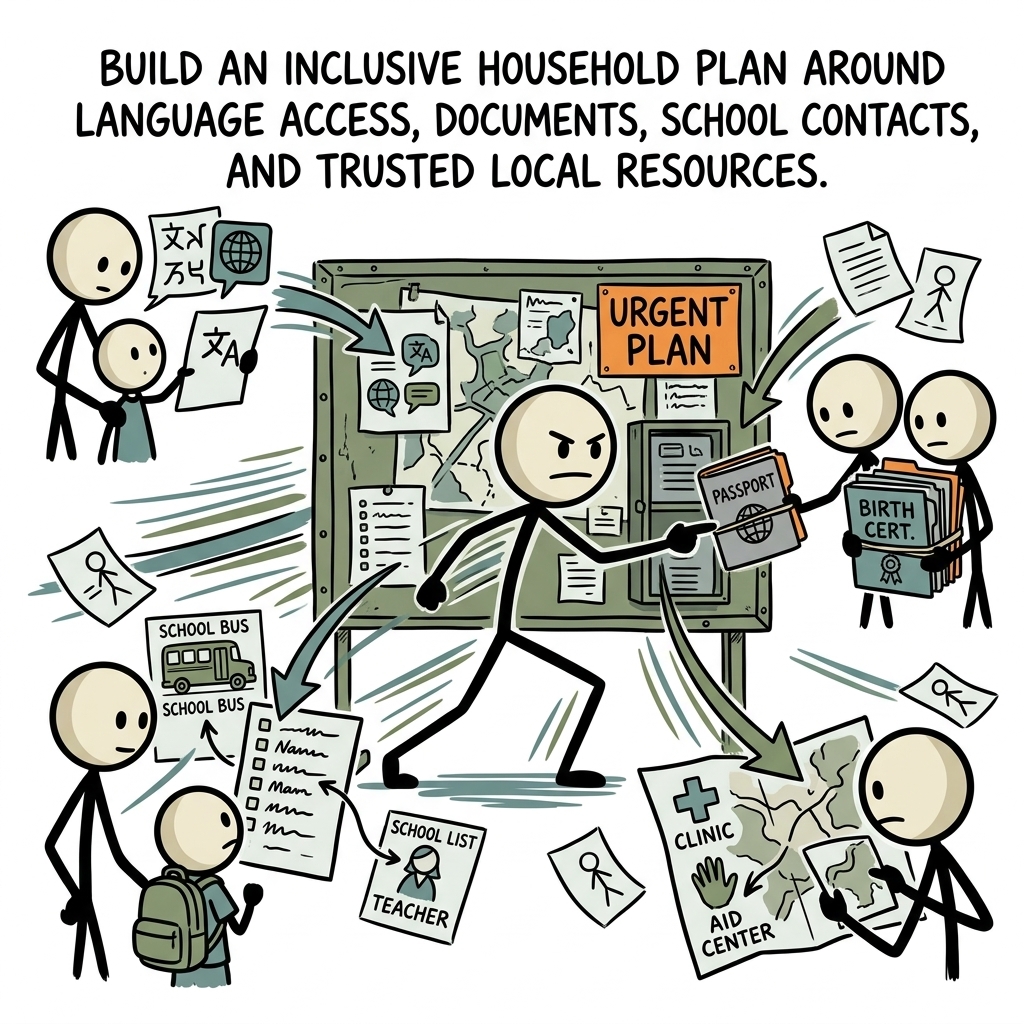
Overcoming Linguistic Barriers: Building a Multilingual Alert Network
A crisis moves at the speed of information. If household members cannot decipher an alert within seconds, response times collapse. Building language access into household resilience ensures that every member of the family—from children to monolingual elders—understands what hazards are approaching and what immediate actions to take.
Configuring Multilingual Wireless Emergency Alerts (WEA)
Modern smartphones receive Wireless Emergency Alerts broadcast by local public safety officials via FEMA's Integrated Public Alert and Warning System (IPAWS). However, the language in which these alerts appear depends entirely on individual device settings and local dispatch capabilities. While WEA 3.0 supports alerts in both English and Spanish, transmission relies on local alerting authorities issuing dual-language messages.
- Verify Device Settings: Ensure every smartphone in the home has its default operating system language set to the user's primary language. If an alert is broadcast with an alternate language payload, the phone will automatically display that native text.
- Install Multilingual Weather Apps: Complement IPAWS alerts with specialized applications. The official FEMA app provides weather alerts, safety tips, and open shelter locations in both English and Spanish. The American Red Cross suite of apps offers instant toggle options for multi-language emergency tracking.
- Enable Push Notifications from Local EmComm Channels: Many metropolitan emergency management offices (such as NYC's Notify NYC or Ready Harris in Texas) provide multilingual SMS alerts in up to a dozen languages, including Mandarin, Vietnamese, Tagalog, and Arabic. Actively opt into these county-level databases.
NOAA Weather Radio and Secondary Audio Programming (SAP)
During severe weather scenarios, cellular towers often fail or congest within the first thirty minutes of a catastrophic event. A dedicated All-Hazards NOAA Weather Radio is an indispensable safeguard, but households must understand its linguistic limits. Standard NOAA radio broadcasts across the United States operate primarily in English.
To overcome this limitation, locate localized broadcast bridges. In numerous southern and western counties, municipal authorities collaborate with local non-English media to rebroadcast NOAA weather feeds via Secondary Audio Programming (SAP) channels on public television or through localized low-power FM radio stations. Keep a laminated card affixed to your emergency radio displaying the specific AM/FM frequencies for trusted foreign-language community stations that maintain backup broadcast power during regional grid failures.
Designating and Cross-Training Household Translators
In many multi-generational immigrant households, younger family members are often the most fluent in English. Relying solely on a single child or teenager during a chaotic evacuation, however, can introduce high emotional stress and single-point-of-failure vulnerabilities.
- Establish Standardized Visual Flashcards: Create a physical ring of flashcards with clear pictograms alongside bilingual text for critical commands: "EVACUATE NOW," "SHELTER IN PLACE," "SHUT OFF GAS," "TAKE MEDICINE," and "CALL 911."
- Designate a Secondary External Translator: Identify a trusted relative, neighbor, or family friend outside your immediate hazard zone who is bilingual. If emergency communication plan fails within the household, this contact serves as an off-site translation relay.
- Practice Low-Tech Drills: Conduct seasonal household drills where no English is spoken, forcing every resident to rely entirely on visual cues, mapped exit routes, and localized non-English communication aids.
Vital Documents: Preservation, Legal Integrity, and Rights Protection
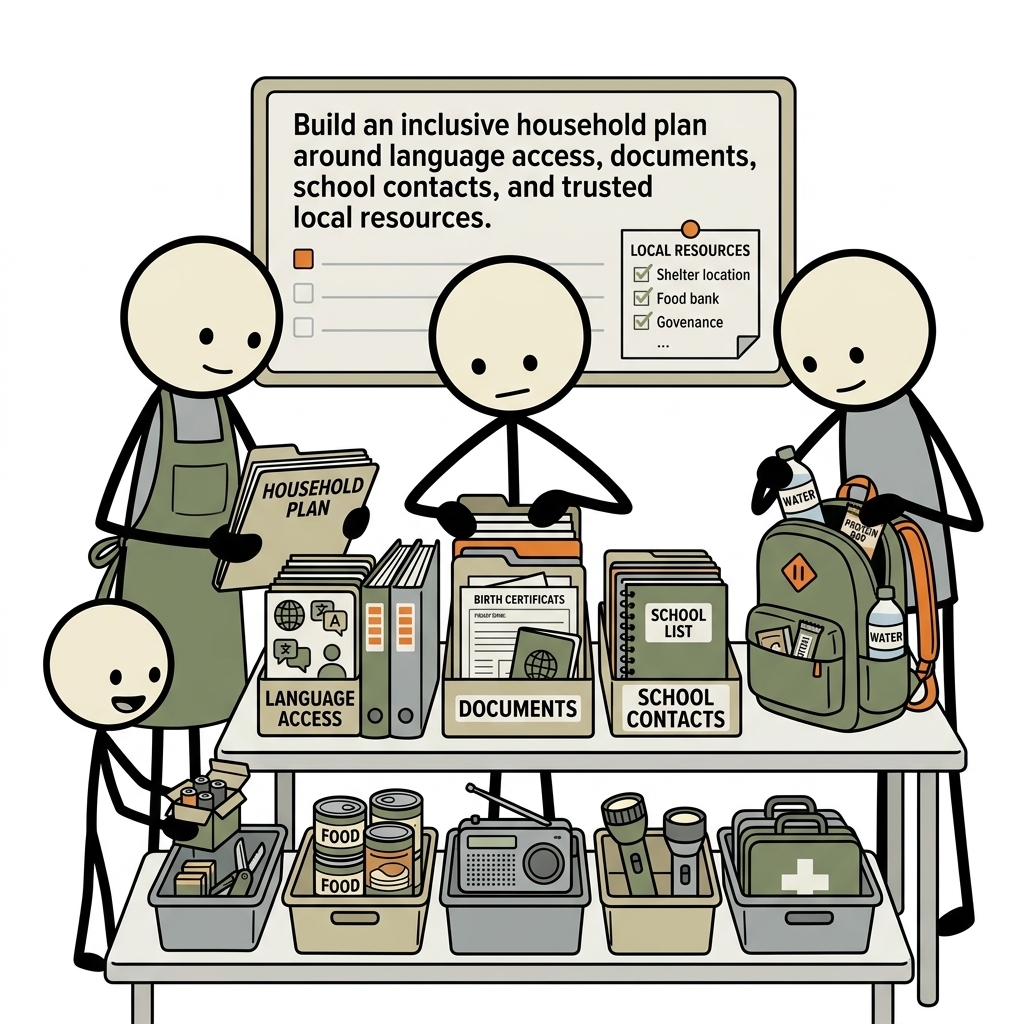
For immigrant families, document management is not merely a matter of retaining insurance paperwork; it is often the barrier between stability and legal peril. Disaster survivors frequently encounter bureaucratic checkpoints, perimeter security, and benefits assessments where proof of identity, ownership, and custody are scrutinized.
The Critical Legal & Identity Inventory
Every comprehensive plan must establish a dedicated record retrieval strategy. When executing emergency preparedness for immigrants, emergency preparedness protocols must explicitly account for foreign-issued records alongside domestic documentation. These items must be organized systematically:
- Foreign Identification & Passports: Consular identity cards (e.g., Matrícula Consular), current and expired foreign passports, original birth certificates, and national identity cards.
- Domestic Legal Records: Permanent Resident Cards (Green Cards), Employment Authorization Documents (EAD), Form I-797 Notice of Action forms, asylum applications, and naturalization certificates.
- Family & Custodial Legal Papers: Marriage certificates, divorce decrees, adoption decrees, and legally executed guardianship orders.
- Vital Health Records: Immunization cards, translated medical history summaries, current prescription lists, and specialized medical device serial numbers.
- Housing & Financial Proofs: Lease agreements, utility bills showing home addresses, land titles, and vehicle registrations—vital for securing municipal re-entry passes post-evacuation.
Hardware Protection: Tri-Tier Redundancy
A single paper copy stored in a wooden desk drawer offers zero protection against structural collapse or floodwaters. Implement a tri-tier redundancy framework:
- Hard Copy Portability (The Rapid Binder): Store original records or notarized duplicates inside heavy-duty (minimum 400-micron) waterproof document sleeves. Place these within an independently rated fireproof, waterproof go-bag essentials guide rated for at least 30 minutes of direct exposure up to 1,550°F (certified UL 72 or equivalent).
- Localized Hardware Encryption: Scan every document at 300+ DPI. Load these files onto an AES-256 hardware-encrypted USB drive. Ensure this drive is stored in your mobile bug-out pack, secured by an alphanumeric password known by at least two adult household members.
- Encrypted Zero-Knowledge Cloud Storage: Back up scanned documentation to a zero-knowledge, end-to-end encrypted cloud storage provider. Ensure two-factor authentication (2FA) is enabled, using an authenticator app rather than SMS-based verification, which can fail if phone service is lost during a disaster.
Understanding Legal Rights During Crisis Interventions
Fear of immigration enforcement should never prevent a family from fleeing a life-threatening hazard. Clear understanding of governing federal laws preserves life and protects individual rights during high-stress interactions with response personnel.
Under Section 308 of the Robert T. Stafford Disaster Relief and Emergency Assistance Act, discrimination based on nationality or English proficiency during disaster relief activities is illegal. Furthermore, the Department of Homeland Security maintains an explicit policy regarding "protected areas," declaring that emergency operations sites—including evacuation routes, emergency shelters, food pantries, and medical clinics—are strictly exempt from routine immigration enforcement actions.
Non-citizen household members should carry a pocket-sized, laminated legal rights card stating their basic constitutional rights, including the right to remain silent and the right to speak with legal counsel. If personal status questions are raised by overreaching personnel at civilian checkpoints, having this information clearly printed prevents confusion and de-escalates stress.
School Contacts, Child Safety, and Reunification Protocols
Disasters routinely strike during working and school hours. When localized infrastructure collapses, the communication gap between parents and regional school systems can cause severe panic. Developing a precise, institutionalized school plan ensures children remain safe, accounted for, and connected to authorized guardians.
Auditing and Expanding School Emergency Cards
Most public and private school districts require annual submission of an Emergency Contact and Authorized Pick-up form. For immigrant families, these documents require proactive auditing:
- Establish Multiple Layered Guardians: List at least three individuals who have legal authorization to collect your child if parents are physically separated or detained by travel closures. Ensure at least one authorized adult lives within walking distance of the educational facility.
- Explicit Identification Alignment: Ensure that the exact spelling of names on school records matches the official identification documents (such as passports or driver's licenses) that the designated individuals will present at the school perimeter. Discrepancies can lead to children being held in temporary municipal care during crises.
- Language Access Registration: Officially request, in writing, that all emergency communications from the school district (automated robocalls, SMS blasts, and emails) be routed via the district's translation desk to your household's primary language. Most public school districts receiving federal Title I funding are legally mandated to furnish translation services.
The Student "ICE" (In Case of Emergency) Kit
Equip each school-aged child with a permanent, weatherproof "In Case of Emergency" (ICE) card secured inside an interior zippered pocket of their school backpack. This card should contain essential information presented in both English and your household's native language:
- The child's full legal name, date of birth, and home address.
- Primary parent/guardian names along with multiple contact numbers (mobile, workplace, messaging apps).
- The name and contact information of the designated out-of-state emergency contact.
- Crucial medical data: blood type, severe allergies, and life-saving daily medications.
- A clear statement indicating that the parents authorize the designated emergency contacts to make temporary medical decisions if parents cannot be reached.
Establishing Multi-Tiered Family Rendezvous Points
When cellular networks go down, family members must know where to assemble without communicating in real time. Establish three distinct rendezvous locations, accounting for varied hazard scenarios:
- Tier 1 (neighborhood preparedness network Level): A specific landmark immediately outside the home (e.g., a specific streetlamp, neighborhood park bench, or community mailbox) used in the event of an isolated residential fire or gas leak.
- Tier 2 (District Level): A recognizable, neutral public structure within walking distance of both the home and school (e.g., a specific public library, trusted house of worship, or community recreation center) if the immediate street is blocked.
- Tier 3 (Regional Level): A pre-agreed location outside the local municipal evacuation zone (e.g., a relative's residence in an adjacent town) if whole-city evacuations are mandated.
Mapping Trusted Local Resources and Mutual Aid Networks
When municipal infrastructure is strained, the frontline of survival is rarely a distant federal agency. It is the immediate network of local organizations, neighborhood community emergency preparedness guide initiatives, and culturally competent non-governmental organizations (NGOs) operating directly inside the community.
Identifying Federally Qualified Health Centers (FQHCs)
During and immediately after a disaster, hospital emergency departments face extreme backlogs. For immigrant households, fear of high costs or status inquiries may lead individuals to delay seeking vital medical care. Federally Qualified Health Centers (FQHCs) provide community-based primary and emergency health services regardless of an individual's immigration status, insurance coverage, or ability to pay.
Locate the two nearest FQHCs in your area via the Health Resources and Services Administration (HRSA) directory. Record their physical addresses, operational hours, and direct triage phone numbers inside your household emergency manual. These clinics routinely maintain multi-lingual staff and offer prescription continuity services during regional disruptions.
Culturally Competent Community-Based Organizations (CBOs)
Local mutual aid groups and Immigrant-serving Community-Based Organizations (CBOs) are frequently the most efficient logistics hubs in localized crises. During historical disasters, such as Hurricane Harvey in 2017, localized grassroots networks mobilized multilingual food distribution, safe transportation, and non-governmental housing assistance days before formal federal resources established operational footprints.
- Identify Verified Non-Profit Partners: Map community organizations that have documented track records of immigrant advocacy, legal defense, and refugee resettlement. Establish direct contact with these organizations during blue-sky (non-disaster) periods.
- Faith-Based Disaster Networks: Houses of worship (churches, mosques, temples, gurdwaras) often operate auxiliary emergency shelters that do not collect personally identifiable information from displaced individuals seeking immediate shelter, food, or basic sanitation.
- Community real-world Survival Scenarioss guide Teams (CERT): Inquire whether your municipal emergency management office supports a multilingual CERT program. Enrolling a bilingual household member in local CERT training builds critical tactical skills while establishing a direct, trusted bridge to municipal first responders.
Navigating 211 and Social Service Directories
The national 2-1-1 telecommunications service, managed by United Way and community agencies, connects callers to essential local resources, including emergency shelter, supplementary food programs, utilities restoration, and post-disaster case management. The service supports translation in over 180 languages. Train all adult and teenage household members on how to dial 2-1-1 from any working phone line and how to clearly pronounce the name of their required language (e.g., "Spanish," "Vietnamese," "Arabic") to trigger instant language-line routing.
The Comprehensive Household Resilience Checklist
Use this actionable, operational framework to verify that your household plan integrates language access, legal protections, and family safety. This complete checklist covers every tier of preparedness:
Phase 1: Communications & Language Infrastructure
- [ ] Audit every household smartphone; verify emergency alert settings and local language configurations.
- [ ] Program local emergency management short codes for localized non-English alerts.
- [ ] Purchase a portable All-Hazards NOAA Weather Radio; document frequencies for regional foreign-language SAP rebroadcasts.
- [ ] Construct visual command and safety flashcards for monolingual seniors and non-English-speaking members.
- [ ] Designate an out-of-region, bilingual contact person to act as an external communications coordinator.
Phase 2: Legal Documentation & Vital Records
- [ ] Assemble all foundational foreign and domestic documents (passports, consular IDs, EADs, Green Cards, visas, birth certificates).
- [ ] Acquire an independently verified fireproof/waterproof document case (UL class 350 or equivalent) and individual waterproof sleeves.
- [ ] Digitize all records at high resolution and store on a hardware-encrypted, password-protected USB flash drive.
- [ ] Upload encrypted document copies to a secure, zero-knowledge cloud platform featuring app-based multi-factor authentication.
- [ ] Secure printed, laminated "Know Your Rights" cards in the wallets of every adult and teenage family member.
- [ ] Execute notarized temporary parental medical consent and caregiver forms for all dependent children.
Phase 3: School Networks & Child Protection
- [ ] Audit public and private school emergency cards; confirm at least three authorized local pickup guardians with matching legal identification.
- [ ] Submit formal language-preference registration forms to educational administration desks.
- [ ] Fabricate dual-language "ICE" (In Case of Emergency) information inserts for every child's school backpack.
- [ ] Walk and physically verify three distinct emergency rendezvous locations (neighborhood, district, and regional).
Phase 4: Community Resources & Mutual Aid Integration
- [ ] Locate and document the addresses and emergency intake procedures of the two closest Federally Qualified Health Centers (FQHCs).
- [ ] Identify three trusted community-based or faith-based centers that provide emergency shelter without personal data collection.
- [ ] Post 2-1-1 call instructions and designated language-access keywords alongside the primary household first-aid kit.
- [ ] Complete basic family-wide walk-throughs of the entire protocol every six months, updating contacts and expired documents.
True Preparedness Protects the Entire Community
True emergency preparedness for immigrants requires moving past generic disaster advice and confronting real-world legal, structural, and linguistic challenges. By proactively building multilingual alert protocols, safeguarding vital personal records, coordinating verified school release procedures, and anchoring your family to trusted community networks, you strip disasters of their power to destabilize your home. Emergencies will always occur, but an inclusive, well-rehearsed, and legally protected household plan ensures that every member of your family moves through the crisis with confidence, safety, and resilience.
Frequently Asked Questions
What should a emergency preparedness for immigrants plan include?
Start with the immediate safety steps, the supplies and records your household needs, a communication plan, and a regular review schedule. Follow local official guidance during an active emergency.
How often should I review emergency preparedness for immigrants preparations?
Review them at least twice a year and whenever your household, medication, location, or local risks change. Replace expired supplies and practice key steps.
Where can I find reliable emergency guidance?
Use local emergency management alerts and established public-health or emergency-management agencies. A blog guide should support, not replace, official real-time instructions.