⚡ Key Facts: Off-Grid Induction Cooking
- High Thermal Transfer: Induction cooktops convert 85% to 90% of their electrical energy directly into food heat, compared to roughly 40% for open-flame propane or butane stoves.
- Surge and Duty Cycle Challenges: Many entry-level induction burners do not scale wattage down continuously; instead, they pulse a full 1,500W to 1,800W load using Pulse-Width Modulation (PWM), which can trip budget power stations.
- The Inverter Overhead: DC-to-AC conversion loss typically consumes 15% to 20% of your power station’s battery reserve before electricity ever reaches the cooktop coil.
- The 1-Liter Water Benchmark: Bringing one liter of water to a rolling boil requires approximately 110 to 130 Watt-hours (Wh) of battery capacity under real-world emergency conditions.
- Life Safety Advantage: The Centers for Disease Control and Prevention (CDC) repeatedly warns that combustion cookers operated indoors during grid collapses pose severe carbon monoxide (CO) risks; induction cooking creates zero toxic indoor emissions.
When an ice storm or severe hurricane knocks out the electrical grid for days, your first survival priority after shelter and hydration is calorie consumption and water sanitization. During extended power outages, such as those documented across the Gulf Coast and Midwest by the Federal Emergency Management Agency (FEMA) and the National Oceanic and Atmospheric Administration (NOAA), the urge to set up a camp stove on the kitchen counter has repeatedly led to tragic carbon monoxide poisonings. Portable battery storage has rewritten this narrative. Pairing a modern battery power station with an electromagnetic induction cooktop delivers a clean, flameless cooking station right on your kitchen table—provided your electrical math and equipment choices are sound. For the practical checklist side, use the community emergency preparedness guide.
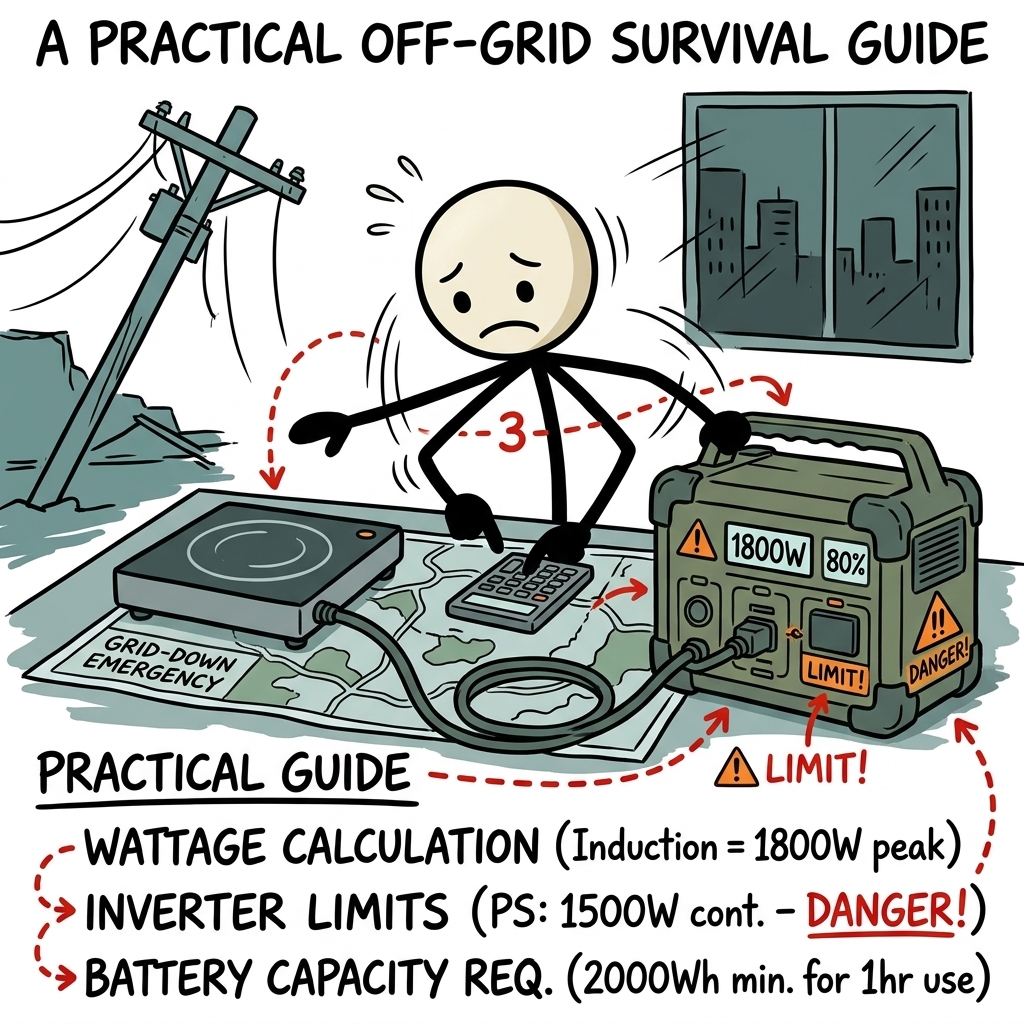
The Thermodynamics of Off-Grid Induction Cooking
Cooking off-grid is a battle of thermal conservation. In a survival situation, every milliamp-hour stored in your battery cells is a finite survival asset that cannot be squandered through inefficient heat exchange. For the practical checklist side, use the neighborhood preparedness network.
Traditional electric coil stoves and radiant glass cooktops rely on resistive heating: current passes through a metal alloy, creating friction and radiant heat. This heat warms the cooktop surface, which warms the exterior of the pan, which eventually warms the food. In open-air or uninsulated environments, more than half of that radiant energy bleeds off into the room. Portable gas burners—such as single-burner butane camping stoves or 20-pound propane attachments—fare even worse outdoors or near open windows, routinely dropping to 35% to 40% efficiency due to convective air currents that siphon heat away from the vessel walls. For the practical checklist side, use the family emergency planning guide.
Induction fundamentally bypasses this thermal ladder. Beneath the ceramic plate sits a tightly wound copper coil driven by high-frequency alternating current. When you place a ferromagnetic vessel (such as cast iron, carbon steel, or magnetic stainless steel) on the cooktop, the alternating magnetic field passes through the base of the cookware, exciting the iron electrons and inducing microscopic "eddy currents." The pan itself becomes the heating element.
Because there is no intermediate heating medium, off grid induction cooking operates at an astonishing 85% to 90% efficiency. This direct electromagnetic transfer means less thermal waste inside your living space during summer outages and significantly lower raw caloric energy requirements to bring drinking water to a rolling, pathogen-killing boil.
Indoor Safety: The Hidden Threat of Off-Grid Combustion
The CDC reports that more than 400 Americans die annually from unintentional carbon monoxide (CO) poisoning, with sharp spikes occurring during catastrophic winter blackouts and post-storm recovery periods. When torrential rains or sub-zero temperatures make outdoor cooking impossible or dangerous, desperate residents frequently bring propane, charcoal, or butane units indoors.
A portable power station running an induction plate produces zero carbon monoxide, zero nitrous oxide, and zero particulate matter. It consumes zero ambient oxygen, making it completely safe to operate within a sealed, energy-conserving safe room during severe weather emergencies. This safety margin alone makes mastering the technology a vital preparedness skill.
Can a Power Station Run an Induction Cooker?
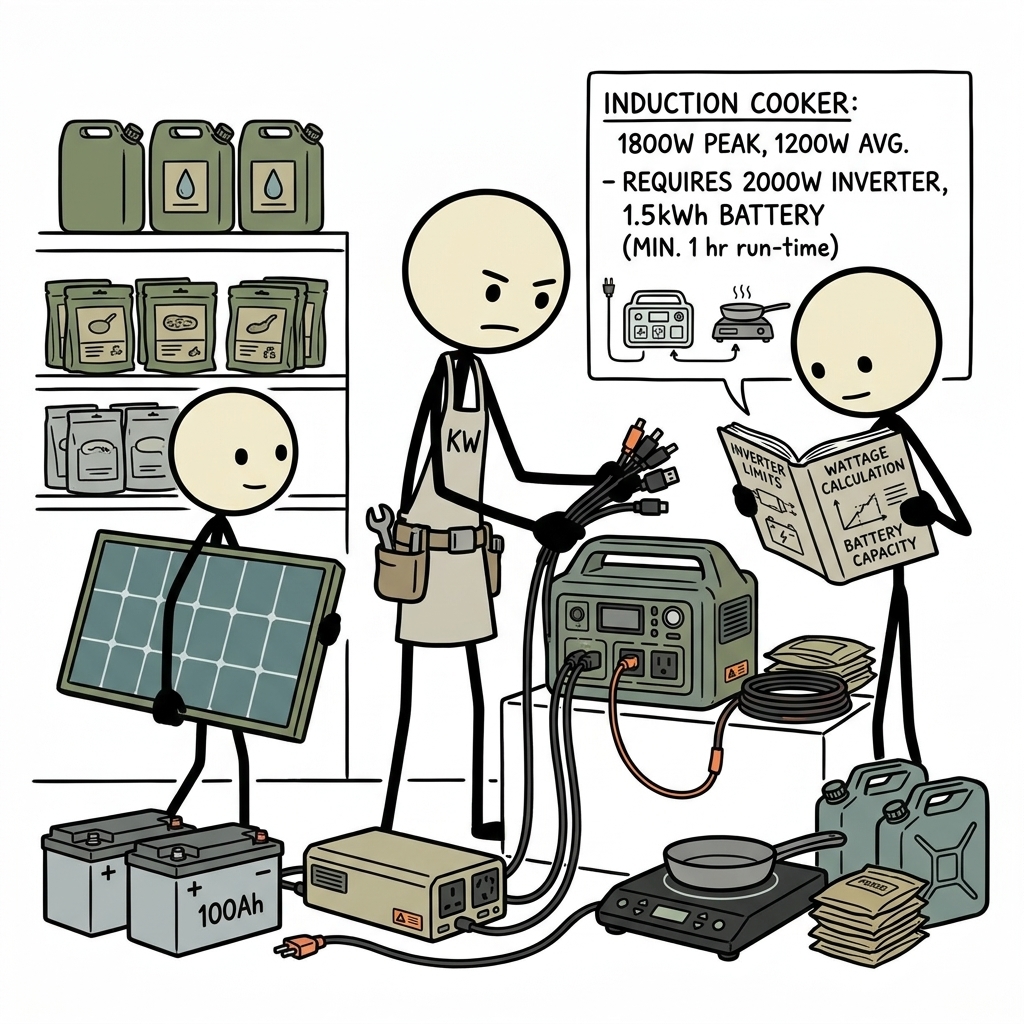
The most direct answer to can a power station run an induction cooker is: yes, provided the power station’s continuous inverter output matches or exceeds the cooker's draw, and the battery holds enough capacity for the meal's duration. However, simple compatibility checks often fail because people confuse continuous running wattage with battery capacity, and peak surges with duty cycles.
To safely bridge an induction plate with a portable solar generator, you must evaluate three interdependent electrical metrics: inverter output rating, pure sine wave architecture, and total Watt-hour (Wh) capacity.
1. Inverter Limits: Continuous Output vs. Surge Ratings
Most standard household induction cooktops found on retailer shelves are rated for 1,800 Watts at maximum power (often labeled "Level 10" or "Boil"). If you plug an 1,800W burner into a power station equipped with a 1,000W continuous inverter, the power station's Battery Management System (BMS) will instantly trigger an overload fault and shut down the output ports to prevent thermal destruction of its internal MOSFET switches.
While power stations advertise impressive "Surge" or "Peak" capacities (e.g., a 1,200W inverter that can surge to 2,400W), that surge window is designed exclusively for micro-second startup inrush currents generated by inductive motor loads like refrigerators or sump pumps. Induction burners present a steady, continuous resistance-equivalent load. Your power station’s continuous inverter rating must match the chosen power setting of your burner.
2. Waveform Architecture: The Necessity of Pure Sine Wave
Older or budget-tier power systems sometimes employ "modified sine wave" inverters. These produce a stepped, square-like waveform that mimics alternating current. While a simple incandescent lightbulb or brush motor can tolerate dirty power, an induction cooktop is packed with sensitive electronics: digital microprocessors, touch-sensing capacitive interfaces, internal cooling fans, and high-frequency resonant circuits.
Connecting a modern induction cooktop to a modified sine wave power source will result in rapid overheating of the burner's internal circuit boards, erratic digital error codes (such as E0 or E1 errors), or total component failure. Always verify that your power station features a Pure Sine Wave (PSW) inverter with total harmonic distortion (THD) under 3%.
Understanding Wattage: Continuous Draw, Duty Cycles, and PWM
To dial in your power station wattage for cooking, you must understand how portable induction stoves manage power across their variable heat settings. Stoves handle low heat using one of two internal technologies: Pulse-Width Modulation or True Variable Power.
The Pulse-Width Modulation (PWM) Trap
Many inexpensive induction cooktops (under $70) actually possess only one operating state: wide-open throttle at 1,500W to 1,800W. When you select a low setting like "Level 2" (roughly 400W), the burner does not reduce its electromagnetic field. Instead, it cycles the full 1,800W load on for two seconds, shuts it completely off for six seconds, and repeats.
This rapid cycling creates significant operational headaches off-grid:
- If your power station has a 1,000W continuous inverter, it will overload and shut down during the two-second 1,800W burst, even though the average draw over time is only 450W.
- The repeated thermal cycling stresses the power station's inverter capacitors and degrades efficiency.
- It can lead to scorching in thin cookware during the full-power pulses, wasting precious emergency food stocks.
True Continuous Low-Wattage Burners
For resilience planning, prioritize induction units engineered with half-bridge or full-bridge resonant inverters that offer true wattage throttling, or purchase dedicated low-wattage cookers. These models allow you to lock the continuous draw to fixed thresholds such as 400W, 600W, or 800W without cycling. Operating at a rock-steady 600W draw allows a modest 1,000W power station to run smoothly with massive safety headroom, completely eliminating inverter trip risks.
Battery Capacity Calculations: The Watt-Hour Formula
Understanding wattage tells you whether the power station can turn the burner on; calculating emergency cooking power requirements in Watt-hours (Wh) tells you how long you can actually cook before the battery sits empty at 0% state of charge.
To calculate real-world consumption, apply this foundational survival equation:
Required Battery Capacity (Wh) = [Burner Draw (Watts) × Cooking Time (Hours)] ÷ Inverter Efficiency Factor
Factoring in the "Inverter Tax"
Portable power stations store direct current (DC) inside their Lithium Iron Phosphate (LiFePO4) or Nickel Manganese Cobalt (NMC) cells. To run an AC induction plate, the unit's internal inverter must step that DC voltage up to 120V AC. This conversion generates heat and consumes parasitic control board power.
Quality inverters operate at roughly 80% to 85% efficiency under typical induction cooking loads. This means you must multiply your calculated raw cooking Watt-hours by 1.18 to 1.25 to reflect the true draw pulled from the internal battery cells. Furthermore, to prevent irreversible cell damage, most power stations lock out the final 5% to 10% of battery depth-of-discharge (DoD), slightly reducing the faceplate capacity stated on the unit's chassis.
Real-World Cooking Energy Benchmarks
The following table illustrates the actual power station drain for standard survival meal preparation tasks, calculated using an 85% overall inverter efficiency factor.
| Cooking Task | Burner Setting | Active Duration | Raw AC Draw | Total Battery Drain (at 85% Inverter Eff.) |
|---|---|---|---|---|
| Boiling 1L Water (Freeze-Dried Meals) | 1,200W (High) | 5 minutes (0.083 hrs) | 100 Wh | ~118 Wh |
| Simmering Rice / Grains (Covered) | 400W (Low) | 18 minutes (0.30 hrs) | 120 Wh | ~141 Wh |
| Scrambling Eggs / Pan Fry | 800W (Med-Low) | 8 minutes (0.133 hrs) | 106 Wh | ~125 Wh |
| Reheating Dense Stew (1 Quart) | 600W (Medium) | 12 minutes (0.20 hrs) | 120 Wh | ~141 Wh |
Notice the vital strategic takeaway: a standard 500Wh entry-level power station can comfortably boil water and prepare two hot meals in a day (~260Wh total drain), leaving ample capacity for LED emergency lights, cell phone charging, and running medical equipment like CPAP machines. Attempting to run a 45-minute continuous uncovered boil for pasta, conversely, will drain over 900Wh, wiping out the reserves of all but the largest mid-tier power units.
Selecting the Ideal Portable Power Station Induction Cooktop System
When selecting your gear combinations, matching equipment parameters ahead of time eliminates grid-down failures.
1. Battery Chemistry: LiFePO4 vs. Traditional NMC
Always opt for a power station built on Lithium Iron Phosphate (LiFePO4 or LFP) battery chemistry. Induction cooking places severe, high-C-rate discharge loads on the battery core. While NMC batteries tolerate high discharge, their lifespan drops rapidly after 500 to 800 cycles, and they run significantly hotter under continuous 1000W+ draws.
LiFePO4 chemistry easily endures 3,000 to 4,000 full discharge cycles before dropping to 80% capacity, possesses vastly superior thermal stability (minimizing thermal runaway risks during multi-hour high-amp draws), and can sit fully charged for emergencies without rapid chemical degradation.
2. The Cooktop: Low-Wattage Adjustable Commercial Models
Avoid buying the flashiest 1,800W kitchen counter unit for emergency preps. Instead, look for compact, single-burner units specifically tailored for RVs, marine environments, or commercial catering. These often feature direct-wattage selection buttons that let you physically lock the system to 400W, 600W, or 1,000W maximum draws.
This design creates an un-trippable configuration when combined with a typical 1,000W to 1,500W pure sine wave portable power station induction cooktop setup. It also protects other critical appliances—like emergency radios or medical coolers—sharing the AC inverter bus from being tripped by sudden power surges.
3. Cookware Optimization: Metallurgy Matters
The efficiency of an off-grid induction setup is heavily dictated by the cookware resting on the glass surface. Induction relies on magnetic permeability and electrical resistance. If a magnet does not stick firmly to the bottom of your pan, it will not function at all.
- Cast Iron: Highly magnetic and holds heat exceptionally well, making it great for residual-heat cooking. However, it takes longer to heat up from cold, demanding higher total Watt-hours during the initial warmup phase.
- Tri-Ply Stainless Steel with Magnetic Base: Heats quickly and distributes energy evenly, making it ideal for rapid water boiling and minimal battery expenditure.
- Thin Stamped Carbon Steel: Extremely fast heat response with negligible thermal inertia, offering the absolute lowest Wh usage for simple boiling tasks.
Off-Grid Replenishment: Solar Sizing for Sustainable Cooking
Relying on stored battery reserves works for short 24- to 72-hour winter emergencies. However, for extended grid-down scenarios—such as the infrastructure destruction tracked by USGS after seismic events or major Category 5 hurricane landfalls—you must establish a sustainable recharge loop.
If your daily cooking consumption totals 350Wh (two hot meals plus morning water sanitization), your solar panel array must produce enough power to cover both this cooking load and the inherent recharge losses within the power station's internal MPPT charge controller.
According to solar insolation data from the National Renewable Energy Laboratory (NREL), average winter peak sun hours across North America drop to approximately 2.5 to 3.5 hours per day, while summer yields 5 to 6 hours. Factoring in a 25% system loss across solar cabling, cloud cover, atmospheric haze, and angle mismatches:
Solar Array Size (W) = Daily Cooking Wh ÷ [Peak Sun Hours × 0.75 Real-World Efficiency Factor]
Plugging in 350Wh for a winter Survival Scenarios with 3.0 peak sun hours:
350 Wh ÷ (3.0 hours × 0.75) = 155.5 Watts of dedicated solar generation.
In this scenario, a bare minimum 200W solar panel array dedicated exclusively to your cooking battery is required just to break even. If you rely on that same battery to power refrigeration, field radios, and emergency communication plan tools, a 400W to 600W array becomes the non-negotiable operational baseline.
Tactical Operating Protocol for Grid-Down Induction Cooking
To stretch your battery reserves as far as possible when fuel and wall power do not exist, integrate these standard operating procedures into your emergency routine.
1. Deploy Thermal Retention Cooking (The Wonderbag Method)
The single greatest energy-wasting mistake people make during an outage is boiling beans, rice, or stews over active electrical heat for 30 to 60 minutes. Continuous simmering drains immense battery capacity.
Instead, use passive thermal retention:
- Place your grains, dried legumes, and water in a heavy, lidded cast-iron or tri-ply pot.
- Bring the contents to a rolling boil using the induction plate at 1,000W for 4 to 6 minutes (consuming roughly 80Wh to 100Wh).
- Allow the boiling core to stabilize for one minute, then turn off the power station entirely.
- Immediately transfer the lidded pot into an insulated thermal retention cooker, heavy wool blanket, or a thick, clean sleeping bag (taking care not to scorch the fabric).
The trapped heat continues cooking the food over the next two to three hours without drawing a single additional milliamp from your battery bank. This single tactic cuts your daily cooking energy consumption by up to 70%.
2. Always Use a Snug Lid and Minimize Liquid Volume
Boiling water uncovered lets evaporative cooling carry away significant thermal energy. A securely fitting lid raises internal vapor pressure, speeds boiling, and cuts total time-to-boil by 20% to 30%. Similarly, measure your water precisely; do not boil two liters of water if your dehydrated emergency rations only require 500 milliliters.
3. Mise en Place: Prep Everything First
Never power up the induction burner until every ingredient is chopped, seasoned, measured, and resting directly beside the stove. An induction plate sitting empty or paused on a low setting while you open cans or search through emergency buckets wastes precious Watt-hours through ongoing inverter overhead and parasitic cooling fan operations.
4. Leverage Stored Ambient Heat
If you are pulling water from deep storage barrels, snowmelt buckets, or unheated outdoor tanks, that water may be sitting at 35°F to 45°F (2°C to 7°C). Raising water temperature across that initial 30-degree delta demands substantial energy. Bring your cooking water jugs inside your insulated living quarters several hours before meal prep, allowing them to naturally rise to indoor ambient temperature (65°F to 70°F) using free radiant warmth before placing the pot on your induction coil.
Engineering True Grid Independence
Transitioning from volatile liquid fuels to stored electrical energy for emergency meal preparation is one of the most reliable upgrades you can make to your household disaster plan. When you balance burner wattage, understand the pulse-width modulation behavior of your cooker, account for inverter transformation overhead, and insulate your cookware, induction cooking shifts from an energy-hogging luxury to a safe, sustainable off-grid asset. Match your battery's continuous inverter rating to your burner's specific power steps, lock in a reliable solar replenishment cycle, and you will ensure your household maintains hot, nutritious meals throughout any prolonged blackout.
Frequently Asked Questions
Can any portable power station run an induction cooker?
No. Most single-burner portable induction cooktops draw between 1,200 and 1,800 watts at peak power. Your power station must feature a continuous AC output rating higher than the cooktop's peak wattage, typically requiring a 1,500W to 2,000W pure sine wave inverter.
How long will a portable power station power an induction burner?
Runtime depends on battery capacity (watt-hours) and the heat setting used. A 1,000Wh battery running an induction cooker set to 1,000W will provide roughly 45 to 50 minutes of continuous runtime after factoring in typical 10 to 15 percent inverter efficiency losses.
Can I lower the burner's wattage setting to preserve battery life?
Yes. Most induction cooktops offer variable power levels ranging from 200W up to 1,800W. Cooking on medium or low settings (such as 600W to 800W) significantly reduces battery draw and allows smaller power stations to operate the unit without tripping the inverter.
Why is an induction cooktop preferred over gas for indoor emergency cooking?
Induction cooktops produce zero open flames and zero carbon monoxide, making them safe to use inside closed living spaces during severe weather or blackouts, whereas propane and butane stoves pose severe fire and asphyxiation risks indoors.
Does an induction cooker require a pure sine wave inverter?
Yes. Induction cookers rely on high-frequency electromagnetic coils, microprocessor controls, and internal cooling fans that require clean, pure sine wave AC electricity to function properly and prevent internal circuit damage.