⚡ Key Facts
- Widespread Hazard: According to the United States Geological Survey (USGS), landslides occur in all 50 states and cause an estimated $1 billion to $2 billion in damage annually. For the practical checklist side, use the community emergency preparedness guide.
- High Fatality Risk: The Centers for Disease Control and Prevention (CDC) reports that landslides and debris flows cause an average of 25 to 50 deaths in the United States each year. For the practical checklist side, use the neighborhood preparedness network.
- Burn Scar Vulnerability: The National Oceanic and Atmospheric Administration (NOAA) warns that post-wildfire burn scars require as little as 0.5 inches of rainfall per hour to trigger catastrophic, fast-moving debris flows. For the practical checklist side, use the family emergency planning guide.
- Debris Flow Speed: FEMA data shows that fast-moving debris flows (often called mudslides) can reach speeds exceeding 30 to 35 miles per hour, leaving virtually no time for escape once they begin.
To those living in hilly, mountainous, or coastal terrain, the ground beneath our feet feels like the ultimate symbol of permanence. However, geology teaches us a different lesson: slopes are dynamic systems constantly balancing the forces of gravity against the shear strength of soil and rock. When that balance is disrupted—most commonly by heavy rainfall, wildfires, or human development—the results can be sudden, violent, and devastating. Understanding how to navigate these environments requires a proactive approach to safety. By mastering the fundamentals of landslide preparedness, learning to read the subtle warning signs of slope instability, and establishing clear evacuation triggers, you can protect your family and property from this underestimated natural hazard.
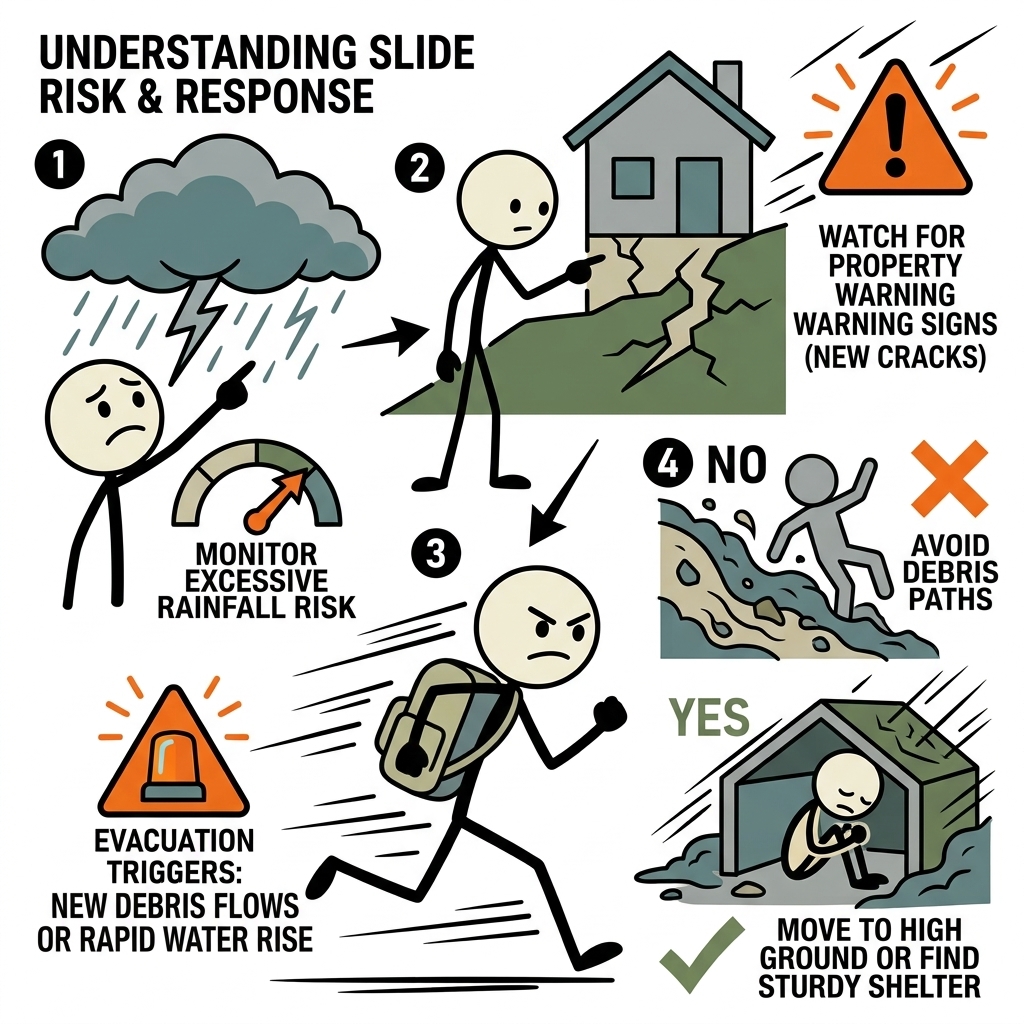
Understanding the Trigger: Rainfall, Slopes, and Soil Saturation
The vast majority of destructive landslides are triggered by water. To understand why, we must look at the physics of soil. Soil is composed of solid particles with tiny spaces, or pores, between them. When light rain falls, these pores absorb the water, and surface tension actually helps hold the soil particles together. However, during periods of prolonged or intense rainfall, these pores fill to capacity. This state is known as soil saturation.
Once soil becomes saturated, any additional water increases what geologists call "pore water pressure." Instead of binding the soil particles together, the water pushes them apart. This dramatically reduces the friction holding the soil in place on a slope. At the same time, the added water increases the physical weight of the slope. When the gravitational pull on this heavy, lubricated mass exceeds the shear strength of the soil, the slope fails, resulting in a landslide.
The Rainfall Threshold Concept
One of the most critical aspects of landslide preparedness is understanding your local rainfall threshold. The USGS and NOAA work together to monitor these thresholds across the United States. A rainfall threshold is the specific amount of rain over a set duration (e.g., 2 inches in 24 hours, or 0.75 inches in 1 hour) that is highly likely to initiate slope failure in a given geographic area.
These thresholds vary significantly depending on local geology. For example, the steep, rocky slopes of the Pacific Northwest may tolerate higher cumulative rainfall than the loose, sandy soils of Southern California. When local meteorological services issue a "Flash Flood Watch" or a specific "Debris Flow Warning," they are signaling that these critical thresholds are close to being breached. Monitoring these alerts is a foundational element of landslide preparedness emergency preparedness.
The Peril of Post-Fire Burn Scars
The risk of catastrophic landslides—specifically debris flows—skyrockets in areas recently affected by wildfires. Wildfires destroy the vegetative canopy and root systems that naturally bind the soil together. Furthermore, the intense heat of a wildfire can create a "hydrophobic" (water-repellent) layer of soil just beneath the surface.
When rain falls on a burn scar, the water cannot penetrate the hydrophobic soil. Instead, it runs off instantly, carrying ash, loose soil, rocks, and charred debris with it. The Federal Emergency Management Agency (FEMA) notes that these post-fire debris flows can occur with little to no warning, often triggered by brief, intense storms that would otherwise be considered harmless. If you live downslope of a burn scar, your threshold for action must be significantly lower than in unburned areas.
Reading the Land: Micro-Signals of Slope Instability
Landslides rarely happen completely out of the blue. In the days, weeks, or even months leading up to a major slope failure, the earth often provides subtle physical warnings. Developing an eye for these micro-signals is key to protecting your home and family.
Structural Red Flags on Your Property
Your home itself can act as a giant tilt-meter, reacting to the slow, initial movements of the ground beneath it. Homeowners living in high-risk zones should conduct regular inspections of their property, looking for the following structural anomalies:
- Sticking Doors and Windows: Doors and windows that suddenly begin to stick, jam, or refuse to close properly can indicate that the home's foundation is shifting or tilting due to ground movement.
- New Cracks in Plaster and Masonry: Keep a close eye on interior plaster, drywall, and exterior brickwork or stucco. New, widening, or diagonal cracks are primary indicators of structural strain caused by soil displacement.
- Separation of Attached Structures: Look closely at the points where chimneys, decks, patios, or concrete walkways meet the main body of the house. If you notice gaps forming or widening, the ground beneath one of the structures is likely moving.
- Cracked or Tilting Concrete: Inspect your basement floor, garage floor, driveway, and retaining walls. Cracks that suddenly appear or step-like offsets in concrete slabs are clear signs of localized ground displacement.
Environmental and Landscape Shifts
Beyond the walls of your home, the surrounding landscape will often signal impending danger. Walk your property regularly—especially during and after heavy rainstorms—and look for these environmental indicators:
- "Drunken Trees" and Tilting Utility Poles: Trees, fence posts, and utility poles on a slope should grow or stand straight up. If you notice a group of trees tilting downslope, or if they have developed a "pistol-butt" curve (where the base of the trunk curves outward before growing upward), the slope is actively creeping.
- New Springs or Seeps: The sudden appearance of wet spots, seeps, or miniature springs on your property, especially in areas that are typically dry, indicates that groundwater levels have risen dramatically. This water is actively lubricating the subsurface soil layers.
- Silt-Laden Runoff: Watch the water running off your slopes. If clear runoff suddenly turns muddy, brown, or highly laden with sediment, it means that soil erosion and internal slope washing are accelerating.
- Tension Cracks in the Ground: Walk the upper portions of your slope. Look for linear cracks or fissures running parallel to the slope's contour. These "tension cracks" indicate that a block of earth is beginning to pull away and slip downward.
- Bulging at the "Toe" of the Slope: Inspect the flat area at the very bottom of your slope (the toe). If you notice the ground bulging, raising, or pushing outward, it means the mass above is pressing down and forcing the soil at the base to displace.
The Ultimate Landslide Preparedness Checklist
To help you systematically monitor your property and maintain a high state of readiness, use this comprehensive landslide preparedness checklist. Save this list and refer to it before the start of your local wet season.
| Inspection Zone | Action Item | Frequency |
|---|---|---|
| Drainage Systems | Clear leaves, debris, and sediment from all gutters, downspouts, French drains, and culverts to prevent water pooling near slopes. | Monthly & before major storms |
| Retaining Walls | Inspect weep holes to ensure they are not clogged. Look for new cracks, tilting, or separation from the slope they support. | Bi-annually |
| Flexible Couplings | Install flexible utility hookups (gas, water, sewer) to prevent catastrophic breaks and fires if the ground shifts. | Once (Retrofit) |
| Slope Vegetation | Maintain deep-rooted, native ground cover on slopes. Avoid overwatering ornamental plants on or near steep inclines. | Ongoing |
| Property Perimeter | Walk the property line to check for new tension cracks, soil bulges, or tilting trees. | Weekly during wet season |
| Emergency Supplies | Review and replenish your landslide preparedness emergency preparedness kit (detailed below). | Every 6 months |
Decisive Action: Evacuation Triggers and Planning
When dealing with landslides and debris flows, timing is everything. Unlike a rising river, which may give hours or days of warning before flooding a home, a debris flow can transition from a slow creep to a roaring torrent in seconds. Therefore, waiting until you see mud sliding down the hill is a fatal mistake. You must establish clear, non-negotiable evacuation triggers well before the storm arrives.
Establishing Your Personal "Go" Triggers
An evacuation trigger is a predetermined boundary that, once crossed, dictates immediate departure. Do not wait for an official evacuation order if your personal triggers are met. Your family's safety plan should include the following triggers:
- The Meteorological Trigger: If the National Weather Service (NWS) issues a Debris Flow Warning or a Flash Flood Warning for your specific burn scar or hillside area, evacuate immediately. Do not hesitate.
- The Sound Trigger: Debris flows emit a very distinct sound as they travel. Survivors often describe it as a low, rumbling roar, similar to a freight train, or the sound of breaking trees and clacking rocks. If you hear this sound, do not investigate—evacuate to high ground immediately.
- The Visual Trigger: If you observe any sudden changes on your property, such as a retaining wall cracking open, water suddenly pouring out of a slope, or rocks tumbling down the hillside, treat this as an immediate trigger to leave.
- The Utility Trigger: Sudden, unexplained loss of water pressure, gas leaks, or snapping utility lines on your street can indicate significant subsurface ground movement. Evacuate and report the issue to utility companies from a safe distance.
Building Your Landslide Preparedness Emergency Preparedness Kit
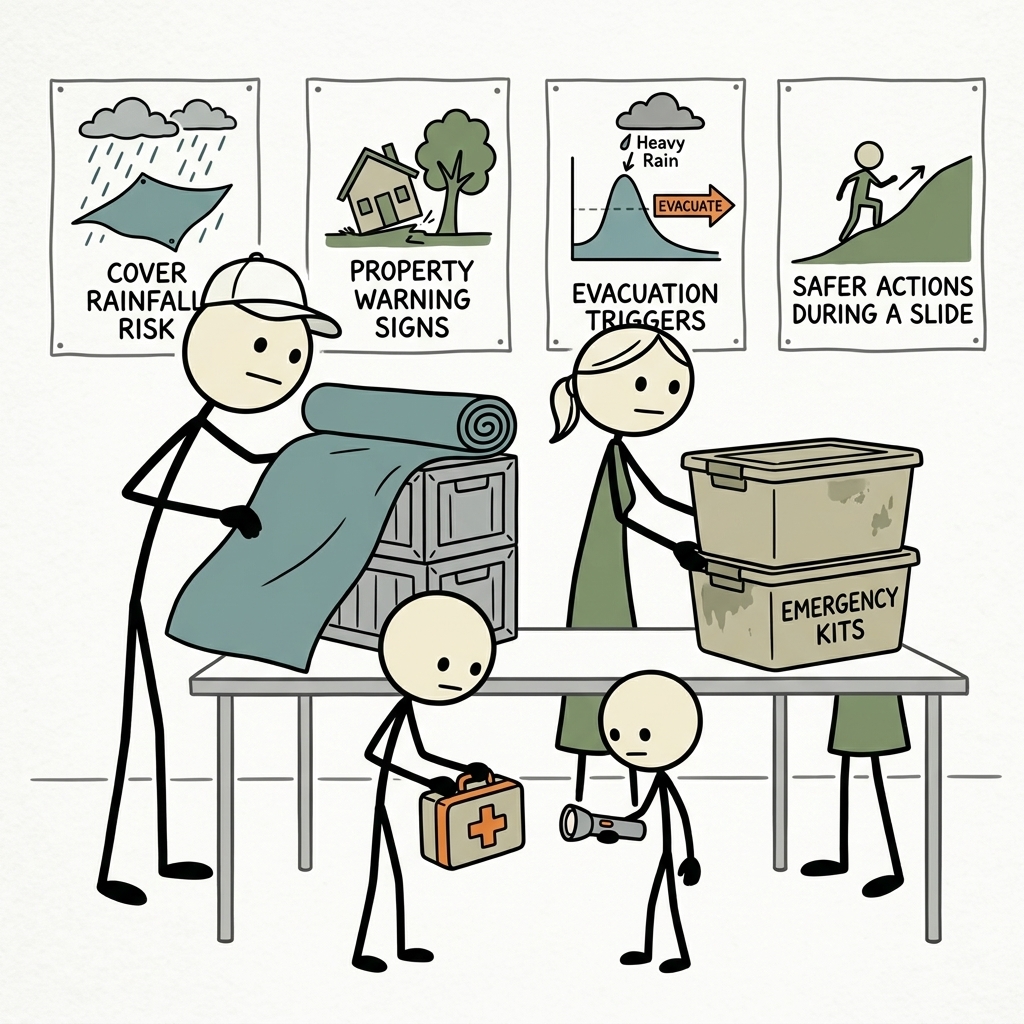
If you must evacuate, you need to be able to grab your essentials and leave within sixty seconds. This requires a dedicated, highly organized landslide preparedness emergency preparedness kit. Because landslides can cut off roads and isolate communities for days, your kit should be fully self-contained.
Your kit should be stored in heavy-duty, waterproof backpacks or rolling bins located near your primary exit. It must include the following critical items:
- Water and Non-Perishable Food: A minimum of one gallon of Water Calculator per day for at least three to seven days, along with high-calorie, shelf-stable food items.
- First Aid and Medications: A comprehensive first aid kit, plus at least a two-week supply of all critical prescription medications for family members and pets.
- Emergency emergency communication plans: A NOAA Weather Radio (battery-powered or hand-crank) to receive real-time updates, along with extra batteries, cell phone chargers, and fully charged power banks.
- Personal Protection Gear: Sturdy, steel-shank boots to protect your feet from nails and sharp debris, heavy-duty work gloves, safety goggles, and N95 dust masks to protect against airborne ash and dust.
- Critical Documents: A waterproof, portable container holding copies of insurance policies, deeds, identification, medical records, and emergency contact lists.
- Sanitation and Hygiene: Moist towelettes, garbage bags, plastic ties, and basic personal hygiene items.
- Lighting: High-lumens LED flashlights, headlamps (crucial for keeping your hands free), and chemical light sticks.
Survival in Motion: Safer Actions During a Slide
Even with the best planning, nature can occasionally catch us off guard. If you find yourself in the path of an active landslide or debris flow and escape is physically impossible, your survival depends on rapid, decisive, and correct physical actions.
Inside the Home: Immediate Protective Actions
If you are inside a building when a landslide strikes, your primary goal is to protect yourself from structural collapse and falling debris. The Red Cross and CDC recommend the following life-saving protocols:
- Move to the Highest Level: If your home has a second story or an attic with a clear exit, move upstairs immediately. This puts more distance between you and the high-impact zone of the mud and debris entering the lower levels.
- Evacuate the Path of Impact: If you can see or hear the slide approaching, move to the side of the house opposite the impact zone. For example, if the slide is coming from the hill behind your house, move to the front rooms.
- Take Cover Under Sturdy Furniture: Get under a heavy desk, table, or workbench. This will protect you from falling ceiling plaster, beams, and flying debris.
- Curl and Protect: If no shelter is available, curl into a tight fetal position on the floor, face down, and clasp your hands firmly behind your head and neck to protect your brain and spine.
- Avoid Basements: Never seek shelter in a basement during a landslide. Basements can easily fill completely with mud, water, and debris, trapping occupants with no means of egress.
Caught Outdoors: Navigation and Survival
If you are caught outside when a landslide or debris flow begins, you must act instantly. The physical forces involved are immense; even a shallow flow of mud can sweep a grown adult off their feet.
First, attempt to determine the direction of the slide. Run to the nearest high ground that is out of the path of the flow. If you are in a valley or canyon, climb up the canyon walls, perpendicular to the direction of the flow, rather than running down the canyon ahead of the debris.
If you cannot escape the path, look for a sturdy structure or a group of large, deeply rooted trees to shelter behind. If you are swept up in the flow, try to grab onto large debris or trees, and attempt to keep your head above the mud. If you are completely overtaken, curl into a ball and protect your head as best as possible.
Driving Through Landslide-Prone Areas
Driving during intense rainfall in mountainous terrain carries extreme risk. Roads are often carved directly into steep hillsides, making them prime targets for both rockfalls and complete roadbed failures. Keep these safety rules in mind:
- Watch the Road for Deformities: Keep a close eye on the pavement ahead. If you see sudden cracks, buckling asphalt, or areas where the shoulder has sloughed away, stop immediately and do not attempt to cross.
- Be Alert for Fallen Rocks: Watch for individual rocks, dirt clods, or small branches on the road. These are often the precursors to a much larger slide originating from the cut-slope above you.
- Never Drive Through Mud or Debris: If mud or water is actively flowing across the road, do not attempt to drive through it. Debris flows can easily sweep a vehicle off the road or trap it in rapidly consolidating mud. Turn around and find an alternative route.
- Listen to Your Vehicle: If you hear unusual scraping or rumbling sounds beneath your car, or if the steering suddenly feels unstable, pull over to a safe area away from steep slopes and assess the situation.
The Aftermath: Navigating Post-Slide Hazards
The danger does not end when the ground stops moving. In many cases, the period immediately following a landslide is just as hazardous due to secondary threats. Understanding how to navigate the aftermath safely is the final, vital component of comprehensive landslide preparedness.
First, be highly aware of the potential for secondary slides. A slope that has suffered a partial failure is extremely unstable. Additional rainfall, emergency vehicle vibrations, or even minor wind gusts can trigger a secondary collapse of the remaining hillside. Keep away from the slide area until geologists and emergency officials have declared it stable.
Second, watch out for utility hazards. Landslides routinely snap underground gas lines, break water mains, and pull down high-voltage power lines. Treat all downed utility lines as live and dangerous. If you smell gas, leave the area immediately and report it to emergency services. Do not use open flames, matches, or electronic devices that could create a spark in the vicinity of a suspected gas leak.
Finally, check for trapped or injured persons near the slide area without directly entering the unstable zone. Direct search and rescue personnel to their locations. If you must assist someone, do so with extreme caution, ensuring your own escape route remains clear at all times.
Landslides are powerful, awe-inspiring displays of nature's force, but they are not entirely unpredictable. By understanding the critical role of rainfall and soil saturation, learning to recognize the physical warning signs on your property, establishing firm evacuation triggers, and knowing how to react during an active slide, you transform yourself from a potential victim into an active, empowered survivor. Preparedness is not about living in fear; it is about cultivating the knowledge, vigilance, and readiness required to live safely alongside the dynamic landscape of our planet.
Frequently Asked Questions
What should a landslide preparedness plan include?
Start with the immediate safety steps, the supplies and records your household needs, a communication plan, and a regular review schedule. Follow local official guidance during an active emergency.
How often should I review landslide preparedness preparations?
Review them at least twice a year and whenever your household, medication, location, or local risks change. Replace expired supplies and practice key steps.
Where can I find reliable emergency guidance?
Use local emergency management alerts and established public-health or emergency-management agencies. A blog guide should support, not replace, official real-time instructions.