⚡ Key Facts
- Up to 30-Year Shelf Life: Landmark research from Brigham Young University (BYU) demonstrates that rolled oats packaged in oxygen-depleted, moisture-barrier containers retain nutritional viability and acceptable flavor for up to 30 years.
- Critical Moisture Threshold: The United States Department of Agriculture (USDA) indicates grain moisture must remain below 10% to 12% to prevent mold proliferation, enzymatic breakdown, and lethal mycotoxin formation.
- Elevated Lipid Vulnerability: Oats contain 5% to 9% natural lipids—substantially higher than wheat (2%) or white rice (1%)—making them inherently prone to hydrolytic and oxidative rancidity without proper environmental isolation.
- Oxygen Barrier Requirement: True long-term oat preservation requires reducing ambient packaging oxygen levels to below 0.1% using calibrated iron-based oxygen absorbers inside high-barrier Mylar films.
During large-scale regional disruptions—whether severe weather events tracked by the National Oceanic and Atmospheric Administration (NOAA) or civil infrastructure failures—food security rests entirely on shelf-stable staples. Grains form the foundational base of caloric security, but not all grains behave equally over time. Understanding how to store oats long term is essential for anyone seeking true food independence; while oats provide a nutritional powerhouse of dense complex carbohydrates, soluble fiber, and essential minerals, their biological composition demands precise handling to prevent premature spoilage. For the practical checklist side, use the community emergency preparedness guide.
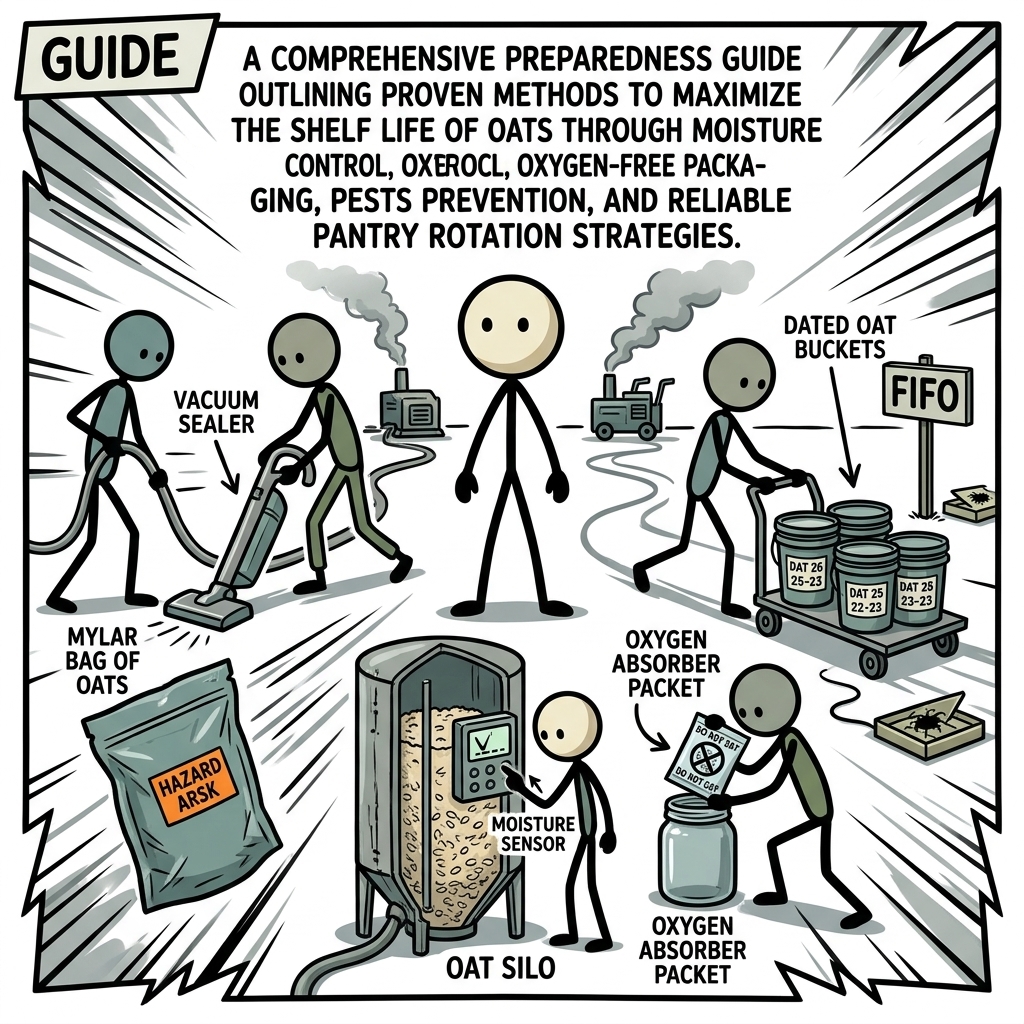
Anatomy of a Grain: Why Oats Present Unique Storage Challenges
Every survival pantry relies on stable macronutrients, but understanding the biological architecture of oats separates successful emergency preparations from costly failures. Oats (Avena sativa) differ fundamentally from other survival staples like hard red winter wheat, dent corn, and polished white rice. The primary divergence lies in their lipid profile and structural processing. For the practical checklist side, use the neighborhood preparedness network.
Oats boast one of the highest fat profiles among cultivated cereal grains, carrying between 5% and 9% total fat depending on the cultivar. Wheat, by comparison, contains approximately 2% fat, while white rice carries under 1%. These polyunsaturated and monounsaturated fatty acids provide clean, calorie-dense energy during an emergency, but they also serve as the primary catalyst for spoilage via oxidative and hydrolytic rancidity. For the practical checklist side, use the emergency communication plan.
Processing methods also alter the grain's shelf-life potential. Raw oat groats undergo mechanical and thermal processing before arriving at consumer markets, and each style responds differently to environmental exposure: For the practical checklist side, use the family emergency planning guide.
- Whole Oat Groats: The intact, hulled kernel. Groats possess the smallest surface-area-to-mass ratio, protecting inner lipids from atmospheric contact. They offer the absolute longest natural storage life but require substantial water and fuel to cook—luxuries that may be scarce during grid-down scenarios.
- Steel-Cut Oats (Pinhead Oats): Whole groats chopped into two or three dense fragments using industrial steel blades. While their lipid-rich interiors are exposed, their dense physical profile maintains high stability if stored properly.
- Rolled Oats (Old Fashioned): Whole groats that have been steamed, flattened through heavy industrial rollers, and lightly toasted. The pre-steaming process inactivates native lipase enzymes that would otherwise rapidly degrade fats into bitter free fatty acids. This enzymatic deactivation makes rolled oats remarkably stable when protected from oxygen.
- Quick and Instant Oats: Rolled thinner and often partially precooked before drying. The drastically increased surface area and fractured structure render these varieties vulnerable to rapid moisture absorption, making them suboptimal for multi-decade caches.
For most emergency kits, standard rolled oats offer the ideal balance between low fuel/water cooking requirements and multi-decade longevity. Selecting the right base grain is the vital first step in effective long term oat storage. For the practical checklist side, use the real-world emergency scenarios guide.
The Four Destructive Forces: Moisture, Oxygen, Heat, and Light
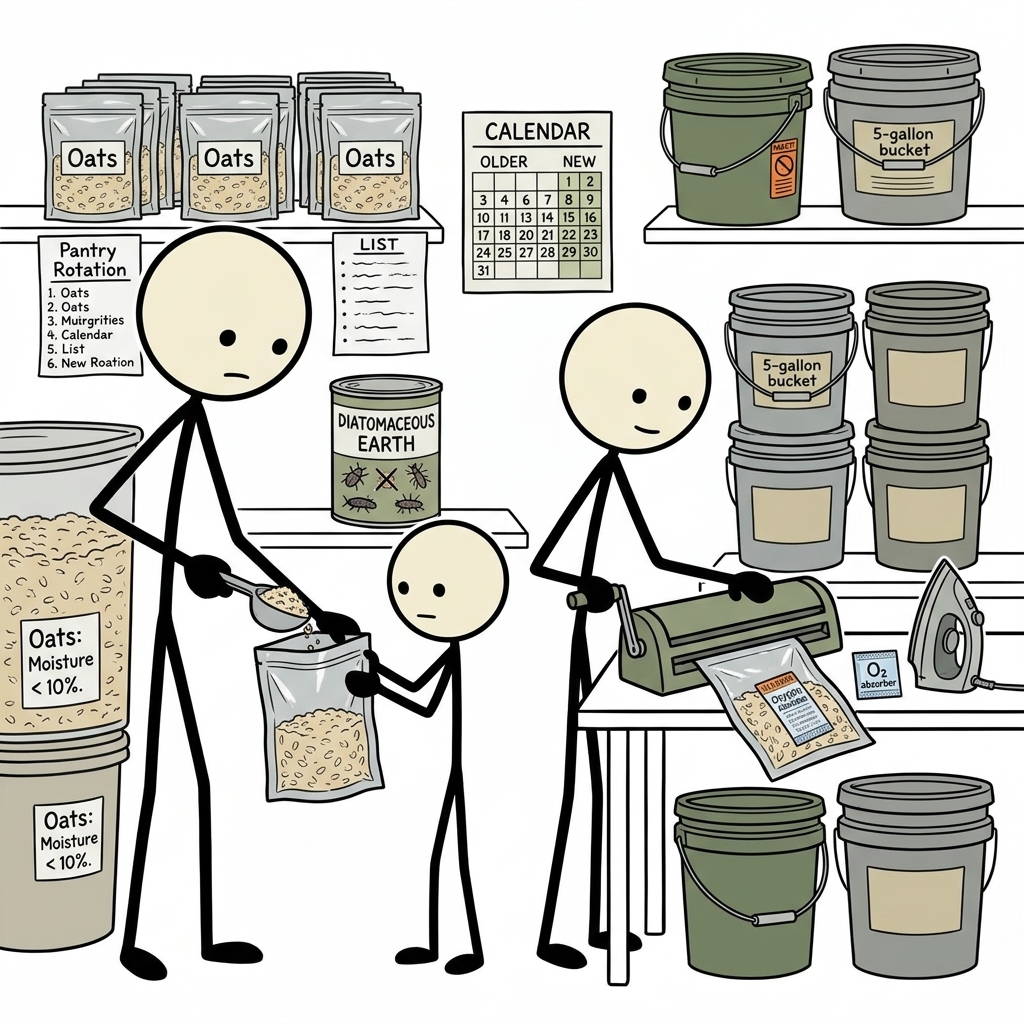
Long-term grain stability is an exercise in controlling chemical and biological decay. Left in standard grocery packaging—thin paper cartons or lightweight polyethylene bags—oats inevitably deteriorate within 12 to 24 months. Preserving them for ten, twenty, or thirty years requires mitigating four specific degradation vectors.
1. Moisture and Water Activity ($a_w$)
Moisture is the most immediate hazard to dry food caches. The USDA and agricultural extension services consistently stress that stored grains must remain below 10% to 12% internal moisture content. High moisture triggers two lethal reactions: rapid mold growth (including dangerous Aspergillus species that produce carcinogenic aflatoxins) and accelerated enzymatic breakdown.
Equally critical is water activity ($a_w$), which measures the unbound water available for chemical reactions. In an enclosed container, fluctuations in exterior temperature cause internal condensation cycles—known as moisture migration—which can turn an otherwise dry bucket of oats into a damp breeding ground for botulism or fungal colonies.
2. Oxygen and Oxidative Rancidity
Atmospheric air comprises roughly 21% oxygen and 78% nitrogen. In an unsealed container, atmospheric oxygen bonds with the unsaturated fatty acids inside the grain through autoxidation. This chemical cascade creates volatile aldehydes and ketones, resulting in the acrid, paint-like smell of rancid grain.
Rancid oats are not merely unpalatable; the ingestion of oxidized lipids can induce gastrointestinal inflammation, stress the liver, and deplete natural antioxidants in an already stressed survival situation. Eliminating oxygen halts oxidative rancidity at the molecular level.
3. Ambient Thermal Degradation
Heat functions as a kinetic accelerator for all chemical decay. The Arrhenius equation dictates that for every 10°C (18°F) rise in temperature, chemical degradation rates approximately double. Storing grain in an uninsulated garage reaching 95°F (35°C) will exhaust shelf life at four to eight times the rate of a stable 60°F (15°C) basement cache.
Elevated temperatures also destroy heat-labile vitamins—most notably thiamine (Vitamin B1), pantothenic acid, and folate—undermining the core objective of storing oats for emergency preparedness.
4. Photo-Oxidation (Ultraviolet and Visible Light)
Photons from sunlight and artificial fluorescent lighting penetrate translucent packaging, exciting grain molecules and accelerating lipid oxidation (photo-oxidation). Light also bleaches naturally occurring carotenoids and degrades riboflavin (Vitamin B2). A complete physical light barrier is mandatory for indefinite storage.
The Packaging Triad: Mylar Bags, Oxygen Absorbers, and HDPE Containers
To eliminate these environmental vectors, preparedness professionals rely on the "Packaging Triad": high-barrier Mylar, specialized oxygen scavengers, and rigid high-density polyethylene (HDPE) buckets. Each component serves a distinct, complementary defense function.
Mylar Bags: The Impermeable Gas and Light Shield
Standard clear plastics (such as polyethylene, polypropylene, and PET) are porous at the microscopic level; ambient oxygen and ambient water vapor slowly diffuse straight through them over several years. Mylar—a bi-axially-oriented polyethylene terephthalate (BoPET) film laminated with a microscopic aluminum layer—provides a nearly zero Oxygen Transmission Rate (OTR) and Water Vapor Transmission Rate (WVTR).
When selecting mylar bags for oats, thickness dictates mechanical durability and puncture resistance. Opt for bags that are at least 5.0 to 7.0 mils thick. Thinner 3.5 mil bags are prone to pinhole punctures from the abrasive, fibrous edges of rolled oats and steel-cut grains under vacuum pressure.
Oxygen Absorbers: The Chemical Purge
Oxygen absorbers (OAs) do not work like desiccants; they do not absorb moisture. Instead, they contain finely divided iron powder, water, salt, and activated carbon. When exposed to ambient air, the iron chemically reacts with oxygen to form iron oxide (rust), permanently trapping the oxygen molecules in a non-gaseous state.
This process reduces ambient oxygen inside the sealed pouch from 21% down to below 0.01% (100 parts per million). Because nitrogen makes up the remaining 78% of the air and is non-reactive, the bag will rarely compress completely like a commercial freeze-dried meal. A partial volume reduction of 20% to 21% is standard and confirms the absorber successfully scavenged the available oxygen.
| Container Size | Approximate Weight of Oats | Recommended Absorber Rating | Target Oxygen Level |
|---|---|---|---|
| 1-Quart Mylar Bag | 0.75 - 1.0 lb | 100cc – 300cc | < 0.01% |
| 1-Gallon Mylar Bag | 4.0 - 5.0 lbs | 300cc – 500cc | < 0.01% |
| 5-Gallon Mylar Bag | 22.0 - 27.0 lbs | 2,000cc – 2,500cc | < 0.01% |
Note: Oats contain significant interstitial airspace due to their uneven geometry. Erring on the side of a higher cubic centimeter (cc) rating is safe and advisable; an oversized absorber will simply remain inactive once all available oxygen is consumed.
Rigid HDPE Buckets: Physical Armor
While Mylar provides exceptional chemical and atmospheric protection, its thin foil matrix can easily be breached by mice, rats, and insects. Food-grade high-density polyethylene (HDPE #2) buckets provide critical structural integrity, allow vertical stacking to optimize floor space, and protect the flexible foil bags from puncture, light, and rodents.
Pantry Pest Protection: Mitigating Biological Threats
No storage plan is complete without robust pantry pest protection. Insects such as the saw-toothed grain beetle (Oryzaephilus surinamensis), the merchant grain beetle, and the Indian meal moth (Plodia interpunctella) are frequent culprits in pantry infestation. Crucially, these pests are rarely introduced through breach of storage; their microscopic eggs are often already mixed within the grain from harvest, processing, or packaging facilities.
Left unchecked at room temperature, these eggs hatch, mature, breed, and destroy pounds of dry matter through consumption and metabolic waste. Fortunately, insects depend on biological mechanisms that emergency packagers can easily neutralize:
- Complete Anoxia (Oxygen Deprivation): The primary line of defense is the oxygen absorber. According to entomological studies, atmospheric oxygen levels sustained below 1% for two to three weeks suffocate and kill insects at every life stage: adult, larva, pupa, and egg. Properly sized oxygen absorbers within thick Mylar packaging create a lethal, anoxic environment without needing toxic chemical fumigants.
- Freezing Protocols (Thermal Purge): If you plan to package in non-hermetic or short-term containers, freezing grain provides an alternative mechanical kill step. The CDC and agricultural extensions note that sub-zero temperatures (0°F / -18°C) maintained continuously for at least 72 to 96 hours disrupt cellular walls within insect eggs. Allow the grain to return fully to ambient room temperature before final packaging to prevent condensation build-up inside the container.
- Food-Grade Diatomaceous Earth (DE): Composed of fossilized, microscopic phytoplankton skeletons, amorphous silica (DE) acts as a physical desiccant against arthropods. Its microscopically sharp edges scratch through an insect's outer waxy cuticle, causing rapid dehydration and death. Adding 1-2 tablespoons of 100% food-grade DE per 5-gallon bucket provides non-toxic, lifelong mechanical insect defense, perfectly safe for human consumption after cooking.
Step-by-Step Protocol: Packaging Oats for Multi-Decade Viability
Executing long-term packaging requires strict adherence to hygiene, mechanical precision, and proper timing. Follow this operational checklist to package rolled or steel-cut oats for maximum durability:
Phase 1: Preparation and Sanitization
- Inspect the Stock: Confirm that your oat stock is completely dry, crisp, and fresh. Never store oats that exhibit a dusty aroma, sour scent, or soft texture.
- Sanitize Hardware: Wash food-grade 5-gallon HDPE buckets with warm water and mild unscented soap, sanitize with a light chlorine-water solution (1 tablespoon unscented bleach per gallon of water), and allow them to dry completely over 24 hours. Any residual water will ruin the cache.
- Prepare Tools: You will need an impulse sealer or a heavy-duty household flat iron, a clean wooden 2x4 board or level tabletop, an assortment of 5.0+ mil Mylar bags, and fresh oxygen absorbers.
Phase 2: Filling and Purging
- Position the Liner: Place a 5-gallon Mylar liner directly inside the cleaned HDPE bucket. Never fill a bag outside the bucket and attempt to force it in later; the expanding grain will stretch the foil and risk micro-tears.
- Transfer Grain: Pour the rolled oats into the bag, pausing at the halfway mark. Tap the sides of the bucket firmly on the ground to consolidate and settle the grain, reducing excess air pockets. Fill until the grain reaches roughly 3 to 4 inches below the bucket rim.
- Prep the Heat Seal: Wipe down the inner lips of the Mylar bag with a clean, dry microfiber cloth to remove stray oat dust. Dust along the seal prevents the thermoplastic layer from fusing properly.
- Seal Most of the Edge: Using your iron set to high heat (approx. 375°F to 400°F) or an impulse sealer, weld the bag along the top edge, leaving a small, unsealed 2-to-3-inch gap at one corner.
- Insert Absorbers: Only now, unseal your packet of oxygen absorbers. Quickly insert the calculated dose (2,000cc for a 5-gallon container) through the open gap directly into the grain. Work within a 10-to-15-minute window before the absorbers exhaust their active lifespan exposed to open air.
- Purge Headspace and Final Seal: Compress the bag with your hands to push out as much ambient headspace air as possible through the gap, then immediately run the heat sealer across the remaining unsealed section. Inspect the seal along the entire length; it should be unbroken, uniform, and free of wrinkles.
Phase 3: Verification and Closure
- Wait 48 to 72 Hours: Monitor the container over the next three days. The Mylar bag should visibly draw inward, pulling tight against the bulk oats. If the bag remains loose and pillowy after 5 days, the seal failed or the oxygen absorber was exhausted. Re-seal with a fresh absorber.
- Apply Rigid Lid: Press an airtight lid with a rubber gasket onto the bucket using a rubber mallet. For regular household access, install a Gamma Seal lid, which transforms standard buckets into easily accessible, threaded-screw storage containers.
- Systematic Labeling: Clearly mark the bucket with the grain type, net weight, initial purchase date, packaging date, and calculated oxygen absorber capacity using permanent, water-resistant ink.
Pantry Logistics: The FIFO Strategy and Culinary Rotation
Food caches are living logistics chains, not static time capsules. The Federal Emergency Management Agency (FEMA) advises that disaster supplies must be reviewed, organized, and refreshed systematically. The most vulnerable prepper is one with thirty-year-old buckets of supplies they do not know how to cook, digest, or rotate.
The FIFO Imperative
Implement the standard culinary and supply-chain methodology: FIFO (First In, First Out). Your oldest packaged oats should always be the next container opened for daily family use. By maintaining an active cycle, you naturally stress-test your packaging integrity, identify any seal failures early, and ensure your home pantry operates continuously on reliable, highly nutritional bulk goods.
FEMA-Aligned Storage Environment Guidance
To maximize your investment, your storage space should strictly adhere to three core baseline metrics:
- Maintain Low Thermal Variance: Store grain between 50°F and 65°F (10°C to 18°C). Avoid attics, unfinished detached garages, and exterior sheds. Basements, interior closets, or under-bed storage zones provide ideal thermal stability.
- Elevate Off Concrete Floors: Never store packaging buckets directly in contact with bare concrete. Concrete is porous and continually wicks hydrostatic moisture upward from the soil, creating a humid microclimate beneath your containers. Rest buckets on wooden pallets, dynamic shelving, or plastic lumber.
- Minimize Humidity Exposure: Target an ambient room relative humidity below 55%. If your subterranean cache area trends damp, install a continuously running, plumbed dehumidifier to protect your outer containment systems.
Culinary Integration and Caloric Realities
In a prolonged emergency, palate fatigue is a recognized psychological challenge, particularly among children. While plain oatmeal provides vital energy, survival planners should actively secure complementary items with matching multi-decade shelf-lives:
- Fats and Proteins: Unsweetened peanut butter powder, freeze-dried whole eggs, and powdered whole milk restore critical essential fats and amino acids to grain-heavy diets.
- Natural Sweeteners: Commercial honey—which has an essentially indefinite shelf life due to its extremely low water activity ($a_w < 0.60$)—alongside maple sugar crystals and white sucrose, improves morale and caloric density.
- Savory Transitions: Oats can easily be cooked as a savory dish. Preparing oats with bouillon cubes, freeze-dried vegetables, sea salt, and shelf-stable dehydrated meats creates nutrient-rich porridge, functioning similarly to rice or barley in traditional survival cooking.
- Grain Grinding: By running rolled oats through an electric or manual hand-crank burr grinder, you instantly create oat flour. This can be cut into standard wheat flour at a 20% to 30% ratio to fortify breads, biscuits, and flatbreads with complex beta-glucan fibers without requiring extra leavening agents.
Securing Your Family's Resilient Caloric Base
True emergency preparedness is rooted in methodical, science-backed risk management, not reactionary purchases made in panic. By understanding the unique lipid architecture of the oat groat, mitigating moisture and oxygen vectors, and enforcing strict clean-room packing protocols, you can transform an affordable, highly available agricultural staple into a multi-decade insurance policy for your family's baseline survival.
Take deliberate steps this week: acquire genuine multi-mil Mylar packaging, test your heat seals, verify your oxygen absorber ratings, and systematically establish your long-term grain caches. When regional disruptions occur, the security of having nutrient-dense, shelf-stable nutrition safely stored away brings unmatched clarity, calm, and independence.
Frequently Asked Questions
What is the best method to store oats for long-term preparedness?
Sealing rolled oats or whole oat groats in food-grade Mylar bags with oxygen absorbers and placing them inside airtight five-gallon plastic buckets protects them from light, oxygen, pests, and moisture for 20 to 30 years.
Which variety of oats lasts the longest in storage?
Whole oat groats have the lowest surface area and natural protective outer hulls, giving them the longest potential shelf life, though regular rolled oats also store reliably for up to 25 to 30 years when oxygen is removed.
How do oxygen absorbers protect stored oats from pests?
Oxygen absorbers drop the ambient oxygen level in a sealed container below 0.1 percent, which suffocates weevils, pantry moths, and insect larvae while preventing lipid oxidation that causes rancidity.
How should a pantry rotation system be applied to oat storage?
Use the First-In, First-Out (FIFO) method by clearly labeling every container with the purchase and packaging dates, using the oldest stock first to maintain peak nutritional value and freshness.
What are the signs that stored oats have spoiled?
Spoiled oats produce a sharp, sour, or cardboard-like rancid odor caused by degraded natural oils, and may show discoloration, clumps from moisture entry, or webbed insect frass.