⚡ Key Facts
- 30-Year Shelf Life: Rigorous food science studies from Brigham Young University (BYU) demonstrate that polished white rice packaged in an oxygen-depleted environment retains acceptable taste and nutritional value for 30 years or more.
- Caloric Efficiency: A single standard 5-gallon food-grade bucket holds approximately 33 to 36 pounds of white rice, delivering over 57,000 calories—enough to meet the baseline caloric needs of an adult for nearly a month.
- Scientific Chemistry: Atmospheric air contains roughly 20.9% oxygen; pairing 7-mil Mylar bags with appropriate oxygen absorbers reduces interior oxygen levels to below 0.01%, suffocating all life stages of common grain pests without chemical fumigants.
- Brown vs. White Composition: According to the USDA Agricultural Research Service, brown rice retains its germ and bran, containing volatile oils that cause rancidity within 6 to 12 months, making enriched white rice the undisputed standard for long term rice storage.
- Structural Defense: High-Density Polyethylene (HDPE) #2 buckets protect pliable Mylar bags from mechanical damage, light intrusion, moisture permeation, and rodent gnawing, forming an impenetrable barrier system.
When supply chains fracture under geopolitical strain, severe weather emergencies, or sudden regional distribution freezes, food security transitions overnight from a theoretical concept to an urgent household priority. The Federal Emergency Management Agency (FEMA) and the American Red Cross routinely advise maintaining emergency food reserves, yet the standard grocery-store staple—packaged in thin paper or micro-perforated polyethylene bags—is biologically engineered to spoil within months. Preparing an enduring, nutritionally viable stockpile demands a deliberate transition from retail packaging to scientific preservation. White rice stands as the uncontested sovereign of shelf-stable carbohydrates, providing a predictable, calorie-dense foundation capable of sustaining a family across decades if sealed correctly. For the practical checklist side, use the community emergency preparedness guide.
The Scientific Case for White Rice in Emergency Preparedness
Every serious strategy surrounding prepper food storage rice begins with a clear understanding of grain biology. While modern nutritional discourse frequently champions whole grains over refined carbohydrates, the long-term survival calculus inverts these standard consumer priorities. The difference lies entirely in the presence of lipids within the grain kernel. For the practical checklist side, use the neighborhood preparedness network.
A grain of paddy rice consists of the protective outer hull, the nutrient-dense bran layer, the lipid-rich germ, and the starchy endosperm. In brown rice, only the non-edible outer hull is stripped away, leaving the bran and germ intact. According to compositional analyses published by the USDA, that remaining germ contains unsaturated fatty acids that inevitably oxidize when exposed to ambient temperature and oxygen. This oxidation process generates peroxides and free fatty acids, producing an unmistakable acrid smell, a bitter taste, and toxic breakdown products within six to twelve months of storage. For the practical checklist side, use the emergency communication plan.
Polished white rice, conversely, undergoes a thorough industrial milling process that completely strips away the hull, the bran, and the germ. What remains is virtually pure starchy endosperm. With the lipid content reduced to less than 0.5%, white rice is devoid of the primary mechanism that drives grain rancidity. When protected against moisture, oxygen, heat, and insect predation, white rice does not chemically deteriorate in any conventional sense. For the practical checklist side, use the family emergency planning guide.
In extensive benchmark studies conducted by the Department of Nutrition, Dietetics, and Food Science at Brigham Young University, researchers evaluated white rice stored in hermetically sealed metal cans and laminated foil pouches with oxygen absorbers over intervals spanning 10, 20, and 30 years. Consumer sensory panels found that samples stored up to 30 years retained acceptable ratings for color, texture, flavor, and overall edibility. The starchy carbohydrates remained bioavailable, rendering white rice one of the most reliable calorie assets accessible to civilians.
Nutritional Profile and Caloric Density
Caloric density dictates survivability during prolonged disruptions. A single pound of uncooked white long-grain rice provides roughly 1,650 to 1,700 calories, alongside 32 to 36 grams of plant-based protein and fundamental trace minerals like iron, thiamine, and niacin (particularly when enriched). A standard 50-pound sack of white rice purchased from a commercial supplier yields approximately 83,000 calories.
From an operational standpoint, this caloric density allows a household to establish a deep, multi-month energy foundation within an exceptionally small physical footprint. Four 5-gallon buckets containing approximately 140 pounds of rice occupy less than six square feet of floor space yet supply roughly 230,000 calories. This represents enough metabolic fuel to sustain an active adult for four months at a solid 1,900 calories per day.
The Five Destructive Vectors of Long-Term Grain Storage
Knowing how to store rice long term requires an active defense against the five primary environmental mechanisms that degrade dry goods: oxygen, moisture, light, heat, and pests. Neutralizing these variables transforms vulnerable bulk grains into an enduring survival asset.
- Oxygen ($O_2$): Ambient air comprises roughly 78% nitrogen, 20.9% oxygen, and trace gases. Oxygen fuels biological degradation. It facilitates the oxidation of residual nutrients, permits the growth of aerobic fungi, and is required for the respiration of stored-product insects. Eliminating oxygen renders the internal environment utterly uninhabitable to biological threats.
- Moisture and Relative Humidity: The United States Department of Agriculture dictates that commercial long-grain white rice must be dried to an internal moisture content of 14% or less prior to market distribution. Storing grain with excessive moisture (above 13-14%) in an anaerobic (oxygen-free) environment carries a catastrophic risk: the proliferation of Clostridium botulinum, the deadly neurotoxin-producing bacterium responsible for botulism. Always ensure commercially packaged white rice is crisp and dry before sealing.
- Thermal Energy (Heat): Chemical reaction rates roughly double with every 10°C (18°F) rise in temperature, a standard known in chemistry as the Arrhenius equation. Storing rice in an uninsulated garage or attic where summer ambient temperatures hit 100°F (38°C) accelerates trace nutrient breakdown, weakens plastic polymers, and dramatically degrades long-term shelf stability.
- Ultraviolet and Ambient Light: Direct sunlight and harsh artificial lighting degrade food quality through photo-oxidation. Light bleaches the outer layer of grain, breaks down synthetic enrichment compounds, and accelerates thermal fluctuations within storage containers.
- Biological Pests: The Rice Weevil (Sitophilus oryzae) and the Lesser Grain Borer (Rhyzopertha dominica) pose the most pervasive threat to bulk rice reserves. Females bore minute cavities into grains, deposit microscopic eggs, and seal them with a gelatinous secretion. You cannot inspect away these hidden eggs; without proper preservation measures, they will hatch within standard retail bags inside your pantry.
The Equipment Trinity: Buckets, Mylar, and Oxygen Absorbers
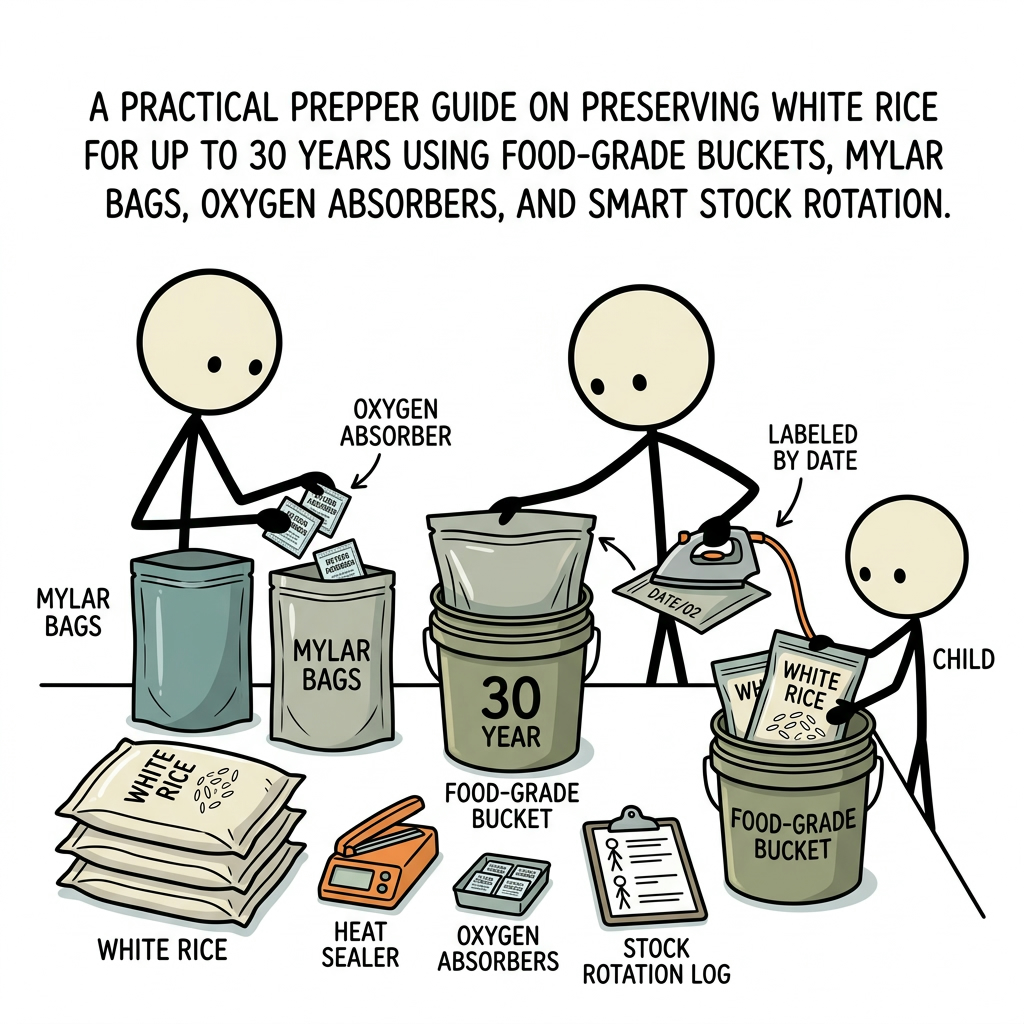
The standard methodology for civilian-grade preservation relies on a three-tier defensive system: a structural outer shell, a flexible gas-barrier envelope, and an active chemical scavenger. Substituting or skipping any leg of this structural tripod introduces an unacceptable point of failure.
1. High-Density Polyethylene (HDPE) Buckets
The outer container must be a rigid, food-grade bucket constructed from High-Density Polyethylene, marked distinctly with the resin identification code #2 inside the universal recycling triangle. Non-food-grade buckets—such as standard utility buckets from regional hardware outlets—are manufactured using industrial mold-release agents, recycled post-consumer plastics containing toxic chemical residues, and plasticizers that continuously off-gas harmful volatile organic compounds (VOCs).
Food-grade HDPE buckets are molded from virgin, non-recycled resins certified by the Food and Drug Administration (FDA) for direct food contact. Structurally, the rigid walls of a 90-mil (0.090 inch) thick HDPE bucket resist the crushing weight of high vertical stacking and deter rodents. While mice and rats can easily chew through thin plastic bags and soft plastics, penetrating a cured HDPE wall requires considerable time and effort, buying you critical reaction time during an infestation.
2. Genuine Mylar Bags
Mylar is a specific brand name for biaxially-oriented polyethylene terephthalate (BoPET), an exceptionally strong polyester film laminated to an interior layer of aluminum foil and a heat-sealable food-grade polyethylene interior. Pure plastics, including thick polyethylene or polypropylene, are microscopic sponges: they are gas-permeable over multi-year timelines. Oxygen and moisture vapor slowly diffuse directly through plastic pail walls.
Mylar solves this through an embedded layer of solid metallic aluminum foil, dropping its Oxygen Transmission Rate (OTR) and Moisture Vapor Transmission Rate (MVTR) effectively to zero. For long term rice storage, you should utilize true food-grade bags with a minimum thickness of 5 mils (0.005 inches), with 7-mil thickness representing the gold standard for long-grain storage. Thin 3.5-mil bags are highly vulnerable to pinhole punctures caused by the sharp, needle-like tips of dried long-grain white rice during handling and compression.
3. Iron-Based Oxygen Absorbers
Oxygen absorbers (often abbreviated as OAs) are neither desiccants nor toxic chemical agents. They are small, permeable paper-and-fabric packets packed with a precisely balanced mixture of finely divided iron powder, activated carbon, sodium chloride, and moisture-retaining agents. When exposed to ambient air, the moisture in the air activates the salt, catalyzing a rapid oxidation reaction: the iron powder chemically rusts into iron oxide ($Fe_2O_3$).
This natural chemical reaction permanently traps atmospheric oxygen within the molecular matrix of the iron compound. Because oxygen makes up 20.9% of ambient air, the absorber scavenges that exact fraction, leaving behind an inert, 99.9% pure atmospheric nitrogen blanket within the sealed Mylar bag. Aerobic bacteria, mold spores, and every developmental stage of the rice weevil (egg, larva, pupa, and adult) suffocate under these conditions.
Calculating Oxygen Absorption: The Precision Math
Guessing your oxygen absorption requirements is one of the most common points of failure in amateur food preservation. Absorbers are rated in cubic centimeters (cc) of pure oxygen they can reliably capture, not the gross volume of the container. Deploying too few absorbers leaves residual oxygen inside the vessel, giving weevil eggs and micro-fungi the resources they need to thrive.
To determine the precise volume of atmospheric oxygen inside a sealed container, you must calculate the interstitial air—the volume of air occupying the open void spaces between packed rice grains. White rice is dense, with a packing factor leaving approximately 35% to 40% interstitial void space when poured into a container.
The Five-Gallon Bucket Calculation
- Total interior volume of a standard 5-gallon pail: ~19,000 cubic centimeters (mL).
- Fill with 33 pounds of white rice (taking up ~60% solid volume): Void space represents 40% of 19,000 cc = 7,600 cc of ambient air.
- Atmospheric air is 20.9% oxygen: 7,600 cc × 0.209 = 1,588.4 cc of pure oxygen present within the void spaces.
To safely scavenge this environment, you require a minimum absolute rating of 1,600 cc of absorption capacity. Best practice dictates rounding up to maintain a safe margin of error against minor sealing delays or pocket headspaces. For a 5-gallon Mylar bag packed with white rice, deploy 2,000 cc to 2,500 cc of total absorption capacity. You can achieve this using a single 2,000 cc packet, or five individually placed 500 cc packets spread evenly from bottom to top.
For smaller batches using 1-gallon Mylar bags (which hold approximately 7 pounds of white rice), the void volume holds approximately 300 cc of oxygen. Placing a single 300 cc to 500 cc absorber in each 1-gallon pouch guarantees complete deoxygenation.
Step-by-Step Protocol: Sealing Rice for 30-Year Survival
Success rests on discipline, absolute cleanliness, and efficient execution. Because oxygen absorbers react immediately upon exposure to air, your staging area and workflow must be completely prepared before exposing the packets to the ambient environment.
Phase 1: Workspace Sanitation and Equipment Staging
Clean and thoroughly sanitize your prep surfaces using a mild bleach-and-water solution or 70% isopropyl alcohol, allowing the tables to dry completely. Moisture is a critical threat; do not allow lingering water droplets near your unsealed grain. Gather your tools:
- Food-grade, virgin HDPE #2 5-gallon buckets.
- 7-mil heavy-duty gusseted Mylar bags (sized 20" × 30" for 5-gallon pails).
- Appropriately sized oxygen absorbers (vacuum-sealed factory fresh).
- A heavy-duty 1-inch thermal impulse sealer, or an adjustable household flat iron (hair straightener) capable of reaching 375°F to 400°F (190°C–205°C).
- A clean 2×4 wooden board or level heat-resistant straightedge.
- Permanent industrial markers (Sharpie) for container labeling.
- A clean Mason jar with an intact two-piece lid for preserving leftover oxygen absorbers.
Phase 2: Filling and Settling the Grain
Drop the Mylar bag directly into the clean HDPE bucket, ensuring the bottom gussets spread flat across the bucket floor. Do not pour rice outside the bucket and attempt to slide a full, heavy Mylar sack into the bucket afterward; doing so will stretch the Mylar and risk structural micro-tears.
Pour bulk white rice directly into the Mylar-lined bucket until it reaches roughly four inches below the bucket rim. Lift the bucket two inches off the floor and drop it flatly onto a concrete slab or reinforced surface three to four times. This settling step consolidates the rice, eliminates excess interstitial air pockets, and drops the overall volume by up to 10%, letting you store more calories per container.
Phase 3: The Initial Heat Seal and Headspace Purge
Wipe the interior lip of the top opening of the Mylar bag with a clean, dry micro-fiber cloth to remove any fine starch dust. Starch particulate trapped within the sealing seam creates micro-channels that allow slow, multi-year air ingress.
Bring the two opposing foil faces together. Using your heated flat iron set to roughly 385°F (196°C) or an impulse sealer, weld a solid, continuous 1-inch wide seam across the top edge. Crucial: Leave an unsealed 2-to-3-inch gap at one corner. Place your hands flat on the chest of the bag and gently press downward to force out excess air through the remaining gap. Purging this headspace means your oxygen absorbers have far less work to do, saving their active chemical capacity for the remaining interstitial air.
Phase 4: Oxygen Absorber Placement and Final Hermetic Seal
Open your factory-sealed pack of oxygen absorbers. Immediately drop the calculated volume of absorbers (e.g., one 2,000 cc packet or four 500 cc packets) through the remaining corner opening, pushing them deep into the top quadrant of the rice.
Immediately seal the remaining 3-inch gap with your heat iron, ensuring the seal merges smoothly into the previously welded seam. Check the entire seal line: a good seal looks flat, solid, and opaque, without wrinkles or gaps. Transfer any unused oxygen absorbers into your clean Mason jar immediately and screw the metal ring down firmly. Deprived of fresh air, the absorbers in the jar will quickly go dormant, preserving their chemistry for your next run.
Phase 5: Inspection, Lidding, and Mechanical Defense
Allow the heat-welded Mylar seam to cool completely for two minutes. Fold the excess Mylar flaps neatly downward into the bucket opening. Do not aggressively crush or sharp-crease the foil, as sharp folds can fatigue the aluminum barrier layer.
Affix the bucket lid. For absolute perimeter defense, install a heavy-duty commercial gasketed lid or a two-piece threaded Gamma Seal lid. Tap standard snap lids down firmly using a rubber mallet until the internal sealing ring locks beneath the bucket rim. This outer HDPE layer protects your package from mice, physical punctures, moisture, and light, keeping the Mylar pouch inside secure.
Understanding the "Brick" Misconception
A widespread point of confusion among beginners is expecting a sealed Mylar bag of rice to pull down into a rock-hard, vacuum-packed "brick" within 24 hours. Remember: oxygen absorbers only consume oxygen (20.9% of the air volume). The remaining 78% of the air is inert nitrogen, which remains inside the bag. While your bag will pull in slightly and show some internal tension, it should not look like a commercial vacuum-sealed bag. A bag that does not collapse like a brick is completely normal—as long as your heat seal is clean and continuous, the interior environment is entirely free of oxygen.
Storage Environment, Floor Isolation, and Pest Interception
Even the most meticulously sealed grain can fail if stored in poor conditions. Storing mylar bags for rice storage inside rigid pails drastically improves environmental resilience, but you must still control external conditions to hit that 30-year target.
According to the Centers for Disease Control and Prevention (CDC) and FEMA emergency management handbooks, primary food stockpiles should be maintained in a cool, dark, and dry environment. Strive for a consistent baseline temperature between 55°F and 65°F (13°C–18°C). While short excursions up to 75°F (24°C) are acceptable, sustained exposure to high heat steadily degrades trace micronutrients like thiamine and folate.
Floor Isolation: The Concrete Condensation Danger
Never store your food-grade storage buckets directly on bare concrete basement floors. Concrete is porous and naturally wicks ground moisture up via capillary action, a process often referred to by structural engineers as vapor emission. Concrete temperatures also fluctuate significantly compared to ambient indoor air.
Placing a plastic bucket directly on raw concrete creates a chronic thermal boundary layer beneath the base. This temperature differential causes condensation to form on the underside of the bucket, creating an ideal breeding ground for persistent molds that can slowly degrade the bucket plastic. Set your buckets atop raw wooden pallets, heavy 2×4 runners, industrial dunnage racks, or metal shelving units to maintain a 2-to-4-inch air gap between the container and the concrete slab.
Stacking Limits and Rodent Defense
While 90-mil HDPE buckets are exceptionally durable, dynamic loads can stress them over time. Stack 5-gallon buckets no more than three units high. Exceeding three tiers risks tipping during seismic events, stresses the lower bucket sidewalls, and can warp lids, potentially compromising the rubber gaskets.
Keep your storage area clear of loose paper, clutter, and cardboard boxes, which attract nesting rodents. Inspect bucket perimeters biannually for evidence of gnawing. Mice cannot chew into smooth, flat plastic faces easily; they need an edge, corner, or ridge to bite down on. High-quality smooth-walled HDPE buckets paired with recessed lids eliminate these bite angles, keeping your rice safe from pests.
The FIFO Rotation Protocol and Household Integration
Even a 30-year survival asset benefits from deliberate inventory discipline. A sound long-term food storage plan does not treat supplies as buried treasure to forget for decades. Establishing a thoughtful inventory strategy keeps your emergency food storage guide fresh, familiar, and fully functional.
The First-In, First-Out (FIFO) Framework
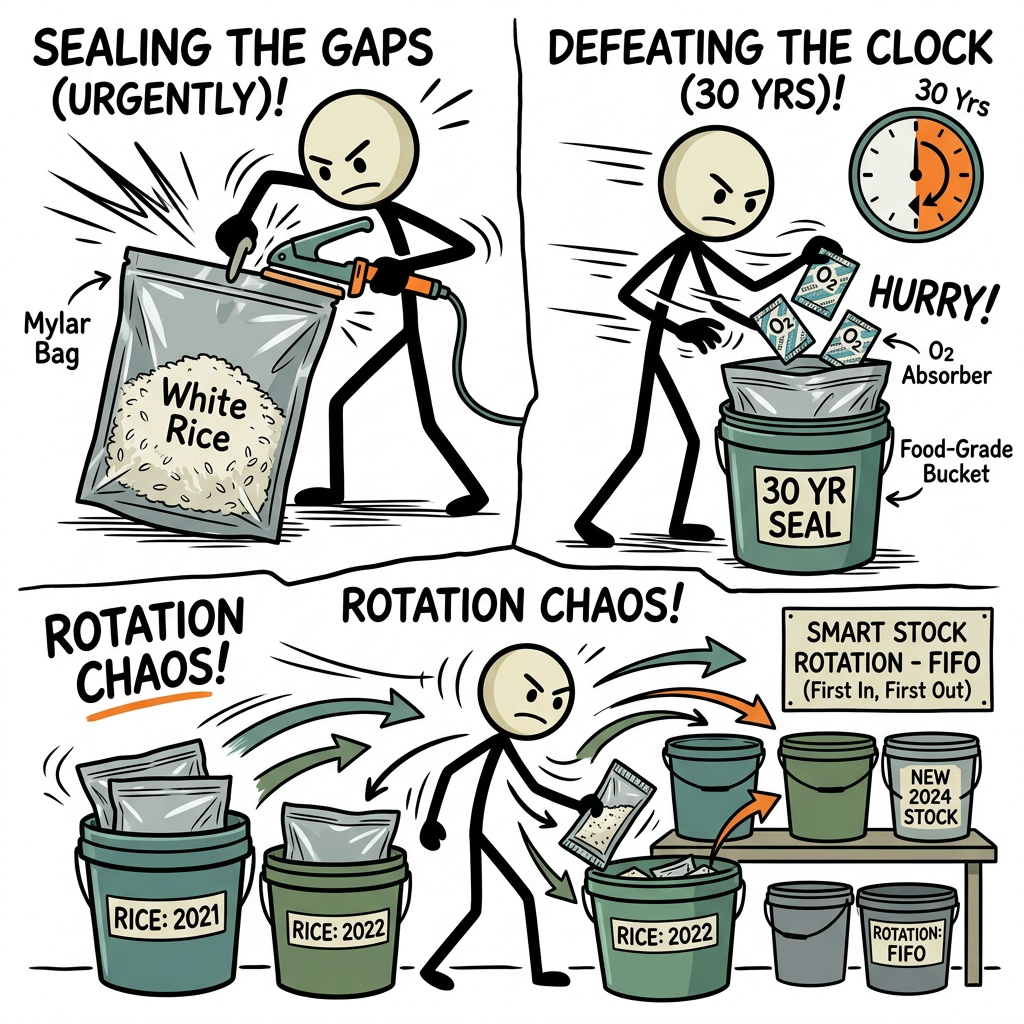
Mark every container clearly on both the bucket lid and the side wall with permanent ink. Record the packaging date, net weight, the variety of rice enclosed (e.g., Enriched Long Grain White, Jasmine, Basmati), and the oxygen absorption volume applied:
BATCH NO: 2026-03A
COMMODITY: Long-Grain White Rice (Enriched)
NET WEIGHT: 34.5 lbs
O2 CAPACITY: 2,000 cc
PACK DATE: March 31, 2026
PROJECTED REVIEW: March 2056
Organize your storage space using the standard commercial warehouse rule: First-In, First-Out (FIFO). Position your older containers at the front and place newly sealed buckets at the rear or bottom. When preparing home meals or refreshing provisions, draw consistently from the oldest production dates.
Culinary Integration and Dietary Adaptation
A true crisis is the worst possible time to introduce your digestive system to radical dietary shifts. Suddenly transitioning a family reliant on processed foods to a high-fiber, high-starch survival diet heavy in white rice and beans can cause significant gastrointestinal distress, low energy, and unnecessary psychological stress.
Integrate your stored staples directly into your family's weekly meals. Unseal an older bucket every few years to check the seal, evaluate the grain, and practice re-integrating it into daily cooking. Cook with it across a wide range of simple, dependable recipes:
- Traditional pilafs, stir-fries, and red beans and rice.
- Ground into fine rice flour using a home grain mill for gluten-free baking and thickening soups.
- Boiled into congee (a classic East Asian rice porridge), an easily digestible dish ideal for anyone recovering from illness.
- Combined with dried broths, canned vegetables, and home-canned meats to build nutritionally complete, shelf-stable meals.
Regularly eating from your food storage demystifies your emergency supplies. It trains your household to see those sealed HDPE buckets not as an intimidating symbol of disaster, but as a practical, everyday household pantry reserve.
The Multi-Decade Caloric Shield
True emergency preparedness is built through deliberate, well-researched action rather than reactive concern. Learning how to store rice long term using heavy-duty Mylar bags, calibrated oxygen absorbers, and rigid food-grade buckets turns a routine agricultural commodity into a decades-long nutritional lifeline. By eliminating moisture, capturing every trace of ambient oxygen, and shielding your investment behind durable physical barriers, you create a robust, home-level hedge against supply disruptions, extreme weather, and unpredictable economic shifts. Approach the packaging process with precision, store your harvest properly, and take confidence in knowing that your household's caloric foundation is secure for years to come.
Frequently Asked Questions
How long can white rice last when stored for long-term preparedness?
When sealed in food-grade Mylar bags with oxygen absorbers and stored in a cool, dark, and dry environment below 70°F (21°C), white rice can remain safe and edible for 25 to 30 years or more.
Can brown rice be stored long term using the same methods as white rice?
No. Brown rice contains natural oils within its outer bran layer that oxidize and turn rancid within 6 to 12 months at room temperature, making it unsuitable for multi-decade survival storage.
What size oxygen absorber is needed for a 5-gallon bucket of rice?
A standard 5-gallon bucket filled with white rice packed in a Mylar bag requires approximately 2,000 cc of oxygen absorption capacity (either a single 2,000 cc packet or multiple smaller packets totaling 2,000 cc).
What is the best container system for protecting stored rice?
The most effective system pairs heavy-duty (5 to 7 mil) heat-sealed Mylar bags containing oxygen absorbers inside food-grade 5-gallon HDPE plastic buckets equipped with airtight gasket or Gamma Seal lids to guard against moisture, light, pests, and rodents.
How should a long-term rice storage rotation plan be managed?
Follow a first-in, first-out (FIFO) rotation strategy, dating all containers upon packing and cycling a portion of your supply into everyday household cooking every 5 to 10 years to verify seal integrity and maintain familiar cooking habits.