The Reality of Emergency Food Preparedness
When the grid goes down, a severe storm hits, or supply chains collapse, your household emergency food supply becomes your primary line of defense. In a prolonged crisis, food is far more than simple fuel. It is a source of psychological comfort, a stabilizer for family morale, and the biological foundation of your physical endurance. For decades, two brands have dominated the emergency preparedness market: Mountain House and ReadyWise. While both brands promise long-term security in a convenient package, they approach food preservation, nutritional density, and recipe formulation from fundamentally different philosophies.
Choosing between these two giants requires looking past marketing buzzwords like "30-year shelf life" and diving into the hard metrics of nutritional value, preparation logistics, and financial efficiency. This comprehensive head-to-head comparison will dissect how Mountain House and ReadyWise perform under pressure. By analyzing their ingredient quality, caloric density, water requirements, and overall cost per calorie, you can make an informed, practical decision for your family survival plan. To understand how these food choices integrate into your broader survival strategy, refer to our comprehensive water and food storage guide.
Key Takeaways: Mountain House vs. ReadyWise
- Preservation Differences: Mountain House relies almost exclusively on premium freeze-drying, which preserves food texture and taste, while ReadyWise utilizes a hybrid blend of freeze-dried and dehydrated ingredients.
- Caloric and Protein Density: Mountain House meals generally offer higher protein and caloric density per serving from real meat sources, whereas ReadyWise utilizes more grain-based fillers and textured vegetable protein (TVP) to keep costs down.
- Water Requirements: ReadyWise meals, often featuring dehydrated starches and powdered sauces, typically require more water and active simmering to prepare compared to the quick-soak freeze-dried meals of Mountain House.
- Cost Efficiency: ReadyWise offers a significantly lower cost per calorie, making it highly efficient for building bulk calorie baselines, while Mountain House represents a premium investment for superior taste and morale.
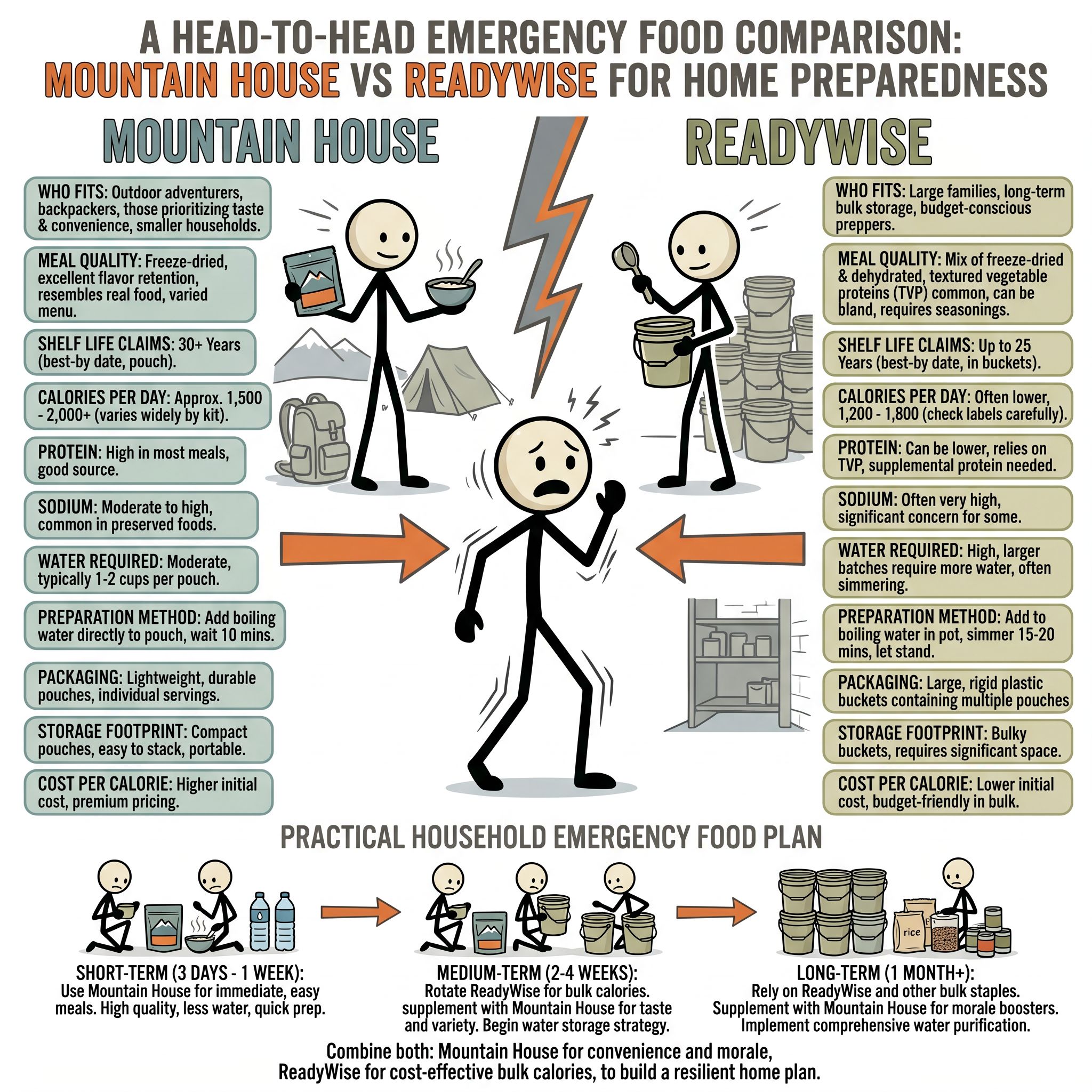
The Core Philosophies: Who Each Brand Fits
To understand which brand fits your pantry, you must first understand who they are designing their food for. Mountain House, manufactured by Oregon Freeze Dry, has been the gold standard of the freeze-dried food industry for over fifty years. Originally born out of a military contract to produce combat rations during the Vietnam War, Mountain House transitioned into the consumer market as a favorite for both high-altitude backpackers and emergency preppers. Their philosophy is simple: freeze-dry real, fully cooked meals so that they taste exactly like freshly prepared food when rehydrated.
ReadyWise, formerly known as Wise Company, took a different path. Founded in the mid-2000s, ReadyWise was designed from the ground up for high-volume, cost-effective home emergency preparedness. Their focus is on stackable, grab-and-go buckets designed to sit quietly in a closet for decades. ReadyWise targets the budget-conscious family looking to secure a high volume of backup calories quickly and compactly. They rely heavily on dehydrated ingredients, starches, and powdered sauce bases to keep their packaging compact and their prices accessible.
When to Choose Mountain House
Mountain House is the ideal choice for households that prioritize taste, high-quality animal protein, and minimal preparation hassle. If you have family members who are picky eaters, children who struggle with unfamiliar textures, or elderly relatives who need easily digestible meals, Mountain House is the superior option. It is also the preferred choice for mobile survival kits, bug-out bags, and active emergency scenarios where fuel and time are limited, as their freeze-dried meals rehydrate perfectly even with lukewarm water in a pinch.
When NOT to Choose Mountain House
Do not buy Mountain House if you are on a strict budget and need to feed a large family for several months. The premium freeze-drying process and high meat content make Mountain House one of the most expensive options on the market. Additionally, if your storage space is highly restricted, the bulky, air-filled pouches and large metal cans of Mountain House can be difficult to organize compared to the tightly packed, stackable buckets of its competitor.
When to Choose ReadyWise
ReadyWise fits the homeowner who wants to establish a substantial caloric baseline without spending thousands of dollars. If your primary goal is to secure a 3-month or 6-month supply of food for a family of four, ReadyWise provides a highly organized, space-efficient solution. Their square, heavy-duty plastic buckets stack easily in closets, under beds, or in basement corners, keeping your prep organized. To learn more about optimizing your physical storage layout, see our guide on how to store emergency food.
When NOT to Choose ReadyWise
Do not buy ReadyWise if you expect gourmet-quality meals with distinct, whole-food textures. Many ReadyWise recipes rely on textured vegetable protein (TVP) rather than real meat, and their sauce-heavy pasta and rice dishes can become mushy or overly salty if not prepared carefully. If your emergency plan relies on a limited water supply or if you lack a reliable stove to simmer food, the preparation requirements of ReadyWise may pose a significant logistical challenge.
Meal Quality, Taste, and Texture
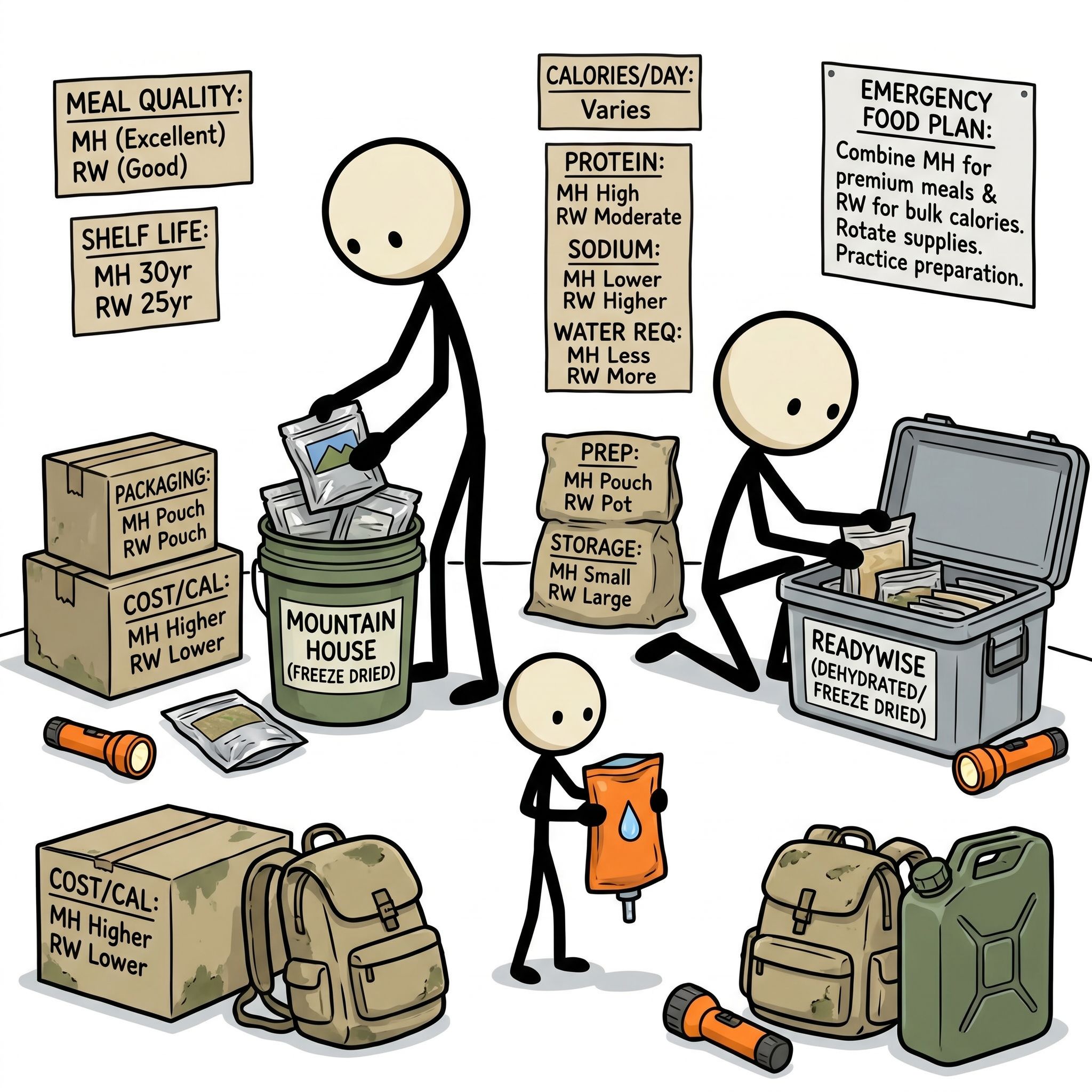
The technical differences in how these two brands manufacture their food directly impact what ends up on your spoon. Mountain House cooks their meals in large batches first, then freeze-dries the entire cooked meal. This means a dish like Beef Stroganoff is cooked as a complete recipe before the moisture is flash-frozen and sublimated out. When you add boiling water to a Mountain House pouch, the ingredients rehydrate at the exact same rate, preserving the cellular structure of the beef, mushrooms, noodles, and sour cream sauce. The result is a meal that looks, smells, and tastes like a home-cooked dinner.
ReadyWise, conversely, uses a dry-blending process for many of their meals. They source individual dehydrated or freeze-dried components (such as dehydrated pasta, freeze-dried peas, and powdered cheese sauce) and blend them together in dry form inside the pouch. While this method is highly cost-effective, it can lead to uneven rehydration. The pasta may require ten minutes of boiling to soften, while the powdered sauce thickens instantly, occasionally leaving you with pockets of dry powder or unevenly cooked starches. Furthermore, the reliance on dehydrated vegetables and TVP instead of freeze-dried whole meats means the overall texture of ReadyWise meals tends to be softer, more uniform, and less distinct than Mountain House.
Nutritional Breakdown: Calories, Protein, and Sodium
In a survival situation, nutritional density is a matter of biological safety. A common pitfall in emergency food planning is relying on "serving counts" rather than actual caloric intake. To maintain physical strength and cognitive function under stress, an average adult requires a minimum of 2,000 calories per day, with active individuals needing significantly more. Let us look at how these brands stack up across the critical metrics of calories, protein, and sodium.
The Calorie Deception
When purchasing emergency food kits, you must look closely at the nutritional label. ReadyWise frequently markets their kits based on "servings." For example, a "120-Serving Bucket" sounds like it could sustain an individual for 40 days at three meals a day. However, many of those servings contain only 150 to 220 calories each, consisting of side dishes, sugary breakfast cereals, or whey milk alternatives. If you consumed three of these servings a day, you would only receive 600 to 800 calories, putting you into a severe caloric deficit. To survive comfortably, you would need to consume 8 to 10 of these servings per day, which rapidly reduces the actual lifespan of the bucket.
Mountain House packages their meals primarily in two-serving or three-serving pouches, with each pouch typically delivering 500 to 900 total calories. Their meals are designed as hearty, single-dish entrees. When planning your pantry, always calculate your purchases based on total calories rather than advertised servings. If you need to plan a low-resource menu that requires no heating or cooking at all, you can compare these options with our no-cook emergency food plan.
Protein Quality and Sources
Protein is essential for muscle recovery, immune function, and satiety during a crisis. Mountain House excels in this category by using generous portions of real, freeze-dried meats, such as beef, chicken, and pork. A single pouch of Mountain House Beef Stroganoff contains approximately 30 to 40 grams of high-quality animal protein with a complete amino acid profile.
ReadyWise, in order to maintain its lower price point, relies heavily on textured vegetable protein (TVP) made from soy, alongside dairy-based sauce powders. While TVP provides necessary protein, some individuals find it harder to digest, and it lacks the satisfying chew and flavor of real meat. ReadyWise does offer select kits with real freeze-dried meats, but these are typically sold as separate add-on buckets rather than being integrated directly into their standard, budget-friendly meal kits.
The Sodium Challenge
Both freeze-dried and dehydrated emergency foods use sodium as a flavor enhancer and stabilizer. However, the concentration of sodium relative to caloric density is a critical metric to watch. Because ReadyWise meals are often lower in calories per serving, the sodium-to-calorie ratio can be quite high. If you must consume six to eight ReadyWise servings a day to meet your caloric needs, you may easily exceed 4,000 to 5,000 milligrams of sodium daily. This high sodium intake can lead to increased thirst, elevated blood pressure, and cardiovascular strain, which is particularly dangerous in a high-stress survival scenario where medical care is unavailable.
Mountain House meals also contain significant sodium, but because their caloric density per meal is higher, you consume fewer total servings to meet your daily energy needs, thereby keeping your overall daily sodium intake more manageable. Regardless of the brand you choose, managing your hydration is critical to flushing excess sodium from your system.
| Metric | Mountain House | ReadyWise |
|---|---|---|
| Primary Preservation | 100% Freeze-Dried | Hybrid (Dehydrated & Freeze-Dried) |
| Average Calories per Pouch | 500 - 900 kcal | 300 - 500 kcal (varies widely) |
| Protein Sources | Real meats (beef, chicken, pork) | Soy-based TVP, dairy, limited real meats |
| Sodium Content | Moderate to high (balanced by calories) | High relative to low caloric density |
| Preparation Method | Add boiling water, stir, let sit 10 mins | Add boiling water, often requires simmering |
| Packaging | Individual pouches, #10 metal cans | Mylar pouches inside stackable plastic buckets |
| Shelf Life Claim | 30-year guarantee | Up to 25-year guarantee |
Water and Preparation Requirements
A critical, often overlooked aspect of emergency food planning is the amount of water required to rehydrate your meals. In a utility failure or natural disaster, clean drinking water is your most precious commodity. If your emergency food requires large volumes of water to become edible, your food storage plan is directly dependent on your water storage plan.
Rehydration Dynamics
Because Mountain House meals are entirely freeze-dried, their structure is highly porous. Freeze-dried food acts like a sponge, rapidly drawing water into its microscopic pathways. You can rehydrate a Mountain House meal by simply pouring boiling water directly into the pouch, sealing the zipper, and waiting 8 to 10 minutes. In an extreme situation where you have no fuel to heat water, Mountain House meals can be rehydrated with cold water, though it will take twice as long (20 to 30 minutes) and the fat in the meats will remain cold. However, it remains completely safe and edible.
ReadyWise meals, which rely heavily on dehydrated starches like pasta and rice, require more thermal energy to rehydrate. Dehydration shrinks food and hardens the outer starch layers. To get a ReadyWise pasta dish to the proper texture, you often cannot simply let it sit in hot water inside a pouch. Many of their recipes instruct you to pour the contents into a pot of boiling water and simmer them on a stove for 12 to 15 minutes. This active boiling process consumes significantly more cooking fuel (such as propane or butane) and requires constant stirring to prevent the powdered sauces from burning to the bottom of your pot.
Calculating Your Water Footprint
To put this into perspective, let us look at the math. A standard 30-day supply of ReadyWise meals can require upwards of 12 to 15 gallons of water just for cooking and rehydration. If you have not stored enough water, you will be forced to choose between drinking your supply or using it to cook your food. Before finalizing your food storage purchase, consult our emergency water storage guide to ensure your water reserves match your food preparation needs. You can also use our interactive water calculator to determine your exact household hydration and cooking requirements.
Packaging, Storage Footprint, and Shelf Life
Both Mountain House and ReadyWise boast impressive shelf life claims, but their packaging methodologies dictate how well those claims hold up under real-world storage conditions.
The 30-Year Shelf Life Reality
Mountain House offers a "30-Year Taste Guarantee" on their pouches and #10 cans. They achieve this longevity by utilizing proprietary, military-grade foil pouches that feature an exceptionally low Oxygen Transmission Rate (OTR). Before sealing, each pouch is flushed with nitrogen gas to drive out oxygen, and an oxygen absorber is enclosed. This process reduces the residual oxygen inside the package to less than 1%, preventing the oxidation of fats and oils that causes food to spoil. Their #10 cans are even more robust, offering physical protection against punctures, crushing, and rodents.
ReadyWise claims a 25-year shelf life for their bucket-stored meals. Their meals are individually packaged in Mylar pouches, which are then packed inside heavy-duty, gasket-sealed plastic buckets. While the individual pouches are well-made, they are thinner than Mountain House pouches. The outer plastic bucket serves as the primary line of defense against physical damage, pests, and light. If the outer bucket is compromised or left open, the individual pouches are more vulnerable to ambient environmental conditions than Mountain House's heavy-duty packaging.
Storage Footprint and Organization
Where ReadyWise shines is in its physical storage footprint. Their square, stackable buckets are designed to nest together, allowing you to store 1,000 meals in a remarkably small closet footprint. The buckets feature carry handles, making them incredibly easy to throw into the back of a vehicle during a rapid evacuation.
Mountain House is traditionally sold in individual pouches or loose in cardboard cases, which can be awkward to stack and organize. While Mountain House does offer some bucket kits, they are generally less space-efficient than the purpose-built ReadyWise system. If you choose Mountain House, you will likely need to invest in your own heavy-duty storage bins or shelving units to keep your inventory organized and protected from pests.
Cost per Calorie: The Real Math of Preparedness
To build a practical household emergency food plan, you must understand the financial metrics of your investment. Looking at the retail price of a bucket or a pouch is highly deceptive. Instead, you must calculate the cost per calorie.
Let us look at a hypothetical comparison based on average market pricing:
- Mountain House Pouch: Costs approximately $11.00 and contains 600 calories. This results in a cost per calorie of roughly $0.0183 (or $18.33 per 1,000 calories).
- ReadyWise Bucket Meal: When purchased in bulk, a single serving costs approximately $2.50 and contains 220 calories. This results in a cost per calorie of roughly $0.0113 (or $11.36 per 1,000 calories).
This math clearly demonstrates that ReadyWise is the more economical choice for raw caloric volume. If your goal is to build a massive reserve of emergency calories on a limited budget, ReadyWise allows your dollar to stretch significantly further. However, you must weigh this financial saving against the lower protein quality, higher sodium ratios, and increased cooking fuel requirements of those calories.
The Hybrid Household Strategy: A Practical Plan
As an emergency preparedness editor, I do not recommend choosing one brand to the complete exclusion of the other. The most resilient, practical, and budget-friendly household food plan is a hybrid strategy that leverages the unique strengths of both Mountain House and ReadyWise.
The "Base and Crown" System
By combining both brands, you can build a food supply that is both financially viable and highly morale-boosting. Think of this as the "Base and Crown" system:
1. The ReadyWise Base (Bulk Calories): Use ReadyWise buckets to build your foundational caloric reserve. These buckets will provide the bulk carbohydrates, warm soups, and breakfast grains that keep your family warm and energized. Because they stack beautifully, they form the quiet backbone of your long-term pantry, stored away in low-value real estate like closet floors or basement shelves.
2. The Mountain House Crown (High-Value Protein & Morale): Supplement your ReadyWise base with a curated selection of Mountain House pouches or #10 cans. These premium freeze-dried meals will provide the high-quality animal proteins, rich textures, and comforting flavors that prevent "appetite fatigue" during a prolonged crisis. When spirits are low, or when cooking fuel is scarce, a hot, highly satisfying plate of Mountain House Beef Stroganoff or Chicken Fajita Bowl can completely shift the psychological atmosphere of your household.
A 14-Day Family Plan Example
For a family of four requiring approximately 8,000 calories per day, a 14-day hybrid plan would look like this:
- ReadyWise Contribution: One 120-serving bucket. This provides a steady stream of breakfast oatmeal, pasta dishes, and soups, delivering roughly 4,000 calories per day for the family at a highly affordable price point.
- Mountain House Contribution: Four cases of Mountain House pouches (specifically high-protein options like Beef Stew, Chicken Fried Rice, and Scrambled Eggs with Bacon). This adds another 4,000 calories per day of high-quality animal protein, real vegetables, and premium flavor, while drastically reducing the overall cooking fuel and water required to prepare the daily menu.
Common Storage Mistakes to Avoid
Regardless of whether you choose Mountain House, ReadyWise, or a hybrid of both, your investment is only as good as your storage discipline. Even a 30-year shelf life can be reduced to 5 years if you make these common storage mistakes:
1. High Temperature Exposure
The single greatest enemy of freeze-dried and dehydrated food is heat. Chemical degradation rates double with every 18-degree Fahrenheit increase in temperature. Storing your emergency food buckets in a hot garage, an uninsulated attic, or a backyard shed will rapidly destroy the nutritional value, taste, and shelf life of your food. Always store your food in a temperature-controlled environment, ideally below 70 degrees Fahrenheit.
2. Humidity and Moisture
While the outer plastic buckets of ReadyWise are water-resistant, they are not completely vapor-proof over decades. High humidity can slowly degrade the integrity of thin Mylar seals. Keep your food storage off concrete floors (which can wick moisture) by placing them on wooden pallets, shelving units, or plastic risers.
3. Rodent Vulnerability
Mice and rats can easily chew through cardboard boxes and thin Mylar pouches. If you store loose Mountain House pouches on open shelves, you are inviting pests to ruin your investment. Always store loose pouches inside heavy-duty, latching plastic totes or metal bins to ensure physical security.
Final Verdict: Which Brand Wins?
In the head-to-head battle of Mountain House vs. ReadyWise, there is no single winner; instead, there are two distinct tools for two distinct preparedness jobs.
Mountain House is the winner for quality, speed, and morale. If you want the absolute best taste, the highest protein quality, the simplest preparation under high-stress conditions, and a true 30-year guarantee backed by decades of military and outdoor experience, Mountain House is worth every premium penny.
ReadyWise is the winner for volume, budget, and space efficiency. If you need to secure a large family's survival baseline quickly, organize your storage in a compact footprint, and maximize your caloric return on every dollar spent, ReadyWise is the practical, logical choice.
By understanding your household's specific nutritional needs, water storage capacity, cooking fuel reserves, and financial boundaries, you can select the perfect balance of these two industry leaders, ensuring your family remains safe, nourished, and comfortable when the unexpected occurs.
Frequently Asked Questions
Is Mountain House or ReadyWise better for emergency food storage?
Mountain House is usually better for taste, pouch meals, and high-confidence grab-and-go food. ReadyWise is usually better for larger buckets and budget-oriented calorie coverage.
Should I trust serving counts on emergency food buckets?
Serving counts are not enough. Compare total calories, calories per day, protein, sodium, and how much water is required to prepare the meals.
Does Mountain House last longer than ReadyWise?
Mountain House advertises a 30-year taste guarantee on many freeze-dried meals. ReadyWise commonly markets up to 25-year shelf life. Storage temperature still matters for both.
Can I live on freeze-dried emergency food for months?
It is possible in a short crisis, but it is not ideal as your only plan. Mix emergency meals with pantry staples, canned foods, fats, protein, and familiar foods your household will actually eat.
Which brand is better for a bug-out bag?
Mountain House pouches are usually easier for small mobile kits. ReadyWise buckets are usually better for home storage where weight and bucket size matter less.