⚡ Key Facts
- While the Federal Emergency Management Agency (FEMA) recommends starting with a baseline 2-week stockpile, modern supply chain vulnerabilities make a 3-month buffer the gold standard for household resilience.
- Adults require a baseline of 2,000 to 2,500 calories per day to maintain physical energy and cognitive function during high-stress emergency situations.
- For a family of four, a complete 3-month food supply requires storing approximately 720,000 to 900,000 total calories.
- Temperature is the greatest enemy of emergency food storage; according to food science principles, for every 18°F (10°C) increase above optimal room temperature, the shelf life of stored food is cut in half.
- Properly packaged staples like white rice, honey, salt, and dried beans can maintain their nutritional value and safety for 25 to 30 years.
Start With Three Days
For most households, 72 hours is 3 days of essentials before outside help or normal services may return. Use the 72-hour emergency preparedness guide to turn this checklist into a realistic water, food, light, communications, and family-plan baseline.
Food Backup Skills That Support the First 72 Hours
After water and a basic 72-hour kit, close the food-access gaps that break real emergency plans. Learn how to open a can without a can opener, compare whether a home freeze dryer is worth it for preppers, and add safe wild-food awareness with the plantain weed identification guide.
First 72 Hours: Fast Action Path
The query behind this page is simple: 72 hours is 3 days. In preparedness terms, those three days are the bridge between a normal household and delayed outside help. Start with the 72-hour rule guide, then build skills through the free Catastrophe Survival 101 course.
For the practical kit, use the 72-hour kit guide, calculate supplies with the supply calculator, and set water targets with the water calculator.
Quick Answer: How Much Emergency Food Do You Need?
For emergency preparedness, plan on 2,000 to 2,500 calories per adult per day, then multiply by the number of people and days you want to cover. A 3-month food supply for one adult is roughly 180,000 to 225,000 calories. For a family of four, the target is usually 700,000 to 900,000 calories, depending on ages, activity level, and medical needs.
If you want the fastest starting point, use the Supply Calculator to estimate food and water by household size, then use this guide to choose shelf-stable foods, storage containers, rotation rules, and no-cook backup meals.
Emergency food storage is not about buying random survival buckets and hoping the labels are honest. It is a household system: calories first, foods your family will actually eat second, and storage conditions third. The goal is to keep normal people fed through job disruption, winter storms, supply-chain interruptions, power outages, or a longer shelter-in-place period without turning every meal into a crisis.
Start with a 72-hour food supply, build toward two weeks, then one month, then a 3-month home plan. Pair this food plan with the Water and Food Storage Guide, package bulk staples with the mylar bags and oxygen absorbers guide, and keep a backup plan for food preservation without electricity.
This refresh focuses on the practical questions searchers are already asking: how much food to store, what a 3-month food supply should include, how many calories per day to plan for, and how to rotate emergency food before it expires.
The Math of Survival: Calorie Calculations
The most common mistake new preparedness advocates make is counting days by counting boxes or cans, rather than calculating actual calories. A bucket of freeze-dried food might claim it contains "30 days of food," but a closer look at the nutritional label often reveals portions that provide only 800 to 1,200 calories a day. In a realistic survival scenario, operating on a starvation diet will lead to rapid physical fatigue, weakened immune response, and poor decision-making.
Establishing Your Caloric Baseline
The Centers for Disease Control and Prevention (CDC) notes that the average adult requires roughly 2,000 to 2,500 calories per day to maintain their weight under normal conditions. However, emergencies are rarely normal. If the power grid fails, you may be chopping wood, hauling stored water, checking your Water Calculator target, or making manual repairs to your home. In these high-exertion scenarios, caloric needs can easily spike to 3,000 calories or more per day. For planning purposes, a baseline of 2,200 calories per adult per day is a safe, realistic average.
Let's break down the math for a single adult building a 3-month food supply (90 days):
- Daily Requirement: 2,200 calories
- Monthly Requirement (30 days): 66,000 calories
- 3-Month Requirement (90 days): 198,000 calories
For a family of four (two adults, two children), the total caloric requirement for 90 days sits comfortably around 700,000 to 750,000 calories. When you view your emergency food storage through the lens of raw caloric data, it completely changes how you shop. You begin to look for foods that offer the highest caloric density per square inch of storage space.
Balancing Macronutrients
Calories alone are not enough; where those calories come from dictates your health and energy levels. A survival diet must be balanced across three primary macronutrients:
- Carbohydrates (50-60% of diet): Carbs are your body's preferred source of rapid energy. In a high-stress event, you need easily accessible fuel. Staples like rice, oats, pasta, and wheat berries are the foundation of your caloric intake.
- Proteins (15-20% of diet): Protein is essential for muscle repair, immune function, and satiety. Dried beans, lentils, canned meats, and peanut butter are critical additions.
- Fats (20-30% of diet): Fats are the most calorically dense macronutrient, offering 9 calories per gram (compared to 4 calories per gram for carbs and protein). Fats keep you feeling full and are vital for brain health. Olive oil, coconut oil, nuts, and clarified butter (ghee) should be heavily featured in your stockpile.
Which Foods to Stock in Your Emergency Food Supply
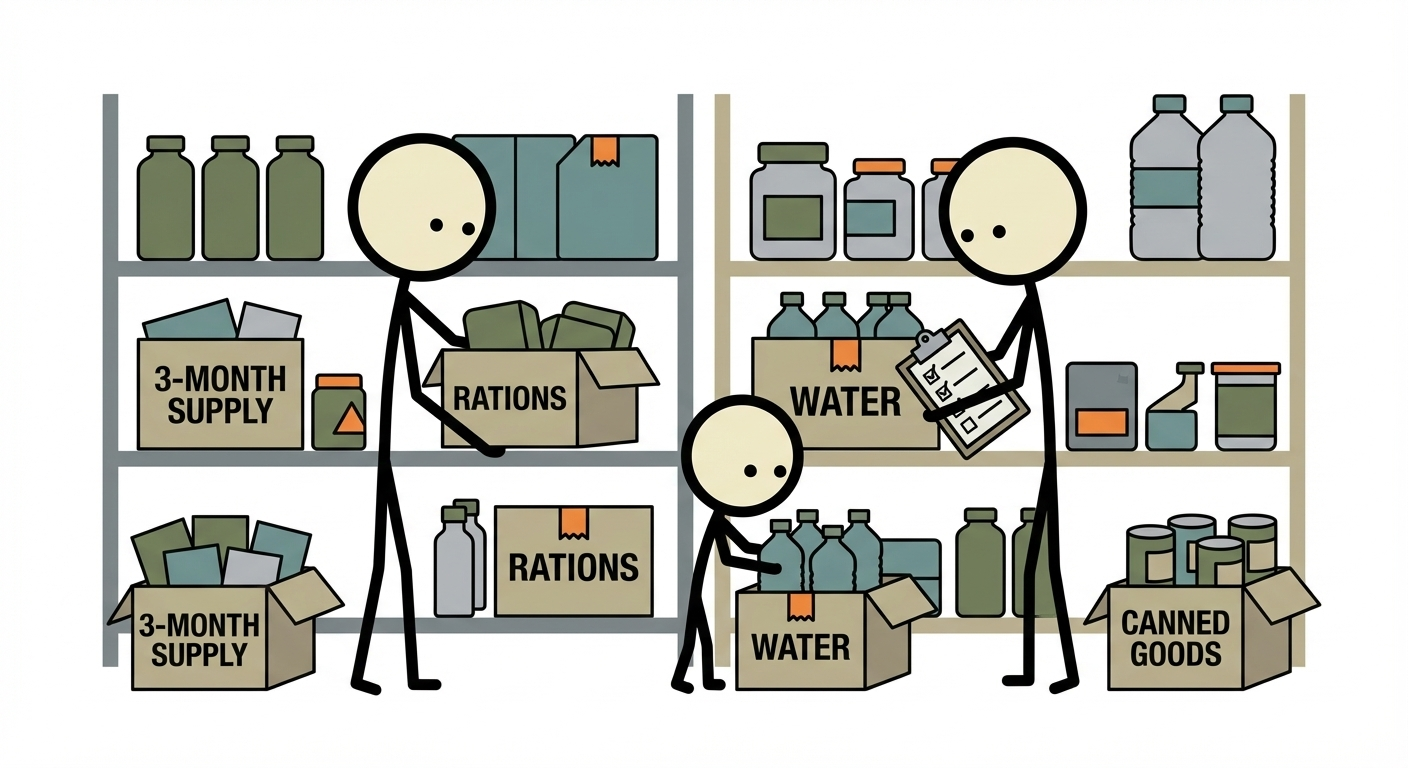
When selecting items for your stockpile, the golden rule of prepper food storage is: Store what you eat, and eat what you store. Introducing completely foreign foods to your family during a highly stressful emergency is a recipe for digestive distress and plummeting morale. Build your supply around shelf-stable versions of the meals you already enjoy.
3-Month Emergency Food Supply List
A balanced 3-month food supply should cover calories, protein, fat, comfort foods, and no-cook meals. Use this as a starter checklist, then adjust for allergies, children, medical diets, and foods your household already eats.
- Calorie base: white rice, pasta, oats, flour, instant potatoes, pancake mix, and other shelf-stable carbohydrates.
- Protein: dried beans, lentils, canned tuna, canned chicken, canned chili, peanut butter, powdered milk, and protein bars.
- Fats: olive oil, coconut oil, ghee, nut butters, nuts, and shelf-stable cooking fats that are rotated often.
- Fruits and vegetables: canned vegetables, canned fruit, freeze-dried produce, tomato products, and dried fruit.
- No-cook meals: ready-to-eat canned meals, tuna packets, crackers, tortillas, trail mix, meal bars, and instant oats.
- Flavor and morale: salt, spices, bouillon, coffee, tea, cocoa, hard candy, sauces, and familiar comfort foods.
- Storage supplies: food-grade buckets, mylar bags, oxygen absorbers, labels, permanent marker, can opener, and a simple inventory sheet.
For a quick cross-check, enter your household size in the Supply Calculator, then compare the calorie target against the foods on this list.
The Long-Term Staples (20 to 30-Year Shelf Life)
These are the foundational building blocks of your 3-month food supply. When packaged correctly (which we will cover in the storage section), these dry goods will outlast your mortgage. They are incredibly cheap, highly caloric, and versatile.
- White Rice: Unlike brown rice, which contains oils that go rancid after six months, white rice can last up to 30 years. It is easily digestible and pairs with almost any protein.
- Dried Beans and Lentils: Pinto, black, and kidney beans provide essential protein and fiber. When combined with rice, they form a complete protein, offering all nine essential amino acids.
- Rolled Oats: A highly nutritious, filling breakfast option that requires very little fuel to cook.
- Pasta and Macaroni: Dense in carbohydrates, comforting, and incredibly easy to prepare.
- Sugar, Salt, and Honey: These are not just flavor enhancers; they are preservatives. Real honey literally never expires-archaeologists have found edible honey in ancient Egyptian tombs.
Medium-Term Goods (1 to 5-Year Shelf Life)
These items add flavor, vital nutrients, and variety to your foundational staples. They require regular rotation but are essential for a balanced diet.
- Canned Meats: Chicken, tuna, salmon, and beef provide high-quality protein without the need for refrigeration.
- Canned Fruits and Vegetables: Essential for preventing vitamin deficiencies (like scurvy). The high liquid content in canned fruits also provides a secondary source of hydration.
- Cooking Oils: Coconut oil is highly recommended as it has a longer shelf life (up to two years) compared to vegetable or canola oils.
- Peanut Butter: An absolute powerhouse of calories, healthy fats, and protein. It requires no cooking and is universally loved by children.
Morale and Comfort Foods
The United States Geological Survey (USGS) and disaster psychologists frequently note the immense mental toll that earthquakes, hurricanes, and prolonged grid-down scenarios take on survivors. Food is deeply tied to psychological comfort. Do not underestimate the power of morale foods in your emergency food supply. Ensure you stock plenty of coffee, tea, chocolate, hard candies, and a vast array of spices and bouillon cubes to prevent appetite fatigue.
Budget-Friendly Approaches to Prepper Food Storage
One of the biggest misconceptions about preparedness is that it requires thousands of dollars in upfront capital. You do not need to buy expensive, pre-packaged "survival buckets" from specialty retailers to be prepared. In fact, building your own supply is often healthier, more tailored to your family's tastes, and vastly cheaper.
The "Copy Canning" Method
The easiest and most budget-friendly way to build a 3-month food supply is a concept known as "copy canning" or the "plus-one" method. You simply buy slightly more of what you are already purchasing. If your weekly grocery run includes two cans of black beans, buy four. If you need a jar of pasta sauce, buy two. By simply diverting an extra $15 to $20 a week toward shelf-stable items, your pantry will organically grow into a formidable stockpile over the course of a few months, with zero impact on your overall financial health.
Buying in Bulk
Once you have a baseline of canned goods, shift your focus to bulk dry goods. Warehouse clubs like Costco or Sam's Club offer 20-pound to 50-pound bags of rice, beans, and oats at a fraction of the cost of standard grocery store packaging. Additionally, look into local restaurant supply stores or agricultural co-ops. Buying a 50-pound bag of wheat berries or rice might cost less than $30, yet it provides tens of thousands of calories.
Avoid the Convenience Tax
Commercially prepared freeze-dried meals are incredibly convenient, lightweight, and boast a 25-year shelf life. However, you are paying a massive premium for that convenience. While it is perfectly fine to have a few days' worth of freeze-dried meals for immediate evacuation (bug-out bags), relying on them for a full 3-month supply will cost thousands of dollars. Focus 90% of your budget on grocery store staples and bulk dry goods.
How to Store Emergency Food Properly
Procuring the food is only the first half of the battle; preserving it is the second. If you do not know how to store emergency food correctly, your investment will be destroyed by mold, rancidity, or pests. The enemies of food storage can be remembered with the acronym HALT: Humidity, Air, Light, and Temperature.
Mastering the Environment: Temperature and Light
Temperature control is the single most critical factor in food preservation. The ideal storage temperature for dry goods is between 50°F and 60°F (10°C to 15°C). According to food preservation science, the shelf life of stored food is cut in half for every 18°F increase in ambient temperature. Storing your emergency food supply in a hot garage or an uninsulated attic will cause the nutritional value to degrade rapidly and fats to turn rancid.
Light is another silent destroyer. Ultraviolet (UV) rays degrade vitamins (particularly Vitamin A and Riboflavin) and accelerate the oxidation of fats. Your storage area should be completely dark. Basements, interior closets, or underneath beds are ideal locations. If you must store food in a lit room, ensure it is kept inside opaque containers.
Defeating Air and Humidity: Mylar Bags and Oxygen Absorbers
For long-term storage (grains, beans, pasta), leaving food in its original cardboard or thin plastic packaging is a fatal error. Pests will chew through it, and moisture will seep in. The gold standard for prepper food storage is the mylar bag and oxygen absorber system.
Mylar is a metalized polyester film that creates an absolute barrier against light, moisture, and oxygen. To package food for decades of storage, follow this process:
- Place a heavy-duty Mylar bag (at least 5 to 7 mils thick) inside a clean, food-grade 5-gallon bucket.
- Fill the bag with your dry staple (e.g., white rice or dried beans).
- Drop in the appropriate number of oxygen absorbers (typically 2000cc for a 5-gallon bucket). Oxygen absorbers contain iron powder; as the iron rusts, it pulls all the oxygen out of the sealed environment, making it impossible for aerobic bacteria or weevil eggs to survive.
- Immediately seal the top of the Mylar bag using a household iron, a hair straightener, or a specialized impulse sealer.
- Seal the bucket with a tight-fitting lid to protect the Mylar bag from rodents.
Crucial Note: Never use oxygen absorbers with foods that have a high moisture or high fat content (like brown rice, nuts, or jerky), as creating a low-oxygen environment in moist foods can increase the risk of botulism.
Mastering the FIFO Rotation System
An emergency food supply is not a static museum exhibit; it is a living, breathing inventory that requires management. The most effective way to ensure your food never expires and goes to waste is to implement the FIFO method: First-In, First-Out.
This is the exact same inventory management system used by grocery stores worldwide. When you purchase new cans of soup or boxes of pasta, you do not place them at the front of the shelf. Instead, you push the older items forward and load the newest items in the back. This guarantees that you are always consuming the oldest food in your stockpile first.
Practical Implementation
To make FIFO seamless, organization is key. Consider investing in or building gravity-fed can racks. These racks allow you to load new cans at the top, while dispensing the oldest cans from the bottom.
Furthermore, never trust the manufacturer's printed expiration date to be easily visible. The moment groceries enter your home, take a thick black permanent marker and write the purchase month and year in large numbers on the top or front of the item. If the grid goes down and you are searching for food by the light of a flashlight, you will not want to be squinting at tiny, faded inkjet expiration dates.
Maintain a simple inventory spreadsheet or a physical clipboard in your pantry. Once a quarter, do a quick audit of your supplies. If you notice you have thirty cans of green beans that are expiring in three months, it is time to incorporate green beans into your weekly dinner menu and replace them with fresh stock.
No-Cook Meal Planning for Grid-Down Scenarios
When planning a 3-month food supply, you must prepare for the worst-case scenario: a complete grid-down event where you have no electricity, no natural gas, and potentially no safe tap water. Use this section alongside the food without electricity guide. While portable camping stoves and outdoor grills are excellent tools, you may face situations-such as severe blizzards or hurricanes-where cooking outdoors is impossible, and cooking indoors with combustible fuels poses a deadly carbon monoxide risk.
Your emergency food storage must include a robust selection of high-calorie, no-cook foods that can be eaten straight from the packaging. In the initial 48 to 72 hours of a major disaster, shock and stress will be high, and the last thing you will want to do is figure out how to boil water over a makeshift fire.
Building a No-Cook Menu
Focus on items that require zero preparation and provide immediate energy. A manual, hand-crank can opener is arguably the most important tool in your entire kitchen during an emergency. Without it, your canned goods are virtually inaccessible.
- Canned Chili and Soups: While they taste better warm, fully cooked canned chili, stews, and Chef Boyardee-style pastas are perfectly safe to eat cold straight from the can. They are heavy in calories and comforting.
- Protein Wraps: Flour tortillas have a much longer shelf life than traditional sliced bread. Spread them generously with peanut butter, honey, and raisins for a massive caloric boost that requires zero cooking or cleanup.
- Tuna and Chicken Packets: Foil pouches of seasoned tuna or chicken are lighter than cans, require no draining, and provide instant, high-quality protein.
- Overnight Oats: If you have access to safe, bottled water, you can soak rolled oats in water (or powdered milk mixed with water) for a few hours. The oats will soften just as if they were cooked, providing a dense, filling meal without a heat source.
- Trail Mix and Meal Replacement Bars: Keep a heavy supply of dense protein bars, mixed nuts, and dried fruit. These are essential for maintaining energy if you are actively working to secure your home or clear debris.
By integrating a solid week or two of strictly no-cook options into your broader 3-month supply, you buy yourself the critical time needed to assess the emergency, set up safe outdoor cooking areas, and stabilize your household environment.
Securing Your Family's Future
Building a 3-month emergency food supply is one of the most empowering steps you can take for your family's safety and independence. It insulates you from the chaos of panic buying, protects you against the reality of fragile supply chains, and ensures that when disaster strikes, your primary focus can remain on your family's physical safety rather than their next meal. By understanding your caloric needs, investing in the right mix of long-term staples and comforting short-term goods, utilizing proper Mylar and temperature-controlled storage, and implementing a strict FIFO rotation, you transform your pantry into a fortress of resilience. Start small, stay consistent with your budget, and take pride in the fact that you are actively taking control of your own survival.
Build Your Household Food Target
Do not guess how much food your family needs. Run your household size through the Supply Calculator, then use the sections above to turn that number into a real pantry plan with staples, no-cook meals, rotation dates, and storage containers.
Frequently Asked Questions
How much food do I need for emergency preparedness?
Start with 2,000 to 2,500 calories per adult per day, then multiply by household size and target duration. One adult needs about 14,000 to 17,500 calories for 7 days, 60,000 to 75,000 calories for 30 days, and 180,000 to 225,000 calories for 90 days. Children, medical diets, physical labor, cold weather, and pregnancy can change the number, so build in a margin.
What should a 3-month food supply include?
A 3-month food supply should include calorie staples like rice, oats, pasta, beans, lentils, canned meat, peanut butter, cooking oils, canned vegetables, canned fruit, powdered milk, spices, and no-cook foods. The best plan mixes long-term dry staples with everyday canned goods your family already eats, then rotates them through normal meals.
How many calories per day should emergency food provide?
For most adults, plan around 2,000 to 2,500 calories per day as a baseline. In a stressful emergency with cold weather, cleanup work, walking, hauling water, or manual repairs, needs can rise. Do not rely on survival buckets that provide only 800 to 1,200 calories per day unless they are only a small part of your food plan.
How do I rotate emergency food so it does not expire?
Use FIFO: first in, first out. Mark each package with the purchase month and year, put new food at the back, eat from the front, and do a quick pantry audit every quarter. Store what you already eat so rotation happens naturally instead of becoming a separate preparedness chore.
Can I build a 3-month food supply on a budget?
Yes. Start with a 72-hour supply, then add one or two extra shelf-stable items every grocery trip. Rice, beans, oats, pasta, canned goods, peanut butter, and cooking oil are usually cheaper per calorie than pre-made emergency buckets. Bulk dry goods become even more cost-effective when stored correctly in food-grade buckets, mylar bags, and oxygen absorbers.
Sources & Further Reading
Related resource: Shelf Life Estimator.
Related resource: Family Emergency Planning Guide.
Related resource: Water & Food Storage Guide.