⚡ Key Facts
- Immediate Self-Reliance: According to FEMA, up to 46% of disaster survivors rely on immediate assistance from neighbors before professional first responders can arrive on the scene.
- The Critical 72-Hour Window: The American Red Cross emphasizes that municipal infrastructure, emergency emergency communication plans, and supply chains can be entirely offline for the first 72 hours of a major disaster.
- Social Cohesion Saves Lives: A landmark study by the CDC on extreme heat waves revealed that neighborhood preparedness networks with high levels of social trust and active community emergency preparedness guide networks had significantly lower casualty rates than demographically identical neighborhoods lacking social cohesion.
- Infrastructure Failure Rates: NOAA and USGS data show that severe weather and geological events disrupt local cellular networks in over 85% of major declared disasters, rendering standard smartphones useless without localized radio networks.
When a severe natural disaster strikes, the immediate reality is often stark and unforgiving: the power grid fails, water treatment plants shut down, cellular towers lose backup battery power, and local emergency services are instantly overwhelmed. In these critical first hours, help will not come from a distant state or federal agency; it must come from across the street. Developing a structured, self-reliant neighborhood mutual aid network is not merely a philosophical exercise in community building—it is a vital pillar of survival. By organizing local resources, establishing robust communication protocols, and fostering deep community trust before a crisis occurs, ordinary neighborhoods can transform themselves into resilient, self-sustaining units capable of weathering the initial impact of any disaster.
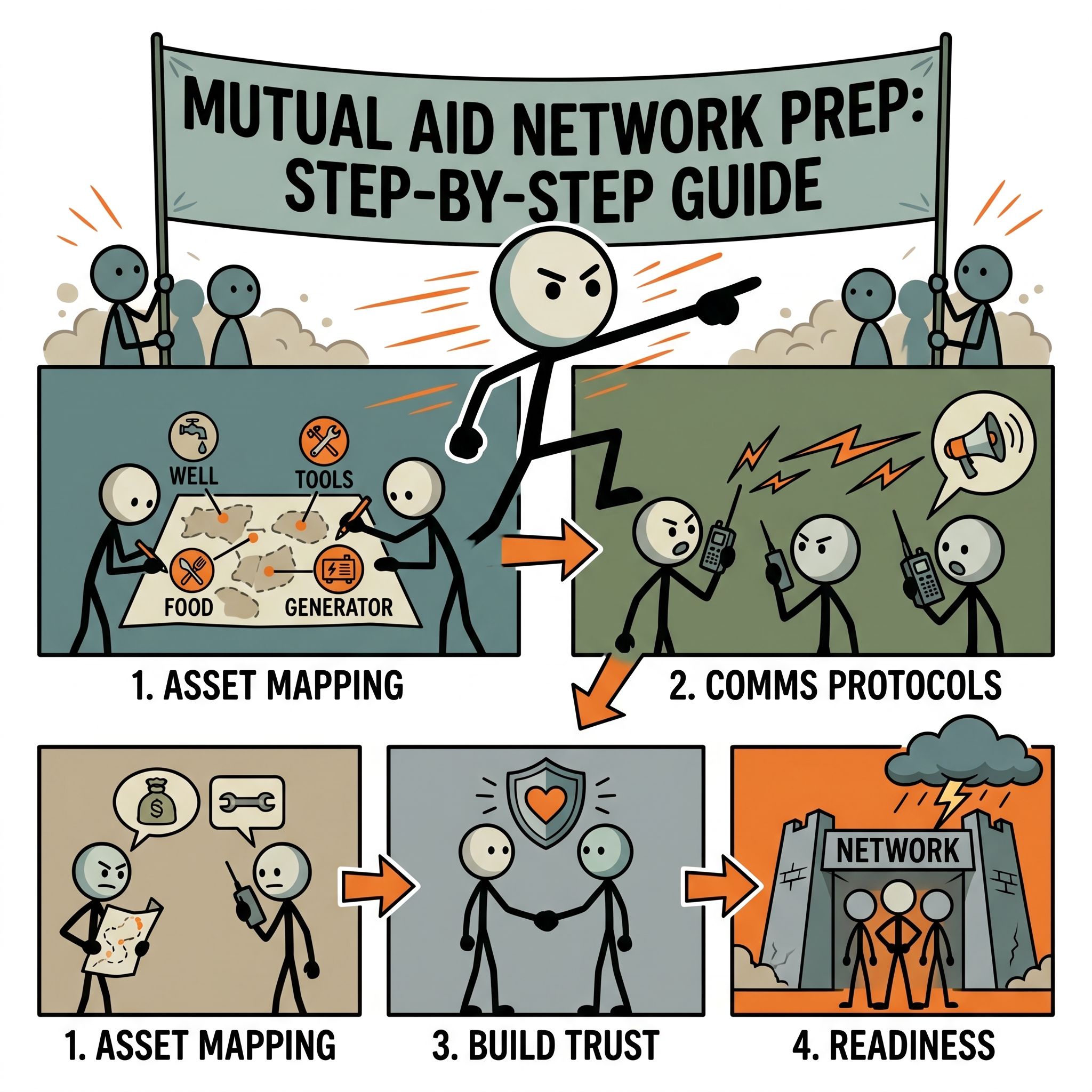
The Philosophy of Mutual Aid vs. Traditional Disaster Response
To build a successful network, we must first understand the fundamental difference between charity and mutual aid. Traditional charity operates on a top-down, hierarchical model where resources are funneled from external benefactors to passive recipients. In contrast, emergency mutual aid is built on horizontal solidarity, voluntary association, and reciprocal support. It assumes that every single member of a community has something valuable to contribute—whether that is medical expertise, a physical tool, language translation skills, or simply the physical capability to clear debris.
FEMA’s "Whole Community" approach to emergency management explicitly acknowledges that government agencies cannot manage large-scale disasters alone. When local emergency services are saturated with high-priority calls, a structured neighborhood family emergency plan bridges the gap. By managing minor injuries, clearing secondary roads, and securing damaged properties locally, mutual aid networks prevent regional emergency infrastructure from collapsing under the weight of minor incidents. This localized self-reliance directly contributes to a more rapid and effective overall local disaster response.
The "Golden Hour" of Disaster Response
In emergency medicine and search-and-rescue operations, the "Golden Hour" refers to the critical window immediately following a traumatic event or disaster during which rapid intervention can prevent long-term injury or death. Without a pre-established network, those first sixty minutes are characterized by panic, confusion, and isolated struggles. With a structured mutual aid network, however, that hour is defined by coordinated, decentralized action. Neighbors immediately deploy along pre-arranged zones, assess damage, check on vulnerable residents, and establish localized communication loops before panic can take root.
Phase 1: Cultivating Community Trust and Inclusivity
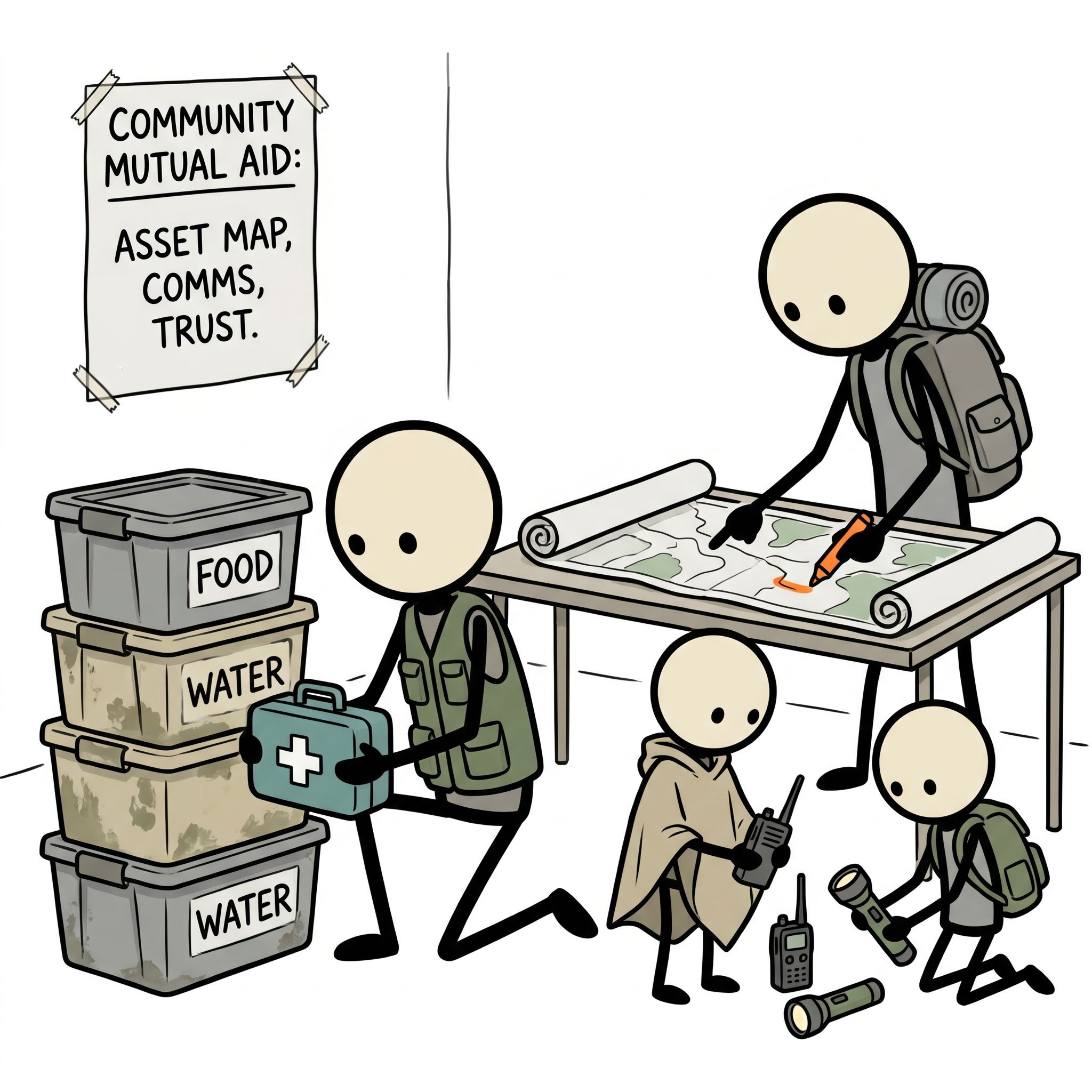
The most sophisticated communication gear and the most advanced survival tools are useless if neighbors do not trust one another. You cannot effectively build a network during a crisis; the social infrastructure must be established under "blue-sky" conditions. Building this foundation requires deliberate, transparent, and inclusive outreach that respects the diverse backgrounds and comfort levels of your neighborhood.
Starting Small and Scaling Up
Do not attempt to organize an entire city or even a massive subdivision overnight. Begin with a micro-network—typically a single street, a cul-de-sac, or an apartment floor comprising 10 to 15 households. Once this core group establishes its framework, it can act as a template for adjacent blocks. To launch, host an informal, low-pressure gathering. Frame the conversation around shared safety, resilience, and mutual support rather than alarmist scenarios. Focus on practical, everyday benefits of knowing one's neighbors, which naturally transitions into discussions about emergency preparedness.
Addressing Inclusivity and Vulnerability
A resilient network must account for every demographic within its geographic footprint. This includes the elderly, individuals with physical or cognitive disabilities, non-native English speakers, and those who may be distrustful of official authorities.
- Language Barriers: Ensure all initial outreach materials, safety checklists, and network documentation are translated into the primary languages spoken in the neighborhood.
- Vulnerability Assessments: Identify individuals who rely on electricity for life-sustaining medical equipment (such as oxygen concentrators or dialysis machines) or those who have limited mobility.
- Privacy Safeguards: Understand that some neighbors may be hesitant to share personal information. Establish clear, strict privacy boundaries. Ensure that any database of skills or medical needs is kept highly secure, offline, and accessible only to trusted, designated coordinators.
Drafting the Neighborhood Charter
To formalize the network without creating bureaucratic bottlenecks, draft a simple, non-binding "Neighborhood Mutual Aid Charter." This document should outline the network's mission, emphasize that participation is entirely voluntary, and clarify that the network does not replace professional emergency services but acts as a temporary support system. Defining these boundaries early prevents misunderstandings and aligns expectations before an emergency occurs.
Phase 2: Systematic Asset Mapping (Cataloging Skills and Resources)
Asset mapping is the process of identifying, categorizing, and cataloging the human skills, physical tools, and specialized resources available within your geographic area. Think of it as a localized inventory of Protocol Survival community. When a disaster strikes, knowing exactly who owns a chainsaw, who has medical training, and who possesses a high-capacity water filter saves precious time.
Categorizing Human Assets (The "Who")
Every neighbor possesses unique skills that can be leveraged during a crisis. When surveying your community, categorize human assets into distinct operational groups:
| Asset Category | Specific Professional or Practical Skills | Emergency Application |
|---|---|---|
| Medical & Wellness | Doctors, nurses, EMTs, veterinarians, wilderness first responders, therapists. | Triage, basic first aid, psychological first aid, veterinary care for displaced pets. |
| Technical & Trade | Plumbers, electricians, carpenters, mechanics, HAM radio operators. | Utility shutoff, structural stabilization, emergency power generation, vehicle recovery. |
| Logistical & Organizational | Project managers, teachers, event planners, translators, child care providers. | Resource distribution, communication dispatch, shelter management, child care during recovery efforts. |
| Physical Labor | Landscapers, construction workers, able-bodied volunteers. | Debris clearance, sandbagging, search and rescue, manual transport of supplies. |
Cataloging Physical Assets (The "What")
In addition to human skills, physical gear is critical for sustaining life and restoring safety. Your asset map should identify the location and availability of the following resources:
- Power and Energy: Portable solar generators, fuel-powered generators, stored fuel (gasoline, diesel, propane), heavy-duty extension cords, and solar charging stations.
- Water and Sanitation: Gravity-fed water filters (e.g., Berkey or Sawyer systems), bulk Water Calculator drums, rainwater harvesting setups, and emergency composting toilet systems.
- Tools and Heavy Equipment: Chainsaws, axes, winches, ladders, heavy-duty jacks, 4WD vehicles, utility trailers, and hand tools for utility shutoffs.
- Medical Supplies: Mass-casualty first aid kits, trauma shears, tourniquets, splints, and automated external defibrillators (AEDs) owned by private households.
The Vulnerability Matrix
Equally important to mapping assets is mapping vulnerabilities. The CDC’s Social Vulnerability Index highlights that localized support is the single greatest factor in reducing mortality among vulnerable populations during emergencies. Identify households with infants, individuals requiring daily prescription medications that require refrigeration, and those with limited mobility. Ensure that the asset map pairs these households with nearby, able-bodied "buddies" who are assigned to check on them immediately when a disaster occurs.
Phase 3: Establishing the PACE Communication Protocol
During a major incident, the primary communication infrastructure is almost guaranteed to fail. Cellular towers become congested or lose power, and internet service providers experience physical line breaks. To maintain coordination, your community disaster preparedness group must implement a PACE (Primary, Alternate, Contingency, Emergency) communication protocol.
Primary (P): Standard Digital Channels
Under normal conditions and during the initial onset of an emergency (provided cell towers are still functioning), utilize encrypted, decentralized messaging applications. Apps like Signal or WhatsApp allow for rapid group communication, media sharing, and real-time coordination. Create dedicated channels for specific teams, such as a "Medical Team" channel and a "General Coordination" channel, to prevent information overload.
Alternate (A): GMRS and FRS Two-Way Radios
When cellular networks fail, the network must transition to localized radio communications. Family Radio Service (FRS) and General Mobile Radio Service (GMRS) handheld radios are ideal for neighborhood-level communication. They require no specialized training, and FRS radios do not require a license, making them highly accessible.
- Standardize Channels: Designate a specific neighborhood channel (e.g., Channel 15, Privacy Code 0) as the primary listening channel.
- Radio Protocols: Conduct brief, regular training on basic radio etiquette. Teach neighbors to keep transmissions short, clear, and focused on essential information ("Keep It Simple, Short, and Direct").
- Range Limitations: Be aware of physical obstructions. In urban or heavily wooded areas, handheld radios may only span a few blocks. Identify high-elevation points within the neighborhood to station "relay" operators.
Contingency (C): Licensed Amateur (HAM) Radio
For communication outside the immediate neighborhood—such as contacting municipal emergency operations centers (EOCs), hospitals, or regional supply hubs—the network should leverage licensed Amateur Radio (HAM) operators. HAM radio waves can travel vast distances without relying on any infrastructure. Encourage at least two or three members of your mutual aid network to obtain their technician-class amateur radio licenses and maintain functional base stations or high-power mobile units.
Emergency (E): The Analog Information Hub
If all electronic communication fails—including radios due to electromagnetic interference or battery depletion—the network must fall back on a pre-designated physical location. Establish a "Neighborhood Information Hub" (typically a central porch, a community park pavilion, or a prominent garage). This hub must feature:
- A physical bulletin board for posting damage maps, resource requests, and safety bulletins.
- A dry-erase board showing the current status of the neighborhood (e.g., cleared roads, medical tent location).
- A secure, weatherproof drop-box where neighbors can leave written requests for assistance or status updates.
Phase 4: Operational Structure and Role Allocation
Without structure, even the most well-intentioned group of neighbors will descend into chaotic, inefficient operations. To prevent this, adapt professional emergency management structures—specifically FEMA’s Incident Command System (ICS)—into a simplified, decentralized neighborhood model. This ensures clear lines of communication, defined responsibilities, and scalability.
The Block Captain System
The foundation of the operational structure is the Block Captain. Divide your mutual aid network into geographic zones of roughly 10 to 15 homes. Each zone is assigned a Block Captain and an Alternate. The Block Captain's responsibilities include:
- Conducting a rapid visual assessment of their assigned zone immediately following a disaster.
- Checking on all vulnerable residents within their zone.
- Reporting localized damage (e.g., downed power lines, gas leaks, structural collapses) and resource needs to the central coordination hub.
- Distributing critical safety information and resources from the hub back to the residents of their zone.
Functional Response Teams
While Block Captains manage geographic zones, specialized Functional Teams manage specific tasks across the entire neighborhood. These teams are activated based on the nature of the emergency:
1. Search, Rescue, and Safety Team
This team is responsible for physical safety and light search and rescue operations. Staffed by individuals with construction, trade, or military/first responder backgrounds, their duties include:
- Conducting rapid damage assessments of structures.
- Safely shutting off compromised utilities (gas, water, electricity) to prevent secondary disasters like fires or flooding.
- Clearing debris from primary roadways to allow emergency vehicle access.
- Conducting light search and rescue in accordance with Community real-world emergency scenarios guide Team (CERT) guidelines (never entering unstable structures).
2. Medical and Wellness Team
Led by healthcare professionals or those certified in advanced first aid, this team establishes a localized medical triage point. Their duties include:
- Administering basic first aid, wound care, and triage.
- Managing the distribution of emergency medical supplies.
- Providing psychological first aid to neighbors experiencing acute trauma or panic.
- Coordinating transport for individuals requiring professional hospital care once external emergency services are accessible.
3. Logistics and Supply Team
The logistical backbone of the network, this team manages the collection, storage, and distribution of physical resources. Their duties include:
- Setting up and managing a centralized tool-share and supply depot.
- Establishing community water purification stations using high-capacity filtration assets.
- Coordinating communal cooking and food distribution to minimize fuel usage and reduce waste.
- Managing sanitation systems (e.g., emergency latrines) to prevent the spread of waterborne illnesses.
Phase 5: Drills, Maintenance, and Scalability
A neighborhood emergency plan is not a static document to be filed away and forgotten. It is a living framework that requires regular maintenance, testing, and refinement. Without active engagement, the network will atrophy, communication gear will fail due to dead batteries, and updated asset data will be lost as neighbors move away.
Conducting Low-Stress Drills
Do not wait for a real disaster to test your protocols. Conduct regular, low-stress drills to keep the community sharp and identify gaps in your planning.
- The 15-Minute Radio Check: Once a quarter, conduct a neighborhood-wide radio check. Have all block captains and participating households turn on their GMRS/FRS radios at a designated time, check in with the net controller, and confirm signal clarity.
- The Mock Evacuation/Check-In Drill: Combine emergency preparedness with social cohesion. Host a neighborhood block party or barbecue, but initiate it with a simulated "check-in" drill. Ask neighbors to walk to the designated Information Hub, sign in, and report a simulated "status" (e.g., "all clear" or "simulated water leak"). This builds the muscle memory of visiting the hub during a crisis.
Biannual Database Audits
People move, tools are sold, and new skills are acquired. Designate a network coordinator to conduct a quick, respectful audit of the asset map twice a year. Update contact information, verify that emergency equipment (like generators and chainsaws) is functional and serviced, and welcome new neighbors by introducing them to the mutual aid concept.
Integrating with Municipal Emergency Services
A self-reliant mutual aid network is not an anti-government or isolationist construct; rather, it is a highly cooperative system designed to integrate seamlessly with official emergency services when they arrive.
- Connect with your local Emergency Management Agency (EMA) or local fire department. Let them know that your neighborhood has an organized mutual aid network.
- Encourage network members to complete official Community Emergency Response Team (CERT) training. This aligns your neighborhood’s terminology, search-and-rescue markings, and triage protocols with those used by professional first responders, ensuring seamless integration during a large-scale rescue operation.
The Power of Localized Self-Reliance
When we look at the history of major disasters—from Hurricane Katrina to the Portland ice storms, to the wildfires of the Mountain West—the defining factor of survival is consistently the strength of the social fabric. True security is not found in high walls, isolated stockpiles, or individualistic survivalism. It is found in the strength of our connections, the clarity of our communication, and the depth of our mutual trust. By taking the structured, proactive steps to map your neighborhood's assets, establish fail-safe communication protocols, and organize clear operational roles today, you are not just preparing for a disaster. You are building a stronger, more connected, and deeply resilient community that is prepared to face whatever the future holds, together.
Related preparedness term: trauma shears.
Frequently Asked Questions
What is a neighborhood mutual aid network?
A neighborhood mutual aid network is a grassroots, volunteer-led group of neighbors who organize to share resources, skills, and support with one another during emergencies and daily life.
How do we start mapping neighborhood resources and needs?
Create a simple survey or asset map to document neighbors' contact info, specialized skills (like medical or construction), and critical equipment (like generators or chainsaws), while identifying vulnerable residents who may need extra help.
What is the best way to establish communication during a disaster?
Set up a multi-tiered communication plan using offline methods like FRS/GMRS walkie-talkies, physical bulletin boards, and designated meeting spots, alongside digital tools like encrypted group chats for pre-disaster coordination.
How do we coordinate our mutual aid network with local emergency services?
Connect with your local Community Emergency Response Team (CERT) or emergency management agency to align your mutual aid efforts with official disaster response protocols and access professional training.
How can we keep the mutual aid network active and engaged before a disaster?
Host regular block parties, safety workshops, tool-sharing days, or seasonal preparedness drills to maintain relationships, update resource lists, and keep neighbors actively engaged.