⚡ Key Facts
- Lethal Timing: According to the National Oceanic and Atmospheric Administration (NOAA), nearly half of all flash flood fatalities occur in vehicles, with nocturnal events experiencing disproportionately higher death rates due to delayed perception and reduced visibility.
- Rapid Water Dynamics: The U.S. Geological Survey (USGS) notes that just six inches of fast-moving floodwater can knock an adult off their feet, twelve inches will float a small car, and eighteen to twenty-four inches can carry away trucks and SUVs.
- Severe Cognitive Lag: Research cited by the Centers for Disease Control and Prevention (CDC) shows that "sleep inertia"—the groggy state experienced immediately upon waking—can impair critical decision-making and motor skills for anywhere from 15 to 30 minutes unless countered by practiced drills.
- Structural Inundation Speed: The Federal Emergency Management Agency (FEMA) records that flash floods can produce rapid water-level increases of several feet within mere minutes, frequently turning standard interior doors into impassable hydrostatic barriers.
- The Evacuation Window: During an active flash flood emergency, the operational window between the issuance of a Wireless Emergency Alert (WEA) and localized road cutoffs can be under five minutes, making pre-staged gear mandatory for survival.
At 2:14 AM, the shrill, discordant pulse of a Wireless Emergency Alert tears through the silence of a pitch-black bedroom. Your heart races, adrenaline surges against a heavy haze of sleep, and outside, the rain sounds less like a storm and more like a continuous, deafening roar. In this exact moment, you do not have time to search for socks, scramble under beds for flashlight batteries, or debate evacuation corridors with your spouse. Flash floods are the fastest-developing natural disasters on Earth, capable of transforming benign suburban streets into violent, debris-choked rivers in a matter of seconds. Surviving an overnight deluge is not a matter of luck; it is an engineered execution of pre-staged gear, spatial awareness, and muscle memory that turns midnight confusion into an organized, tactical withdrawal. For the practical checklist side, use the community emergency preparedness guide.
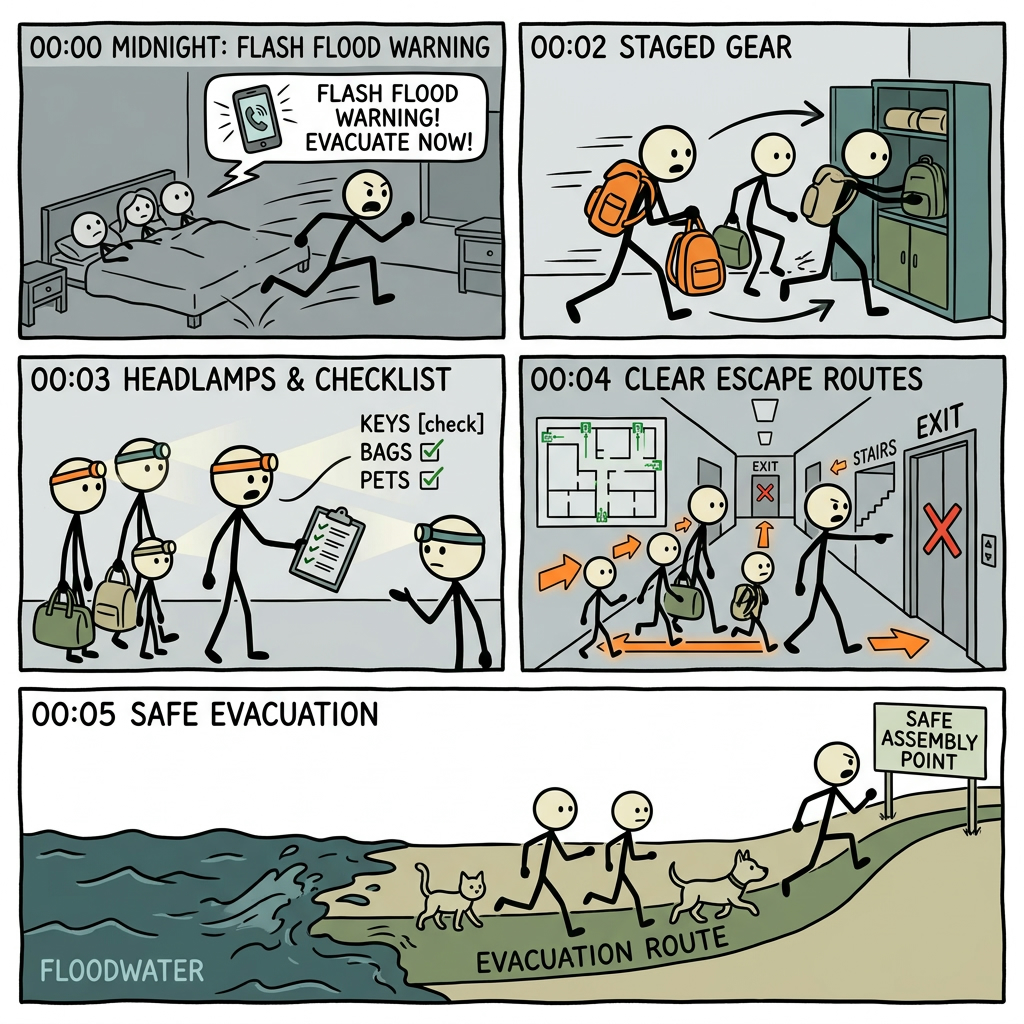
The Physiology of Midnight Alarms: Beating Sleep Inertia Under Pressure
When an emergency alert wakes your household in the dead of night, you are not operating at your baseline mental capacity. Scientists at the CDC and the National Institute for Occupational Safety and Health (NIOSH) study sleep inertia—the temporary cognitive deficit that occurs immediately after sudden awakening from deep, slow-wave sleep. During this physiological state, your prefrontal cortex, the seat of executive decision-making, spatial orientation, and risk assessment, is functionally impaired. In an overnight flash flood evacuation, sleep inertia is your first invisible hazard.
Without an external operational framework, adults faced with sudden alarms tend to exhibit "freeze or fiddle" behaviors. People waste precious minutes looking for trivial items like phone chargers, reading glasses, or matching footwear, entirely blind to the water rising against their exterior foundation. To bypass sleep inertia, your evacuation procedure must be binary and physical. You do not wake up and assess whether you feel like leaving; you execute predetermined, physical tasks that require zero creative thinking.
The solution is an intentional tactile trigger system. When the alarm sounds, your tactile environment must immediately guide your body through the initial 90 seconds of movement. Clear, pre-staged visual and physical markers—such as high-visibility pull tabs, illuminated bedside gear, and rigid step-by-step checklists—act as an external brain. By offloading cognitive load onto simple physical systems, you bypass mental fog and start moving before panic or grogginess can freeze your family in place.
The Zero-Friction Bedroom Emergency Kit
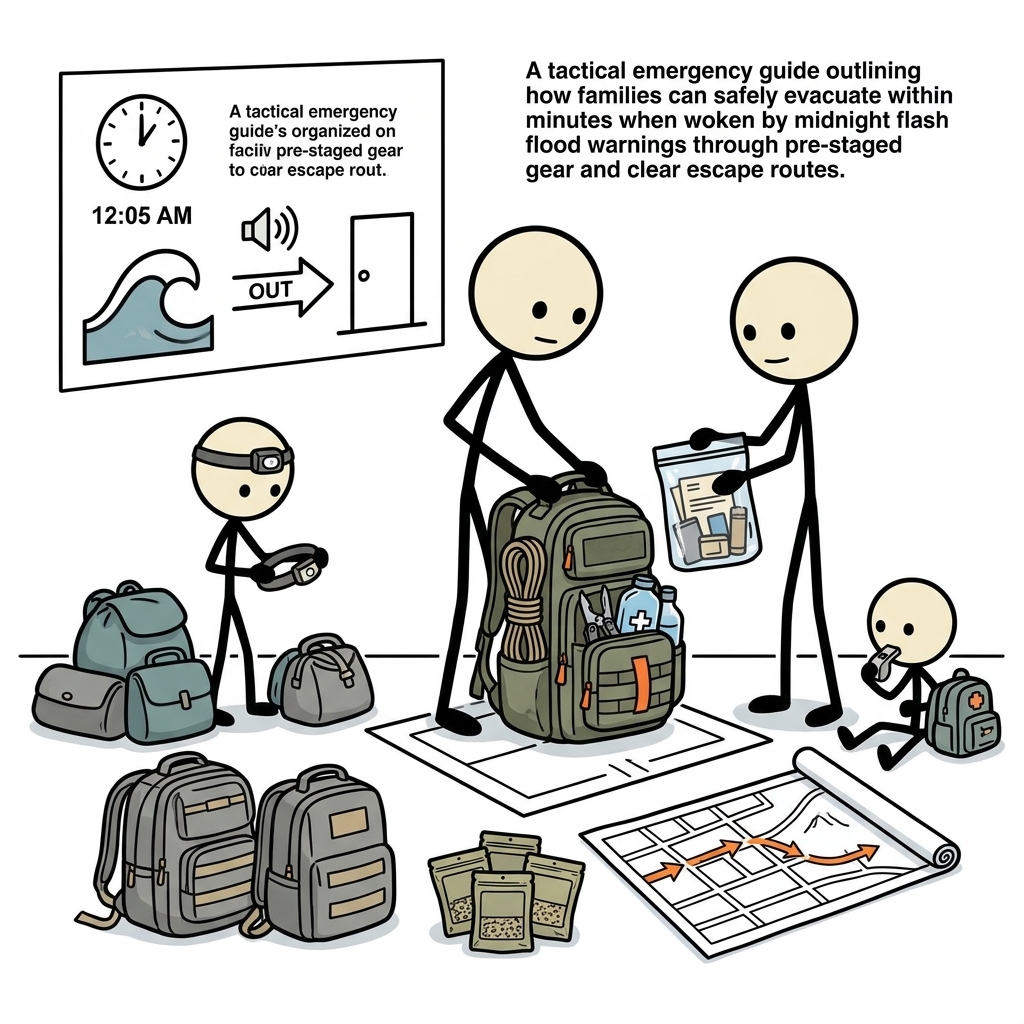
A standard 72-hour survival bag stored in a hall closet or basement is useless when five inches of water are already creeping across your floorboards. True nighttime flood preparedness demands a dedicated bedroom emergency kit kept within arm's reach of every sleeping occupant. If you have to walk down a dark hallway to retrieve shoes or illumination, your staging system has failed.
Every bedroom in your home should feature an "Immediate Action Station" positioned right against the nightstand or the bed frame. This setup strips away every physical barrier between waking up and stepping out of the room fully protected against the elements. Your gear must be organized logically by order of donning: light, footwear, protection, and emergency communication plan.
Bedside Kit Inventory Checklist
- Hard-Soled, High-Traction Footwear: Running shoes, tactical boots, or thick-soled neoprene river boots placed directly on the floor where your feet swing out of bed. Never leave flip-flops, slippers, or bare feet to face broken glass, structural splinters, or submerged electrical hazards.
- Red-Spectrum Hands-Free Headlamp: Affixed directly around the boots or hanging from the bedpost. Use red light initially to preserve your night vision and prevent waking family members into an immediate, blinded panic.
- The "Go-Sling" Bag: A lightweight, 100% waterproof dry-bag sling (10–15 liters) containing:
- Prescription medications (7-day supply in a water-sealed pouch).
- Compact, waterproof emergency whistle (for acoustic signaling to rescue teams).
- Pre-charged power bank with tethered phone charging cables.
- Physical laminated copy of your family flood escape plan and critical phone numbers.
- Waterproof pouch containing government IDs, insurance declaration pages, and cash.
- Heavy-Duty Work Gloves: Submerged handrails, storm doors, and debris require hand protection against biological contamination and lacerations.
- Glow-in-the-Dark Snap Bracelets or Chem Lights: Snagged around children's wrists immediately upon waking for instant visual tracking in pitch-black conditions.
For young children, the kit should be managed entirely by the designated adult, but older kids and teenagers must be trained to put on their bedside shoes and headlamps the moment they hear the primary alarm. Practice this movement until it becomes as reflexive as turning off a morning alarm.
Mapping the Home Flood Escape Route: Primary and Secondary Corridors
Water inside a home does not behave like a placid swimming pool; it acts as a dynamic force carrying silt, sewage, and destructive pressure. Creating a home flood escape route requires identifying your primary ground egress points while establishing strict rules about vertical movement. FEMA's flood safety protocols explicitly warn against vertical traps: fleeing upward into an attic without an exterior exit route has historically proven fatal in extreme storm surge and flash flood scenarios.
Your primary escape route must always lead outward toward pre-identified high ground, not upward, unless external egress is physically blocked by moving currents. Map out two distinct escape pathways from every single sleeping quarter: the Primary Corridor (usually central hallways leading to the front or back exterior doors) and the Secondary Corridor (secondary bedrooms exiting through ground-floor windows or porch roofs).
Interior Water Dynamics and Door Protocols
As flash floods rise against exterior walls, hydrostatic pressure builds rapidly. If water reaches even twelve inches up an outward-swinging exterior door, the weight of the water can exert hundreds of pounds of force against the frame, making it mechanically impossible for an adult to push open. Conversely, opening an inward-swinging door against rising exterior water can cause an explosive inward rush, knocking family members off their feet and pinning them beneath furniture.
- Test Before You Turn: Never yank open an interior or exterior door leading toward lower ground. Place the back of your hand against the lower seam of the door to feel for moisture, cold air rushing inward, or the vibration of moving water.
- Watch the Sills: If water is actively seeping under the doorframe, that exit is compromised. Redirect immediately to your secondary egress route before opening the door and flooding your current safe compartment.
- Avoid the Basement at All Costs: Never enter a basement, sub-level room, or sunken garage during an overnight flood warning. Electrical panels can short, floor drains can erupt with backed-up municipal sewage, and stairwells can become instantaneous water chutes.
- The Attic Trap Precaution: If flash floodwaters rise so violently within the home that you are forced upward, never enter a closed attic space unless you carry a dedicated structural breaching tool—such as a drywall saw, fire ax, or crowbar. If you are trapped in an attic without a roof-access hatch or breaching tool, rising water can seal you against the roof decking with zero escape route.
Marshaling the Household: The 3-Minute Family Drill
During an overnight emergency, symmetrical actions cause chaos. If both parents run to the kitchen for supplies while no one checks the children, or if both parents converge on the nursery while the vehicles remain unprepared, critical seconds slip away. A resilient flash flood family plan relies on asymmetrical, non-overlapping assignments designed to execute simultaneously.
Assign explicit tactical responsibilities well before any storm system enters the local forecast. In a two-adult household, divide the operational duties into clear, unambiguous roles: Lead Guardian and Logistics Marshal. Single-parent households must streamline these duties, prioritizing life-safety over any physical property or vehicle retrieval.
Lead Guardian Responsibilities
The Lead Guardian focuses exclusively on human and pet extraction. When the alarm sounds, this individual dons their bedside kit and immediately moves through the sleeping quarters:
- Move systematically to children's rooms, issuing clear, calm verbal commands: "The flood alarm is active. Shoes on, bags on, follow me."
- Snap luminous chem-lights or reflective bands onto children's wrists or jackets to maintain visual contact in unlit or smoky conditions.
- Secure infants into chest-mounted baby carriers. Never carry an infant loose in your arms during a flood evacuation; you must have both hands free to break a fall, open resistant doors, or assist another child.
- Leash pets using fixed nylon slip-leads. Do not hunt for pet crates or fancy harnesses. If a dog or cat resists, use a high-traction towel wrap to secure the animal immediately.
- Guide the family group directly to the primary interior staging zone—typically an elevated entryway or garage transition threshold.
Logistics Marshal Responsibilities
The Logistics Marshal focuses on situational stabilization, egress clearance, and vehicle prep:
- Perform a 5-second perimeter sweep through strategic windows to confirm external water levels and identify the safest exit vector.
- Retrieve the Master Document binder and family medical go-bags from their centralized, elevated staging spot.
- If time and water levels permit safely (meaning water has not reached wall outlets or utility rooms), shut off the primary electrical main breaker using a non-conductive tool to mitigate the risk of electrocution from standing water. *Crucial rule: If you must stand in water to reach your breaker panel, leave it completely alone.*
- Transition to the garage or driveway, open the vehicle, fire the ignition, unlock all passenger doors, and verify the path to the street remains free of fast-moving surface water.
- Sound two sharp blasts on a whistle to signal the Lead Guardian that the vehicular egress route is clear and ready for immediate loading.
Vehicle Departure and Vehicular Egress Protocols
Transitioning from the shelter of your home into an automobile is the most hazardous phase of an overnight flash flood evacuation. The American Red Cross and NOAA consistently emphasize that moving water is deceptively powerful. Operating a motor vehicle in active flood conditions carries extreme risk, but remaining in a low-lying structure facing catastrophic inundation can be equally lethal. Precision in this transition is non-negotiable.
Your vehicle staging strategy begins before you go to sleep on nights with severe weather watches. Always park your vehicle facing outward toward the street ("combat parking" or backing into the driveway or garage). Trying to execute a three-point turn or back down a narrow, unlit driveway submerged under brown floodwater is a recipe for sliding off the asphalt into a drainage ditch or culvert.
The Garage Door Failure Contingency
Flash floods are frequently accompanied by localized grid failure. If the power cuts out overnight, your automatic garage door opener will not function. You cannot afford to lose three minutes fumbling around an unlit garage searching for the emergency release mechanism.
- Locate the red emergency disconnect cord hanging from your garage door opener track.
- Tie a high-visibility, waterproof ribbon or luminescent marker to the pull handle so it stands out against the dark ceiling.
- Practice the manual release motion: pull the cord down and back toward the motor unit to disengage the trolley, then lift the door manually using the bottom structural lift handle.
- Ensure all family members know how to lift the door manually, as counter-springs make the physical weight manageable even for older children or teens.
Vehicular Escape Tools and Submersion Survival
Every vehicle in your household must be equipped with a mechanical emergency egress tool—such as a spring-loaded window punch and seatbelt cutter (e.g., a Resqme tool)—mounted within arm's reach of the driver's seat. Standard tempered side windows cannot be kicked out or broken with bare hands when submerged. Note that many modern vehicles use laminated glass on side windows; verify your vehicle's glass type beforehand, as laminated glass requires an extraction saw rather than a center-punch tool.
If you encounter standing or flowing water while driving away from your home, remember the gold standard rule from the National Weather Service: Turn Around, Don't Drown®. It is impossible to determine the condition of the road surface beneath floodwater. Culverts wash out, bridges collapse, and sinkholes form beneath seemingly shallow surface puddles.
If your vehicle stalls in rising water or gets swept into a current, your survival timeline drops to seconds. Follow the established USGS and emergency rescue protocol:
- Unbuckle Immediately: Release your seatbelt and command all passengers to do the same. Unbuckle children starting from the oldest to the youngest so older siblings can assist.
- Roll Windows Down Promptly: Do not wait. While the electrical system is still functioning, roll down all windows completely. Once the vehicle's electrical circuitry shorts or water pressure seals the doors against the frame, the windows become your only viable escape hatch.
- Abandon the Vehicle: Climb out through the open windows immediately onto the vehicle's roof. Never attempt to push open a door against incoming flood currents. From the roof, evaluate the safest path to shore or prepare to signal first responders with your bedside whistle and headlamp.
Micro-Topography: Scouting Elevated Safe Havens in Advance
An family emergency plan without a verified destination is merely wandering into danger. During an overnight flash flood evacuation, your town's standard evacuation shelter may be inaccessible if the arterial roads leading across valley floors are inundated. True nighttime flood preparedness requires identifying at least three hyper-local high-ground rally points based on micro-topography.
You can access USGS topographical maps and the FEMA Flood Map Service Center online to examine the elevation profile of your immediate neighborhood preparedness network. Identify localized high points—ridges, elevated commercial parking lots, churches built on hilltops, or high-school campuses positioned outside the 500-year floodplain—that can be reached using secondary, ridge-line roads rather than valley-floor parkways.
Designing Your Family Route Cards
Do not rely on smartphone GPS routing apps during a localized flash flood. Cell towers often lose power or become overwhelmed with cellular traffic, and mapping algorithms rarely account for hyper-local flash flooding or washed-out residential culverts until hours after the event has peaked. Create physical, waterproof "Route Cards" and secure them inside every family go-bag essentials guide and vehicle glove compartment.
- Primary Route: The fastest, most direct route to your designated elevated safe zone, explicitly avoiding any road that crosses creek beds, retention ponds, or low-lying underpasses.
- Secondary/Ridge Route: An alternate path that uses higher-elevation neighborhood streets, even if the distance is considerably longer. In flood conditions, elevation trumps distance every time.
- Pedestrian Fallback Route: A foot-egress pathway to nearby high ground if your driveway or local streets become instantly impassable for vehicles. Identify pathways through neighboring backyards or elevated easements that keep you out of moving gutter currents.
Review these routes twice a year with your family, coinciding with seasonal severe weather shifts. Walk or drive the alternate routes during the day so every driver in the household recognizes landmarks without relying on street signs that may be unreadable in blinding midnight squalls.
Conducting the 90-Second Nighttime Evacuation Drill
A survival plan on paper is simply an unverified hypothesis. The only way to ensure your household can transition from sound sleep to rolling out the driveway in under three minutes is through realistic, low-stress physical rehearsal. Conduct a semi-annual "Midnight Flash Flood Drill" to identify systemic failures before nature tests your household for real.
Pick an evening, set an unexpected alarm on a parent's phone at 10:00 PM after the children have gone to bed, and activate the drill. Do not turn on the main overhead household lights; rely entirely on the bedside headlamps, flashlights, and staged glow markers. Evaluate the exercise objectively:
- Did every family member find their bedside footwear within ten seconds?
- Did the sleep-inertia fog cause anyone to wander off to pick up unnecessary personal items?
- Was the baby carrier secured correctly in the dark?
- Did the pets cooperate, or did their handling add unexpected minutes to the extraction timeline?
- Was the garage door manual release successfully located and operated without overhead electricity?
Address the friction points immediately. If a child struggled to tie their shoes in the dark, switch to slip-on neoprene boots. If the pet bolted under a bed, stage treats or high-value food right next to the bedroom slip-lead. Streamlining this operational workflow transforms what would otherwise be a chaotic, life-threatening catastrophe into a calm, methodical, and well-executed family drill.
Nighttime flash floods are among the most intimidating natural events a homeowner will ever confront, stripping away daylight, visibility, and familiar surroundings. Yet, moving water obeys the laws of physics, and your family's response can be engineered to outpace it. By implementing a zero-friction bedroom staging system, establishing crisp household roles, mastering vehicular egress, and reinforcing your strategy with daylight reconnaissance, you strip the midnight alarm of its terror. Preparedness is not about living in chronic fear of the storm; it is the quiet, practiced confidence that when the sirens wail and the water rises, your family will move with purpose, precision, and complete control.
Frequently Asked Questions
How can we ensure nighttime emergency alerts wake us while sleeping?
Enable Government Alerts (WEA) on smartphones and set them to override 'Do Not Disturb' or sleep focus modes, and keep a dedicated NOAA weather radio with battery backup and an audible alarm plugged in next to the bed.
What gear should be kept in the bedroom for an immediate overnight evacuation?
Keep sturdy closed-toe shoes, a battery-powered headlamp or flashlight, your primary go-bag, essential medications, and car keys directly beside or under the master bed.
What should you do if floodwaters have already surrounded the house before you can exit?
If water is actively rising outside your doors, move to the highest interior level rather than stepping into swift water. Never enter an attic without an axe or a guaranteed egress point onto the roof.
Is it safe to drive away during a middle-of-the-night flash flood emergency?
Only evacuate by vehicle if local officials order it and routes are confirmed clear; nighttime driving during flash floods is extremely hazardous because deep or swift-moving water is nearly impossible to see in the dark.
How should a family coordinate nighttime child and pet evacuation?
Assign specific responsibilities in advance: one parent secures children with emergency shoes and life vests if appropriate, while the other secures pets and the bedroom emergency kit before proceeding to the designated exit.