⚡ Key Facts: CPAP Power & Grid Resilience
- Vulnerable Population: The American Academy of Sleep Medicine estimates that 30 million American adults suffer from obstructive sleep apnea (OSA), making CPAP therapy a frontline medical necessity for millions during grid failures.
- Grid Instability Realities: According to the U.S. Energy Information Administration (EIA), the average U.S. electricity customer experienced over seven hours of power interruptions in recent years, with major weather events driving extended multi-day outages.
- The Humidifier Power Penalty: Running integrated heated humidification and heated tubing accounts for up to 75% to 80% of a CPAP machine's total energy draw; disabling them can extend your backup battery runtime by a factor of three or four.
- The DC Advantage: Utilizing an OEM direct-current (DC) power converter instead of plugging a standard AC plug into an inverter improves battery efficiency by 15% to 25%, preserving vital watt-hours when off-grid.
- FEMA Emergency Standard: Federal Emergency Management Agency (FEMA) guidelines recommend that electricity-dependent individuals prepare for a minimum 72-hour self-sufficiency window, though regional events frequently demand a 7- to 10-day power strategy.
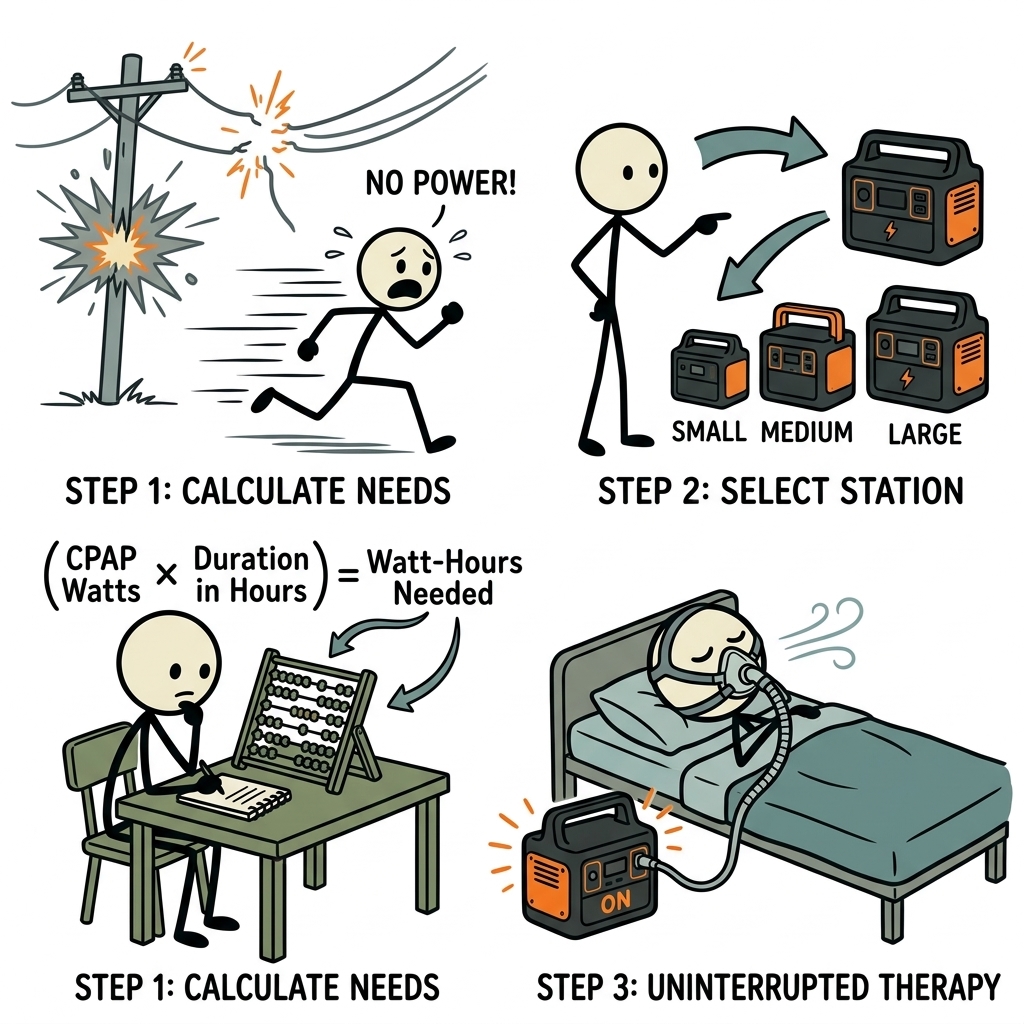
When the catastrophic winter storm of February 2021 crippled Texas’s electrical grid, leaving more than 4.5 million homes in freezing darkness, thousands of individuals with obstructive sleep apnea faced a quiet, terrifying medical crisis within their own bedrooms. For a patient dependent on continuous positive airway pressure therapy, a blackout is not merely an inconvenience marked by dark rooms and spoiling food. The abrupt cessation of pressurized air causes severe sleep-disordered breathing events, rapid oxygen desaturation, surges in systemic blood pressure, and cognitive exhaustion at the exact moment clear-headed crisis management is vital. Achieving true sleep apnea blackout preparedness requires treating your medical equipment not as an afterthought, but as a critical infrastructure load that demands calculated, redundant, and resilient power engineering. For the practical checklist side, use the community emergency preparedness guide.
The Clinical Urgency of Continuous CPAP Therapy During Disasters
The Federal Emergency Management Agency (FEMA) and the Centers for Disease Control and Prevention (CDC) classify CPAP units as life-sustaining or life-supporting durable medical equipment (DME) depending on patient pathology. When power cuts out mid-breath, a modern CPAP mask acts as a physical obstruction. While anti-asphyxia valves prevent suffocation, the sudden drop in therapeutic pressure triggers immediate micro-arousals, panic, and an immediate collapse of the upper airway. For the practical checklist side, use the emergency communication plan.
In a prolonged emergency, the physiological toll of going without therapy accumulates rapidly. Severe obstructive sleep apnea can cause dozens of apneic episodes per hour, starving the brain and heart of vital oxygen. The resulting cardiovascular strain elevates the risk of cardiac arrhythmias, hypertensive crises, and transient ischemic attacks—medical complications that local emergency rooms, already overwhelmed by weather-related traumas, may be unable to manage. For the practical checklist side, use the family emergency planning guide.
Moreover, acute sleep deprivation critically impairs cognitive performance. In a disaster environment—where you may need to chop firewood, operate a dual-fuel generator, clear debris, or navigate hazardous roadways—sleep-deprived reaction times mimic those of acute alcohol intoxication. Maintaining your CPAP therapy through a dedicated emergency CPAP power supply ensures that you remain alert, decisive, and capable of protecting your household when the grid collapses. For the practical checklist side, use the real-world emergency scenarios guide.
Deconstructing CPAP Energy Dynamics: Volts, Amps, and Watt-Hours
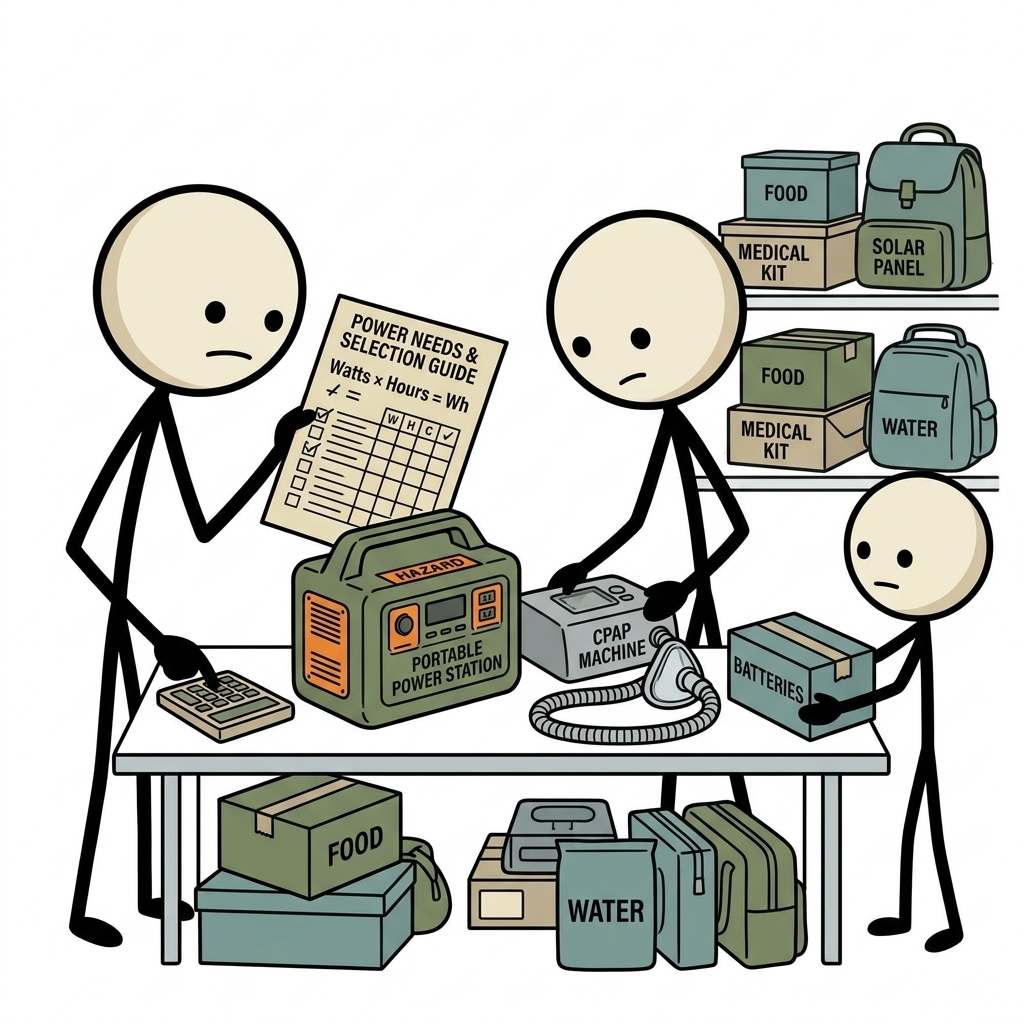
Before purchasing hardware, you must understand how your specific machine consumes power. CPAP power consumption is rarely static; it fluctuates based on programmed air pressure, dynamic mask leaks, altitude, and, most significantly, climate control settings.
Electrical capacity in battery backups is measured primarily in Watt-hours (Wh). A watt-hour represents the consumption of one watt of power sustained over one hour. Calculating your nightly energy budget requires translating your machine's operating parameters into these precise metrics.
The Massive Impact of Humidifiers and Heated Tubing
The heating elements inside your CPAP water chamber and hose are thermodynamic heat engines that demand massive amounts of electrical power. While the internal blower motor might consume a meager 8 to 15 watts to deliver therapeutic pressure, heating a reservoir of cold water to ambient room temperature and maintaining a heated hose to prevent condensation ("rainout") requires a continuous 40 to 80 watts.
- Blower Motor Only (DC Connection): Draws between 5 and 15 Watts depending on your prescribed pressure (e.g., 8 cm H₂O vs. 18 cm H₂O). Over an 8-hour sleep cycle, this consumes approximately 40 to 120 Watt-hours.
- Blower with Passive Humidification: Adding water to the chamber without turning on the heater plate maintains the low 5 to 15 Watt footprint while providing moderate airway comfort.
- Blower with Heated Humidifier & Heated Tubing (AC Connection): Draws between 60 and 110 Watts continuously. Over an 8-hour sleep cycle, consumption skyrockets to 480 to 880 Watt-hours per night.
Understanding this operational divide is fundamental. Running your CPAP on full climate control during an extended blackout demands a massive, heavy, and expensive battery system. Adjusting your comfort parameters transforms the math, allowing a lightweight, budget-friendly portable power station for CPAP use to sustain you for multiple consecutive nights.
The Inverter Tax: AC vs. DC Efficiency
Every commercial portable power station contains an internal inverter that converts direct current (DC) stored in its lithium cells into alternating current (AC) delivered via standard household wall sockets. However, conversion is not free. Inverters generate heat and experience baseline parasitic draw, losing 15% to 25% of their total stored energy in the translation process.
Most major CPAP machines, including the ResMed AirSense 10 and 11, the Philips DreamStation series, and the Breas Z2, operate internally on direct current (typically 12-volt or 24-volt systems). When you connect your CPAP using its standard three-prong wall cord, the power station converts its DC battery power to AC, sends it through the wall plug, and then the CPAP's external power brick converts that AC back into DC. This double-inversion loop is profoundly inefficient.
By investing in a manufacturer-certified DC converter cable, you plug directly into the power station's 12V cigarette-lighter port or proprietary DC barrel port. This setup bypasses the internal AC inverter entirely, capturing an immediate 15% to 25% runtime dividend without changing a single clinical setting.
| CPAP Configuration | Pressure Setting (cm H₂O) | Average Continuous Draw (Watts) | Total Consumption per 8-Hour Night (Wh) | Min. Battery Spec (3-Night Buffer) |
|---|---|---|---|---|
| Direct Current (DC) / No Heat | 10 | 8W | 64 Wh | ~250 Wh Capacity |
| Direct Current (DC) / No Heat | 15 | 12W | 96 Wh | ~350 Wh Capacity |
| Alternating Current (AC) / No Heat | 10 | 13W (Inverter Loss Included) | 104 Wh | ~400 Wh Capacity |
| DC / Humidifier Level 3 / No Heated Tube | 10 | 35W | 280 Wh | ~1,000 Wh Capacity |
| AC / Humidifier Level 4 / Heated Tube Max | 15 | 85W | 680 Wh | ~2,500 Wh Capacity |
Calculating Your Emergency Power Needs: The Math of Resilience
Sizing an emergency CPAP power supply cannot involve guesswork. To build a robust system, execute a straightforward multi-step power audit based on your specific prescription and local hazard profiles.
Step 1: Determine Your Machine's Real-World Continuous Wattage
Check the bottom label of your CPAP unit for maximum electrical ratings, but do not use these numbers for capacity planning; they reflect momentary maximum startup surges. Instead, consult your manufacturer’s technical data sheets or connect your device to an inexpensive inline watt-meter (such as a Kill A Watt device) at home. Measure your draw overnight under two distinct conditions: your normal comfort configuration and a stripped-down emergency profile (heat elements disabled).
Step 2: Apply the Inverter and Operational Loss Multipliers
If you intend to power your CPAP via the standard AC plug, divide your calculated watt-hours by 0.80 to account for the typical 20% inverter and transformation penalty. If you are operating via native DC, divide by 0.95 to account for minor cord resistance.
Step 3: Factor in Depth of Discharge (DoD)
Modern lithium power stations feature sophisticated Battery Management Systems (BMS) that protect the cells from deep over-discharge. While high-grade cells can discharge to 90% or 95% of stated capacity, running a battery to true zero degrades cell health. Apply a conservative safety buffer by multiplying your total required watt-hours by a factor of 1.20.
Step 4: Establish Your Autonomy Target
Determine how many nights of power you must guarantee without access to the electrical grid. FEMA's baseline recommendation is 72 hours (3 nights). However, if you reside in regions prone to severe hurricanes, ice storms, or catastrophic wildfire hazards tracked by agencies like the National Oceanic and Atmospheric Administration (NOAA) and the U.S. Geological Survey (USGS), planning for a 5- to 7-night baseline is significantly safer.
The Final Sizing Formula:
Required Station Capacity (Wh) = [ Nightly Watt-Hours × Desired Nights × Safety Factor (1.20) ] ÷ Efficiency Factor (0.80 for AC, 0.95 for DC)
Worked Example: Assume you run your CPAP via a DC cable with humidification turned off, consuming 10W continuously over an 8-hour sleep session (80 Wh/night). You want a 4-night survival capability during a winter ice storm:
[ 80 Wh × 4 nights × 1.20 ] ÷ 0.95 = 384 Wh ÷ 0.95 = 404.2 Wh
In this scenario, a 500Wh portable power station delivers the operational margin necessary to guarantee restful sleep through the disruption.
Selecting the Right Portable Power Station: Engineering and Architecture
Not all consumer battery stations can safely run delicate, computerized medical equipment. Understanding internal battery chemistry and component engineering ensures your investment survives storage and performs flawlessly under emergency conditions.
Battery Chemistry: LiFePO4 vs. NMC
The portable power station industry is divided between two primary lithium formulations: Lithium Iron Phosphate (LiFePO4 or LFP) and Nickel Manganese Cobalt (NMC). For emergency life-support preparedness, the choice is clear.
LiFePO4 batteries offer profound advantages in cycle life and thermal stability. While traditional NMC batteries degrade to roughly 80% capacity after 500 to 800 charge cycles, LiFePO4 batteries routinely deliver 3,000 to 4,000 complete charge cycles before witnessing comparable degradation. If you preserve a LiFePO4 unit for emergency deployment, it will maintain its integrity across a decade of seasonal readiness checks.
Furthermore, LiFePO4 chemistry is chemically stable and non-combustible. It exhibits dramatically higher resistance to thermal runaway caused by external puncture, internal short-circuits, or high ambient temperatures—an invaluable safety margin when operating inside an enclosed home during an active disaster.
Pure Sine Wave vs. Modified Sine Wave Inverters
If you must operate via alternating current, verify that any potential cpap backup battery power outage solution incorporates a Pure Sine Wave inverter. The electrical grid provides alternating current in a smooth, continuous mathematical wave. Cheaper power banks generate a "modified sine wave" (essentially a choppy, stepped square wave).
Delicate medical microprocessors and variable-speed blower fans are vulnerable to modified sine waves. Running an expensive medical device on a modified sine wave inverter risks overheating the motor, introducing severe harmonic noise, corrupting flow-sensor data, or immediately frying the logic boards. Never connect medical equipment to anything less than a certified pure sine wave output.
Uninterruptible Power Supply (UPS) Functionality
Certain high-performance power stations offer seamless EPS/UPS pass-through switching capabilities. When connected permanently between the wall outlet and your CPAP, the unit charges its cells while letting household grid power flow directly to your machine. If an outage occurs at 3:00 AM, the station’s internal transfer switch detects the drop and routes power from its battery cells in under 20 milliseconds.
This rapid handover prevents your CPAP from shutting down or tripping safety faults mid-cycle. You sleep through the initial power failure completely undisturbed, waking up fully rested and unaware that the neighborhood preparedness network has gone dark.
Replenishing Power Off-Grid: Selecting the Best Solar Generator for CPAP
Stored battery energy is a finite resource. In a prolonged regional crisis—such as the aftermath of a major category hurricane or catastrophic earthquake—recharging from the central grid is impossible. This makes pairing your power station with photovoltaic (PV) solar panels the definitive answer for true, indefinite medical resilience.
Calculating Solar Replenishment
To establish a continuous energy loop, your solar panels must generate more energy during peak daylight hours than your CPAP consumes throughout an entire night, while accounting for daytime charging inefficiencies.
Solar generation depends on "Peak Sun Hours" (PSH)—the equivalent hours per day when solar irradiance averages 1,000 Watts per square meter. According to the National Renewable Energy Laboratory (NREL), winter conditions across northern latitudes can depress average PSH to as little as 1.5 to 2.5 hours per day, while sunny summer conditions provide 5 to 6 hours.
If your CPAP setup requires 100 Wh per night, and you reside in a region providing an average of 3 Peak Sun Hours in winter, simple math suggests you need roughly 33 Watts of continuous solar input. However, real-world solar collection suffers from thermal losses, atmospheric haze, improper panel angle, and dust accumulation. Always derate solar panel ratings by at least 25% to 35%.
- Minimalist DC Setup (No Heat): Consuming 80–120 Wh per night requires a minimum 100W rigid or portable monocrystalline solar panel. Under moderate sunlight, this repowers the station completely in under two hours.
- Moderate Setup (Low Humidification): Consuming 250–350 Wh per night necessitates a 200W to 300W solar array to guarantee a complete recovery even during partially overcast days.
- High-Consumption Setup (Full Climate Control): Sinking 600–800 Wh per night demands a substantial 400W to 600W array paired with an advanced MPPT (Maximum Power Point Tracking) charge controller to pull down sufficient energy in tight sun windows.
For individuals seeking the best solar generator for cpap applications, prioritize power stations with high solar input limits (at least 200W to 400W) and integrated MPPT charge controllers, which extract up to 30% more energy from daylight than legacy PWM (Pulse Width Modulation) circuits during cold or partially cloudy conditions.
Operational Field Tactics: Stretching Every Watt-Hour
When operating an emergency CPAP power supply during an extended crisis, basic field conservation measures can double or triple your operational runway. Adopting an off-grid operational mindset is crucial.
- Ditch the Heating Plate: The most powerful conservation step you can take is turning the humidifier chamber heater setting to "OFF." Fill the chamber with distilled water anyway. The air rushing across the water's surface will collect passive, ambient moisture—significantly reducing airway dryness without consuming a single watt of battery energy.
- Deploy an HME (Heat and Moisture Exchanger): Frequently used by travelers, an HME is an inline, hygienic filter that mounts between your mask and tubing. It captures moisture from your exhalations and returns it when you inhale. Using an HME allows you to leave your heavy water chamber completely dry and empty, eliminating energy costs entirely while protecting your mucous membranes.
- Deactivate Heated Tubing: Swap out your powered, copper-lined heated hose for a standard, non-heated plastic tubing assembly. If condensation ("rainout") becomes an issue due to cold ambient room temperatures, insulate the hose using a zippered fleece hose sleeve.
- Audit and Seal Mask Leaks: High mask leakage forces the CPAP blower motor to spin up to maximum RPM to compensate for pressure losses, increasing baseline wattage draw. Check your mask cushion, headgear, and silicone seals before storm season arrives. A well-fitted, leak-free mask saves valuable battery power.
- Regulate Battery Temperature: Chemical batteries are sensitive to ambient temperatures. The chemical kinetics of both LiFePO4 and NMC cells degrade dramatically below 32°F (0°C). Never charge a lithium battery that has dropped below freezing, as doing so can cause permanent internal dendrite formation and catastrophic failure. Keep your power station inside your home's thermal envelope alongside your living space.
The Redundant Medical Bug-In Action Plan
True emergency preparedness is rooted in clear, executed protocols rather than unboxed hardware sitting in a closet. To ensure seamless continuity when a blackout hits, institute an operational readiness protocol aligned with proven emergency management principles.
Phase 1: Pre-Disaster Calibration and Inventory
Perform a biannual "blackout drill." Disconnect your CPAP from municipal power, hook up your DC converter, plug into your portable power station, and sleep through the night solely on battery reserves. This tests your equipment, confirms cable compatibility, and verifies that your actual power consumption matches theoretical calculations.
Ensure you have two distinct methods of charging your station: an appropriately sized solar array with compatible MC4-to-DC connection cables, and an automotive 12V charging plug that enables you to replenish the station using your vehicle's alternator if severe storms block sunlight for days.
Phase 2: Immediate Outage Response
When the grid drops, assess your timeline. If the blackout is driven by an unfolding catastrophic event (such as a severe derecho or winter storm), immediately transition your CPAP to low-draw conservation mode. Strip the heating elements, plug in through your native DC converter, and isolate the power station from running non-essential loads like consumer electronics or decorative lighting.
Phase 3: Daytime Power Management
Establish a strict operational rhythm. The moment the sun rises, stage your solar panels in an unshaded location with appropriate seasonal tilt. Connect the station and prioritize replenishing medical reserves before powering smaller task devices. Clean panel faces of snow, dust, or moisture to maintain charging performance. Monitor weather forecasts via an emergency NOAA weather radio to anticipate incoming cloud systems and capture power while the sun is available.
Treat your emergency CPAP power supply as an indispensable medical life-support asset. With the proper hardware, deliberate mathematical calculations, and disciplined operational protocols, you can transform a sudden, dangerous blackout from a night of sleep-deprived vulnerability into a calm, controlled, and restorative event.
Frequently Asked Questions
What size portable power station do I need to run a CPAP machine overnight?
A standard CPAP running on pressure-only mode consumes 30 to 60 watts, requiring a 300Wh to 500Wh power station for 1 to 2 nights. If using a heated humidifier and heated tubing, power consumption increases to 90 to 120 watts, necessitating a 700Wh to 1000Wh battery per night.
Should I power my CPAP using a 12V DC adapter or the standard AC wall plug?
Always use a dedicated 12V or 24V DC power cable when running a CPAP from a portable power station. Bypassing the AC inverter eliminates energy conversion loss, extending battery runtime by 15% to 30%.
How much battery life is saved by disabling heated humidification?
Turning off the heated humidifier and heated tube reduces power draw by roughly 50% to 75%. During an extended emergency outage, running the machine without heat can double or triple overall runtime.
Does a CPAP machine require a pure sine wave power station?
Yes. CPAP motors and sensitive internal microprocessors require pure sine wave electrical output to prevent motor whine, overheating, erratic pressure delivery, and permanent component damage.
How can I recharge a CPAP battery station during an extended grid outage?
Portable power stations can be replenished during prolonged outages using compatible solar panels (typically 100W to 200W), a 12V automotive charging port while running errands, or an outdoor inverter generator.