⚡ Key Facts
- Grid Vulnerability: According to the U.S. Energy Information Administration (EIA), American electric customers experienced an average of over five to seven hours of power interruptions annually in recent years, with major weather events multiplying that figure drastically.
- Food Safety Deadlines: The Centers for Disease Control and Prevention (CDC) warns that a closed refrigerator will only keep food safe for 4 hours during a blackout, while a full freezer maintains safe temperatures for approximately 48 hours.
- True Usable Capacity: Due to DC-to-AC inverter conversion losses and internal resistance, a portable power station delivers only 80% to 85% of its rated nameplate capacity to connected household appliances.
- Chemistry Durability: Lithium Iron Phosphate (LiFePO4) power stations provide 3,000 to 3,500+ full charge cycles before degrading to 80% capacity, compared to just 500 to 800 cycles for traditional nickel-manganese-cobalt (NMC) chemistries.
- The Solar Replenishment Gap: Based on National Renewable Energy Laboratory (NREL) data, average winter solar harvest yields only 2 to 3.5 "peak sun hours" per day across most of North America, requiring solar input arrays to be sized substantially larger than the daily watt-hour burn rate.
When an ice storm shears high-voltage transmission lines or an unexpected substation failure plunges your neighborhood preparedness network into freezing darkness, the value of modern emergency backup power shifts from theoretical to urgent within minutes. In past decades, emergency preparedness meant wrestling a deafening, carbon-monoxide-spewing gas generator out to the patio, hoping you treated the fuel six months ago, and threading heavy extension cords through cracked, drafty doors. Today, advanced high-capacity lithium units have fundamentally changed residential resilience. Yet, the most dangerous mistake a homeowner can make is buying a portable power station based on marketing buzzwords rather than rigorous, individualized load calculations.
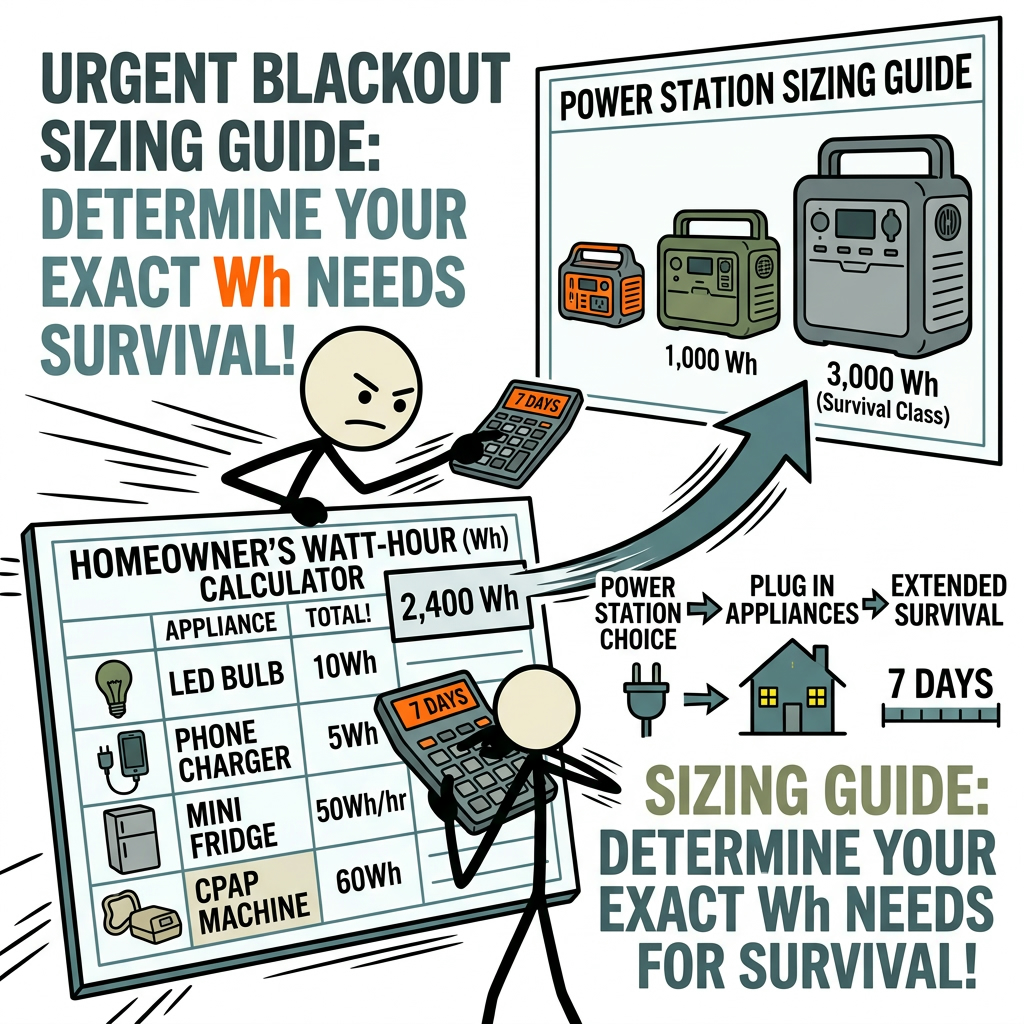
A battery that runs a camping fridge for a sunny weekend can fail catastrophically when tasked with sustaining critical medical equipment, emergency food storage guide, and emergency communication plan hubs through a 72-hour multi-season blackout. Sizing a blackout power supply is not an exercise in guesswork; it is an applied physics calculation. This engineering-grade sizing guide removes the mystery from reserve power, walking you through the exact equations, conversion variables, and architecture specifications necessary to keep your household safe, connected, and functional when the municipal grid collapses.
The Fundamentals: Watts, Watt-Hours, and Inverter Inefficiencies
Before inventorying home appliances, you must master the fundamental units of electrical measurement. Consumers frequently conflate electrical flow with electrical storage capacity, leading to disastrous procurement errors. A unit capable of outputting massive instantaneous power may run out of energy in twenty minutes, while a massive reservoir of energy may lack the muscle to start a single basic motor. For the practical checklist side, use the community emergency preparedness guide.
To accurately evaluate emergency backup power hardware, separate your requirements into three distinct metrics: For the practical checklist side, use the family emergency planning guide.
- Running Watts (Continuous Power): The baseline electrical power an appliance consumes continuously while operating. For example, a modern 55-inch LED television uses approximately 60 to 100 continuous watts.
- Starting Watts (Surge Power): The brief, high-energy spike required by devices with inductive motor loads—such as refrigerators, sump pumps, and power tools—to initiate mechanical rotation. Surge draw often ranges from two to four times the running wattage and lasts anywhere from a fraction of a second to several seconds.
- Watt-Hours (Wh - Total Capacity): The total volume of energy stored inside the battery cells. Consuming 100 watts for one hour drains exactly 100 watt-hours of capacity. A 1,000Wh battery can theoretically power a 100W appliance for 10 hours.
The Inverter Tax: Accounting for Conversion Losses
The single greatest oversight in portable power station sizing is assuming that a 1,000Wh battery provides 1,000Wh of usable alternating current (AC) power to standard household wall plugs. It does not.
The raw chemical storage in a power station exists as direct current (DC). To run household appliances, an internal component called an inverter must convert that DC energy into 120-volt AC power. This conversion is an imperfect thermodynamic process that generates heat and burns energy. Most high-tier pure sine wave inverters run at 80% to 88% efficiency under optimal loads.
Furthermore, the power station's internal logic board, active cooling fans, and LCD displays consume steady power—often referred to as "parasitic draw" or idle load. If you leave an inverter switched on overnight to power an intermittent load, the standby consumption can quietly drain 15W to 30W every hour simply keeping the high-voltage circuits energized.
To arrive at the actual usable capacity of any system, you must apply an industry-standard derating multiplier:
Usable Wh = Nameplate Battery Wh × Inverter Efficiency (0.85) × Depth of Discharge (0.90 to 0.95)
Consequently, a standard 2,048Wh unit yields roughly 1,560 to 1,740Wh of practical work under typical conditions. Sizing calculations that ignore this reality will leave you without power hours or days before anticipated.
Phase 1: The Critical Load Audit
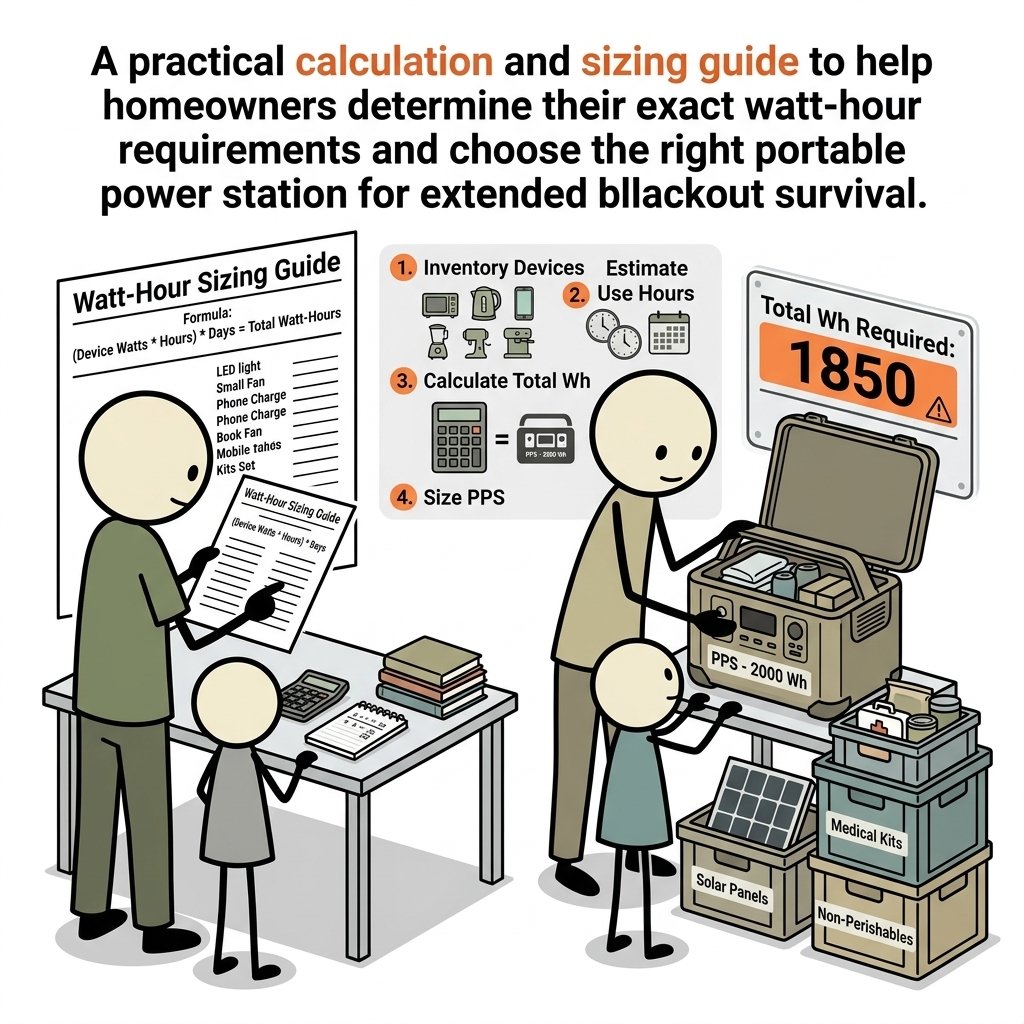
The Federal Emergency Management Agency (FEMA) advises that every American household maintain emergency provisions for a baseline minimum of 72 hours. When mapping this guideline to electrical resilience, trying to run your entire home in a "business-as-usual" state is financially impractical and mechanically inefficient for portable systems. Instead, triage your home's electrical devices into structured necessity tiers.
Tier 1: Survival, Life Safety, and Communications
These devices must remain powered to protect human life, monitor civil emergency alerts, and coordinate logistics. The CDC routinely emphasizes that households relying on medical equipment must have verified redundant power plans before severe weather arrives.
- Medical Devices: CPAP machines, home dialysis support, oxygen concentrators, and medication-cooling coolers.
- Critical Communications: Smartphones, satellite messengers, emergency NOAA weather radios, home cellular boosters, and municipal routers.
- Low-Level Illumination: High-efficiency LED lanterns, headlamps, and battery charging bays for handheld task lighting.
Tier 2: Asset Protection and Food Security
Loss of power quickly degrades biological safety and property integrity. Tier 2 devices protect thousands of dollars in food assets and prevent costly structural damage from water intrusion.
- Food Preservation: Full-size kitchen refrigerators and standalone deep chest freezers.
- Hydrology and Drainage: Primary sump pumps preventing basement inundation during torrential hurricane rainbands or rapid snowmelt.
- Essential Well Pumps: For homes reliant on private groundwater wells (requires dedicated 240V split-phase capacity or specialized low-voltage DC setups).
Tier 3: Comfort, Climate, and Sanitation
While secondary to basic survival, maintaining thermal stability significantly reduces psychological stress, hypothermia risk, and heat exhaustion.
- Air Circulation and Ventilation: 12V or AC box fans during high-heat grid failures.
- Combustion Appliance Circulation: 120V furnace blower motors or pellet stove augers and exhaust fans.
- Targeted Heating: Low-wattage 12V personal heating blankets (vastly superior in efficiency to electric space heaters).
Appliance Power Profile Matrix
The table below provides realistic operational metrics for common emergency loads. Use these baselines, but check the UL rating plates on your specific appliances to verify actual draws.
| Appliance | Running Watts (W) | Surge Watts (W) | Est. Daily Run Time | Effective Daily Duty Cycle | Raw Daily Wh Consumption |
|---|---|---|---|---|---|
| Full-Size Refrigerator (Modern Energy Star) | 100 - 150 | 800 - 1,200 | 8 Hours (compressor active) | 33% (cycles on/off) | 960 - 1,200 Wh |
| Chest Freezer (High Efficiency) | 60 - 100 | 500 - 800 | 6 Hours (compressor active) | 25% (cycles on/off) | 400 - 600 Wh |
| CPAP Machine (Humidifier & Heated Hose OFF) | 30 - 45 | 45 | 8 Hours | 100% continuous | 240 - 360 Wh |
| CPAP Machine (Humidifier & Heated Hose ON) | 90 - 120 | 120 | 8 Hours | 100% continuous | 720 - 960 Wh |
| Home Wi-Fi Router + Fiber ONT | 15 - 30 | 30 | 24 Hours | 100% continuous | 360 - 720 Wh |
| Smartphone Recharges (×4 charges) | 15 - 25 | 25 | 2 Hours total | Direct DC transfer | 60 - 80 Wh |
| 1/3 HP Sump Pump (Submersible) | 600 - 800 | 1,300 - 2,100 | 1.5 Hours cumulative | Intermittent (storm dependent) | 900 - 1,200 Wh |
| 12V Heated Sleeping Blanket | 40 - 55 | 55 | 7 Hours | Thermostatic (approx. 60%) | 170 - 230 Wh |
| Pellet Stove (Auger, Igniter, Exhaust Fan) | 100 - 150 (400 on start) | 450 | 14 Hours | Continuous during cold spells | 1,600 - 2,100 Wh |
*Important Duty Cycle Note: Devices like refrigerators, freezers, and sump pumps do not pull power constantly. Their compressors and motors cycle on and off based on ambient temperatures and water levels. A refrigerator rated at 150W running power that cycles on for 20 minutes every hour has an effective daily run time of 8 hours, yielding an actual consumption of 1,200Wh per day, not 3,600Wh.
Phase 2: The Portable Power Station Sizing Formula
Calculating your required system capacity requires a two-step formula: calculating your total net daily watt-hour burn rate, and adjusting that value for inverter inefficiencies and depth-of-discharge buffers.
Step 1: Calculate Total Net Consumption per Day
For each piece of equipment in your triage matrix, multiply its running wattage by the actual number of hours it will draw power across a single 24-hour cycle:
Appliance Wh/Day = Running Watts × Run Hours per Day
Sum the individual yields to determine your Total Daily Load (TDL):
TDL = Wh(Appliance 1) + Wh(Appliance 2) + Wh(Appliance 3) + ...
Step 2: Apply the Inverter and Safety Multiplier
To establish the actual nameplate battery size required to support that single-day load, divide your TDL by an aggregate system efficiency factor of 0.80 (representing an 85% inverter conversion rate multiplied by a standard 95% battery depth-of-discharge ceiling), or multiply your TDL by a factor of 1.25.
Minimum Required Battery Capacity (Wh) = TDL × 1.25
If you intend to survive a multi-day blackout without any solar or grid replenishment, multiply this result by your target duration (e.g., 2 or 3 days). If you integrate solar recharging, read the solar calculation section below.
Worked Example 1: The "Life Support & Comms" Baseline (24-Hour Horizon)
Consider an urban or suburban household during a rolling blackout, where the primary objective is sustaining medical equipment, keeping phones alive, and preserving one unit of refrigerated medicine and essential food:
- Full-size refrigerator (cycle adjusted): 1,100Wh
- CPAP machine (humidifier set to passive, heated hose OFF): 30W × 8 hours = 240Wh
- Two smartphone recharges via direct USB-C ports: 40Wh
- Home mesh router run intermittently (8 hours total during check-ins): 20W × 8 hours = 160Wh
- LED area task lighting (two 5W bulbs for 5 hours): 50Wh
Total Daily Load: 1,100 + 240 + 40 + 160 + 50 = 1,590 Wh/Day
Required Battery Size: 1,590 Wh × 1.25 System Factor = 1,987.5 Wh
Verdict: A standard 2,000Wh class portable power station (such as units featuring expandable battery packs) safely covers this 24-hour baseline without running the cells to empty.
Worked Example 2: The Extended Winter Storm Profile (No Active Solar Input)
In a deep freeze, solar arrays are often occluded by snow, clouds, or freezing rain. Consider a 48-hour shelter-in-place scenario without solar replenishment, adding comfort heating elements to the load:
- Kitchen Refrigerator: 1,100Wh/day × 2 days = 2,200Wh
- Two 12V Heated Mattress Pads: (45W × 7 hours × 2 blankets) × 2 days = 1,260Wh
- CPAP Machine (with low humidification): (60W × 8 hours) × 2 days = 960Wh
- Radios, Phones, Emergency Lanterns: 150Wh/day × 2 days = 300Wh
Total Two-Day Load: 2,200 + 1,260 + 960 + 300 = 4,720 Wh
Required Battery Sizing: 4,720 Wh × 1.25 System Factor = 5,900 Wh
Verdict: This profile requires a large, split-chassis modular power station comprising a base inverter unit (around 2,000Wh to 3,000Wh) paired with one or two supplementary expansion battery modules, bringing total system storage to approximately 6,000Wh.
Solar Generator Sizing Guide: Calculating Continuous Input
A battery without a charging source is merely an emergency countdown clock. Once internal watt-hours are spent, you are in the dark unless you have access to continuous replenishment. Converting a portable power station into a self-sustaining blackout power supply requires adding an appropriately sized photovoltaic array.
Understanding Peak Sun Hours (PSH)
A common mistake is assuming that ten hours of daylight yields ten hours of solar energy production. The National Oceanic and Atmospheric Administration (NOAA) and NREL calculate solar availability using "Peak Sun Hours" (PSH)—the equivalent number of hours per day when solar irradiance averages 1,000 watts per square meter.
Across the continental United States, winter PSH values plummet dramatically. While parts of the American Southwest enjoy 4.5 to 5.5 PSH in the summer, northern, Midwestern, and northeastern regions frequently see winter averages between 1.5 and 2.5 PSH due to cloud cover, low solar angles, and atmospheric scattering.
The Daily Solar Harvesting Equation
To determine the solar panel wattage required to replace your daily electricity consumption, use this formula:
Solar Array Wattage = Daily Wh Target / (Local Peak Sun Hours × Solar System Efficiency Factor)
Solar arrays lose efficiency due to heat, atmospheric haze, dirty panels, and DC-to-DC conversion losses within the station's Maximum Power Point Tracking (MPPT) charge controller. Standard industry calculations use an efficiency factor of 0.75.
Let us apply this equation to Worked Example 1, which requires 1,590 Wh per day, assuming a winter storm aftermath with 2.5 Peak Sun Hours:
Required Solar = 1,590 Wh / (2.5 PSH × 0.75) = 1,590 / 1.875 = 848 Watts
To sustainably run your basic critical loads indefinitely during winter conditions, you cannot rely on a single 200W or 400W folding panel. You must deploy an array rated for at least 800 to 1,000 Watts. If you only deploy 400W of solar in that environment, you will capture roughly 750Wh per day—leaving an 840Wh daily deficit that will steadily drain your storage to zero within two to three days.
Input Limitations: Voltage, Amperage, and MPPT Controllers
Before purchasing solar panels, review your portable power station's technical specification sheet for its solar input limits:
- Maximum Open Circuit Voltage (Voc): Exceeding the maximum rated input voltage (often 60V on mid-tier units, up to 150V on high-tier units) triggers the station's overvoltage protection or permanently destroys the MPPT controller. When wiring solar panels in series, their voltages add together.
- Maximum Amperage (Current Limit): If your panels supply more amperage than the controller's input ceiling, the station safely caps ("overpanels") the current at its maximum threshold. While this does not damage the unit, excess current is clipped and wasted during peak noon sun.
- Dual-MPPT Controllers: Larger stations often feature dual solar inputs with independent trackers. This lets you orient one array southeast and a second array southwest, maximizing solar capture across the entire arc of the day rather than relying entirely on a brief midday peak.
Battery Chemistry: Why LiFePO4 Outmatches NMC
When shopping for emergency backup power hardware, you will encounter two primary lithium chemistries: Nickel Manganese Cobalt (NMC) and Lithium Iron Phosphate (LiFePO4, or LFP). For long-term emergency readiness, this chemical distinction is critical.
Cycle Life and Longevity
NMC batteries, historically favored in mobile devices and early electric vehicles due to their slightly higher energy density, generally degrade to 80% of their initial capacity after 500 to 800 full charge-discharge cycles. In an extended blackout or regular off-grid application, this lifespan deteriorates relatively quickly.
Conversely, LiFePO4 cells last through 3,000 to 4,000+ cycles before dropping to that same 80% capacity threshold. Even if cycled completely every single day, an LFP battery will deliver reliable, full-capacity service for close to a decade before experiencing meaningful chemical degradation.
Thermal Stability and Safety
Safety is non-negotiable when operating high-capacity energy storage units inside living areas alongside family and pets. NMC batteries have a lower thermal runaway threshold (around 410°F / 210°C). If punctured, internally short-circuited, or overcharged, they can enter an uncontrolled, self-sustaining thermal event that produces intense heat and toxic gas.
LiFePO4 features an exceptionally stable chemical structure, with a thermal runaway threshold exceeding 518°F (270°C). The phosphate-oxygen bond is chemically stronger than the cobalt-oxygen bond in NMC cells, making LFP units virtually immune to combustion or explosive venting under common physical stress or electrical faults. For indoor operations during an emergency, LiFePO4 is the undisputed standard.
Shelf Life and Parasitic Drain
An emergency unit spends most of its life in standby storage, waiting for a crisis. LiFePO4 chemistry demonstrates exceptionally low monthly self-discharge rates (typically 1.5% to 3% per month). However, internal battery management systems (BMS) continuously pull micro-currents to monitor cell health. Store your unit in a temperature-controlled environment and execute a scheduled top-off charge every three to six months to prevent the cells from dropping below critical low-voltage thresholds.
Cold-Weather Derating and Operating Architecture
A little-known chemical reality of all lithium-ion platforms is their extreme sensitivity to sub-freezing temperatures—a vulnerability that can catch homeowners flat-footed during winter grid failures.
The Freezing Temperature Trap
While most lithium power stations can safely discharge power in temperatures down to -4°F (-20°C), they cannot safely charge when cell temperatures drop below 32°F (0°C). Attempting to push current (from solar or AC lines) into a frozen lithium cell causes permanent chemical damage known as "lithium plating," which quickly ruins the cell and creates severe internal fire risks.
Modern quality units feature BMS cut-offs that block cold charging, meaning that if you leave your power station on an uninsulated back porch or inside a freezing garage, connected solar panels will produce zero battery charge. Keep your backup storage inside your home's thermal envelope. If you must run your setup in sub-freezing environments, choose premium units equipped with internal PTC heating elements that use incoming solar power to warm the cells above freezing before routing power to the storage core.
Indoor Deployment and Connection Protocols
One of the primary operational advantages of a portable power station over an internal-combustion generator is zero carbon monoxide emissions. You can safely deploy these systems inside a living room, hallway, or bedroom.
For clean, organized deployment, implement the following best practices:
- Heavy-Gauge Extension Runs: When routing power from your station to distant appliances (like a kitchen refrigerator), use continuous 12-gauge (AWG) or 14-gauge commercial extension cords under 50 feet in length. Undersized (16-18 AWG) cords drop line voltage, generate resistive heat, and prematurely trigger the power station's inverter overload safeties.
- Direct DC Conversion: Whenever possible, bypass the power station's AC inverter entirely. Power your devices using direct DC outputs: charge phones and laptops via the station's 100W USB-C PD ports, and run CPAP machines or portable coolers using the 12V 10A "cigarette lighter" port with a manufacturer-approved 12V adapter. Bypassing the AC inverter cuts energy loss by 10% to 15%, stretching your daily watt-hour reserves substantially further.
- Manual Transfer Switches: For whole-circuit convenience, hire a licensed electrician to install a mechanical transfer switch or an inlet interlock beside your primary service panel. This allows a central power station to safely backfeed selected critical branch circuits (like overhead lights and furnace blowers) without running extension cords across living areas, while physically preventing dangerous backfeeding into municipal lines.
Final Sizing Recommendations
When selecting your hardware, place your household into one of three primary configuration tiers based on your audit results:
1. The Urban Essential Tier (~1,000Wh Capacity / 1,200W Inverter):
Designed for apartments or urban residences prioritizing life safety, communication, and minimal food preservation over short 24- to 48-hour blackouts. Supports mobile devices, basic lighting, router infrastructure, and portable medical gear without supporting full-size compressors or large inductive loads.
2. The Suburban Resilience Tier (~2,000Wh to 3,000Wh Capacity / 2,000W–3,000W Inverter):
The balanced choice for typical single-family homes. Handles high inductive surge currents from full-size refrigerators, chest freezers, and sump pumps. Paired with 400W to 800W of solar input, this configuration provides sustainable long-term survival capacity for critical Tier 1 and Tier 2 loads through prolonged, wide-area grid failures.
3. The Extended Semi-Off-Grid Tier (5,000Wh+ Modular Capacity / 3,000W+ Split-Phase Inverter):
Designed for rural properties, extreme climates, or households requiring heavy medical equipment, well-pump operation, or continuous heating support. These systems use modular, expandable battery blocks, paired with a permanent or semi-permanent rooftop/ground-mount solar array of 1,200W or higher, creating a resilient microgrid that can run indefinitely without municipal support.
True emergency preparedness is rooted in clear, objective planning. When you replace assumptions with verified load audits, correct for conversion inefficiencies, and accurately balance your storage capacity with realistic solar harvesting cycles, severe weather loses its ability to disrupt your household. By engineering your emergency backup power around exact mathematical realities today, you ensure that your family remains safe, warm, and self-sufficient through whatever grid challenges lie ahead.
Frequently Asked Questions
How do I calculate the portable power station capacity needed for an outage?
Multiply the running wattage of your essential devices by their planned runtime in hours, then divide the total watt-hours (Wh) by 0.85 to account for standard inverter and conversion efficiency losses.
What is the difference between running watts and starting surge watts?
Running watts represent continuous power consumed during normal operation, whereas starting surge watts are brief power spikes—often 2 to 3 times higher—required to start inductive loads like refrigerator compressors and sump pumps.
Which battery chemistry is best for emergency backup power stations?
LiFePO4 (Lithium Iron Phosphate) is preferred for disaster prep because it offers 2,500 to 3,500+ charge cycles, superior thermal stability, and a lower risk of fire compared to conventional NMC lithium-ion chemistries.
Can a portable power station power a full-sized household refrigerator?
Yes, provided the station's inverter supports starting surge loads around 1,200W to 1,500W. A standard 1,000Wh to 1,500Wh power station will typically run an efficient modern refrigerator for 12 to 24 hours.
How should a portable power station be maintained during long-term standby?
Store the unit in a dry, climate-controlled space at roughly 50% to 80% charge level, and discharge/recharge it to recommended levels every 3 to 6 months to maintain battery health and readiness.