⚡ Key Facts
- Irreversible Chemical Damage: Forcing a charging current into standard lithium-ion or lithium iron phosphate (LiFePO4) cells at or below 32°F (0°C) triggers permanent metallic lithium plating on the anode rather than safe ion intercalation.
- Discharging vs. Charging Divergence: While most modern portable power stations can safely discharge power in temperatures down to -4°F (-20°C), they cannot safely recharge below freezing without active internal heating elements.
- Phantom Capacity Loss: According to data from the National Renewable Energy Laboratory (NREL), sub-freezing temperatures temporarily increase internal cell resistance, slashing accessible battery capacity by 20% to 50% through severe voltage drop.
- Solar Inversion Threat: Cold winter weather increases solar panel open-circuit voltage ($V_{oc}$), creating a dual hazard where freezing arrays can exceed a power station’s maximum charge controller voltage while the battery simultaneously locks out charging current.
- Federal Safety Baseline: The Federal Emergency Management Agency (FEMA) notes that prolonged winter power outages are among the deadliest weather-related events; preserving off-grid emergency power requires rigorous thermal management rather than passive reliance on factory hardware.
During the historic 2021 North American winter storm (Winter Storm Uri), the National Oceanic and Atmospheric Administration (NOAA) tracked temperatures that collapsed electrical grids across the central United States, leaving over 4.5 million homes without power in sub-zero conditions. In emergency survival situations, modern preparedness advocates increasingly rely on portable solar generators to sustain mission-critical medical gear, emergency communication plan rigs, and high-efficiency lighting. Yet, thousands of families discovered a brutal mechanical reality: when indoor or field ambient temperatures dip below freezing, their high-tech power backups abruptly fail to charge—or suffer fatal internal short-circuits when forced to do so. Understanding the underlying electrochemical laws of cold-weather power preservation is not merely an equipment-maintenance check; it is a life-safety imperative.
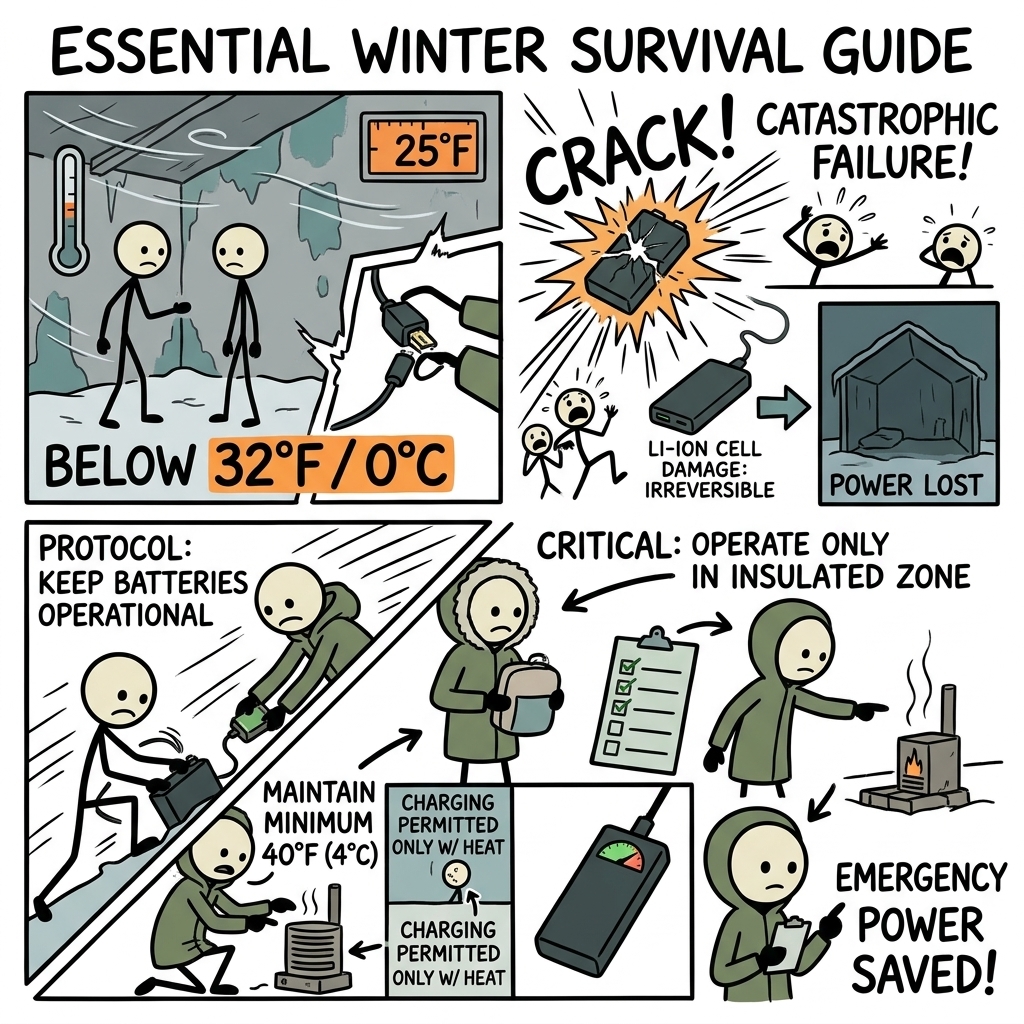
The Physics of Freezing: What Happens Inside a Cold Lithium Battery
To master the deployment of portable power stations in freezing weather, you must first understand the micro-scale chemistry governing modern energy storage. Most off-grid power banks utilize either Lithium Nickel Manganese Cobalt Oxide (NMC) or Lithium Iron Phosphate (LiFePO4) chemistries. Under mild operating temperatures (68°F to 77°F / 20°C to 25°C), lithium ions glide effortlessly through a liquid or gel electrolyte between the cathode and anode during cycles. Temperature drops directly alter the viscosity of this chemical medium. For the practical checklist side, use the community emergency preparedness guide.
As ambient conditions descend toward 32°F (0°C), the electrolyte fluid thickens, substantially reducing ion mobility. At the same time, the solid-electrolyte interphase (SEI) layer on the battery's negative electrode (the graphite anode) becomes far more resistant to ion transfer. When you attempt lithium battery cold weather charging, the external power source pushes lithium ions toward the anode faster than the sluggish, chilled chemistry can absorb them. For the practical checklist side, use the neighborhood preparedness network.
Instead of intercalating cleanly into the porous carbon lattice of the anode, the lithium ions accumulate on the exterior surface. They undergo a reduction reaction that transforms them into solid, metallic lithium. This electrochemical failure mode is known as lithium plating, and unlike typical cyclic degradation, its destructive consequences are permanent, progressive, and catastrophic. For the practical checklist side, use the family emergency planning guide.
Discharging vs. Charging: An Asymmetrical Vulnerability
A frequent point of confusion during winter grid failures is why a power station can illuminate a room or power a medical device at 15°F (-9.4°C), yet flatly refuse to take input from a solar panel or wall outlet. This disparity lies in the fundamental physics of charge direction:
- During Discharge: Lithium ions naturally vacate the negative graphite anode and migrate toward the positive cathode. Because the cathode possesses an open crystal framework that readily accommodates incoming ions, the reaction can safely occur at sub-freezing temperatures—down to -4°F (-20°C) in high-quality systems—albeit with reduced runtime due to internal resistance.
- During Charge: Ions are actively forced back into the compressed, resistant graphite anode against an electrochemical gradient. This process requires maximum ion velocity. When the electrolyte is semi-solidified by cold, the system encounters an immediate bottleneck, resulting in surface plating rather than absorption.
Consequently, your survival strategy must treat discharging and charging as two distinct operational modes governed by radically different thermal boundaries.
The Catastrophic Risks of Lithium Plating
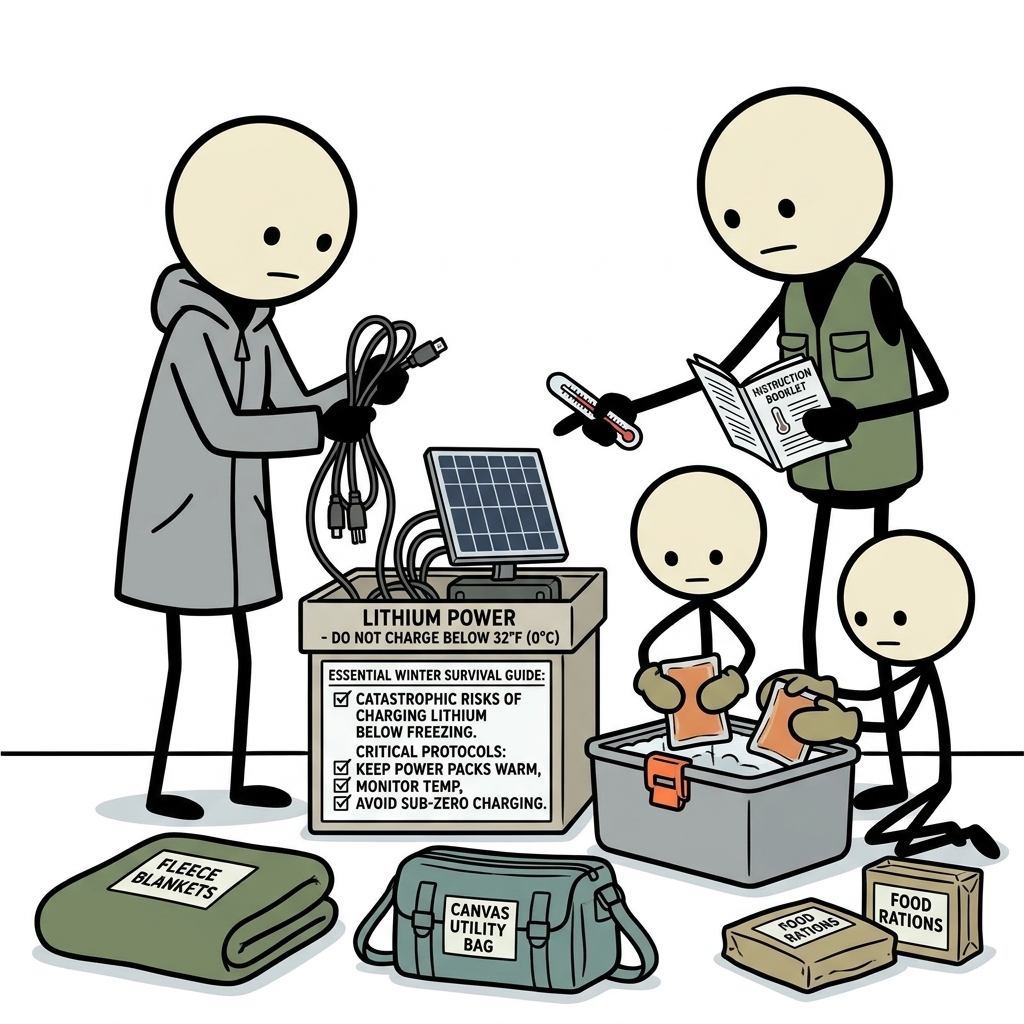
Operating outside established thermal limits introduces immediate system-level failure points. When charging power station below freezing parameters occurs, the accumulation of metallic lithium creates two life-threatening hazards for off-grid operations: irreversibly depleted capacity and severe thermal runaway risks.
Dendrite Formation and Internal Short Circuits
Metallic lithium plated on the anode surface does not form a smooth, uniform coat. Instead, it accumulates in microscopic, needle-like crystalline structures known as dendrites. With each subsequent attempt to charge in sub-freezing conditions, these microscopic metal spikes elongate across the microscopic space separating the battery's positive and negative terminals.
Eventually, these metallic dendrites pierce the ultra-thin polymer separator membrane. When the separator is breached, an immediate direct internal short circuit occurs. Unlike an external short circuit, which internal fuses or a Battery Management System (BMS) can isolate, an internal short bypasses all onboard safety switches. The stored chemical energy discharges instantaneously into the cell core.
Thermal Runaway in Sub-Zero Environments
The term "thermal runaway" is frequently associated with blazing summer heat, but catastrophic combustion events often trace their origin directly to sub-freezing operating errors. When a dendrite causes a localized internal short, it generates intense, concentrated heat inside the cell. This micro-zone heat rapidly breaks down the surrounding electrolyte, creating flammable hydrocarbon gases like methane, ethylene, and hydrogen.
According to safety research published by the Underwriters Laboratories (UL) Battery Safety Council, this localized exothermic reaction can cascade into adjacent cells even if the surrounding environment is well below zero. Once self-sustaining decomposition initiates, a lithium power station can produce sustained flare temperatures exceeding 1,100°F (593°C). In an enclosed survival shelter, basement, or vehicle, the resulting fire and dense toxic gas plume—packed with carbon monoxide, hydrogen cyanide, and hydrogen fluoride—can prove fatal in minutes.
Cold Weather Solar Generator Limits: BMS, Inverters, and Solar Panels
Navigating cold-weather off-grid power requires a complete systems approach. A winter emergency power backup unit is an integrated ecosystem composed of an electrochemical pack, a Battery Management System (BMS), a pure sine wave inverter, and external charging inputs. Sub-zero temperatures apply unique, harsh mechanical stresses to every one of these components.
The False Security of Battery Management Systems
High-tier portable power stations incorporate low-temperature charging protection within their software architecture. In theory, an internal thermistor detects that the cells are below 32°F (0°C) and commands the charge controller to reject incoming current. However, field operators must never assume the BMS is an infallible fail-safe:
- Sensor Placement Latency: In lower-cost or mid-tier units, thermal sensors are typically taped to the exterior structural bracket of the pack rather than submerged within the central cells. If a unit is moved from an unheated vehicle into a warm tent, the exterior sensor may register 36°F (2.2°C) while the dense, high-mass core of the battery remains frozen at 24°F (-4.4°C).
- Micro-Charging Trickle Leaks: Certain basic integrated charge controllers cut high-amperage input when frozen, yet still permit micro-current trickle charges (such as 0.1A to 0.5A) to seep past the threshold. At low temperatures, even micro-current inputs systematically plate the anode over extended periods.
- Low-Tier Firmware Failures: In budget power banks and off-brand solar generators, low-temperature charging cutoffs are frequently omitted entirely to cut manufacturing costs, placing the operational burden entirely on user discipline.
Solar Panel Over-Voltage in Freezing Air
A pervasive, overlooked danger of winter operations stems from cold weather solar generator limits linked to photovoltaic physics. Solar panels run on light, not heat; in fact, solar cells operate with higher electrical efficiency in frigid conditions. However, this efficiency gain produces a severe operational side-effect: a massive spike in open-circuit voltage ($V_{oc}$).
Solar panels carry a temperature coefficient rating (typically between -0.28% and -0.38% per degree Celsius below standard test conditions of 77°F / 25°C). In clear, sub-zero conditions, such as -10°F (-23.3°C), a nominal 100-watt solar panel will produce a $V_{oc}$ up to 15% to 20% higher than its rated capacity. If you connect an array configured near your power station's maximum voltage ceiling (e.g., a 60V maximum input limit), freezing, clear winter conditions can drive that voltage well beyond safety limits, instantly burning out the Maximum Power Point Tracking (MPPT) charge controller.
| Operational Condition | LiFePO4 Chemistry | NMC Chemistry | System Impact / Required Protocol |
|---|---|---|---|
| Discharging > 32°F (0°C) | 100% Capacity | 100% Capacity | Optimal operating baseline. Standard runtimes. |
| Discharging 14°F to 31°F (-10°C to -0.5°C) | 70% - 80% Capacity | 80% - 90% Capacity | Increased internal resistance causes premature low-voltage cutoff. |
| Discharging < -4°F (-20°C) | Critical Failure / Cutoff | 40% - 50% Capacity | Severe voltage sag under load; high risk of premature inverter shutdown. |
| Charging ≤ 32°F (0°C) | PROHIBITED | PROHIBITED | Immediate permanent damage via lithium plating. Fire risk. |
Protocol Survival Blueprint: Keeping Power Running in Sub-Zero Conditions
When the commercial power grid collapses in mid-winter, you cannot pack your equipment away and wait for spring. Surviving extreme weather demands cold-weather protocols designed to maintain power stations at operational temperatures using passive physics, thermodynamic capture, and active thermal management.
1. Establish a Thermal Micro-Environment (The Box-in-a-Box Protocol)
Never place a portable power station directly on cold surfaces like concrete garage floors, uninsulated floorboards, or frozen soil. Cold concrete acts as an aggressive heat sink, pulling thermal energy out of the core cells through conductive heat transfer.
- Conductive Isolation: Place the unit atop an insulated base layer of at least two inches of closed-cell foam, an insulated sleeping pad, or thick expanded polystyrene (EPS) board.
- Passive Containment Enclosure: Place the power station inside an insulated ice chest (such as a heavy-duty rotomolded cooler) or a heavy-duty fabric thermal wrap. Modern rotomolded coolers are designed to block heat transfer; in winter, they perform the reverse function just as effectively, trapping internal heat.
- Venting Management: Ensure the cooling vents of the power station inverter have 3-4 inches of clearance within the enclosure. When running an active load of 100 watts or more, the internal inverter naturally produces waste heat, warming the micro-environment inside the chest.
2. The Self-Sustaining Thermal Loop
If you must charge your power station in an unheated structure, vehicle, or outbuilding, you must generate parasitic heat *before* introducing external charging current. High-end modern survival units sometimes include integrated internal heating elements, but you can build a highly dependable external equivalent using standard emergency gear:
- Place your power station inside your insulated secondary enclosure (cooler or thermal box).
- Connect a low-wattage 12V silicone heating pad or a USB-powered heating blanket (drawing 10W to 20W) directly to the power station's DC 12V output port.
- Wrap the heating element safely around the chassis of the unit—avoiding direct blockages of cooling intake fans.
- Power the heating element using the battery's discharge capability. Because the unit can safely discharge at sub-freezing temperatures, it draws from its own capacity to elevate its core temperature.
- Monitor the temperature with an accurate digital probe thermometer inserted into the enclosure. When the ambient temperature inside the box stabilizes above 45°F (7.2°C) for at least one full hour, you can safely connect your solar arrays or generator input.
⚠️ Critical Safety Warning: Core Equilibrium Latency
Air warms significantly faster than dense battery blocks. If a 1,000Wh to 2,000Wh power station has been thoroughly cold-soaked at 0°F (-17.7°C) for 12 hours, its internal cells act as a concentrated thermal block. Even if your field heater warms the surrounding air inside your tent or enclosure to 65°F (18.3°C) within twenty minutes, the core lithium cells may remain frozen for up to 4 to 6 hours. Do not initiate charging until the unit has soaked in warm ambient air long enough for internal temperatures to balance completely.
3. Real-World Field Shelter Integration (CDC & FEMA Alignments)
During severe cold, the instinct to bring all electrical components inside a living space must be balanced against vital domestic safety rules established by the Centers for Disease Control and Prevention (CDC) and FEMA.
You can operate portable power stations indoors because they emit zero carbon monoxide (CO) gas during typical discharge. However, you must maintain clean perimeter clearances: keep at least three feet of open airspace around the unit, clear of sleeping bags, dry firewood, and fabric shelters. Never run an external combustion generator indoors or close to open windows to warm your power station. Instead, place the combustion generator outdoors at least 20 feet away, and route heavy-gauge extension cords indoors to power your indoor station's safe, warm charging cycle.
Triage Protocols: How to Revive a Deep-Frozen Battery
If you encounter a Survival Scenarios scenario where an emergency power backup has cold-soaked in sub-zero temperatures (e.g., inside an unheated cabin or abandoned vehicle) and displays a low-temperature error code or fails to power on, execute this exact recovery protocol:
Step 1: Complete Power Disconnection
Immediately disconnect all charging inputs (solar panels, AC wall cords, or 12V car adaptors). Never leave a frozen station plugged into an active charge source hoping it will "automatically start when warm." If the BMS safety circuit fails or suffers software lag as it warms, unregulated current can surge into partially frozen cells, initiating destructive lithium plating.
Step 2: Passive Acclimation (The "Slow-Bake" Rule)
Move the power station into a heated environment (such as the interior of an occupied vehicle or a heated room). Do not place the unit directly against wood stoves, radiant space heaters, or open flames. Direct external heat can warp the plastic chassis, crack internal structural seals, and cause uneven localized thermal stress across individual cells. Allow the unit to absorb warmth passively over a period of 6 to 8 hours.
Step 3: Verification of Cell Core Equilibrium
Before applying a charge, turn on the unit’s master display screen without connecting any loads or inputs. Check the operational diagnostics. If your unit features an integrated temperature readout, ensure it reads well above the minimum threshold—ideally 50°F (10°C) or higher. If your station does not display internal thermistor readings, place your hand flat against the center base of the unit. If the casing feels cold to the touch, internal thermal mass has not reached equilibrium. Wait another two hours.
Step 4: Low-Amperage Test Charge
Once you verify the pack has thoroughly warmed, initiate charging using the lowest available amperage setting. Many modern portable systems allow you to manually throttle input wattage via onboard software or a mobile app (e.g., dialing AC input back from 1,200W to 200W). Charging at a low C-rate generates minimal internal heat stress, allowing the chemistry to resume healthy, balanced ion flow smoothly.
Winter Emergency Power Backup Triage Checklist
When sub-zero conditions strike, keep this operational workflow near your emergency gear to avoid costly equipment damage:
- [ ] Isolate from the Ground: Power station resting on closed-cell foam or a thermal platform? (Never raw concrete or frozen ground).
- [ ] Assess Thermal Environment: Ambient air temperature around the battery verified to be above 40°F (4.4°C) with an external thermometer?
- [ ] Check Thermal Equilibrium: Has the cold-soaked pack had 4–8 hours to warm up in a heated area before accepting current?
- [ ] Verify Solar Voltage Limits: Have you calculated your solar array's winter open-circuit voltage ($V_{oc}$) to make sure it will not overload the MPPT charge controller?
- [ ] Use Waste Heat Effectively: Is the station enclosed in an insulated cooler or thermal box that safely vents inverter heat while keeping the battery core warm?
- [ ] Protect Your Life-Support Gear: Critical medical devices (CPAPs, monitors) plugged directly into DC outputs whenever possible to cut conversion losses and extend runtime?
Off-grid energy systems offer an incredible tactical advantage during modern winter crises, but they remain strictly bound by the laws of electrochemistry. Forcing a high-amperage charge into a frozen lithium power station destroys your equipment when you need it most, turning an expensive lifeline into a dead weight or a hazardous fire source. By building proper thermal barriers, accounting for voltage swings, and keeping battery temperatures above freezing, you safeguard both your equipment and your household. True winter resilience is not just about buying the best gear—it is about mastering the operational disciplines required to keep critical systems working through the most punishing environments on Earth.
Frequently Asked Questions
Can you charge a portable power station below freezing?
No. Attempting to charge lithium-ion or LiFePO4 batteries below 32°F (0°C) causes lithium plating on the anode, resulting in permanent capacity loss and internal short-circuit risks. Most quality units feature a Battery Management System (BMS) that automatically blocks incoming charge until internal temperatures rise.
Can you still draw power from a power station in sub-freezing weather?
Yes. Most power stations can discharge in temperatures ranging from -4°F to 14°F (-20°C to -10°C), although available capacity and runtimes will be temporarily reduced due to increased internal chemical resistance.
What is lithium plating and why is it dangerous?
Lithium plating occurs when charging current forces lithium ions to deposit as metallic lithium onto the anode rather than intercalating into it. Over time or under high current, these deposits form dendrites that can puncture the separator, causing severe internal shorts, thermal runaway, and fire.
How should you safely warm up a cold power station before charging?
Bring the unit into a heated space such as an insulated shelter, vehicle cab, or conditioned room. Allow several hours for the internal core cells—not just the outer plastic shell—to warm above 41°F (5°C) naturally before initiating charging.
Do LiFePO4 batteries perform better in freezing weather than standard lithium-ion?
While LiFePO4 offers longer overall lifespans and greater thermal stability at high temperatures, it shares the exact same 32°F (0°C) charging limit as standard lithium-ion. Unless the unit features built-in self-heating elements, it must not be charged while frozen.