⚡ Key Facts
- The Restoration Hazard: According to the Institute of Electrical and Electronics Engineers (IEEE), up to 80% of transient voltage spikes originate from utility grid switching and load recovery operations rather than direct lightning strikes.
- Financial Exposure: The Insurance Information Institute (III) reports that non-weather electrical surges and lightning-induced power surge damage account for over $1 billion in annual homeowners insurance claims across the United States.
- Microscopic Component Vulnerability: Modern microprocessors operate at logic levels as low as 1.2 to 3.3 volts; a transient spike as brief as 5 nanoseconds at just 30 to 50 volts above nominal line voltage can permanently rupture silicon gate oxides.
- The "Recloser" Threat: Electrical utilities use automated circuit reclosers that attempt to clear faults by re-energizing dead distribution lines up to three consecutive times in seconds, bombarding connected loads with multiple high-amperage inrush surges.
When an extreme weather system or unexpected grid collapse strikes, the instinctive response of most homeowners is to focus entirely on the impending darkness. We scramble for flashlights, stage battery banks, and inventory our chilled food supplies. Yet forensic electrical engineers know that the most destructive phase of an outage is rarely the blackout itself; it is the chaotic fractions of a second immediately preceding the collapse and the violent electrical rebound that occurs when the utility grid is re-energized. For the practical checklist side, use the community emergency preparedness guide.
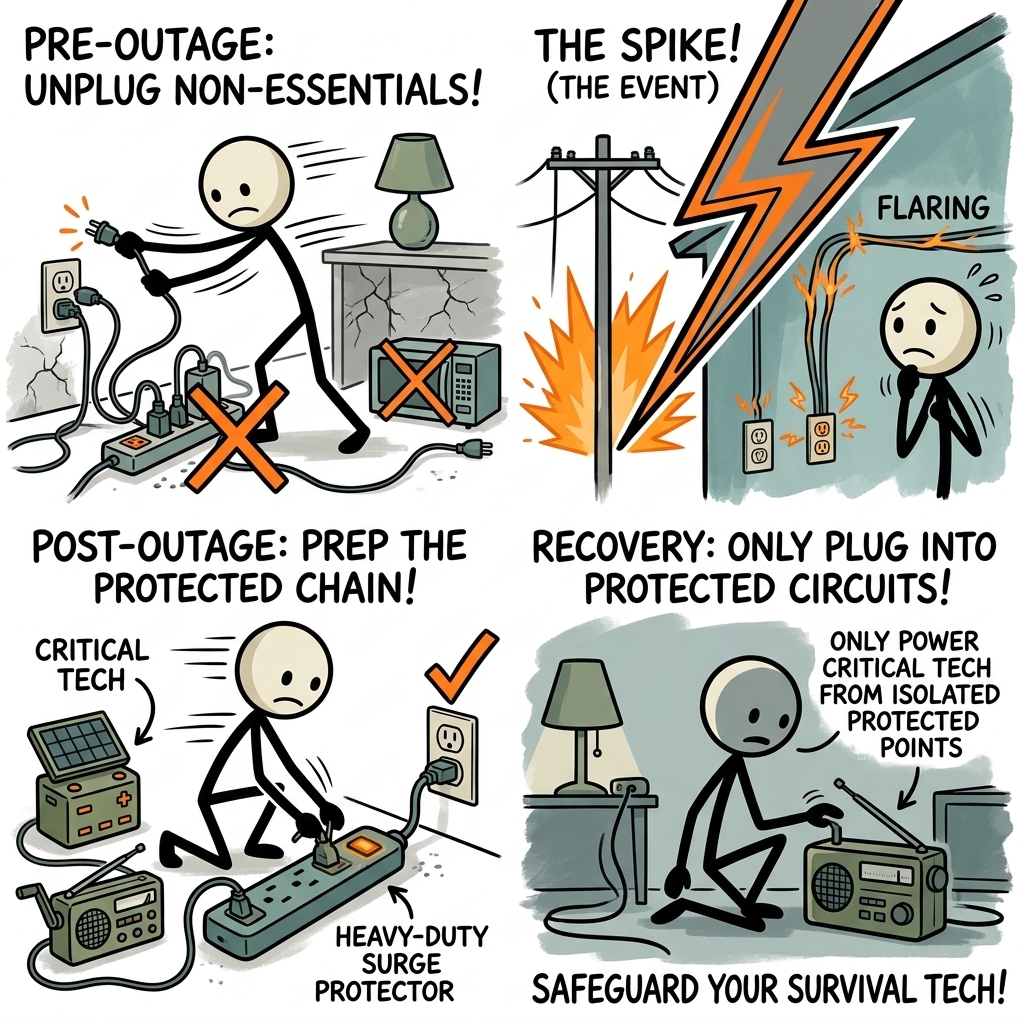
Without deliberate, layered defensive protocols, a sudden blackout can instantly destroy sensitive basecamp emergency communication plans gear, high-efficiency solar inverters, medical equipment, and essential home survival tech. Taking control of your electrical perimeter transforms vulnerability into operational resilience. Implementing rigorous power surge protection safeguards your critical gear against the invisible, high-velocity transients that travel along utility and off-grid transmission lines.
The Physics of Outage-Related Voltage Spikes
To protect electronics during a power outage, you must first understand the fundamental electrodynamics of a grid failure. Alternating current (AC) in North American domestic systems alternates at a stable frequency of 60 Hertz, delivering approximately 120 volts root-mean-square (RMS). When this equilibrium is interrupted, the energy moving through the regional transmission network does not simply evaporate; it must dissipate through physical pathways. For the practical checklist side, use the family emergency planning guide.
Pre-Outage Transients and Inductive Load Rebound
In the seconds leading up to a blackout, the local distribution grid frequently undergoes high-stress mechanical and electrical events. Tree limbs contacting overhead three-phase conductors create momentary phase-to-phase and phase-to-ground faults. These intermittent faults produce severe arcing, generating high-frequency transient overvoltages that backfeed into residential service drops.
Simultaneously, when a substation circuit breaker trips to isolate a compromised line, the sudden interruption of current through thousands of inductive loads—such as residential air conditioners, industrial pumps, and neighborhood preparedness network step-down transformers—triggers an effect known as inductive kickback. The collapsing magnetic fields inside these massive inductive components generate high-amplitude voltage spikes that push line voltage far past the standard 120-volt threshold, stressing every connected device downstream.
The Danger of Grid Re-Energization
The moment utility crews restore electrical service, the grid experiences massive instantaneous demand known as "cold load pickup." As thousands of refrigeration compressors, water heaters, and HVAC systems attempt to draw starting current at the exact same millisecond, the local grid experiences profound voltage instability.
Utility substations manage this reconnection through automated circuit switchers and reclosers. If a fault is still present—such as a line resting in wet brush—the recloser slams high-voltage current into the line, senses the short circuit, trips open, and then re-closes multiple times in rapid succession. This rapid cycling subjects connected electronics to repeated inrush currents, oscillating overvoltages, and destructive ringing waves that overwhelm low-cost power strips.
The Vulnerability Matrix: What Breaks First?
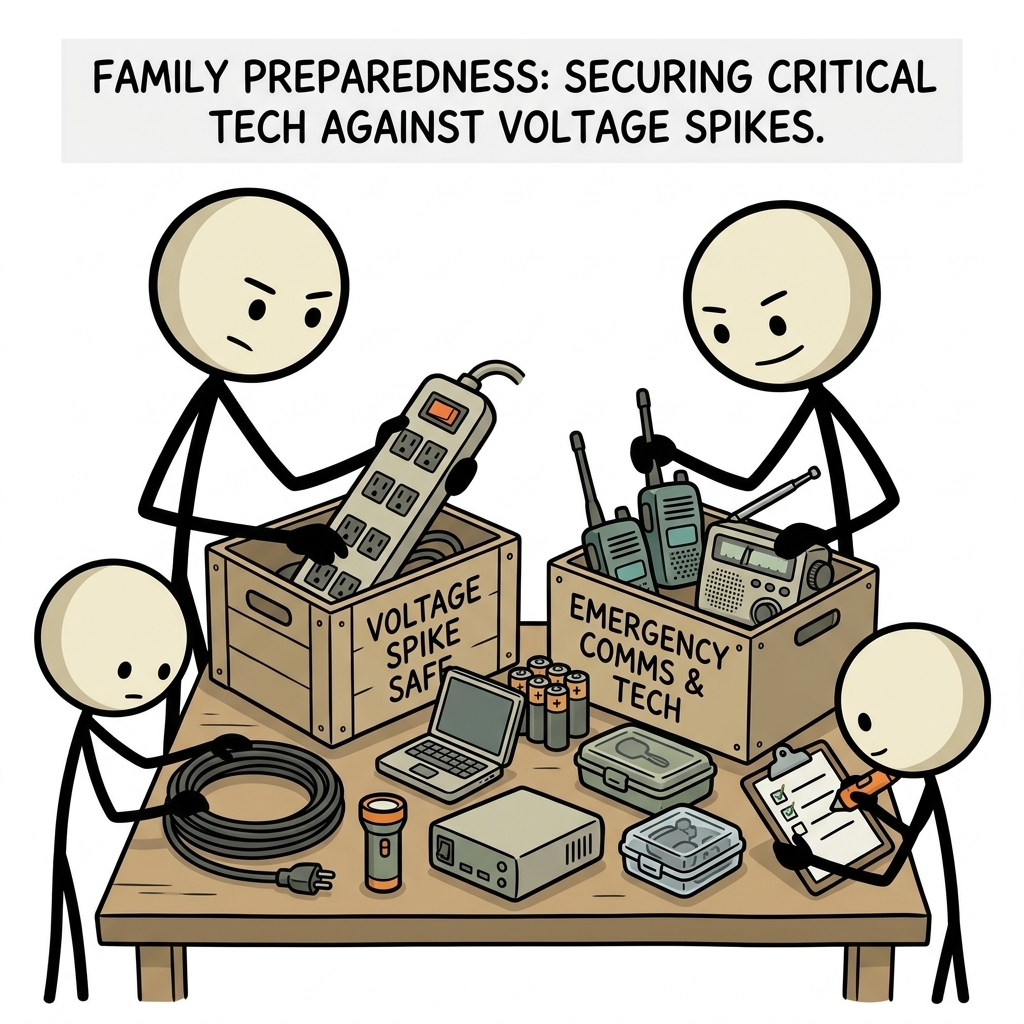
Modern off-grid and emergency preparedness gear relies on sensitive solid-state electronics. A survivalist or prepared homeowner must categorize their hardware based on electrical susceptibility to effectively prioritize defenses against power outage surge damage.
Emergency Communications and Field Computers
High-frequency (HF) amateur radio transceivers, handheld radio charging cradles, satellite communication nodes (such as Starlink terminals), and field laptops run on micro-miniaturized integrated circuits. These processors feature microscopic gate oxide layers measuring mere atoms in thickness. When subjected to transient overvoltages that bypass the power supply unit (PSU), these gates experience dielectric breakdown, causing permanent internal short circuits.
Even if an overvoltage does not immediately destroy your communications terminal, it frequently induces "latent component degradation." The silicon substrate suffers micro-fractures and thermal stress, leading to random system freezes, phantom errors, and sudden hardware failure weeks or months down the line when emergency communications are needed most.
Solar Inverters, Battery Management Systems, and Off-Grid Tech
A resilient household often relies on photovoltaic (PV) systems, hybrid inverters, and high-capacity lithium iron phosphate (LiFePO4) energy storage systems. While these units are built to manage fluctuating power, their alternating-current inputs and outputs are acutely vulnerable to grid feedback surges if tied to the utility line.
Grid-interactive inverters contain fast-switching insulated-gate bipolar transistors (IGBTs) and metal-oxide-semiconductor field-effect transistors (MOSFETs). A high-voltage transient entering via the AC grid connection during a blackout or restoration event can easily exceed the drain-to-source breakdown voltage of these switching components, disabling your backup power generation capacity on day one of a long-term emergency.
Medical and Baseline Survival Appliances
Equipment such as CPAP machines, oxygen concentrators, and modern inverter-driven refrigerators contain onboard microcontrollers. Modern high-efficiency appliances feature complex printed circuit boards (PCBs) instead of mechanical relays and switches. These logic boards are just as vulnerable to line surges as a desktop computer, leaving clean emergency food storage guide and critical life support systems at immediate risk.
Tiered Defense Architecture: The 3-Zone Protection Strategy
Relying on an inexpensive multi-outlet tap under a desk is not an electrical defense strategy; it is a vulnerability. The National Electrical Manufacturers Association (NEMA) and standard IEEE C62.41 guidelines establish that robust protection requires a coordinated, multi-stage strategy. To construct bulletproof grid down electronics protection, deploy a three-zone surge mitigation matrix.
Zone 1: Service Entrance Suppression (Type 1 and Type 2 SPDs)
The first line of defense must be anchored directly at the electrical service panel. A certified Type 1 or Type 2 Surge Protective Device (SPD) mounted to the main load center diverts massive, high-energy transients entering via the utility line directly to earth ground before they disperse across interior household circuits.
- Type 1 SPDs: Installed between the secondary of the service transformer and the line side of the service disconnect switch. These handle heavy lightning-induced energy and catastrophic external line surges.
- Type 2 SPDs: Hardwired onto the load side of the main service breaker, often occupying two dedicated breaker spaces. A quality unit should offer a minimum surge current rating of 50kA to 100kA per phase.
- Critical Standard: Ensure the device is certified under UL 1449 4th or 5th Edition, verifying the unit includes integrated thermal disconnects to prevent catastrophic failure if an internal component overheats.
Zone 2: Branch and Critical Distribution Points
If you utilize subpanels—such as a dedicated backup subpanel powered by a generator or stationary battery bank—a secondary Type 2 SPD is required at this junction. Line impedance (the natural resistance and inductance of copper wiring) causes voltage spikes to travel and reflect along interior conductors, creating standing waves that can elevate line voltage at distant outlets. Installing a secondary SPD dampens these internal reflections.
Zone 3: Point-of-Use Point Protection (Type 3 SPDs)
Type 3 SPDs comprise premium surge protector strips and dedicated plug-in units deployed at the specific outlet feeding critical survival hardware. These units provide fine clamping capabilities, shaving down any residual voltage ("let-through voltage") that slips past Zone 1 and Zone 2 hardware.
- Let-Through / Voltage Protection Rating (VPR): Look for a UL 1449 VPR of 330V or 400V on a 120V circuit. Lower numbers mean the protector begins shunting excess voltage sooner.
- Energy Absorption (Joules): Opt for devices rated for at least 2,000 to 4,000 Joules. Higher joule ratings indicate the device uses larger or banked internal components capable of absorbing repeated surges over time.
- Response Time: Demand units utilizing components with sub-nanosecond response times (such as modern Metal Oxide Varistors paired with Silicon Avalanche Diodes).
Surviving the Recloser: The Power Restoration SOP
Hardware alone is insufficient; true resilience combines engineering with disciplined operational procedures. When the electrical grid destabilizes, a deliberate Standard Operating Procedure (SOP) prevents the devastating mechanical and electrical shocks associated with utility line re-energization.
The "Lights Out" Isolation Protocol
The moment an unplanned power outage strikes your residence, execute an immediate physical load isolation protocol. Do not assume that your panel-mounted SPDs can handle repeated, continuous hits from a struggling utility recloser indefinitely without degradation.
- Kill High-Draw Breakers: Immediately switch off the circuit breakers for heavy motor loads, specifically your central HVAC system, heat pump, well pump, and electric water heater. This prevents high inrush demands when the power returns and stops dangerous low-voltage ("brownout") conditions from burning out compressor windings.
- Physical Air-Gap Disconnection: Manually unplug your high-value communications gear, Starlink routers, radio transceivers, and battery charging hubs from the wall outlets. An open air gap provides infinite electrical resistance; no utility transient can bridge an unplugged physical cord.
- Designate a "Scout" Light: Leave a single low-wattage, non-critical LED lamp turned on in an easily visible area, or rely on a street-facing window. This light serves as your visual indicator that grid power has returned, keeping all other branch circuits completely clear of early voltage swings.
The Staged Reconnection Timeline
When the scout light illuminates, resist the immediate impulse to power everything back up. Utility engineers advise that line restoration goes through a period of wild frequency drift, reactive power swings, and phase imbalance during the first 10 to 15 minutes of recovery.
Monitor your main service panel. If your primary Type 2 SPD features diagnostic LEDs, verify that both line-to-neutral (L-N) and line-to-ground (L-G) protection circuits are illuminated green and operational. Wait a minimum of 15 full minutes following stable power restoration before closing the breakers for major appliances or reconnecting mission-critical electronics to Zone 3 surge strips. This window allows the utility to clear any lingering secondary faults and balance system frequency across the regional grid.
Hardening Off-Grid Energy Systems and Comms Nodes
Off-grid systems and emergency radio communications equipment present unique electrical defense challenges. These systems incorporate elevated external antennas and lengthy solar array wiring runs, transforming these conductive structures into massive harvesting antennas for electromagnetic surges.
DC-Side Photovoltaic Surge Suppression
Homeowners often invest in a surge protector for home AC systems while entirely overlooking the direct current (DC) circuits feeding their solar charge controllers. Lightning strikes occurring miles away induce significant voltages into long PV string wiring runs through inductive coupling.
Standard AC surge protectors cannot be used on DC circuits because direct current does not cross a natural zero-voltage point, meaning an activated MOV will fail to extinguish its internal arc, resulting in an electrical fire. You must install dedicated, polarized DC SPDs (such as MidNite Solar or DIN-rail mounted Type 2 DC protectors) inside a non-combustible combiner box, mounted as close as possible to the point where the PV conductors enter your building envelope.
Protecting Portable "Solar Generators" and Power Stations
Portable power stations (featuring integrated lithium battery packs, solar charge controllers, and inverters) have become common survival gear. However, their internal circuitry is exceptionally compact and vulnerable to thermal and electrical overstress.
When charging these power stations from an unstable AC grid during intermittent storm conditions, never plug them directly into an unconditioned wall receptacle. Route the charging power through a heavy-duty, series-mode line conditioner or high-joule point-of-use surge device. Better yet, disconnect the unit entirely from utility wall power during turbulent conditions, charging the pack solely through isolated, surge-protected ground-mounted solar panels or a clean-inverter generator.
RF Feedlines and Amateur Radio Stations
If you maintain an emergency radio setup, your coaxial transmission lines present a direct vector for surge energy to penetrate deep into your living space. A proper installation adheres strictly to standard National Electrical Code (NEC) Article 810 guidelines.
- Bulkhead Grounding: Mount heavy-duty, gas discharge tube (GDT) coaxial surge arrestors (such as PolyPhaser or Alpha Delta units) on an exterior grounding bus bar immediately before the coax lines enter the dwelling.
- Common-Point Grounding: The RF exterior ground rod system must be electrically bonded directly to the home's main electrical service ground via minimum 6 AWG solid copper wire. Failing to bond these grounds creates a lethal ground loop potential difference; during a nearby strike or utility neutral fault, thousands of volts will flow across your radio chassis seeking the lower-impedance ground path.
- Physical RF Disconnects: Maintain an antenna patch panel allowing for quick physical disconnection. When severe atmospheric activity or deep grid instability threatens, unscrew the PL-259 or N-connectors from the transceiver and drop the cable ends into a grounded metal grounding box or conductive can set away from the station.
Auditing Your Grounding System and Protective Hardware
Surge protection devices do not eliminate high-voltage transients; they merely function as fast-acting automated valves that divert excess electrical energy away from your equipment. For that diversion to work safely, that energy must have an unrestricted, low-impedance path to the physical earth.
The Critical Role of Low-Impedance Earth Grounding
Even the most expensive UL-listed Type 1 panel protector will fail to protect electronics during a power outage if the structure's electrical ground rod has deteriorated. National Electrical Code (NEC 250.56) mandates that a single grounding electrode system must have a resistance to earth of 25 ohms or less, with critical communications installations aiming for under 5 to 10 ohms.
Over time, ground rods corrode, mechanical clamps loosen, and shifting soil compositions—particularly in sandy, rocky, or drought-stricken regions—dramatically increase grounding impedance. If a surge encounters high resistance at the ground rod, the diverted voltage simply rebounds through the household neutral and ground wiring, destroying the very devices the system was designed to protect. Inspect your service ground annually. Verify that clamps are clean and tightly torqued, and install a secondary, bonded 8-foot copper-clad steel ground rod spaced at least 6 to 10 feet from the primary rod if you operate high-value survival electronics.
Understanding MOV Wear and Sacrificial Tech
The vast majority of modern SPDs rely on Metal Oxide Varistors (MOVs). An MOV acts as an open circuit during normal voltages, but its electrical resistance drops rapidly when voltage exceeds its rated threshold, allowing surge current to flow to ground. However, MOVs are sacrificial components.
Every small surge, voltage spike, and utility switching event erodes the internal micro-structure of the varistor. Over time, its clamping threshold changes, or the material breaks down thermally. Cheap power strips often drop all surge suppression entirely after absorbing several medium spikes, continuing to supply utility power to your gear without providing a shred of actual protection.
Audit Checklist: Is Your Gear Truly Protected?
Perform an objective operational audit of your electrical infrastructure every six months using this verification standard:
- Status Indicators: Check the diagnostic lights on every surge protector for home use. If the "Protected" LED has extinguished, replace the unit immediately—it is functioning only as an unshielded extension cord. If the "Ground" or "Site Wiring Fault" light is illuminated, you have an ungrounded or phase-reversed outlet that requires prompt electrician intervention.
- Component Architecture: Verify that your Zone 3 surge strips for high-value gear incorporate thermal fuses. Premium units house their MOVs in fire-resistant enclosures packed with thermal sand or utilize series-mode protection technologies (such as SurgeX or Zero Surge), which eliminate the fire hazard associated with degraded MOVs entirely.
- Joule Aging: Replace standard point-of-use surge strips every three to five years, or immediately following any significant direct local lightning strike or catastrophic neighborhood transformer explosion.
Building Total Electrical Resilience
Real-world preparedness means anticipating threats before they compromise your operational capability. The power grid is undergoing profound structural shifts: an aging regional transmission backbone, increasing frequency of severe weather events documented by NOAA, and volatile utility demand curves make catastrophic power surges an engineering inevitability rather than an abstract risk.
Leaving your survival communications, off-grid power banks, and sensitive domestic technologies tied directly to raw utility lines is a critical single-point of failure. By establishing an engineered, three-zone surge mitigation perimeter, verifying the physical low-impedance ground of your home, and strictly enforcing the "Lights Out" disconnect protocol during outages, you shield your vital gear from destructive electrical shocks. When the lights flicker, pop, and die, you can rest easy knowing that your communication links will remain clear, your critical power storage intact, and your electrical systems fully operational.
Frequently Asked Questions
What causes power surges during and after a power outage?
Surges often occur when grid power is suddenly restored or when lightning and downed utility lines introduce abrupt, massive spikes in electrical voltage beyond standard household tolerances.
What is the difference between a standard power strip and a surge protector?
A standard power strip merely adds extra outlets, while a surge protector contains metal oxide varistors (MOVs) designed to divert dangerous excess voltage harmlessly away from connected electronics.
Should electronics be unplugged during a blackout?
Yes, unplugging computers, televisions, and major appliances during an outage isolates them from the high-voltage inrush that frequently occurs when the municipal power grid is re-energized.
How long should you wait to reconnect electronics once power returns?
Wait 10 to 15 minutes after power is restored to allow grid voltages and frequencies to stabilize before plugging devices back into wall outlets.
Do surge protectors wear out over time?
Yes, internal protective components degrade every time they absorb a surge, meaning surge protectors should be replaced every three to five years or immediately following a direct lightning or major power surge event.