⚡ Key Facts
- Critical Caloric Yield: According to the Federal Emergency Management Agency (FEMA), securing high-protein food sources is a secondary but vital step in long-term Survival Scenarioss exceeding 72 hours, where physical exertion rapidly depletes glycogen stores.
- Passive Efficiency: Primitive traps and weirs operate 24/7 with zero caloric expenditure after construction, making them up to 80% more energy-efficient than active hunting or gathering. For the practical checklist side, use the community emergency preparedness guide.
- Resource Abundance: United States Geological Survey (USGS) data indicates that freshwater river basins and estuaries hold some of the densest biomass of edible protein per square mile in North America. For the practical checklist side, use the neighborhood preparedness network.
- Pathogen Mitigation: The Centers for Disease Control and Prevention (CDC) warns that wild freshwater fish frequently carry parasites like liver flukes and tapeworms, requiring a minimum internal cooking temperature of 145°F (63°C) to guarantee safety. For the practical checklist side, use the emergency communication plan.
Imagine being stranded in a remote wilderness environment. Your commercial emergency rations are gone, your energy levels are plummeting, and your body is burning through its remaining fat reserves to maintain basic metabolic function. In a prolonged survival situation, your survival depends entirely on your ability to secure high-density calories with minimal energy expenditure. While land-based hunting is physically exhausting and carries a high rate of failure, water bodies are teeming with life. Mastering the art of primitive fishing allows you to tap into an abundant, self-replenishing reservoir of fat and protein. By understanding the behavior of aquatic life and leveraging survival fishing techniques, you can transition from a state of active crisis to sustainable self-reliance without a single piece of modern gear. For the practical checklist side, use the family emergency planning guide.
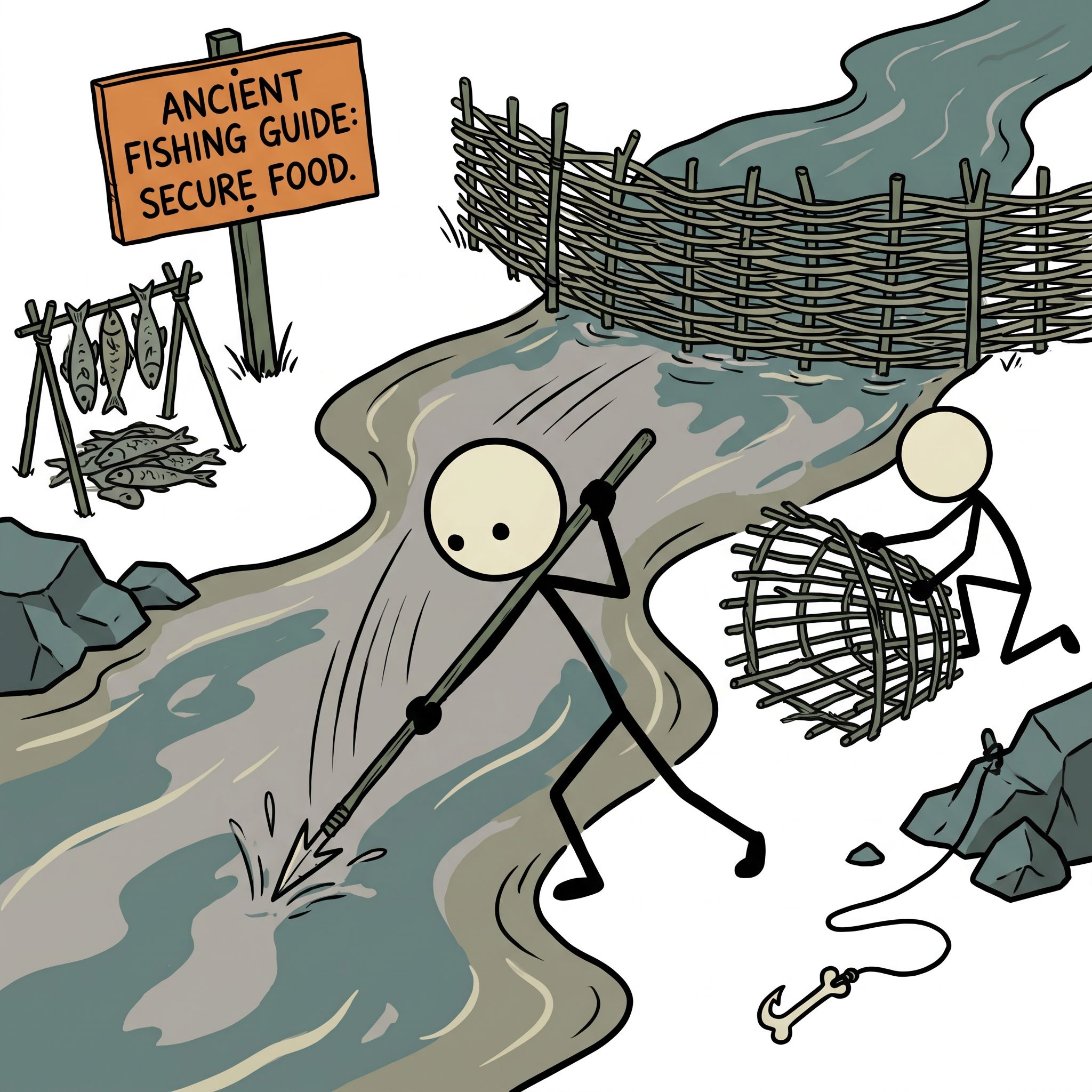
The Physiology of Survival: Why Fish Are the Ultimate Wilderness Food
In a survival scenario, caloric economics govern your life expectancy. The American Red Cross emphasizes that conserving energy is paramount when lost or displaced. Active hunting for large game requires immense caloric expenditure, carries a high risk of injury, and often results in empty hands. Conversely, harvesting fish provides an exceptionally high return on investment. Fish are rich in essential fatty acids, highly digestible proteins, and critical micronutrients like iodine and vitamin D, which support cognitive function and physical endurance under stress.
Furthermore, aquatic environments concentrate life. While land mammals disperse across vast territories, aquatic species are confined to specific channels, pools, and shoreline structures. This concentration allows you to target them systematically. By utilizing improvised fishing gear and passive trapping systems, you can establish a continuous food procurement loop that works for you while you sleep, build shelter, or purify water.
Reading the Water: How to Locate Your Target

Before you can deploy any survival fishing tool, you must understand where fish live. Water is not uniform; it is a complex map of currents, temperatures, and oxygen levels. According to the National Oceanic and Atmospheric Administration (NOAA), aquatic organisms organize themselves based on microclimates and structural protection. To successfully catch fish without a rod, you must learn to read these aquatic patterns.
Understanding Flow and Current Eddies
In moving water, fish constantly battle the current. To conserve energy, they seek out "eddies"—areas behind boulders, fallen logs, or river bends where the water flows backward or remains calm. Fish sit in these slack-water zones, waiting for the current to sweep food directly to them. Target the margins where fast water meets slow water; this boundary line is a prime feeding zone.
Undercut Banks and Deep Pools
Soil erosion along riverbanks often carves out hollows beneath the roots of overhanging trees. These undercut banks provide shelter from overhead predators and relief from direct sunlight. Similarly, deep pools at the base of rapids or waterfalls offer cool, oxygen-rich water and safety. During the heat of the day, fish congregate in these deep, shaded sanctuaries, making them ideal targets for hand fishing or drop-lining.
Hand Fishing and Noodling: The Purest Form of Harvesting
Hand fishing, historically known as "noodling" when targeting large catfish, is one of the oldest survival fishing techniques known to humanity. It requires absolutely no equipment, relying instead on stealth, patience, and physical dexterity. This method is highly effective in slow-moving rivers, muddy bayous, and shallow lakeshores.
The Technique of Hand Fishing
To hand-fish successfully, you must move with extreme deliberation. Wade slowly into the water, taking care not to cast a shadow over the area you intend to search. Look for submerged logs, hollow clay banks, or underwater rock crevices. Gently submerge your hands and slide them into these cavities, keeping your fingers slightly cupped and relaxed.
When your hand makes contact with a fish, do not make sudden, jerky movements. Fish are accustomed to debris brushing against them. Slowly slide your hand along the belly of the fish toward the gills. Once your fingers reach the gill plates, slip your thumb and fingers inside the gill openings or directly into the mouth (if targeting catfish) and grip firmly. Lift the fish out of the water in one fluid, continuous motion to prevent it from thrashing free.
Safety Considerations and Hazards
While hand fishing is highly effective, it carries inherent risks. Submerged cavities are also inhabited by snapping turtles, water moccasins, and aggressive beavers. The CDC warns that puncture wounds sustained in natural water bodies are highly susceptible to severe bacterial infections, such as those caused by Aeromonas hydrophila. Always probe cavities cautiously, and never stick your hand into a hole if you cannot verify what is inside.
Crafting Improvised Fishing Gear from Scratch
When hand fishing is impractical due to water depth or temperature, you must construct improvised fishing gear from materials harvested directly from the landscape. You do not need high-carbon steel hooks and monofilament lines to catch fish; natural analogs have worked for millennia.
The Anatomy of a Gorge Hook
Before the invention of the curved hook, ancient anglers used "gorges." A gorge is a small, double-pointed stick or bone splint, roughly one to two inches long, with a groove carved around its center.
- Material Selection: Choose a dense, dry hardwood (such as oak or hickory), a splinter of animal bone, or a sturdy piece of seashell.
- Shaping: Whittle both ends of the material to needle-sharp points. Carve a shallow, circular groove around the exact midpoint of the gorge to secure your line.
- How it Works: Unlike a modern hook that pierces the mouth, a gorge is buried entirely inside a soft bait (like a worm or insect grub) parallel to the line. When a fish swallows the bait and swims away, tension on the line causes the gorge to pivot 90 degrees inside the fish’s stomach or esophagus, locking it securely in place.
Harvesting Natural Cordage
A hook is useless without a line. In a survival situation, you can manufacture high-tensile cordage from wild plant fibers. Excellent sources of natural fiber include the inner bark of willow, cedar, or basswood trees, as well as the stalks of stinging nettle, dogbane, or wild hemp.
To create the line, strip the inner fibers and dry them slightly to prevent shrinkage. Use the "reverse-wrap" technique: split a bundle of fibers into two strands, twist each strand clockwise individually, and then wrap them around each other counter-clockwise. This opposing twist locks the fibers together, creating a incredibly strong, flexible line capable of holding significant weight.
The Handline Setup
To deploy your improvised gear, construct a handline. Wind your natural cordage around a smooth, cylindrical piece of wood. This acts as your spool. Attach your gorge hook to the end of the line, and add a small, heavy stone as a sinker just above the hook. This simple setup allows you to cast your bait into deep pools and retrieve it manually, providing a highly portable and effective way to secure wilderness survival food.
Ancient Fish Weirs and Traps: Passive Harvesting Systems
If you are managing multiple survival priorities—such as building a shelter, treating injuries, or signaling for rescue—you cannot afford to spend hours holding a handline. Passive systems are the cornerstone of long-term survival. By constructing fish weirs and basket traps, you create a system that harvests food continuously without your physical presence.
The Stone and Wood River Weir
A fish weir is an artificial barrier constructed in a river or tidal estuary that channels fish into a central containment area from which they cannot escape. This method has been used by indigenous cultures globally for thousands of years.
To build a river weir:
- Select a shallow, moving section of a river or stream, preferably just below a deeper pool.
- Construct a V-shaped wall of stones or wooden stakes driven into the riverbed. The wide mouth of the "V" should face upstream, pointing downcurrent.
- Leave a narrow opening at the apex of the "V" that leads into a circular holding pen (or "heart") constructed of tightly spaced rocks or woven branches.
- As fish travel downstream with the current, they are naturally funneled by the diagonal walls through the narrow opening and into the holding pen. The swirling current inside the pen disorients the fish, preventing them from locating the small exit.
The Funnel Basket Trap
For smaller streams or slow-moving ponds, a portable basket trap is highly effective. You can construct this trap using flexible saplings (such as willow or hazel) and vines.
Weave a cylindrical basket roughly three to four feet long. On one end, construct a cone-shaped entrance that points inward toward the center of the basket, ending in a small opening just wide enough for a fish to squeeze through. Bait the interior of the basket with crushed snails, insects, or shiny river shells. Fish swim through the funnel to reach the bait but are unable to find the narrow suspended opening to escape. Secure the trap to the bank with cordage and submerge it near structure.
Primitive Spearfishing and Gigging
For clear, shallow waters, active spearfishing is an excellent way to harvest large fish quickly. This technique is particularly effective at night when many predatory species move into the shallows to feed, or during spring spawning runs.
Crafting a Multi-Pronged Spear
Do not use a single-pointed spear; the surface of a fish is slick, and a single point is highly likely to glance off or allow the fish to wriggle free. Instead, craft a four-pronged spear (or "gig").
Select a straight, green hardwood sapling approximately six to eight feet long and 1.5 inches in diameter. Split the tip of the shaft down the center twice at right angles, creating four separate quadrants extending down about six inches. Insert small wooden wedges into the splits to splay the prongs outward in a diamond pattern. Sharpen the inside edges of each prong to a needle-like point, and carve small backward-facing barbs into them. Finally, lightly pass the tips over hot coals to dry out the moisture and harden the wood.
Overcoming Light Refraction
The greatest challenge in spearfishing is physics. Because water is denser than air, light bends when it exits the water's surface. This phenomenon, known as refraction, makes a fish appear to be higher and further away than it actually is.
To compensate for refraction, you must always aim below the fish's visual image. A general rule of thumb is to aim approximately one inch lower for every foot of water depth. For the best results, position yourself directly above the target if possible, as looking straight down minimizes the refractive distortion.
Piscicides: The Historical Use of Natural Fish Poisons
In extreme, life-or-death survival situations, traditional societies have utilized ethnobotanical compounds to harvest entire pools of fish rapidly. These compounds, known as piscicides, temporarily stun or suffocate fish without making their flesh toxic to humans. Note: The use of fish poisons is highly regulated and illegal under normal circumstances; however, it remains a critical tool in true wilderness survival emergencies.
Mullein and Black Walnut Hulls
Many common plants contain saponins or rotenone—compounds that, when dissolved in water, coat the gills of fish and prevent them from absorbing dissolved oxygen. The fish quickly suffocate and float to the surface, where they can be gathered easily by hand.
Two of the most common North American sources are:
- Black Walnut (Juglans nigra): The green husks of black walnuts contain juglone and tannins. Gather a large quantity of green husks, crush them into a pulp, and place them in a porous bag (such as an improvised shirt bundle). Submerge and agitate the bag in a stagnant pool or slow-moving section of a stream.
- Mullein (Verbascum thapsus): The seeds and leaves of the common mullein plant contain high concentrations of saponins. Crush the seeds and leaves into a fine powder and disperse it directly into quiet water.
Within minutes, affected fish will begin to gasp at the surface. Collect them immediately. Because these compounds block oxygen absorption through the gills rather than poisoning the blood, the meat remains perfectly safe for human consumption once cooked.
Safety, Processing, and Pathogen Mitigation
Securing your catch is only half the battle. In a survival situation, a foodborne illness can be fatal due to rapid dehydration from vomiting and diarrhea. You must handle and prepare your harvest with strict adherence to wilderness hygiene standards.
Immediate Processing and Field Dressing
Do not let fish sit in warm water or direct sunlight after harvesting. Bacteria multiply exponentially in warm environments. Dispatch the fish immediately with a swift blow to the head behind the eyes.
To clean the fish, make a shallow incision from the vent (anus) up to the throat, taking care not to puncture the digestive tract, which contains harmful bacteria. Remove the entrails, scraping the dark kidney line along the spine clean. Cut away the gills, as they spoil first. Rinse the cavity thoroughly with clean, purified water.
The Danger of Parasites
The CDC notes that wild freshwater fish are frequent hosts for zoonotic parasites, including the broad tapeworm (Diphyllobothrium) and various species of flukes. These parasites can infect humans if the fish is consumed raw or undercooked. Never eat wild-caught freshwater fish raw.
To guarantee safety, you must cook the fish thoroughly. Cook until the flesh is completely opaque and flakes easily with a fork, indicating it has reached the safe internal threshold of 145°F. If you do not have a cooking pot, you can spit-roast the fish over hot coals, bake it wrapped in non-toxic leaves (such as burdock) buried under hot ashes, or boil it in an improvised bark container using the "hot rock" method.
A Comparative Overview of Primitive Fishing Methods
To help you choose the right strategy based on your environment, resource availability, and physical condition, refer to the operational matrix below:
| Method | Energy Required | Yield Potential | Best Environment | Primary Risk |
|---|---|---|---|---|
| Hand Fishing | Medium | Medium | Undercut banks, muddy rivers | Animal bites, hand infections |
| Improvised Gear | Low | High | Deep pools, lakeshores | Line breakage, loss of bait |
| Weirs & Traps | High (Initial setup) | Very High (Passive) | Shallow streams, tidal zones | Theft by wild predators |
| Spearfishing | High | Medium | Clear, shallow waters | Caloric depletion, slipping on rocks |
Mastering the Art of Self-Reliance
Survival in the wild is not about dominating nature; it is about understanding it. The ability to secure a sustainable food source without modern gear is one of the most empowering skills a survivalist can possess. By shifting your perspective from active, high-energy hunting to the strategic deployment of primitive fishing techniques, you transform the aquatic ecosystems around you into a reliable, life-saving pantry. Whether you are carving a delicate wood gorge, weaving a basket trap from willow saplings, or constructing a stone weir on a tidal flat, you are participating in a lineage of self-reliance that has sustained humanity for thousands of generations. True security does not lie in the gear on your back, but in the knowledge in your mind. Practice these skills, respect the water, and carry the confidence of a true survivor into the wild.
Frequently Asked Questions
What is the easiest primitive fishing method for beginners?
Constructing a fish weir (a shallow-water trap made of rocks or sticks) or using a hand-carved gorge hook are the most reliable primitive methods.
How do you make a primitive fish hook?
You can carve a gorge hook from a small, double-pointed piece of bone, hardwood, or shell. When a fish swallows the bait, the hook pivots and lodges in its throat.
What can be used as natural cordage for a fishing line?
Strong natural fibers from plants like yucca, stinging nettle, or the inner bark of cedar and willow can be reverse-twisted to create durable fishing line.
Is spear fishing effective in a survival situation?
Yes, especially in shallow water. Carving a multi-pronged spear from a sapling increases your surface area and improves your chances of striking a fish.
How do you ensure fish caught in the wild are safe to eat?
Always cook the fish thoroughly to destroy parasites, and avoid harvesting from stagnant waters or areas close to chemical runoff.