⚡ Key Facts
- Infinite Shelf Life: Unlike gasoline or diesel, which degrade within months, the propane shelf life is virtually limitless, making it the ultimate fuel for long-term disaster resilience. For the practical checklist side, use the community emergency preparedness guide.
- The 80% Rule: Propane tanks are only filled to 80% capacity to allow for liquid expansion under fluctuating temperatures—a critical element of propane safety for preppers. For the practical checklist side, use the neighborhood preparedness network.
- High Energy Density: One gallon of liquid propane contains approximately 91,502 BTUs of potential energy, outperforming wood and charcoal by orders of magnitude.
- Strict Siting Regulations: The National Fire Protection Association (NFPA) Standard 58 mandates that large off-grid propane storage tanks (over 125 gallons) must be sited at least 10 feet from any building or ignition source.
- FEMA and Red Cross Endorsement: Both agencies recommend maintaining alternative fuel sources for cooking and heating during extended grid failures, citing propane as a highly stable option.
When the power grid fails, the clock starts ticking. In a severe winter storm, an electromagnetic pulse (EMP) event, or a prolonged cyberattack on our electrical infrastructure, the loss of heating, cooking, and sanitation facilities can turn critical in a matter of hours. During the 2021 Texas power crisis, millions of citizens were left without heat in sub-freezing temperatures, illustrating how fragile our centralized systems truly are. In these extreme scenarios, your survival depends entirely on the energy security you have established beforehand. While solar arrays and wind turbines are excellent long-term assets, they are highly dependent on weather conditions and require expensive battery banks. For immediate, high-output, and reliable off-grid energy, nothing matches the utility of liquid petroleum gas (LPG)—specifically, propane. This comprehensive guide will walk you through the precise science, math, safety protocols, and storage strategies needed to master your emergency fuel reserve.
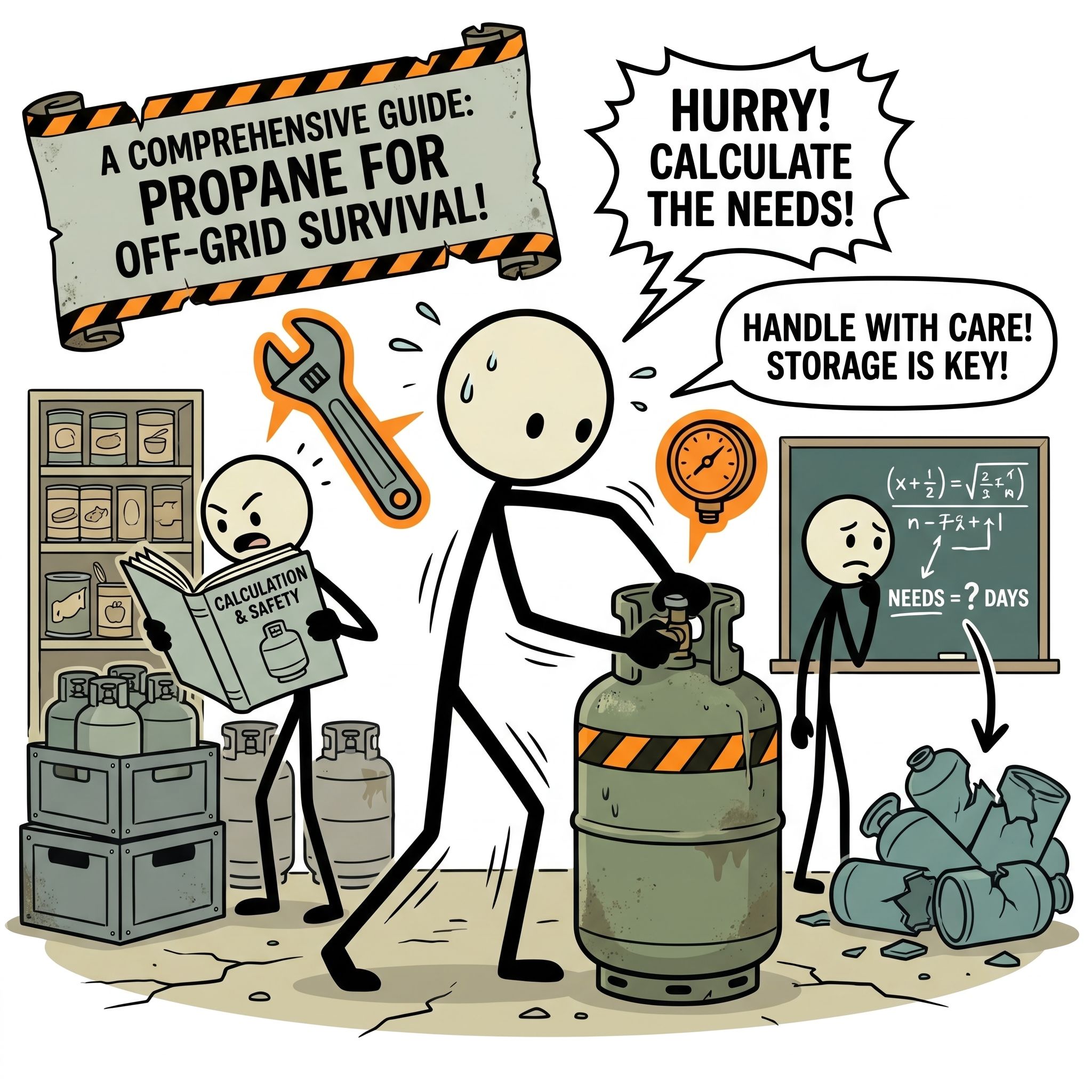
The Science of Propane: Why It Is the Ultimate Survival Fuel
To build a truly resilient family emergency plan, you must understand the fuel you are relying on. Propane ($C_3H_8$) is a hydrocarbon gas that is compressed and stored as a liquid. Under normal atmospheric pressure, propane boils at -44°F (-42°C). This means that at any temperature above this freezing point, propane will naturally vaporize into a highly flammable gas, ready to power your appliances. This low boiling point makes propane incredibly reliable in sub-zero winter Survival Scenarioss where other liquid fuels like diesel or kerosene struggle to ignite or gel up.
One of the most compelling reasons to choose propane for disaster preparedness is the propane shelf life. Unlike gasoline, which begins to oxidize and degrade within three to six months, or diesel, which can grow algae and spoil within a year, propane does not degrade over time. It has no expiration date. The chemical structure of propane remains completely stable indefinitely. The only limiting factor in your emergency propane storage strategy is the integrity of the storage vessel itself. If you keep your steel or composite tanks free from rust, physical damage, and valve degradation, the fuel inside will be just as potent 30 years from now as it is today.
Furthermore, propane burns incredibly clean. According to the Department of Energy (DOE), propane combustion produces significantly fewer greenhouse gases and particulate emissions than gasoline, diesel, or coal. For an off-grid prepper, this clean-burning profile is not just an environmental benefit; it is a tactical advantage. Clean combustion means your appliances—such as stoves, heaters, and generators—will suffer from far less carbon buildup, reducing maintenance requirements and extending the operational lifespan of your critical survival gear when spare parts are impossible to source.
Calculating Your Emergency Propane Needs: The Survival Math
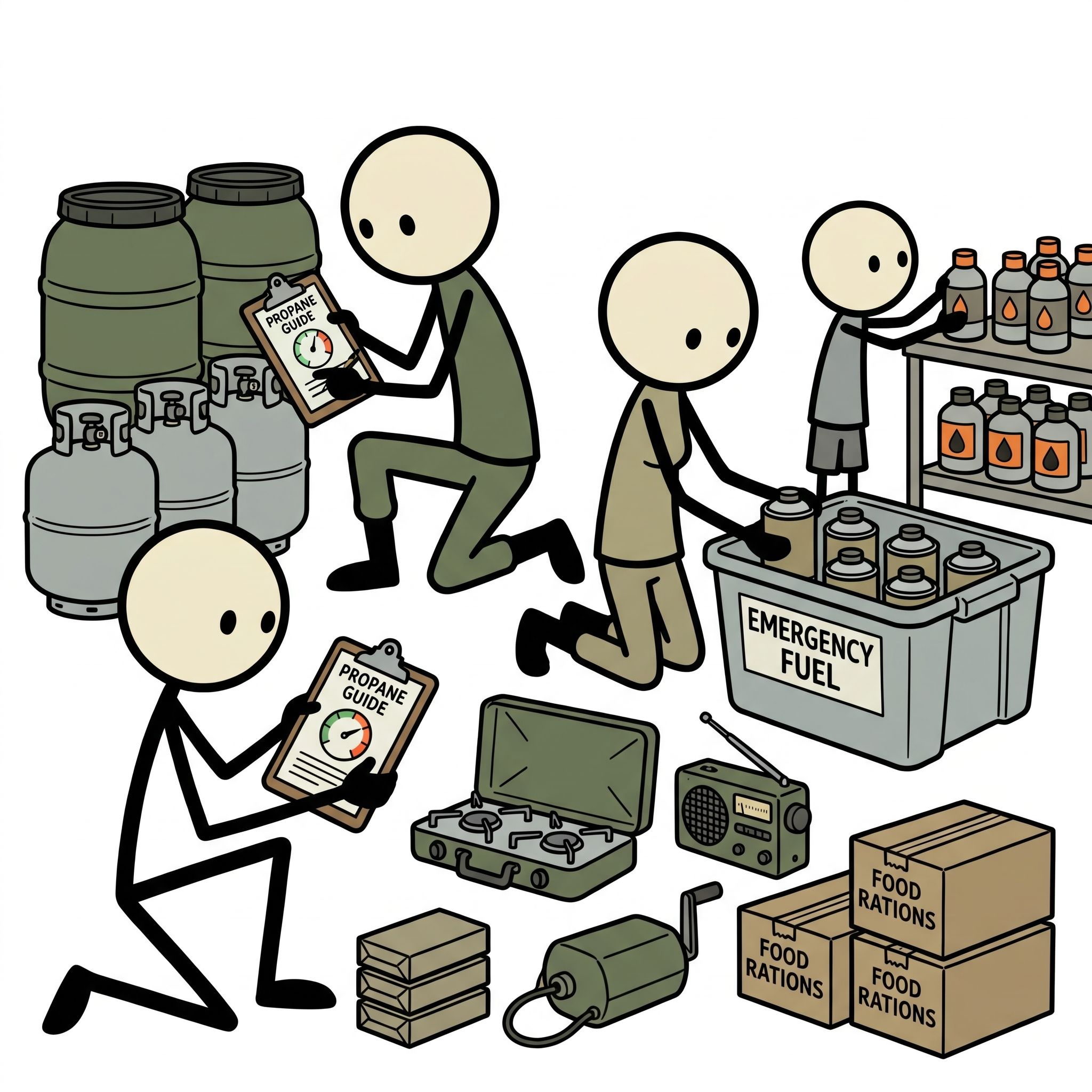
A common mistake among novice preppers is guessing how much fuel they need. Underestimating your fuel consumption can leave you freezing in the dark mid-crisis, while overestimating can lead to unnecessary expenses and logistical storage headaches. To calculate your exact off-grid propane storage requirements, you must understand the British Thermal Unit (BTU). A BTU is the amount of heat required to raise the temperature of one pound of water by one degree Fahrenheit.
Propane energy density can be broken down into these standard engineering metrics:
- 1 Gallon of Propane = ~91,502 BTUs
- 1 Pound of Propane = ~21,548 BTUs
- 1 Standard "20 lb" BBQ Cylinder = Holds ~4.7 gallons of liquid propane, yielding ~430,000 BTUs
To determine your survival fuel footprint, you must catalog every propane-powered appliance you plan to run, locate its BTU rating (usually found on a metal plate on the back or side of the unit), and estimate its daily run time. Below is a reference table outlining typical emergency appliances and their consumption rates:
| Appliance Type | Average BTU Rating | Propane Consumption (Per Hour of Use) | Survival Scenario Context |
|---|---|---|---|
| Emergency Camp Stove (2-Burner) | 20,000 BTUs (total) | 0.22 Gallons (0.93 lbs) | Cooking hot meals, boiling water for sanitation. |
| Indoor-Safe Radiant Heater (e.g., Mr. Heater Buddy) | 9,000 BTUs (high setting) | 0.10 Gallons (0.42 lbs) | Zonal heating for a single insulated room. |
| Whole-House Propane Heater | 40,000 BTUs | 0.44 Gallons (1.86 lbs) | Maintaining baseline temperatures across an entire home. |
| Dual-Fuel Portable Generator (5,000 Watts) | ~60,000 BTUs (at 50% load) | 0.65 Gallons (2.78 lbs) | Running medical devices, well pumps, and freezers. |
| Propane Tankless Water Heater | 40,000 BTUs | 0.44 Gallons (1.86 lbs) | On-demand hot water for bathing and medical hygiene. |
Step-by-Step Calculation Scenario: 30 Days of Winter Survival
Let us calculate the fuel requirements for a family of four aiming to survive comfortably off-grid for 30 days during a severe winter grid collapse. This family plans to use propane for targeted zone heating, daily cooking, and occasional power generation.
1. Cooking: Operating a two-burner camp stove for 1.5 hours per day to cook meals and boil drinking water.
1.5 hours/day × 20,000 BTUs = 30,000 BTUs/day
2. Space Heating: Running an indoor-safe radiant heater in a sealed basement safe-room for 8 hours per day on the medium setting (approx. 6,000 BTUs/hr).
8 hours/day × 6,000 BTUs = 48,000 BTUs/day
3. Power Generation: Running a dual-fuel generator for 2 hours per day to recharge battery banks, power emergency communication plans, and run a water well pump.
2 hours/day × 60,000 BTUs = 120,000 BTUs/day
Total Daily Energy Requirement: 30,000 + 48,000 + 120,000 = 198,000 BTUs per day.
Total 30-Day Energy Requirement: 198,000 BTUs/day × 30 days = 5,940,000 BTUs.
To convert this total BTU figure into physical fuel volume, divide by the energy content of a single gallon of propane:
5,940,000 BTUs ÷ 91,502 BTUs/gallon = 64.9 Gallons of Propane
To determine how many standard 20 lb cylinders this requires:
64.9 Gallons ÷ 4.7 Gallons/cylinder = 13.8 Cylinders (Round up to 14 cylinders)
By executing this math, the family knows that to survive this specific 30-day winter scenario, they must have at least fourteen 20 lb cylinders, or a single larger tank (such as a 120-gallon horizontal tank) filled to its safe capacity.
Choosing Your Armor: Tank Anatomy, Sizing, and Selection
Understanding how propane is contained is a pillar of propane safety for preppers. Propane vessels are broadly categorized into two types based on the regulatory frameworks that govern their manufacturing: DOT (Department of Transportation) cylinders and ASME (American Society of Mechanical Engineers) tanks.
DOT Cylinders (Portable Storage)
These are the highly portable, vertically oriented tanks most common in residential settings. They range in size from tiny 1 lb camp cylinders up to 100 lb (23.6 gallon) heavy-duty cylinders. Under DOT regulations, these tanks must be inspected and recertified every 10 to 12 years (depending on local laws and visual wear) from their date of manufacture. The date is stamped clearly on the collar of the tank. For preppers, DOT cylinders offer excellent modularity; if one tank leaks, you only lose a fraction of your reserve, and they are light enough to be transported in a vehicle if you are forced to bug out.
Modern DOT cylinders are equipped with an Overfill Prevention Device (OPD) valve. The OPD valve features a triangular handwheel and an internal float mechanism that physically blocks the filling process once the liquid reaches the 80% mark. This 20% vapor space is critical because liquid propane expands significantly when exposed to ambient heat. Without this expansion cushion, rising temperatures could cause hydrostatic pressure to rupture the cylinder's steel walls.
ASME Tanks (Stationary Storage)
If your survival strategy centers on defending your home or a dedicated off-grid retreat, ASME tanks are the gold standard for how to store propane long term. These heavy-duty, horizontally oriented tanks are manufactured with much thicker steel and are designed to be permanently installed. They range in size from 120 gallons to over 1,000 gallons. Unlike DOT cylinders, ASME tanks do not require periodic recertification, though they should be visually inspected regularly for structural integrity and surface rust.
ASME tanks are fitted with a comprehensive suite of brass valves protected by a heavy steel dome shroud. This suite includes:
- The Fill Valve: A heavy-duty, one-way check valve where the delivery driver connects the filling hose.
- The Vapor Service Valve: The main shut-off valve that controls the flow of propane gas to your regulators and appliances.
- The Fixed Liquid Level Gauge (Bleeder Valve): A manual valve used during filling to visually verify when the liquid level reaches exactly 80%.
- The Float Gauge: A magnetic dial indicator that provides a continuous reading of the tank's current volume (from 5% to 95%).
- The Pressure Relief Valve: A spring-loaded safety valve designed to pop open and vent excess pressure if the internal pressure exceeds safe design limits (typically 250 to 312 PSI).
How to Store Propane Long Term: Siting and Maintenance
When establishing your emergency propane storage footprint, your physical layout must prioritize safety and regulatory compliance. Propane gas is heavier than air. If a leak occurs, the vapor will not dissipate into the sky; instead, it will pool along the ground, flowing downhill into low-lying areas, window wells, crawlspaces, and basements. If it encounters an ignition source while pooled, a catastrophic explosion can occur.
Critical Siting Rules (NFPA 58 Standards)
To mitigate the risk of vapor pooling and ignition, the NFPA has established strict clearance distances that every prepper must implement:
- Small Cylinders (under 125 gallons water capacity): Must be placed at least 5 feet away from any building opening (windows, doors, crawlspace vents) that is lower than the relief valve discharge, and at least 10 feet away from any ignition source (such as air conditioning compressors, heat pumps, or electrical panels).
- Medium Tanks (125 to 500 gallons): Must be sited a minimum of 10 feet away from any residential structure, property line, or potential ignition source.
- Large Tanks (501 to 1,000 gallons): Must be sited a minimum of 25 feet away from any building, property line, or active ignition source.
Environmental Protection and Rust Mitigation
Because the steel container is the only thing standing between safe fuel security and a dangerous leak, protecting your tanks from environmental degradation is paramount. Moisture is the ultimate enemy of steel. Follow these steps to maximize your tank's operational lifespan:
- Elevate Your Tanks: Never store propane cylinders directly on bare soil, wet grass, or standing water. Soil moisture will rapidly corrode the bottom ring (foot ring) of the tank, leading to structural failure. Place your tanks on concrete pads, heavy-duty pavers, or treated wooden timbers.
- Paint and Color Choice: If you must repaint a rusty tank, never paint it a dark color. Dark colors absorb solar radiation, which will raise the internal temperature of the liquid propane, causing the pressure to spike and trigger the pressure relief valve. Always paint your tanks reflective silver, light gray, or off-white. Use high-quality rust-inhibitive primer and exterior-grade enamel.
- Provide Overhead Protection: While propane tanks are designed to withstand the elements, shielding them from direct sunlight, heavy snow accumulation, and falling debris with a well-ventilated, non-combustible canopy will drastically reduce wear on the valves and paint. Never enclose the storage area completely; natural airflow is vital to disperse any minor vapor leaks.
Propane Safety for Preppers: Handling, Transport, and Leak Detection
Respecting the physics of pressurized liquid gas is the foundation of accident prevention. When handling propane, you are dealing with a substance under immense pressure (ranging from 100 to over 200 PSI depending on ambient temperature). A single mistake can result in severe frostbite, chemical burns, or ignition events.
Safe Transport Protocols
When transporting DOT cylinders to a refilling station, you must observe strict transport safety protocols to prevent accidents before they happen:
- Always Transport Upright: Cylinders must always be secured in an upright position. If a cylinder is laid on its side, liquid propane can come into contact with the safety relief valve. If the valve opens due to pressure build-up, it will spray highly concentrated liquid propane instead of vapor, creating an immediate, massive fire hazard.
- Secure the Load: Use ratchet straps, heavy-duty bungee cords, or dedicated transport crates to prevent tanks from rolling, sliding, or knocking against one another.
- Ventilate Your Vehicle: Never leave propane cylinders inside a closed, hot vehicle for extended periods. If you must transport them in an enclosed SUV or car trunk, keep the windows down to ensure continuous airflow, and drive directly to your destination. Once home, unload the cylinders immediately.
The Soapy Water Leak Test
Never search for a propane leak using a match, lighter, or open flame. The safest, most effective off-grid method for detecting leaks is the classic soapy water test. This should be performed every time you connect a new tank, swap a cylinder, or recommission an appliance that has been sitting idle.
- Mix a solution of 50% liquid dish soap and 50% clean water in a spray bottle or small bucket.
- Slowly open the main vapor service valve on the tank to pressurize the system.
- Generously spray or brush the soapy solution onto all connections, including the valve stem, the regulator threads, the hose fittings, and the appliance inlet.
- Watch closely for the formation of growing bubbles. If you see bubbles expanding, you have a leak.
- If a leak is detected, immediately close the service valve, tighten the loose fitting, and repeat the test. If the leak persists despite tightening, shut off the gas, disconnect the component, and inspect the threads for damage or debris.
Carbon Monoxide: The Silent Killer
According to the Centers for Disease Control and Prevention (CDC), carbon monoxide (CO) poisoning claims hundreds of lives every year during emergency power outages. When propane burns, it requires oxygen. If an appliance is operated in an enclosed space with insufficient ventilation, it will deplete the oxygen supply, resulting in incomplete combustion. This incomplete combustion produces carbon monoxide—a colorless, odorless, tasteless, and highly toxic gas.
To prevent CO poisoning during off-grid operations, follow these life-saving rules:
- Never Use Outdoor Appliances Indoors: Outdoor propane grills, camp stoves, and high-output patio heaters are not designed with the precise combustion controls required for indoor use. They must never be operated inside a home, tent, camper, or garage.
- Use Certified Indoor-Safe Heaters: If you must heat an indoor space with propane, use a heater specifically certified for indoor use (such as a catalytic or radiant heater equipped with an Oxygen Depletion Sensor (ODS)). The ODS automatically shuts off the unit if oxygen levels in the room drop below a safe threshold.
- Install Battery-Operated CO Detectors: Always place battery-operated or rechargeable carbon monoxide detectors in your sleeping areas and near any indoor heating appliances. Test these detectors monthly and keep a healthy supply of replacement batteries in your prepper inventory.
Advanced Off-Grid Infrastructure: Regulators and Multi-Fuel Integration
To build a truly robust off-grid energy system, you must look beyond individual appliances and design a cohesive fuel delivery network. This requires an understanding of gas pressure regulation and multi-fuel equipment integration.
The Role of Pressure Regulators
The pressure inside a propane tank is far too high and fluctuating to be piped directly into your appliances. Appliance burners require a steady, low-pressure flow of gas to operate safely and efficiently. This transition is managed by pressure regulators.
Regulators are classified into three main types:
- Single-Stage Regulators: These reduce tank pressure down to appliance working pressure (typically 11 inches of water column, which is roughly 0.4 PSI) in one step. They are commonly found on portable grills and small camp stoves. They are not recommended for long pipe runs or permanent installations.
- Two-Stage Regulators: These use two separate diaphragms to step down pressure. The first stage drops tank pressure to a stable intermediate pressure (around 5 to 10 PSI), and the second stage drops it down to the final 11 inches of water column. Two-stage regulation is highly stable, resists freeze-ups in extreme cold, and is the standard for permanent off-grid home setups.
- High-Pressure Regulators: These deliver gas at pressures ranging from 1 to 20 PSI. They are used specifically for high-output commercial burners, deep fryers, and specialized off-grid equipment. Connecting a high-pressure regulator to a standard low-pressure appliance can cause a catastrophic fire. Always match your regulator to your appliance specifications.
Tri-Fuel and Dual-Fuel Generators
In a long-term survival scenario, fuel diversity is your shield against scarcity. Relying on a single fuel source is a single point of failure. One of the most effective ways to integrate propane into your survival plan is by deploying dual-fuel or tri-fuel portable generators.
These specialized generators can run interchangeably on gasoline, propane, or natural gas. While running a generator on propane results in a minor power derating (typically a 5% to 10% reduction in peak wattage compared to gasoline due to propane's lower energy density by volume), the trade-off is overwhelmingly positive. Running on propane eliminates carburetor gumming—the number one cause of generator failure—and allows you to tap into your stable, non-degrading off-grid propane storage reserves when gasoline supplies are exhausted.
Securing Your Energy Independence
In an unpredictable world, true security is not found in hoping the grid never fails; it is found in knowing you can thrive when it does. Propane is a cornerstone of this self-reliance. Its indefinite shelf life, clean combustion profile, and exceptional energy density make it an invaluable asset for any serious emergency preparedness plan. By calculating your family's exact BTU requirements, selecting the appropriate DOT or ASME storage vessels, executing rigorous safety protocols, and maintaining your infrastructure, you effectively insulate your household from the chaos of a wider societal collapse. Take control of your energy security today, secure your fuel reserves, and build the resilient foundation your family deserves.
Frequently Asked Questions
How long does propane last in storage?
Propane does not degrade over time and has an indefinite shelf life. However, the storage cylinder itself must be inspected and recertified periodically (typically every 10 to 12 years depending on local regulations) to ensure safety.
Can I store propane tanks indoors?
No, you should never store propane tanks indoors, including in living spaces, basements, or attached garages. Always store them outdoors in a well-ventilated area, upright, and away from direct sunlight or heat sources.
How do I check how much propane is left in my tank?
You can check the level by installing an inline pressure gauge, using a magnetic leak detector strip, or by pouring warm water down the side of the tank and feeling for where the metal goes from warm to cold.
What should I do if I smell a propane leak?
If you smell propane (a rotten-egg odor), immediately extinguish all open flames, do not operate electrical switches, evacuate the area, turn off the cylinder valve if safe to do so, and call emergency services from a safe distance.
How many propane tanks can I safely store on my property?
While residential safety codes (like NFPA 58) generally limit outdoor storage of individual cylinders to a maximum of 1,000 pounds total, local municipal ordinances and HOA rules may have much stricter limits.