⚡ Key Facts
- Sodium Hypochlorite Concentration: Standard household bleach concentrations have shifted from 5.25% to 6% and 8.25%. Always check the label, as dosing must be adjusted accordingly to prevent under-dosing or chemical toxicity. For the practical checklist side, use the community emergency preparedness guide.
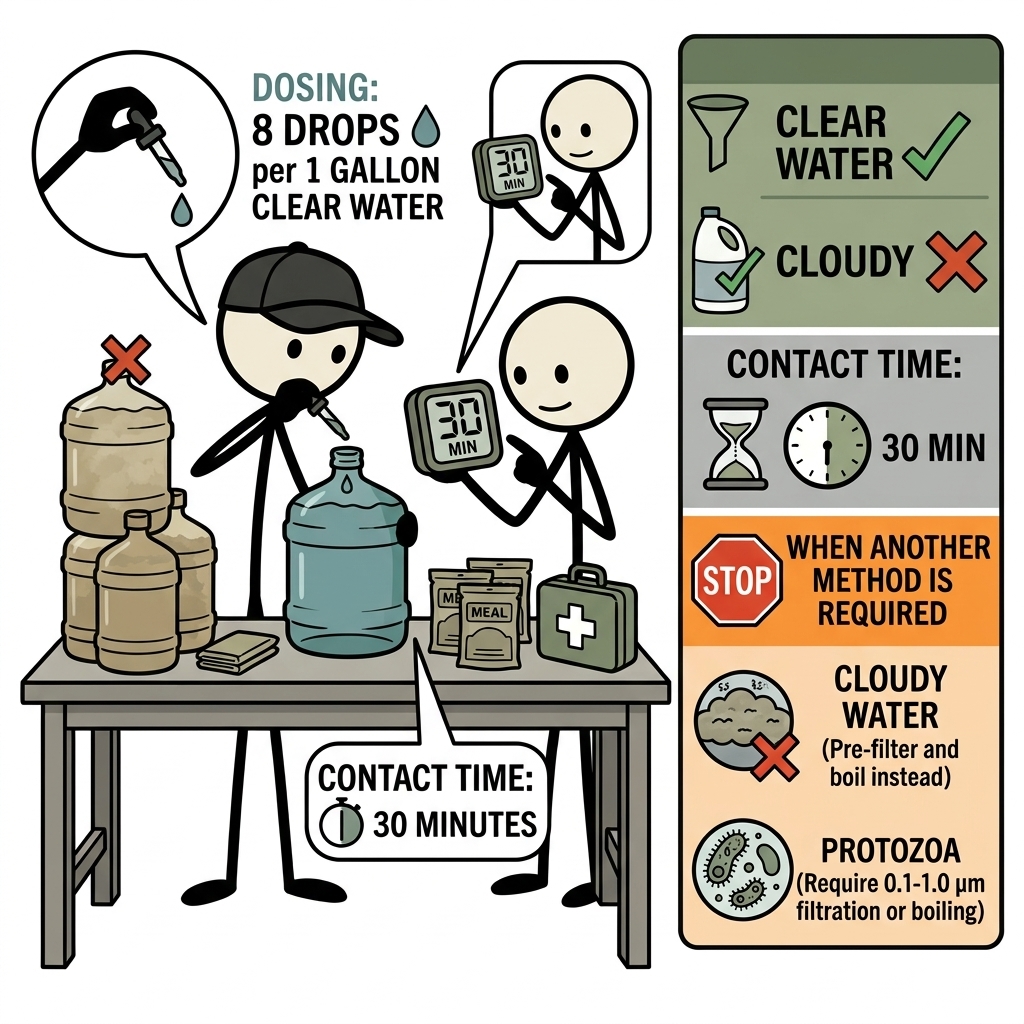
- The 30-Minute Rule: The Centers for Disease Control and Prevention (CDC) mandates a minimum contact time of 30 minutes after mixing bleach into water before it is safe to consume. For the practical checklist side, use the neighborhood preparedness network.
- Protozoan Resistance: Chlorine bleach is highly ineffective against hard-shelled protozoan parasites like Cryptosporidium and Giardia at standard emergency doses. For the practical checklist side, use the emergency communication plan.
- Shelf-Life Degradation: Bleach is highly unstable; it loses up to 20% of its potency per year when stored at room temperature, and degrades even faster in hot environments.
- Chemical Limitations: Bleach does not remove heavy metals, salts, pesticides, or industrial chemicals from contaminated water.
When a major natural disaster strikes—whether it is a Category 5 hurricane, a catastrophic flood, or an earthquake that ruptures municipal infrastructure—water treatment plants are often the first systems to fail. According to the Federal Emergency Management Agency (FEMA) and the Red Cross, securing a safe drinking Water Calculator is the single most critical step in emergency preparedness. While stockpiling bottled water is ideal, long-term Survival Scenarioss require the ability to treat raw water on-site. Among the various methods available, using unscented household bleach is one of the most widely recommended, cost-effective, and accessible techniques. However, treating water with bleach is a precise chemical process, not a guessing game. Miscalculating the dose or ignoring environmental variables can result in either severe chemical poisoning or exposure to life-threatening waterborne pathogens.
The Chemistry of Bleach as a Disinfectant
To understand how to purify water with bleach, you must first understand the chemistry of disinfection. The active ingredient in household bleach is sodium hypochlorite ($\text{NaOCl}$). When sodium hypochlorite is added to water, it undergoes a chemical reaction that produces hypochlorous acid ($\text{HOCl}$) and hypochlorite ions ($\text{OCl}^-$). Together, these compounds are referred to as "free chlorine."
Hypochlorous acid is the primary workhorse of the disinfection process. Because it carries no electrical charge, it can easily penetrate the negatively charged cell walls of bacteria and the protective protein coats of viruses. Once inside, it oxidizes the internal structures of the pathogen, denaturing proteins and destroying metabolic pathways, effectively killing the organism. Hypochlorite ions, which carry a negative charge, are far less effective at penetrating cell walls, meaning the pH of the water plays a critical role in how well the bleach performs. In highly alkaline water (high pH), the chemical equilibrium shifts, producing more hypochlorite ions and less hypochlorous acid, which significantly reduces the bleach's sanitizing power.
This chemical reaction is highly effective against a broad spectrum of biological threats, including cholera, typhoid, hepatitis A, rotavirus, and E. coli. However, it is not an instantaneous process. The chemical reactions require time to work, and the efficiency of these reactions depends heavily on temperature, water clarity, and the concentration of the bleach itself.
Understanding Bleach Concentrations
Before you can apply any dosing protocol, you must identify the exact concentration of sodium hypochlorite in your bleach bottle. Historically, standard household bleach was sold at a 5.25% concentration. In recent years, manufacturers have shifted to concentrated formulas of 6% or 8.25% to reduce packaging and shipping costs. Some industrial or outdoor bleach products can be as high as 10% to 12.5%, while "splashless" or scented varieties contain added surfactants, fragrances, and thickeners that are toxic if ingested.
Crucial Rule: Only use regular, unscented, liquid household chlorine bleach that is suitable for disinfection and sanitization, as indicated on the label. Never use splashless, scented, color-safe, or powdered bleach formulas for water purification.
The Dosing Matrix for Clear vs. Cloudy Water
The amount of bleach required to purify water depends on two primary factors: the concentration of the sodium hypochlorite and the turbidity (cloudiness) of the water. Turbid water contains suspended organic matter, such as clay, silt, and algae. This organic matter reacts with the free chlorine, consuming it before it can attack the pathogens. This phenomenon is known as "chlorine demand." To compensate for this, you must double the dosage of bleach when treating cloudy, muddy, or extremely cold water.
Below is the standard dosing matrix compiled from guidelines provided by the Environmental Protection Agency (EPA) and the CDC:
| Water Volume | Bleach Concentration | Dose for Clear Water | Dose for Cloudy/Cold Water |
|---|---|---|---|
| 1 Quart / 1 Liter | 6% to 8.25% | 2 drops | 4 drops |
| 1 Gallon | 6% | 8 drops (~1/8 tsp) | 16 drops (~1/4 tsp) |
| 1 Gallon | 8.25% | 6 drops | 12 drops (~1/8 tsp) |
| 5 Gallons | 6% | 40 drops (~1/2 tsp) | 80 drops (~1 tsp) |
| 5 Gallons | 8.25% | 30 drops (~1/2 tsp) | 60 drops (~1 tsp) |
To measure these doses accurately in an emergency, you should include a medicine dropper (pipette) in your emergency kit. If you do not have a dropper, you can use a clean teaspoon. Note that 1/8 of a teaspoon is roughly equivalent to 8 drops of 6% bleach, and 1/4 of a teaspoon is roughly equivalent to 16 drops.
Contact Time: The Critical Wait
Once you have added the correct dose of bleach to your water, you must stir or shake the container thoroughly to distribute the chemical evenly. At this point, the water is not yet safe to drink. You must wait for the chemical reaction to complete.
The standard recommended contact time is 30 minutes. This is the minimum time required for hypochlorous acid to destroy the cell walls of common bacteria and viruses under normal conditions (water temperatures above 68°F or 20°C). If the water is cold—specifically below 50°F (10°C)—the chemical reactions slow down dramatically. In cold-weather survival situations, you must double the contact time to at least 60 minutes to ensure complete disinfection.
The Sensory Check
After the contact time has elapsed, you must perform a sensory check of the water before drinking it. Open the container and smell the water. It should have a faint, distinct chlorine odor, similar to the smell of a public swimming pool. This smell is proof that there is "residual chlorine" left in the water, meaning all biological pathogens have been neutralized, and there is still active disinfectant available to prevent recontamination.
- If there is no chlorine smell: This indicates that the organic load in the water was too high, and all the chlorine was consumed before disinfection was complete. You must add a second dose of bleach (equal to the first dose), stir thoroughly, and wait another 15 to 30 minutes. If it still does not smell of chlorine after the second treatment, discard the water; it contains too much organic matter to be safely purified with bleach alone.
- If the chlorine smell is overwhelmingly strong: This means you have over-dosed the water. While not immediately lethal, drinking highly chlorinated water can cause gastrointestinal distress, nausea, and chemical burns to the esophagus. To fix this, pour the water back and forth between two clean containers several times. This process, called aeration, releases the chlorine gas into the atmosphere and improves the taste. Alternatively, let the container sit uncapped for a few hours to allow the chlorine to naturally off-gas.
The Hard Limits of Chlorine Disinfection
While learning how to purify water with bleach is a cornerstone of emergency preparedness, it is equally important to understand what bleach cannot do. Chlorine is not a magic bullet, and relying on it blindly in the wrong scenario can be fatal.
The Protozoan Problem: Cryptosporidium and Giardia
The most significant biological limitation of chlorine bleach is its inability to kill certain protozoan parasites. Cryptosporidium parvum and Giardia lamblia are microscopic parasites commonly found in surface waters contaminated by animal or human feces. These organisms form protective outer shells, known as oocysts or cysts, that are highly resistant to chemical oxidation.
According to the CDC, *Cryptosporidium* has an incredibly high tolerance to chlorine. At standard emergency chlorine levels, it would take over 10 hours of continuous contact time to neutralize *Cryptosporidium* oocysts. In typical survival scenarios where you only wait 30 minutes, these parasites will survive completely unaffected. Ingestion of these parasites leads to severe diarrheal illnesses (cryptosporidiosis and giardiasis) that can cause rapid dehydration—a critical threat when clean water is already scarce.
Chemical and Heavy Metal Contamination
Bleach only targets biological pathogens. It has absolutely no effect on chemical contaminants. If your water source is contaminated with industrial runoff, agricultural pesticides, fertilizers, fuel, heavy metals (such as lead, arsenic, or mercury), or radiological isotopes, adding bleach will not make it safe. In fact, adding chlorine to water heavily contaminated with organic chemicals can create toxic chlorinated byproducts, such as trihalomethanes (THMs), which are highly carcinogenic over long-term exposure. In urban flooding scenarios, chemical contamination is highly likely, meaning chemical purification methods must be bypassed in favor of other treatment options.
When Another Purification Method Is Required
Because of these hard limitations, there are many scenarios where bleach should not be your primary choice, or where it must be combined with other purification steps. Knowing when to pivot to another method is a key skill in how to purify water with bleach emergency preparedness.
1. Boiling: The Gold Standard
If you have a heat source and a container, boiling is always superior to chemical treatment. The CDC and EPA state that boiling is the single most effective method for destroying all waterborne pathogens, including bacteria, viruses, and the chemical-resistant protozoa like *Cryptosporidium* and *Giardia*.
To purify water by boiling, bring it to a vigorous, rolling boil for at least 1 minute. If you are at an altitude above 6,500 feet (2,000 meters), the boiling point of water is lower, so you must extend the rolling boil to 3 minutes to ensure all pathogens are thermally destroyed. Boiling does not remove heavy metals or chemical toxins, but it eliminates 100% of biological threats without leaving a chemical taste.
2. Mechanical Micro-Filtration
When dealing with turbid water or water suspected of containing protozoan cysts, mechanical filtration is required. Modern emergency water filters use hollow-fiber membrane technology to physically block pathogens based on size.
To successfully filter out bacteria and protozoa, you need a filter with an absolute pore size of 0.1 microns or smaller. If you are concerned about viruses (which are much smaller than bacteria), you need an advanced purifier system with a pore size of 0.02 microns, or you must combine a 0.1-micron filtration step with a subsequent chlorine bleach treatment. Filtering the water first removes the suspended solids and protozoa, allowing the chlorine to work highly efficiently on the remaining viruses without being wasted on background organic matter.
3. Distillation and Reverse Osmosis
If your only available water source is brackish (salty), contaminated with heavy metals, or saturated with industrial chemicals, you cannot use bleach or standard micro-filters. These contaminants are dissolved at the molecular level.
To remove dissolved solids, you must use distillation or a portable reverse osmosis system. Distillation involves boiling the contaminated water and capturing the pure steam, which condenses back into liquid water in a separate container, leaving all heavy metals, salts, and chemicals behind. While energy-intensive, distillation is the only reliable DIY method for purifying chemically poisoned or saltwater sources in an extreme survival scenario.
The Bleach Degradation Factor
A critical, often overlooked aspect of emergency preparedness is the shelf life of your disinfection agents. Unlike water purification tablets (such as sodium dichloroisocyanurate or chlorine dioxide), which can remain stable for up to five years in sealed packaging, liquid household bleach degrades rapidly.
Sodium hypochlorite is highly sensitive to temperature, light, and air exposure. Once a bottle of bleach is manufactured, it begins to break down into salt and water. According to studies by the USGS and chemical manufacturers, standard liquid bleach loses about 20% of its active chlorine concentration per year when stored under ideal conditions (around 70°F or 21°C). If stored in a hot garage, shed, or vehicle trunk where temperatures exceed 90°F (32°C), bleach can lose up to 50% of its potency in just a few months.
Preparedness Action: Do not rely on a bottle of bleach that has been sitting in your emergency supply closet for several years. For emergency water purification, use bleach that is less than six months old. If you must use older bleach, you may need to increase the dosage, but doing so increases the risk of chemical over-exposure. To avoid this, rotate your household bleach stock regularly, or store dry calcium hypochlorite (pool shock) instead, which has a much longer shelf life when kept dry and cool, and can be used to mix fresh liquid chlorine solutions as needed.
How to Purify Water with Bleach Checklist
To ensure you execute this process flawlessly during a high-stress emergency, keep this step-by-step checklist printed and stored alongside your emergency gear.
- Assess the Water Source: Choose the cleanest, clearest water source available. Avoid stagnant water, water near agricultural fields, or water in industrial zones to minimize chemical contamination.
- Pre-Filter the Water: If the water is turbid, muddy, or contains suspended debris, let it settle first. Pour the top layer through a clean cloth, coffee filter, or paper towel to remove as many physical particles as possible.
- Inspect Your Bleach: Confirm the bleach is liquid, unscented, and contains only sodium hypochlorite as the active ingredient. Locate the concentration percentage on the label (typically 6% or 8.25%). Ensure the bottle is less than one year old.
- Measure the Dose: Using a clean pipette or measuring spoon, add the precise number of drops required based on your water volume, clarity, and the bleach concentration (refer to the dosing matrix above).
- Agitate and Mix: Seal the water container and shake or stir it vigorously for 10 to 15 seconds to ensure the bleach is completely distributed throughout the water column.
- Loosen the Cap (The Thread Sanitation Trick): Slightly loosen the cap of your container and squeeze a small amount of the treated water out so that it flows over the threads of the bottle neck and cap. This ensures that any pathogens hiding on the drinking rim are also exposed to the disinfectant. Retighten the cap.
- Wait (Contact Time): Set a timer. Wait a minimum of 30 minutes for warm water (above 68°F/20°C) or 60 minutes for cold water (below 50°F/10°C). Keep the container out of direct sunlight during this time.
- Perform the Smell Test: Open the container and smell the water. If you detect a faint chlorine odor, the water is safe to drink. If there is no smell, add a second identical dose, mix, wait another 15 minutes, and re-test.
Empowered Preparedness
Mastering the science of water purification is one of the most empowering steps you can take in your personal emergency preparedness journey. Water is the foundation of life, and in a crisis, having the knowledge to transform a questionable water source into a safe, life-saving resource changes your status from a victim of circumstances to an active survivor. By understanding the precise dosing mechanics of sodium hypochlorite, respecting the critical role of contact time, and recognizing the physical limitations of chemical treatment, you ensure that you and your family remain safe from both biological pathogens and chemical missteps. Keep your gear organized, keep your bleach rotated, and always prioritize safety through precise execution.
Frequently Asked Questions
What should a how to purify water with bleach plan include?
Start with the immediate safety steps, the supplies and records your household needs, a communication plan, and a regular review schedule. Follow local official guidance during an active emergency.
How often should I review how to purify water with bleach preparations?
Review them at least twice a year and whenever your household, medication, location, or local risks change. Replace expired supplies and practice key steps.
Where can I find reliable emergency guidance?
Use local emergency management alerts and established public-health or emergency-management agencies. A blog guide should support, not replace, official real-time instructions.