⚡ Key Facts
- FEMA and the Red Cross recommend storing at least one gallon of water per person per day for emergencies, making high-capacity portable filters a critical backup when stored supplies run out.
- The CDC states that water filters must have an absolute pore size of 1 micron or less to effectively remove parasitic protozoa like Cryptosporidium and Giardia. Both the Sawyer Squeeze and LifeStraw exceed this standard.
- In a comparison of longevity, the Sawyer Squeeze is rated for up to 100,000 gallons with proper maintenance, while the standard LifeStraw is rated for 1,000 gallons (4,000 liters).
- Neither standard microfilter removes viruses, heavy metals, or chemical contaminants, necessitating secondary treatment methods in certain urban disaster scenarios according to USGS and EPA guidelines.
- Weighing under 3 ounces each, both devices represent the gold standard for lightweight, highly mobile emergency water purification in Go-Bag Builders and 72-hour kit guides.
When natural disasters strike, municipal water infrastructure is often the first system to fail. Recent data from the National Oceanic and Atmospheric Administration (NOAA) highlights a steady increase in billion-dollar weather events, many of which result in prolonged power outages and compromised water treatment facilities. The human body can survive weeks without food, but a mere three days without water can be fatal. In the immediate aftermath of an emergency, securing a safe, potable Water Calculator is not just a priority - it is the absolute foundation of survival. See Water Calculator for additional options. See Water Calculator for additional options.
While stockpiling bottled water is the foundational step recommended by disaster response agencies, mobility and longevity require a more sustainable solution. You cannot carry a two-week supply of water on your back if you are forced to evacuate. This reality makes portable water filtration a non-negotiable component of any serious preparedness plan. Among the myriad of options on the market, two names consistently dominate the conversation: Sawyer and LifeStraw. Both have saved countless lives globally, but they operate on different philosophies of design and functionality. For a quick definition, see water filter.
In this comprehensive guide, we will analyze the sawyer vs lifestraw debate from a strict emergency preparedness perspective. By examining flow rates, maintenance requirements, versatility, and real-world disaster applications, we will help you determine the best survival water filter for your specific needs. Preparedness is about building resilience through reliable tools, and understanding the exact capabilities of your gear is the first step toward self-reliance.
The Reality of Emergency Water Purification
The Federal Emergency Management Agency (FEMA) and the American Red Cross are clear in their directives: households should store at least one gallon of water per person, per day, for a minimum of three days. However, they also advise preparing for up to two weeks in severe scenarios. For a family of four, a two-week supply equates to 56 gallons of water, weighing over 460 pounds. While home storage is essential for sheltering in place, it becomes entirely useless if a flood, wildfire, or hurricane forces an immediate evacuation.
This logistical bottleneck is where emergency water purification becomes vital. When you transition from relying on stored municipal water to scavenging from creeks, rain barrels, or compromised tap water, you introduce the risk of waterborne illness. The Centers for Disease Control and Prevention (CDC) warns that post-disaster water sources are frequently contaminated with gastrointestinal pathogens. Contracting dysentery or cholera during an emergency compounds a crisis, leading to rapid dehydration and requiring medical interventions that simply may not be available.
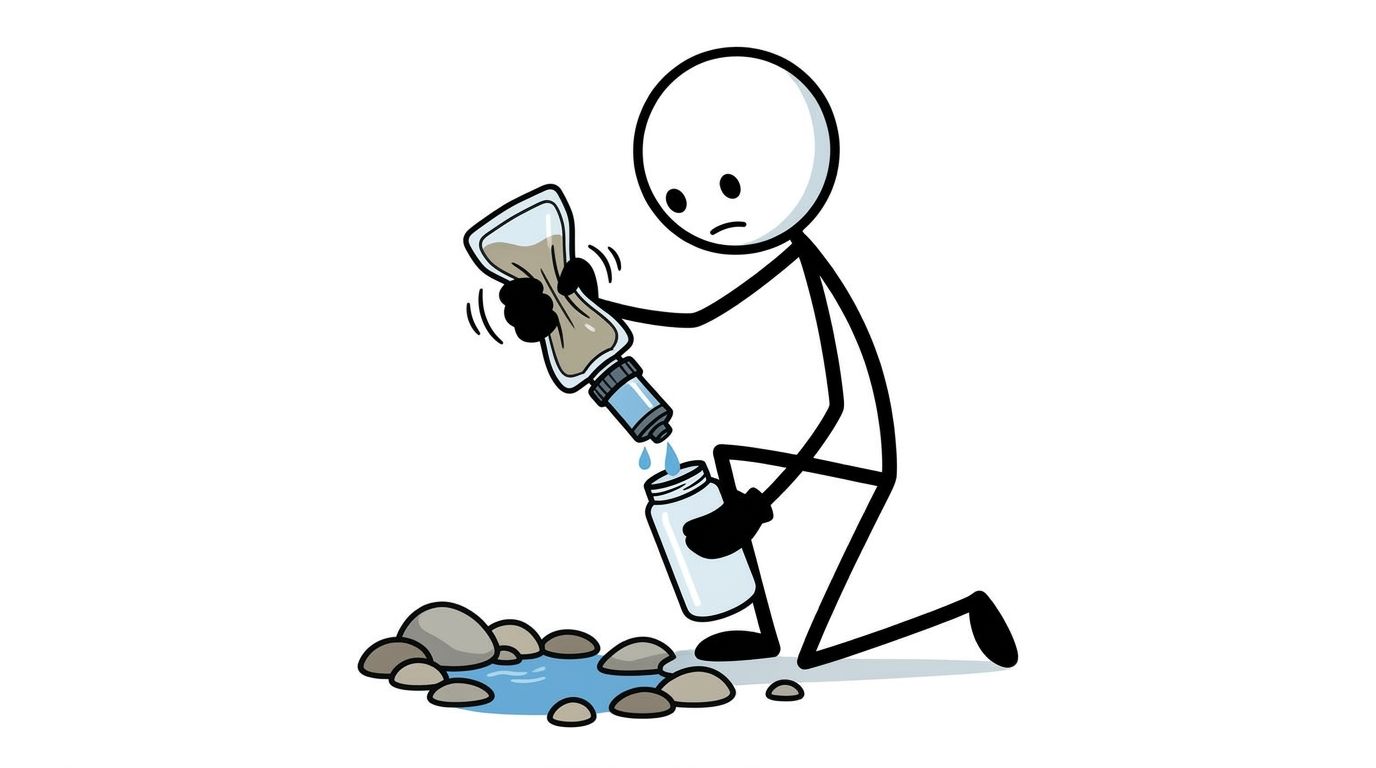
Portable microfilters bridge the gap between stationary water storage and unpredictable Survival Scenarioss. By utilizing advanced hollow-fiber membrane technology, these compact devices allow you to safely process thousands of gallons of water from questionable sources. They are lightweight, require no electricity, and have no moving parts to break down, making them the ultimate insurance policy for your hydration needs. For a quick definition, see water storage.
The Science of Hollow-Fiber Filtration
To understand why the Sawyer Squeeze and LifeStraw are so effective, it is necessary to understand the science of hollow-fiber membranes. Inside the casing of both filters are hundreds of microscopic, U-shaped tubes. These tubes look similar to bundles of raw spaghetti, but they are hollow and their walls feature microscopic pores. When contaminated water is forced through the filter, the water molecules are small enough to pass through the pores, but the physical size of bacteria and protozoa is too large.
The CDC classifies biological water contaminants into three main categories: protozoa, bacteria, and viruses. Protozoa (like Giardia and Cryptosporidium) range from 1 to 50 microns in size. Bacteria (like E. coli, Salmonella, and Cholera) range from 0.2 to 2 microns. To achieve safe drinking water, a filter must have an absolute pore size smaller than these pathogens.
Both the Sawyer Squeeze and the LifeStraw operate well below the threshold required to trap these dangerous organisms. By relying on physical size exclusion rather than chemical reactions, these filters provide instantaneous results. There is no waiting period, no chemical aftertaste, and no reliance on expiration dates associated with purification tablets. As long as the physical integrity of the hollow fibers remains intact, the filter will continue to block harmful bacteria and protozoa.
Contender 1: The LifeStraw Personal Water Filter
The LifeStraw is arguably the most recognizable water filter on the planet. Its origins are deeply rooted in global humanitarian efforts rather than recreational backpacking. Developed in 2005 by Vestergaard, the LifeStraw was originally designed as a tool to eradicate Guinea worm disease in developing nations - a mission spearheaded by the Carter Center. Its core design philosophy is absolute simplicity: a tool so intuitive that anyone, regardless of language or education, can use it immediately to prevent illness.
Specifications and Performance
The standard LifeStraw Personal Water Filter is a thick, cigar-shaped tube weighing a mere 1.62 ounces. It features a 0.2-micron hollow fiber membrane that is capable of filtering up to 1,000 gallons (4,000 liters) of water. It removes 99.999999% of waterborne bacteria and 99.999% of waterborne parasites, easily meeting EPA and NSF P231 standards for drinking water.
Because it is designed as a literal straw, there are no attachments, hoses, or separate bags required. The user simply un-caps both ends, places the bottom of the straw directly into the water source, and sucks water through the top mouthpiece. This direct-use mechanism makes it incredibly robust and practically foolproof in a high-stress survival situation.
The Advantages of LifeStraw
The primary advantage of the LifeStraw is its ease of use. In an emergency, fine motor skills degrade due to adrenaline and stress. The LifeStraw requires no assembly, no threading of caps, and no secondary containers. If you find a puddle, a stream, or a bucket of questionable water, you can hydrate immediately. This makes it an excellent choice for children, the elderly, or individuals who may not have the capacity to manage complex gear.
Furthermore, the LifeStraw is highly affordable. Because of its low price point, it is easy to stockpile multiple units. You can place one in the glovebox of every vehicle, inside every family member's bug-out bag, and in your primary home emergency kit without breaking the bank. It represents accessible, democratic preparedness at its finest.
The Limitations of LifeStraw
The simplicity of the LifeStraw is also its greatest limitation. Because it requires suction to draw water up through the filter, it is strictly a point-of-use device. You cannot easily use a LifeStraw to filter water into a clean container to carry with you. If you are moving away from the water source, you must carry the dirty water in a bottle and drink from that bottle using the straw later.
Additionally, drinking directly from a natural water source requires you to physically get down on your hands and knees near the water's edge. In a disaster scenario - such as a flooded urban street or a steep, muddy riverbank - this can be dangerous or highly impractical. The 1,000-gallon lifespan, while sufficient for short-term emergencies, is significantly lower than its competitors, making it less ideal for long-term, off-grid survival.
Contender 2: The Sawyer Squeeze
While the LifeStraw was born from humanitarian aid, the Sawyer Squeeze gained its legendary status on the long-distance hiking trails of America. Backpackers tackling the Appalachian Trail and the Pacific Crest Trail demanded a filter that was lightweight, incredibly durable, and capable of processing large volumes of water quickly. Sawyer Products delivered a system that has since become the gold standard for both outdoor recreation and serious emergency preparedness.
Specifications and Performance
The Sawyer Squeeze is a compact, cylindrical filter that weighs approximately 3 ounces. It utilizes an absolute 0.1-micron hollow fiber membrane, which is twice as fine as the LifeStraw's 0.2-micron rating. However, both ratings are more than sufficient for bacteria and protozoa removal. What truly sets the Sawyer Squeeze apart is its staggering lifespan: it is rated to filter up to 100,000 gallons of water.
The system is designed around versatility. The filter features standard 28mm threading on the bottom, allowing it to screw onto the included Mylar squeeze pouches or standard disposable water bottles (like SmartWater or soda bottles). The user fills the pouch with dirty water, attaches the filter, and squeezes the pouch to force clean water out the top into a secondary container or directly into their mouth.
The Advantages of the Sawyer Squeeze
Versatility is the defining characteristic of the Sawyer Squeeze. Unlike the LifeStraw, which limits you to immediate consumption, the Sawyer allows you to process and store clean water. You can squeeze clean water into a hydration bladder, a cooking pot, or a canteen. This is crucial in a survival scenario where you need to gather water, filter it, and keep moving.
The Sawyer Squeeze can also be configured in multiple ways. With the right adapters, it can be spliced directly into the drinking tube of a hydration bladder (inline filtration) or set up as a gravity filtration system at a basecamp. A gravity system allows you to hang a large bag of dirty water from a tree, letting gravity push the water through the filter into a clean receptacle below, freeing up your hands for other survival tasks.
Finally, the 100,000-gallon lifespan is achieved through field maintainability. The Sawyer kit includes a cleaning plunger (a large plastic syringe). When the flow rate begins to slow down due to silt and debris clogging the pores, you simply force clean water backward through the filter - a process known as backflushing. This clears the microscopic pores and restores the filter to nearly its original flow rate, ensuring it lasts for years of daily use.
The Limitations of the Sawyer Squeeze
The Sawyer system requires more active management than the LifeStraw. The included Mylar squeeze pouches are notorious for failing over time; squeezing them too hard near the neck can cause them to split or burst. Preparedness experts often recommend discarding the factory pouches and replacing them with highly durable CNOC Vecto bags or relying on standard PET plastic water bottles.
Furthermore, the Sawyer Squeeze requires a clean water container and a dirty water container to function optimally. If you lose your dirty water collection pouch, the filter becomes much harder to use. The backflushing process, while essential for longevity, also means you must keep track of the cleaning syringe and ensure you have clean water available to perform the flush.
Head-to-Head: Sawyer vs LifeStraw
When evaluating the sawyer vs lifestraw debate for emergency preparedness, we must look at how these devices perform across several distinct metrics. The best survival water filter is the one that aligns with your specific disaster response plan, whether that involves huddling in a storm shelter or hiking 50 miles to safety.
1. Flow Rate and Processing Speed
In a survival situation, time and energy are precious commodities. The Sawyer Squeeze, when attached to a durable pouch and squeezed with moderate pressure, can output roughly 1.7 liters of clean water per minute. This allows you to quickly fill multiple bottles for a family and move on. The LifeStraw's flow rate is entirely dependent on your lung capacity and suction power. It is sufficient for personal hydration but incredibly inefficient if you are trying to provide water for multiple people or gather water for rehydrating freeze-dried survival meals.
2. Lifespan and Maintenance
The Sawyer Squeeze dominates in longevity. At 100,000 gallons, a single Sawyer filter could theoretically provide a family of four with their FEMA-recommended daily water intake for decades. However, this longevity requires the discipline to backflush the filter regularly. The LifeStraw, rated for 1,000 gallons, will eventually clog permanently. Once a LifeStraw reaches the end of its lifespan, it stops drawing water, acting as a fail-safe so you never accidentally drink contaminated water. For a short-term 72-hour kit, 1,000 gallons is more than enough. For long-term grid-down scenarios, the Sawyer is superior.
3. Versatility and Water Storage
As previously established, the LifeStraw is a point-of-use tool. If you are bugging out and cross a river, you can drink your fill, but you cannot easily take clean water with you unless you carry the dirty water and drink through the straw as you hike. The Sawyer Squeeze acts as a miniature water treatment plant. You can process dirty water into clean storage vessels, allowing you to hydrate safely while miles away from the water source. This makes the Sawyer fundamentally better for mobile family emergency plans.
4. Ease of Use Under Duress
Stress degrades cognitive function. If you are injured, exhausted, or dealing with panicked family members, complex gear becomes a liability. The LifeStraw shines in its absolute simplicity. Hand a LifeStraw to a frightened child and tell them to drink from a bucket; they will intuitively understand how to use it. The Sawyer Squeeze requires assembling parts, distinguishing between "dirty" and "clean" containers, and understanding not to cross-contaminate the clean side of the filter. This requires prior training and practice.
Crucial Vulnerabilities: What Neither Filter Can Do
A critical aspect of emergency water purification is understanding the limitations of your gear. While hollow-fiber membranes are miraculous for removing bacteria and protozoa, they are not invincible. Relying blindly on a microfilter without understanding local water threats can lead to severe consequences.
The Threat of Viruses
Standard microfilters do not remove waterborne viruses. Viruses, such as Norovirus, Rotavirus, and Hepatitis A, are incredibly small - often ranging from 0.02 to 0.04 microns. Because they are smaller than the 0.1 or 0.2-micron pores of the Sawyer and LifeStraw, they can pass right through the membrane.
In pristine North American wilderness environments, waterborne viruses are exceedingly rare, which is why backpackers rely solely on these filters. However, in a disaster scenario - such as a massive flood, an earthquake that ruptures sewage lines, or a crowded refugee camp - human waste can contaminate surface water, introducing viral threats. The CDC advises that in situations where viral contamination is suspected, filtration must be paired with chemical disinfection. Adding a secondary purification step, such as chlorine dioxide tablets or boiling the water after it has been filtered, provides comprehensive protection.
Chemicals, Heavy Metals, and Toxins
According to the United States Geological Survey (USGS), flooding often overwhelms industrial sites, agricultural lands, and urban infrastructure, washing massive amounts of chemicals into the watershed. Neither the Sawyer Squeeze nor the standard LifeStraw can remove dissolved chemicals, heavy metals (like lead or arsenic), pesticides, or petroleum products.
If you are sourcing water from an urban environment post-disaster, you must be hyper-vigilant about where you draw your water. Avoid floodwaters containing visible oil slicks or water sourced near industrial zones. While some advanced filters incorporate activated carbon to reduce chemical tastes and odors, a standard microfilter only targets biological threats. Always prioritize the cleanest, clearest source water available before filtering.
The Danger of Freezing Temperatures
Both the Sawyer Squeeze and the LifeStraw share a critical physical vulnerability: freezing temperatures will destroy them. Because they rely on microscopic hollow tubes, any residual water left inside the filter will expand when frozen. This expansion shatters the delicate fibers, rendering the filter completely useless against bacteria and protozoa. Worse, the damage is internal and invisible to the naked eye.
If you are operating in winter environments, you must keep your water filter close to your body. During the day, keep it in an inside jacket pocket. At night, place it inside your sleeping bag. If you suspect your filter has frozen even once, you must discard it and replace it immediately to avoid the risk of consuming contaminated water.
Choosing the Right Filter for Your Survival Plan
The debate over the best survival water filter ultimately comes down to context. Preparedness is not a one-size-fits-all endeavor. How you plan to survive dictates the gear you should carry. Here is how to deploy these filters effectively based on common emergency scenarios.
The Bug-Out Bag (Evacuation Kits)
If you are forced to evacuate on foot or navigate disrupted infrastructure, mobility and versatility are paramount. In this scenario, the Sawyer Squeeze is the clear winner. Its ability to process water into clean containers means you can hydrate on the move. You can quickly filter water from a park fountain or a stream into your canteen and continue your evacuation without being tethered to the water source. The minor weight penalty (3 ounces) is negligible compared to the massive tactical advantage of portable water storage.
The Vehicle Emergency Kit
Vehicles offer more storage capacity but are subject to extreme temperature fluctuations. While you must still protect water filters from freezing in a car, the low cost and simplicity of the LifeStraw make it an excellent addition to a glovebox kit. If you break down on a remote highway and run out of stored water, a LifeStraw allows you to safely drink from a roadside ditch or creek while waiting for rescue. Because they are inexpensive, you can stock multiple units for every passenger.
Home Sheltering (Grid-Down Scenarios)
When sheltering in place during a boil-water advisory or a prolonged grid-down event, you are likely dealing with larger volumes of water for an entire family. Here, a gravity-fed system is ideal. You can purchase a high-capacity gravity bag and attach the Sawyer Squeeze to the bottom. Hang the system in your kitchen or bathroom, and let gravity do the work of filtering gallons of water while you focus on home security, food preparation, or medical needs. The LifeStraw is simply too labor-intensive for sustaining a household over multiple days.
The Layered Approach
True emergency preparedness relies on the principle of redundancy: "Two is one, and one is none." The most robust strategy is not to choose between the Sawyer Squeeze and the LifeStraw, but to utilize both within a layered system. A Sawyer Squeeze serves as your primary workhorse for processing large volumes of water and filling canteens. A LifeStraw serves as a lightweight, foolproof backup that can be handed to an untrained family member or used immediately if your primary system fails or is lost.
Mastering Your Gear Before Disaster Strikes
Purchasing a water filter and leaving it sealed in its original packaging inside a closet is a critical error. In the chaos of an emergency, you do not want to be reading instruction manuals by flashlight. To ensure your emergency water purification plan is viable, you must test your gear. Take your Sawyer Squeeze or LifeStraw on a weekend hike. Practice filling the dirty water pouches, threading the filter correctly, and performing a backflush cycle. Familiarize yourself with the flow rate and the physical effort required to operate the device.
Furthermore, integrate secondary purification methods into your practice. Purchase a reliable brand of chlorine dioxide tablets and understand the required wait times (often up to 4 hours for maximum efficacy against viruses). Learn how to build a safe fire to boil water, understanding that the CDC recommends bringing water to a rolling boil for one minute (or three minutes at elevations above 6,500 feet) to kill all pathogens.
The transition from relying on municipal utilities to sourcing your own water is one of the most profound shifts in a disaster scenario. It requires a fundamental understanding of local water sources, potential contaminants, and the exact mechanical capabilities of your gear. By respecting the limitations of microfiltration and adhering to rigorous maintenance protocols, you can eliminate the threat of waterborne illness entirely.
Whether you choose the unmatched versatility and lifespan of the Sawyer Squeeze or the rugged, foolproof simplicity of the LifeStraw, taking the step to secure a portable water filter drastically increases your resilience. You are no longer at the mercy of fragile infrastructure or delayed rescue efforts. By taking control of your hydration, you empower yourself to navigate crises with clarity, sustain your family through prolonged emergencies, and survive the unpredictable challenges of a disrupted world.
For broader buying research, use the preparedness product comparisons hub to compare emergency gear categories before you spend money. If you are narrowing a decision between two specific options, the survival gear vs comparisons page keeps those head-to-head choices organized.
Compare water filter options through our water and food storage guide. Learn water safety from our emergency water storage guide. Calculate filter needs with our water calculator. Build filtration kits with our go-bag builder. Master water purification through our preparedness courses.
Frequently Asked Questions
Is Sawyer or LifeStraw better for survival?
Sawyer Squeeze is generally preferred for long-term survival due to its higher capacity (100,000 gallons vs LifeStraw's 1,000 gallons) and ability to filter into containers.
Can LifeStraw remove viruses?
Standard LifeStraw filters bacteria and parasites but not viruses. The LifeStraw Mission and some newer models include virus filtration.
How long do survival water filters last?
Sawyer Squeeze: up to 100,000 gallons with backflushing. LifeStraw: up to 1,000 gallons (about 5 years for one person).
Which water filter is best for a bug out bag?
Both are lightweight and packable. Sawyer Squeeze is more versatile (gravity feed, squeeze, inline), while LifeStraw is simpler (just drink through it).
Do I need a water filter in my emergency kit?
Absolutely. FEMA recommends 1 gallon per person per day. If your stored water runs out, a filter lets you safely use natural water sources.
Compare water filtration and storage options. Review private well preparedness techniques. Develop emergency preparedness strategies. Calculate needs with our water calculator and explore our courses.
Sources & Further Reading
Related resource: Real-World Emergency Scenarios Guide.