⚡ Key Facts
- The Critical Window: According to the Federal Emergency Management Agency (FEMA), emergency responders can take anywhere from minutes to several hours to establish access to secured facilities during regional disasters, making immediate self-sufficiency essential for school staff.
- Trauma Survival Rates: Research from the American College of Surgeons (ACS) "Stop the Bleed" program demonstrates that an individual suffering severe arterial hemorrhage can succumb to blood loss within 3 to 5 minutes—long before field medics can breach an active scene.
- Backpack Ergonomics: The American Academy of Pediatrics (AAP) recommends that a child's backpack weigh no more than 10% to 15% of their total body weight, requiring compact, multi-use packing strategies for student emergency pouches.
- Disaster Frequency: The National Oceanic and Atmospheric Administration (NOAA) tracks an average of 1,200 tornadoes and dozens of extreme convective storm events across the United States annually, many striking during standard operating school hours.
- Sanitation Deficits: In extended lockdown or shelter-in-place events exceeding three hours, standard facilities become inaccessible, making bio-waste containment one of the most frequently overlooked classroom liabilities.
During a crisis on campus, time collapses. Whether an incident stems from an atmospheric event like an EF3 tornado warning, an industrial hazardous-material plume, or an active threat prompting an immediate facility lockdown, the modern classroom transforms instantly from a center of learning into a self-contained survival shelter. When the exterior doors seal and sirens wail, teachers transition from educators to operational incident commanders responsible for dozens of vulnerable lives. Preparing for these high-stress events cannot rely on improvised solutions or scattered supplies; it demands a structured, modular system developed before the alarm sounds. For the practical checklist side, use the community emergency preparedness guide.
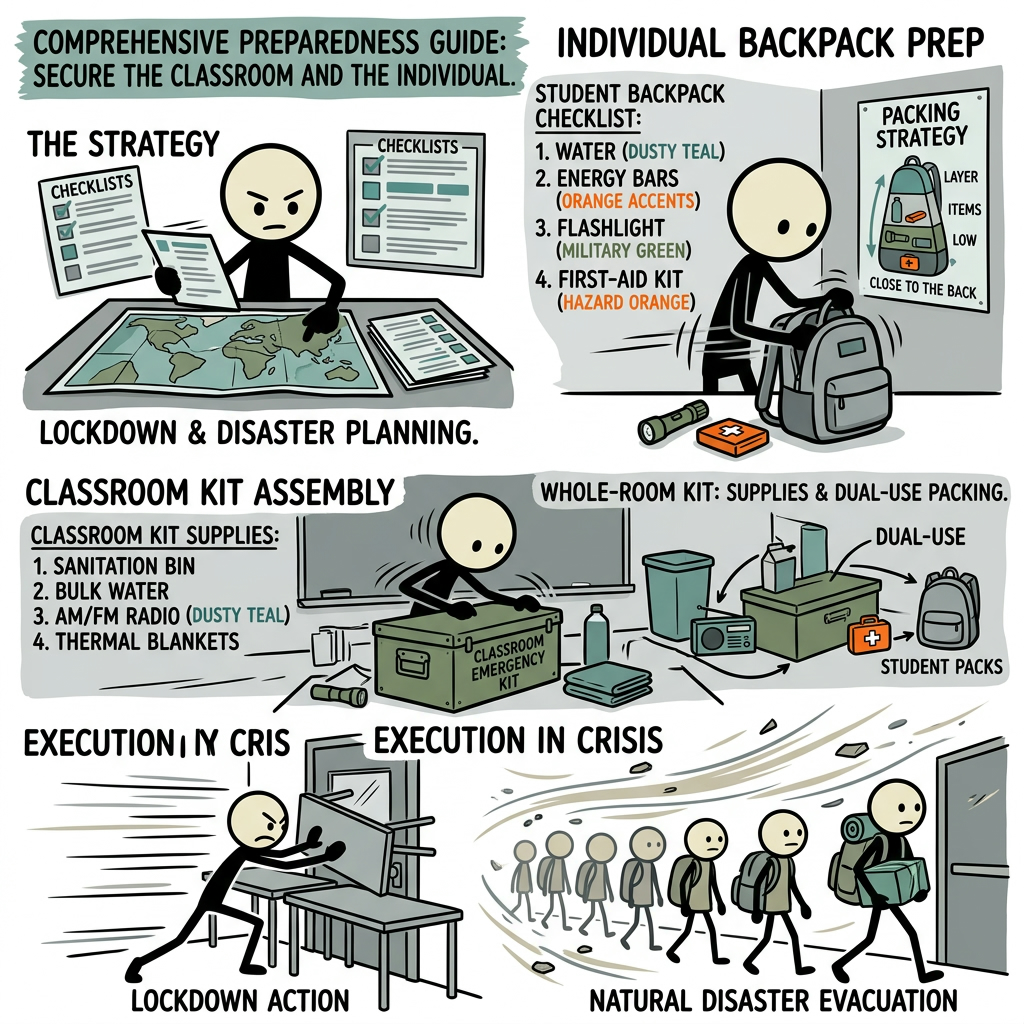
True resilience in an educational environment relies on a coordinated, two-tiered operational model: individual student readiness combined with comprehensive room-level capabilities. By outfitting students with low-profile, non-disruptive personal kits and equipping classrooms with robust, multi-hazard emergency modules, school districts and families can mitigate panic, treat traumatic injuries, maintain emergency communication plan, and sustain morale through extended operational interruptions. This guide outlines the logistical requirements, technical checklists, and tactical considerations needed to establish absolute readiness across both tiers.
The Threat Architecture: Dual-Scenario Readiness
School emergencies fall into two primary operational profiles: shelter-in-place incidents (including hostile lockdowns and external environmental hazards) and rapid evacuation events (such as seismic activity, interior structural fires, or post-impact storm departures). Each profile exerts distinct pressures on students and staff, dictating the physical tools required inside the room. For the practical checklist side, use the neighborhood preparedness network.
In rapid evacuation scenarios, mobility is paramount. Classrooms must clear structures within minutes, navigating blocked corridors or compromised stairwells to reach exterior staging areas. Classroom emergency supplies must therefore be transportable in a single, hands-free loadout carried by the educator, while students carry only their immediate personal protection gear. For the practical checklist side, use the family emergency planning guide.
Conversely, extended shelter-in-place events force occupants to isolate within their assigned square footage for hours—sometimes overnight. Under these conditions, the environment rapidly degrades: municipal power may fail, climate control ceases, plumbing becomes off-limits or non-functional, and the psychological strain on young minds compounds minute by minute. Designing an effective school disaster kit checklist requires balancing the rapid mobility of a grab-and-go kit with the deep sustainability required for prolonged confinement.
Understanding the "First 60 Minutes" Rule
In real-world emergency scenarios guide doctrine, the initial hour following an incident is termed the Golden Hour, where intervention dramatically alters trauma survival curves. For school personnel, the first 60 minutes are rarely managed by municipal emergency medical services (EMS); they are managed exclusively by on-site educators and staff. Classroom kits must prioritize life safety—specifically rapid hemorrhage control, airway management, and physical containment—before addressing comfort, sustenance, or hydration.
Once life threats are stabilized, the operational phase shifts to maintenance: keeping students calm, hydrated, and accounted for while maintaining situational awareness via local emergency broadcasting networks.
Tier 1: The Student Everyday Emergency Pouch (EDC)
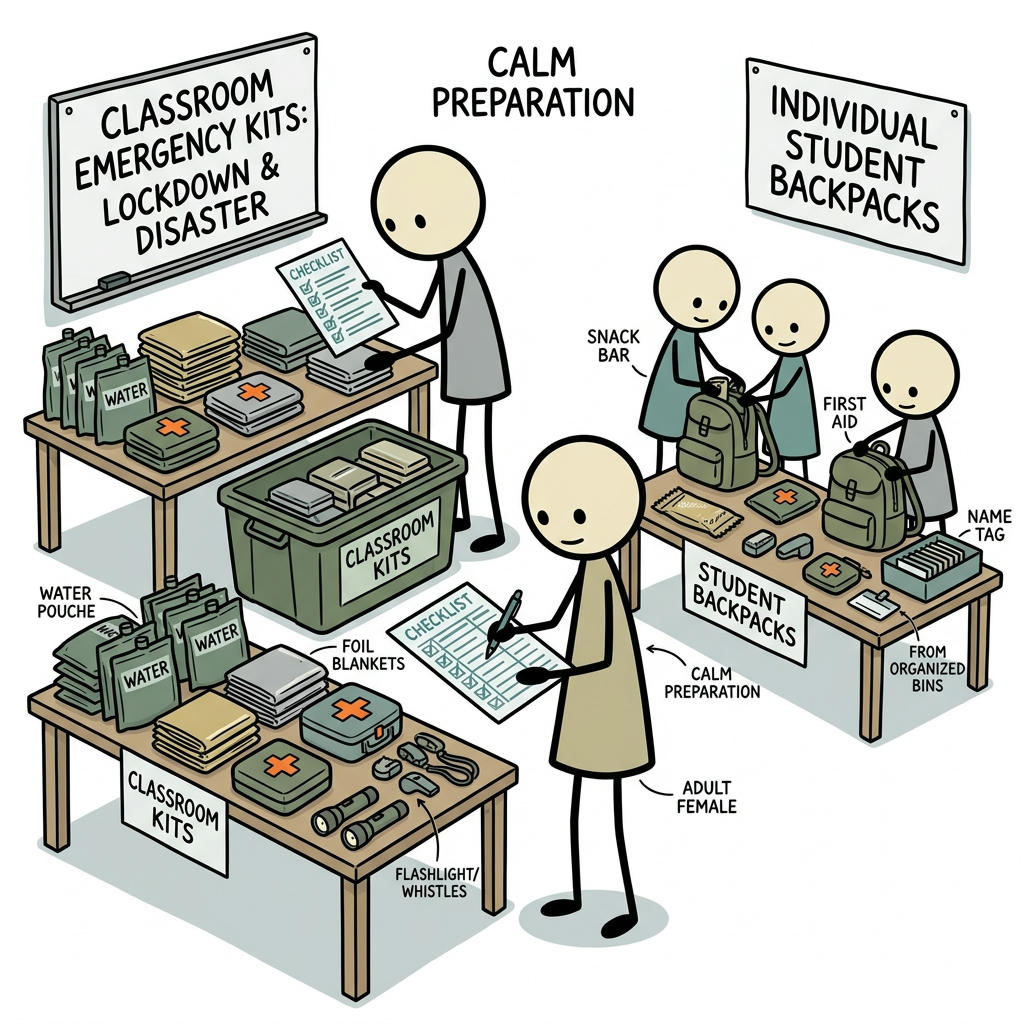
Student emergency preparedness must balance thorough utility with daily practicality. Children cannot carry heavy survival gear alongside textbooks, digital devices, and athletic uniforms. Furthermore, personal survival gear must comply fully with school district safety policies and administrative codes.
The solution is an ultra-compact, lightweight "Everyday Carry" (EDC) emergency pouch designed to sit at the base of the student’s main compartment year-round. This pouch should be housed in a durable, bright-colored, water-resistant zip pouch (such as a 500D Cordura nylon or reinforced vinyl organizer) weighing no more than 1.5 to 2.5 pounds total.
Student Emergency Pouch Checklist
- Identification & Emergency Contact Dossier: A laminated card listing parents'/guardians' primary and secondary phone numbers, out-of-state emergency contacts (critical during overloaded local cellular networks), baseline medical history, daily medications, and known severe allergies.
- Auxiliary Illumination: One compact, durable LED keychain light or micro-flashlight with a lockout function to prevent accidental battery discharge, providing independent mobility in blacked-out hallways.
- Emergency Whistle: A pealess safety whistle (such as a Fox 40 design) that functions even when wet, allowing a trapped or separated student to signal location through rubble or structural smoke without exhausting their vocal cords.
- Personal Hydration & Calorie Reserve: One 4.22 fl. oz. vacuum-sealed emergency water pouch (5-year shelf life) and two high-calorie, nut-free, temperature-resilient food bars compliant with standard school dietary rules.
- Protective Barrier Equipment: One pair of nitrile gloves, two surgical face masks or KN95 respirators (rated to filter dust, particulates, and biological aerosols), and an emergency mylar space blanket for hypothermia prevention.
- Personal Comfort & Hygiene: A travel pack of sanitary wet wipes, two individual sterile adhesive bandages, and a small, family-provided comfort item (such as a written family note or pocket-sized photo) to mitigate panic and acute stress reaction.
- Critical Daily Medication: If approved under district health plans, a 24-to-48-hour self-administered backup supply of essential prescription medication (e.g., inhaler, chewable antihistamines) labeled in original pharmaceutical containers.
Packing Strategy for Students
The student emergency pouch should reside at the bottom or back panel of the backpack, maintaining a low center of gravity to protect musculoskeletal health as outlined by the AAP. Students should be taught that this pouch is an absolute "no-touch" zone during regular school operations; it is not for casual snacking or sharing supplies with classmates during routine school days. Run a drill at home at the beginning of each academic term, testing the student's ability to locate the pouch blindly in a low-visibility or simulated zero-light setting.
Tier 2: The Master Classroom Emergency Kit
While student pouches provide individual contingency support, the primary survival burden rests on the whole-room classroom emergency supplies. When municipal lifelines are severed, this centralized module converts four drywalled walls into a self-sufficient shelter.
The most functional, field-tested vessel for a classroom kit is not a soft duffel bag or rolling plastic bin; it is a heavy-duty, gasket-sealed 5-gallon utility bucket equipped with an emergency toilet seat conversion lid. The rigid bucket protects sensitive medical consumables from classroom wear, keeps vermin and water out, supports heavy loads, and serves an essential dual-role operational function during extended lockdown lockdowns.
Modular Organization: The Five Survival Pillars
A disorderly container will fail under stress. Classroom kits should be packed using transparent, color-coded internal pouches (or heavy-duty dry bags) organized according to the five survival priorities: Immediate Trauma, Perimeter Control & Lockdown, Hydration & Sustenance, Bio-Sanitation, and Command/Signaling.
1. Trauma & Medical First Aid Module
Standard retail first-aid kits are designed for minor abrasions, small lacerations, and headaches; they are entirely inadequate for high-consequence disasters or dynamic hostile incidents. The trauma module of a school emergency kit must integrate equipment aligned with Tactical Emergency Casualty Care (TECC) guidelines and the Department of Homeland Security's (DHS) "Stop the Bleed" program.
- Mechanical Tourniquets: Minimum two Committee on Tactical Combat Casualty Care (CoTCCC)-approved windlass tourniquets (e.g., CAT Gen 7 or SOFTT-W). Tourniquets should be staged outside plastic wrappers, pre-threaded for immediate one-handed or pediatric/adult limb application.
- Hemostatic Gauze: Two to four rolls of kaolin-impregnated or chitosan-based hemostatic gauze (e.g., QuikClot Combat Gauze) to accelerate internal blood clotting within junctional zones (groin, axilla, neck) where tourniquets cannot be placed.
- Pressure Dressings: Two 4-inch or 6-inch elastic compression bandages (e.g., Israeli Bandage or Emergency Trauma Dressing) capable of exerting direct mechanical pressure over packed wounds.
- Vented Chest Seals: Two pairs of vented occlusive chest seals designed to seal penetrating thoracic trauma while preventing tension pneumothorax.
- Splinting & Stabilization: One moldable aluminum foam splint (e.g., SAM Splint) and two triangular cravats to immobilize musculoskeletal fractures caused by structural collapses or falls during severe weather.
- Hypothermia Mitigation: Four reinforced, aluminized heat-reflective blankets. Shock, whether caused by severe blood loss or hypothermia, degrades coagulopathy rapidly; preserving core body temperature is a critical medical intervention.
- Personal Protective Equipment (PPE): Ten pairs of powder-free nitrile examination gloves (sizes medium and large), four sets of protective eyewear, and two CPR pocket masks equipped with one-way valves.
- General Medical Sundries: High-leverage 7.25-inch trauma shears (capable of slicing through thick winter coats and denim), heavy medical tape (cloth or duct), assorted sterile dressings, and antiseptic washes.
2. Perimeter Lockdown & Tactical Hardware Module
During an active-threat protocol, educators must secure the physical perimeter instantly, minimize room signatures, and establish tactical depth. A school lockdown kit must contain non-lethal, practical hardware designed to delay breaches and control visual profiles.
Every second spent struggling with window latches or searching for a door barricade is a direct threat to student safety. These items should sit at the very top of the room kit for immediate access.
- Heavy-Duty Commercial Door Wedges: Two to three vulcanized, non-slip rubber wedges. Driven underneath the interior side of an inward- or outward-swinging door, these significantly increase the physical force required for exterior breach attempts.
- Rapid Blackout Curtains / Sheeting: Pre-cut, dense black vinyl or opaque fabric sheets fitted with heavy-duty magnets or industrial hook-and-loop tape tailored to the specific dimensions of the classroom's door vision panel and hallway-facing internal windows.
- High-Tensile Mechanical Strapping: A 1-inch-wide ratchet strap or heavy-duty tubular webbing sling, capable of cinching down scissor-hinge overhead hydraulic door closers to secure commercial doors lacking interior manual deadbolts.
- Industrial Duct Tape & Paracord: One 60-yard roll of 2-inch reinforced duct tape and 100 feet of military-grade 550 paracord for structural jury-rigging, securing blackout curtains, or affixing secondary defensive measures.
- Dry-Erase Accountability Placards: Double-sided green/red/black signal cards (or heavy cardstock) to slip under exterior doors or press to outside windows during first responder sweeps, communicating room casualties, occupancy status, or complete clearance without vocalizing.
3. Sanitation & Biological Waste Module
Human biological waste becomes an immediate logistical and psychological issue when plumbing lines fail after a seismic event or when students are locked in a room for 6, 8, or 12 hours. Without functional facilities, sanitation breaks down, dignity is compromised, and the risk of biological contamination escalates.
The 5-gallon master bucket serves as the foundation for this module. When emptied of its internal sub-kits, the bucket functions directly as a secure chemical commode.
- Snap-On Commode Seat Lid: A molded plastic toilet seat and integrated cover lid designed to lock securely over the rim of any standard 5-gallon utility bucket (e.g., Luggable Loo conversion lid).
- Heavy-Duty Biohazard Waste Bags: Minimum 10 to 15 double-ply, 1.5-mil thick leak-resistant waste bags sized precisely for 5-gallon receptacles.
- Absorbent Solidifier / Cat Litter: A sealed container of absorbent polymer powder or chlorinated deodorizing solidifier (e.g., Poo Powder or lightweight crystalline cat litter). A single scoop immediately solidifies liquids, manages noxious odors, and neutralizes pathogens.
- Sanitary Supplies: Two full rolls of individually wrapped toilet tissue, one large container of hospital-grade disinfectant wipes, and two bottles of broad-spectrum, alcohol-based hand sanitizer (minimum 60% alcohol, as recommended by the CDC).
- Privacy Screen: A lightweight, compact pop-up shelter fabric, or a large, opaque 8x10-foot dark tarp complete with spring-loaded tension clamps, allowing educators to instantly create a visual privacy corner in the rear of the classroom.
4. Hydration, Sustenance & Environmental Comfort
Extreme weather events can knock out municipal electrical grids and leave entire campuses without heat, light, or running water. In freezing conditions, a structure loses ambient heat rapidly; in summer, stagnant classrooms can induce heat exhaustion. The school emergency kit must provide baseline thermodynamic and caloric support.
Consumables must be shelf-stable, resistant to extreme seasonal temperature cycling, and allergen-conscious. Avoid supplies that require clean water, fuel stoves, or heat sources for preparation.
- Emergency Drinking Water Pouches: Vacuum-sealed, flexible 4.22-ounce drinking water pouches engineered to withstand temperature variations from -40°F to 210°F without bursting or leeching chemicals (e.g., Datrex, Mainstream, or SOS Food Lab brands). Plan for a minimum of two pouches per student for baseline survival over a standard 8-to-12-hour isolation window.
- Hypoallergenic Ration Bars: Food items must be 100% nut-free, dairy-free, and non-thirst-provoking. Specialized survival food biscuits engineered with regulated calorie distributions ensure students sustain steady blood sugar levels without precipitating allergic emergencies.
- Thermal Space Blankets: Minimum 15 to 30 mylar survival blankets. In winter storms, multiple children can be grouped under shared blankets to capture and recirculate metabolic body heat.
- Instant Thermal Packs: A box of instant chemical cold packs (for heat exhaustion and sprain stabilization) and instant air-activated hot packs (to stave off peripheral frostbite or soothe acute anxiety).
5. Command, Lighting & Environmental Monitoring
Classrooms plunged into darkness devolve quickly into confusion. Mobile phones are poor tools for primary light and situational updates; their batteries deplete rapidly, and cell towers frequently crash or choke during widespread emergencies. Standalone, ruggedized technical infrastructure is essential.
- NOAA Weather / Multi-Band Radio: A dedicated, hand-crank and solar-chargeable radio receiver with access to National Weather Service broadcasts, local AM/FM channels, and an integrated auxiliary charging port to preserve teacher communication lines.
- Low-Signature Illumination: Two high-output LED lanterns with stepped down-lighting (adjustable lumen settings) and at least four red/white LED headlamps. Headlamps free up both hands for triage, barricading, or manual tasks, while red-light modes preserve night vision and avoid casting exterior shadows during lockdown events.
- Industrial Chem-Lights: A box of 10 to 15 military-grade, 6-inch snap-lights (green and red). Chem-lights emit zero heat, produce no fire hazard, require no electrical cells, and provide reliable, passive ambient illumination for up to 12 hours.
- Multi-Tool & Structural Entry/Exit Implements: A heavy-duty multi-tool featuring locking pliers, wire cutters, a serrated blade, and screwdrivers. Also include a standardized four-way sillcock key to access municipal water bibs on exterior building walls if water main pressure survives.
- Administrative Accountability Binder: Housed within a sealed waterproof pouch: the up-to-date classroom student roster, special needs tracking forms, primary/secondary evacuation maps, school emergency protocol flip charts, industrial permanent markers (Sharpies), waterproof notepads (e.g., Rite in the Rain), and high-visibility reflective educator vests.
Tactical Execution: Natural Disasters vs. Hostile Lockdowns
Possessing gear is meaningless without a clear operational framework. Supplies must be deployed differently depending on the nature of the crisis. Educators should memorize these tactical adaptations to match their actions to the surrounding hazard environment.
Adapting for Natural Hazards (Earthquakes, Severe Convective Storms)
When geological or meteorological warnings occur, immediate physical safety comes first. For seismic activity, the United States Geological Survey (USGS) dictates an immediate Drop, Cover, and Hold On posture under reinforced furniture away from exterior glass. During tornado warnings, as emphasized by NOAA, classrooms must move rapidly to interior structural corridors on the lowest floor.
In these events, the master classroom kit is hauled immediately to the secondary staging zone. Once the event passes, utility lines are often compromised. The primary threats are gas leaks, shattered glass, falling ceiling infrastructure, and electrical failures. First aid must be deployed immediately for lacerations and crushing injuries, while the sillcock key and utility shutoff knowledge become critical to prevent post-event structural fires or contamination.
Adapting for Active Hostile Threats
During an active security emergency, the room kit’s priority flips from sustainment to total sensory concealment and trauma readiness. Every light source in the room must be killed. The perimeter lockdown module takes immediate precedence: drive door wedges into the floor, fasten mechanical braces to overhead hydraulic closers, deploy blackout panels over viewports, and herd students into dead-space corners out of the direct line of sight of exterior hallway windows.
During this acute, silent phase, silence is life. No radios are activated unless fitted with a tactile ear-piece. Chem-lights remain uncracked. The trauma kit is opened quietly and positioned directly next to the adult coordinator, ready for immediate, silent deployment should an explosive or ballistic breach occur. Do not access the bio-waste commode unless an extended lockdown spans past the immediate threat phase and first-responder incident commanders have stabilized the perimeter.
Classroom Disaster Kit Checklist: Master Inventory Matrix
Use the following structural matrix as an audit template to build, balance, and verify classroom emergency supplies across the academic year.
| Category | Item Description | Target Quantity | Replacement / Audit Cycle |
|---|---|---|---|
| Trauma Care | CoTCCC Tourniquets (CAT/SOFTT-W) | 2 units | Inspect annually; replace if deployed |
| Trauma Care | Hemostatic Gauze (Kaolin-based) | 2–4 packages | Check expiration (typically 3–5 years) |
| Trauma Care | Compression Bandages & Chest Seals | 2 each | Check seal integrity every 12 months |
| Lockdown | Heavy Vulcanized Door Wedges | 3 units | Indefinite; check for rubber dry-rot |
| Lockdown | Custom Blackout Window Shades | Specific to room | Inspect adhesive/magnets twice a year |
| Lockdown | Ratchet Strap / Closure Webbing | 1 unit | Indefinite shelf life |
| Sanitation | 5-Gal Bucket + Commode Lid | 1 system | Inspect plastic for stress cracks yearly |
| Sanitation | Biohazard Liners & Polymer Solidifier | 10 bags / 1 shaker | Replace solidifier if clumped/compromised |
| Sustenance | Hermetic Emergency Water Pouches | 50–60 pouches | 5-year factory expiration date |
| Sustenance | Nut-Free Caloric Survival Bars | 30 rations | 5-year factory expiration date |
| Command | NOAA Multi-Band Emergency Radio | 1 unit | Test run and battery cycle every 6 months |
| Lighting | 12-Hour Industrial Chem-Lights | 15 units | 4-year shelf life; check packaging |
Maintenance Logistics: The Bi-Annual Readiness Cadence
A school lockdown kit is only as reliable as its most recent maintenance check. Over time, plastic packaging becomes brittle, adhesive tapes degrade in unconditioned summer classrooms, and emergency batteries slowly self-discharge. Emergency preparedness requires an established operational schedule to prevent supply failure.
School safety committees should institutionalize a strict Bi-Annual Inspection Cadence coordinated with the academic calendar:
Audit Benchmark 1: The August Pre-Term Verification
Prior to student arrival in late summer, teachers and facility managers must perform a comprehensive inventory of the classroom bucket. Unpack the contents and cross-check them against the laminated checklist secured to the underside of the lid. Ensure medical products remain hermetically sealed; discard and replace any dressing whose sterile packaging has lost its vacuum seal. Install fresh alkaline batteries into flashlights and radios, and confirm that the commode lid snaps cleanly and firmly onto the bucket rim.
At the same time, verify that administrative documentation is current. Update printed class rosters, identify students with individualized education programs (IEPs) or critical medical alerts, and restock personal comfort supplies.
Audit Benchmark 2: The January Mid-Year Reset
Upon return from winter recess, run a secondary operational check. Extreme temperature swings between active heating hours and unheated holiday breaks can accelerate the breakdown of chemical heat packs, sanitizing wipes, and adhesive products. Ensure that student EDC pouches have returned to backpacks after the holidays, and rotate any water rations approaching their expiration dates.
This mid-year reset is also the optimal window for staff to run a simulated deployment drill: secure the room, extract the trauma pouch, mount the door lockdown hardware, and set up the commode and privacy screen within a timed two-minute window. Tactical muscle memory built during quiet periods is what preserves clarity and order during an actual crisis.
Building a Resilient Campus Culture
Equipping classrooms with high-grade emergency modules is not an admission of vulnerability; it is a foundational investment in operational resilience. Panic is the natural psychological consequence of finding oneself trapped in a catastrophic situation without options, tools, or a plan. Conversely, when educators and students know that reliable trauma supplies, physical containment hardware, and basic survival necessities are secured within arm's reach, confidence replaces anxiety.
True safety in the modern educational environment is achieved when comprehensive gear matches thorough, decisive training. By outfitting individual student backpacks with light, practical emergency essentials and deploying structured, robust classroom emergency kits across every campus building, school communities take direct ownership of their safety. When the unexpected occurs, preparation stands firm, protocols run smoothly, and lives are saved.
Frequently Asked Questions
What is a classroom emergency 'go-bucket' and what should it contain?
A classroom go-bucket is a heavy-duty 5-gallon bucket containing critical lockdown and evacuation supplies, including a comprehensive first aid kit, flashlights, emergency whistle, student roster, emergency foil blankets, non-perishable rations, water packets, and basic sanitation items.
What individual emergency supplies should parents pack in a child's backpack?
Parents should provide a laminated emergency contact card, a family reunification plan, a compact flashlight or glow stick, a bottle of water, high-calorie nut-free snacks, a rain poncho, and a recent family photo for identification and emotional comfort.
How should prescription medications be managed for school emergencies?
Prescription medications such as inhalers, insulin, or EpiPens must be registered through the school nurse and coordinated under an individualized emergency action plan, ensuring an extra 72-hour supply is accessible during lockdowns or evacuations.
How do classrooms manage sanitation during an extended lockdown?
Classrooms prepare for extended sheltering by outfitting a 5-gallon bucket with heavy-duty trash liners, a snap-on toilet seat lid, absorbent deodorizing powder or kitty litter, hand sanitizer, wet wipes, and a pop-up privacy sheet or tarp.
How often should school and backpack emergency kits be inspected?
Kits should be inspected twice each school year—once at the start of the academic year in autumn and once after winter break—to rotate expiring foods, check water pouches, replace depleted batteries, and update emergency contact information.