⚡ Key Facts
- 40% to 60% Failure Rate: According to the Federal Emergency Management Agency (FEMA), 40% of small businesses never reopen following a disaster, and an additional 25% fail within one year.
- Escalating Climate Impact: The National Oceanic and Atmospheric Administration (NOAA) recorded 28 separate billion-dollar weather and climate disasters in the United States in 2023 alone, underscoring that localized disruptions are now systemic operational threats.
- Cash Flow Fragility: Federal Reserve research indicates that over 60% of small businesses cannot cover three months of operating expenses through cash reserves alone during an operational shutdown.
- Data Vulnerability: The Cybersecurity and Infrastructure Security Agency (CISA) reports that ransomware and localized server hardware loss represent dual existential risks to small enterprises, with over 70% of attacks explicitly targeting firms with fewer than 100 employees.
- Human Recovery Velocity: Businesses utilizing structured, pre-assigned operational roles and decentralized emergency communication plan protocols resume revenue-generating operations up to 70% faster than those operating without an active continuity manual.
When a municipal water main ruptures beneath an office building, a Category 3 hurricane knocks out regional cellular towers, or a targeted ransomware payload encrypts a core server at 2:00 AM on a Friday, the survival of a small enterprise is rarely determined by luck. It is determined by operational architecture. Large multinational corporations maintain dedicated enterprise risk management (ERM) departments, redundant satellite campuses, and seven-figure disaster budgets. Small teams—operating with lean staffing between five and fifty employees—do not have the luxury of bureaucratic redundancy. If a key employee is unreachable, a single commercial storefront is evacuated, or merchant processing gates are frozen, daily revenue grinds to an absolute halt while payroll and overhead liabilities tick on unchecked.
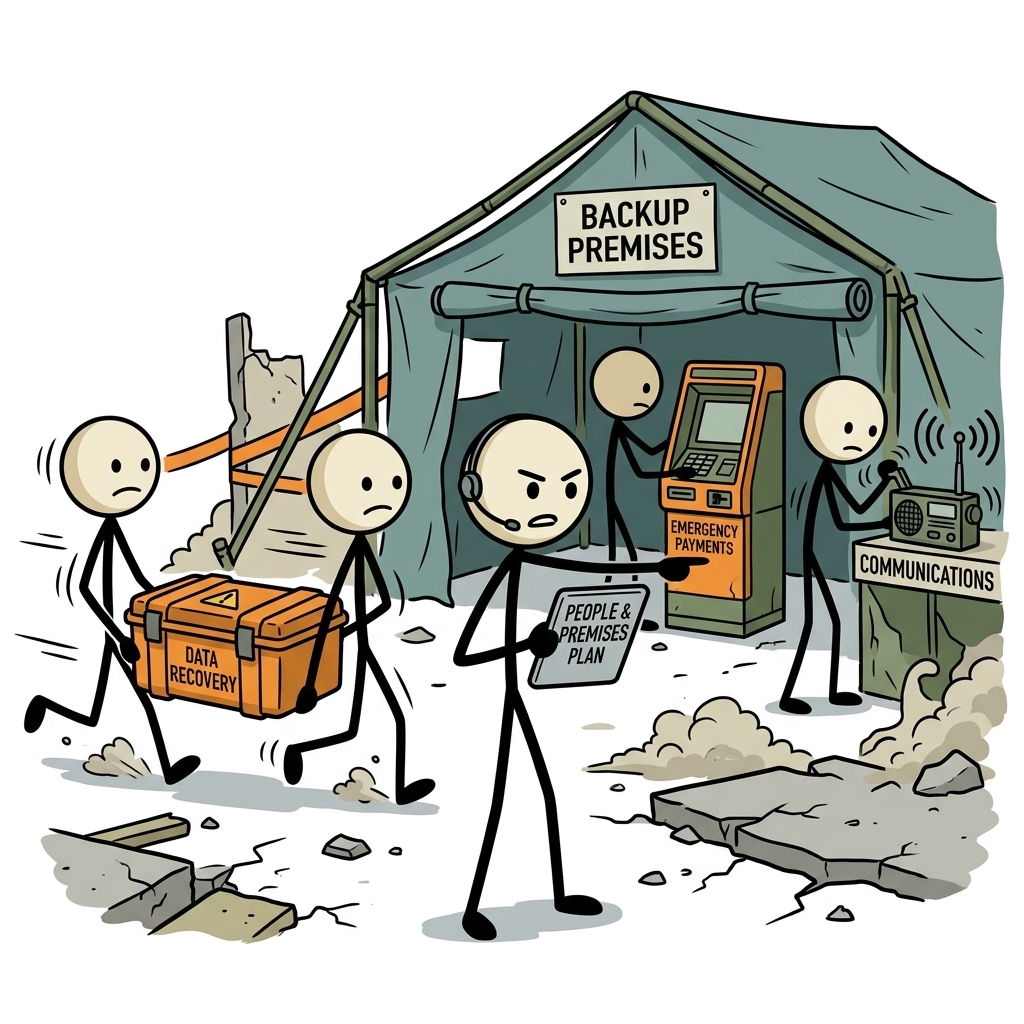
Real-world continuity for small operations is not about filling out three-hundred-page compliance binders that sit untouched on an office shelf. Effective emergency preparedness small business strategy demands a modular, execution-oriented plan designed specifically for the resource realities of tight-knit teams. By systematically fortifying five core pillars—people, premises, data, payments, and communications—small business owners and operational leaders can build an operational fortress that maintains critical functions, protects team welfare, and defends commercial viability during acute crises.
The Five-Pillar Framework for Resilient Small Teams
Standard corporate business continuity planning (BCP) templates often fail small enterprises because they assume unlimited administrative bandwidth and complex departmental silos. When executing emergency preparedness small business protocols, simplicity and delegation of authority are paramount. If an operational process cannot be executed by an associate during a 48-hour regional power grid failure, it is not a continuity plan; it is wishful thinking.
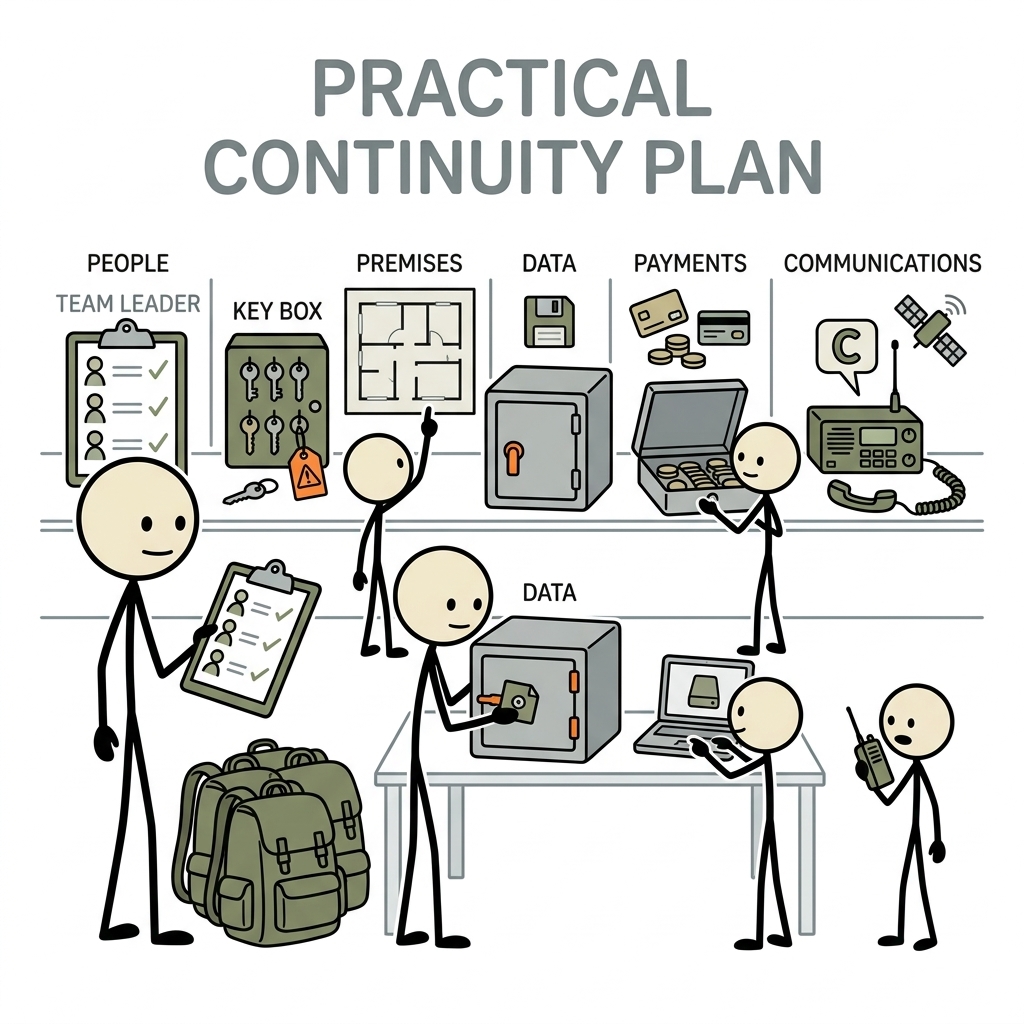
A functional framework isolates operational vulnerabilities into five mutually supportive operational sectors:
- People: Preserving life safety, accounting for remote and on-site staff, establishing succession chains, and sustaining frontline human capacity.
- Premises: Hardening physical workspaces, managing access controls, mitigating localized asset destruction, and operationalizing alternate assembly or dispatch points.
- Data: Defending intellectual property, customer records, and core infrastructure through resilient offline storage, immutable cloud backups, and identity management.
- Payments: Ensuring unbroken payroll compliance, preserving accounts receivable, sustaining merchant gateway alternatives, and securing emergency credit cushions.
- Communications: Establishing resilient internal out-of-band contact trees, dark web/status pages, external client expectation controls, and supply chain liaisons.
Building resilience across these domains transforms a reactive business into a structurally anti-fragile organization capable of weathering natural hazards, infrastructure outages, cyber crises, and civil disruptions.
Pillar 1: People – Preserving Life Safety, Command Chains, and Staff Resilience
Your team members are not merely economic inputs; they are the sole dynamic engine capable of resolving unanticipated operational friction. In an acute emergency—whether an active seismic event mapped by the U.S. Geological Survey (USGS), an active shooter event, or an unpredicted flash flood—human safety supersedes all commercial operations. A robust continuity model details exactly who leads, who supports, and how accountability is achieved when standard working environments disintegrate.
Decentralizing Command: The Rule of Three
In small organizations, tribal knowledge concentrated in an individual founder, managing director, or lead engineer represents a fatal single point of failure. Every critical continuity responsibility must follow the "Rule of Three": a Primary Owner, a Secondary Deputy, and a Tertiary Successor. If the Managing Partner is stranded without power or injured during a severe winter storm, the Operations Lead automatically assumes operational command. If the Operations Lead is unavailable, the Senior Project Specialist steps in with pre-authorized, binding decision-making authority.
Document this chain of command explicitly. Ensure successors possess the legal and operational keys to execute decisions—such as spending authorization caps, corporate card approvals, and vendor sign-offs—without needing emergency board meetings or absent signatures.
Establishing Immediate Accountability
During an incident, managers must determine team safety in minutes, not days. The Occupational Safety and Health Administration (OSHA) requires clear procedures for emergency evacuations and headcounts. Implement an out-of-band accountability roll-call workflow. Avoid relying solely on corporate email or Slack, which may fail during single-tenant authentication collapses or widespread regional internet outages.
- Automated SMS Polling: Implement lightweight emergency notification tools capable of blasting an automated text: "Safety Check: Reply '1' for Safe, '2' for Need Assistance."
- The 90-Minute Assembly Window: Mandate that every staff member confirm their safety and personal availability within 90 minutes of a declared incident. If an individual is non-responsive, the secondary successor triggers an escalating welfare check protocol.
- Cross-Training for Operational Continuity: Map critical micro-tasks (such as running daily invoice reconciliation, managing patient intake, or servicing physical inventory) and ensure at least two non-primary staff members can execute them at a baseline level using written Standard Operating Procedures (SOPs).
Supporting the Domestic Front
A fundamental reality of business resilience is that workers cannot and will not focus on enterprise continuity if their immediate families or personal residences are in physical danger. Following guidance from the American Red Cross, small teams should encourage and incentivize personal and domestic preparedness among staff. Provide emergency go-bag essentials guide allowances, grant schedule flexibility during storm preparation windows, and never penalize personnel who prioritize life safety over business asset protection.
Pillar 2: Premises – Hardening Assets and Securing Alternative Operations
Whether you operate a boutique medical clinic, a distribution warehouse, or a creative services agency in an urban office building, physical locations are fundamentally exposed to structural hazards. Severe weather tracked by the National Weather Service (NWS), localized building fires, gas leaks, structural collapse, and localized theft represent direct physical threats that can halt revenue for weeks or months if not mitigated through physical site protocols.
Critical Utility Shut-Off Knowledge
Small teams cannot wait for municipal emergency services or building landlords to shut down utility feeds during an escalating crisis. Uncontrolled natural gas leaks or backfeeding electrical mains can rapidly escalate a minor building flood into an irreversible total structural loss. Every employee who works on-site must know the locations of and procedures for the primary shut-offs:
- Main Electrical Breaker: Identify the physical breaker panel. Paint or tag the primary master disconnect switch in high-visibility safety yellow. Post a clear warning against manipulating energized equipment when standing in standing water.
- Natural Gas Meter: Keep a dedicated non-sparking shutoff wrench tethered directly to the gas meter pipe. Train facility personnel that gas valves must be turned a quarter-turn perpendicular to the pipe to close the line, and must never be turned back on by non-utility personnel.
- Water Mains: Label the primary gate or ball valve where water enters the premises. Install water leak detection sensors near water heaters, kitchen nodes, and computer server closets that send immediate mobile alerts upon moisture detection.
Facility Hardening and Asset Relocation
When impending hazards provide advance warning—such as tropical cyclones, winter blizzards, or rising floodwaters—a structured pre-landfall checklist shields expensive operational hardware from destruction. Establish a mandatory physical asset protection sequence:
Elevate all critical processing machinery, specialized tools, and inventory pallets a minimum of 18 to 24 inches above the floor level. If the business is in a FEMA-designated Special Flood Hazard Area (SFHA), relocate all portable electronic assets, local hard drives, and legal paperwork to upper-level cabinets or an off-site elevation. Ensure all exterior openings, loading bays, and low-lying glass barriers are reinforced with custom-fitted storm shutters or water-inflatable flood barriers.
Alternative Operating Footprints
If your primary operating site is sealed off by yellow tape or designated uninhabitable by code enforcement authorities, where does work occur? Small teams must maintain pre-negotiated contingency agreements for physical workspaces. This does not require expensive, dedicated cold-sites. Practical solutions include:
- Reciprocal Facility Agreements: Partner with a non-competing business in an adjacent town or neighborhood preparedness network to provide temporary hot-desk or warehouse processing space should either party lose premises access.
- On-Demand Co-Working Accounts: Maintain active, enterprise-level membership profiles across nationwide co-working networks (e.g., Regus, WeWork, or local collectives) that allow immediate drop-in access with working Wi-Fi and power.
- Fully Portable Core Operations: Ensure all physical checkout registers, customer intake stations, and diagnostic kits are packed in mobile, impact-resistant cases that can be deployed from an automobile trunk or temporary hotel workspace within three hours.
Pillar 3: Data & Digital Assets – Redundancy, Recovery, and Cyber Defense
For modern small enterprises, digital assets—including proprietary files, client databases, transactional histories, and licensed configurations—often hold far greater economic value than physical desks and chairs. While physical infrastructure can be leased or replaced, catastrophic digital loss is often fatal. When structuring an emergency preparedness small business checklist, digital data protection must balance rapid recoverability with military-grade protection against ransomware and physical media destruction.
The 3-2-1-1-0 Backup Architecture
Modern operational safety requires expanding the traditional IT "3-2-1" backup rule into the enterprise-grade 3-2-1-1-0 standard, adapted for lean business infrastructures:
- 3 Copies of Data: Maintain the original production data, a primary backup copy, and a secondary backup copy.
- 2 Different Media Types: Store data across distinct technological mediums (e.g., enterprise cloud object storage and localized high-density Solid State Drives/NAS).
- 1 Off-Site Location: Ensure at least one comprehensive copy is held physically distinct and geographically separated from your main operational region (outside your local flood plain or utility grid).
- 1 Immutable or Air-Gapped Copy: Retain a dedicated copy that cannot be altered, overwritten, or encrypted by external malware commands, even if domain-admin credentials are breached.
- 0 Errors on Recovery Testing: Routinely run manual restoration drills to confirm backup files are completely clean, uncorrupted, and quickly restorable.
Software-as-a-Service (SaaS) False Assumptions
A widespread, dangerous assumption among small businesses is that hosting operational files on platforms like Microsoft 365, Google Workspace, or cloud-based CRMs eliminates the need for independent backups. Under the standard "Shared Responsibility Model" enforced by major cloud service providers, platforms guarantee uptime of the underlying infrastructure, but explicitly leave data preservation, retention, and disaster recovery to the end-user. If a compromised account deletes a critical customer database, or an errant administrative sync empties cloud drives, native recovery windows can close in as little as 14 to 30 days. Invest in automated, third-party SaaS-to-Cloud backup solutions that snapshot cloud environments daily into an independent, encrypted architecture.
The "Break-Glass" Offline Continuity Kit
When regional internet services collapse, mobile towers drop, or zero-trust identity providers become inaccessible, your team cannot afford to be locked out of essential corporate accounts. Small business teams must engineer and safeguard an analog and offline digital "Break-Glass Kit":
- Hardware-Encrypted Offline Storage: Maintain a pair of FIPS 140-2 validated, hardware-encrypted USB flash drives containing offline copies of critical SOPs, operating licenses, insurance policies, facility blueprints, and base employee directories.
- Password Vault Export Protocols: If the primary enterprise password manager becomes unreachable, keep an encrypted, password-protected offline export file stored securely in physical safe storage, with decryption master keys separated between the Primary and Secondary operational leaders.
- Physical Paper Records: In an era of screen-dependent workflows, print hard copies of the primary Continuity Playbook, corporate bank routing profiles, vendor contract indices, and local emergency contact rosters. Laminate these documents and keep them in water-sealed transport envelopes.
Pillar 4: Payments & Cash Flow – Shielding Payroll, Receivables, and Capital Access
Revenue feeds operations, but payroll feeds people. The quickest way to trigger total organizational breakdown during a crisis is failing to process staff paychecks. If the team is worried about their personal mortgages and family expenses while helping recover your business, retention and loyalty rapidly deteriorate. A practical continuity strategy treats financial channels with the same defensive urgency as physical life safety.
Uninterrupted Payroll Execution
A disrupted enterprise must maintain payroll commitments even if main corporate workstations are inaccessible or internal banking administrators are offline. Modern emergency preparedness small business protocols demand structured financial safeguards:
Establish emergency administrative credentials with your third-party payroll provider (e.g., Gusto, ADP, Paychex). Verify that at least one secondary administrator based outside the primary operational office holds direct processing clearance. Maintain a static "Disaster Payroll Run" schedule: an agreed-upon protocol dictating that if accurate, granular hourly timesheets cannot be assembled due to severe power outages, the payroll provider automatically executes a flat-rate payment matching the preceding pay cycle's baseline totals, with reconciliation deferrals scheduled for the following operational cycle.
Diversifying Point-of-Sale (POS) and Merchant Gateways
Businesses that interface directly with retail, medical, or field clients must prepare for localized telecommunication blackouts. When primary point-of-sale terminals lose their broadband connection, transactions fail, resulting in immediate revenue loss. Build payment redundancies into everyday operations:
- Offline Payment Processing: Configure modern card terminals to accept "Store and Forward" or offline transactions. This allows staff to capture transaction data without active cellular connectivity, automatically processing the card transactions once connections are restored.
- Independent Cellular Terminals: Equip field teams and checkout desks with cellular-enabled mobile terminals (utilizing eSim cards capable of toggling across AT&T, Verizon, and T-Mobile networks) decoupled from standard local Wi-Fi infrastructure.
- Secondary Merchant Provider Setup: Maintain an active secondary merchant account (e.g., Square, Stripe, or PayPal Zettle). If your primary merchant gateway freezes funds due to abnormal transaction spikes or fraud false-positives following an event, redirect transactional traffic to your secondary rail without missing an operating hour.
Securing the Emergency Capital Fortress
Business interruption insurance claims and Small Business Administration (SBA) Economic Injury Disaster Loans (EIDL) are valuable recovery tools, but they move slowly. Historical claims data reveals that direct federal payouts and insurance adjusters take weeks or months to disburse funds. To survive this liquidity gap, maintain a prioritized defensive capital hierarchy:
Secure a revolving business line of credit (LOC) when the company is financially stable; do not wait until disaster strikes to apply. In addition to credit facilities, maintain a liquid capital reserve held in dedicated, yield-bearing money market accounts equivalent to 60 to 90 days of baseline operational overhead (payroll, facility leases, vital cloud software, and minimum utility bills). This operating runway grants absolute strategic autonomy while competitor firms are paralyzed by capital shortfalls.
Pillar 5: Communications – Out-of-Band Channels, Dark Sites, and Stakeholder Messaging
During an active disaster, communication breakdowns happen quickly. If primary email servers go down, phone systems lose power, or key personnel are in transit, confusion takes hold. Rumors flourish, team members operate on conflicting assumptions, customers panic, and commercial trust dissolves. To keep operations moving, teams must build pre-scripted, highly disciplined communications protocols that operate independent of traditional corporate channels.
Deploying Out-of-Band Communication Channels
Never rely on a single software application to communicate during an operational crisis. If your company runs daily operations on Microsoft Teams or Google Meet, an identity verification lock, active cloud platform outage, or infrastructure compromise will instantly silence your leadership team. Establish and test formal out-of-band protocols:
- Secure Mobile Groups: Set up an encrypted signal group (such as Signal or WhatsApp) containing all staff personal cell numbers, completely separated from corporate IT networks and active Active Directory authentications.
- Conference Bridge Numbers: Maintain a dedicated, analog-accessible toll-free emergency teleconference line. If internet connectivity drops entirely, staff can dial in using landlines or standard cellular voice networks for scheduled situation briefings (e.g., 9:00 AM and 3:00 PM daily).
- Satellite Messaging Capability: For teams operating in wildfire, hurricane, or earthquake zones with proven histories of total telecommunications failure, keep at least two satellite communicators (such as Garmin inReach or dedicated satellite messenger devices) on hand to send direct emergency coordinates and updates regardless of cell tower status.
Client Retention and Expectation Management
Clients and commercial buyers do not necessarily leave a business simply because it experiences a disruption; they leave when met with silence, hidden issues, or broken promises. Controlling the narrative through transparent, scheduled updates prevents customer attrition.
Draft and pre-approve internal templated statements covering common crisis scenarios: severe facility damage, cybersecurity quarantine, supply chain interruption, or municipal transit lockouts. When an incident occurs, your team can adjust these pre-approved templates rather than spending critical hours drafting releases under extreme stress. Post updates directly to an external status dashboard (hosted independently of your main corporate website) and mirror the notices across verified social channels.
Vendor and Supply Chain Interlocks
Your business depends on an ecosystem of external vendors: suppliers, logistics shippers, IT managed service providers (MSPs), specialized trade subcontractors, and commercial landlords. If these partners are unaware of your operational status, shipments may be delivered to abandoned, storm-damaged loading docks, or critical maintenance tickets will languish in vendor queues.
Maintain an indexed, cloud-backed Master Vendor Directory containing after-hours emergency phone numbers, master policy identifiers, and alternative direct contacts for every mission-critical supplier. Appoint a dedicated team member to notify these partners within 12 hours of an incident, rerouting pending shipments, deferring service billings, or requesting emergency on-site support.
Actionable Continuity Testing: The Small-Team Tabletop Exercise
An family emergency plan that exists only on paper gives a dangerous illusion of security. The only reliable way to validate an emergency preparedness small business strategy is by putting it into practice through controlled, low-stress operational exercises. Massive multinational drills are unnecessary; small teams can build deep organizational reflexes through focused quarterly tabletop simulations.
Every three months, dedicate 45 minutes of an all-hands or management meeting to walk through a realistic, plausible Survival Scenarios. Select a single, disruptive scenario from the operational catalog below:
| Quarter | Simulated Scenario | Primary Stress Test | Core Success Metric |
|---|---|---|---|
| Q1 | Facility Access Lockout (Broken Water Main / Civil Closure) | Can field personnel access essential files, route customer calls, and ship stock from alternate nodes? | Full remote operations live within 120 minutes. |
| Q2 | Simulated Ransomware / Cloud Tenant Lockout | Can operations rebuild critical daily customer records using the offline "Break-Glass" data kit? | Data restoration complete with zero paid ransoms. |
| Q3 | Acute Leadership Incapacitation | Can the Secondary Deputy execute payroll approvals and disburse emergency funds without the owner? | Zero payroll delays; clear command transitions. |
| Q4 | Regional Grid Failure (Power & Cell Blackout) | Does the analog Out-of-Band cascade accurately account for all staff members? | 100% staff safety accounted for within 90 minutes. |
After each exercise, conduct a blunt, non-punitive after-action review. Identify where communication stumbled, which accounts were unreachable, and where documentation broke down. Update your continuity manual immediately. Resiliency is not an end state; it is an active, ongoing operational discipline.
The 48-Hour Continuity Sprint: Operational Checklist
To take immediate action and elevate your organization's resilience, execute this tactical emergency preparedness small business checklist over the next two business days:
- [ ] Appoint Succession Chains: Formally designate, document, and cross-train the Secondary Deputy and Tertiary Successor for all executive functions.
- [ ] Audit Facility Cut-Offs: Locate the natural gas valve, master electrical breaker, and primary water gate. Mark each clearly with high-visibility tags and confirm emergency shut-off tools are present.
- [ ] Establish the Out-of-Band Comms Group: Build a closed, off-network emergency message group on Signal or WhatsApp and confirm every employee has downloaded the application.
- [ ] Build the Physical "Break-Glass" Kit: Print emergency rosters, core operational SOPs, and critical banking profiles; laminate and store them in an easily accessible, water-resistant fire safe.
- [ ] Activate Immutable Cloud Snapshots: Confirm with your internal or contract IT provider that backups adhere to the 3-2-1-1-0 framework, verifying at least one immutable snapshot is secured off-site.
- [ ] Authorize Emergency Payroll Overrides: Coordinate with your payroll vendor to establish secondary administrative credentials and codify standard pay policies for severe disruptions.
- [ ] Verify Insurance Coverage Limits: Review commercial policies with your insurance underwriter, checking for clear terms regarding direct physical damage, civil authority closures, utility services coverage, and business income interruption payouts.
By transforming abstract safety policies into an actionable operating manual, you protect your business against unforeseen crises. True security comes from deep preparation, verified redundancies, and a prepared, confident team ready to navigate disruption and keep operations running.
Frequently Asked Questions
What should a emergency preparedness small business plan include?
Start with the immediate safety steps, the supplies and records your household needs, a communication plan, and a regular review schedule. Follow local official guidance during an active emergency.
How often should I review emergency preparedness small business preparations?
Review them at least twice a year and whenever your household, medication, location, or local risks change. Replace expired supplies and practice key steps.
Where can I find reliable emergency guidance?
Use local emergency management alerts and established public-health or emergency-management agencies. A blog guide should support, not replace, official real-time instructions.