⚡ Key Facts
- Extreme Energy Demands: Melting one liter of ice-cold snow into liquid water consumes roughly 334 kilojoules of latent heat alone—demanding over 80% of the total thermal energy just to induce the phase change before water temperature even begins to rise.
- Severe Fuel Penalties: Producing winter survival water exclusively from low-density powder snow requires between 150% and 250% more stove fuel than heating liquid water, rapidly exhausting canister and liquid-fuel reserves within 48 to 72 hours.
- Canister Failure Dynamics: Standard isobutane-propane canister stoves experience severe vapor pressure collapse below -0.5°C (31°F), dropping fuel output by up to 80% unless winterized liquid-feed or white-gas pressurized systems are utilized.
- Mechanical Filter Vulnerabilities: Hollow-fiber membrane filters (e.g., Sawyer Squeeze, LifeStraw) suffer microscopic internal fractures when exposed to sub-freezing temperatures after initial use, irreversibly failing without presenting any visible exterior damage.
- Atmospheric Chemical Scavenging: Snowflakes scavenge volatile organic compounds, industrial sulfates, and microplastics from the air column; simple boiling neutralizes biological pathogens but concentrates chemical contaminants and particulate matter.
During an extended cold-weather emergency, dehydration constitutes an immediate, insidious physiological threat. While surrounded by a landscape buried in deep snow, an untrained individual sees an infinite supply of fresh water. A survival technician, however, sees an energy sinkhole and a complex thermodynamic equation. The human body loses between 2.5 and 4.0 liters of moisture daily in sub-freezing environments through heavy metabolic output, dry-air respiration, and cold diuresis. Attempting to quench that deficit by converting field snow into pure, biologically safe potable water is one of the most resource-intensive operations in off-grid survival. Without an empirical understanding of latent heat, canister vapor pressures, chemical kinetics, and mechanical filter failure modes, relying on winter snow can precipitate hypothermia, acute fuel starvation, or debilitating gastrointestinal illness. For the practical checklist side, use the community emergency preparedness guide.
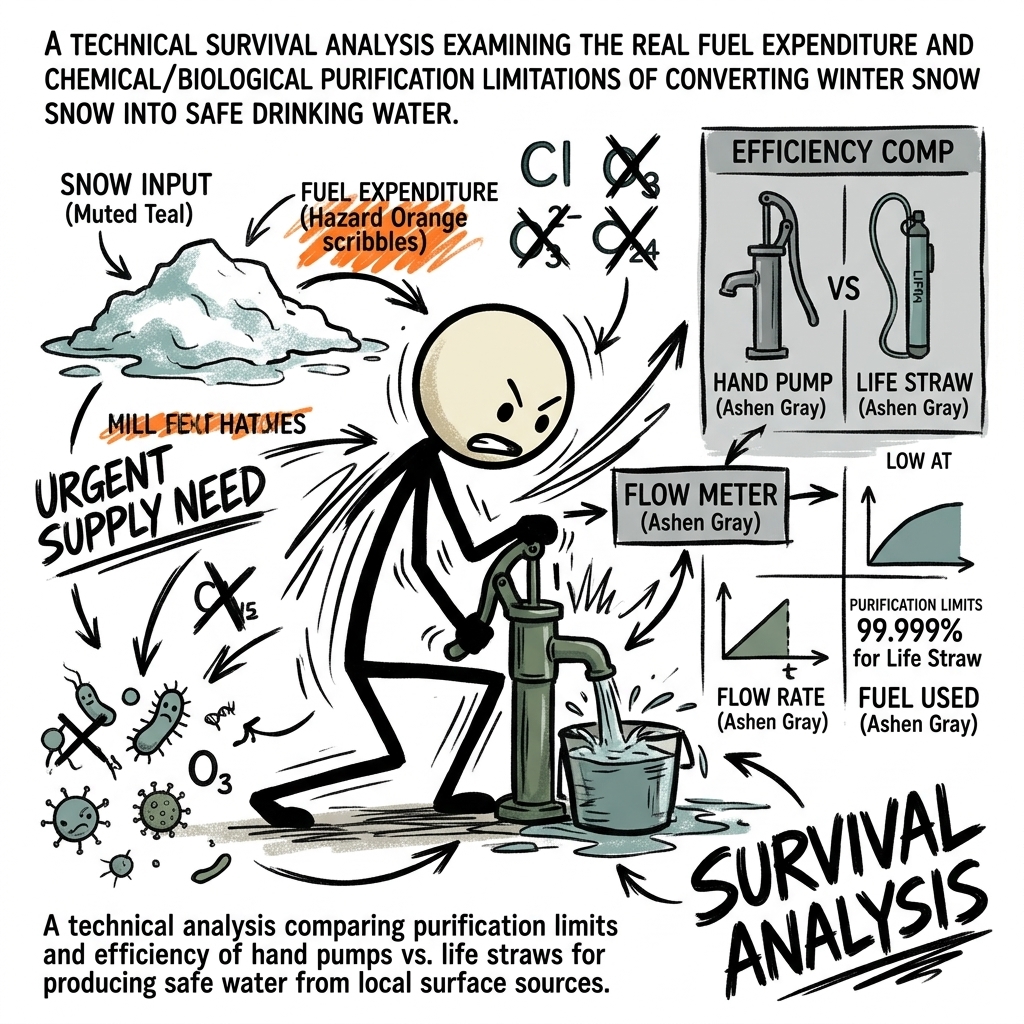
The Thermodynamics of Melting Snow: The Latent Heat Deficit
To understand the high fuel cost of melting snow, you must first calculate the precise thermodynamic barrier of the phase change. Water possesses one of the highest specific heat capacities and latent heats of any common substance on Earth. Raising the temperature of one gram of liquid water by 1°C requires 4.184 Joules (1 calorie) of energy. However, transforming one gram of solid ice at 0°C into one gram of liquid water at 0°C requires a staggering 334 Joules (79.7 calories) of energy—known as the latent heat of fusion. For the practical checklist side, use the neighborhood preparedness network.
When you account for sub-freezing starting temperatures, the energetic equation grows even more demanding. If you retrieve dry powder snow at an ambient temperature of -15°C (5°F), the total energy input per gram of finished, boiled water unfolds across three distinct thermodynamic phases: For the practical checklist side, use the emergency communication plan.
- Phase 1 (Sensible Heat of Ice): Raising ice from -15°C to 0°C requires roughly 31.4 Joules per gram (ice specific heat ≈ 2.09 J/g°C).
- Phase 2 (Latent Heat of Fusion): Inducing the solid-to-liquid phase transition at 0°C demands 334.0 Joules per gram.
- Phase 3 (Sensible Heat of Water): Elevating the meltwater from 0°C to rolling boil (100°C at sea level) consumes 418.4 Joules per gram.
Under this baseline scenario, simply turning -15°C snow into 0°C liquid requires 365.4 Joules per gram—nearly 47% of the entire thermal journey to boiling. In a real-world field setting, thermal transfer efficiencies through cooking vessels (aluminum, titanium, or stainless steel) drop to 30–60% due to convective heat loss from wind and radiant dissipation. Consequently, melting snow for drinking water demands an extraordinary thermodynamic sacrifice before a single drop can safely enter your hydration system. For the practical checklist side, use the family emergency planning guide.
Fuel Cost of Melting Snow: Practical Burn Rates and Caloric Accounting
Calculating the true fuel cost of melting snow requires shifting from theoretical physics to realistic stove metrics. A standard outdoor party operating in three-season conditions typically budgets 15 to 25 grams of hydrocarbon fuel per person per day for simple meal rehydration and hot water production. In a sustained sub-zero scenario, that baseline budget balloons to 80 to 120 grams of fuel per person per day if all metabolic water must be procured from frozen snowpack. For the practical checklist side, use the real-world emergency scenarios guide.
Stove efficiency diverges dramatically depending on burner architecture, pot metallurgy, windshielding, and environmental temperature. The following table illustrates the empirical fuel expenditure required to melt dense winter snowpack (-10°C) and bring it to a rolling boil for biological safety, based on a 40% thermal transfer efficiency model.
| Fuel Type | Energy Density (MJ/kg) | Fuel Needed per Liter (Grams) | Operational Limit (Ambient Temp) | Primary Cold-Weather Risk |
|---|---|---|---|---|
| Isobutane / Propane Blend (80/20) | ~49.5 | 38 – 48 g | -10°C (14°F) with liquid feed | Canister depressurization; failure to vaporize |
| White Gas (Naphtha) | ~44.0 | 45 – 58 g | -40°C (-40°F) | Priming soot; cold spills causing instant frostbite |
| Automotive Unleaded Gas | ~43.5 | 48 – 62 g | -35°C (-31°F) | Generator clogging; highly toxic aromatic vapors |
| Denatured Alcohol (Ethanol/Methanol) | ~26.0 | 85 – 110 g | -15°C (5°F) | Extremely long boil times; high weight penalty |
| Solid Fuel Tablets (Hexamine) | ~30.0 | 75 – 95 g | -20°C (-4°F) | Inadequate heat output for large volumes of snow |
When relying on standard isobutane canister stoves, cold temperatures introduce an engineering hazard: the ideal gas law and vapor pressure equilibrium. Propane boils at -42°C, whereas isobutane boils at -11.7°C, and standard n-butane boils at -0.5°C. In sub-freezing conditions, the canister's propellant vaporizes unevenly. The propane burns off rapidly first, leaving behind cold liquid isobutane or butane that cannot achieve sufficient vapor pressure inside the canister to feed the burner.
According to field trials and data cited by mountaineering entities and military arctic survival manuals, ambient temperatures below freezing reduce standard canister heat outputs by 50% to 80% within minutes of operation. As the stove runs, evaporative cooling further lowers the temperature of the internal fuel, creating a vicious cycle of depressurization. For dependable winter survival water production, you must use manually pressurized white-gas stoves (such as the MSR XGK or WhisperLite) or inverted canister systems equipped with pre-heat generator loops.
The Caloric Danger of Ingesting Unmelted Snow
When fuel reserves are low, survivalists often contemplate eating raw snow to combat dehydration. The Federal Emergency Management Agency (FEMA) and the U.S. Army Cold Regions Research and Engineering Laboratory (CRREL) strongly advise against this practice except as a measure of absolute last resort. Ingesting sub-zero snow forces the body's internal core furnace to provide the 334 J/g latent heat of fusion internally.
Consuming just one liter's worth of powder snow at -10°C robs your metabolic core of approximately 95 kilocalories of pure energy solely to melt and warm the mass to body temperature (37°C). In a survival context where caloric intake is scarce and physical exertion is high, this rapid, localized cooling of the stomach and core viscera accelerates clinical hypothermia, stimulates cold diuresis (which exacerbates fluid loss), and causes mechanical burns to delicate oral tissues.
Snowpack Stratigraphy: Density, Volume, and the "Seed Water" Imperative
Snow is not a uniform matrix; it is an aerated crystal scaffolding containing surprising amounts of atmospheric gas. The National Oceanic and Atmospheric Administration (NOAA) tracks the Snow Water Equivalent (SWE), which measures the depth of liquid water resulting from melting a given volume of snowpack. Understanding snow stratigraphy determines how much raw volume must be collected, transported, and melted to secure sufficient hydration.
- Wild, Cold Powder Snow: High loft, needle-form crystals. Density sits between 5% and 8% SWE. Yield ratio: 12 to 20 volumes of snow to produce 1 volume of liquid water.
- Settled, Mid-Winter Snowpack: Wind-packed, mechanically broken granules. Density sits between 15% and 25% SWE. Yield ratio: 4 to 6 volumes of snow to produce 1 volume of liquid water.
- Spring Firn / Glacial Crust: Coarse, recurrently thawed, and refrozen granules. Density exceeds 35% to 50% SWE. Yield ratio: 2 to 3 volumes of snow to produce 1 volume of liquid water.
Attempting to melt dry powder snow inside a dry, heated survival pot triggers a destructive phenomenon known as pot scorching. Because low-density snow acts as a superb thermal insulator—trapping dead air within its crystalline matrix—the thermal energy conducted through the pot base cannot dissipate into the snowpack rapidly enough.
Instead, the bottom micro-layer of snow sublimates into steam or melts into a minute film that instantly superheats, burning the bottom of the pot, destroying non-stick coatings, warping titanium, and infusing the resulting meltwater with an acrid, unpalatable taste. To safely melt low-density snow, always retain a small reservoir of liquid—known as "seed water"—in the bottom of the vessel (approximately 100 to 200 milliliters). This fluid provides an efficient liquid-conduction conduit that transfers thermal energy dynamically into the freshly added snow crystals.
The Sterility Myth: Biological Pathogens Frozen in the Winter Cryosphere
A persistent and dangerous myth in the outdoor and prepper communities asserts that sub-zero temperatures sterilize snow. In truth, freezing does not act as a sterilization mechanism; it serves as a cryogenic preservation method. While some vegetative bacteria perish from cellular rupture during ice crystal expansion, extensive populations of pathogens, spores, and protozoan cysts survive inside winter snowbanks for months.
The Centers for Disease Control and Prevention (CDC) note that robust encysted protozoa—primarily Giardia duodenalis (lamblia) and Cryptosporidium parvum—remain fully viable in sub-zero snowpacks and frozen alpine stream banks. When high-altitude winds sweep across terrain, they desiccate and carry fecal material from alpine mammals, birds, and rodents, redepositing dormant cysts onto seemingly pristine, untouched snow surfaces hundreds of miles from industrial infrastructure.
Furthermore, wild snow contains its own dedicated micro-ecosystems:
- Psychrophilic Microorganisms: Cold-adapted bacteria such as Pseudomonas syringae actively live in cloud formations and high alpine snowpack, using ice-nucleating proteins to foster freezing around themselves.
- Snow Algae (Chlamydomonas nivalis): Commonly known as "watermelon snow" or "pink snow." This cold-adapted chlorophyte produces a bright reddish-pink secondary carotenoid pigment (astaxanthin) to shield itself from intense high-altitude ultraviolet radiation. Consuming melted pink snow is a recognized medical risk; the algal bloom contains secondary compounds that trigger acute, debilitating gastrointestinal distress and explosive diarrhea within hours.
- Soil-Borne Spores and Fungal Pathogens: Surface wind scouring regularly lifts dust particles carrying mold, yeast, and endospore-forming bacteria (such as Bacillus cereus) directly into pristine snowfields.
Relying on aesthetic visual purity is a dangerous error. Clear, crystalline snow can harbor infectious loads sufficient to cause waterborne illness. In cold-weather survival, a severe diarrheal infection introduces unmanageable fluid losses, electrolyte collapse, rapid degradation of physical insulation, and imminent death from hypothermia.
Chemical Scavenging: Atmospheric Deposition and Industrial Contaminants
Snow is an exceptional physical scrubber of atmospheric chemistry. Due to their expansive surface-area-to-mass ratio and dendritic structural geometry, falling snowflakes scavenge airborne particulates, industrial aerosols, and gaseous chemical pollutants far more efficiently than falling raindrops.
The United States Geological Survey (USGS) and the Environmental Protection Agency (EPA) track the chemical composition of atmospheric deposition across remote wilderness sites through the National Atmospheric Deposition Program. Their research shows that snowpacks, even in deeply isolated wilderness environments, contain measurable quantities of industrial contaminants:
- Inorganic Combustion Byproducts: Atmospheric sulfur dioxide ($SO_2$) and nitrogen oxides ($NO_x$) transform into sulfuric and nitric acids within cloud decks, depositing as low-pH acid snow.
- Persistent Organic Pollutants (POPs): Polycyclic aromatic hydrocarbons (PAHs), organochlorine pesticides, and polybrominated diphenyl ethers (flame retardants) undergo a process known as the "grasshopper effect"—evaporating in warmer latitudes and condensing out of the atmosphere over cold alpine and polar terrain.
- Combustion Particulates and Microplastics: Deep-core snow testing in alpine preserves routinely uncovers microplastic fibers, fine particulate matter ($PM_{2.5}$), and elemental black carbon originating from wildland forest fires and urban vehicular emissions thousands of miles distant.
This reality introduces a critical emergency water treatment limitation: boiling snow water does not remove chemical contaminants. In fact, violent boiling drives off pure water vapor via evaporation, marginally concentrating dissolved heavy metals, nitrates, sulfates, and non-volatile chemical compounds within the remaining liquid. While this chemical concentration rarely poses an acute survival threat over a 72-hour window, relying long-term on urban snow, highway-adjacent drift, or industrial runoff zones presents genuine toxicological risks that demand carbon filtration or selective avoidance.
Failure Points of Standard Purification Gear in Sub-Freezing Conditions
Most field survival water purification protocols rely heavily on microfiltration or chemical disinfection. Unfortunately, both operational classes face catastrophic physical and chemical degradation in sub-zero environments, demanding specialized cold-weather adaptations.
1. Mechanical Microfiltration: The Invisible Freeze Fracture
Hollow-fiber membrane filters—including industry-standard units like the Sawyer Squeeze, Katadyn BeFree, and LifeStraw—rely on thousands of microscopic tubes with nominal pore sizes ranging between 0.1 and 0.2 microns. These micropores physically block protozoa and bacteria through mechanical exclusion.
However, when a hollow-fiber filter is used once, its capillaries remain saturated with water due to capillary action. If that wet filter is subsequently exposed to sub-freezing ambient air—even for brief intervals—the trapped liquid water expands by roughly 9% as it transitions into ice. This internal crystalline expansion fractures the microscopic fiber tubes, expanding the nominal pore size to several microns.
The most dangerous characteristic of freeze damage in hollow-fiber filters is that it leaves no visible exterior trace. The plastic casing remains pristine, and water flows through the filter with minimal hydraulic resistance—a deceptive sign that often makes users think the filter is flowing well, when in fact it is letting all biological pathogens straight through the cracked internal matrix. If an emergency microfilter drops below 0°C after its initial wetting, you must consider it compromised and unfit for biological protection unless tested via strict bubble-point protocols.
2. Chemical Disinfection: The Arrhenius Effect on Kinetic Rates
Chemical purifiers—primarily sodium dichloroisocyanurate, calcium hypochlorite, and chlorine dioxide—depend directly on chemical oxidation kinetics to destroy cellular walls and biological membranes. The reaction rate of chemical disinfectants is rigorously governed by the Arrhenius equation: chemical reaction velocities drop exponentially as liquid temperature falls.
According to the CDC and EPA disinfection criteria, chlorine dioxide tabs that achieve a 4-log (99.99%) inactivation of Giardia cysts within 15 minutes in 20°C (68°F) summer water require up to four hours of contact time when the water hovers just above freezing at 4°C (39°F). If a survivor doses freezing meltwater with halogens and consumes it 30 minutes later, the biological pathogens will enter the gastrointestinal tract virtually unscathed. The liquid must either be chemically dosed inside an insulated space for extended contact intervals or warmed significantly over a heat source before chemical treatment begins.
The Protocol: An Optimized Field Doctrine for Snow Water Production
Procuring and purifying safe drinking water from winter snow without squandering fuel or exposing yourself to environmental pathogens requires a methodical, multi-stage protocol. By following this technical sequence, you maintain high thermal efficiency while safeguarding the integrity of your digestive system and operational gear.
Stage 1: Snow Sourcing and Extraction
- Excavate Past the Fresh Surface: Avoid the top two centimeters of the snowpack, which collect falling airborne particulates, airborne animal debris, and microplastics. Discard the base layers directly touching mineral soil to avoid organic matter and mud.
- Prioritize Dense Snowpack: Harvest dense, wind-packed drifts or firm sub-surface layers. Slicing dense snow into uniform blocks using a snow saw or shovel delivers far more water-equivalent mass directly to the melting vessel with less bulk and air space.
- Never Harvest Discolored Snow: Completely bypass pink, yellow, or grey-tinted drifts. No thermal survival method can neutralize both chemical hazards and toxic algal blooms simultaneously in an off-grid scenario.
Stage 2: The Seed-Water Melting Process
- Always Prime the Pot: Pour 100 to 150 ml of liquid water into the cooking pot before placing it over the flame. If no liquid water exists, melt a small, loosely packed snowball over very low flame, rotating the pot continuously until a protective liquid layer forms.
- Pack Snow Incrementally: Gradually add dense blocks of snow into the boiling pool. Forcing a mountain of light, aerated powder into a dry pot insulates the heat, scorches the vessel bottom, and wastes thermal energy.
- Employ Heat-Trapping Architecture: Always cover the pot with a tight-fitting lid to trap escaping steam. Utilize an efficient windscreen surrounding the burner base and place an insulated reflective pad underneath the stove to prevent heat sink losses into the frozen ground.
Stage 3: Biological and Particulate Neutralization
- Perform a Vigorous Rolling Boil: The CDC and EPA mandate that bringing water to a rolling boil for one full minute completely inactivates all vegetative bacteria, viruses, and encysted protozoa (including Cryptosporidium and Giardia). At altitudes exceeding 2,000 meters (6,561 feet), atmospheric pressure drops significantly; increase the rolling boil duration to three full minutes to compensate for water's lower boiling point.
- Mechanical Particulate Pre-Filtration: Pass the meltwater through a tight weave fabric, clean bandana, or paper coffee filter before or immediately after boiling. This simple gravity stage isolates suspended atmospheric grit, soot, pine needles, and macro-invertebrates without putting hollow-fiber membrane filters at risk of freeze-fractures.
- Chemical Treatment Alternative (Fuel Conservation): If fuel reserves are critically low, bring the snow solely to its phase-change liquid point (5°C to 10°C). Transfer the cold liquid into a container stored close to your body or inside your sleeping system, add chlorine dioxide, and extend the reaction contact duration to a full 4 hours before drinking.
Stage 4: Cold-Weather Hydration Management
- Thermal Storage Maintenance: Never pour warm meltwater into uninsulated single-wall metal canteens exposed to sub-zero environments; doing so creates an immediate thermal heat sink that yields a block of ice within hours. Store finished water in vacuum-insulated flasks or bury wide-mouth Nalgene bottles upside down inside closed-cell foam sleeves. Water freezes from the top down; storing bottles inverted ensures the screw threads remain ice-free and functional when you need to drink.
- Electrolyte Rebalancing: Melted snow consists of pure, naturally distilled atmospheric moisture virtually devoid of mineral ions (calcium, magnesium, sodium). Ingesting large volumes of pure demineralized water flushes critical electrolytes out through your kidneys. Always add an electrolyte matrix, a pinch of table salt, or culinary bouillon to maintain systemic osmotic balance and cellular hydration.
Transforming wild winter snow into safe drinking water is not a simple, passive task. It is a calculated exercise in thermodynamic accounting, fuel preservation, and microbiology. When you respect the extreme latent heat demands of phase changes, accommodate for canister depressurization, and enforce strict, fail-safe purification habits, you can reliably convert a frozen landscape into a dependable, life-sustaining resource.
Frequently Asked Questions
Can you safely eat unmelted snow directly for hydration?
Eating unmelted snow should be avoided because it lowers your core body temperature, accelerating hypothermia, and expends significant metabolic energy to convert the ice into water internally.
How much more fuel is required to melt snow than to boil water?
Melting snow requires roughly double the fuel of heating liquid water to a boil due to the high latent heat of fusion (approximately 334 joules per gram) needed just to phase-change ice into liquid.
Does melting snow automatically make the water safe to drink?
No, simply melting snow does not eliminate biological pathogens; the water must be brought to a rolling boil for at least one minute (or three minutes at elevations above 6,500 feet) to ensure it is microbiologically safe.
Can standard survival filters remove chemical contaminants from snow?
Standard 0.1- or 0.2-micron hollow-fiber membrane filters remove bacteria and protozoa but cannot remove dissolved chemical pollutants, pesticides, or exhaust particulates trapped in snowpack, which require activated carbon or distillation.
How do you prevent scorching the cooking pot when melting snow?
Add a small amount of liquid water to the bottom of the pot before adding snow to establish thermal conductivity, prevent dry-pot scorching, and speed up the melting process.