⚡ Key Facts
- Insolation Drop: According to the National Renewable Energy Laboratory (NREL), average daily solar insolation in the Northern Hemisphere can drop by over 60% between July and December, requiring precise panel adjustments to compensate. For the practical checklist side, use the community emergency preparedness guide.
- The Freezing Point Danger: Standard Lithium Iron Phosphate (LiFePO4) batteries—the core of most modern solar generators—cannot safely accept a charge below 32°F (0°C) without causing permanent lithium plating and capacity degradation. For the practical checklist side, use the neighborhood preparedness network.
- The Albedo Advantage: Clean, fresh snow has an albedo rating of up to 0.90, meaning it reflects up to 90% of incoming sunlight. Utilizing this reflection can boost solar panel output by up to 20% if panels are angled correctly.
- Critical Tilt Variance: Adjusting your solar panels to a winter-specific angle (typically your Latitude + 15 degrees) can increase winter solar harvesting efficiency by up to 10% to 15% compared to keeping them at a flat summer tilt.
When the power grid fails in the dead of winter, the stakes are instantly higher than during a summer blackout. According to the Federal Emergency Management Agency (FEMA), winter storms account for billions of dollars in property damage and pose severe risks of hypothermia, carbon monoxide poisoning from improperly vented fuel generators, and prolonged utility outages. While a portable solar generator is one of the safest, cleanest, and most reliable tools for emergency backup power, operating these systems in sub-freezing temperatures is not a "set-it-and-forget-it" endeavor. Winter environments fundamentally alter the physics of solar energy capture and battery chemistry. To ensure your family remains warm, connected, and safe, you must design and execute a robust solar generator winter strategy built around the realities of reduced daylight, freezing temperatures, and snow dynamics.
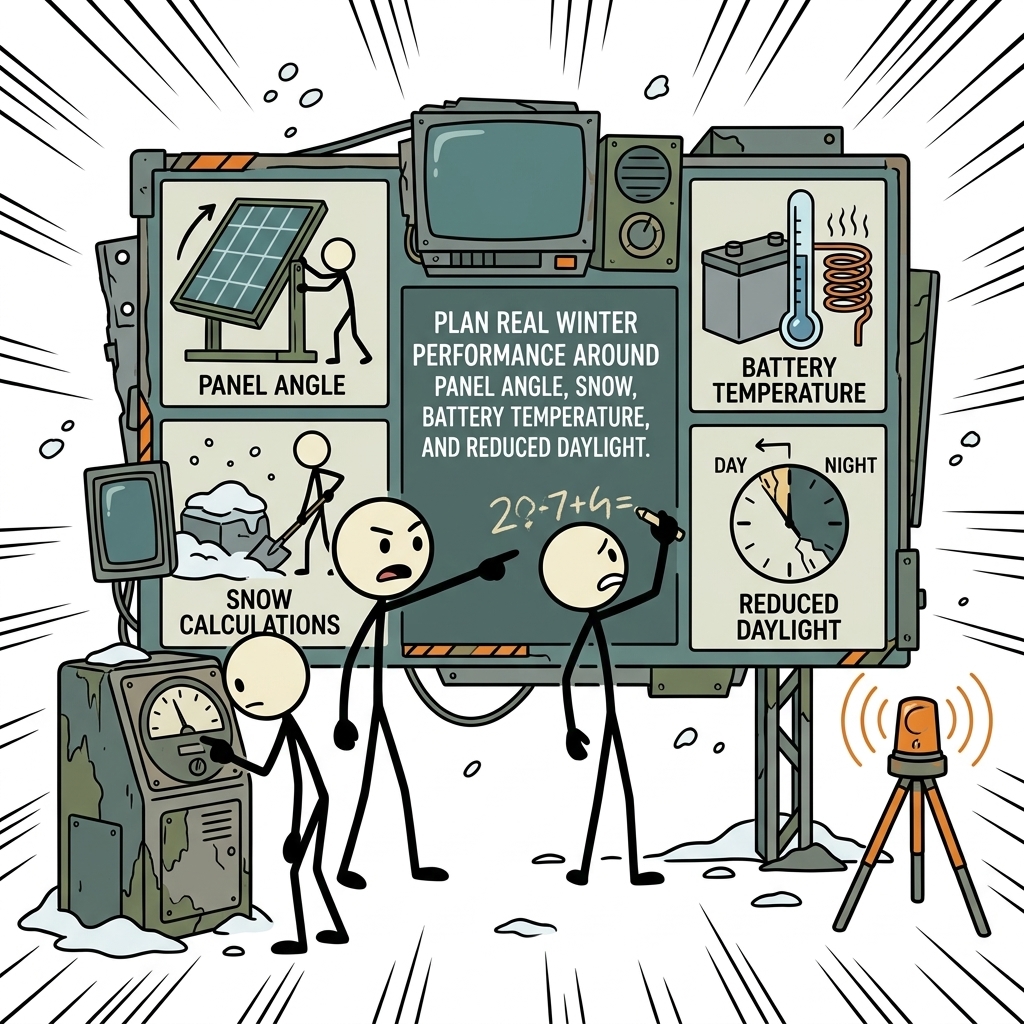
The Physics of Winter Solar: Angle, Insolation, and Latitude
The most immediate obstacle to winter solar harvesting is the dramatic reduction in solar insolation—the amount of solar radiation reaching a given area over a specific time. During the winter solstice, the Earth's tilt causes the sun to sit much lower on the horizon. This means sunlight must travel through a thicker layer of the Earth's atmosphere, scattering more photons and reducing the overall intensity of the light reaching your panels. Combined with shorter days, your window for charging a solar generator is severely compressed.
Calculating Your Optimal Winter Tilt Angle
In the summer, horizontal or low-angle panels perform exceptionally well because the sun passes directly overhead. In the winter, keeping your panels flat is a recipe for system failure. To maximize photon capture when the sun is low, you must tilt your panels steeply to face the sun directly. This is known as the Cosine Law of Radiation: the energy per unit area decreases as the angle of incidence departs from perpendicular.
To find your optimal winter tilt, use this standard industry formula:
Winter Tilt Angle = (Your Latitude × 0.9) + 29°
Alternatively, a simpler, highly effective rule of thumb used by emergency preparedness specialists is:
Winter Tilt Angle = Your Latitude + 15° (or up to 20° for extreme northern latitudes)
For example, if you live in Denver, Colorado (approximately 40° N latitude), your winter panel angle should be set to 55° to 60° from horizontal, facing true south. This steep angle serves two critical purposes: it aligns the face of the panel perpendicularly to the low winter sun, and it encourages snow, frost, and debris to naturally slide off the glass surface under the influence of gravity.
Navigating True South vs. Magnetic South
When positioning your panels for emergency winter charging, do not rely blindly on a standard magnetic compass without adjusting for magnetic declination. The National Oceanic and Atmospheric Administration (NOAA) provides online tools to calculate the magnetic declination for your specific coordinates. Aligning your panels to True South rather than Magnetic South ensures that your solar array captures the absolute peak solar window, which typically occurs between 10:00 AM and 2:00 PM.
The Silent Battery Killer: Temperature Dynamics and Chemistry
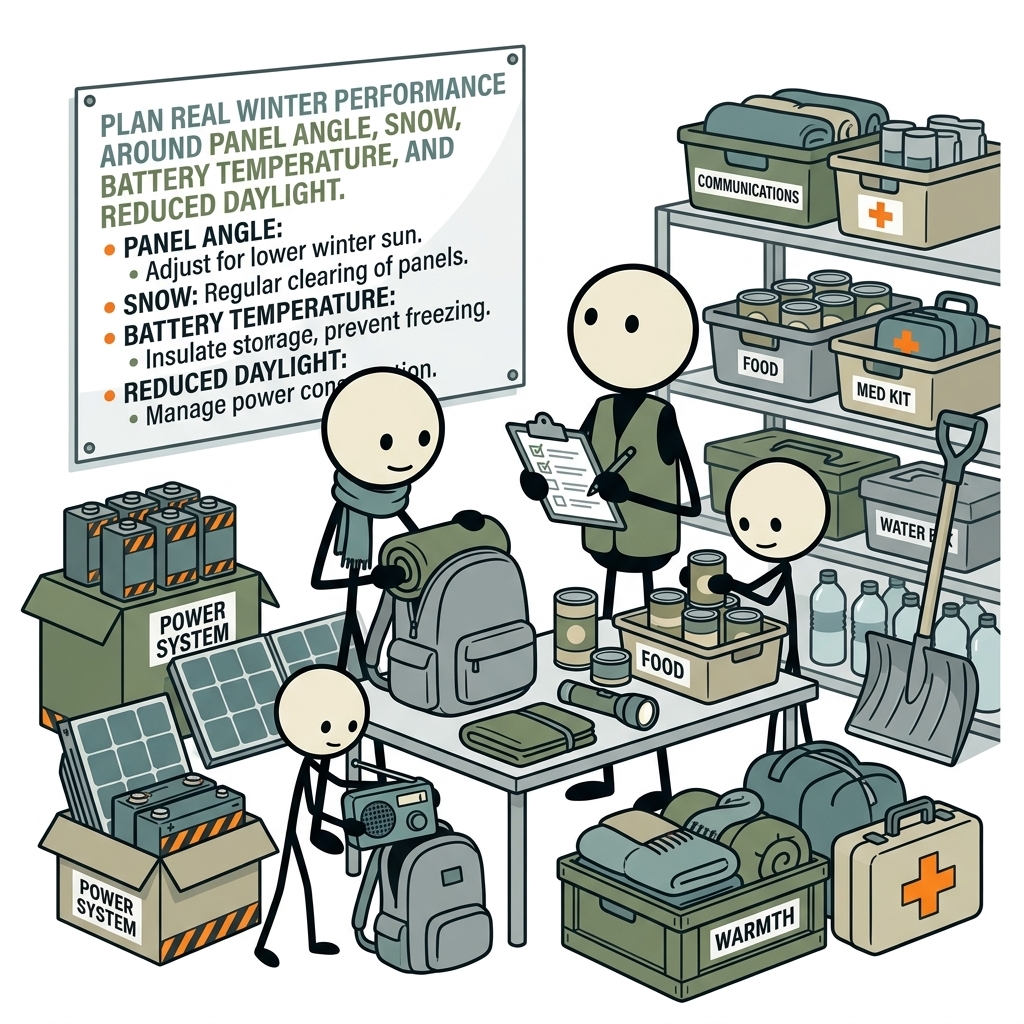
While solar panels actually perform more efficiently in cold, crisp air—due to the temperature coefficient of silicon, which produces higher voltage as temperatures drop—the exact opposite is true for the batteries inside your solar generator. Whether your power station utilizes Lithium Iron Phosphate (LiFePO4) or Nickel Manganese Cobalt (NMC) chemistry, cold weather presents severe chemical and physical challenges that can permanently ruin your investment if not managed carefully.
The Danger of Sub-Freezing Charging
The single most critical rule of solar generator winter emergency preparedness is this: Never charge a lithium battery when its internal cells are below 32°F (0°C).
While you can safely *discharge* (draw power from) most lithium-based solar generators in temperatures down to -4°F (-20°C), attempting to force a charge into a freezing lithium cell causes a destructive phenomenon known as "lithium plating." In freezing temperatures, the lithium ions inside the battery cannot intercalate (insert themselves) into the graphite anode quickly enough. Instead, they accumulate on the surface of the anode, forming metallic lithium plating. This causes:
- An immediate, irreversible loss of battery capacity.
- An increase in internal resistance, making the battery less efficient.
- The formation of microscopic metallic fibers called dendrites, which can eventually pierce the internal separator, causing a catastrophic internal short circuit, thermal runaway, and fire.
Most premium solar generators feature an integrated Battery Management System (BMS) with low-temperature charging protection that automatically blocks incoming current when cell temperatures drop below freezing. However, cheaper or older models may not have this safeguard. Even with a BMS, relying on the system to shut itself down is a risky strategy; you must proactively manage the thermal environment of your storage unit.
Thermal Management Solutions for Cold Weather
To keep your solar generator operational during a prolonged winter grid failure, you must maintain its ambient environment above freezing. If you are sheltering in place, keep the generator inside the insulated, thermal envelope of your home. If you must run the system outdoors or in an unheated garage, employ the following mitigation strategies:
- Insulated Enclosures: Construct a simple, insulated micro-climate box using rigid foam insulation (such as XPS boards). The natural heat generated by the inverter and charge controller during use can often keep the interior of an insulated box above freezing.
- Active Heating Blankets: Use low-wattage, 12V DC silicone heating pads or specialized battery thermal wraps powered by the generator's own auxiliary ports. Ensure these are thermostatically controlled to turn off once the battery compartment reaches 45°F (7°C).
- Pre-warming Protocols: If your generator has been exposed to sub-freezing temperatures, bring it into a warm room or vehicle and allow it to sit for several hours until its internal temperature matches the room before plugging in any solar panels or AC chargers.
Snow, Frost, and the Magic of the Albedo Effect
Snow is both the enemy and the unexpected ally of the winter solar prepper. Even a thin layer of snow or heavy frost can completely block sunlight from reaching the photovoltaic cells, dropping your power output to zero. Because solar panels are typically wired in series or strings, shading just a single cell can choke off the current of the entire panel or array.
Safe and Effective Snow Removal Techniques
Clearing snow from your panels must be done with extreme care to avoid scratching the anti-reflective tempered glass coating, which can permanently reduce panel efficiency. Implement the following guidelines:
- Use a Soft Squeegee or Foam Rake: Avoid metal shovels, stiff-bristled brooms, or ice scrapers. A soft foam snow rake designed for vehicles is the safest tool for pulling snow off angled panels.
- Never Use Hot Water: Pouring hot water on a freezing solar panel will cause immediate thermal shock, shattering the tempered glass and destroying the panel instantly.
- Leverage the Steep Angle: If your panels are mounted at the recommended winter tilt (55° to 60°), a gentle tap on the frame or the natural warming of the cells once a tiny sliver of sun hits them will cause the snow to slide off in large sheets.
Harnessing the Albedo Effect
Once your panels are clear, the surrounding snowfield can actually become an asset. The Albedo Effect refers to the measure of how much solar radiation is reflected from a surface. While bare ground, grass, or asphalt absorbs most sunlight (low albedo), fresh snow reflects up to 90% of it (high albedo).
By positioning your steeply angled panels near a wide, open snowfield, you can capture both direct sunlight and the intense reflected light bouncing off the snow. This is particularly effective if you are utilizing bifacial solar panels, which feature active photovoltaic cells on both the front and back of the panel. Bifacial panels can see production increases of 15% to 30% in snow-covered environments because the rear side captures the high-albedo reflection while the front captures direct overhead sunlight.
The Ultimate Solar Generator Winter Checklist
To ensure your portable power system is ready to perform when a blizzard strikes, you must transition from passive ownership to active preparation. Use this comprehensive solar generator winter checklist to audit your gear, calculate your loads, and establish a resilient cold-weather routine before the first snowflake falls.
| Phase | Action Item | Technical Detail / Target |
|---|---|---|
| Pre-Season Prep | Verify Low-Temp Protection | Consult manual; confirm BMS blocks charging below 32°F (0°C). |
| Pre-Season Prep | Inspect Cable Insulation | Ensure MC4 and XT60 cables are rated for sub-zero temperatures (look for UV/Cold resistance ratings). |
| Pre-Season Prep | Calculate Winter Load Budget | Identify essential appliances (medical, communication, basic heating) and eliminate parasitic loads. |
| Active Storm Protocol | Maintain Thermal Envelope | Keep generator unit indoors or within an insulated enclosure (target ambient temp: 45°F to 80°F). |
| Active Storm Protocol | Optimize Panel Angle | Set panels to Latitude + 15°. Align to True South at Solar Noon. |
| Post-Storm Action | Clear Snow & Frost | Use a soft foam rake or squeegee. Clear surrounding areas to maximize albedo reflection. |
| Maintenance | Execute Deep Cycle Storage | Store at 50% to 60% State of Charge (SoC) in a dry, cool (but above freezing) location if not in active use. |
Load Management and Efficiency Optimization in the Cold
When executing a solar generator winter emergency preparedness plan, you must realize that you cannot run your home the same way you do when the utility grid is functional. Because your recharging capability is severely restricted by shorter days and potential overcast skies, high-wattage heating appliances are generally off-limits.
The Trap of Space Heaters
A common mistake is attempting to run standard 1,500-watt electric space heaters off a portable solar generator. Even a massive 3,000-watt-hour power station will be completely depleted in less than two hours by a single space heater. According to the Red Cross, the key to cold-weather survival is heating the *person*, not the *space*.
Instead of space heaters, redirect your solar generator's precious watt-hours to highly efficient, low-wattage alternatives:
- 12V DC Heated Blankets: These typically draw only 40 to 60 watts on high, allowing a mid-sized solar generator to run them for 15 to 20 hours continuously.
- Heated Mattress Pads: Similar to blankets, these draw minimal power and trap heat directly beneath your sleeping bag or heavy quilts.
- High-Efficiency Appliance Alternatives: Use a 12V travel kettle or a highly insulated slow cooker to prepare hot meals and drinks, which raises your core body temperature far more effectively than trying to warm an uninsulated room.
Managing Parasitic Draws
In cold weather, every watt counts. Solar generators have internal cooling fans, LCD screens, and BMS circuitry that consume power simply by being turned on. This is known as "parasitic draw" or "idle consumption." The built-in pure sine wave inverter, which converts DC battery power to AC wall-outlet power, is particularly inefficient at low loads.
To maximize your winter runtime, run as many devices as possible off the generator's native DC ports (USB-C, USB-A, and 12V car sockets). Only turn on the AC inverter when absolutely necessary to power a critical device, and turn it off immediately when finished. For example, charging a smartphone or running a 12V portable refrigerator via DC ports bypasses the inverter entirely, saving up to 15% to 20% of your battery's total capacity over a 24-hour period.
Real-World Winter Solar Math: A Scenario Study
To understand how these factors converge, let us analyze a typical winter Survival Scenarios. Imagine a severe ice storm hits Minneapolis, Minnesota (Latitude 45° N) in mid-January, knocking out power for four days. The homeowner has a 2,000Wh solar generator and 400 watts of portable solar panels.
Scenario A: Unoptimized Setup (The Passive Approach)
The homeowner leaves the solar panels flat on the deck (0° angle) and leaves the solar generator sitting in an unheated garage where the temperature has dropped to 25°F (-4°C).
- The Battery Outcome: The generator's BMS detects the sub-freezing temperature and completely blocks all incoming solar charge to protect the cells. The system cannot recharge at all.
- The Panel Outcome: Three inches of heavy, wet snow accumulates on the flat panels, completely blocking the cells. Even if the battery were warm, zero current would flow.
- The Result: The system is dead within 24 hours once the initial 2,000Wh charge is depleted.
Scenario B: Optimized Setup (The Protocol Survival Approach)
The homeowner brings the solar generator inside the warm house, keeping it at a stable 65°F (18°C). They deploy the 400W solar panel array in the backyard, tilting the panels to a steep 60° angle (Latitude 45° + 15°) facing True South. They clear the panels of frost each morning with a soft squeegee.
- The Battery Outcome: Because the generator is warm, the BMS allows maximum charging current.
- The Panel Outcome: The steep 60° angle prevents new snow from settling. The surrounding snow-covered yard reflects sunlight onto the panels (Albedo Effect), boosting the 400W array's real-world output to roughly 320 watts during peak hours, despite the hazy winter sun.
- The Energy Harvest: Over a compressed 4-hour winter solar window, the system successfully harvests approximately 1,100 to 1,200 watt-hours of clean energy.
- The Result: The homeowner easily powers a 12V heated blanket (50W), charges emergency communication plan gear (30W), and runs a medical CPAP machine (60W) every single night of the blackout, maintaining indefinite energy independence.
Securing Your Cold-Weather Power Independence
Surviving a winter power outage is not about fighting the elements; it is about working in harmony with the laws of physics. By understanding how cold temperatures affect lithium chemistry, adjusting your solar panels to match the low winter sun, keeping your power station insulated, and utilizing the reflective power of snow, you transform a fragile setup into a rugged, reliable winter life-support system. Do not wait for the grid to fail and the temperatures to plummet to test your gear. Integrate this knowledge into your family emergency plan today, execute your cold-weather preparations, and ensure that when the next great winter storm arrives, your home remains a beacon of warmth, light, and safety.
Frequently Asked Questions
What should a solar generator winter plan include?
Start with the immediate safety steps, the supplies and records your household needs, a communication plan, and a regular review schedule. Follow local official guidance during an active emergency.
How often should I review solar generator winter preparations?
Review them at least twice a year and whenever your household, medication, location, or local risks change. Replace expired supplies and practice key steps.
Where can I find reliable emergency guidance?
Use local emergency management alerts and established public-health or emergency-management agencies. A blog guide should support, not replace, official real-time instructions.